
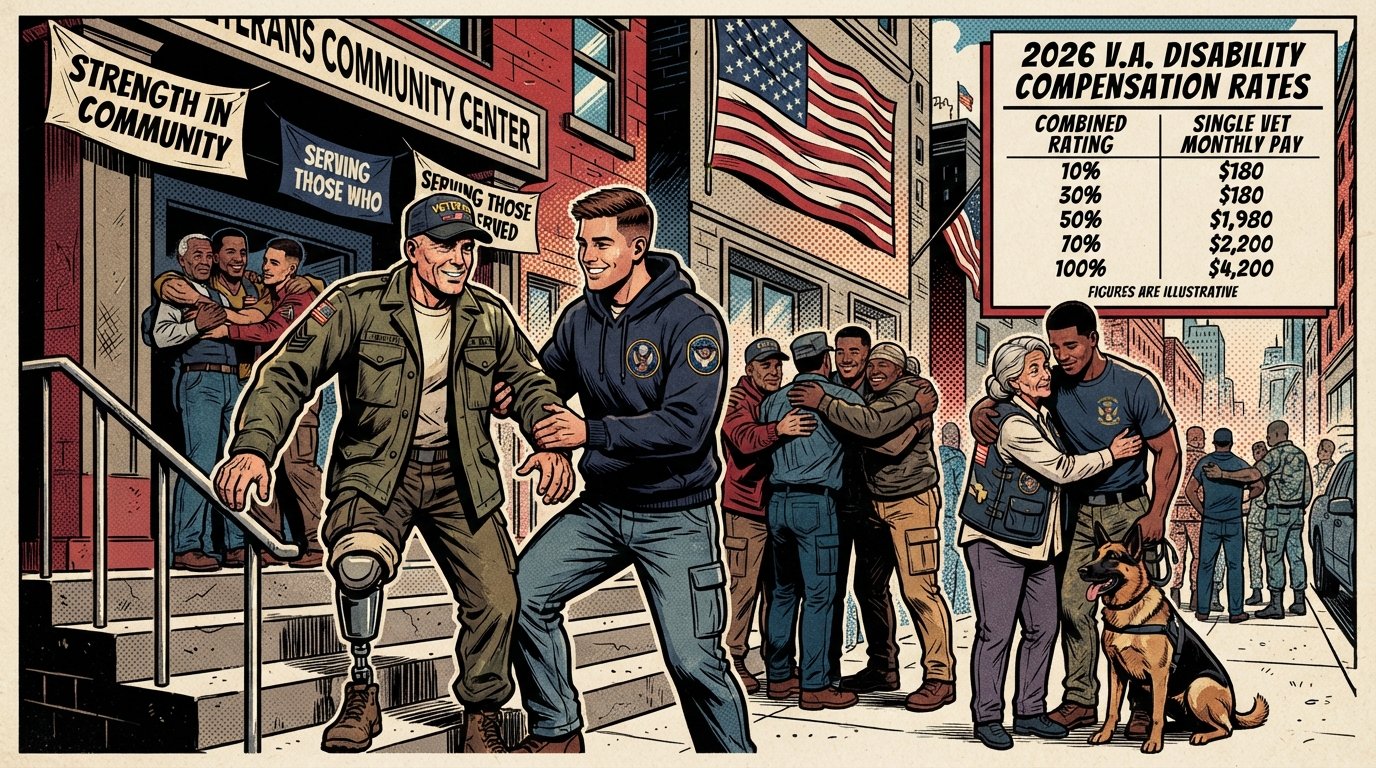
Current VA Disability Rates: Full Pay Chart for Every Rating
VA disability compensation is a tax-free monthly payment for Veterans with service-connected conditions. For 2026, rates range from $180.42 per month at 10% to $3,938.58 per month at 100% for a Veteran alone. Rates increased 2.8% effective December 1, 2025, and the first payment at the new rate arrived December 31, 2025.
Quick Facts
| Item | Details |
|---|---|
| Benefit | Tax-free monthly payment for service-connected disabilities |
| Eligibility | Veterans, active duty, Guard, Reserve with service-connected conditions |
| Application | VA Form 21-526EZ, online at va.gov |
| Processing Time | 125–180 days average for initial claims |
| Official Agency | U.S. Department of Veterans Affairs (VA) |
| Required Forms | VA Form 21-526EZ (initial claim); VA Form 20-0995 or 20-0996 (appeals) |
| Updated For | 2026 rates (effective December 1, 2025, through November 30, 2026) |
2026 VA Disability Compensation Rates: Veteran Alone
VA disability compensation for a Veteran with no dependents ranges from $180.42 per month at 10% to $3,938.58 per month at 100% in 2026. Each 10% increase in your combined rating raises your monthly payment by hundreds of dollars.

| Disability Rating | 2026 Monthly Payment | Annual Amount | Monthly Increase vs. 2025 |
|---|---|---|---|
| 10% | $180.42 | $2,165.04 | $4.91 |
| 20% | $356.66 | $4,279.92 | $9.71 |
| 30% | $552.47 | $6,629.64 | $15.05 |
| 40% | $795.84 | $9,550.08 | $21.68 |
| 50% | $1,132.90 | $13,594.80 | $30.86 |
| 60% | $1,435.02 | $17,220.24 | $39.09 |
| 70% | $1,808.45 | $21,701.40 | $49.26 |
| 80% | $2,102.15 | $25,225.80 | $57.26 |
| 90% | $2,362.30 | $28,347.60 | $64.34 |
| 100% | $3,938.58 | $47,262.96 | $107.28 |
Source: VA.gov 2026 rates, effective December 1, 2025

What you should do next: If your rating seems lower than expected, review your decision letter and consider whether a Higher-Level Review or Supplemental Claim is appropriate. Each 10% increase can mean thousands more per year.
2026 VA Disability Rates With Spouse (No Children)
Dependents add compensation only at the 30% rating level and above. A Veteran rated 10% or 20% receives the same amount with or without dependents. At 30%, a spouse adds $65.00 per month. At 100%, a spouse adds $219.59 per month.
| Rating | Veteran Alone | With Spouse | Spouse Addition |
|---|---|---|---|
| 10% | $180.42 | $180.42 | $0.00 |
| 20% | $356.66 | $356.66 | $0.00 |
| 30% | $552.47 | $617.47 | $65.00 |
| 40% | $795.84 | $882.84 | $87.00 |
| 50% | $1,132.90 | $1,241.90 | $109.00 |
| 60% | $1,435.02 | $1,566.02 | $131.00 |
| 70% | $1,808.45 | $1,961.45 | $153.00 |
| 80% | $2,102.15 | $2,277.15 | $175.00 |
| 90% | $2,362.30 | $2,559.30 | $197.00 |
| 100% | $3,938.58 | $4,158.17 | $219.59 |
Source: VA.gov 2026 rates, effective December 1, 2025
Important: Former spouses and deceased spouses do not qualify as dependents for VA compensation. Only a current spouse counts.
2026 VA Disability Rates With Children
Veterans May Qualify for Extra Benefits
Check available financial assistance, healthcare programs and other opportunities that may apply to you.
Check EligibilityEach dependent child under 18 adds $32.00 to $106.14 per month to your compensation, depending on your rating. Children between 18 and 23 who are enrolled in school may also qualify as dependents.
| Rating | Veteran + 1 Child | Veteran + Spouse + 1 Child | Veteran + Spouse + 2 Children |
|---|---|---|---|
| 10% | $180.42 | $180.42 | $180.42 |
| 20% | $356.66 | $356.66 | $356.66 |
| 30% | $596.47 | $666.47 | $698.47 |
| 40% | $853.84 | $947.84 | $990.84 |
| 50% | $1,205.90 | $1,322.90 | $1,376.90 |
| 60% | $1,521.02 | $1,663.02 | $1,728.02 |
| 70% | $1,909.45 | $2,074.45 | $2,150.45 |
| 80% | $2,218.15 | $2,406.15 | $2,493.15 |
| 90% | $2,492.30 | $2,704.30 | $2,802.30 |
| 100% | $4,089.99 | $4,318.99 | $4,428.10 |
Source: VA.gov 2026 rates, effective December 1, 2025
Additional Dependent Amounts (2026)
| Dependent Type | Monthly Addition |
|---|---|
| Spouse (at 30%+) | $65.00–$219.59 |
| Each child under 18 | $32.00–$106.14 |
| Each child 18–23 in school | $32.00–$106.14 |
| One dependent parent | $52.00–$176.23 |
| Two dependent parents | $104.00–$352.46 |
Source: VA.gov 2026 rates
2026 VA Disability Rates With Dependent Parents
Dependent parents add compensation at the 30% rating level and above. The addition depends on how many parents qualify and your disability rating.
| Rating | Veteran + 1 Parent | Veteran + 2 Parents | Veteran + Spouse + 1 Parent | Veteran + Spouse + 2 Parents |
|---|---|---|---|---|
| 30% | $604.47 | $656.47 | $669.47 | $721.47 |
| 40% | $865.84 | $935.84 | $952.84 | $1,022.84 |
| 50% | $1,220.90 | $1,308.90 | $1,329.90 | $1,417.90 |
| 60% | $1,540.02 | $1,645.02 | $1,671.02 | $1,776.02 |
| 70% | $1,931.45 | $2,054.45 | $2,084.45 | $2,207.45 |
| 80% | $2,242.15 | $2,382.15 | $2,417.15 | $2,557.15 |
| 90% | $2,520.30 | $2,678.30 | $2,717.30 | $2,875.30 |
| 100% | $4,114.82 | $4,291.06 | $4,334.41 | $4,510.65 |
Source: VA.gov 2026 rates
Who qualifies as a dependent parent: A parent is considered a dependent if their income is below the VA income limit and they are not remarried if the Veteran’s other parent is deceased.
Total Disability Individual Unemployability (TDIU) Rates 2026
TDIU pays at the 100% rate even if your combined rating is below 100%. To qualify, you generally need one disability rated at 60% or a combined rating of 70% with at least one disability rated at 40%, and you must be unable to maintain substantially gainful employment.
| Status | Monthly Rate |
|---|---|
| Veteran alone | $3,938.58 |
| With spouse | $4,158.17 |
| With spouse and 1 child | $4,318.99 |
| With spouse and 2 children | $4,428.10 |
Source: VA.gov 2026 rates
Why it matters: TDIU can provide a significant increase for Veterans who cannot work due to service-connected conditions but whose combined rating does not reach 100%. TDIU with dependents uses the same dependent supplement rates as the 100% column.
Special Monthly Compensation (SMC) Rates 2026
Special Monthly Compensation is additional compensation above your regular disability pay for Veterans with severe disabilities. SMC-L through SMC-T require specific qualifying conditions.
| SMC Level | Monthly Rate | Qualifying Condition |
|---|---|---|
| SMC-K | $139.87 | Loss or loss of use of a creative organ, thumb, or similar |
| SMC-L | $4,900.83 | Loss of use of both feet, both hands, or Aid & Attendance |
| SMC-L½ | $5,154.00 | Between SMC-L and SMC-M qualifying factors |
| SMC-M | $5,408.55 | Loss or loss of use of one foot AND one hand |
| SMC-M½ | $5,780.00 | Between SMC-M and SMC-N qualifying factors |
| SMC-N | $6,152.64 | Blindness in both eyes, or loss of both legs at hip |
| SMC-N½ | $6,514.00 | Between SMC-N and SMC-O qualifying factors |
| SMC-O/P | $6,877.12 | Total blindness, multiple amputations, extreme disability |
| SMC-R1 | $9,826.88 | Requires regular Aid & Attendance from another person |
| SMC-R2/T | $11,271.67 | Requires higher level of care / TBI-related need |
| SMC-S (Housebound) | $4,408.53 | 100% plus housebound |
Source: VA.gov 2026 SMC rates, effective December 1, 2025
What you should do next: If you have severe disabilities that may qualify for SMC, review the SMC criteria and consult with a Veterans Service Officer (VSO) or accredited attorney.
Who Qualifies for VA Disability Compensation
You may qualify for VA disability compensation if you have a service-connected disability and meet basic eligibility requirements. VA disability compensation is a tax-free monthly payment for Veterans who got sick or injured during military service, or whose service made an existing condition worse.
Basic Eligibility Requirements
You served in the active military, naval, air, or space service, AND
You were discharged or released under conditions other than dishonorable, AND
You have a service-connected disability, OR
You have a condition that was made worse by your military service, OR
You are a surviving spouse, child, or parent of a deceased Veteran
Who Qualifies for Dependent Additions
Spouse: You must be married to the Veteran at the time of the rating decision.
Children: Unmarried children under 18, or between 18 and 23 if enrolled in school.
Parents: Biological, adoptive, or foster parents whose income is below the VA limit.
Income limits: VA disability compensation is not needs-based for the Veteran. However, dependent parents must meet income thresholds to qualify as dependents for compensation purposes.
How to Apply for VA Disability Compensation
Apply for VA disability compensation using VA Form 21-526EZ, the Application for Disability Compensation and Related Compensation Benefits. You can apply online at va.gov, by mail, or in person at a VA regional office.
Step-by-Step Application Process
Gather your documents. Collect your DD-214, military medical records, private medical records, and any lay statements.
Complete VA Form 21-526EZ. Apply online at va.gov/disability/file-disability-claim-form-21-526ez.
Submit supporting evidence. Upload medical records, nexus letters, and buddy statements electronically.
Wait for VA processing. Initial claims average 125–180 days.
Attend a C&P Exam if requested. VA may schedule a Compensation and Pension exam to evaluate your conditions.
Receive your decision. VA will mail you a decision letter with your rating and effective date.
Receive back pay if applicable. If approved, you may receive back pay to your effective date.
Required Documents
DD-214 (Certificate of Release or Discharge from Active Duty)
Military medical records
Private medical records and hospital reports
VA medical records
Lay statements from family, friends, or fellow service members
Nexus letter from a medical provider linking your condition to service
What you should do next: If you have not yet filed a claim, start the online application today. The effective date is generally the date VA receives your claim, so delaying filing can cost you back pay.
VA Disability Payment Dates 2026
VA disability payments are deposited on the first business day of each month for the previous month’s benefits. When the first of the month falls on a weekend or federal holiday, payment arrives on the last business day of the previous week.
| Payment Month | Deposit Date |
|---|---|
| January 2026 | Friday, January 30, 2026 |
| February 2026 | Friday, February 27, 2026 |
| March 2026 | Wednesday, April 1, 2026 |
| April 2026 | Friday, May 1, 2026 |
| May 2026 | Monday, June 1, 2026 |
| June 2026 | Wednesday, July 1, 2026 |
| July 2026 | Friday, July 31, 2026 |
| August 2026 | Tuesday, September 1, 2026 |
| September 2026 | Thursday, October 1, 2026 |
| October 2026 | Friday, October 30, 2026 |
| November 2026 | Tuesday, December 1, 2026 |
| December 2026 | Thursday, December 31, 2026 |
Source: Woods & Woods 2026 VA payment schedule
Important: The first payment at the 2026 COLA rate (2.8%) was deposited on December 31, 2025, because January 1 is a federal holiday.
Common Mistakes That Reduce Your VA Disability Payment
Avoiding these errors can protect your compensation and ensure you receive the correct amount:
Not claiming all qualifying conditions. Each service-connected condition adds value to your combined rating, even if rated at 0%.
Failing to report dependent changes. Marriage, new children, or a child turning 18 (if not in school) affects your compensation at 30% and above.
Missing the one-year appeal deadline. You have one year from your decision letter to file an appeal and preserve your effective date.
Skipping the C&P exam. If VA schedules a Compensation and Pension exam and you do not attend, VA may decide your claim based on the evidence of record — often resulting in a denial or lower rating.
Not providing a nexus letter. A medical opinion linking your condition to service strengthens your claim significantly.
Assuming a 0% rating is worthless. A 0% service-connected rating establishes service connection, which can later support a claim for an increased rating or secondary condition.
Failing to update your direct deposit information. If VA cannot deposit your payment, it may be delayed.
Not appealing a low rating. If your symptoms are worse than the rating criteria reflect, you may be entitled to a higher rating.
Appeals Process for VA Disability Decisions
If you disagree with a VA disability decision, you have three review options under the Appeals Modernization Act (AMA). You must file your appeal within one year of the decision letter to preserve your effective date.
| Review Option | VA Form | Best When | New Evidence? | Processing Goal |
|---|---|---|---|---|
| Supplemental Claim | VA Form 20-0995 | You have new and relevant evidence | Yes, required | 125 days average |
| Higher-Level Review | VA Form 20-0996 | VA made an error of fact or law on the existing record | No | 125 days average |
| Board Appeal | VA Form 10182 | You want a Veterans Law Judge to decide | Depends on docket | 365–730 days |
Key rules:
You can only pursue one review lane at a time for the same issue.
If a Higher-Level Review goes against you, you can file a Supplemental Claim or a Board Appeal.
Two Higher-Level Reviews in a row on the same issue are not allowed.
Two Board Appeals in a row on the same claim are not allowed.
What you should do next: If your rating seems lower than your own calculation, request a Higher-Level Review with VA Form 20-0996. If you have new medical evidence, file a Supplemental Claim with VA Form 20-0995 instead.
PACT Act and VA Disability Rates
The PACT Act (Promise to Address Comprehensive Toxics Act of 2022) expanded VA disability benefits for Veterans exposed to burn pits, Agent Orange, and other toxic substances. It added more than 20 presumptive conditions, meaning Veterans no longer need to prove direct service connection for those conditions.
How the PACT Act affects your rating: Each new presumptive condition you are granted adds an individual rating that is combined using VA math. Filing one comprehensive claim for all qualifying conditions can yield a higher combined rating than filing separate individual claims.
What you should do next: If you served in a location covered by the PACT Act and have a qualifying condition, file a claim using VA Form 21-526EZ. Even a 10% rating for one PACT Act condition can move your combined rating into a higher tier when paired with existing ratings.
State Differences in VA Disability Benefits
Some states offer additional benefits for Veterans with service-connected disabilities, including property tax exemptions, education benefits, and vehicle registration discounts. These vary widely and are not administered by the VA.
| State | Key Veteran Benefit |
|---|---|
| Texas | Property tax exemption for 100% disabled Veterans |
| California | Disabled Veteran Property Tax Exemption |
| Florida | $5,000 homestead exemption for disabled Veterans |
| New York | Veterans Tuition Award for disabled Veterans |
| Pennsylvania | Real estate tax exemption for 100% disabled Veterans |
What you should do next: Contact your state’s Department of Veterans Affairs or Veterans Service Office to learn about additional state benefits you may qualify for.
Common Questions
How much does VA disability pay in 2026?
VA disability compensation ranges from $180.42 per month at 10% to $3,938.58 per month at 100% for a Veteran with no dependents. Rates increased 2.8% effective December 1, 2025, and vary by rating and dependent status.
Does the VA pay extra for dependents?
Yes, but only at 30% and above. A spouse adds $65.00 to $219.59 per month, each child adds $32.00 to $106.14, and dependent parents add $52.00 to $176.23 each, depending on your rating.
What is the 2026 VA disability COLA?
The 2026 COLA is 2.8%, applied to VA disability compensation, TDIU, SMC, DIC, and most VA benefits. It took effect December 1, 2025, with the first payment on December 31, 2025.
When will I receive my VA disability payment each month?
VA deposits payments on the first business day of each month for the previous month’s benefits. If the first falls on a weekend or holiday, payment arrives earlier.
Can I get VA disability and Social Security at the same time?
Yes. Receiving VA disability compensation does not affect your Social Security benefits. You can receive both simultaneously.
What is TDIU, and how much does it pay in 2026?
TDIU pays at the 100% rate — $3,938.58 per month for a Veteran alone — even if your combined rating is below 100%. You may qualify with one condition at 60% or a combined 70% with one at 40%, plus unemployability.
What is the difference between VA disability compensation and VA pension?
VA disability compensation is for service-connected conditions and is not needs-based. VA pension is a needs-based benefit for wartime Veterans with low income and limited net worth.
How do I add a dependent to my VA disability claim?
File VA Form 21-686c to add a spouse, child, or dependent parent. You can also add dependents online through your VA.gov account or by calling 1-800-827-1000.
Does a 0% VA rating pay anything?
No, a 0% rating does not pay monthly compensation. However, a 0% rating establishes service connection, which can qualify you for other benefits and support future claims for increased ratings or secondary conditions.
What is the highest VA disability rating?
The highest schedular rating is 100%. However, Special Monthly Compensation (SMC) can pay more than 100%, ranging from $139.87 for SMC-K to $11,271.67 for SMC-R2/T in 2026.
How long does a VA disability claim take in 2026?
Initial VA disability claims average 125–180 days. Appeals through the Supplemental Claim or Higher-Level Review lanes average 125 days, while Board Appeals take 365–730 days.
Can I work while receiving VA disability?
Yes. VA disability compensation is not affected by employment income unless you are receiving TDIU. TDIU recipients must report income and may lose eligibility if earnings exceed the poverty threshold.
Key Takeaways
2026 VA disability rates range from $180.42/month at 10% to $3,938.58/month at 100% for a Veteran alone.
The 2026 COLA is 2.8%, effective December 1, 2025; first payment arrived December 31, 2025.
Dependents add compensation only at 30% and above: spouse ($65–$219.59), children ($32–$106.14 each), parents ($52–$176.23 each).
TDIU pays at the 100% rate for Veterans who cannot work due to service-connected conditions.
SMC pays additional compensation above the 100% rate for severe disabilities, from $139.87 to $11,271.67 per month.
VA disability compensation is tax-free and not affected by employment income (except TDIU).
The PACT Act added presumptive conditions that can increase your combined rating.
Three appeal options exist: Supplemental Claim, Higher-Level Review, and Board Appeal.
Apply for disability compensation using VA Form 21-526EZ at va.gov.
Always verify your dependent information is current to ensure correct payment amounts.
Official Resources
VA Disability Compensation — Official VA disability benefits hub.
VA Disability Compensation Rates — Current payment tables.
VA Form 21-526EZ — Application for Disability Compensation.
VA Dependents Application — Add or remove dependents.
Choosing a Decision Review Option — VA appeals guidance.
PACT Act Information — VA PACT Act hub.
Special Monthly Compensation — VA SMC information.
VA.gov — Official VA website.
Ask VA — Online inquiry portal.
VA Benefits Hotline — 1-800-827-1000.




🇺🇸 IMPORTANT DISCLAIMER – Veterans Benefits Information
This site provides general information about U.S. Department of Veterans Affairs (VA) benefits for educational and informational purposes only.
- Not Official: We are NOT affiliated with, endorsed by, or connected to the U.S. Department of Veterans Affairs (VA), the Veterans Benefits Administration (VBA), the Veterans Health Administration (VHA), or any other government agency.
- No Legal/Financial Advice: The content on this website is for informational purposes only and does not constitute legal, financial, or medical advice. VA benefits rules change frequently – always consult with an accredited Veterans Service Officer (VSO) or a qualified professional for your specific situation.
- Official Sources: For official, binding information and to apply for benefits, always visit official .gov websites: VA.gov, Benefits.VA.gov, or SSA.gov.
- No Data Collection: This site does not collect, store, or process any personal information. It does not have login forms, contact forms, or any system to capture user data. We never ask for your Social Security Number, bank details, or any personal information.
- 🚨 Scam Alert: The VA and other government agencies never charge fees for benefit applications. If anyone asks for money to "process" your VA claim, it is a scam. Report it to the VA Office of Inspector General at VA.gov/OIG.
- Advertising: This site uses third-party advertising (Adsterra) to cover operational costs. We do not endorse or guarantee any products or services advertised.
📌 Information provided as of June 2026. Always verify current eligibility and rules with official .gov sources.
This site is not affiliated with the U.S. Department of Veterans Affairs or any government agency. All information is for educational purposes only. Please visit VA.gov for official information.
