
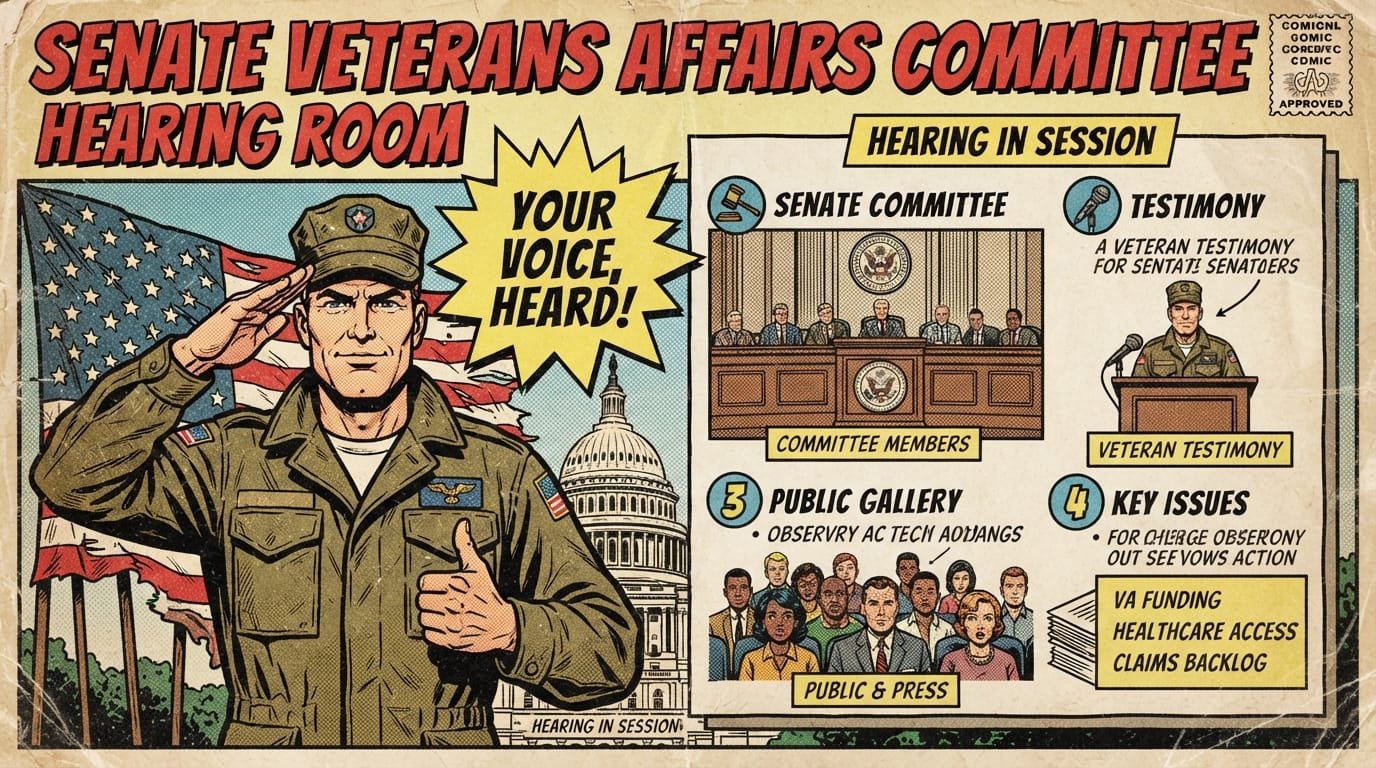
What Is the Senate Veterans Affairs Committee?
The Senate Veterans Affairs Committee (SVAC) is the Senate committee responsible for overseeing the Department of Veterans Affairs, reviewing veterans legislation, and confirming VA nominees. In 2026, it is chaired by Sen. Jerry Moran (R-Kan.) with Sen. Richard Blumenthal (D-Conn.) as Ranking Member. The committee oversees a VA budget of approximately $133 billion in discretionary funding and $263.7 billion in mandatory benefits.
Quick Facts
| Item | Details |
|---|---|
| Committee Name | U.S. Senate Committee on Veterans’ Affairs |
| Chairman | Sen. Jerry Moran (R-Kan.) |
| Ranking Member | Sen. Richard Blumenthal (D-Conn.) |
| Members | 19 total (10 Republicans, 7 Democrats, 2 Independents) |
| Created | 1970 |
| Jurisdiction | Veterans compensation, education, medical care, vocational rehabilitation, civilian readjustment |
| Key 2026 Legislation | Major Richard Star Act, Presumptive CLARITY Act, National Veterans Strategy Act |
| FY 2026 VA Budget | $133.2 billion discretionary + $52.6 billion Toxic Exposures Fund |
| Mandatory Benefits | $263.7 billion |
| Website | veterans.senate.gov |
| Phone | (202) 224-9126 |
| Updated For | 2026 |
Committee Leadership and Members
The Senate Veterans Affairs Committee is chaired by Sen. Jerry Moran (R-Kan.) and led in the minority by Ranking Member Sen. Richard Blumenthal (D-Conn.). The committee has 19 members in the 119th Congress: 10 Republicans, 7 Democrats, and 2 Independents.

Chairman: Sen. Jerry Moran (R-Kan.)
Sen. Moran has served on both the House and Senate Committees on Veterans’ Affairs and has served as both ranking member and chairman of the committee. He was ratified as Chairman in January 2025. Moran introduced four of the 25 bills discussed at the April 29, 2026, legislative hearing, including the Disabled Veterans Dignity Act, National Veterans Strategy Act, and Veterans STAND Act.
Ranking Member: Sen. Richard Blumenthal (D-Conn.)

Sen. Blumenthal serves as Ranking Member and is a leading voice on PACT Act implementation, toxic exposure benefits, and the Major Richard Star Act. He has introduced the Presumptive CLARITY Act, which would require the VA to establish a public-facing website to educate toxic-exposed veterans on how the agency determines presumptive conditions.
Full Committee Roster
| Senator | Party | State |
|---|---|---|
| Jerry Moran (Chair) | Republican | Kansas |
| John Boozman | Republican | Arkansas |
| Bill Cassidy | Republican | Louisiana |
| Thom Tillis | Republican | North Carolina |
| Dan Sullivan | Republican | Alaska |
| Marsha Blackburn | Republican | Tennessee |
| Kevin Cramer | Republican | North Dakota |
| Tommy Tuberville | Republican | Alabama |
| Jim Banks | Republican | Indiana |
| Tim Sheehy | Republican | Montana |
| Richard Blumenthal (Ranking) | Democrat | Connecticut |
| Patty Murray | Democrat | Washington |
| Bernard Sanders | Independent | Vermont |
| Mazie Hirono | Democrat | Hawaii |
| Margaret Wood Hassan | Democrat | New Hampshire |
| Angus King | Independent | Maine |
| Tammy Duckworth | Democrat | Illinois |
| Ruben Gallego | Democrat | Arizona |
| Elissa Slotkin | Democrat | Michigan |
Source: Senate Veterans’ Affairs Committee
What Does the Senate Veterans Affairs Committee Do?
The Senate Veterans Affairs Committee reviews programs and agencies for veterans, examines current laws impacting veterans, and develops legislation to improve existing laws. The committee also holds confirmation hearings on those nominated by the President to fill positions within the Department of Veterans Affairs and the U.S. Court of Appeals for Veterans Claims.
Jurisdiction
The committee has legislative jurisdiction over matters relating to veterans compensation and veterans generally, as well as matters relating to vocational rehabilitation, education, medical care, civil relief, and civilian readjustment of veterans.
Key Responsibilities
Legislative Review: The committee considers bills related to veterans benefits, healthcare, education, housing, and employment.
Oversight: The committee oversees the Department of Veterans Affairs, including its budget, staffing, and program implementation.
Nominations: The committee reviews and confirms VA nominees for key positions.
Investigations: The committee investigates issues affecting veterans and VA operations.
VSO Coordination: The committee holds regular hearings with Veterans Service Organizations to gather input on legislative priorities.
History
Veterans May Qualify for Extra Benefits
Check available financial assistance, healthcare programs and other opportunities that may apply to you.
Check EligibilityThe Veterans’ Affairs committee was created in 1970 to transfer responsibilities for veterans from the Finance and Labor committees to a single panel. From 1917 to 1946, the Finance Committee was the Senate standing committee most responsible for veterans programs. After World War II, oversight was split between multiple committees until the dedicated Veterans’ Affairs Committee was established.
FY 2026 VA Budget and Appropriations
The FY 2026 Military Construction, Veterans Affairs, and Related Agencies Appropriations Act provides $133.2 billion for the VA, augmented by $52.6 billion for the Toxic Exposures Fund. Combined with mandatory spending, total veterans funding exceeds $396 billion.
Budget Breakdown
| Category | Amount |
|---|---|
| Total Discretionary (VA) | $133.2 billion |
| Toxic Exposures Fund | $52.6 billion |
| VA Medical Care | $115.1 billion |
| Direct Care at VA Facilities | $59.2 billion |
| Community Care | $34 billion |
| Mental Health | $18.9 billion |
| Telehealth Services | $6.4 billion |
| Veterans Homelessness Programs | $3.5 billion |
| Mandatory Benefits | $263.7 billion |
Source: Senate Appropriations Committee FY 2026 MilCon-VA Bill Summary
What This Means for Veterans
The FY 2026 budget increases VA medical care funding and maintains the Toxic Exposures Fund established under the PACT Act. Combined, VA will have $167.7 billion to care for veterans. This funding supports direct care at VA facilities, community care through the Veterans Community Care Program, mental health services, telehealth expansion, and homelessness prevention programs.
Senate Passage
The Senate Appropriations Committee advanced the Military Construction, VA, and Related Agencies bill by a vote of 26 to 3. The full Senate passed the bill by a vote of 87 to 9 on August 1, 2025.
Key Legislation Before the Committee in 2026
The Senate Veterans Affairs Committee has considered more than 25 pieces of legislation in 2026, covering toxic exposure benefits, disability compensation, education, caregiver support, and VA workforce reforms.
Major Richard Star Act
The Major Richard Star Act is legislation to deliver medically retired combat-injured veterans their full Department of Defense retirement and VA disability payments, which is currently subject to a dollar-for-dollar reduction. The bill has 77 co-sponsors in the Senate and 316 co-sponsors in the House.
Despite widespread bipartisan support, Senate Republicans blocked two attempts from Ranking Member Blumenthal to advance the legislation in March 2026. Sen. Ron Johnson (R-Wis.) blocked the motion saying “we simply cannot afford it.” Veterans Service Organizations have continuously cited the legislation as their top policy priority.
Presumptive CLARITY Act
The Presumptive CLARITY Act requires the VA to establish a public-facing website to educate toxic-exposed veterans on the processes it uses to determine which conditions are related to military toxic exposures. The bill would ensure veterans know if the VA plans to add or remove their exposure or condition as a presumptive and instruct veterans on how they can provide input.
At the April 29, 2026, hearing, Blumenthal pressed VA Principal Deputy Under Secretary for Benefits Margarita Devlin for greater transparency. When Devlin responded that VA already publishes these changes in the Federal Register, Blumenthal replied: “With all due respect, I don’t know too many veterans who read the Federal Register on a regular basis. Can’t more be done?”
National Veterans Strategy Act
The National Veterans Strategy Act of 2026, introduced by Chairman Moran and Ranking Member Blumenthal, directs the President to develop a national strategy every four years to better coordinate federal, state, and community efforts to support veterans. The bill would establish shared metrics and a government-wide framework for defining and advancing veteran success. AMVETS strongly supports the legislation.
Disabled Veterans Dignity Act
The Disabled Veterans Dignity Act, introduced by Chairman Moran, permanently authorizes a VA program to support disabled veterans and their caregivers. The legislation addresses bowel and bladder care needs of veterans living with spinal cord injuries and disorders.
Veterans Appeals Improvement and Modernization Act 2.0
S. 3286, the Veterans Appeals Improvement and Modernization Act 2.0, would amend title 38, United States Code, to improve processes relating to appeals of decisions regarding claims for benefits. The bill was introduced by Sen. Bill Cassidy (R-La.) and co-sponsored by Ranking Member Blumenthal. The committee held hearings on the legislation on April 29, 2026.
Veterans STAND Act
The Veterans STAND Act, introduced by Chairman Moran, improves treatments and technology for veterans with spinal cord injuries.
Justice for ALS Veterans Act
The Justice for ALS Veterans Act addresses an inequity in survivor benefits for families of veterans who die from ALS. Although ALS is recognized by the VA as a presumptive service-connected condition, current law governing Dependency and Indemnity Compensation does not account for the rapid progression of the disease. The legislation ensures veterans who die from ALS are treated as meeting relevant requirements for enhanced compensation.
Take Care of America’s Veterans Act
The Take Care of America’s Veterans Act was introduced to provide additional funding for VA programs. Ranking Member Blumenthal attempted to pass an amended version in July 2026, but Republican leadership blocked the effort. Blumenthal stated that Republican leaders should “come to the table—there is no path for your proposal to cut benefits for disabled veterans.”
PACT Act Oversight and Toxic Exposure
The Senate Veterans Affairs Committee has conducted extensive oversight of PACT Act implementation in 2026. The PACT Act expanded VA benefits and healthcare for veterans exposed to toxic substances including burn pits, Agent Orange, and other hazards during military service.
Committee Concerns
At the April 29, 2026, hearing, Blumenthal pressed the VA for transparency over the PACT Act presumptive process. Key concerns include:
Transparency in presumptive decisions: The committee wants the VA to proactively notify veterans when it makes significant changes to presumptive benefits.
Veteran awareness: The committee found that not enough veterans are aware of PACT Act benefits.
Rollback of benefits: Previous reporting revealed the Trump Administration secretly rolled back benefits for a presumptive condition established under the PACT Act.
Toxic Exposures Fund
The FY 2026 budget provides $52.6 billion for the Toxic Exposures Fund, which supports PACT Act implementation and expanded eligibility for toxic-exposed veterans. The bill also provides $5.9 billion for information technology systems to support claims processing.
What Veterans Should Do
Veterans who served in locations or eras covered by the PACT Act should:
File a claim for VA disability compensation using VA Form 21-526EZ
Review the list of presumptive conditions on VA.gov
Contact a Veterans Service Organization or accredited representative for free claims assistance
Monitor committee hearings and legislation for changes to presumptive conditions
Key Hearings and Oversight Activities in 2026
The Senate Veterans Affairs Committee has held multiple hearings in 2026 on VA reform, disability benefits, PACT Act implementation, and pending legislation.
January 28, 2026: VHA Reform Hearing
Chairman Moran led a hearing with VA Secretary Doug Collins about VA’s efforts to reform the Veterans Health Administration through the Restructure for Impact and Sustainability Effort (RISE) reorganization initiative. The RISE initiative aims to modernize VHA operations and improve efficiency.
February 24, 2026: Joint VSO Hearing
The committee held a joint hearing with the House Veterans’ Affairs Committee with Veterans Service Organizations. Ranking Member Blumenthal commended veterans for forcing the Trump Administration to walk back a new policy that would have slashed disability ratings for thousands of veterans. Senator Duckworth called out the Administration for attacking veterans’ benefits.
March 3-4, 2026: Legislative Presentations
The committee held joint hearings with the House Veterans’ Affairs Committee for legislative presentations from Veterans of Foreign Wars, Disabled American Veterans, and other VSOs. Ranking Member Blumenthal highlighted the importance of veterans’ advocacy and emphasized his commitment to passing the Major Richard Star Act.
April 29, 2026: Pending Legislation Hearing
Chairman Moran led a hearing to discuss 25 pieces of legislation with representatives from the VA, Wounded Warrior Project, AMVETS, and Military Officers Association of America. Ranking Member Blumenthal pressed the VA for transparency over the PACT Act presumptive process.
June 3, 2026: Nominations Hearing
The committee considered two nominations: Gary Shatswell to be Assistant Secretary for Information and Technology and Michael Tierney to be Assistant Secretary for Accountability and Whistleblower Protection.
September 23, 2026: Contract Cancellation Report
Blumenthal released a statement on a watchdog report exposing the Trump Administration’s cancellation of contracts serving veterans. In January 2026, Blumenthal and the committee released a report detailing the Administration’s lack of transparency and false savings claims around its cancellation of thousands of contracts providing services to veterans.
How Veterans Can Engage with the Committee
Veterans can engage with the Senate Veterans Affairs Committee through several channels. The committee holds public hearings, accepts written testimony, and welcomes input from Veterans Service Organizations.
Contact the Committee
Website: veterans.senate.gov
Phone: (202) 224-9126
Address: 412 Russell Senate Office Building, Washington, DC 20510
Contact Individual Members
Veterans can contact their state’s senators through the Senate website at senate.gov. Committee members respond to constituent inquiries about veterans benefits, VA claims, and legislative priorities.
Submit Written Testimony
The committee accepts written testimony from veterans and Veterans Service Organizations for consideration. Instructions for submitting testimony are posted on the committee website before each hearing.
Work with Veterans Service Organizations
Veterans Service Organizations present legislative priorities to the committee and advocate for veterans’ interests. AMVETS, VFW, Disabled American Veterans, and other congressionally chartered VSOs regularly testify before the committee.
Monitor Legislation
Veterans can track bills before the committee through Congress.gov. Search by committee name or bill number to view the latest status of legislation affecting veterans.
How Committee Decisions Affect Veterans’ Benefits
The Senate Veterans Affairs Committee directly impacts veterans’ benefits through its legislative and oversight responsibilities. Changes to VA disability compensation, education benefits, healthcare access, and survivor benefits all flow through the committee.
Disability Compensation
The committee oversees VA disability compensation programs, including the rating schedule, appeals process, and effective dates for benefits. The Veterans Appeals Improvement and Modernization Act 2.0, currently before the committee, would modify how veterans appeal claims decisions.
Healthcare
The committee oversees VA healthcare, including the Veterans Community Care Program, mental health services, telehealth expansion, and the MISSION Act. The FY 2026 budget provides $115.1 billion for VA medical care.
Education Benefits
The committee oversees GI Bill benefits, including the Post-9/11 GI Bill, Forever GI Bill, and vocational rehabilitation programs. The FY 2026 budget provides $263.7 billion for mandatory veterans benefits, including education benefits.
Caregiver Support
The Disabled Veterans Dignity Act, introduced by Chairman Moran, permanently authorizes a VA program to support disabled veterans and their caregivers. The Program of Comprehensive Assistance for Family Caregivers provides stipends, healthcare, and training for caregivers of severely disabled veterans.
Survivor Benefits
The Justice for ALS Veterans Act would ensure that veterans who die from ALS are treated as meeting relevant requirements for Dependency and Indemnity Compensation. The committee also oversees VA survivor benefits including DIC, dependency and indemnity compensation, and burial benefits.
Common Questions
1. Who is the chairman of the Senate Veterans Affairs Committee?
Sen. Jerry Moran (R-Kan.) serves as Chairman of the Senate Veterans Affairs Committee in 2026. He was ratified as Chairman in January 2025 and has served on both the House and Senate Committees on Veterans’ Affairs.
2. Who is the ranking member of the Senate Veterans Affairs Committee?
Sen. Richard Blumenthal (D-Conn.) serves as Ranking Member. He is a leading voice on PACT Act implementation, toxic exposure benefits, and the Major Richard Star Act.
3. What does the Senate Veterans Affairs Committee do?
The committee reviews programs and agencies for veterans, examines current laws impacting veterans, develops legislation to improve existing laws, and holds confirmation hearings on VA nominees. It has legislative jurisdiction over veterans compensation, education, medical care, and civilian readjustment.
4. What is the Major Richard Star Act?
The Major Richard Star Act delivers medically retired combat-injured veterans their full Department of Defense retirement and VA disability payments. Currently, these payments are subject to a dollar-for-dollar reduction. The bill has 77 Senate co-sponsors and 316 House co-sponsors but has been blocked by Senate Republicans.
5. What is the PACT Act?
The PACT Act expanded VA benefits and healthcare for veterans exposed to toxic substances including burn pits, Agent Orange, and other hazards. The Senate Veterans Affairs Committee conducts oversight of PACT Act implementation and has pressed the VA for greater transparency in the presumptive conditions process.
6. What is the Presumptive CLARITY Act?
The Presumptive CLARITY Act requires the VA to establish a public-facing website to educate toxic-exposed veterans on how the agency determines which conditions are related to military toxic exposures. It would ensure veterans know if the VA plans to add or remove their condition as a presumptive.
7. How much is the VA budget for 2026?
The FY 2026 budget provides $133.2 billion in discretionary funding for the VA, plus $52.6 billion for the Toxic Exposures Fund. Combined with mandatory spending, the total exceeds $396 billion, including $263.7 billion for mandatory veterans benefits.
8. How can veterans contact the Senate Veterans Affairs Committee?
Call (202) 224-9126 or write to 412 Russell Senate Office Building, Washington, DC 20510. Visit veterans.senate.gov for hearing schedules, legislation, and contact information.
9. What hearings has the committee held in 2026?
The committee held hearings on VHA reform (January 28), joint VSO hearings (February 24), legislative presentations (March 3-4), pending legislation including the PACT Act (April 29), and nominations (June 3). Blumenthal also released a report on VA contract cancellations in September 2026.
10. What is the National Veterans Strategy Act?
The National Veterans Strategy Act of 2026 directs the President to develop a national strategy every four years to coordinate federal, state, and community efforts to support veterans. The bill establishes shared metrics and a government-wide framework for veteran success.
11. How does the committee affect my VA disability claim?
The committee oversees VA disability compensation programs, including the rating schedule and appeals process. Legislation like the Veterans Appeals Improvement and Modernization Act 2.0, currently before the committee, would modify how veterans appeal claims decisions.
12. What is the Disabled Veterans Dignity Act?
The Disabled Veterans Dignity Act, introduced by Chairman Moran, permanently authorizes a VA program to support disabled veterans and their caregivers. It addresses bowel and bladder care needs of veterans living with spinal cord injuries and disorders.
13. How do I submit testimony to the committee?
Instructions for submitting written testimony are posted on the committee website before each hearing. Veterans and VSOs can also contact committee members directly through their Senate offices.
14. What is the Toxic Exposures Fund?
The Toxic Exposures Fund provides $52.6 billion for PACT Act implementation and expanded eligibility for toxic-exposed veterans. It supports claims processing, healthcare, and information technology systems.
15. How do committee decisions affect my benefits?
The committee’s legislative and oversight decisions directly affect VA disability compensation, education benefits, healthcare access, and survivor benefits. Changes to VA programs flow through the committee before becoming law.
Key Takeaways
The Senate Veterans Affairs Committee is chaired by Sen. Jerry Moran (R-Kan.) with Sen. Richard Blumenthal (D-Conn.) as Ranking Member in the 119th Congress.
The committee has 19 members: 10 Republicans, 7 Democrats, and 2 Independents.
The FY 2026 VA budget provides $133.2 billion in discretionary funding plus $52.6 billion for the Toxic Exposures Fund.
The Major Richard Star Act, which would deliver full DOD retirement and VA disability payments to combat-injured veterans, has been blocked by Senate Republicans despite 77 co-sponsors.
The Presumptive CLARITY Act would require the VA to create a public website explaining how it determines presumptive conditions under the PACT Act.
The committee held hearings in 2026 on VHA reform, VSO priorities, pending legislation, and VA nominations.
The National Veterans Strategy Act would establish a government-wide framework for veteran success with shared metrics.
The committee oversees VA disability compensation, education benefits, healthcare, caregiver support, and survivor benefits.
Veterans can contact the committee at (202) 224-9126 or veterans.senate.gov.
The Veterans Appeals Improvement and Modernization Act 2.0 would modify how veterans appeal VA claims decisions.
Official Resources
Senate Veterans Affairs Committee — veterans.senate.gov
Congress.gov — Track bills and legislation
VA.gov — Apply for disability compensation, education benefits, home loans, and healthcare
GovTrack — Committee membership and bill tracking
VA Benefits Hotline — 1-800-827-1000
Veterans Crisis Line — 988, press 1
SSA.gov — Social Security benefits
USA.gov — Government services and information


🇺🇸 IMPORTANT DISCLAIMER – Veterans Benefits Information
This site provides general information about U.S. Department of Veterans Affairs (VA) benefits for educational and informational purposes only.
- Not Official: We are NOT affiliated with, endorsed by, or connected to the U.S. Department of Veterans Affairs (VA), the Veterans Benefits Administration (VBA), the Veterans Health Administration (VHA), or any other government agency.
- No Legal/Financial Advice: The content on this website is for informational purposes only and does not constitute legal, financial, or medical advice. VA benefits rules change frequently – always consult with an accredited Veterans Service Officer (VSO) or a qualified professional for your specific situation.
- Official Sources: For official, binding information and to apply for benefits, always visit official .gov websites: VA.gov, Benefits.VA.gov, or SSA.gov.
- No Data Collection: This site does not collect, store, or process any personal information. It does not have login forms, contact forms, or any system to capture user data. We never ask for your Social Security Number, bank details, or any personal information.
- 🚨 Scam Alert: The VA and other government agencies never charge fees for benefit applications. If anyone asks for money to "process" your VA claim, it is a scam. Report it to the VA Office of Inspector General at VA.gov/OIG.
- Advertising: This site uses third-party advertising (Adsterra) to cover operational costs. We do not endorse or guarantee any products or services advertised.
📌 Information provided as of June 2026. Always verify current eligibility and rules with official .gov sources.
This site is not affiliated with the U.S. Department of Veterans Affairs or any government agency. All information is for educational purposes only. Please visit VA.gov for official information.
