
Common VA Disability Claims: The Most Approved Conditions
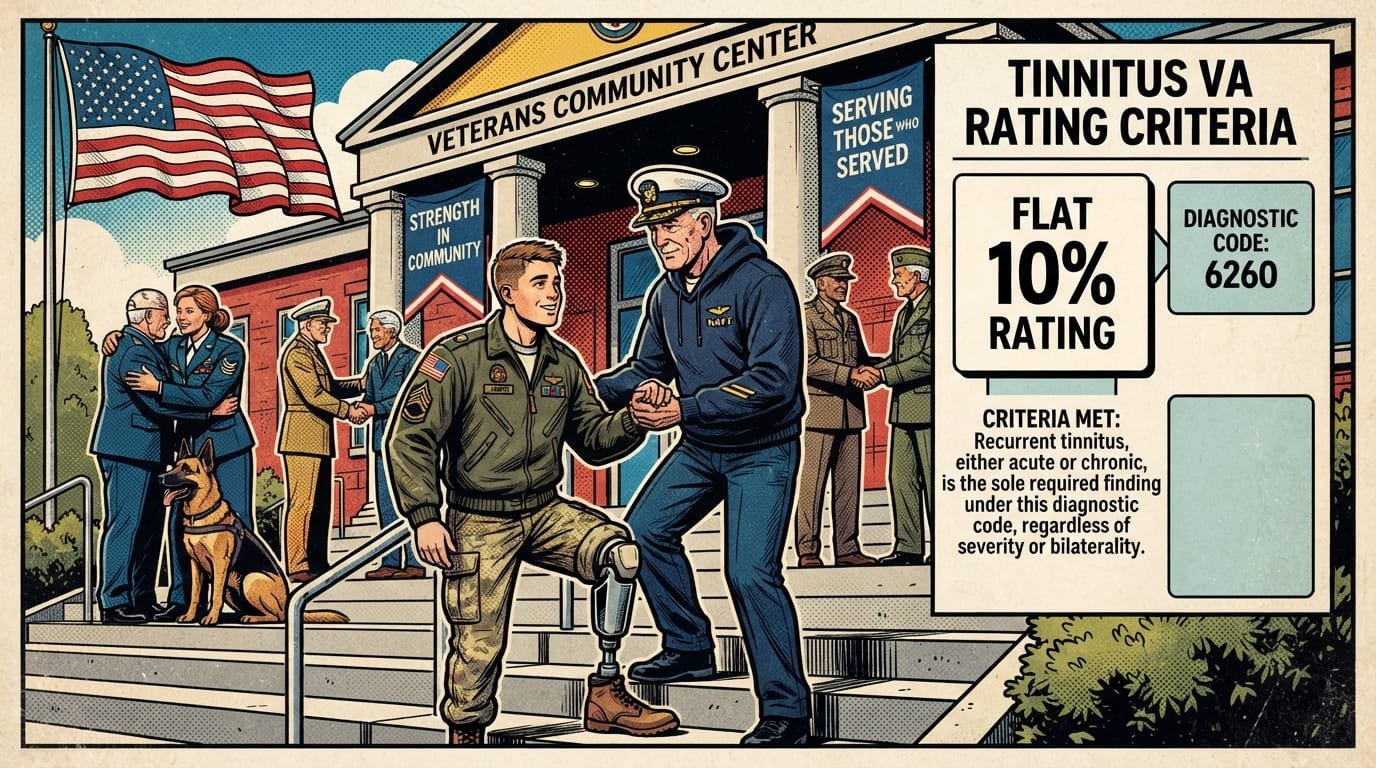
Tinnitus is the most common VA disability claim, affecting more than 3.5 million veterans at a flat 10% rating. It is followed by limitation of knee flexion, hearing loss, lumbosacral or cervical strain, and PTSD. Musculoskeletal conditions dominate the top 10, accounting for four of the ten most prevalent service-connected disabilities.
Quick Facts
| Item | Details |
|---|---|
| Benefit | Tax-free monthly compensation for service-connected disabilities |
| Eligibility | Veterans with a current diagnosis, an in-service event, and a medical nexus |
| Application | VA Form 21-526EZ, online at va.gov |
| Processing Time | 125–180 days average for initial claims |
| Official Agency | U.S. Department of Veterans Affairs (VA) |
| Required Forms | VA Form 21-526EZ (initial claim); VA Form 21-686c (dependents) |
| Updated For | FY 2025 VA Annual Benefits Report data (released April 2026) |
What Are the Most Common VA Disability Claims?
The most common VA disability claims in fiscal year 2025 were tinnitus, limitation of knee flexion, back or neck strain, limited arm motion, hearing loss, second-degree burn scars, migraine, sciatic nerve paralysis, PTSD, and limited ankle motion. These conditions reflect the everyday toll of military service rather than catastrophic injury alone.

According to VA’s Annual Benefits Report based on FY2025 data, a total of 476,802 veterans began receiving VA disability compensation, with an average of 6.15 service-connected conditions each. Tinnitus remained the single most common first-time claim, with 287,138 new recipients.
Top 10 Most Prevalent Service-Connected Disabilities (All Recipients)

The top 10 most prevalent service-connected disabilities among the 6,338,253 veterans receiving VA disability compensation are led by tinnitus, which affects 56.5% of all compensation recipients. Four of the top 10 conditions are musculoskeletal, and PTSD is the only mental health condition on the list.
| Rank | Condition | Veterans Affected | % of Compensation Population | Typical Rating Range |
|---|---|---|---|---|
| 1 | Tinnitus | 3,583,295 | 56.5% | Flat 10% |
| 2 | Limitation of flexion, knee | 2,312,985 | 36.5% | 0–30% |
| 3 | Paralysis of the sciatic nerve | 2,026,583 | 32.0% | 10–80% |
| 4 | Lumbosacral or cervical strain | 1,791,869 | 28.3% | 10–100% |
| 5 | PTSD | 1,760,497 | 27.8% | 0–100% |
| 6 | Hearing loss | 1,690,837 | 26.7% | 0–100% |
| 7 | Limitation of motion of the arm | 1,385,549 | 21.9% | 0–40% |
| 8 | Scars, burns (2nd degree) | 1,323,340 | 20.9% | 0–80% |
| 9 | Migraine | 1,300,172 | 20.5% | 0–50% |
| 10 | Limitation of motion of the ankle | 1,273,110 | 20.1% | 0–40% |
Source: VA Annual Benefits Report FY2025, via VA Claims Insider
Top 10 First-Time Claims (FY 2025)
First-time claims rank differently than the full recipient population. PTSD and sciatica sit lower on the new-claims list, suggesting many veterans pick these up later, often as secondary conditions. The table below shows the 10 most common first-time claims in FY 2025.
| Rank | Condition | Diagnostic Code | Typical Rating | New Recipients (FY2025) |
|---|---|---|---|---|
| 1 | Tinnitus | 6260 | Flat 10% | 287,138 |
| 2 | Limitation of flexion, knee | 5260 | 0–30% | 162,407 |
| 3 | Back or neck strain | 5235–5243 | 10–100% | ~150,000 |
| 4 | Limited arm motion | 5201–5215 | 0–40% | ~130,000 |
| 5 | Hearing loss | 6100 | 0–100% | 104,000 |
| 6 | Second-degree burn scars | 7800–7805 | 0–80% | ~95,000 |
| 7 | Migraine | 8100 | 0–50% | ~90,000 |
| 8 | Sciatic nerve paralysis | 8520 | 10–80% | ~85,000 |
| 9 | PTSD | 9411 | 0–100% | ~80,000 |
| 10 | Limited ankle motion | 5271 | 0–40% | ~75,000 |
Source: CCK Law analysis of VA Annual Benefits Report FY2025
Tinnitus: The #1 Most Common VA Disability Claim
Veterans May Qualify for Extra Benefits
Check available financial assistance, healthcare programs and other opportunities that may apply to you.
Check EligibilityTinnitus is the most commonly service-connected condition for VA disability compensation, with more than 3.5 million veterans receiving benefits. It is rated at a flat 10% under Diagnostic Code 6260, regardless of whether it is experienced in one ear, both ears, or in the head.
What it is: Tinnitus causes a ringing, buzzing, roaring, clicking, hissing, or humming in the ears, almost always from a phantom source no one else can hear. For veterans, tinnitus risk factors may include head injuries, bomb blast shock waves, heavy artillery fire, loud machinery, and firing MAAWS.
Who qualifies: You must have a current diagnosis of recurrent tinnitus and evidence of an in-service event that caused or worsened it. The condition must be persistent, not occasional.
Why it matters: While the 10% rating is modest ($180.42 per month in 2026), tinnitus can serve as a gateway to secondary conditions like anxiety, depression, and sleep disturbances, each of which can carry higher ratings.
What you should do next: If you have ringing in your ears that began during or worsened because of service, file a claim using VA Form 21-526EZ. Document the frequency and severity in your medical records.
Proposed Changes to Tinnitus Rating
The VA has proposed evaluating tinnitus as a symptom of the underlying disease that causes it, rather than as a stand-alone disability. Under the proposed rule, tinnitus would need to be related to non-compensable hearing loss or another service-connected disability to receive a rating. As of April 2026, these changes have not been finalized. Veterans who currently receive compensation for tinnitus would not have their rating reduced if the changes are finalized.
Limitation of Knee Flexion: The #2 Most Common Claim
Limitation of knee flexion is the second-most commonly claimed VA disability, affecting more than 2.3 million veterans. It is rated under Diagnostic Code 5260, with ratings from 0% to 30% based on how far the knee can flex.
| Flexion Limitation | VA Rating | Monthly Payment (2026) |
|---|---|---|
| Flexion limited to 15 degrees or less | 30% | $552.47 |
| Flexion limited to 16–30 degrees | 20% | $356.66 |
| Flexion limited to 31–40 degrees | 10% | $180.42 |
| Flexion limited to 41–60 degrees | 0% | None |
Source: 38 CFR § 4.71a, Diagnostic Code 5260
What it is: Limitation of knee flexion means your knee cannot bend as far as it should. Normal knee flexion is 140 degrees. Veterans who cannot bend their knee past certain thresholds qualify for ratings.
Who qualifies: You need a current knee condition diagnosis, an in-service event that injured or worsened your knee, and a medical nexus linking the two.
Why it matters: Knee conditions often lead to secondary conditions like hip pain, back pain, and ankle problems due to altered gait. Each secondary condition can add to your combined rating.
What you should do next: If you have knee pain or stiffness from service, get a current diagnosis and file a claim. Document your range of motion limitations with a medical provider.
Hearing Loss: The #3 Most Common Auditory Claim
Hearing loss affects more than 1.6 million veterans and is rated under Diagnostic Code 6100. Ratings range from 0% to 100% based on the results of audiology testing that measures puretone thresholds and speech discrimination.
What it is: Hearing loss is a partial or total inability to hear in one or both ears. It is measured using decibel loss at different frequencies.
Who qualifies: You must have a current hearing loss diagnosis, evidence of acoustic trauma during service (such as exposure to weapons, machinery, or explosions), and a medical nexus.
Why it matters: Hearing loss can affect communication, employment, and safety. Higher ratings reflect more severe hearing impairment and carry higher monthly compensation.
What you should do next: Request an audiology exam through VA or a private provider. The C&P exam for hearing loss uses specific testing protocols that must be documented correctly.
Lumbosacral or Cervical Strain: Back and Neck Conditions
Lumbosacral or cervical strain affects more than 1.7 million veterans and is rated under the General Rating Formula for the Spine (Diagnostic Codes 5235–5243). Ratings range from 10% to 100% based on range of motion, flare-ups, and functional loss.
| Forward Flexion (Thoracolumbar) | VA Rating | Monthly Payment (2026) |
|---|---|---|
| 30 degrees or less | 40% | $795.84 |
| Greater than 30° but not greater than 60° | 20% | $356.66 |
| Greater than 60° but not greater than 85° | 10% | $180.42 |
| Unfavorable ankylosis of entire thoracolumbar spine | 50% | $1,132.90 |
| Unfavorable ankylosis of entire spine | 100% | $3,938.58 |
Source: 38 CFR § 4.71a, General Rating Formula for the Spine
What it is: Lumbosacral strain affects the lower back; cervical strain affects the neck. Both are common in veterans who performed heavy lifting, wore heavy gear, or experienced injuries during service.
Who qualifies: You need a current diagnosis of a back or neck condition, an in-service event or injury, and a medical nexus. Under 38 CFR § 4.59, if you experience pain during joint movement — even with full range of motion — the VA must assign at least the minimum compensable rating for that joint. For the spine, this means a 10% minimum rating when painful motion is present.
Why it matters: Back conditions often lead to secondary conditions like radiculopathy (nerve pain in the legs or arms), which can carry ratings of 10% to 80% per affected extremity. These secondary ratings can significantly increase your combined disability rating.
What you should do next: Document your range of motion limitations, flare-ups, and any radiating pain in your arms or legs. A C&P exam will measure your range of motion using a goniometer, and the results directly determine your rating.
PTSD: The Most Common Mental Health Claim
PTSD affects more than 1.7 million veterans and is rated under Diagnostic Code 9411 using the General Rating Formula for Mental Disorders. Ratings range from 0% to 100% based on the severity of occupational and social impairment.
| Rating | Key Criteria | Monthly Payment (2026) |
|---|---|---|
| 100% | Total occupational and social impairment | $3,938.58 |
| 70% | Occupational and social impairment with deficiencies in most areas | $1,808.45 |
| 50% | Reduced reliability and productivity | $1,132.90 |
| 30% | Occasional decrease in work efficiency | $552.47 |
| 10% | Mild or transient symptoms under stress or controlled by medication | $180.42 |
| 0% | Diagnosis confirmed but no functional impairment | None |
Source: 38 CFR § 4.130, General Rating Formula for Mental Disorders
What it is: PTSD is a mental health condition that can develop after experiencing or witnessing a traumatic event. Symptoms include flashbacks, nightmares, severe anxiety, and uncontrollable thoughts about the event.
Who qualifies: You need a current PTSD diagnosis, an in-service stressor (such as combat, sexual assault, or a life-threatening event), and a medical nexus. VA may schedule a C&P exam with a mental health professional.
Why it matters: PTSD is the only mental health condition in the top 10 most prevalent disabilities, and it grew faster year-over-year than every auditory condition on the list. Veterans with severe PTSD may also be eligible for TDIU if the condition prevents them from maintaining substantially gainful employment.
What you should do next: If you have PTSD symptoms, seek a diagnosis from a VA or private mental health provider. Document how your symptoms affect your work, relationships, and daily functioning.
Proposed Changes to Mental Health Ratings
The VA has proposed evaluating mental health conditions based on a more robust and holistic approach that assesses how impactful the disability is to cognition, interpersonal relationships, task completion, life activities, and self-care. The proposed criteria include a 10% minimum evaluation for having one or more service-connected mental health conditions and would no longer require “total occupational and social impairment” to attain a 100% evaluation. As of April 2026, these changes have not been finalized.
Migraine Headaches: The #9 Most Common Claim
Migraine headaches affect more than 1.3 million veterans and are rated under Diagnostic Code 8100. Ratings range from 0% to 50% based on the frequency of prostrating attacks and their impact on work.
| Frequency of Prostrating Attacks | VA Rating | Monthly Payment (2026) |
|---|---|---|
| Very frequent, completely prostrating, prolonged attacks with severe economic inadaptability | 50% | $1,132.90 |
| Characteristic prostrating attacks averaging once a month over last several months | 30% | $552.47 |
| Characteristic prostrating attacks averaging one in two months over last several months | 10% | $180.42 |
| Less frequent attacks | 0% | None |
Source: 38 CFR § 4.124a, Diagnostic Code 8100
What it is: Migraines are severe, recurring headaches often accompanied by nausea, sensitivity to light and sound, and visual disturbances. “Prostrating” means the headache is so severe that you must lie down until it passes.
Who qualifies: You need a current migraine diagnosis, evidence of migraines beginning or worsening during service, and a medical nexus. Migraines are often secondary to TBI, PTSD, or tinnitus.
Why it matters: A 30% or 50% rating for migraines can significantly increase your combined rating, especially when combined with other conditions.
What you should do next: Keep a headache log documenting frequency, duration, severity, and the need to lie down. This log is strong evidence for your claim.
Scars and Burns: The #8 Most Common Claim
Scars and burns affect more than 1.3 million veterans and are rated under Diagnostic Codes 7800–7805. Ratings range from 0% to 80% based on location, size, number, and whether they are painful or unstable.
What it is: Scars are areas of fibrous tissue that replace normal skin after injury. They are rated based on how they affect your appearance and function.
Who qualifies: You need a current scar or burn diagnosis, evidence that the injury occurred during service or that the scar resulted from a service-connected condition or surgery, and documentation of the scar’s characteristics.
Why it matters: Scars on the head, face, or neck are rated under Diagnostic Code 7800 and can receive higher ratings for disfigurement. Scars elsewhere on the body are rated under 7801 based on total area.
What you should do next: Measure your scars and document their characteristics (length, width, pain, instability). Take photographs to submit with your claim.
Scar Rating Criteria (Head, Face, or Neck – DC 7800)
| Criteria | VA Rating |
|---|---|
| Tissue loss with gross distortion of 3+ features OR 6+ characteristics of disfigurement | 80% |
| Tissue loss with gross distortion of 2 features OR 4–5 characteristics | 50% |
| Tissue loss with gross distortion of 1 feature OR 2–3 characteristics | 30% |
| One characteristic of disfigurement | 10% |
Source: 38 CFR § 4.118, Diagnostic Code 7800
Sleep Apnea: A Growing Claim
Sleep apnea affects a rapidly growing number of veterans and is rated under Diagnostic Code 6847. Under the current 2026 criteria, veterans who require a CPAP machine receive an automatic 50% rating.
| Criteria | VA Rating | Monthly Payment (2026) |
|---|---|---|
| Asymptomatic but with documented sleep-disordered breathing | 0% | None |
| Persistent daytime hypersomnolence | 30% | $552.47 |
| Requires use of a breathing assistance device (CPAP) | 50% | $1,132.90 |
| Chronic respiratory failure with carbon dioxide retention or cor pulmonale; OR requires tracheostomy | 100% | $3,938.58 |
Source: 38 CFR § 4.97, Diagnostic Code 6847
What it is: Sleep apnea is a potentially serious sleep disorder in which breathing repeatedly stops and starts. Obstructive sleep apnea (OSA) is the most common form and is often linked to weight gain, aging, and anatomical factors.
Who qualifies: You need a current sleep apnea diagnosis confirmed by a sleep study, evidence of an in-service event or a service-connected condition that caused or worsened the sleep apnea, and a medical nexus. Sleep apnea is frequently claimed as secondary to PTSD, sinusitis, or rhinitis.
Why it matters: The 50% rating for CPAP users makes sleep apnea one of the highest-rated common conditions. As of 2026, if a veteran is forced to use a CPAP machine to treat their apnea, they earn an automatic 50% rating.
What you should do next: If you have symptoms like snoring, gasping during sleep, or daytime fatigue, request a sleep study. A confirmed diagnosis with a CPAP prescription is strong evidence for a 50% rating.
Proposed Changes to Sleep Apnea Rating
The VA has proposed eliminating the automatic 50% rating for CPAP users and shifting sleep apnea evaluations to a treatment-effectiveness standard. Under the proposed rule, the 50% rating would apply only when treatment is ineffective or cannot be used without end-organ damage. Veterans whose CPAP treatment is effective would drop to 10% under the proposed criteria. As of April 2026, these changes have not been finalized. Veterans who currently receive compensation for sleep apnea would not have their rating reduced if the changes are finalized.
PACT Act Presumptive Conditions: The Newest Category
The PACT Act added more than 20 presumptive conditions for veterans exposed to burn pits, Agent Orange, and other toxic substances. These conditions do not require a nexus letter — only a current diagnosis and qualifying service records.
Most Frequently Claimed PACT Act Conditions
| Condition | Claims Filed | Grant Rate |
|---|---|---|
| Hypertensive vascular disease | ~749,887 | 58% |
| Allergic rhinitis | 556,699 | 75% |
| Maxillary sinusitis | 279,998 | 49% |
| Bronchial asthma | 248,770 | 43% |
| Chronic bronchitis | 145,000+ | 21% |
Source: VA 2026 Annual Benefits Report (FY2025 data)
What it is: PACT Act presumptive conditions are illnesses the VA automatically treats as connected to service for veterans with qualifying toxic exposure and a current diagnosis. The veteran does not need a nexus letter or proof that the exposure caused the disease.
Who qualifies: Veterans who served in listed Gulf War or post-9/11 locations on or after August 2, 1990, including Iraq, Afghanistan, Kuwait, Saudi Arabia, Qatar, Bahrain, Somalia, Syria, Djibouti, Uzbekistan, nearby waters, and recognized airspace. There is no minimum time requirement for the exposure presumption.
Why it matters: The PACT Act removes the hardest part of a disability claim — proving the medical link between exposure and disease. If you have a qualifying diagnosis and served in a covered location, you may be entitled to benefits.
What you should do next: Review the full PACT Act presumptive conditions list and file a claim if you have a qualifying diagnosis. If the VA denied the same condition before the PACT Act, a Supplemental Claim can be the right move when the condition is now presumptive.
Common Secondary Conditions That Increase Your Rating
Secondary service connection is one of the most powerful tools for increasing your combined VA disability rating. A secondary condition is one that results from an already service-connected condition. Filing for secondary conditions can add ratings that combine with your existing ratings.
| Primary Condition | Common Secondary Conditions |
|---|---|
| PTSD / Mental Health | Sleep apnea, migraines, hypertension, GERD, erectile dysfunction, anxiety, depression |
| Knee Injury / Knee Replacement | Back (lumbar spine), hip, opposite knee (compensating), radiculopathy, gait abnormality |
| Back (Lumbar Spine) | Radiculopathy, depression, sleep disturbances |
| Diabetes Mellitus Type 2 | Peripheral neuropathy, cataracts, kidney dysfunction, erectile dysfunction |
| Tinnitus | Anxiety, depression, sleep disturbances |
| Hearing Loss | Tinnitus, social isolation, depression |
Source: CCK Law, VetCalc, and VA secondary condition guides
What it is: Secondary service connection means the new condition is caused or worsened by an already service-connected condition, rather than directly by military service.
Who qualifies: You need a current diagnosis of the secondary condition, a service-connected primary condition, and a medical nexus linking the two.
Why it matters: Secondary conditions are often rated higher than the primary condition. For example, a veteran with a 40% back rating who develops radiculopathy in both legs could add 20% or more per leg, significantly increasing their combined rating.
What you should do next: Review your service-connected conditions and ask your doctor whether any of your current health problems could be related. File a secondary claim using VA Form 21-526EZ.
How to File a VA Disability Claim for These Conditions
Apply for VA disability compensation using VA Form 21-526EZ, the Application for Disability Compensation and Related Compensation Benefits. You can apply online at va.gov, by mail, or in person at a VA regional office.
Step-by-Step Application Process
Gather your documents. Collect your DD-214, military medical records, private medical records, and any lay statements.
Complete VA Form 21-526EZ. Apply online at va.gov/disability/file-disability-claim-form-21-526ez.
Submit supporting evidence. Upload medical records, nexus letters, and buddy statements electronically.
Wait for VA processing. Initial claims average 125–180 days.
Attend a C&P Exam if requested. VA may schedule a Compensation and Pension exam to evaluate your conditions.
Receive your decision. VA will mail you a decision letter with your rating and effective date.
Receive back pay if applicable. If approved, you may receive back pay to your effective date.
Required Documents
DD-214 (Certificate of Release or Discharge from Active Duty)
Military medical records
Private medical records and hospital reports
VA medical records
Lay statements from family, friends, or fellow service members
Nexus letter from a medical provider linking your condition to service
Common Mistakes That Cost Veterans Their Claims
Avoiding these errors can protect your rating and compensation:
Not claiming all qualifying conditions. Each service-connected condition adds value to your combined rating, even if rated at 0%.
Failing to report dependent changes. Marriage, new children, or a child turning 18 (if not in school) affects your compensation at 30% and above.
Missing the one-year appeal deadline. You have one year from your decision letter to file an appeal and preserve your effective date.
Skipping the C&P exam. If VA schedules a Compensation and Pension exam and you do not attend, VA may decide your claim based on the evidence of record — often resulting in a denial or lower rating.
Not providing a nexus letter. A medical opinion linking your condition to service strengthens your claim significantly.
Assuming a 0% rating is worthless. A 0% service-connected rating establishes service connection, which can later support a claim for an increased rating or secondary condition.
Failing to claim secondary conditions. Many veterans miss out on higher combined ratings because they do not file for conditions caused by their primary service-connected disabilities.
Appeals Process for VA Disability Decisions
If you disagree with a VA disability decision, you have three review options under the Appeals Modernization Act (AMA). You must file your appeal within one year of the decision letter to preserve your effective date.
| Review Option | VA Form | Best When | New Evidence? | Processing Goal |
|---|---|---|---|---|
| Supplemental Claim | VA Form 20-0995 | You have new and relevant evidence | Yes, required | 125 days average |
| Higher-Level Review | VA Form 20-0996 | VA made an error of fact or law on the existing record | No | 125 days average |
| Board Appeal | VA Form 10182 | You want a Veterans Law Judge to decide | Depends on docket | 365–730 days |
Key rules:
You can only pursue one review lane at a time for the same issue.
If a Higher-Level Review goes against you, you can file a Supplemental Claim or a Board Appeal.
Two Higher-Level Reviews in a row on the same issue are not allowed.
Two Board Appeals in a row on the same claim are not allowed.
Common Questions
What is the most common VA disability claim?
Tinnitus is the most common VA disability claim, affecting more than 3.5 million veterans — about 56.5% of all compensation recipients. It is rated at a flat 10% under Diagnostic Code 6260, regardless of severity or whether it affects one ear, both ears, or the head.
What is the easiest VA disability to get approved?
Tinnitus is widely considered the easiest VA disability to get approved because it requires only a current diagnosis and evidence of an in-service event that caused or worsened it. There is no objective test for tinnitus, so VA relies on the veteran’s reported symptoms and service history.
What percentage of VA disability claims are approved?
The VA reported a 62% approval rate for disability claims in recent data, with nearly 64% of approvals receiving a rating of 70% or higher. Approval rates vary widely by condition, from 75% for allergic rhinitis to 21% for chronic bronchitis.
What are the top 3 VA disability claims?
The top three most prevalent service-connected disabilities are tinnitus (3.58 million veterans), limitation of knee flexion (2.31 million), and paralysis of the sciatic nerve (2.03 million). Among first-time claims, the top three are tinnitus, limitation of knee flexion, and back or neck strain.
How many conditions can I claim on one VA disability application?
There is no limit to the number of conditions you can claim on one VA Form 21-526EZ. Veterans receiving compensation average 6.15 service-connected conditions each. Filing all qualifying conditions in one claim ensures they are considered together for your combined rating.
What is a secondary VA disability claim?
A secondary VA disability claim is for a condition caused or worsened by an already service-connected condition. Common examples include sleep apnea secondary to PTSD, radiculopathy secondary to a back disability, and hypertension secondary to PTSD. Secondary conditions can be rated higher than the primary condition.
What is the PACT Act, and which conditions does it cover?
The PACT Act (Promise to Address Comprehensive Toxics Act of 2022) expanded VA benefits for veterans exposed to burn pits, Agent Orange, and other toxins. It added more than 20 presumptive conditions, including several cancers, asthma, chronic bronchitis, COPD, chronic rhinitis, and chronic sinusitis.
Can I get VA disability for sleep apnea without a CPAP?
Yes. Sleep apnea can be rated at 30% for persistent daytime hypersomnolence or at 0% if asymptomatic but with documented sleep-disordered breathing. The 50% rating requires the use of a breathing assistance device like a CPAP machine.
How long does it take to get a VA disability decision?
Initial VA disability claims average 125–180 days. Supplemental Claims and Higher-Level Reviews average 125 days. Board Appeals take 365–730 days. The VA claims backlog dropped below 70,000 in 2026 for the first time in six years.
Does the VA rate scars?
Yes. Scars are rated under Diagnostic Codes 7800–7805 based on location, size, number, and whether they are painful or unstable. Scars on the head, face, or neck can receive ratings up to 80% for disfigurement. Scars elsewhere on the body are rated based on total area.
What is the highest rating for PTSD?
The highest schedular rating for PTSD is 100%, which requires total occupational and social impairment. Veterans with severe PTSD who cannot work may also qualify for TDIU, which pays at the 100% rate even if their combined rating is lower.
Are VA disability ratings changing in 2026?
The VA has proposed changes to the rating criteria for sleep apnea, tinnitus, and mental health conditions. As of April 2026, these changes have not been finalized. Veterans who currently receive compensation would not have their rating reduced if the changes are finalized.
Key Takeaways
Tinnitus is the most common VA disability claim, affecting 3.58 million veterans (56.5% of all compensation recipients) at a flat 10% rating.
The top 10 most prevalent conditions include four musculoskeletal conditions, three auditory conditions, one mental health condition, one neurological condition, and scars.
Musculoskeletal conditions dominate the top 10, with knee flexion limitation, sciatic nerve paralysis, and lumbosacral strain ranking in the top five.
PTSD is the only mental health condition in the top 10 and grew faster year-over-year than every auditory condition.
Sleep apnea rated at 50% for CPAP users is one of the highest-rated common conditions, though proposed changes could eliminate the automatic 50% rating.
The PACT Act added more than 20 presumptive conditions for toxic-exposed veterans, removing the need for a nexus letter.
Secondary conditions are a powerful tool for increasing combined ratings; common examples include radiculopathy from back conditions and sleep apnea from PTSD.
Approval rates vary widely by condition, from 75% for allergic rhinitis to 21% for chronic bronchitis.
The VA reported a 62% overall approval rate, with nearly 64% of approvals rated at 70% or higher.
File all qualifying conditions on one VA Form 21-526EZ to maximize your combined rating.
Official Resources
VA Disability Compensation — Official VA disability benefits hub.
VA Form 21-526EZ — Application for Disability Compensation.
VA Annual Benefits Report — Official VA statistics on disability claims.
PACT Act Information — VA PACT Act hub.
VA Combined Ratings Table — Official combined ratings regulation.
Choosing a Decision Review Option — VA appeals guidance.
VA.gov — Official VA website.
Ask VA — Online inquiry portal.
VA Benefits Hotline — 1-800-827-1000.
VA Disability Compensation Rates — Current payment tables.




🇺🇸 IMPORTANT DISCLAIMER – Veterans Benefits Information
This site provides general information about U.S. Department of Veterans Affairs (VA) benefits for educational and informational purposes only.
- Not Official: We are NOT affiliated with, endorsed by, or connected to the U.S. Department of Veterans Affairs (VA), the Veterans Benefits Administration (VBA), the Veterans Health Administration (VHA), or any other government agency.
- No Legal/Financial Advice: The content on this website is for informational purposes only and does not constitute legal, financial, or medical advice. VA benefits rules change frequently – always consult with an accredited Veterans Service Officer (VSO) or a qualified professional for your specific situation.
- Official Sources: For official, binding information and to apply for benefits, always visit official .gov websites: VA.gov, Benefits.VA.gov, or SSA.gov.
- No Data Collection: This site does not collect, store, or process any personal information. It does not have login forms, contact forms, or any system to capture user data. We never ask for your Social Security Number, bank details, or any personal information.
- 🚨 Scam Alert: The VA and other government agencies never charge fees for benefit applications. If anyone asks for money to "process" your VA claim, it is a scam. Report it to the VA Office of Inspector General at VA.gov/OIG.
- Advertising: This site uses third-party advertising (Adsterra) to cover operational costs. We do not endorse or guarantee any products or services advertised.
📌 Information provided as of June 2026. Always verify current eligibility and rules with official .gov sources.
This site is not affiliated with the U.S. Department of Veterans Affairs or any government agency. All information is for educational purposes only. Please visit VA.gov for official information.
