
Understanding VA Total and Permanent Disability
VA Total and Permanent Disability is a classification that the Department of Veterans Affairs (VA) assigns to veterans who are unable to secure and maintain substantially gainful employment due to service-related injuries or conditions. It signifies that the veteran’s health issues are not only severe but also permanent, meaning they are unlikely to improve over time. This designation is crucial as it impacts the level of benefits a veteran may receive, including monthly compensation, healthcare services, and other support programs available through the VA.
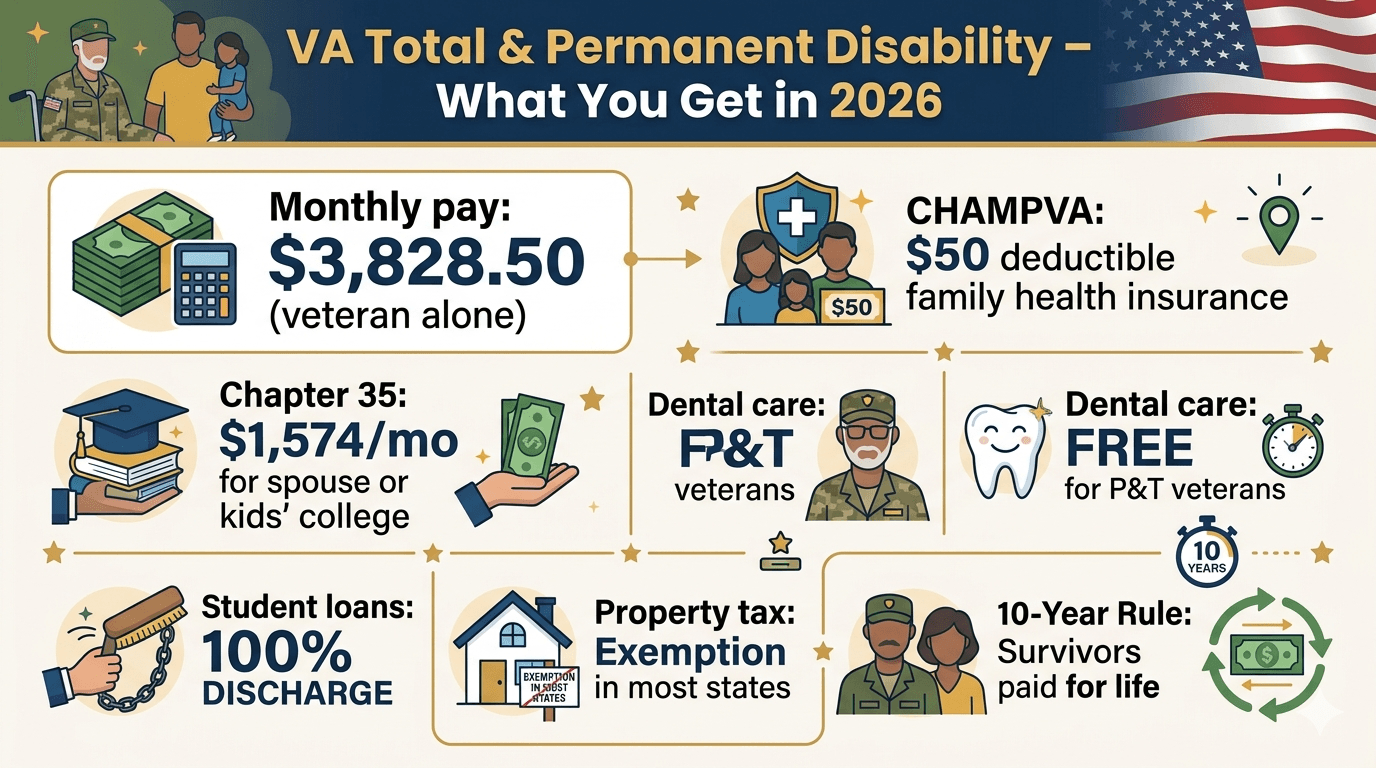
If you have a VA total and permanent disability rating (also called “P&T” or “100% P&T”), you are not just getting a monthly check. You just unlocked a hidden package worth an extra $30,000 to $150,000+ per year in free healthcare for your family, college money for your kids, and tax breaks your state may not want you to know about.

Here is the latest information today on VA total and permanent disability for 2026.
“Permanent and Total” means the VA has decided your service-connected disabilities are unlikely to improve. This is not a temporary 100% rating for something like surgery recovery. This is a lifetime designation. And it changes the rules for everything from student loans to property taxes.
What Veterans Need to Know Right Now (May 2026)

The number one mistake veterans make with a P&T rating is assuming the monthly check is the only benefit. It is not even the most valuable one long-term.
Your 2026 monthly tax-free payment (100% rating):
- Veteran alone: $3,828.50
- Veteran + spouse: $4,044.64
- Add children: Increases further
But the real money is in the附加 benefits that most veterans never claim.
Critical update: The 2026 COLA increase is 2.8% , effective January 1, 2026 . You do not need to do anything. Your January payment automatically reflected this increase.
Latest Updates Today (April–May 2026)
Veterans May Qualify for Extra Benefits
Check available financial assistance, healthcare programs and other opportunities that may apply to you.
Check EligibilityThree major changes affect P&T veterans right now:
1. New Medication Rating Rule (February 2026)
The Trump Administration issued an interim final rule changing how VA evaluates disability ratings for veterans taking medication . Previously, VA had to consider your condition “on your worst day” and discount the effects of medication. The new rule directs examiners to rate disabilities as they currently present—even if medication controls your symptoms.
Real-life impact: If you are applying for an increase to reach 100% P&T, your medication use may no longer help your claim. Veterans already rated P&T are not affected —your rating is protected. But if you are trying to move from 90% to 100%, talk to an accredited VSO before filing. This rule is being challenged by Senate Veterans’ Affairs Committee members and VSOs .
2. 10-Year Rule Locked for Survivors
The “10-Year Rule” remains fully active in 2026. If you have held a 100% P&T rating for 10 continuous years before your death, your surviving spouse receives Dependency and Indemnity Compensation (DIC) regardless of the cause of death .
2026 DIC rate: Approximately $1,699.36 per month tax-free for life .
If you die from a heart attack, car accident, or any non-service-connected cause after holding P&T for 10 years, your family still gets paid. This is better than most life insurance policies—and it is free.
3. No P&T Reduction Reviews Scheduled for 2026
The VA has confirmed no mass reviews or “rating reduction sweeps” for 2026. P&T status remains protected. If you have the designation, you will not be called for routine future exams.
Who Qualifies for VA Total and Permanent Disability
There are three ways to achieve P&T status:
Path 1: Schedular 100% P&T
Your combined disability rating reaches 100% using VA’s rating schedule, AND the VA determines your conditions are “static” (unlikely to improve). Static conditions include chronic PTSD, traumatic brain injury, amputations, severe respiratory conditions, and many cancers in remission .
Path 2: Total Disability Based on Individual Unemployability (TDIU)
You have a combined rating below 100% (often 70% or 80%), but you cannot work a substantially gainful job because of your service-connected disabilities. The VA pays you at the 100% rate .
TDIU eligibility:
- One condition rated at 60% OR
- Two or more conditions with a combined rating of 70% (one condition at 40% minimum)
TDIU can also be designated Permanent and Total . If you receive TDIU with P&T status, you get all the same additional benefits as a schedular 100% P&T veteran.
Myth busted: You can still work with TDIU if it is “marginal employment” (earning below the federal poverty threshold or working in a sheltered environment with special accommodations) . You do not need to be completely unemployed.
Path 3: Extra-Scheduler P&T (Rare)
If you do not meet the rating requirements but your disabilities clearly prevent work, the VA’s Director of Compensation Service can grant P&T status . This is uncommon and requires strong evidence.
How to Apply for P&T Status (or Check If You Already Have It)
Step 1: Check if you already have P&T designation
Log into VA.gov → “Manage your VA disability” → “View your disability rating.” Look for language like:
- “You are considered to be permanently and totally disabled due to your service-connected disabilities”
- “Basic eligibility to Dependents’ Educational Assistance is established”
If you see those words, you are P&T. If you only see “100%” without P&T language, you do not have the designation yet.
Step 2: Request P&T designation if missing
Many veterans with severe static conditions are never formally designated P&T. You can request it through a Supplemental Claim or Higher-Level Review .
What you need:
- Medical evidence showing your conditions are static (not expected to improve)
- A statement from your doctor saying treatment is for maintenance, not cure
Submit VA Form 21-526EZ to:
Department of Veterans Affairs
Claims Intake Center
PO Box 4444
Janesville, WI 53547-4444
Step 3: Work with an accredited representative
Veterans Service Organizations (VSOs) like DAV, VFW, or American Legion do this for free. Do not pay a “claims shark” who charges upfront fees. Only accredited attorneys or agents can charge—and only if you win.
File online at VA.gov/disability/how-to-file-claim/
Common Mistakes Veterans Make With P&T Status
Mistake #1: Not applying for CHAMPVA for your family
CHAMPVA is health insurance for your spouse and children. It costs $50 per person or $100 per family annual deductible , with a $3,000 catastrophic cap .
The math: Private family health insurance in 2026 costs $800–$1,200 per month. CHAMPVA saves you $10,000–$14,000 per year .
How to apply:
- Download VA Form 10-10d (Application for CHAMPVA Benefits)
- Mail to: CHAMPVA Intake Center, PO Box 469063, Denver, CO 80246-9063
- Call CHAMPVA Helpline: 1-800-733-8387
Mistake #2: Skipping Chapter 35 DEA benefits
The Survivors’ and Dependents’ Educational Assistance (DEA) Program, also called Chapter 35 , pays your spouse or children up to $1,574 per month for full-time college or vocational training .
Your children get: 36 months of benefits (up to $56,664 total) between ages 18 and 26 .
Your spouse gets: 36 months of benefits, must use within 10 years of your P&T notification .
If you have a spouse and two children, that is over $160,000 in total education benefits —none of which requires the GI Bill .
Mistake #3: Not applying for student loan discharge
100% P&T veterans qualify for Total and Permanent Disability (TPD) Discharge of federal student loans. This includes Direct Loans, FFEL Loans, and Perkins Loans .
Warning: The discharge is currently tax-free through 2026, but tax rules change. Apply now.
Mistake #4: Ignoring state property tax exemptions
Most states offer full or partial property tax exemption for 100% P&T veterans. In Texas, Florida, and many others, you pay zero property tax on your primary residence.
Action: Call your county tax assessor’s office. Ask for “Disabled Veterans Property Tax Exemption Application.” You may need your VA award letter showing P&T status.
Mistake #5: Believing P&T means you cannot work
This is false. P&T status does not prohibit employment. TDIU with P&T has work restrictions, but schedular 100% P&T veterans can work any job, any salary, with no penalty .
What This Means Financially for Your Family
Let me be direct. The difference between “100%” and “100% P&T” is the difference between a good disability check and generational wealth transfer.
Annual value breakdown for a typical P&T veteran with a family:
| Benefit | Annual Value |
|---|---|
| Monthly compensation ($3,828.50 x 12) | $45,942 |
| CHAMPVA family healthcare | $10,000–$14,000 |
| Chapter 35 DEA (one child, 4 years) | $7,500 (annualized) |
| Property tax exemption (national average) | $3,500 |
| Student loan discharge (if applicable) | $20,000+ (one-time) |
Total additional value beyond the monthly check: Over $25,000 per year.
That is not a guess. That is the actual cash value of benefits you have already earned.
The 10-Year Rule for survivors
If you have held 100% P&T for less than 10 years, your family only gets DIC if your death is service-connected. After 10 years, cause of death does not matter .
The clock started the day your P&T rating was awarded. Check your VA letters. If you are at 8 years, you are almost there. Do not lose hope.
Political and Government Context Behind P&T Updates
The Ingram v. Collins fallout
In 2025, the U.S. Court of Appeals for Veterans Claims ruled that VA must base disability ratings on a veteran’s “worst day” and discount the effects of medication . VSOs celebrated it as a victory for accurate ratings.
Then in February 2026, the VA issued an interim final rule reversing that standard—without public comment . The new rule says examiners must rate disabilities as they present, even if medication is controlling symptoms.
What this means for you: If you are trying to reach 100% P&T, do not stop taking your medication. But understand that VA examiners may now rate you lower than your true baseline severity. Work with a VSO to document flare-ups and “worst day” symptoms separately from your medicated state.
Congressional action stalled
The “VA Flexible Pay Act” and “Veterans Benefits Fairness Act” both died in committee in 2025. No major P&T legislation is moving in 2026. The current administration’s focus is on reducing claim backlogs (currently averaging 150+ days) rather than expanding benefits.
FAQ: Latest Information Today on VA Total and Permanent Disability
Q: What is the difference between 100% disabled and P&T?
A: You can be 100% disabled without being P&T. That means the VA may schedule future re-exams. P&T means no future exams and unlocks CHAMPVA, Chapter 35, and other family benefits .
Q: Can the VA reduce my P&T rating?
A: Almost never. P&T means “permanent.” The VA cannot reduce your rating without showing fraud or a clear and unmistakable error .
Q: Does P&T qualify for expedited Social Security Disability (SSDI)?
A: Yes. A 100% P&T rating can help you get expedited SSDI processing. You can collect both VA compensation and SSDI at the same time—neither reduces the other .
Q: Is P&T the same as TDIU?
A: No. TDIU is a way to get paid at 100% even if your rating is lower. TDIU can also be designated P&T. If you have TDIU with P&T, you get all the same additional benefits .
Q: Do I get free dental care with P&T?
A: Yes. Veterans with 100% P&T qualify for free VA dental care. Non-P&T 100% veterans may have to pay for dental .
Q: What happens to my P&T benefits if I get married or divorced?
A: Marriage increases your monthly payment. Divorce removes the spouse increase but does not affect your P&T status. Your ex-spouse loses CHAMPVA eligibility upon divorce .
Q: Can my children lose Chapter 35 benefits?
A: Children lose eligibility at age 18 (or 23 if enrolled in college). They also lose eligibility if they get married before 18 .
Final Takeaway
The latest information today on VA total and permanent disability is clear: P&T is the most underutilized benefit in the entire VA system.
You have already fought for your rating. Now fight for what comes with it.
Your three tasks this week:
- Check VA.gov to confirm you have P&T designation (not just 100%)
- Apply for CHAMPVA for your family (Form 10-10d)
- Tell your spouse and children about Chapter 35 DEA benefits
Most veterans stop at the monthly check. That is a $45,000 mistake. The real value of P&T is over $70,000 per year when you add healthcare, education, and tax benefits.
Do not leave that money on the table.
And remember the 10-Year Rule. If you are not there yet, keep fighting to maintain your rating. Every year you hold P&T is one year closer to locking in lifetime survivor benefits for the people who matter most.
To qualify for such a status, the veteran must meet specific criteria set forth by the VA. Primarily, they must be rated as 100% disabled. This rating often stems from conditions that can be assessed through medical examinations, such as PTSD, traumatic brain injuries, or debilitating physical conditions that impair daily living activities. Apart from the 100% disability rating, the VA also evaluates whether the disability is considered permanent, meaning it is expected to last indefinitely without significant likelihood of recovery.
The legal framework governing Total and Permanent Disability is embedded within the Title 38 of the United States Code, which outlines veterans’ benefits. The adjudication process can be intricate, often requiring comprehensive medical documentation and evaluations. Veterans may seek assistance from accredited representatives or organizations specializing in veterans’ claims to navigate through the complexities of the application process. Achieving a Total and Permanent Disability rating is vital for veterans not only for receiving financial support but also for accessing additional entitlements such as vocational rehabilitation and employment services.
Current Benefits for VA Total and Permanent Disability
Veterans who are classified as totally and permanently disabled by the Department of Veterans Affairs (VA) are entitled to a range of benefits designed to provide comprehensive support and assistance. These benefits include financial compensation, healthcare services, education assistance, and various other support programs that aim to enhance the quality of life for these veterans.
The financial compensation for veterans who are totally and permanently disabled varies according to the severity of the disability and the number of dependents. As of 2026, the VA provides monthly disability compensation, which is non-taxable and adjusts based on cost-of-living increases. This financial support is essential in helping veterans maintain their independence and meet their everyday needs.
Healthcare benefits play a crucial role in the lives of these veterans. They are eligible for VA healthcare services, which include access to medical treatment, mental health care, and specialized rehabilitation programs. The VA also covers the costs related to prescription medications and assists with long-term care if necessary. This ensures that veterans receive the medical attention they require without the burden of prohibitively high expenses.
In addition to healthcare and financial support, education assistance programs are available for veterans classified as totally and permanently disabled. These programs include the Post-9/11 GI Bill and the Vocational Rehabilitation and Employment (VR&E) program, which help veterans pursue higher education or vocational training. This educational opportunity is invaluable for transitioning back into civilian life and gaining skills that can lead to successful employment.
Furthermore, veterans may also have access to adaptive housing assistance, transportation services, and support groups aimed at helping them reintegrate into society. The comprehensive nature of these benefits underscores the VA’s commitment to supporting veterans who endure challenges due to their service-related disabilities.
Changes Expected in VA Disability Benefits in 2026
As stakeholders anticipate the future of VA disability benefits, numerous changes are expected to take effect by 2026. The Department of Veterans Affairs (VA) is continually assessing its policies to ensure that they meet the evolving needs of veterans suffering from disabilities due to military service. These changes are likely to include adjustments to compensation rates, updates to healthcare policies, and the introduction of new programs designed to enhance support for disabled veterans.
One significant area of anticipated change is the adjustment of compensation rates. Given the rising cost of living, the VA is likely to evaluate and modify the compensation structure to better align with current economic conditions. This could manifest as an increase in monthly disability payments to ensure that veterans are not financially disadvantaged due to inflation.
In addition to compensation adjustments, updates to healthcare access and policy are expected. The VA has been working to streamline processes and improve services for veterans with disabilities. By 2026, it is anticipated that the VA will implement a more integrated healthcare system, which may include better access to specialists, mental health services, and telehealth options, making it easier for veterans to receive timely care.
New initiatives aimed at providing additional resources for disabled veterans are also on the horizon. Programs focused on vocational rehabilitation and employment may receive enhancements, thereby aiding veterans in transitioning to civilian life more effectively. Such programs could include increased training opportunities and partnerships with private sector employers willing to hire veterans.
Overall, the expected changes to VA disability benefits by 2026 reflect a growing commitment to honor and support those who have served. By continually adapting and improving benefits and services, the VA aims to ensure that veterans receive the comprehensive care and support they deserve.
Eligibility Criteria for VA Benefits in 2026
To qualify for the VA Total and Permanent Disability benefits in 2026, veterans must meet specific eligibility requirements that encompass both service connection and disability levels. Primarily, the veteran must have a service-connected disability rated at a minimum of 100% by the Department of Veterans Affairs (VA). This rating indicates that the individual is considered completely disabled due to injuries or conditions that arose during military service.
Another crucial aspect of eligibility involves demonstrating that the total disability is permanent, meaning it is expected to remain for an extended duration without the likelihood of improvement. Veterans will typically undergo a thorough evaluation process, including medical examinations and reviews of their military medical history, to substantiate their claims.
The application process requires veterans to gather and submit pertinent documentation meticulously. This includes information about their service, medical records, and any assessments demonstrating the impact of their disabilities on daily living. It is advisable for veterans to work closely with accredited representatives or organizations that assist in navigating the VA claims process. These agencies are equipped to provide guidance on how to present a strong application and highlight the areas of concern necessary for successful approval.
Common pitfalls to avoid during this process include incomplete applications, inadequate medical evidence, and missing deadlines for submission. Ensuring that all requested documentation is collected and submitted in a timely manner can significantly enhance the chances of receiving the desired disability benefits. Moreover, veterans should be aware that seeking support from peer groups or legal assistance can be invaluable in avoiding typical mistakes and understanding the complexities of the VA system.
Application Process for Total and Permanent Disability Benefits
The application process for VA Total and Permanent Disability benefits is designed to ensure that veterans who are unable to secure employment due to their disabilities receive the necessary support. Understanding the various steps involved can make this process more manageable.
Initially, veterans must gather all relevant medical documentation that supports their disability claim. This documentation may include treatment records, diagnosis from healthcare providers, and other assessments that indicate the severity and permanence of the condition. These documents will serve as a critical foundation for the claim.
Once the necessary documents are compiled, the veteran must complete VA Form 21-526EZ, which is the Application for Disability Compensation and Related Compensation Benefits. It is essential that all sections of the form are filled out accurately, as incomplete forms can lead to delays in processing.
After completing the form, it can be submitted through various channels, including online via the VA’s eBenefits portal, by mail, or in person at a regional VA office. Following submission, the VA will acknowledge the receipt of the application and provide an estimated timeline for processing, which can often take several months.
To navigate the application process successfully, applicants are advised to remain proactive. This includes checking the status of the claim periodically and responding promptly to any requests from the VA for additional information or documentation. Furthermore, veterans may also consider engaging with a Veteran Service Organization (VSO) that specializes in assisting with disability claims for guidance and support throughout the process.
By understanding these steps and remaining diligent, veterans can effectively pursue the total and permanent disability benefits they deserve, thereby improving their overall quality of life.
Impact of Total and Permanent Disability on Other Benefits
Qualifying for VA total and permanent disability presents veterans with significant advantages, particularly in terms of financial support and access to various benefits. However, it is crucial to understand how this status can impact other forms of assistance that a veteran might be receiving, including Social Security Disability Insurance (SSDI) and state-level benefits.
When a veteran is awarded total and permanent disability status by the VA, this determination may streamline the SSDI application process. The Social Security Administration (SSA) recognizes the VA’s evaluation, which can lead to a presumption of disability in SSDI claims. Therefore, veterans with a total and permanent disability rating may find it easier to secure SSDI benefits, as the SSA often relies on the VA’s assessments.
Moreover, receiving VA total and permanent disability benefits does not necessarily disqualify veterans from state-level benefits. Many states offer additional resources, such as property tax exemptions, educational benefits, or transportation assistance, that complement federal benefits. However, some states may have rules about the income thresholds and financial eligibility which could be influenced by the veteran’s VA compensation payments.
It is also important to note that the total and permanent disability designation can impact income-based programs. In these cases, increased income from VA benefits may affect the financial assistance veterans seek through various welfare systems. Veterans are encouraged to consult with a disability advocate or legal advisor to clarify how their VA benefits might interact with other benefits they receive, ensuring they maximize their support without jeopardizing other forms of assistance.
Resources Available for Veterans and Their Families
Veterans and their families can access a myriad of resources designed to aid their transition and adjustment following military service. The Department of Veterans Affairs (VA) is at the forefront, offering various programs tailored to meet the unique needs of disabled veterans. These services encompass health care, vocational rehabilitation, and education benefits, which are crucial for ensuring a stable and fulfilling life post-service.
Support groups play an essential role in the healing and adjustment period for veterans. Organizations such as the Wounded Warrior Project and the Disabled American Veterans (DAV) provide not only emotional support but also practical assistance. These groups often organize events, workshops, and peer-to-peer support networks, thereby fostering a community among veterans and their families.
Financial counseling is another critical resource available to veterans. Numerous non-profit organizations, such as the National Military Family Association, offer financial workshops and one-on-one counseling sessions. These services help veterans navigate benefits, budget, and financial planning, which can alleviate stress and improve overall well-being. Additionally, the VA offers financial assistance programs that can help cover medical expenses, housing, and other necessary living costs.
Moreover, online resources from the VA website provide comprehensive information about the various benefits available for disabled veterans. This includes eligibility criteria, application processes, and contact points for further assistance. In addition, many local VA offices host informational sessions to educate veterans and their families about the benefits and services accessible to them. Utilizing these resources can significantly improve a veteran’s quality of life and help them reintegrate smoothly into civilian life.
Success Stories: Veterans Living with Total and Permanent Disability
Many veterans have faced the overwhelming challenges of total and permanent disability with resilience and determination. Their inspiring journeys not only highlight the various paths to obtaining VA benefits but also the transformative strength that emerges when adapting to new realities. One veteran, John, a former infantryman, sustained significant injuries during deployment, leading to a total and permanent disability designation. Despite his difficulties, John navigated the VA’s complex bureaucracy and successfully accessed benefits that have been crucial for his rehabilitation and reintegration into civilian life.
Another remarkable story is that of Sarah, a veteran who lost her vision due to service-related injuries. After her diagnosis, Sarah faced numerous obstacles, but she utilized available resources, including support groups and rehabilitation programs, to find new passions and career opportunities. Her determination not only earned her the benefits she deserved but also allowed her to become an advocate for other veterans experiencing similar challenges. Sarah’s story serves as a testament to the importance of seeking help and utilizing available services to foster change.
Furthermore, many veterans have found innovative ways to adapt using assistive technology and community support. For example, Michael, a mechanic before his disability, discovered a newfound interest in online coaching for fellow veterans. Through his platform, he shares strategies for adapting to life post-disability and connects with others facing similar situations. His journey demonstrates how meaningful relationships and shared experiences can significantly enhance recovery and quality of life.
The stories of these veterans exemplify the strength inherent within the military community. They illustrate the potential for growth and adaptation, inspiring others to seek benefits and support while overcoming the hurdles associated with total and permanent disability.
Looking Ahead: Advocacy and Future Improvements for Disabled Veterans
As the landscape of veteran care continues to evolve, advocacy groups play a pivotal role in shaping policies that directly impact disabled veterans. Several organizations, including the Disabled American Veterans (DAV) and the American Legion, are tirelessly advocating for enhancements in benefits related to the VA Total and Permanent Disability program. Their efforts are primarily focused on ensuring that veterans receive not only the medical care they require but also the financial support that reflects their sacrifices.
One of the primary areas of concern among advocates is the need for streamlined access to benefits. Many veterans find themselves navigating a convoluted bureaucracy that complicates their ability to secure the assistance they need. Advocates are pushing for reforms that would simplify the application process, thereby reducing wait times and expediting service delivery. This could involve implementing more efficient online systems or increasing funding to the VA for staff training and resource allocation.
Additionally, there is a growing call for an expansion of eligibility criteria for benefits. Many veterans feel that the current standards do not encompass the full spectrum of disabilities related to military service. Advocacy groups are working alongside lawmakers to consider amendments that would allow more veterans to access the total and permanent disability benefits they deserve. Initiatives aimed at raising awareness about rare or less-recognized service-related conditions are also in the pipeline, reflecting a commitment to inclusivity.
To support these advocacy efforts, veterans themselves can play a crucial role. Participation in community forums, public discussions, and outreach events can amplify their voices and highlight the distinct challenges they face. By sharing personal stories and engaging with legislators, disabled veterans can significantly influence policy changes that enhance their quality of life.


🇺🇸 IMPORTANT DISCLAIMER – Veterans Benefits Information
This site provides general information about U.S. Department of Veterans Affairs (VA) benefits for educational and informational purposes only.
- Not Official: We are NOT affiliated with, endorsed by, or connected to the U.S. Department of Veterans Affairs (VA), the Veterans Benefits Administration (VBA), the Veterans Health Administration (VHA), or any other government agency.
- No Legal/Financial Advice: The content on this website is for informational purposes only and does not constitute legal, financial, or medical advice. VA benefits rules change frequently – always consult with an accredited Veterans Service Officer (VSO) or a qualified professional for your specific situation.
- Official Sources: For official, binding information and to apply for benefits, always visit official .gov websites: VA.gov, Benefits.VA.gov, or SSA.gov.
- No Data Collection: This site does not collect, store, or process any personal information. It does not have login forms, contact forms, or any system to capture user data. We never ask for your Social Security Number, bank details, or any personal information.
- 🚨 Scam Alert: The VA and other government agencies never charge fees for benefit applications. If anyone asks for money to "process" your VA claim, it is a scam. Report it to the VA Office of Inspector General at VA.gov/OIG.
- Advertising: This site uses third-party advertising (Adsterra) to cover operational costs. We do not endorse or guarantee any products or services advertised.
📌 Information provided as of June 2026. Always verify current eligibility and rules with official .gov sources.
This site is not affiliated with the U.S. Department of Veterans Affairs or any government agency. All information is for educational purposes only. Please visit VA.gov for official information.
