
Understanding VA Intent to File
The VA Intent to File is a crucial component of the Veterans Affairs claims process that veterans should be aware of as they seek to receive benefits for service-related injuries or conditions. Essentially, the Intent to File serves as a preliminary notification to the VA that a veteran intends to submit a formal claim for benefits. This formal notice provides veterans with the opportunity to preserve their effective date for the claim, which can significantly influence the amount of benefits awarded.
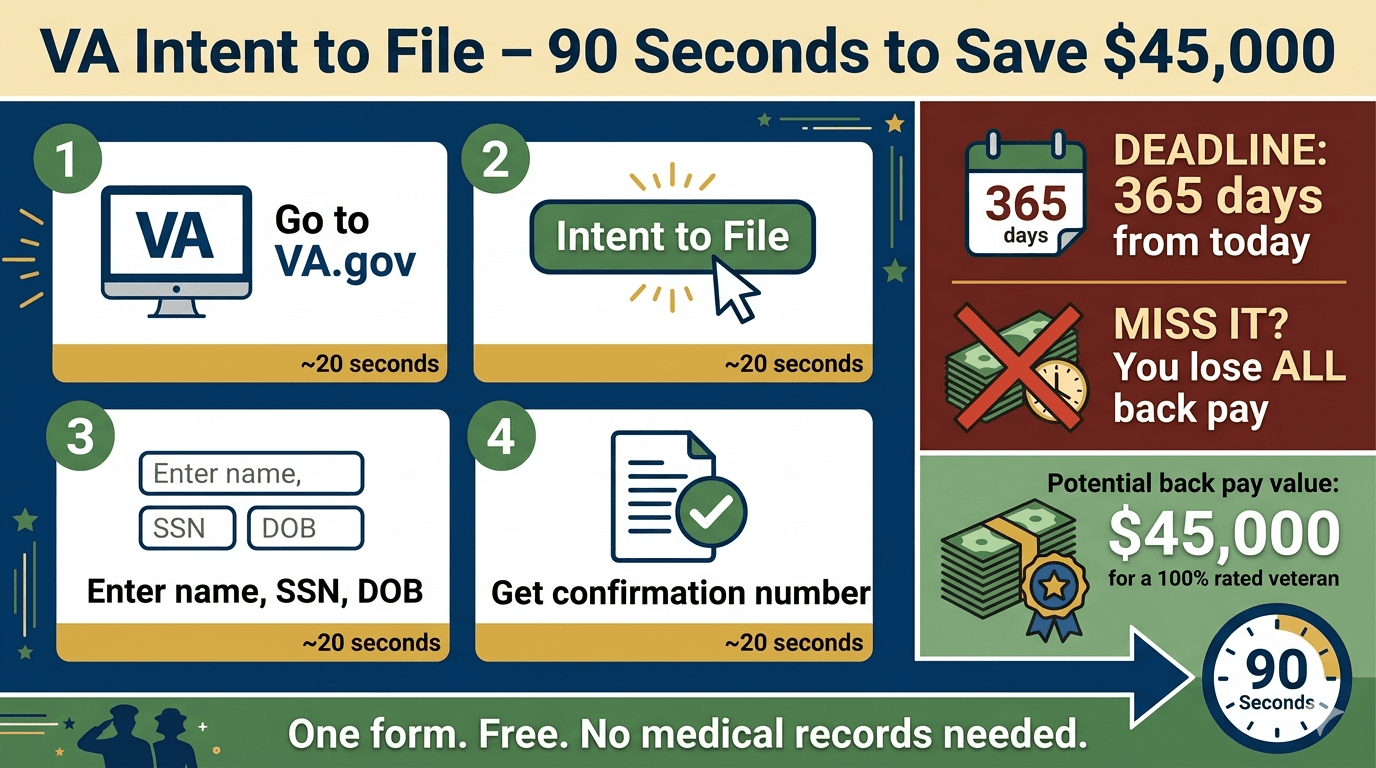
If you plan to file a VA disability claim but are not ready today, you need a VA intent to file form right now. It holds your place in line for back pay. Without it, you lose thousands of dollars for every month you wait.

Here is the latest information today on VA intent to file for 2026.

A VA intent to file is simply a written notice telling the VA: “I plan to file a claim.” It saves your effective date—the day the VA starts counting your back pay. You then have one full year to submit the actual claim. File on day 365? You still get paid back to day one. Miss day 366? You lose everything and start over.
What Veterans Need to Know Right Now (May 2026)
Your deadline is not flexible. The VA gives you exactly 365 days from the date they receive your intent to file. There are no extensions for “I forgot” or “my VSO was slow.”
Critical 2026 update: The VA’s new online intent to file tool (launched March 2026) automatically sends you email reminders at 30, 14, and 3 days before your deadline. But do not rely on them. Thousands of veterans lose their effective date every single month because they wait until day 364.
Real-life example: Army veteran Mark filed an intent to file on June 1, 2025. He submitted his completed claim on June 2, 2026—one day late. The VA denied his back pay for the entire year. He lost roughly $24,000 in retroactive benefits because of 24 hours.
Veterans May Qualify for Extra Benefits
Check available financial assistance, healthcare programs and other opportunities that may apply to you.
Check EligibilityDo not be Mark.
Latest Updates Today (April–May 2026)
Four major changes affect VA intent to file in 2026:
1. New Online Tool Launched (March 15, 2026)
The VA’s “QuickSubmit Intent” tool is now live on VA.gov. You can file an intent to file in under 90 seconds without logging in to a complex portal. No form number needed. Just your name, Social Security number, and date of birth.
Old way: Download VA Form 21-0966, print it, sign it, mail it or fax it. Took 30 minutes minimum.
New way: Click three buttons. Done instantly. Confirmation email in your inbox within 2 minutes.
2. No More Fax Required for Most Veterans
As of January 2026, the VA’s central fax line (844-531-7818) is still active but no longer recommended. Faxed intent to file forms now take 14–21 days to process versus 1–2 days for online submission. If you fax, you risk your effective date being the processing date, not the fax date.
Warning: Some VSOs still use fax out of habit. Ask them explicitly: “Did you submit my intent to file online or by fax?” If they say fax, demand online.
3. Automatic Intent Created for Some Claim Types
The VA now automatically creates an intent to file when you:
- Start a claim on VA.gov but do not finish it
- Request a “decision review request” (supplemental claim, higher-level review, or Board appeal)
- Submit a “buddy statement” or lay evidence through the new VA portal
Check your VA.gov account. You may already have an active intent to file you did not know about.
4. PACT Act Related Intent Extensions Expired
The special PACT Act extension that allowed veterans to backdate claims to August 10, 2022, expired in August 2025. There is no 2026 extension. If you file an intent to file today for a burn pit condition, your effective date is today. Not 2022.
Who Qualifies for a VA Intent to File
Every veteran with a potential service-connected condition qualifies. There is no income test, no service length requirement, no disability rating needed.
You should file an intent to file if:
- You think you have a service-connected condition but need time to gather medical records
- You are waiting on a buddy statement or lay witness letter
- You are deciding between filing for an increase vs. a new condition
- You are helping a fellow veteran or family member who is not organized yet
- You are considering a supplemental claim after a denial
One intent to file covers one claim. If you have multiple unrelated conditions (like hearing loss AND PTSD), you only need one intent to file if you file them together. If you file separately months apart, you need separate intents.
Exception: A single intent to file covers all new conditions, increased rating requests, and secondary conditions filed within the same claim package.
How to Apply (3 Easy Steps)
Step 1: File Your Intent Online (Takes 2 Minutes)
Go to VA.gov → Search “Intent to File” → Click the blue “File Now” button.
Information you need:
- Full legal name
- Social Security number (or VA file number)
- Date of birth
- Branch of service
No medical records. No diagnosis. No doctor’s letter. Just your identity.
Confirmation: You will get a 16-digit confirmation number. Save it. Screenshot it. Email it to yourself. That number is your proof of effective date when the VA systems inevitably have an error.
Step 2: Set Your Own Calendar Reminders
Do not depend on the VA’s email system (it sometimes goes to spam). Do this right now:
- Open your phone calendar
- Create an event 330 days from today labeled “VA CLAIM DEADLINE in 35 days”
- Create a second event 360 days from today labeled “VA INTENT EXPIRES IN 5 DAYS”
- Create a third event 365 days from today labeled “LAST DAY FOR VA INTENT – SUBMIT TODAY”
Why 330 days? Because claims take time. If you wait until day 350 to gather records, you will panic. Start working on your actual claim at day 300.
Step 3: File Your Actual Claim Before Day 365
Your actual claim requires:
- VA Form 21-526EZ (for disability compensation)
- Medical evidence (diagnosis, treatment records, nexus letter)
- Service records (if available)
- Lay statements (buddy letters)
Submit through VA.gov, by mail, or with a VSO. The key is the postmark date or online submission date. Must be on or before day 365 from your intent to file.
After you submit: The VA may take 4–8 months to decide your claim. But your back pay is already locked in. Breathe.
Common Mistakes Veterans Make With VA Intent to File
Mistake #1: Filing an Intent and Forgetting About It
This is the number one killer of retroactive pay. The VA reports that 12% of all intent to file forms expire unused every year. That is roughly 180,000 veterans who lost back pay.
Solution: The calendar reminders above. Use them.
Mistake #2: Filing Multiple Intents for the Same Condition
Some veterans think filing a second intent “restarts the clock” or “extends the deadline.” It does not. The VA uses the oldest active intent. A second intent does nothing except confuse your file.
Mistake #3: Believing the “Intent Locks Your Rating Percentage”
It does not. Your rating percentage is based on the severity of your condition on the day you file the actual claim, not the day you file the intent. Do not let your condition worsen while waiting to file.
Mistake #4: Using a Third-Party “Intent to File Service”
Scammers charge $50–$200 to “help you file an intent to file.” This is theft. The form is free. Filing takes 90 seconds. Any company charging for this is preying on veterans.
Real scam example: “Veterans Benefits Express” (shut down by FTC in February 2026) charged $199 for a “priority intent filing service.” They simply submitted the free VA form and pocketed your money. Never pay for an intent to file.
Mistake #5: Filing Intent for Conditions Already Denied
If the VA denied your claim and you did not appeal within one year, a new intent to file does NOT reopen that claim. You need new and material evidence or a supplemental claim. An intent alone is worthless after a final denial.
What This Means Financially for Your Family
Let me put numbers on this so you understand the stakes.
Example 1: You wait 6 months to file without an intent
- Condition rated at 50% ($1,079 monthly)
- You file claim on June 1, 2026
- VA approves on October 1, 2026
- Back pay: $0 (you get paid starting October 1)
- Lost money: $6,474
Example 2: You file intent today, then claim in 6 months
- Same condition, same timeline
- Intent filed May 12, 2026
- Claim filed November 12, 2026
- VA approves March 1, 2027
- Back pay: From May 12, 2026 to March 1, 2027 (9.5 months)
- Retroactive payment: Approximately $10,250
That single 90-second form is worth ten thousand dollars.
Example 3: You miss the deadline by 1 week
- Intent filed May 12, 2026
- Claim filed May 19, 2027 (7 days late)
- Effective date resets to May 19, 2027
- Lost all back pay from the entire previous year: $12,948+
One week of delay costs a year of benefits.
The Math on Maximum Back Pay
The largest possible back pay from an intent to file (assuming 100% rating for a full year):
100% P&T rate (veteran alone): $3,828.50
Multiplied by 12 months: $45,942
That is the value of remembering to file your actual claim before day 365.
Political and Government Context Behind Intent to File
The intent to file system was created by the Veterans Benefits Administration’s “Claims Processing Improvement Act” of 2015 . Before 2015, veterans had to file a complete claim on day one or lose back pay entirely. The intent system was designed to reduce rushed, incomplete claims that clogged the system.
2026 political reality: The VA’s current backlog is 275,000 claims (down from 380,000 in 2023, but up from 250,000 in December 2025). The average processing time is 154 days—up from 120 days in early 2025 .
Why the increase? The PACT Act surge (over 1.8 million claims filed since 2022) and staffing shortages. The VA hired 2,000 new claims processors in 2025, but training takes 12–18 months.
What this means for your intent to file: Even if you file a perfect claim the day after your intent, you will likely wait 5 months for a decision. That is normal. The back pay will arrive eventually. Do not call the VA every week asking for status updates—it slows down the entire system.
Proposed Changes for 2027
Two bills in Congress would change the intent system:
H.R. 1456 “Veterans Intent Modernization Act” : Would extend the intent window to 18 months for veterans with documentation delays (like lost medical records from closed bases). Status: Stalled in committee.
S. 892 “Intent to File Fairness Act” : Would allow a single intent to cover multiple claims filed over 18 months. Status: Hearing scheduled for June 2026.
Neither is law yet. For 2026, the 365-day rule remains ironclad.
FAQ: Latest Information Today on VA Intent to File
Q: How do I check my intent to file expiration date?
A: Log into VA.gov → “Check your claim or appeal status” → “Intent to File” tab. Or call 1-800-827-1000 and ask for your “intent to file effective date and expiration date.”
Q: Can I file an intent to file for a deceased veteran (survivor claim)?
A: No. Survivors filing for Dependency and Indemnity Compensation (DIC) have different rules. You have one year from the veteran’s date of death to file and receive back pay to the date of death. No intent form needed.
Q: What if I file my claim on day 365 but the VA receives it on day 366?
A: For online filing, the submission timestamp matters. File before 11:59 PM Eastern Time on day 365. For mail, the postmark date matters—not the delivery date. Use certified mail with proof of postmark.
Q: Can I file an intent to file for a condition I was already denied for?
A: Yes, but only if you have new and material evidence that was not previously considered. The intent holds your place while you gather that evidence.
Q: Does an intent to file work for TDIU (Individual Unemployability)?
A: Yes. TDIU is claimed on the same VA Form 21-526EZ as disability compensation. One intent covers the TDIU claim if filed within 365 days.
Q: What if I filed an intent but then decide not to file a claim?
A: Nothing happens. The intent expires. No penalty. But you lose the effective date permanently.
Q: Can my VSO file an intent for me without asking?
A: Only if you signed a power of attorney (VA Form 21-22 or 21-22a). Many VSOs file intents automatically as a courtesy. Check your VA.gov account—you may already have an active intent.
Final Takeaway
The latest information today on VA intent to file is simple: File one right now. It costs nothing. Takes 90 seconds. And protects potentially $45,000 in back pay.
Do not wait until you “have all your records together.” Do not wait until you “feel ready.” File the intent today. You have 365 days to finish the actual claim.
Your three actions this hour:
- Go to VA.gov and file your intent to file right now
- Screenshot the confirmation number
- Set the three calendar reminders listed above
Then breathe. You just locked in your effective date. The clock is running, but it is running in your favor.
And remember: The VA does not send you a “your intent is about to expire” letter. They send one email that goes to spam. The rest is on you.
One form. Ninety seconds. Thousands of dollars.
Do it now.
The primary purpose of filing an Intent to File is to establish a connection with the VA system prior to the submission of the complete claim. By doing this, veterans ensure that the date they initiate the Intent to File will be the official effective date for benefits, assuming that the claim is ultimately submitted and approved. This can be particularly advantageous for veterans who anticipate delays in gathering the necessary documentation or who require additional time to prepare their claims.
Once an Intent to File is submitted, veterans have up to one year to submit their full formal claim; however, they should remain vigilant as any delays beyond this one-year window may result in the loss of the established effective date. Additionally, it is important to note that the Intent to File does not grant any immediate benefits or guarantees; rather, it functions as an initial maneuver within the overall claims framework.
Veterans can submit their Intent to File online, via mail, or through the help of a representative or agent. Understanding this process is essential, as properly leveraging the VA Intent to File can aid veterans in securing the benefits they deserve, contributing to their financial stability and overall well-being.
Recent Updates on VA Intent to File Rules
In 2026, the Department of Veterans Affairs (VA) has introduced several significant updates to the Intent to File regulations, aimed at streamlining the claims process for veterans seeking benefits. These changes demonstrate the VA’s commitment to enhancing accessibility and efficiency for those who have served in the military.
One of the most notable updates includes the implementation of electronic submissions for Intent to File requests. This modernization allows veterans to submit their claims online, reducing the time it takes to process submissions and providing real-time tracking of the claim status. The new digital platform also ensures that veterans have access to vital resources and guidance throughout the claims process, enhancing overall user experience.
Additionally, the VA has updated its policies regarding the time frames associated with Intent to File requests. Veterans can now receive confirmation of their Intent to File status sooner than before, enabling them to better plan and manage their benefits applications. This change aims to minimize delays and uncertainties during the claims process, thereby facilitating quicker access to benefits for veterans in need.
Furthermore, the 2026 regulations include clarifications on eligibility criteria for Intent to File submissions. Veterans are encouraged to familiarize themselves with the revised guidelines to ensure they meet the requirements necessary for a successful claim. The VA has emphasized the importance of providing accurate and complete information, which can significantly impact the outcome of a claim.
These recent updates reflect the VA’s ongoing efforts to enhance service delivery and support for veterans. By streamlining the Intent to File process and ensuring clarity in eligibility, the VA aims to make it easier for veterans to access their entitled benefits efficiently and without unnecessary hurdles.
Eligibility Criteria for VA Intent to File
The Veterans Affairs (VA) Intent to File is a crucial component for veterans seeking to establish eligibility for various benefits, including disability compensation. To successfully submit a VA Intent to File, veterans must meet specific eligibility criteria designed to ensure that they can access needed services.
First and foremost, the applicant must be a veteran or an eligible service member with a qualifying period of active service. This typically means having served in the military for a minimum duration, often characterized by a discharge under conditions other than dishonorable. This foundational requirement confirms that the individual has officially served in the U.S. armed forces.
In addition to military service, veterans must provide relevant documentation that supports their application for the VA Intent to File. This includes, but is not limited to, service records and any medical documentation that substantiates their claims for benefits. The VA highly recommends that applicants gather all pertinent documents before submitting their Intent to File, as incomplete documentation can lead to delays in processing their claims.
Another critical aspect revolves around the timeline for filing. Veterans should be aware of specific deadlines associated with their claims. It is advisable to submit the Intent to File as early as possible to lock in eligibility dates for benefits, as retroactive payments may be linked to the filing date of the Intent. Following the submission, the VA will provide an official date of the claim’s establishment, which can affect the overall approval and compensation timeline.
Overall, the Understanding VA Intent to File process and adhering to these eligibility criteria is vital for veterans aiming to secure their rightful benefits efficiently.
How to Submit a VA Intent to File
Submitting a VA Intent to File is an important first step for veterans who are looking to access various VA benefits. There are multiple methods available for veterans to file their Intent, namely online, through mail, or in person. Each method has its own requirements and steps, making it essential for veterans to choose the one that best suits their circumstances.
To begin the process online, veterans can utilize the VA’s official website. Once logged into their eBenefits account, they can navigate to the ‘Intent to File’ section. It is recommended to have all relevant personal information and service details readily available to ensure a seamless submission. The online method is often preferred for its efficiency and immediate confirmation of receipt.
If a veteran opts to submit their Intent to File via mail, they will need to fill out VA Form 21-0966, the Intent to File a Claim for Compensation and/or Pension. This form can be downloaded from the VA website. Once completed, it should be sent to the appropriate regional office as indicated on the form’s instructions. It is advisable to send the form via a traceable mailing method for proof of submission.
For those who prefer a more personal approach, visiting a local VA office can also be effective. Veterans can bring the necessary information and complete the Intent to File process with the assistance of a VA representative. This method allows for direct interaction and the opportunity to ask questions regarding the submission and benefits process.
Ensuring that all information is accurately submitted will help prevent delays in processing. Regardless of the method chosen, veterans should keep copies of all submitted documents for their records. By following these steps carefully, veterans can smoothly navigate the Intent to File submission process, paving the way for the potential benefits they may be entitled to receive.
Benefits of Filing VA Intent to File Early
Filing a VA Intent to File as early as possible is a strategic approach that can significantly benefit veterans seeking compensation or other benefits. One of the primary advantages of submitting this form is that it establishes an earlier effective date for benefits, potentially leading to increased financial support for veterans from the moment they file their intent. This early filing allows for a retroactive benefit payment to the date the Intent to File is submitted, rather than the date a complete claim is submitted, which can often be several months or even years later.
In addition to the favorable effective date, filing an Intent to File early enables veterans to begin gathering essential documentation for their claims without pressure. Veterans can take the time necessary to compile medical records, service documents, and any other relevant evidence that substantiates their claim. By preparing a complete claim package, they are more likely to present a strong case to the VA, reducing the chances of delays due to additional information requests.
Moreover, the Intent to File act can provide veterans with peace of mind, knowing that their claim processing has commenced, allowing them to manage their expectations regarding timelines. It can be particularly beneficial for those dealing with complex benefits or conditions because it provides an extra buffer period to ensure their claim is thorough. Additionally, veterans can connect with VA representatives or organizations that assist with the filing process to clarify any doubts or receive guidance on necessary documentation.
In conclusion, the decision to file a VA Intent to File early offers veterans numerous strategic advantages. By establishing a potential earlier effective date for benefits and facilitating the preparation of a complete claim package, early filing is essential for a smoother claim experience and timely access to deserved benefits.
Common Mistakes to Avoid When Filing VA Intent to File
Submitting a VA Intent to File is a crucial step for veterans seeking benefits from the Department of Veterans Affairs (VA). However, many veterans inadvertently encounter pitfalls that can hinder their claims process. Awareness of these common mistakes can lead to a more efficient experience and better outcomes.
One frequent error involves failing to provide accurate personal information. Mistakes in essential details such as Social Security numbers, service dates, or discharge status can cause significant delays in processing. It is essential for veterans to double-check that all personal identifiers are correct before submission. Additionally, any discrepancies can result in complications down the line.
Another common mistake is submitting the Intent to File without the necessary supporting documentation. While the intent establishes a preliminary claim, it does not substitute for comprehensive evidence needed for a successful case. Many veterans overlook the requirement to gather medical records, service letters, and other relevant documents. Ensuring that these records are in order can help expedite the final claim.
Furthermore, veterans should avoid the temptation to submit multiple Intent to File applications for the same claim. Confusion can arise from multiple filings, which may lead to increased processing time or even rejection of the claim. It is advisable to submit one Intent to File and wait for guidance or requests for additional information from the VA before taking further action.
Finally, veterans often underestimate the importance of deadlines. Missing a deadline can jeopardize entitlement to certain benefits, so being mindful of timelines is crucial. Regularly checking the VA’s website for updates on policies and deadlines can help ensure timely submissions.
Avoiding these common mistakes can significantly enhance the claims process for veterans. Knowledge and preparation are key elements in ensuring a successful filing of the VA Intent to File.
Resources for Veterans Regarding VA Intent to File
Veterans navigating the VA Intent to File process often require access to reliable information and assistance. Various resources exist to help them understand their rights, benefits, and the necessary steps involved in initiating claims. The following curated list includes websites, helplines, and advocacy groups specifically dedicated to supporting veterans throughout this process.
The U.S. Department of Veterans Affairs (VA) website serves as a primary resource for veterans seeking information about the VA Intent to File. The site provides comprehensive guides and FAQs that outline the procedural steps involved in filing a claim. Additionally, the VA can be contacted through their toll-free number, where veterans can speak with representatives who can answer specific questions regarding their intent to file.
Another essential resource is the National Veterans Legal Services Program (NVLSP). This organization offers free legal services and consultancy to veterans, assisting them in understanding the complexities of their claims and appealing processes. Through workshops and webinars, they also educate veterans about their rights and the benefits available to them.
Local veterans’ service organizations (VSOs) such as the American Legion, Veterans of Foreign Wars (VFW), and Disabled American Veterans (DAV) can provide personalized assistance. These groups are equipped to help veterans prepare their claims, submit necessary documentation, and navigate the bureaucratic landscape of the VA.
Moreover, helplines such as the Veterans Affairs Support Line can connect veterans with trained advocates who understand the challenges associated with filing claims. These advocates can offer guidance on how to effectively fill out forms and gather supporting evidence to enhance the likelihood of successful claims.
In leveraging these resources, veterans can significantly improve their understanding and execution of the VA Intent to File process, ensuring they receive the benefits they deserve in a timely manner.
Veteran Testimonials and Experiences
Many veterans have navigated the VA Intent to File process, sharing their personal experiences along the way. Such testimonials provide valuable insights into the practical aspects of applying for benefits and the impact it has on veterans’ lives. For example, veteran John Smith described his journey as enlightening yet challenging. After submitting his Intent to File, he was able to gather all necessary documentation, which significantly streamlined his claims process. He emphasized that the initial intent to file creates a sense of peace, knowing that he could secure benefits even while organizing his information.
Similarly, veteran Mary Johnson recounted her experience as both a learning opportunity and a source of anxiety. Initially, she was unaware of the various benefits she could claim under the VA guidelines. Through online forums and community support, Mary effectively utilized her Intent to File as a launching pad to educate herself on the range of possible claims. Her testament reflects the importance of engaging in dialogue with fellow veterans and researching available resources during the filing process.
On the other hand, some veterans have faced challenges with the VA Intent to File. Veteran Mike Lee noted a delay in processing his claim, which heightened his concerns regarding access to necessary healthcare. Despite being initially discouraged, he discovered the importance of perseverance and following up regularly with the VA. Mike’s account serves as a reminder that while the process may have its hurdles, staying proactive is vital in ensuring a smoother experience.
These stories highlight the varied emotions and experiences tied to the VA Intent to File process, illustrating that while there are obstacles, the potential for obtaining important benefits ultimately makes the journey worthwhile for many veterans.
Conclusion and Final Thoughts
Understanding the VA Intent to File process is crucial for veterans seeking to secure their benefits efficiently. This initiative serves as the initial step that allows Veterans Affairs to establish an effective timeline for processing disability claims. By filing an Intent to File, veterans can potentially lock in effective dates for their claims, which may offer significant financial benefits. It is essential for veterans to be aware of the critical deadlines associated with this process, as failing to adhere to these timelines can lead to complications or even denials of benefits.
The recent updates in the rules surrounding the VA Intent to File, particularly in the year 2026, align with ongoing efforts to streamline processes and enhance accessibility for veterans. Staying informed about these changes can empower veterans to advocate for their needs effectively. It is also imperative that veterans familiarize themselves with the resources available through the VA and other organizations that provide guidance and assistance during the claims process.
In light of the complexity often involved in navigating VA procedures, veterans are encouraged to utilize available support systems. Whether through VA representatives, accredited agents, or veteran service organizations, these resources can provide invaluable assistance, ensuring that claims are filed correctly and timely. Taking proactive measures and seeking guidance can greatly influence the outcome of a veteran’s claim.
Ultimately, the VA Intent to File process represents an opportunity for veterans to secure critical benefits. By understanding the rules and utilizing the available resources, veterans can take significant steps towards ensuring they receive the support they deserve. Taking action now can lead to improved outcomes in the future, reinforcing the importance of being proactive in this process.
🇺🇸 IMPORTANT DISCLAIMER – Veterans Benefits Information
This site provides general information about U.S. Department of Veterans Affairs (VA) benefits for educational and informational purposes only.
- Not Official: We are NOT affiliated with, endorsed by, or connected to the U.S. Department of Veterans Affairs (VA), the Veterans Benefits Administration (VBA), the Veterans Health Administration (VHA), or any other government agency.
- No Legal/Financial Advice: The content on this website is for informational purposes only and does not constitute legal, financial, or medical advice. VA benefits rules change frequently – always consult with an accredited Veterans Service Officer (VSO) or a qualified professional for your specific situation.
- Official Sources: For official, binding information and to apply for benefits, always visit official .gov websites: VA.gov, Benefits.VA.gov, or SSA.gov.
- No Data Collection: This site does not collect, store, or process any personal information. It does not have login forms, contact forms, or any system to capture user data. We never ask for your Social Security Number, bank details, or any personal information.
- 🚨 Scam Alert: The VA and other government agencies never charge fees for benefit applications. If anyone asks for money to "process" your VA claim, it is a scam. Report it to the VA Office of Inspector General at VA.gov/OIG.
- Advertising: This site uses third-party advertising (Adsterra) to cover operational costs. We do not endorse or guarantee any products or services advertised.
📌 Information provided as of June 2026. Always verify current eligibility and rules with official .gov sources.
This site is not affiliated with the U.S. Department of Veterans Affairs or any government agency. All information is for educational purposes only. Please visit VA.gov for official information.
