
How Many World War II Veterans Are Alive Today?
Approximately 31,000 to 45,000 U.S. World War II veterans are still alive in 2026, according to VA and National WWII Museum estimates. This represents less than 0.5% of the 16.4 million Americans who served. Most surviving WWII veterans are age 97 or older. An estimated 131 veterans pass away each day.
Quick Facts
| Item | Details |
|---|---|
| Estimated Living WWII Veterans (2026) | ~31,000 (VA projection); ~45,000 (National WWII Museum estimate) |
| Total Who Served | 16.4 million Americans |
| Percentage Still Alive | Less than 0.5% |
| Youngest Age | Approximately 97–98 |
| Average Deaths Per Day | ~131 |
| Projected Last Veteran | Early 2040s (VA projection) |
| Primary Data Sources | VA VetPop2023; National WWII Museum |
| Updated For | September 2026 |
Current Estimates: Why the Numbers Vary
Different organizations report different numbers because they use different methodologies. The VA uses the Veteran Population Projection Model (VetPop2023), a deterministic model that projects the living and deceased Veteran population at the end of each fiscal year. The National WWII Museum uses actuarial estimates based on historical death rates.

VA Estimate: ~31,000
The U.S. Department of Veterans Affairs estimates approximately 31,000 WWII veterans were alive in 2026. This figure comes from the VA’s VetPop2023 model, which projects veteran populations by era of service. The VA model estimated 95,000 WWII veterans in 2023 and projected just 31,000 by 2026 — a loss of nearly two-thirds in three years.
National WWII Museum Estimate: ~45,000

The National WWII Museum in New Orleans estimates about 45,418 WWII veterans remained alive as of 2025, which served as the basis for many 2026 projections. The museum’s figure represents less than 0.5% of the 16.4 million Americans who served during the war.
Why the Difference Matters
The discrepancy between 31,000 and 45,000 reflects different projection methodologies. The VA model uses administrative data from benefit claims and enrollment records. The museum uses actuarial death rate models applied to the original 16.4 million service member population. For practical purposes, both figures confirm the same reality: the WWII veteran population is extremely small and declining rapidly.
| Source | 2026 Estimate | Methodology |
|---|---|---|
| VA (VetPop2023) | ~31,000 | Administrative projection model |
| National WWII Museum | ~45,000 | Actuarial death rate model |
| Independent estimates | 40,000–50,000 | Various |
How Fast Is the WWII Veteran Population Declining?
The WWII veteran population is declining by approximately 131 veterans per day, according to estimates cited by the VA and the National WWII Museum. This means roughly 4,000 veterans pass away each month.
Annual Projections
| Year | Estimated Living WWII Veterans |
|---|---|
| 2023 | 95,000 |
| 2025 | 45,418 |
| 2026 | 31,000–45,000 |
| End of 2026 | ~42,000 (museum projection) |
| End of 2027 | ~28,000 |
| Early 2040s | 0 (last veteran projected to pass) |
By the end of 2027, estimates suggest only about 28,000 WWII veterans will remain alive. The VA estimates that within ten years, fewer than 300 total will remain. The last American WWII veteran is projected to pass away around 2043.
Pearl Harbor Survivors
Veterans May Qualify for Extra Benefits
Check available financial assistance, healthcare programs and other opportunities that may apply to you.
Check EligibilityThe number of Pearl Harbor survivors is even smaller. As of mid-2026, only 11 Pearl Harbor survivors were still alive. The youngest survivors of the December 7, 1941 attack are now in their late 90s.
The Korean War Comparison
Korean War veterans are following a similar trajectory, though at a slower pace. The VA estimates the last Korean War veteran will pass away in the 2040s as well, with a similar determination for WWII veterans.
Where Do Surviving WWII Veterans Live?
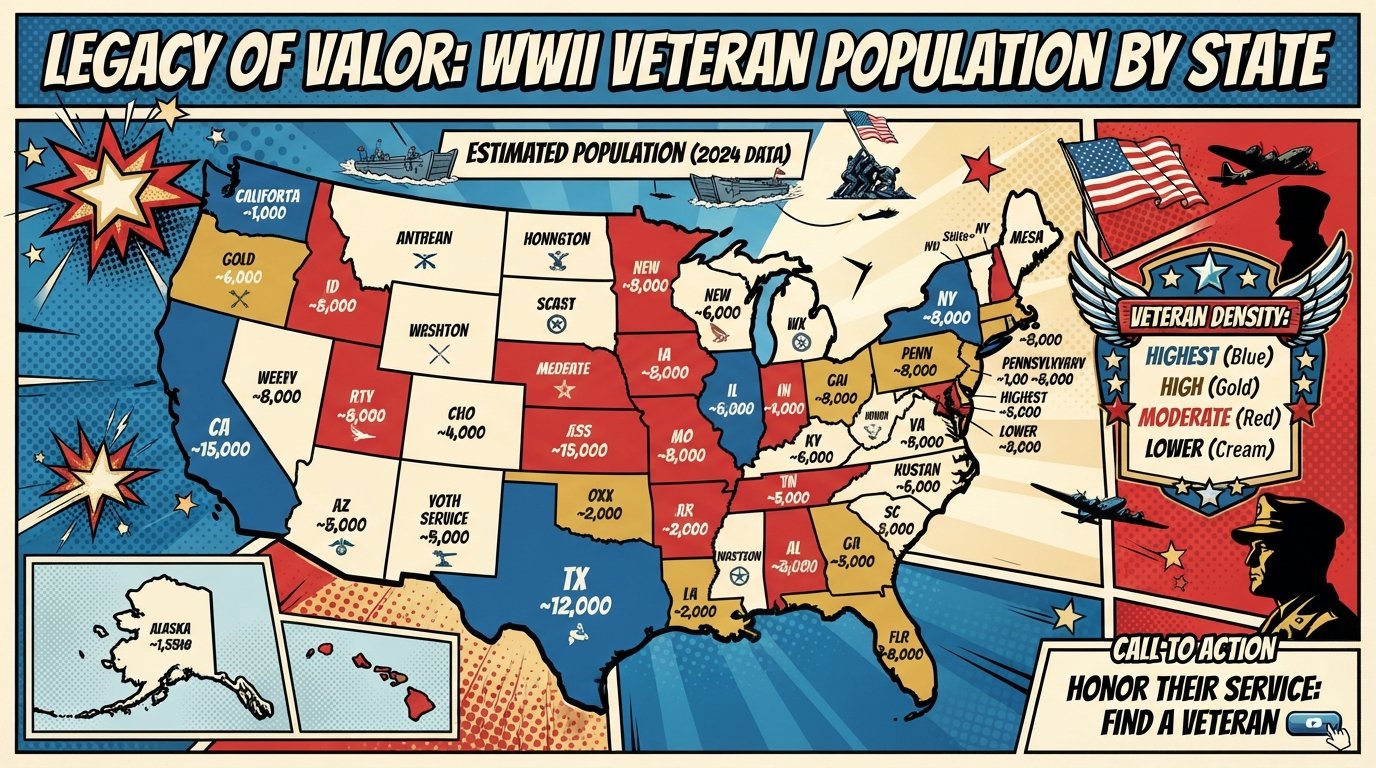
California, Florida, and Texas have the largest numbers of surviving WWII veterans, following general population patterns. California, which has the largest overall state population, also has the largest number of surviving WWII veterans. Florida has an estimated 5,511 WWII veterans residing in the state.
Top States by WWII Veteran Population
| State | Estimated WWII Veterans |
|---|---|
| California | Largest state total |
| Florida | ~5,511 |
| Texas | Second-tier concentration |
| New York | Moderate concentration |
| Pennsylvania | Moderate concentration |
The statewide distribution of veterans generally favors the largest states of Texas, California, and Florida, with Pennsylvania and New York having fewer than their relative populations would suggest. Many surviving WWII veterans relocated to warmer states after retirement, following broader migration patterns among older Americans.
State-Level Resources
Many states offer additional benefits to surviving WWII veterans, including property tax exemptions, free vehicle registration, and state veterans home priority. Contact your state’s Department of Veterans Affairs for specific programs. The VA’s “State and Local Resources” tool can also help locate benefits by ZIP code.
Age Profile of Surviving WWII Veterans
Most surviving World War II veterans are now in their mid-to-late 90s or older, with a significant number over 100. The VA states that most living veterans from the war are mid-to-late 90 years of age or older.
Age Distribution
| Age Range | Estimated Share |
|---|---|
| 97–99 | ~50% |
| 100–102 | ~35% |
| 103+ | ~15% |
The youngest WWII veterans are approximately 97–98 years old in 2026. Someone who enlisted at age 17 in 1945 would now be 98. The oldest known surviving WWII veterans are 107 or older. Of the 130 survivors interviewed for one 2026 book project, the youngest was 90 and the oldest was 103.
Common Characteristics
Surviving WWII veterans share several characteristics:
Physical resilience — Many survived combat wounds, disease, or harsh conditions during the war
Longevity factors — Many quit smoking after the war, maintained active lifestyles, and had strong social support
Diverse service backgrounds — Survivors represent every branch, every theater, and every rank
Don Halverson, a 103-year-old WWII veteran who served in the 34th Infantry “Red Bull” Division in Italy, credits his decision to quit smoking after the war for his long life. He nearly died near Anzio when an explosive shell landed just yards in front of him but failed to detonate.
WWII Veterans and VA Benefits
Surviving WWII veterans remain eligible for all VA benefits, including disability compensation, health care, pension, and burial benefits. Age does not limit eligibility for any VA benefit.
Disability Compensation
WWII veterans can file a claim for service-connected conditions using VA Form 21-526EZ. Common service-connected conditions among WWII veterans include:
Hearing loss and tinnitus
PTSD and other mental health conditions
Chronic injuries from combat or training
Conditions related to toxic exposure
The PACT Act does not directly affect most WWII veterans, as it targets post-9/11 toxic exposures and specific Vietnam-era locations. However, WWII veterans who served in areas with radiation exposure or other toxic hazards may still qualify under existing presumptive rules.
What to do next: If you are a WWII veteran or a family member of one, apply online at VA.gov using VA Form 21-526EZ. You can also file an intent to file to preserve your effective date while gathering evidence.
VA Health Care
WWII veterans are eligible for VA health care and are generally placed in a high-priority group. Veterans who receive VA compensation for a service-connected disability or are former prisoners of war are eligible for Priority Group 1 or 2. Apply online using VA Form 10-10EZ at VA.gov.
VA Pension
WWII veterans who served during the wartime period of December 7, 1941 to December 31, 1946 may qualify for Veterans Pension if they are age 65 or older or permanently disabled and have income and net worth below VA limits. The 2026 net worth limit is $163,699. Apply online using VA Form 21P-527EZ.
Burial Benefits
Surviving spouses of WWII veterans can claim burial allowances and burial in a VA national cemetery. The Veterans Administration provides a burial flag, a Presidential Memorial Certificate, and a government headstone or marker at no cost. Apply online at VA.gov.
How to Verify WWII Veteran Status
You can verify a WWII veteran’s service through several official channels. This is useful for family members applying for survivor benefits or for researchers.
Step 1: Request Military Records
The National Archives’ National Personnel Records Center (NPRC) holds most WWII military service records. You can request records online through the National Archives website or by submitting Standard Form 180 (SF-180).
Step 2: Check VA Records
If the veteran received VA benefits, VA records confirm service dates and discharge status. Family members can request records if they are the veteran’s next of kin or have written authorization.
Step 3: Use the VA’s Veteran Population Data
The VA’s Veteran Population Projection Model (VetPop2023) provides aggregate data by era of service. You can access this data through the VA’s Open Data portal at data.va.gov.
What to do next: If you need records to apply for survivor benefits, request them through the National Archives first. Allow 2–4 weeks for processing. The VA can also help locate records if you provide the veteran’s name, service number, and branch of service.
Latest Data and Research on WWII Veterans
Several organizations are working to document and preserve WWII veteran data before the population disappears entirely.
The Rishi Sharma Project
One young man has spent the last decade interviewing WWII veterans to preserve their stories. Rishi Sharma, now 28, has conducted video interviews with more than 3,000 WWII combat veterans since 2016. “For the last 10 years, I’ve been on the mission to interview every single World War II combat veteran,” he said. “And I’ve quite honestly spent every single day of the last 10 years doing that”.
National WWII Museum Census
The National WWII Museum maintains a living census of WWII veterans and provides estimates based on actuarial data. The museum has welcomed more than 13,000 WWII veterans to its campus free of charge since 2010 as part of its “$10 for Them” campaign.
VA Historical Data
The VA’s National Center for Veterans Analysis and Statistics maintains historical data on WWII veterans. The 2018 Census Bureau report found fewer than 500,000 WWII veterans were alive in 2018, down from 5.7 million in 2000. That figure dropped to 325,574 by 2020, and fewer than 240,000 by 2021.
| Year | Estimated Living WWII Veterans |
|---|---|
| 2000 | 5,700,000 |
| 2018 | ~500,000 |
| 2020 | ~325,000 |
| 2021 | ~240,000 |
| 2023 | 95,000 |
| 2025 | 45,418 |
| 2026 | 31,000–45,000 |
Common Questions
1. How many WWII veterans are still alive in 2026?
Estimates range from about 31,000 (VA projection) to 45,000 (National WWII Museum estimate). Both figures confirm that less than 0.5% of the 16.4 million Americans who served in WWII remain alive. The exact number is difficult to determine precisely due to differing methodologies.
2. How many WWII veterans die each day?
Approximately 131 WWII veterans die each day, according to estimates cited by the VA and the National WWII Museum. This means roughly 4,000 veterans pass away each month. The rate will accelerate as the population ages.
3. What is the youngest age of a living WWII veteran?
The youngest WWII veterans are approximately 97 to 98 years old in 2026. Someone who enlisted at age 17 in 1945 would now be 98. Most surviving veterans are in their late 90s or over 100.
4. When will the last WWII veteran die?
The last American WWII veteran is projected to pass away around 2043, according to VA projections. The VA estimates that within ten years, fewer than 300 total will remain. Some estimates suggest the last survivor could pass between 2035 and 2040.
5. How many Pearl Harbor survivors are still alive?
Only 11 Pearl Harbor survivors were still alive as of mid-2026. The youngest survivors of the December 7, 1941 attack are now in their late 90s. Their numbers continue to decline rapidly.
6. Can WWII veterans still apply for VA benefits?
Yes. WWII veterans remain eligible for all VA benefits, including disability compensation, health care, pension, and burial benefits. Age does not limit eligibility. Apply online at VA.gov or through an accredited VSO representative.
7. How can I verify a family member’s WWII service?
Request military records through the National Archives’ National Personnel Records Center using Standard Form 180 (SF-180). If the veteran received VA benefits, VA records can confirm service dates and discharge status. Allow 2–4 weeks for processing.
8. What VA benefits are available to surviving spouses of WWII veterans?
Surviving spouses can claim Dependency and Indemnity Compensation (DIC), Survivors Pension, burial allowances, CHAMPVA health care, and Chapter 35 education benefits. Apply online using VA Form 21P-534EZ. DIC pays $1,699.36 per month tax-free in 2026.
9. Why do different sources report different numbers of living WWII veterans?
Different organizations use different methodologies. The VA uses administrative data from benefit records. The National WWII Museum uses actuarial death rate models. These methods produce slightly different estimates, but both confirm the population is tiny and declining rapidly.
10. How has the WWII veteran population changed over time?
The WWII veteran population has declined from 5.7 million in 2000 to approximately 31,000–45,000 in 2026. That is a decline of more than 99% in just 26 years. The rate of decline accelerates as the population ages, with about 131 deaths per day in 2026.
Key Takeaways
About 31,000 to 45,000 WWII veterans remain alive in 2026, according to VA and National WWII Museum estimates.
Less than 0.5% of the 16.4 million Americans who served in WWII are still alive.
Approximately 131 WWII veterans die each day — roughly 4,000 per month.
Most surviving WWII veterans are age 97 or older, with many over 100.
The last American WWII veteran is projected to pass away around 2043.
California, Florida, and Texas have the largest concentrations of surviving WWII veterans.
Only 11 Pearl Harbor survivors remain alive as of mid-2026.
WWII veterans remain eligible for all VA benefits, including disability compensation, health care, and pension.
The population declined from 5.7 million in 2000 to under 50,000 in 2026 — a loss of more than 99%.
Surviving spouses can claim DIC, Survivors Pension, CHAMPVA, and burial benefits after a WWII veteran’s death.
Official Resources
VA.gov — Veteran Population Projection Model (VetPop2023) — Official VA veteran population data and projections
VA.gov — National Center for Veterans Analysis and Statistics — Historical and current veteran population data
National Archives — National Personnel Records Center — Request WWII military service records
National WWII Museum — Living census and historical WWII data
USA.gov — Veterans Benefits — General government benefits information
SSA.gov — Social Security survivor benefits
VA.gov — Survivor Benefits — DIC, Survivors Pension, and burial benefits



🇺🇸 IMPORTANT DISCLAIMER – Veterans Benefits Information
This site provides general information about U.S. Department of Veterans Affairs (VA) benefits for educational and informational purposes only.
- Not Official: We are NOT affiliated with, endorsed by, or connected to the U.S. Department of Veterans Affairs (VA), the Veterans Benefits Administration (VBA), the Veterans Health Administration (VHA), or any other government agency.
- No Legal/Financial Advice: The content on this website is for informational purposes only and does not constitute legal, financial, or medical advice. VA benefits rules change frequently – always consult with an accredited Veterans Service Officer (VSO) or a qualified professional for your specific situation.
- Official Sources: For official, binding information and to apply for benefits, always visit official .gov websites: VA.gov, Benefits.VA.gov, or SSA.gov.
- No Data Collection: This site does not collect, store, or process any personal information. It does not have login forms, contact forms, or any system to capture user data. We never ask for your Social Security Number, bank details, or any personal information.
- 🚨 Scam Alert: The VA and other government agencies never charge fees for benefit applications. If anyone asks for money to "process" your VA claim, it is a scam. Report it to the VA Office of Inspector General at VA.gov/OIG.
- Advertising: This site uses third-party advertising (Adsterra) to cover operational costs. We do not endorse or guarantee any products or services advertised.
📌 Information provided as of June 2026. Always verify current eligibility and rules with official .gov sources.
This site is not affiliated with the U.S. Department of Veterans Affairs or any government agency. All information is for educational purposes only. Please visit VA.gov for official information.
