
Veterans Home Care Services Alaska: The Complete 2026 Guide
Veterans in Alaska can access home care through VA programs including Homemaker and Home Health Aide Care, Veteran Directed Care, Home Based Primary Care, and Aid and Attendance. Eligibility requires enrollment in the Alaska VA Healthcare System, a clinical need for help with daily activities, and in some cases income and net worth limits. Alaska also offers Medicaid waivers and state veterans homes.
Quick Facts
| Item | Details |
|---|---|
| Benefit | Homemaker/Home Health Aide, Veteran Directed Care, Home Based Primary Care, Aid and Attendance, Respite Care, Hospice |
| Eligibility | Enrolled in Alaska VA Healthcare System; clinical need for ADL assistance; income limits for pension-based benefits |
| Application | VA Form 10-10EZ (health care enrollment); VA Form 21P-527EZ (pension); VA Form 21-2680 (A&A examination) |
| Processing Time | Health care enrollment: 1–2 weeks; Aid and Attendance: 3–6 months; VDC request: up to 14 days |
| Official Agency | U.S. Department of Veterans Affairs (VA); Alaska VA Healthcare System; Alaska Division of Senior and Disabilities Services |
| Required Forms | 10-10EZ, 21P-527EZ, 21-2680, DD-214 |
| Updated For | 2026 |
What Are Veterans Home Care Services in Alaska?
Veterans home care services in Alaska are VA-administered programs that help eligible veterans receive personal care, skilled nursing, and support services in their own homes rather than in institutional settings. Alaska veterans can access federal VA home care programs, the state’s unique Veteran Directed Care program, Medicaid home and community-based waivers, and the Alaska Veterans’ and Pioneers’ Home in Palmer.

Why it matters: Alaska home care costs average $8,580 per month, roughly 50% above the national average. Nursing home care in Alaska is even more expensive, averaging $13,250 per month for a private room. VA and Medicaid programs can significantly reduce or eliminate these costs for eligible veterans and surviving spouses.

What veterans should do next: If you are not already enrolled in VA health care, complete VA Form 10-10EZ. Then contact your Alaska VA primary care provider or VA social worker to request a clinical assessment for home care services. The Alaska VA Long Term Care Coordinator can be reached at 907-257-4863.
Who Qualifies for VA Home Care in Alaska?
You qualify for VA home care in Alaska if you served in the active military, naval, or air service, were discharged under conditions other than dishonorable, and are enrolled in the Alaska VA Healthcare System. Clinical eligibility requires a VA provider to determine that you need help with daily activities such as bathing, dressing, meal preparation, or mobility.
Basic Eligibility Requirements
Active duty service: You must have served on active duty and been discharged under conditions other than dishonorable. National Guard alone does not qualify unless activated for federal service.
VA health care enrollment: You must be enrolled at the VA and have a primary care provider assigned either at a VA clinic or through the VA with a community-based provider. If you are uncertain about your enrollment, contact the Alaska VA Eligibility Office at 907-257-4700.
Clinical need: A VA provider must assess and confirm that you need assistance with activities of daily living (ADLs) or have significant cognitive impairment.
Community care eligibility: You must qualify for VA community care under the MISSION Act criteria, or the service must be available through a VA-contracted provider.
Income limits for pension programs: Aid and Attendance benefits are need-based and have income and net worth limits. For 2026, the net worth limit is $163,699, and the primary home and vehicle are excluded from that calculation.
Who Qualifies
Veterans of any age enrolled in Alaska VA health care
Veterans with service-connected disabilities
Veterans with non-service-connected conditions who meet financial and clinical criteria
Surviving spouses (for Aid and Attendance and certain respite benefits)
Caregivers of eligible veterans (for respite care and support services)
Important: The Homemaker and Home Health Aide program is for veterans who need personal care services and help with activities of daily living. It is also for veterans who are isolated or whose caregiver is experiencing burden. Homemaker and Home Health Aide services can be used in combination with other home and community services, which may vary by location.
VA Home Care Programs Available in Alaska
Alaska veterans have access to several VA home care programs. Each serves a different purpose and has distinct eligibility requirements.
Homemaker and Home Health Aide Care
Veterans May Qualify for Extra Benefits
Check available financial assistance, healthcare programs and other opportunities that may apply to you.
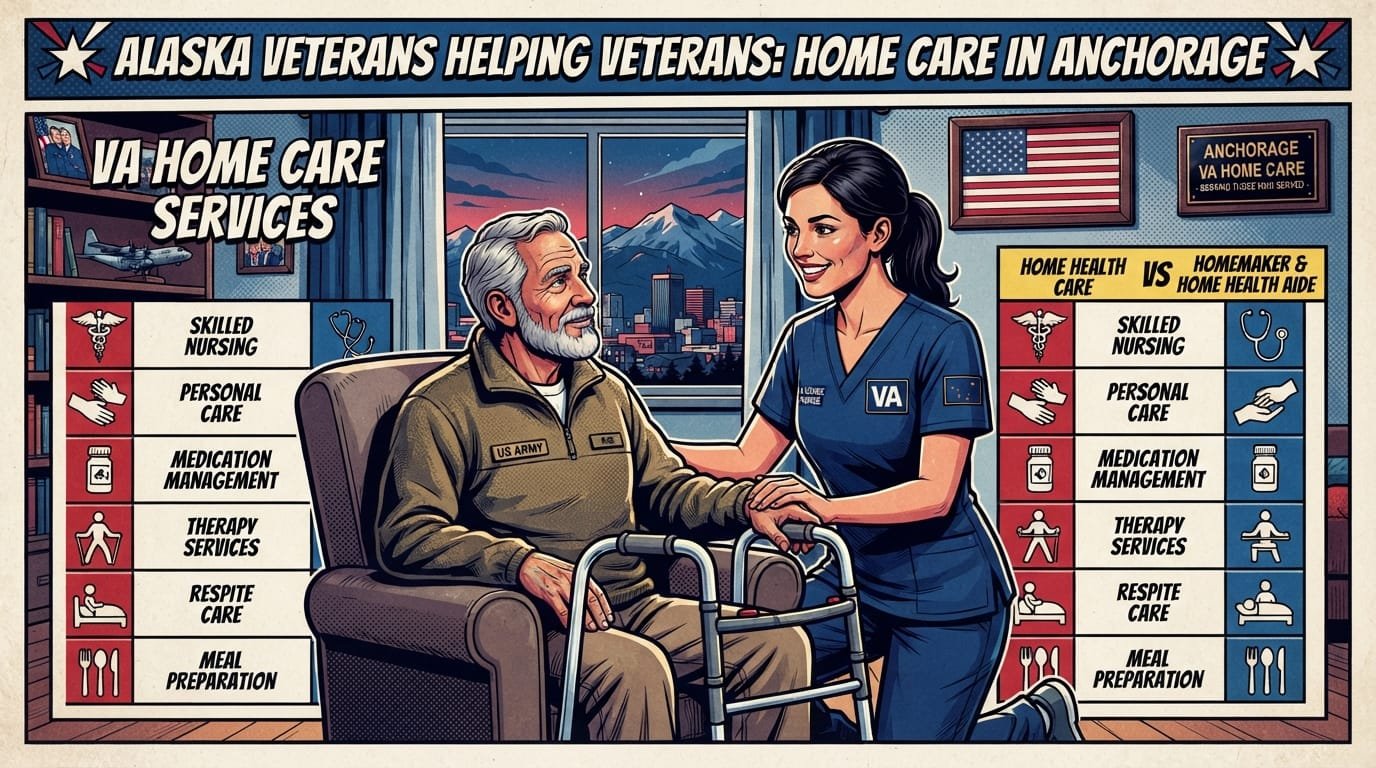
Check EligibilityThe Homemaker and Home Health Aide program pays for a caregiver from a community agency to come to a veteran’s home and help with daily activities such as bathing, dressing, transfers, toileting, personal grooming, eating, and getting to appointments. Homemakers and home health aides are not nurses, but they are trained in nurse aide level hands-on personal care and supervised by a registered nurse who assesses the veteran’s daily living needs.
Eligibility: All enrolled veterans are eligible if they meet the clinical need for the service. The veteran must require assistance with some activities of daily living or have significant cognitive impairment.
Why it matters: This program helps veterans remain living in their own home and can serve veterans of any age. It can be used as an alternative to nursing home care and to provide respite care at home for veterans and their family caregivers. The Alaska VA works with agencies in several regions of the state so they can provide this service to veterans in as many areas as possible.
What veterans should do next: Contact your Alaska VA primary care physician or social worker to discuss a referral for Homemaker/Home Health Aide services. The Alaska VA Long Term Care Coordinator is Eileen Heaston, reachable at 907-257-4863.
Veteran Directed Care (VDC)
Veteran Directed Care is a VA program that gives enrolled veterans more choice, control, and flexibility over the services they receive. It is a participant-directed alternative to the VA’s agency-based care options. The veteran directs who provides their care — including the option to hire family members, friends, or neighbors — and manages their own care budget.
Eligibility: Veterans may qualify for directed care if they are enrolled in the Alaska VA Healthcare System, have a primary care provider, can self-direct their own care, and meet clinical criteria. A community provider who believes a veteran needs home health care should submit a Request for Services (RFS) to get care authorized. VA typically has up to 14 days to review and approve this request.
Why it matters: Alaska’s VDC program was established in 2015 as a collaboration between the Alaska VA and Independent Living Centers. It supports veterans enrolled in VA health care who need hands-on assistance to remain in supportive home environments. It also provides support and respite for family and informal caregivers, allowing veterans to remain in their own homes longer by preventing the need for higher levels of care.
What veterans should do next: Contact Consumer Direct Care Alaska at 907-776-2137 or contact your local Alaska VA Medical Center to see if there is a Veteran Directed Care program in your area.
Home Based Primary Care (HBPC)
Home Based Primary Care provides comprehensive primary care in the home to veterans with complex chronic conditions. An interdisciplinary team including physicians, nurses, social workers, and rehabilitation therapists delivers care directly to the veteran’s home. The Alaska VA Healthcare System operates an HBPC program based in Anchorage.
Eligibility: HBPC is for veterans with complex medical needs who have difficulty traveling to VA clinics. A VA provider determines eligibility based on clinical criteria. The HBPC program serves veterans living within the program’s service area.
Why it matters: HBPC brings coordinated, comprehensive care to veterans who are homebound or have difficulty accessing facility-based care. It reduces hospitalizations and improves quality of life for veterans with serious chronic illnesses. The HBPC team provides case management, assessment, triage, veteran education, resource coordination, medication and treatment coordination, and care planning.
What veterans should do next: Ask your Alaska VA primary care provider for a referral to the HBPC program.
Respite Care
Respite care provides temporary in-home support so family caregivers can rest, work, or take time away. Alaska VA offers an Outpatient Respite program that provides relief services to unpaid caregivers who care for a veteran receiving VA health care. An unpaid caregiver may be a family member, friend, neighbor, or other person who provides assistance with supervision and ADLs.
Eligibility: Eligible caregivers may utilize up to 30 days of respite services per fiscal year (October 1 to September 30). One day of respite consists of up to 6 hours of services in one day.
Why it matters: Caregiver burnout is a serious concern for families caring for veterans with complex medical or emotional conditions, especially in Alaska where geographic isolation can increase caregiver stress. Respite care helps sustain caregiving relationships and keeps veterans at home longer.
What veterans should do next: Contact your Alaska VA primary care physician or social worker to discuss a referral for respite services. The Alaska VA Caregiver Support Program is available at 907-375-2606.
Community Adult Day Health Care (CADHC)
Community Adult Day Health Care programs provide assistance with personal care, social and recreational activities, and other services at contracted facilities in the community. The Alaska VA contracts with Adult Day programs located in Anchorage and Juneau.
Eligibility: Veterans must be enrolled in Alaska VA health care and have a clinical need for adult day health care services. Veterans and caregivers are requested to visit the adult day center prior to authorizing services to ensure they are willing to attend and approve of the facility.
Why it matters: Adult day health care provides socialization and structured activities for veterans while giving family caregivers a break during the day.
Hospice and Palliative Care
VA provides hospice and palliative care to veterans with terminal illnesses or serious life-limiting conditions. Care is delivered in the home, in VA facilities, or through community settings. VA is required to furnish necessary home care, palliative and hospice care, and non-institutional alternatives to nursing home care when clinically indicated.
Eligibility: Veterans must be enrolled in VA health care and meet clinical criteria for hospice or palliative care.
What veterans should do next: Contact your Alaska VA primary care provider for a hospice or palliative care referral.
Alaska VA Home Care Programs: Comparison Table
| Program | Eligible Veterans | Income Limits | Online Application |
|---|---|---|---|
| Homemaker/Home Health Aide | Enrolled in Alaska VA; clinical need for ADL assistance | No income limit for service-connected; copays may apply | VA Form 10-10EZ for enrollment; referral through VA provider |
| Veteran Directed Care | Enrolled in Alaska VA; can self-direct care; meets clinical criteria | No income limit | Request for Services (RFS) submitted by provider |
| Home Based Primary Care | Enrolled in Alaska VA; complex chronic conditions | No income limit | Referral through VA primary care |
| Aid and Attendance | Wartime veterans; surviving spouses; need assistance with daily activities | Net worth limit $163,699; income test after medical deductions | VA Form 21P-527EZ and 21-2680 |
| Respite Care | Caregivers of enrolled veterans | No income limit | Contact VA Caregiver Support at 907-375-2606 |
| Community Adult Day Health Care | Enrolled in Alaska VA; clinical need | No income limit | Referral through VA provider |
Alaska State Veterans Benefits for Home Care
Alaska Veterans’ and Pioneers’ Home (Palmer)
The Alaska Veterans’ and Pioneers’ Home in Palmer is a state-operated facility that provides assisted living, residential care, and prescription services to eligible Alaska veterans and seniors. The home is certified as an “approved” veterans’ home, which allows partial reimbursement from the Department of Veterans Affairs for the care of Alaska veterans.
Fee Structure:
| Care Level | Monthly Fee |
|---|---|
| Level I Care | $2,976 |
| Level II Care | $5,396 |
| Independent Living (estimate) | $3,518 |
Why it matters: The Palmer home offers a significantly lower-cost alternative to private assisted living facilities in Alaska, which can charge $12,000 or more per month. The VA reimbursement reduces the financial burden on veterans and their families.
What veterans should do next: Contact the Alaska Division of Pioneer Homes for admissions information. Veterans must be eligible for admission and agree to pay the applicable monthly rate.
Alaska Pioneer Homes System
The Division of Alaska Pioneer Homes provides assisted living settings and prescription services in Sitka, Fairbanks, Anchorage, Ketchikan, Palmer, and Juneau. While these homes serve seniors generally, the Palmer location has a dedicated veterans’ component.
Services include:
Housing and meals
Emergency assistance
Recreation and social activities
Prescription drug benefits
Assisted living support
Alaska Medicaid Home Care Programs for Veterans
Alaska veterans who meet Medicaid income and functional eligibility requirements may qualify for home and community-based services. These programs can be used alongside VA benefits.
Alaskans Living Independently (ALI) Waiver
The Alaskans Living Independently Waiver (formerly the Older Alaskans Waiver) provides home and community-based services to Medicaid-eligible individuals who are age 21 or older and meet a nursing home level of care.
2026 Income Limits:
Applicant income limit: $2,982 per month (300% of the Federal Benefit Rate, regardless of marital status)
When both spouses are applicants, each spouse is considered individually
ALI Services Include:
Personal care assistance (bathing, dressing, meal preparation)
Nursing and skilled therapy assessments
Home modifications (ramps, widened doorways, grab bars)
Assistive technologies and medical equipment
Adult day health care
Home-delivered meals
Caregiver respite
Environmental modifications (E-MOD)
Why it matters: In FY 2022, 2,262 Alaskans received services under the ALI Waiver at an average annual cost per beneficiary of $34,379. This program supports seniors to live in their own homes and communities at a cost equal to about 10% of the cost of a skilled nursing facility in Alaska.
What veterans should do next: Contact the Alaska Division of Senior and Disabilities Services to apply. Applications are processed based on eligibility and service availability.
Community First Choice (CFC)
Community First Choice is a Medicaid state plan option that provides personal care services to qualified Alaskan seniors and individuals with disabilities. It was implemented in October 2018.
Eligibility: Applicants must meet an institutional level of care and income eligibility requirements. They must apply and be approved for Alaska Medicaid and complete the Person-Centered Intake process through the Aging and Disability Resource Center.
CFC Services Include:
Personal care assistance with activities of daily living (ADLs) and instrumental activities of daily living (IADLs)
Health-related tasks through hands-on assistance, supervision, or cueing
Time for supervision and cuing
Skill building
Worker supervision training
Personal Emergency Response systems
Chore services
Why it matters: CFC provides an alternative to waiver programs for Medicaid-eligible veterans who need personal care services. It does not have waitlists like some waiver programs and can be accessed through the Medicaid state plan.
Nursing Facility Transition Program
The Nursing Facility and Assisted Living Home Transition Program helps families by offering support and funds to enable seniors and disabled citizens to return to independent or family living after a stay in a nursing facility or assisted living home.
Program funding can cover:
One-time home or environmental modifications
Travel costs
Room and board to bring caregivers from rural communities for training
Security deposits
Initial cleaning of a home
Basic furnishings
Transportation to the new home
Why it matters: This program helps veterans transition out of institutional care and back into their homes and communities. In FY 2022, the program helped 7 people transition from nursing facilities, with an average cost of $2,521 per person.
What veterans should do next: Contact the Centers for Independent Living (CILs) to apply. They work with the individual, discharge planner, family members, and service providers to develop a transition plan.
Alaska Medicaid vs. VA Home Care: Comparison Table
| Feature | VA Home Care | Alaska Medicaid Home Care |
|---|---|---|
| Administering Agency | U.S. Department of Veterans Affairs | Alaska Division of Senior and Disabilities Services |
| Primary Eligibility | Veterans enrolled in Alaska VA health care | Medicaid-eligible individuals age 21+ meeting nursing home level of care |
| Income Limits | No income limit for service-connected; $163,699 net worth for Aid and Attendance | $2,982/month for ALI Waiver (2026) |
| Personal Care | Yes, through Homemaker/Home Health Aide | Yes, through ALI Waiver and CFC |
| Respite Care | Up to 30 days per fiscal year | Available through waiver programs |
| Home Modifications | Limited through VA | Yes, through ALI Waiver E-MOD services |
| Family Caregiver Payment | Through Veteran Directed Care (self-directed option) | Limited; Alaska does not currently have broad self-direction options for Medicaid-funded services |
| Waitlist | No | May exist for waiver programs |
How to Apply for VA Home Care in Alaska
Applying for VA home care in Alaska involves several steps. The process begins with VA health care enrollment and a clinical assessment.
Step 1: Enroll in VA Health Care
If you are not already enrolled, complete VA Form 10-10EZ, Application for Health Benefits. You can apply online at VA.gov, by mail, or in person at the Alaska VA Healthcare System in Anchorage.
Required documents for VA Form 10-10EZ:
DD-214 or discharge papers
Social Security number
Financial information (for certain benefits)
Insurance information
Step 2: Contact Your Alaska VA Primary Care Provider
Once enrolled, schedule an appointment with your Alaska VA primary care provider. Explain that you are requesting home care services. The provider will evaluate your clinical needs and determine whether you meet the criteria for home care.
If you need to verify your enrollment or primary care provider assignment, contact the Alaska VA Eligibility Office at 907-257-4700.
Step 3: Complete a Clinical Assessment
A VA social worker, nurse, or provider will conduct a clinical assessment. The assessment evaluates your ability to perform activities of daily living, your medical conditions, your living situation, and your caregiver support. The assessment determines what services you qualify for and how many hours of care you may receive.
Step 4: Obtain a Referral
If you meet the clinical criteria, your Alaska VA provider will approve and refer you for home care services. For Homemaker/Home Health Aide services, the referral goes to the VA Community Care department or a VA-contracted home care agency.
Key Alaska VA contacts for referrals:
| Role | Name | Phone |
|---|---|---|
| Long Term Care Coordinator | Eileen Heaston | 907-257-4863 |
| Long Term Care Social Worker | Nicki Addonisio | 907-257-3728 |
| Long Term Care MSA | Lauren Gangel | 907-257-6944 |
Step 5: Select a Provider
VA works with approved home care agencies through the VA Community Care Network (CCN). Region 5 of the CCN covers Alaska, with TriWest Healthcare Alliance as the regional contractor. In Alaska, CCN-credentialed agencies include:
Comfort Keepers (Anchorage and surrounding areas)
BrightStar Care (Anchorage and Eagle River)
Home Instead (Anchorage; phone 907-277-4663)
Consumer Direct Care Alaska (Veteran Directed Care program; phone 907-776-2137)
Genacta In Home Care
Verify that your chosen agency is authorized before services begin.
Step 6: Begin Services
Once approved, the home care aide begins assisting with daily activities at home. Services are based on your assessed needs. An aide may come every day or several times a week.
Processing Times
VA health care enrollment: 1–2 weeks
Clinical assessment: 1–3 weeks after referral
Veteran Directed Care request: Up to 14 days for VA review
Homemaker/Home Health Aide authorization: Up to 5 business days after the request is received
Aid and Attendance: 3–6 months
Required VA Forms
| Form | Purpose |
|---|---|
| VA Form 10-10EZ | Application for Health Benefits (enrollment in VA health care) |
| VA Form 21P-527EZ | Application for Pension (including Aid and Attendance) |
| VA Form 21-2680 | Examination for Housebound Status or Permanent Need for Regular Aid and Attendance |
| VA Form 21-0779 | Request for Nursing Home Information in Connection with Claim for Aid and Attendance |
| VA Form 21-526EZ | Application for Disability Compensation and Related Compensation Benefits |
| DD-214 | Military discharge documentation |
Aid and Attendance 2026 Rates
VA Aid and Attendance is a need-based pension benefit that provides additional monthly payments to veterans and surviving spouses who require the aid and attendance of another person or are housebound. It is paid in addition to monthly VA pension.
2026 Aid and Attendance Rates
| Beneficiary Category | Maximum Monthly Benefit | Annual Benefit |
|---|---|---|
| Surviving Spouse | $1,558 | $18,696 |
| Married Veteran (spouse needs care) | $1,903 | — |
| Single Veteran | $2,424 | $29,088 |
| Married Veteran (with care needs) | $2,874 | $34,488 |
| Married Veterans (both with care needs) | $3,845 | $46,140 |
Net worth limit: $163,699 (effective December 1, 2025 through November 30, 2026). The primary residence and one vehicle do not count toward this figure.
Why it matters: Aid and Attendance can provide significant monthly financial assistance to help cover the cost of in-home care. It is especially important for families paying for ongoing care out of pocket, particularly in Alaska where home care costs are 50% above the national average.
What veterans should do next: Apply using VA Form 21P-527EZ (pension) and VA Form 21-2680 (examination for housebound status or permanent need for regular aid and attendance). A physician must complete the examination form documenting your need for assistance. The veteran or spouse must demonstrate the need for assistance from another individual on a regular basis or have a cognitive impairment.
Common Mistakes to Avoid
1. Not enrolling in VA health care first. Homemaker/Home Health Aide, Veteran Directed Care, and HBPC require Alaska VA health care enrollment. If you are not enrolled, apply using VA Form 10-10EZ before requesting home care services.
2. Assuming VA covers all home care. VA covers skilled, medically necessary home health services. It does not cover 24-hour custodial care or long-term care without clinical need. If you need ongoing help with daily activities, you may need Medicaid waivers or the Alaska Veterans’ Home.
3. Expecting VA to pay family caregivers through standard programs. VA does not pay family members through the Homemaker/Home Health Aide program. However, the Veteran Directed Care program allows veterans to hire family members, friends, or neighbors as caregivers.
4. Not completing the clinical assessment. The clinical assessment is required to determine eligibility and service hours. Failing to complete it delays services.
5. Missing the Aid and Attendance physician examination. VA Form 21-2680 must be completed by a physician documenting your need for aid and attendance. Without it, your claim cannot be approved.
6. Not exploring Alaska Medicaid waiver options. The Alaskans Living Independently Waiver and Community First Choice program can supplement VA benefits for veterans who meet Medicaid income limits. Many veterans who do not qualify for VA home care alone may qualify for Medicaid waivers.
7. Ignoring the Alaska Veterans’ and Pioneers’ Home. The Palmer home offers care at significantly lower costs than private facilities, with VA reimbursement available.
8. Failing to coordinate benefits. VA, Medicaid, and TRICARE may all provide home care benefits. Coordinating these programs can maximize coverage and reduce out-of-pocket costs.
9. Not knowing about the Nursing Facility Transition Program. This program provides one-time funding to help veterans return home from nursing facilities, including home modifications, furnishings, and transportation.
10. Assuming you are not eligible. Many veterans assume they do not qualify because they do not have a service-connected disability. Non-service-connected veterans may still qualify for home care based on financial need or clinical necessity.
Appeals Process
If your VA home care request or Aid and Attendance claim is denied, you have the right to appeal. VA appeals are processed through the Veterans Benefits Administration.
How to Appeal
File a Notice of Disagreement: Submit VA Form 21-0958 or a written statement within one year of the decision.
Request a Decision Review: Choose from three options: Higher-Level Review, Supplemental Claim, or Board Appeal.
Submit additional evidence: You can submit new evidence at any time during the appeals process.
Attend a hearing: If you request a Board Appeal, you may attend a hearing with a Veterans Law Judge.
Why it matters: Many claims are denied due to missing documentation or insufficient evidence. Appeals give veterans a second chance to present their case with additional medical evidence or legal representation.
What veterans should do next: Contact a VA-accredited representative, such as a Veterans Service Officer (VSO), for free assistance with your appeal. The Alaska Office of Veterans Affairs provides VSO services throughout the state.
Alaska-Specific Challenges and Solutions
Alaska’s geography presents unique challenges for veterans seeking home care. Many veterans live in remote or hard-to-reach areas where home care agencies do not operate.
Remote Area Solutions
Telehealth: The Alaska VA uses clinical video telehealth to connect veterans in remote areas with primary care providers based in Colorado, Florida, and Idaho. Home telehealth nurses monitor and manage chronically ill patients from a distance.
VA Community Care Network: Region 5 of the CCN covers all of Alaska. TriWest Healthcare Alliance administers the network and contracts with providers across the state.
Veteran Directed Care: This program allows veterans to hire caregivers in their own communities, which is especially valuable in areas where traditional home care agencies do not operate.
Travel for Care: VA may authorize travel for veterans in remote areas to receive care at the Anchorage VA Medical Center or community providers.
Caregiver Support in Alaska
The Alaska VA Caregiver Support Program provides skill development, education, and support to qualified caregivers through the Program of General Caregiver Support Services (PGCSS). The program staff is available to support family caregivers in their role and to link caregivers to VA and community support services.
Alaska VA Caregiver Support:
Phone: 907-375-2606
Location: Alaska VA HealthCare System and Regional Office, 1201 N. Muldoon Road, Anchorage, AK 99504
Latest Rule Changes Affecting Veterans Home Care in Alaska
Elizabeth Dole Home Care Act (2025)
The Senator Elizabeth Dole 21st Century Veterans Healthcare and Benefits Improvement Act was signed into law on January 2, 2025. This law significantly expands veterans’ access to home- and community-based services.
Key changes:
Increased coverage for non-institutional care: Coverage for home care alternatives increased from 65% of nursing home costs to 100%, with authority to exceed that cap for veterans with ALS or spinal cord injuries.
Expanded caregiver supports: Strengthens support for family caregivers to promote aging in place.
Increased respite care: Covers up to 30 days of inpatient or crisis residential care.
Why it matters: The Dole Act makes it easier for Alaska veterans to receive care at home instead of in nursing homes, and it expands financial support for family caregivers. Veterans who were previously denied home care due to the 65% cap may now qualify.
PACT Act (2022) and Home Care
The PACT Act expanded VA health care eligibility for veterans exposed to burn pits, Agent Orange, and other toxic substances. Veterans who became eligible for VA health care under the PACT Act are also eligible for home care programs if they meet clinical criteria. Millions of new veterans now qualify for VA health care and compensation, opening the door to home care benefits.
2026 Aid and Attendance Rate Increase
VA increased Aid and Attendance rates by 2.8% effective December 2025. Current 2026 rates are $2,424 per month for a single veteran and $2,874 for a married veteran. These rates adjust annually.
Alaska Medicaid Waiver Updates
The Alaskans Living Independently Waiver has been approved through June 30, 2026. Alaska continues to operate five waiver programs, including ALI and the Community First Choice program. The state has also implemented self-directed waiver services for veterans through the Veteran Directed Care program, which was established in 2015 as a collaboration between the Alaska VA and Independent Living Centers.
Common Questions
1. What home care services are available to veterans in Alaska?
Veterans in Alaska can access VA Homemaker and Home Health Aide Care, Veteran Directed Care, Home Based Primary Care, respite care, Community Adult Day Health Care, and hospice care. Alaska also offers the Veterans’ and Pioneers’ Home in Palmer and Medicaid waivers including the Alaskans Living Independently Waiver and Community First Choice.
2. How do I qualify for VA home care in Alaska?
You must be enrolled in the Alaska VA Healthcare System, have a primary care provider, and have a clinical need for help with daily activities or significant cognitive impairment. A VA provider must assess and confirm your need. Priority is given to veterans with service-connected disabilities, but non-service-connected veterans may also qualify.
3. What is Veteran Directed Care in Alaska?
Veteran Directed Care is a VA program that gives enrolled veterans more choice, control, and flexibility over the services they receive. It allows veterans to direct who provides their care — including the option to hire family members, friends, or neighbors — and manage their own care budget. Contact Consumer Direct Care Alaska at 907-776-2137.
4. What is VA Aid and Attendance?
Aid and Attendance is a need-based VA pension benefit that provides additional monthly payments to veterans and surviving spouses who require help with daily activities or are housebound. In 2026, eligible single veterans can receive up to $2,424 per month, and married veterans up to $2,874 per month. The net worth limit is $163,699.
5. Does VA pay for family caregivers in Alaska?
VA does not pay family members through the standard Homemaker/Home Health Aide program. However, Alaska’s Veteran Directed Care program allows veterans to hire family members, friends, or neighbors as caregivers. This is a key distinction that makes Alaska unique among states for veteran-directed care options.
6. How long does it take to get VA home care in Alaska?
VA health care enrollment takes 1–2 weeks. A clinical assessment follows within 1–3 weeks after referral. Veteran Directed Care requests are reviewed within 14 days. Homemaker/Home Health Aide authorization is typically processed within 5 business days. Aid and Attendance claims can take 3–6 months.
7. What is the difference between VA home care and Medicaid home care in Alaska?
VA home care is administered by the U.S. Department of Veterans Affairs and is available to enrolled veterans regardless of income for service-connected conditions. Alaska Medicaid home care is administered by the Division of Senior and Disabilities Services and is need-based, with income limits of $2,982 per month for the ALI Waiver. Veterans may qualify for both programs.
8. Does Alaska have a state veterans home?
Yes. The Alaska Veterans’ and Pioneers’ Home is located in Palmer. Monthly fees are $2,976 for Level I care and $5,396 for Level II care. The home is certified as an approved veterans’ home, allowing partial VA reimbursement for care of Alaska veterans.
9. What is the Alaskans Living Independently Waiver?
The ALI Waiver is Alaska’s primary Medicaid home and community-based services waiver for adults 21 and older who meet nursing home level of care criteria. It provides personal care, nursing services, home modifications, respite care, and environmental modifications. The 2026 income limit is $2,982 per month.
10. What forms do I need to apply for VA home care in Alaska?
You need VA Form 10-10EZ to enroll in Alaska VA health care. For Aid and Attendance, you need VA Form 21P-527EZ and VA Form 21-2680 (physician examination). You will also need your DD-214 and financial documentation.
11. What is the Elizabeth Dole Home Care Act?
The Elizabeth Dole Home Care Act, signed into law in January 2025, expands veterans’ access to home- and community-based services. It increases coverage for non-institutional care from 65% to 100% of nursing home costs and strengthens support for family caregivers. The law aims to help more veterans age in place.
12. Can I use VA and Medicaid home care at the same time?
It depends on your eligibility and the specific services. Some veterans are eligible for both VA and Medicaid benefits. For dual-eligible beneficiaries, other programs may provide home care, supplies, and equipment that augment VA benefits. Coordinate with both the Alaska VA and Alaska Medicaid to avoid duplication of services.
13. What is the Alaska VA Caregiver Support Program?
The Alaska VA Caregiver Support Program provides skill development, education, and support to qualified caregivers through the Program of General Caregiver Support Services (PGCSS). The program staff is available to support family caregivers in their role and link caregivers to VA and community support services. Call 907-375-2606 for more information.
14. How much does home care cost in Alaska?
Alaska home care costs average $8,580 per month, which is 50% above the national average. Nursing home care averages $13,250 per month for a private room. VA and Medicaid programs can significantly reduce these costs for eligible veterans. VA Aid and Attendance can provide up to $2,874 per month for married veterans.
15. What should I do if my VA home care claim is denied in Alaska?
If your claim is denied, you have the right to appeal. You can file a Notice of Disagreement within one year of the decision and choose from three review options: Higher-Level Review, Supplemental Claim, or Board Appeal. Contact a VA-accredited Veterans Service Officer for free assistance. The Alaska Office of Veterans Affairs provides VSO services throughout the state.
Key Takeaways
VA home care in Alaska includes Homemaker/Home Health Aide, Veteran Directed Care, Home Based Primary Care, respite, adult day health care, and hospice. Each program serves different needs and has distinct eligibility criteria.
Alaska VA health care enrollment is required for most home care programs. Apply using VA Form 10-10EZ if you are not already enrolled. The Alaska VA Eligibility Office is at 907-257-4700.
Veteran Directed Care allows Alaska veterans to hire family members, friends, or neighbors as caregivers. This is a unique option that gives veterans control over their care and is especially valuable in remote areas.
Aid and Attendance provides up to $2,424 per month for single veterans and $2,874 for married veterans in 2026. The net worth limit is $163,699, and medical expenses reduce countable income.
The Elizabeth Dole Home Care Act (2025) expanded home care coverage from 65% to 100% of nursing home costs. This makes it easier for Alaska veterans to age in place.
The Alaska Veterans’ and Pioneers’ Home in Palmer charges $2,976 per month for Level I care and $5,396 for Level II care. VA reimbursement is available for eligible veterans.
Alaska Medicaid’s Alaskans Living Independently Waiver provides home care for eligible veterans with income under $2,982 per month. It includes personal care, home modifications, respite, and environmental modifications.
Alaska home care costs average $8,580 per month, 50% above the national average. VA and Medicaid programs can significantly reduce these costs for eligible veterans.
The PACT Act expanded VA health care eligibility, opening home care benefits to millions of new veterans. Veterans exposed to burn pits or Agent Orange should apply.
Alaska VA Long Term Care Coordinator Eileen Heaston (907-257-4863) can help navigate home care options. Veterans Service Officers also provide free assistance with claims and appeals.
Official Resources
U.S. Department of Veterans Affairs: www.va.gov
VA Aid and Attendance: www.va.gov/pension/aid-attendance-housebound/
VA Caregiver Support: www.caregiver.va.gov
VA Caregiver Support Line: 1-855-260-3274
Alaska VA Healthcare System: www.va.gov/alaska-health-care/
Alaska VA Caregiver Support Program: 907-375-2606
Alaska VA Eligibility Office: 907-257-4700
Alaska VA Long Term Care Coordinator: Eileen Heaston, 907-257-4863
Alaska Office of Veterans Affairs: www.veterans.alaska.gov
Alaska Division of Senior and Disabilities Services: health.alaska.gov/dsds
Alaska Division of Pioneer Homes: dhss.alaska.gov/dph/pioneerhomes
Alaska Medicaid: health.alaska.gov/dhcs/medicaid
Consumer Direct Care Alaska (Veteran Directed Care): www.consumerdirectak.com | 907-776-2137
Medicare: www.medicare.gov
Medicaid: www.medicaid.gov


🇺🇸 IMPORTANT DISCLAIMER – Veterans Benefits Information
This site provides general information about U.S. Department of Veterans Affairs (VA) benefits for educational and informational purposes only.
- Not Official: We are NOT affiliated with, endorsed by, or connected to the U.S. Department of Veterans Affairs (VA), the Veterans Benefits Administration (VBA), the Veterans Health Administration (VHA), or any other government agency.
- No Legal/Financial Advice: The content on this website is for informational purposes only and does not constitute legal, financial, or medical advice. VA benefits rules change frequently – always consult with an accredited Veterans Service Officer (VSO) or a qualified professional for your specific situation.
- Official Sources: For official, binding information and to apply for benefits, always visit official .gov websites: VA.gov, Benefits.VA.gov, or SSA.gov.
- No Data Collection: This site does not collect, store, or process any personal information. It does not have login forms, contact forms, or any system to capture user data. We never ask for your Social Security Number, bank details, or any personal information.
- 🚨 Scam Alert: The VA and other government agencies never charge fees for benefit applications. If anyone asks for money to "process" your VA claim, it is a scam. Report it to the VA Office of Inspector General at VA.gov/OIG.
- Advertising: This site uses third-party advertising (Adsterra) to cover operational costs. We do not endorse or guarantee any products or services advertised.
📌 Information provided as of June 2026. Always verify current eligibility and rules with official .gov sources.
This site is not affiliated with the U.S. Department of Veterans Affairs or any government agency. All information is for educational purposes only. Please visit VA.gov for official information.
