
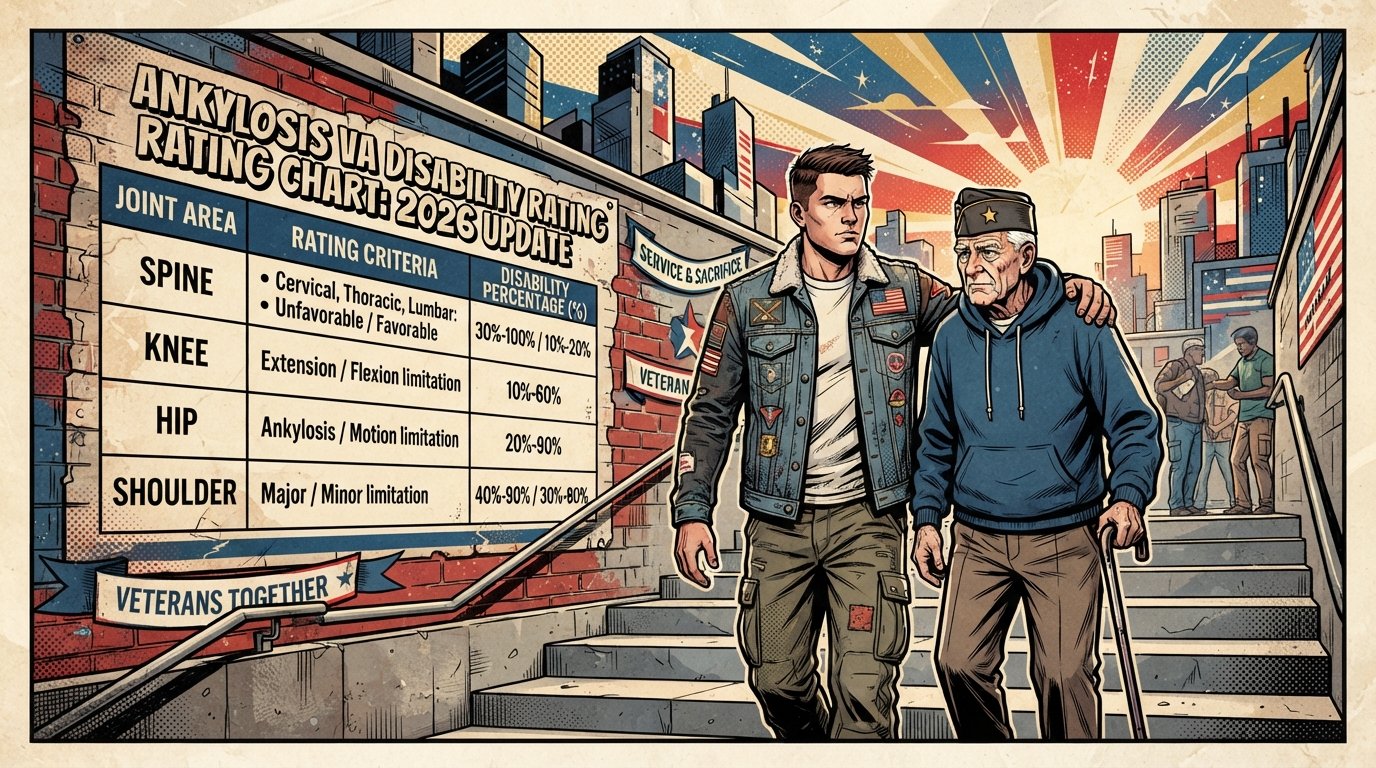
Ankylosis and VA Disability: Ratings and What Qualifies
Ankylosis is the complete immobility of a joint. VA rates it based on which joint is affected and whether the fusion is in a favorable or unfavorable position. For example, unfavorable ankylosis of the entire spine is rated 100%, while favorable ankylosis of the knee is rated 30%. Ratings range from 10% to 100%.
Quick Facts
| Item | Details |
|---|---|
| Benefit | Tax-free monthly compensation for service-connected joint immobility |
| Eligibility | Veterans with service-connected ankylosis of the spine or extremities |
| Application | VA Form 21-526EZ (online via VA.gov or by mail) |
| Processing Time | Average 75-125 days for initial claims (2026) |
| Official Agency | U.S. Department of Veterans Affairs (VA) |
| Required Forms | 21-526EZ, 21-4138 (statements), 21-686c (dependents) |
| Updated For | 2026 rates effective December 1, 2025 (2.8% COLA) |
What Is Ankylosis?
Ankylosis is the complete absence of motion in a joint, caused by disease, injury, or surgical fusion. The term comes from the Greek word “ankylos,” meaning stiff or crooked. For VA disability purposes, ankylosis is an objective finding—it means the joint is fixed and cannot move through any functional range.

This is different from limitation of motion, where the joint retains some movement but less than normal. Ankylosis is the end stage: the joint is fused, frozen, or immobile. The VA Schedule for Rating Disabilities (VASRD) treats ankylosis as one of the most severe musculoskeletal conditions because it eliminates the joint’s function entirely.

Ankylosis can result from:
Traumatic injury during military service that damages the joint surface
Surgical fusion (arthrodesis) performed to stabilize a damaged joint
Inflammatory arthritis such as ankylosing spondylitis
Infection that destroys the joint cartilage
Degenerative disease that progresses to complete immobility
How VA Rates Ankylosis
VA rates ankylosis under diagnostic codes specific to each joint in 38 CFR Part 4. The rating depends on three factors: which joint is ankylosed, the angle or position of the fusion, and whether the fusion is favorable or unfavorable for function.
A favorable ankylosis means the joint is fixed in a position that still allows some useful function. An unfavorable ankylosis means the joint is fixed in a position that severely impairs function—such as a knee fused in 25 degrees of flexion, making walking difficult.
For the spine, the distinction is even more specific. According to 38 CFR § 4.71a, Note (5): “For VA compensation purposes, unfavorable ankylosis is a condition in which the entire cervical spine, the entire thoracolumbar spine, or the entire spine is fixed in flexion or extension, and the ankylosis results in one or more of the following: difficulty walking because of a limited line of vision; restricted opening of the mouth and chewing; breathing limited to diaphragmatic respiration; gastrointestinal symptoms due to pressure of the costal margin on the abdomen; dyspnea or dysphagia; atlantoaxial or cervical subluxation or dislocation; or neurologic symptoms due to nerve root stretching.”
Veterans May Qualify for Extra Benefits
Check available financial assistance, healthcare programs and other opportunities that may apply to you.
Check EligibilityFixation of a spinal segment in a neutral position (zero degrees) always represents favorable ankylosis.
2026 VA Disability Pay Rates by Rating
The 2026 VA disability compensation rate for a veteran alone at 100% is $3,938.58 per month. This reflects a 2.8% COLA effective December 1, 2025. All VA disability compensation is tax-free at the federal level.
| Rating | Veteran Alone (Monthly) | Veteran + Spouse (Monthly) | Veteran + Spouse + 1 Child (Monthly) |
|---|---|---|---|
| 10% | $180.42 | $180.42 | $180.42 |
| 20% | $356.66 | $356.66 | $356.66 |
| 30% | $552.47 | $617.47 | $670.48 |
| 40% | $795.84 | $882.84 | $952.84 |
| 50% | $1,132.90 | $1,241.90 | $1,329.90 |
| 60% | $1,435.02 | $1,566.02 | $1,672.10 |
| 70% | $1,808.45 | $1,961.45 | $2,084.45 |
| 80% | $2,102.15 | $2,277.15 | $2,417.15 |
| 90% | $2,362.30 | $2,559.30 | $2,717.30 |
| 100% | $3,938.58 | $4,158.17 | $4,334.41 |
Dependent pay begins at 30%. To add dependents, file VA Form 21-686c.
Ankylosis of the Spine: Ratings
Spine disabilities are rated under the General Rating Formula for Diseases and Injuries of the Spine (38 CFR § 4.71a, Diagnostic Codes 5235-5243). Ankylosis of the spine produces some of the highest ratings in the VASRD because complete spinal fusion severely limits a veteran’s ability to function.
| Condition | Rating |
|---|---|
| Unfavorable ankylosis of the entire spine | 100% |
| Unfavorable ankylosis of the entire thoracolumbar spine | 50% |
| Unfavorable ankylosis of the entire cervical spine | 40% |
| Favorable ankylosis of the entire thoracolumbar spine | 40% |
| Favorable ankylosis of the entire cervical spine | 30% |
| Unfavorable ankylosis of a spinal segment (individual) | Varies |
| Favorable ankylosis of a spinal segment (individual) | Varies |
A 100% rating is warranted for unfavorable ankylosis of the entire spine. A 50% rating is warranted for unfavorable ankylosis of the entire thoracolumbar spine. A 40% rating is warranted for forward flexion of the thoracolumbar spine 30 degrees or less, or favorable ankylosis of the entire thoracolumbar spine.
For cervical spine ankylosis, a 40% rating is warranted for unfavorable ankylosis of the entire cervical spine. A 30% rating is warranted for favorable ankylosis of the entire cervical spine.
Ankylosing Spondylitis
Ankylosing spondylitis is an inflammatory disease that causes the vertebrae to fuse over time, leading to progressive spinal ankylosis. VA rates this condition under DC 5240. The rating criteria track the same ankylosis framework:
100% – Unfavorable ankylosis of the entire spine
50% – Unfavorable ankylosis of the entire thoracolumbar spine
40% – Unfavorable ankylosis of the entire cervical spine; or, favorable ankylosis of the entire thoracolumbar spine
30% – Favorable ankylosis of the entire cervical spine
10% – Symptoms such as pain, stiffness, or aching that do not meet the above criteria
Cervical Spine Ankylosis
Cervical spine ankylosis is rated as follows:
| Condition | Rating |
|---|---|
| Unfavorable ankylosis of the entire cervical spine | 40% |
| Favorable ankylosis of the entire cervical spine | 30% |
Unfavorable cervical ankylosis typically involves fixation in flexion, which limits the line of vision and makes walking difficult.
Ankylosis of the Knee: Ratings
Ankylosis of the knee is rated under Diagnostic Code 5256. The rating depends on the angle of fusion and whether it is favorable or unfavorable for walking.
| Condition | Rating |
|---|---|
| Favorable ankylosis, full extension or slight flexion (0°-10°) | 30% |
| Unfavorable ankylosis, flexion between 10° and 20° | 40% |
| Unfavorable ankylosis, flexion between 20° and 30° | 50% |
| Extremely unfavorable ankylosis, flexion beyond 30° | 60% |
Diagnostic Code 5256 provides ratings for ankylosis of the knee. Favorable ankylosis of the knee, with angle in full extension, or in slight flexion between zero degrees and 10 degrees, is rated 30 percent disabling. Unfavorable ankylosis of the knee, in flexion between 10 degrees and 20 degrees, is to be rated 40 percent disabling.
A 60 percent rating is warranted for extremely unfavorable ankylosis, with flexion beyond 30 degrees.
Ankylosis of the Hip: Ratings
Ankylosis of the hip is rated under Diagnostic Code 5250. Hip ankylosis ratings are among the highest in the VASRD for joint conditions because hip mobility is essential for walking, sitting, and most daily activities.
| Condition | Rating |
|---|---|
| Favorable ankylosis, flexion 20°-40° with slight adduction/abduction | 60% |
| Intermediate ankylosis | 70% |
| Unfavorable/extremely unfavorable, foot not reaching ground, crutches needed | 90% |
Diagnostic Code 5250 evaluates ankylosis of the hip. A 60 percent evaluation may be assigned for favorable ankylosis in flexion at an angle between 20 and 40 degrees with slight adduction or abduction. A higher 70 percent rating is warranted for intermediate ankylosis of the hip, while a maximum 90 percent rating is assigned for unfavorable or extremely unfavorable ankylosis, the foot not reaching the ground and crutches necessitated.
Ankylosis of the Shoulder: Ratings
Ankylosis of the scapulohumeral (shoulder) articulation is rated under Diagnostic Code 5200. Ratings are higher for the major (dominant) arm than the minor arm.
| Condition | Major Arm | Minor Arm |
|---|---|---|
| Favorable, abduction to 60°, can reach mouth/head | 30% | 20% |
| Intermediate between favorable and unfavorable | 40% | 30% |
| Unfavorable, abduction limited to 25° from body side | 50% | 40% |
Ankylosis of scapulohumeral articulation is evaluated as 50 percent disabling on the major side and 40 percent disabling on the minor side when unfavorable, that is, abduction limited to 25° from the body side.
A 30 percent disability rating is warranted when there is favorable ankylosis of the major upper extremity with abduction to 60 degrees and the ability to reach the mouth and head.
Ankylosis of the Elbow: Ratings
Elbow ankylosis is rated under Diagnostic Code 5205. The rating depends on the angle of fusion and the position of the forearm.
| Condition | Major Arm | Minor Arm |
|---|---|---|
| Favorable, flexion to 50° or more | 50% | 40% |
| Intermediate | 60% | 50% |
| Unfavorable, flexion less than 50° | 70% | 60% |
Ankylosis of the Wrist: Ratings
Wrist ankylosis is rated under Diagnostic Code 5214. The rating depends on the position of fusion and whether it is favorable or unfavorable.
| Condition | Major Arm | Minor Arm |
|---|---|---|
| Favorable, in dorsiflexion 0°-20° | 30% | 20% |
| Unfavorable, in extension or flexion beyond favorable position | 40% | 30% |
Under DC 5214, ankylosis of the wrist in dorsiflexion between zero and 20 degrees is rated as favorable. Fusion in flexion beyond that range, or in extension, is rated as unfavorable.
Ankylosis of the Ankle: Ratings
Ankle ankylosis is rated under Diagnostic Code 5270. The rating depends on the angle of plantar flexion or dorsiflexion.
| Condition | Rating |
|---|---|
| Favorable, plantar flexion less than 30° | 20% |
| Intermediate, plantar flexion 30°-40° or dorsiflexion 0°-10° | 30% |
| Unfavorable, plantar flexion more than 40° or dorsiflexion more than 10° | 40% |
Under DC 5270, a 20 percent rating is assigned for ankylosis of the ankle in plantar flexion less than 30 degrees. A 30 percent rating is warranted for plantar flexion between 30 and 40 degrees, or dorsiflexion between zero and 10 degrees. A 40 percent rating is assigned for plantar flexion more than 40 degrees, or dorsiflexion more than 10 degrees, or with deformity.
Ankylosis of the Fingers and Hand
Ankylosis of the digits is rated under DCs 5216-5223. The ratings distinguish between favorable and unfavorable ankylosis of multiple digits.
| Condition | Major Hand | Minor Hand |
|---|---|---|
| Five digits, unfavorable ankylosis | 60% | 50% |
| Four digits, unfavorable ankylosis | 50% | 40% |
| Three digits, unfavorable ankylosis | 40% | 30% |
| Two digits, unfavorable ankylosis | 30% | 20% |
| One digit, unfavorable ankylosis | 20% | 10% |
| Five digits, favorable ankylosis | 50% | 40% |
| Four digits, favorable ankylosis | 40% | 30% |
| Three digits, favorable ankylosis | 30% | 20% |
Amputation of the thumb at or distal to the interphalangeal joint is graded as unfavorable ankylosis (grade value 2) for rating purposes.
Favorable vs. Unfavorable Ankylosis: What’s the Difference?
Favorable ankylosis means the joint is fixed in a position that preserves some useful function. Unfavorable ankylosis means the joint is fixed in a position that significantly impairs function.
For the knee, a favorable fusion is in full extension or slight flexion (0°-10°), allowing the veteran to stand and walk with minimal difficulty. An unfavorable fusion is in greater flexion, which forces the veteran to walk with a limp or use assistive devices.
For the spine, the distinction is more complex. A spine fused in a neutral position (zero degrees) is always considered favorable. A spine fused in flexion or extension—particularly when it causes difficulty walking, restricted mouth opening, breathing limitations, or gastrointestinal symptoms—is considered unfavorable.
How to Apply for Ankylosis VA Disability
Step 1: Gather evidence. Collect service treatment records, surgical reports documenting fusion, imaging studies (X-rays, MRIs, CT scans), and private medical records.
Step 2: File VA Form 21-526EZ. Submit online through VA.gov, by mail, or in person at a VA regional office. This is the Application for Disability Compensation.
Step 3: Attend your C&P exam. VA will schedule a Compensation and Pension examination. The examiner will measure your joint’s range of motion using a goniometer and document the ankylosis.
Step 4: Submit lay statements. File VA Form 21-4138 with statements from yourself, family members, or coworkers describing how the ankylosis affects your daily life and employment.
Step 5: Add dependents. File VA Form 21-686c to claim a spouse, children, or dependent parents.
Required Documents for Ankylosis Claims
Service treatment records showing the injury or disease that caused the ankylosis
Surgical reports documenting joint fusion (arthrodesis)
Imaging studies (X-rays, CT scans, MRIs) showing the fused joint
Private medical records from treating physicians
Lay statements describing functional limitations
Employment records if claiming TDIU due to ankylosis
Common Mistakes in Ankylosis Claims
Not documenting the angle of fusion. The rating for many joints depends on the precise angle of ankylosis. Ensure your C&P exam includes goniometer measurements.
Confusing ankylosis with limitation of motion. Ankylosis is complete immobility. If your joint retains some motion, it is rated as limitation of motion, not ankylosis.
Failing to claim secondary conditions. Ankylosis in one joint often causes compensatory strain in adjacent joints. These secondary conditions are separately ratable.
Not appealing within one year. You have one year from the decision date to file a Notice of Disagreement or request a Higher-Level Review. Filing within one year preserves your effective date for back pay.
Appeals Process for Ankylosis Ratings
If VA denies your ankylosis claim or assigns a lower rating than expected, you have three review options:
| Appeal Type | Form | New Evidence? | Average Time |
|---|---|---|---|
| Supplemental Claim | 20-0995 | Yes | 60-125 days |
| Higher-Level Review | 20-0996 | No | 125-150 days |
| Board Appeal | 10182 | Depends on docket | 212-870 days |
Supplemental Claim: For submitting new and relevant evidence, such as an independent medical examination or updated imaging.
Higher-Level Review: A senior reviewer reexamines the decision based on the existing record. No new evidence is allowed.
Board Appeal: A Veterans Law Judge reviews your case. You can choose the Direct Docket (no new evidence), Evidence Submission Docket, or Hearing Docket.
Common Questions
What is ankylosis in VA disability?
Ankylosis is the complete immobility of a joint due to disease, injury, or surgical fusion. VA rates it based on the joint affected and whether the fusion is in a favorable or unfavorable position for function.
What is the difference between favorable and unfavorable ankylosis?
Favorable ankylosis means the joint is fixed in a position that preserves some useful function. Unfavorable ankylosis means the joint is fixed in a position that significantly impairs function, such as a knee fused in 25 degrees of flexion.
How does VA rate ankylosis of the spine?
Unfavorable ankylosis of the entire spine is rated 100%. Unfavorable ankylosis of the entire thoracolumbar spine is rated 50%. Favorable ankylosis of the entire thoracolumbar spine is rated 40%.
Can I get 100% VA disability for ankylosis?
Yes. Unfavorable ankylosis of the entire spine warrants a 100% rating. Extremely unfavorable ankylosis of the hip warrants a 90% rating. These are among the highest ratings available for musculoskeletal conditions.
What is the VA rating for knee ankylosis?
Favorable ankylosis of the knee (0°-10° flexion) is rated 30%. Unfavorable ankylosis in 10°-20° flexion is rated 40%. Flexion between 20°-30° is rated 50%, and beyond 30° is rated 60%.
What is the VA rating for hip ankylosis?
Favorable ankylosis of the hip in 20°-40° flexion with slight adduction or abduction is rated 60%. Intermediate ankylosis is rated 70%. Unfavorable ankylosis with the foot not reaching the ground and crutches necessitated is rated 90%.
What is the VA rating for shoulder ankylosis?
Unfavorable ankylosis of the shoulder (abduction limited to 25°) is rated 50% for the major arm and 40% for the minor arm. Favorable ankylosis (abduction to 60°, can reach mouth/head) is rated 30% for the major arm.
How do I prove ankylosis for a VA claim?
You need medical evidence showing the joint is completely immobile. This includes imaging studies, surgical reports documenting fusion, and a C&P exam with goniometer measurements showing zero range of motion.
Can ankylosis be rated as a secondary condition?
Yes. If ankylosis develops in a joint due to compensating for a service-connected condition in another joint, it can be rated as a secondary condition. For example, knee ankylosis may cause hip or ankle strain that is separately ratable.
What is the minimum rating for ankylosis?
The minimum rating for ankylosis is typically 10%, which applies to favorable ankylosis of a single minor digit. Most ankylosis ratings for major joints range from 20% to 90%.
Does ankylosis qualify for TDIU?
Ankylosis alone may not meet the schedular requirements for TDIU, but when combined with other service-connected conditions, it can contribute to a combined rating of 70% or higher with one condition at 40%, qualifying for TDIU.
What is ankylosing spondylitis and how does VA rate it?
Ankylosing spondylitis is an inflammatory disease that causes spinal fusion. VA rates it under DC 5240 using the same ankylosis framework: 100% for unfavorable ankylosis of the entire spine, 50% for unfavorable thoracolumbar ankylosis, and lower ratings for less severe involvement.
Key Takeaways
Ankylosis is complete joint immobility, rated by joint and position under the VASRD.
Unfavorable ankylosis of the entire spine warrants a 100% rating, the highest available for musculoskeletal conditions.
Knee ankylosis ranges from 30% (favorable) to 60% (extremely unfavorable).
Hip ankylosis ranges from 60% (favorable) to 90% (extremely unfavorable, foot not reaching ground).
Shoulder ankylosis ranges from 30% to 50% for the major arm, depending on position.
Favorable ankylosis means the joint is fused in a functional position; unfavorable means it is fused in a position that impairs function.
The 2026 rate for a single veteran at 100% is $3,938.58 per month, tax-free.
Evidence requires imaging studies, surgical reports, and C&P exam measurements showing zero range of motion.
Appeals options include Supplemental Claim, Higher-Level Review, and Board Appeal.
Ankylosis in one joint can cause secondary conditions in adjacent joints that are separately ratable.
Official Resources
VA Disability Compensation: va.gov/disability
VA Compensation Rate Tables: va.gov/disability/compensation-rates
VA Decision Reviews and Appeals: va.gov/decision-reviews
VA Schedule for Rating Disabilities (VASRD): ecfr.gov
VA Health Care: va.gov/health-care






🇺🇸 IMPORTANT DISCLAIMER – Veterans Benefits Information
This site provides general information about U.S. Department of Veterans Affairs (VA) benefits for educational and informational purposes only.
- Not Official: We are NOT affiliated with, endorsed by, or connected to the U.S. Department of Veterans Affairs (VA), the Veterans Benefits Administration (VBA), the Veterans Health Administration (VHA), or any other government agency.
- No Legal/Financial Advice: The content on this website is for informational purposes only and does not constitute legal, financial, or medical advice. VA benefits rules change frequently – always consult with an accredited Veterans Service Officer (VSO) or a qualified professional for your specific situation.
- Official Sources: For official, binding information and to apply for benefits, always visit official .gov websites: VA.gov, Benefits.VA.gov, or SSA.gov.
- No Data Collection: This site does not collect, store, or process any personal information. It does not have login forms, contact forms, or any system to capture user data. We never ask for your Social Security Number, bank details, or any personal information.
- 🚨 Scam Alert: The VA and other government agencies never charge fees for benefit applications. If anyone asks for money to "process" your VA claim, it is a scam. Report it to the VA Office of Inspector General at VA.gov/OIG.
- Advertising: This site uses third-party advertising (Adsterra) to cover operational costs. We do not endorse or guarantee any products or services advertised.
📌 Information provided as of June 2026. Always verify current eligibility and rules with official .gov sources.
This site is not affiliated with the U.S. Department of Veterans Affairs or any government agency. All information is for educational purposes only. Please visit VA.gov for official information.
