

VA Disability Percentages for Conditions: Complete 2026 Rating Guide
VA disability percentages represent the average impairment in earning capacity caused by a service-connected condition. Ratings are assigned in 10% increments from 0% to 100% under the VA Schedule for Rating Disabilities (VASRD) at 38 CFR Part 4. The percentage determines your monthly tax-free compensation.
Quick Facts What Are VA Disability Percentages for Conditions?
| Item | Details |
|---|---|
| Benefit | Tax-free monthly VA disability compensation |
| Eligibility | Veterans with service-connected conditions |
| Application | VA Form 21-526EZ |
| Processing Time | 100-200+ days depending on complexity |
| Official Agency | U.S. Department of Veterans Affairs |
| Required Forms | VA Form 21-526EZ; DBQs for specific conditions |
| Updated For | 2026 |
How VA Disability Ratings Work
VA assigns disability ratings using the VA Schedule for Rating Disabilities (VASRD), codified at 38 CFR Part 4. Each condition has a diagnostic code with specific criteria for each rating level. The rating reflects the average impairment in earning capacity caused by your condition—not how bad it feels on your worst days, though symptom severity is heavily weighted.

Ratings are assigned in increments: 0%, 10%, 20%, 30%, 40%, 50%, 60%, 70%, 80%, 90%, and 100%. A 0% rating means service connection is established but the condition isn’t currently disabling enough to warrant compensation. It still matters—it establishes the service connection foundation you can build on later.
The Rating Is Based on Symptoms, Not Diagnosis

Two Veterans with the same diagnosis can receive very different ratings based on symptom severity. A Veteran with PTSD who can function at work with medication might receive a 50% rating. A Veteran with PTSD who cannot maintain employment and has severe social isolation might receive 70% or 100%. The diagnosis opens the door; the symptoms determine the rating.
Your “Worst Days” Are What Matter
Under VA regulations, raters are supposed to consider the full picture of your condition—including how it affects you during flare-ups, not just your average day. This is especially important for conditions with intermittent symptoms like PTSD, migraines, IBS, and back pain. Document your worst episodes in detail.
2026 VA Disability Compensation Rates
Effective December 1, 2025, VA disability compensation rates increased by 2.8% for 2026. The following table shows monthly rates for a single Veteran with no dependents:
| Disability Rating | 2026 Monthly Payment |
|---|---|
| 10% | $180.42 |
| 20% | $356.66 |
| 30% | $552.47 |
| 40% | $795.84 |
| 50% | $1,132.90 |
| 60% | $1,435.02 |
| 70% | $1,808.45 |
| 80% | $2,102.15 |
| 90% | $2,362.30 |
| 100% | $3,938.58 |
Veterans with dependent spouses, children, or parents may receive higher rates at the 30% level and above.
Compensation Rates with Dependents (Selected)
| Rating | Veteran with Spouse | Veteran with Spouse + 1 Child |
|---|---|---|
| 30% | $617.47 | $665.47 |
| 50% | $1,241.90 | $1,318.90 |
| 70% | $1,961.45 | $2,081.45 |
| 100% | $4,158.17 | $4,314.17 |
Veterans May Qualify for Extra Benefits
Check available financial assistance, healthcare programs and other opportunities that may apply to you.
Check EligibilityFor complete rate tables, visit VA.gov/disability/compensation-rates[reference:6].
VA Disability Ratings by Condition
Mental Health Conditions
Mental health conditions are rated under a General Rating Formula for Mental Disorders (38 CFR § 4.130). All mental health diagnoses—PTSD, depression, anxiety, bipolar disorder—are rated on the same scale based on occupational and social impairment.
| Condition | Typical Rating Range | Key Factors |
|---|---|---|
| PTSD | 0% – 100% | Occupational/social impairment, frequency of symptoms, ability to work |
| Major Depressive Disorder | 0% – 100% | Same general formula as PTSD; severity of depressive episodes |
| Generalized Anxiety Disorder | 0% – 70% | Panic attacks, social functioning, work performance |
| Bipolar Disorder | 10% – 100% | Frequency of manic/depressive episodes, hospitalization history |
| Schizophrenia | 30% – 100% | Psychotic symptoms, ability to care for self, hospitalization |
| TBI (Traumatic Brain Injury) | 0% – 100% | Cognitive deficits, behavioral changes, memory loss, headaches |
PTSD Rating Criteria
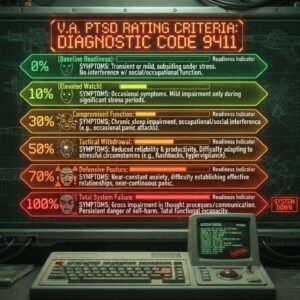
PTSD is rated under Diagnostic Code 9411 using the General Rating Formula for Mental Disorders. Ratings are assigned at 0%, 10%, 30%, 50%, 70%, or 100% based on how much PTSD impairs occupational and social functioning.
0%: Diagnosis confirmed but no impairment of social/occupational function
10%: Mild or transient symptoms controlled by medication
30%: Occasional decrease in work efficiency; panic attacks weekly or less often
50%: Reduced reliability and productivity; panic attacks more than once a week; memory impairment
70%: Deficiencies in most areas; suicidal ideation; near-continuous panic
100%: Total occupational and social impairment; persistent delusions or hallucinations
TBI Rating Criteria
TBI is rated under Diagnostic Code 8045 at 0%, 10%, 40%, 70%, or 100% based on lasting effects across three areas: cognitive, emotional/behavioral, and physical.
10%: Mild impairment of memory, attention, concentration, or executive functions
40%: Moderate impairment affecting work and social functioning
70%: Severe impairment requiring supervision or assistance
100%: Total impairment; need for daily care
Musculoskeletal Conditions
Musculoskeletal conditions are the most commonly claimed VA disabilities. Ratings depend on range of motion, functional loss, and painful motion.
| Condition | Diagnostic Code | Typical Rating Range |
|---|---|---|
| Knee – Limitation of Flexion | 5260 | 0% – 30% |
| Knee – Instability | 5257 | 10% – 20% |
| Knee – Ankylosis | 5256 | 30% – 60% |
| Shoulder – Limitation of Motion | 5201 | 0% – 40% |
| Lumbar Spine (Back) – Limitation of Motion | 5237 | 10% – 100% |
| Cervical Spine (Neck) – Limitation of Motion | 5237 | 10% – 100% |
Back (Spine) Rating Criteria
The spine is rated under Diagnostic Codes 5235-5243. A 40% rating applies when forward flexion is limited to 30 degrees or less. A 20% rating applies when forward flexion is limited between 30 and 60 degrees. Incapacitating episodes (bed rest prescribed by a physician) can also factor into the rating.
Knee and Shoulder Rating Criteria
Knee and shoulder conditions are rated based on limitation of motion, instability, and painful motion. A 10% rating is assigned for each major joint affected by limitation of motion. The shoulder and knee are considered major joints.
Hearing Loss and Tinnitus
| Condition | Diagnostic Code | Maximum Rating |
|---|---|---|
| Tinnitus | 6260 | 10% |
| Hearing Loss | 6100 | 0% – 100% |
Tinnitus Rating
Tinnitus is rated at a maximum of 10% under Diagnostic Code 6260. Only one 10% rating is allowed, whether tinnitus affects one ear or both ears. There is no legal basis for a schedular rating above 10% for tinnitus.
Hearing Loss Rating
Hearing loss is rated using two medical tests: the Maryland CNC Test and the Puretone Audiometric Test. Ratings range from 0% to 100% based on the severity of hearing impairment in each ear.
Sleep Apnea
Sleep apnea is rated under Diagnostic Code 6847 at 0%, 30%, 50%, or 100%. A 50% rating applies when a Veteran requires use of a breathing assistance device such as a CPAP machine.
| Rating | Criteria |
|---|---|
| 0% | Asymptomatic |
| 30% | Persistent daytime hypersomnolence |
| 50% | Requires CPAP or other breathing assistance device |
| 100% | Chronic respiratory failure with carbon dioxide retention |
Diabetes and Neuropathy
Type II diabetes is rated under Diagnostic Code 7913 based on the level of management required:
| Rating | Criteria |
|---|---|
| 10% | Manageable by restricted diet only |
| 20% | Requires oral medication or insulin |
| 40% | Requires regulation of activities and insulin |
| 60% | Requires insulin and restricted diet, with episodes of ketoacidosis or hypoglycemia |
Diabetic peripheral neuropathy is rated separately under Diagnostic Codes 8520-8521. Ratings range from 10% (mild incomplete paralysis) to 80% (complete paralysis).
Cardiovascular Conditions
| Condition | Diagnostic Code | Typical Rating Range |
|---|---|---|
| Hypertension | 7101 | 10% – 60% |
| Coronary Artery Disease | 7005 | 10% – 100% |
| Arrhythmias | 7010-7015 | 10% – 100% |
| Heart Failure | 7020 | 30% – 100% |
Respiratory Conditions
| Condition | Diagnostic Code | Typical Rating Range |
|---|---|---|
| Asthma | 6602 | 10% – 100% |
| COPD | 6604 | 10% – 100% |
| Sleep Apnea | 6847 | 0% – 100% |
Skin Conditions
| Condition | Diagnostic Code | Typical Rating Range |
|---|---|---|
| Eczema | 7806 | 0% – 60% |
| Psoriasis | 7816 | 0% – 60% |
| Scars | 7801-7804 | 0% – 80% |
Cancer Ratings
Cancer ratings depend on the type, stage, and treatment status. Many cancers receive a 100% rating during active treatment. After treatment ends, VA reevaluates based on residuals. For example, Non-Hodgkin’s lymphoma receives a 100% rating during active disease or treatment phase.
Infectious Diseases
| Condition | Diagnostic Code | Typical Rating Range |
|---|---|---|
| HIV | 7917 | 10% – 100% |
| Hepatitis C | 7345 | 10% – 100% |
| Tuberculosis | 6730 | 0% – 100% |
How VA Combines Multiple Ratings (VA Math)
VA does not simply add disability percentages together. It uses a combined rating formula—often called “VA math”—based on the whole person method. The first (highest) rating is subtracted from 100%, then the next rating is applied to the remaining percentage, and so on.
Example: Three Conditions
A Veteran has:
Back injury: 30%
Knee injury: 20%
Shoulder injury: 10%
Step 1: Start with 100% – 30% = 70% remaining
Step 2: 20% of 70% = 14%; 70% – 14% = 56% remaining
Step 3: 10% of 56% = 5.6%; 56% – 5.6% = 50.4% remaining
Step 4: Round to nearest 10% = 50% combined rating
Bilateral Factor
When disabilities affect both sides of the body (both knees, both shoulders, etc.), VA applies a bilateral factor. The bilateral disabilities are combined first, then 10% is added to that combined value. The result is then combined with other disabilities.
Combined Rating Table (Selected Combinations)
| Combined Ratings | Result |
|---|---|
| 50% + 30% | 65% → rounds to 70% |
| 70% + 50% | 85% → rounds to 90% |
| 70% + 40% | 82% → rounds to 80% |
| 90% + 50% | 95% → rounds to 100% |
How to Apply for a VA Disability Rating
Step-by-Step Process
Gather your evidence: DD-214, medical records, nexus letters, buddy statements
Complete VA Form 21-526EZ: Application for Disability Compensation
Submit supporting documents: Medical records, DBQs, lay statements
Attend your C&P exam: VA will schedule a Compensation and Pension examination
Receive your decision: VA will assign a rating for each condition
Review your combined rating: Understand how individual ratings combine
Required Documents
DD-214 or separation documents
Current diagnosis from a qualified provider
Medical records showing symptom severity
Nexus letter linking condition to military service
Lay statements from family, friends, or coworkers
Completed Disability Benefits Questionnaires (DBQs) for each condition
Online Application
Apply online at VA.gov using VA Form 21-526EZ. Upload supporting documents directly to your claim.
Processing Times
| Claim Type | Typical Processing Time |
|---|---|
| Initial claim | 100-200 days |
| Rating increase | 100-150 days |
| Appeal (Supplemental Claim) | 125-200 days |
| Appeal (Board) | 1-3 years |
Payment Dates
VA disability compensation is paid on the first business day of each month. If the first falls on a weekend or holiday, payment arrives the preceding business day.
Proposed 2026 Changes to the VA Rating Schedule
VA has proposed or implemented several changes affecting disability ratings in 2026. These changes are complex and remain in various stages of implementation.
Medication Evaluation Rule (Effective February 17, 2026)
VA published an interim final rule amending 38 CFR 4.10 within the VASRD. The rule clarifies that Veterans should be compensated for the actual level of functional impairment they experience, and that the ameliorative effects of medication should not be estimated or discounted when evaluating severity at the time of the disability examination.
What this means: VA examiners cannot reduce a rating based on what your condition might be like if you were not taking medication. They must evaluate your condition as it actually exists.
Critics argue this rule could lead to lower ratings for Veterans whose symptoms are controlled by medication. Veterans’ organizations including the VFW and lawmakers have raised concerns.
Mental Health Rating Changes (Proposed February 2022, Not Final)
VA proposed replacing the current occupational and social impairment language for mental health conditions with a five-domain functional assessment:
Cognition
Relationships
Task completion
Navigating environments
Self-care
The 0% rating would be eliminated, with every service-connected condition starting at 10%. As of December 2025, these changes have not been finalized.
Sleep Apnea Rating Changes (Proposed, Not Final)
Under proposed changes, Veterans could receive a 0% rating for asymptomatic sleep apnea. The current 50% automatic rating for CPAP use would be revised.
Rating Schedule Modernization
VA has updated medical information for 11 of 15 body systems. The remaining four systems—mental disorders, respiratory, auditory, and neurological—are planned for updates in fiscal year 2026.
Common Mistakes That Hurt VA Claims
Presenting your best self at the C&P exam: The examiner evaluates your worst days, not your best. Be honest about your struggles.
Not filing for secondary conditions: Sleep apnea, IBS, migraines, and hypertension secondary to a primary condition can significantly increase your combined rating.
Assuming a 50% rating is “good enough”: If your symptoms meet 70% or 100% criteria, file for an increase.
Missing the appeal deadline: You have one year from the decision letter to file a Notice of Disagreement.
Not submitting lay statements: Buddy statements from family and friends are powerful evidence.
Downplaying symptoms: Many Veterans minimize symptoms due to pride or stigma. This hurts your claim.
Not documenting medication side effects: Sedation, weight gain, and emotional numbness affect functioning and should be documented.
Filing without a current diagnosis: You need a diagnosis from a qualified provider for each claimed condition.
Not appealing a 0% rating: A 0% rating is service connected but not compensable. If symptoms persist, appeal or file for an increase.
Waiting too long to file: Back pay is limited to the date you filed or up to one year before if you file within one year of an informal claim.
Appeals Process for VA Rating Decisions
If VA denies your claim or assigns a lower rating than you believe you deserve, you have three appeal options under the Appeals Modernization Act.
Three Review Options
Supplemental Claim (VA Form 20-0995): Submit new and relevant evidence for a new decision
Higher-Level Review (VA Form 20-0996): Request a senior reviewer to examine your case based on existing evidence
Board Appeal (VA Form 10182): Appeal directly to the Board of Veterans’ Appeals
Deadlines
One year from the date of a VA decision letter to file a Notice of Disagreement
60 days for Board of Veterans’ Appeals decisions
Getting Help
Accredited Veterans Service Organizations (VSOs) provide free representation. Options include the DAV, VFW, American Legion, and state/county Veterans service officers.
Common Questions
What is the VA disability rating for PTSD?
VA rates PTSD under 38 CFR § 4.130, Diagnostic Code 9411, at 0%, 10%, 30%, 50%, 70%, or 100%. The rating depends on how much PTSD impairs occupational and social functioning. The 50% rating requires reduced reliability and productivity. The 100% rating requires total impairment.
How does VA calculate combined disability ratings?
VA uses a combined rating formula called “VA math.” The highest rating is subtracted from 100%, then the next rating is applied to the remaining percentage. For example, 50% + 30% equals 65%, which rounds to 70%. VA does not simply add percentages together.
What is the most common VA disability rating?
The most common ratings are 10% and 50%. Tinnitus is rated at a maximum of 10%. PTSD and other mental health conditions commonly receive 50% ratings. Musculoskeletal conditions vary widely based on range of motion and functional loss.
Can I get 100% VA disability for PTSD?
Yes. A 100% PTSD rating requires total occupational and social impairment. Symptoms include gross impairment in thought processes, persistent delusions or hallucinations, persistent danger of hurting yourself or others, and disorientation to time or place.
How do I increase my VA disability rating?
File VA Form 21-526EZ for an increase. Submit an updated DBQ, treatment records showing worsened symptoms, and lay statements describing how the condition affects daily life. If symptoms now meet higher criteria, VA should increase your rating.
What is the VA rating for sleep apnea?
Sleep apnea is rated at 0%, 30%, 50%, or 100% under Diagnostic Code 6847. A 50% rating applies when a Veteran requires a CPAP machine or other breathing assistance device. The 30% rating applies for persistent daytime hypersomnolence.
What is the VA rating for tinnitus?
Tinnitus is rated at a maximum of 10% under Diagnostic Code 6260. Only one 10% rating is allowed, whether tinnitus affects one ear or both ears. There is no higher schedular rating for tinnitus.
What are the proposed 2026 VA rating changes?
VA has implemented an interim final rule on medication evaluation effective February 17, 2026. Proposed changes to mental health and sleep apnea ratings remain under review. The medication rule clarifies that examiners cannot discount the effects of medication when evaluating severity.
What is the VA rating for a back injury?
Back (spine) conditions are rated under Diagnostic Codes 5235-5243. A 40% rating applies when forward flexion is limited to 30 degrees or less. A 20% rating applies when forward flexion is limited between 30 and 60 degrees. Incapacitating episodes can also factor into the rating.
How long does a VA disability claim take?
Initial claims typically take 100-200 days. Rating increases take 100-150 days. Supplemental Claims take 125-200 days. Board appeals can take 1-3 years. Processing times vary by VA regional office and claim complexity.
Can I work and still receive VA disability?
Yes. Receiving VA disability compensation does not prohibit employment. However, a 100% rating under the schedular criteria requires total occupational impairment. TDIU (Total Disability Individual Unemployability) has stricter employment restrictions.
What is the PACT Act and how does it affect ratings?
The PACT Act expands VA health care and benefits for toxic-exposed Veterans. It adds presumptive conditions, making it easier to establish service connection for certain cancers, respiratory conditions, and other illnesses. It does not directly change rating criteria but expands eligibility.
What is a DBQ?
A Disability Benefits Questionnaire (DBQ) is a medical form completed by your provider that documents your diagnosis and symptoms. DBQs help VA rate your condition. Different conditions have different DBQs. Your provider can complete the appropriate DBQ for each claimed condition.
Can I get separate ratings for PTSD and TBI?
Yes. PTSD and TBI are rated under different diagnostic codes. PTSD falls under DC 9411 (mental disorders), and TBI is rated under DC 8045. VA must avoid rating the same symptoms under both conditions.
What is TDIU?
TDIU (Total Disability Individual Unemployability) pays Veterans at the 100% rate even if their schedular rating is lower. To qualify, you generally need one condition rated at 60% or more, or two or more conditions with one at 40% or more and a combined rating of 70% or more.
Key Takeaways
VA disability percentages represent average impairment in earning capacity and are assigned in 10% increments from 0% to 100%.
2026 compensation rates range from $180.42 per month (10%) to $3,938.58 per month (100%) for single Veterans, after a 2.8% COLA.
Mental health conditions (PTSD, depression, anxiety) are rated on the same 0%–100% scale based on occupational and social impairment.
Musculoskeletal conditions (back, knee, shoulder) are rated based on range of motion and functional loss.
Tinnitus maxes out at 10%. Sleep apnea with CPAP use receives 50%.
VA uses a combined rating formula (“VA math”) that does not simply add percentages together. 50% + 30% = 65%, rounded to 70%.
A February 2026 interim final rule clarifies that VA cannot discount the effects of medication when evaluating disability severity.
Proposed changes to mental health and sleep apnea ratings remain under review and are not yet final.
You have one year from a VA decision letter to file an appeal.
Lay statements, DBQs, and documentation of your worst days are critical for maximizing your rating.
Official Resources
VA Disability Compensation: va.gov/disability
VA Compensation Rate Tables: va.gov/disability/compensation-rates
VA Form 21-526EZ: va.gov/forms/21-526EZ
VA Schedule for Rating Disabilities (VASRD): ecfr.gov (38 CFR Part 4)
VA Appeals: va.gov/decision-reviews
Board of Veterans’ Appeals: va.gov/board-of-veterans-appeals
PACT Act Information: va.gov/pact
VA Combined Ratings Table: va.gov/disability/about-disability-ratings/combined-ratings
VA Disability Benefits Questionnaires: va.gov/vaforms






🇺🇸 IMPORTANT DISCLAIMER – Veterans Benefits Information
This site provides general information about U.S. Department of Veterans Affairs (VA) benefits for educational and informational purposes only.
- Not Official: We are NOT affiliated with, endorsed by, or connected to the U.S. Department of Veterans Affairs (VA), the Veterans Benefits Administration (VBA), the Veterans Health Administration (VHA), or any other government agency.
- No Legal/Financial Advice: The content on this website is for informational purposes only and does not constitute legal, financial, or medical advice. VA benefits rules change frequently – always consult with an accredited Veterans Service Officer (VSO) or a qualified professional for your specific situation.
- Official Sources: For official, binding information and to apply for benefits, always visit official .gov websites: VA.gov, Benefits.VA.gov, or SSA.gov.
- No Data Collection: This site does not collect, store, or process any personal information. It does not have login forms, contact forms, or any system to capture user data. We never ask for your Social Security Number, bank details, or any personal information.
- 🚨 Scam Alert: The VA and other government agencies never charge fees for benefit applications. If anyone asks for money to "process" your VA claim, it is a scam. Report it to the VA Office of Inspector General at VA.gov/OIG.
- Advertising: This site uses third-party advertising (Adsterra) to cover operational costs. We do not endorse or guarantee any products or services advertised.
📌 Information provided as of June 2026. Always verify current eligibility and rules with official .gov sources.
This site is not affiliated with the U.S. Department of Veterans Affairs or any government agency. All information is for educational purposes only. Please visit VA.gov for official information.
