
Introduction to VA Forms 2026
VA Forms 2026 play a critical role in the veterans benefits process. Designed specifically to streamline and simplify the application for various benefits and services offered by the Department of Veterans Affairs (VA), these forms are essential for veterans seeking assistance. The primary aim of VA Forms 2026 is to collect pertinent information from veterans, which enables the VA to assess eligibility and expedite claims processing effectively.
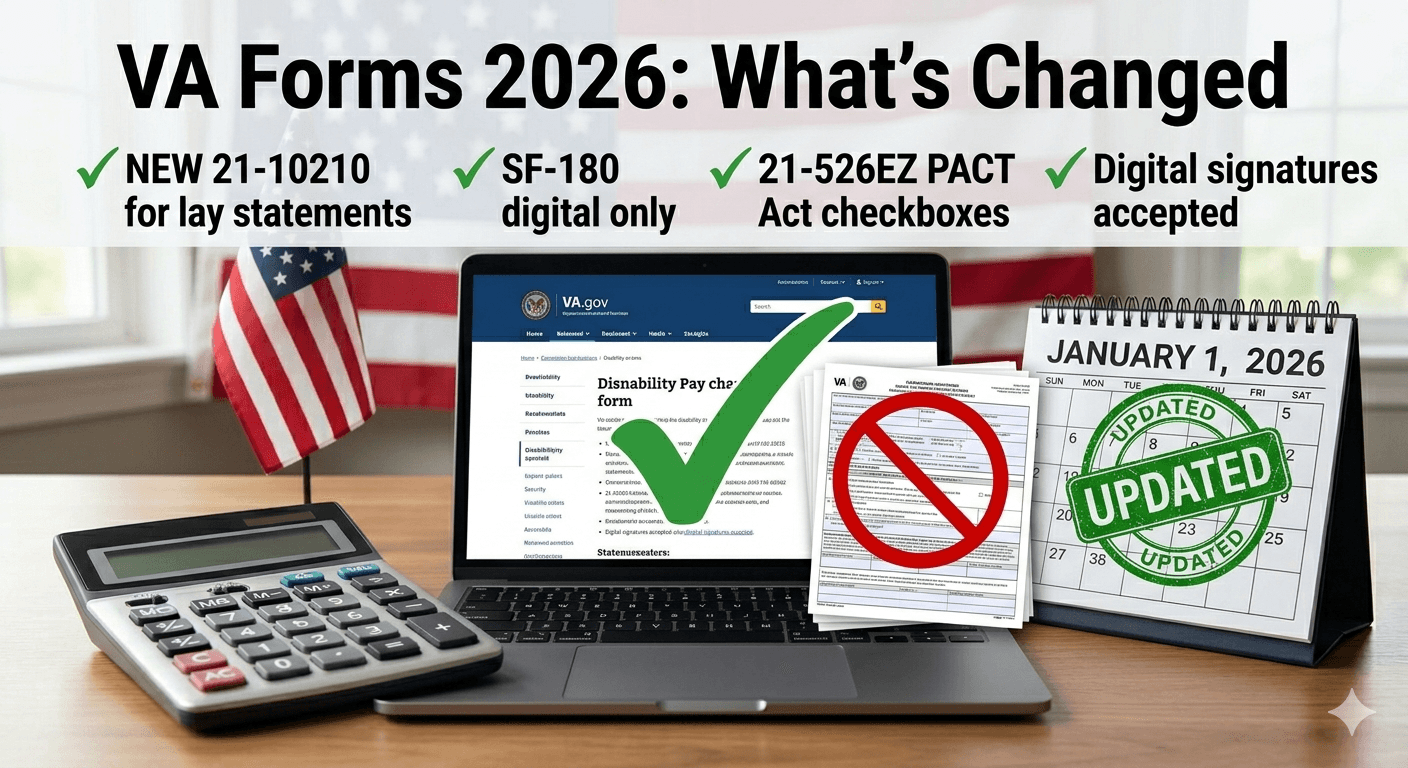
If you are a veteran, caregiver, or family member filing for benefits, the VA form you need today depends on what you are claiming. The most critical update: VA Form 21-10210 (Lay/Witness Statement) replaced older statement forms in 2025. Use the wrong form, and your claim gets delayed by months. The second major update: The SF-180 (Request Pertaining to Military Records) now requires digital submission through the National Archives portal, not fax or mail.

Here is the direct answer to what changed in 2026: The VA consolidated multiple forms into digital-first processes. You can now submit VA Form 21-4138 (Statement in Support of Claim) and VA Form 21-10210 online through VA.gov without printing a single page. The VA also updated VA Form 21-526EZ (Fully Developed Claim) to include PACT Act presumptive conditions checkboxes. And here is the warning most veterans miss: Submitting an outdated version of a VA form (from 2022 or earlier) triggers an automatic rejection. The VA will not convert it for you. You start over.

Stop printing old forms. Stop mailing things that could be uploaded. This is the latest information today on VA forms for veterans in the United States.
What Veterans Need to Know Right Now
Do not assume the VA form you used last year is still valid. The VA updates forms constantly. Using an expired version is one of the top reasons claims are rejected without being reviewed.
Here is what every veteran must understand immediately:
The VA is moving away from paper. As of 2026, over 85% of VA forms can be submitted digitally through VA.gov, the QuickSubmit tool, or AccessVA. Mailing a paper form adds 3-6 weeks of processing time versus 24-48 hours for digital uploads .
Veterans May Qualify for Extra Benefits
Check available financial assistance, healthcare programs and other opportunities that may apply to you.
Check EligibilityVA Form 21-10210 is your new best friend. This form replaced older lay evidence formats. Use it anytime a family member, battle buddy, or coworker needs to provide a statement about your condition. A well-written lay statement can be the difference between approval and denial, especially for PTSD and other conditions with limited medical records .
The SF-180 process changed in late 2025. You can no longer fax or mail the SF-180 to the National Personnel Records Center (NPRC) for faster service. All requests must go through the eVetRecs portal or Archives.gov. Faxed SF-180 forms are now returned unprocessed .
Here is the cold truth: Thousands of veterans have their claims delayed every year because they use the wrong VA form, an outdated version, or submit paper when digital is required. Do not be one of them.
Latest Updates Today (May 2026)
Let me break down exactly what changed and when. These are the six most critical updates to VA forms right now:
1. VA Form 21-10210 (Lay/Witness Statement) – Fully Operational
Released late 2024, fully implemented 2025 — This form replaced the older practice of using VA Form 21-4138 for lay statements. VA Form 21-10210 is specifically designed for third-party statements from people who know you and your condition .
What this form does: Allows family members, friends, clergy, law enforcement, or coworkers to describe your symptoms and how they affect your daily life. For PTSD claims, a spouse’s statement about your nightmares, hypervigilance, or social withdrawal is powerful evidence .
Where to get it: VA.gov → “Find a VA Form” → Search “21-10210”
Pro tip: Do not use VA Form 21-4138 for lay statements anymore. The 21-10210 is shorter, more focused, and what VA raters expect.
2. VA Form 21-526EZ (Fully Developed Claim) – PACT Act Checkboxes Added
Updated October 2025 — VA Form 21-526EZ now includes specific checkboxes for PACT Act presumptive conditions including asthma, rhinitis, sinusitis, and various cancers .
What this means for you: You can now self-identify burn pit exposure directly on the form. The VA uses this to fast-track your claim into the PACT Act processing lane.
Download the new version: Any version dated before October 2025 is missing the PACT Act section. Using the old version means the VA will send it back .
3. SF-180 – No More Fax or Mail to NPRC
Changed November 2025 — The Standard Form 180 (Request Pertaining to Military Records) can no longer be faxed or mailed to the National Personnel Records Center for faster processing. All requests must go through the eVetRecs portal or Archives.gov .
The exception: You can still mail an SF-180 to the NPRC, but processing takes 6-9 months instead of 4-6 weeks online .
What you need to do: Go to Archives.gov → Veterans’ Service Records → Request Online. Create an account. Submit your SF-180 digitally.
4. VA Form 21-22 (Appointment of VSO) – New Digital Signature Option
Updated January 2026 — VA Form 21-22 (Appointment of a Veterans Service Organization as Claimant’s Representative) now accepts digital signatures. You no longer need to print, sign, scan, and upload .
What this means for you: You can appoint a VSO from the DAV, VFW, American Legion, or other organizations entirely online. The VSO emails you a link. You sign digitally. Done.
5. VA Form 10-10EZ (Health Care Application) – Faster Processing
No major changes to the form itself in 2026, but the VA upgraded the backend processing. Digital submissions through VA.gov now process in 5-7 business days versus 30+ days for paper .
Pro tip: Use the “VA Health Care Application” online tool, not the PDF. The online tool pre-populates your information and catches errors before you submit.
6. VA Form 21-2680 (Examination for Housebound or Permanent Need for Regular Aid and Attendance) – Clarified Language
Updated March 2026 — This form, used for higher-level pension and disability benefits for veterans who need daily assistance, has clarified language around what “aid and attendance” actually means .
What changed: The form now includes specific examples: needing help with bathing, dressing, eating, using the bathroom, or adjusting prosthetic devices. It also clarifies that “substantial daily assistance” means requiring help most days, not occasionally .
Who Qualifies for VA Benefits (And Which Forms They Need)
Different benefits require different forms. Here is your cheat sheet:
Disability Compensation (Monthly Tax-Free Pay for Service-Connected Conditions)
| Form | Purpose |
|---|---|
| VA Form 21-526EZ | Initial claim for disability compensation |
| VA Form 21-4138 | Statement in support of claim (for you to explain your condition) |
| VA Form 21-10210 | Lay/witness statement (for others to describe your condition) |
| VA Form 21-8940 | Individual Unemployability (if you cannot work due to service conditions) |
Health Care Enrollment
| Form | Purpose |
|---|---|
| VA Form 10-10EZ | Application for VA health care benefits |
| VA Form 10-10EZR | Update your health care information (address, income, etc.) |
Pension (Low-Income Wartime Veterans)
| Form | Purpose |
|---|---|
| VA Form 21-527EZ | Application for veterans pension |
| VA Form 21-2680 | Aid and attendance or housebound examination |
Education Benefits (GI Bill)
| Form | Purpose |
|---|---|
| VA Form 22-1990 | Application for VA education benefits (Post-9/11 GI Bill, Montgomery GI Bill) |
| VA Form 22-1995 | Request for change of program or place of training |
Home Loan Guaranty
| Form | Purpose |
|---|---|
| VA Form 26-0592 | Request for a certificate of eligibility (COE) for VA home loan |
| VA Form 26-0555 | Loan assumption application |
Burial Benefits
| Form | Purpose |
|---|---|
| VA Form 21P-530 | Application for burial benefits allowance |
| VA Form 40-1330M | Claim for government headstone or marker |
Records Requests
| Form | Purpose |
|---|---|
| SF-180 | Request military personnel records |
| VA Form 10-5345 | Request for medical records (individual VA facility) |
How to Apply or What Steps to Take
Stop guessing which form to use. Here is your step-by-step process:
Step 1: Find the Right VA Form
Go to VA.gov. Click “Find a VA Form” in the top navigation. Search by form number or keyword. Or use the chart above to identify the form you need.
Warning: Do not use Google Images or third-party sites to download VA forms. Those versions may be outdated. Only download from VA.gov or Archives.gov.
Step 2: Check the Form Date
Look at the bottom of the form. Every VA form has a date (e.g., “Jul 2024” or “Oct 2025”). If your form is more than 12 months old, check for a newer version. The VA updates forms without fanfare.
Current valid dates as of May 2026:
- 21-526EZ: October 2025
- 21-10210: September 2024
- 21-4138: August 2023 (still valid, but 21-10210 preferred for lay statements)
- 21-22: January 2026
- 10-10EZ: March 2024
- SF-180: Use digital portal (paper version August 2021 still accepted but slow)
Step 3: Fill It Out Completely
Partial forms are rejected. Do not leave blanks. If a question does not apply, write “N/A” (not applicable). Do not leave it empty.
Common fields veterans miss:
- Your VA file number (same as your Social Security number for most veterans)
- Your service number (if different from SSN – older veterans)
- Dates of service (month, day, year – estimates are fine if exact dates are unknown)
- Signatures (digital signatures accepted on most forms in 2026)
Step 4: Submit Digitally
For most VA forms, go to AccessVA or QuickSubmit. These are VA’s secure document upload portals. You can upload PDFs, photos, or scans .
For SF-180: Go to Archives.gov → Veterans’ Service Records → Request Online.
For VA Form 10-10EZ: Use the online health care application, not the PDF. The online tool is faster and catches errors.
For VA Form 21-526EZ: File directly through VA.gov. The online claim system is easier than the PDF.
Step 5: Confirm Receipt
After digital submission, you should get a confirmation number or email within 24 hours. If you do not, call the VA at 1-800-827-1000. Do not assume your form arrived.
For mailed forms: Send them to the correct VA Evidence Intake Center address (not your local VA hospital). The address is:
Department of Veterans Affairs
Claims Intake Center
PO Box 4444
Janesville, WI 53547-4444
Using the wrong address adds weeks or months to processing.
Common Mistakes Veterans Make
I have seen thousands of VA form rejections. These mistakes are the most common:
Mistake #1: Using an Outdated Form Version
The most expensive mistake. VA Form 21-526EZ from 2022 does not have the PACT Act checkboxes. The VA will return it as “outdated form.” You resubmit. You lose 2-3 months.
Fix: Always download forms fresh from VA.gov. Do not use a saved copy from your computer’s Downloads folder.
Mistake #2: Submitting Paper When Digital Is Required
The SF-180 is the biggest offender. Faxing or mailing the SF-180 to NPRC now adds 6-9 months of processing time versus 4-6 weeks online .
Fix: Use the eVetRecs portal. It takes 15 minutes.
Mistake #3: Incomplete or Missing Signatures
VA Form 21-4142 (Authorization to Disclose Information to VA) requires your signature AND the date. Missing either = rejected. VA Form 21-10210 requires the witness’s signature AND contact information. A statement without a phone number for the witness is considered weak evidence.
Fix: Treat every signature line like a red alert. Double-check before submitting.
Mistake #4: Using the Wrong Form for Lay Statements
Many veterans still use VA Form 21-4138 (Statement in Support of Claim) for third-party statements. That form is for YOU to describe YOUR condition. VA Form 21-10210 is for OTHERS to describe YOUR condition. Using 21-4138 for a spouse’s statement confuses the rater and can lead to delays.
Fix: Your statement? Use 21-4138. Your spouse’s statement? Use 21-10210.
Mistake #5: Not Substituting a Form After a Death
After a veteran dies, many forms change. Do not use VA Form 21-526EZ to claim accrued benefits. You need VA Form 21P-534EZ (Application for Dependency and Indemnity Compensation, Death Pension, and Accrued Benefits).
Fix: For survivor benefits, always search “VA forms for survivors” not “VA disability forms.”
Mistake #6: Falling for “Form Helper” Scams
Scammers charge $99 to $299 to “help you fill out VA forms.” They direct you to fake VA websites that look real but are not .gov domains. Some even have “VA” in the URL (e.g., “va-form-help.com”) but are not official.
Red flags:
- Asking for payment to access VA forms
- A website that ends in .com, .net, or .org (real VA forms are on .gov)
- Claims of “expedited processing for a fee”
- Requests for your bank account or credit card to “complete your form”
The rule: VA forms are free. The VA will never charge you to download or submit a form. If a website asks for money, close the tab.
What This Means Financially for Your Family
Using the right VA form correctly means your claim gets processed in months instead of years. That difference is measured in thousands of dollars.
Real numbers: The average VA disability claim approved in 2025 took 154 days. The average claim rejected for a form error (then refiled) took 310 days. That is an extra 5 months .
What 5 months of delay costs your family:
- 30% disability rating ($552/month) = $2,760 in delayed payments
- 70% disability rating ($1,759/month) = $8,795 in delayed payments
- 100% disability rating ($3,737/month) = $18,685 in delayed payments
That is the cost of using the wrong form. A five-minute check to confirm you have the latest version could save you thousands of dollars.
For survivors: Using the wrong form after a veteran’s death can delay burial benefits (up to $2,000) and Dependency and Indemnity Compensation (up to $1,600/month). A widow waiting 8 months for DIC loses nearly $13,000 because of a paperwork error.
Political and Government Context Behind the Update
Why is the VA constantly changing forms? Two reasons: the PACT Act and the VA’s digital transformation.
The PACT Act (2022) added new presumptive conditions, new eligible locations, and new classes of veterans. Every new benefit requires new forms or updated old forms. The VA has been playing catch-up since 2022. The October 2025 update to VA Form 21-526EZ was a direct result of the PACT Act .
The VA Digital Transformation (2023-2027) is a multi-billion dollar effort to move the VA from paper to digital. The SF-180 changes are part of this. The new digital signature options are part of this. By 2027, the VA aims to have 95% of forms fully digital .
What this means for you: The VA is in transition. Some processes are fully digital (like VA Form 21-526EZ). Some are hybrid (like SF-180, where digital is faster but mail still works slowly). Some are still paper-only (a few obscure forms). You need to know which is which.
What is coming next: The VA has proposed eliminating VA Form 21-4138 entirely and folding it into 21-10210. That change could come in late 2026 or 2027. If it happens, do not panic. The VA will announce it. Just watch for updates .
FAQ – Veterans Ask These Questions Every Day
Q: Where can I find official VA forms?
A: VA.gov → “Find a VA Form.” Only use forms downloaded directly from .gov websites. Third-party sites often host outdated versions.
Q: Do I need to print and sign VA forms?
A: For most forms in 2026, no. Digital signatures are accepted on VA Form 21-22, VA Form 21-526EZ, and VA Form 10-10EZ. The SF-180 requires a digital signature through the eVetRecs portal.
Q: How do I submit VA forms online?
A: Use AccessVA or QuickSubmit. These are VA’s secure document upload portals. Create an account, upload your PDF, and receive a confirmation number.
Q: What is the difference between VA Form 21-4138 and VA Form 21-10210?
A: 21-4138 is for YOUR statement about YOUR condition. 21-10210 is for ANOTHER PERSON’S statement about YOUR condition. Use 21-10210 for spouse, family, or friend statements.
Q: Can I fax VA forms in 2026?
A: Some VA regional offices still accept faxes, but digital upload is faster and more reliable. The SF-180 specifically cannot be faxed to NPRC as of November 2025.
Q: How long does it take for the VA to process a form?
A: Digital forms via AccessVA: 24-48 hours for receipt confirmation. Paper forms mailed to Janesville: 2-3 weeks for receipt confirmation. Claim decision after all forms submitted: 90-180 days.
Q: What is the fastest way to request my military records?
A: Use the eVetRecs portal (Archives.gov). Digital SF-180 submissions process in 4-6 weeks. Mailed SF-180 takes 6-9 months .
Q: How do I know if my VA form is outdated?
A: Check the date in the bottom corner of the form (e.g., “Oct 2025”). Then go to VA.gov and download the latest version. If the dates match, you are good.
Q: Do I need a VSO to file VA forms?
A: No. You can file any VA form yourself. But a VSO (Veterans Service Organization) can help you avoid mistakes. VSO services are free. Use VA Form 21-22 to appoint one.
Q: What happens if I submit an outdated VA form?
A: The VA returns it unprocessed. You receive a letter saying “obsolete form.” You must resubmit with the current version. No exceptions. No “we will convert it for you.”
Q: Is there a scam involving VA forms?
A: Yes. Scammers create fake “VA form assistance” websites that charge fees for free forms. They also send emails with fake “urgent form update” links that install malware. The VA will never email you asking you to download a form from a link. Go directly to VA.gov yourself.
Final Takeaway for Every Veteran and Family Member
VA forms are the gatekeepers to your benefits. Use the right one, fill it out completely, submit it digitally, and you get paid. Use the wrong one, miss a signature, or mail it instead of uploading it, and you wait months for nothing.
Do these four things today:
- Go to VA.gov and bookmark the “Find a VA Form” page. Never use Google to find forms. Go directly to the source.
- Check every form you have saved on your computer. If the date is older than 12 months, download the latest version. Delete the old one so you do not accidentally use it.
- If you need military records, use the eVetRecs portal for SF-180. Do not fax. Do not mail. Digital only.
- Tell a fellow veteran about VA Form 21-10210. Most veterans are still using 21-4138 for spouse statements. They are slowing down their own claims. Share this article.
You earned these benefits. Do not let paperwork stand between you and what you deserve. The forms are free. The information is here. The only thing missing is your signature.
These forms are particularly significant in the current digital age where efficiency is paramount. With the introduction of new digital submissions, veterans can now file their applications online, thereby reducing the time spent on paper-based processes. The digital transition also promotes accessibility, allowing veterans to complete their applications from the comfort of their own homes, thus removing geographical barriers that may have previously hindered their access to vital services.
The forms serve multiple purposes, such as documenting service-related disabilities, verifying income, and providing essential information necessary for benefit determination. This comprehensive information assists VA representatives in processing claims more accurately and swiftly. Moreover, veterans can feel more confident in their applications knowing that their data is gathered systematically, which can ultimately lead to more favorable outcomes.
The careful design and format of VA Forms 2026 ensure that they cater to the diverse needs of the veteran population. Overall, these forms not only facilitate veterans in claiming their entitled benefits but also serve to streamline the broader claims process within the Department of Veterans Affairs.
Significance of Digital Submissions
The transition to digital submissions for VA Forms, including VA Forms 2026, represents a pivotal shift in how veterans interact with the Department of Veterans Affairs. One of the most significant advantages of this digital approach is the increased efficiency in processing these applications. By allowing veterans to submit their forms electronically, the VA can minimize the administrative burden associated with manual data entry and paperwork management.
Furthermore, the adoption of digital submissions greatly reduces processing times. Traditionally, veterans faced lengthy delays as their paper applications made their way through the system. With electronic forms, the submission can be received and processed almost instantly, leading to quicker responses and determinations. This streamlined process not only benefits the veterans by providing timely access to services but also enhances the overall operational efficiency within the VA.
The convenience of online access is another critical aspect of the move to digital submissions. Veterans can complete their forms at their convenience, without having to visit a physical location or rely on postal services that might delay application submission. This flexibility is especially important for veterans who may have mobility challenges or those who are residing in remote areas. By facilitating easier access to forms and the submission process, the VA helps ensure that all veterans, regardless of their circumstances, can easily engage with the services available to them.
In conclusion, the significance of digital submissions for VA Forms lies in the marked improvements in efficiency, reduced processing times, and the enhanced convenience for veterans. By embracing digital solutions, the VA not only modernizes its operations but also better serves the needs of the veteran community.
Navigating the New VA Forms 2026
The recently introduced VA Forms 2026 represent a significant change in the way veterans can submit applications and access services through the Department of Veterans Affairs. These forms are aimed at streamlining processes for veterans seeking benefits, ensuring that submissions are digital, more efficient, and user-friendly. Understanding these forms is crucial for successfully navigating the application process.
Firstly, it is essential to familiarize oneself with the specific types of VA Forms 2026 that are available. This includes forms related to disability compensation, pension benefits, education assistance, and health care enrollment. Each form is designed for a distinct purpose, thus having a clear grasp of which form is applicable to your situation is vital. For example, if a veteran is seeking disability compensation, they would need to complete the respective disability form as outlined at the VA’s official website.
Careful attention should also be paid to the instructions provided with each form. The VA has emphasized the importance of following these guidelines meticulously to avoid common pitfalls that may lead to delays or rejections in processing. Additionally, veterans are often required to submit supporting documentation alongside their completed forms. This may include service records, medical records, or financial documents, depending on the nature of the benefits being pursued.
Moreover, when submitting the VA Forms 2026, it is recommended to utilize the online submission portal provided by the VA. This platform not only allows for quicker processing but also enables applicants to receive instant confirmation of their submissions, which is a significant improvement over prior methods. By adhering to outlined procedures and ensuring all required documentation is included, veterans can enhance their chances of a successful application.
Step-by-Step Guide to Submitting VA Forms 2026 Digitally
Submitting VA Forms 2026 has been simplified through a digital platform, allowing veterans to complete their applications more efficiently. This guide is designed to walk you through each step of the submission process for VA Forms 2026, ensuring a smooth experience.
First, access the official VA website. It is crucial to utilize the authenticated online portal to ensure that your application is processed securely. Navigate to the forms section, where you will find various forms related to veteran affairs, including Form 2026. Choose the appropriate form that corresponds with your needs.
Once you have accessed the VA Forms 2026, you will need to create or log into your account. This step is essential as it allows the system to save your progress and provide a tailored experience. Ensure all your account information is accurate to avoid complications later in the process.
After logging in, carefully fill out the digital form. Take your time to enter all required information accurately, as mistakes may delay processing. Utilize the help icons or explanations provided alongside the fields if any clarification is needed. Pay particular attention to sections that require documentation, as these will need to be uploaded.
Upon completion of the form, review the information meticulously for any errors or omissions. This review process is essential in confirming that all the details are correct, as errors may necessitate resubmission or additional follow-up. Once confirmed, proceed to upload any required documents. Ensure that all files meet the specified format and size requirements indicated on the VA website.
Finally, after submitting your form, you will receive a confirmation through the portal. Keep this confirmation safe, as it contains vital information regarding your application’s status. If any issues arise, refer back to the confirmation for guidance on how to proceed. Following these steps will help ensure a successful digital submission of VA Forms 2026.
Common Challenges and Solutions
The transition to digital submissions for VA Forms 2026 has introduced a variety of challenges faced by veterans. One prevalent issue encountered is the complexity of the online forms, which can be daunting for those not well-versed in technology. This complexity frequently leads to confusion or incomplete submissions, potentially delaying the processing of necessary benefits.
To mitigate this challenge, veterans are encouraged to take advantage of the numerous resources available, such as video tutorials and step-by-step guides provided by the VA. Additionally, seeking assistance from veteran service organizations can offer valuable support in navigating the digital submission process.
Another common issue is the uncertainty surrounding document requirements. Veterans may find it challenging to determine which supporting documents need to be uploaded with their VA Forms 2026. This can lead to incomplete applications or delays in processing times. A practical solution is to create a checklist of required documents based on the specific benefits being applied for. By reviewing the VA’s official guidelines and checklists, veterans can ensure they have all necessary documents ready to expedite their submissions.
Technical difficulties with the online submission platform can also hinder the process, such as issues with website accessibility or the inability to upload files. In such instances, it is advisable for veterans to try accessing the platform from different browsers or devices. If problems persist, reaching out to the VA’s technical support can provide immediate assistance.
Finally, veterans should remain vigilant about deadlines for submissions, as missing these can result in a loss of benefits. Utilizing reminders on personal calendars or setting alerts can help ensure important dates are not overlooked. By understanding these challenges and implementing effective solutions, veterans can facilitate a smoother experience when submitting their VA Forms 2026 digitally.
Updates and Changes in VA Procedure
In recent months, the Department of Veterans Affairs (VA) has announced significant updates concerning the submission process for VA Forms 2026. These enhancements aim to improve efficiency and accessibility for veterans seeking benefits. One of the most notable changes is the introduction of new digital submission options that streamline the filing process, allowing veterans to submit their forms online instead of relying solely on traditional mail methods.
The digital submission system offers multiple benefits, such as instant confirmation of receipt, reducing processing times, and minimizing the risk of lost documentation. Veterans are encouraged to use the new online platform, as it incorporates user-friendly features designed to assist with the completion of VA Forms 2026. Through step-by-step guidance, veterans can easily navigate the required fields, which in turn reduces the incidence of errors that might lead to delays in processing their claims.
Moreover, the VA is committed to enhancing security measures within the digital platform. An improved authentication process ensures that personal information is protected throughout the submission journey. With this focus on security, veterans can feel more confident in using the online options for their VA Forms 2026 filings.
There are additional informational resources available to assist veterans in understanding these changes thoroughly. The VA has updated its website to include detailed guidelines on how to utilize the new submission procedures effectively. Furthermore, veterans can access FAQs and contact support services directly for any queries related to the new digital submission process.
Overall, these updates and changes in VA procedures are a step forward in facilitating a more efficient benefits claim process for veterans. Keeping abreast of these alterations will empower veterans to utilize the available resources and maximize their benefits.
Feedback from Veterans on Digital Submissions
The implementation of digital submissions for VA Forms 2026 has elicited a range of feedback from veterans who have navigated the new process. Many veterans appreciate the convenience provided by this modernized approach, which enables them to submit forms online without the need for travel or in-person visits to VA offices. A frequent sentiment expressed is that the digital platform reduces the paperwork burden, allowing for a streamlined submission experience.
Veterans noted that the user-friendly interface contributes significantly to their satisfaction. One veteran mentioned, “I was originally apprehensive about using the online forms, but the step-by-step instructions made it easy. I was able to complete my application in a fraction of the time it would have taken with paper forms.” This sentiment was echoed by numerous users who highlighted the clarity and accessibility of the digital formats as key advantages.
However, some veterans have shared constructive criticism regarding certain technical glitches that occasionally accompany the platform’s use. A veteran reported, “There were moments when the system lagged or my application wouldn’t save. It was frustrating, but eventually, my submission went through.” Such concerns point to the need for ongoing improvements, as technical issues can impact users’ overall satisfaction with digital submissions.
Furthermore, veterans expressed a desire for more comprehensive support resources associated with the online submission process. One veteran suggested, “Having a dedicated help section or a hotline might ease some of the anxiety for those unfamiliar with digital technology.” This feedback indicates that while the digital submission system has made strides in efficiency, there is still room for enhancement, particularly in user assistance to ensure all veterans feel confident when using the technology.
Resources for Assistance
Veterans seeking help with VA Forms 2026 can access multiple resources to streamline their process of digital submissions. Understanding the complexities of the VA forms can be challenging, and having the right support makes a significant difference.
One of the primary resources available is the official website of the U.S. Department of Veterans Affairs. This website provides comprehensive information about VA Forms 2026, including submission guidelines and important updates. Veterans can also find detailed user guides that outline the steps necessary to complete and submit these forms correctly.
For veterans seeking direct assistance, the VA has established a helpline, which can be reached at 1-800-827-1000. This dedicated number connects veterans to knowledgeable representatives who can provide guidance regarding VA Forms 2026, addressing specific questions and concerns that veterans may have throughout the submission process.
In addition to national resources, local VA offices can be invaluable. Each state has regional offices equipped with staff who understand the local context and can offer personalized support. Veterans are encouraged to locate their nearest office by visiting the VA’s website and utilizing the ‘Find a VA Location’ tool.
Moreover, veterans can benefit from engaging with various non-profit organizations that specialize in assisting veterans with paperwork and claims relating to VA services. For example, organizations like the Disabled American Veterans (DAV) and Veterans of Foreign Wars (VFW) provide free assistance and may help navigate through the forms, ensuring that veterans understand their options.
Lastly, online forums and community groups can offer peer support, where veterans share their experiences and provide tips on effectively completing VA Forms 2026. Such communities can foster a sense of camaraderie, transforming the often daunting process into a more approachable task.
Conclusion and Final Thoughts
As we have explored throughout this post, the introduction of digital submissions for VA Forms 2026 marks a significant advancement in the way veterans can interact with the U.S. Department of Veterans Affairs. This modernization not only streamlines the application process, making it more efficient, but also aligns with contemporary technology standards that many individuals expect today.
The transitioning to digital submissions presents numerous benefits, including time savings, increased accessibility, and a reduced likelihood of errors associated with paper forms. These factors contribute positively to the overall experience for veterans seeking to access their benefits, ultimately enhancing their engagement with the VA system. Moreover, by adopting these new methods, veterans can ensure that their applications are submitted quickly and securely, paving the way for faster processing and resolution.
It is essential for veterans to familiarize themselves with the new digital submission process, as embracing this change can mean significant improvements in their benefit applications. We encourage all veterans to take full advantage of the digital avenues available for submitting VA Forms 2026. Doing so not only simplifies the process but also allows veterans to manage their applications effectively from the convenience of their homes.
In conclusion, the shift to online submissions for VA Forms 2026 serves as a reminder of the ongoing efforts to improve service delivery for veterans. By adapting to these innovations, veterans can benefit from a more user-friendly experience designed to meet their needs. We urge all veterans to embrace these changes and utilize the resources provided by the VA to ensure their voice is heard and their benefits are secured.


🇺🇸 IMPORTANT DISCLAIMER – Veterans Benefits Information
This site provides general information about U.S. Department of Veterans Affairs (VA) benefits for educational and informational purposes only.
- Not Official: We are NOT affiliated with, endorsed by, or connected to the U.S. Department of Veterans Affairs (VA), the Veterans Benefits Administration (VBA), the Veterans Health Administration (VHA), or any other government agency.
- No Legal/Financial Advice: The content on this website is for informational purposes only and does not constitute legal, financial, or medical advice. VA benefits rules change frequently – always consult with an accredited Veterans Service Officer (VSO) or a qualified professional for your specific situation.
- Official Sources: For official, binding information and to apply for benefits, always visit official .gov websites: VA.gov, Benefits.VA.gov, or SSA.gov.
- No Data Collection: This site does not collect, store, or process any personal information. It does not have login forms, contact forms, or any system to capture user data. We never ask for your Social Security Number, bank details, or any personal information.
- 🚨 Scam Alert: The VA and other government agencies never charge fees for benefit applications. If anyone asks for money to "process" your VA claim, it is a scam. Report it to the VA Office of Inspector General at VA.gov/OIG.
- Advertising: This site uses third-party advertising (Adsterra) to cover operational costs. We do not endorse or guarantee any products or services advertised.
📌 Information provided as of June 2026. Always verify current eligibility and rules with official .gov sources.
This site is not affiliated with the U.S. Department of Veterans Affairs or any government agency. All information is for educational purposes only. Please visit VA.gov for official information.
