
Introduction to VA Claims and Disability Ratings
Veterans Affairs (VA) claims are applications submitted by military veterans to receive benefits and services provided by the U.S. Department of Veterans Affairs. These claims often pertain to various forms of assistance, including health care, education, and financial support for disabilities resulting from military service. The process of filing a VA claim can be intricate, requiring a thorough understanding of the necessary documentation and evidence to substantiate the veteran’s condition.
One crucial aspect of the VA claims process is the assessment of a veteran’s disability rating. This rating is expressed as a percentage, typically ranging from 0% to 100%, and it serves as an indication of the severity of the veteran’s service-connected disability. The disability rating is determined based on a variety of factors, including the nature and impact of the disability on daily living and employment capabilities. A higher disability rating generally correlates with increased benefits, which can significantly impact a veteran’s quality of life.

The importance of understanding disability ratings cannot be overstated. It is the foundation upon which veterans’ benefits are built, influencing the level of compensation they receive for their service-related injuries or illnesses. Accurate disability ratings are essential not only for financial support but also for accessing various VA services such as vocational rehabilitation, housing assistance, and healthcare benefits. Veterans must engage with the VA claims process fully informed about how their ratings are determined and what appeals options are available if they disagree with the VA’s assessment.

In conclusion, navigating the VA claims process and comprehending disability ratings is vital for veterans seeking to secure the benefits they have earned. By being informed about these key components, veterans can better advocate for themselves and ensure they receive the appropriate level of support for their unique circumstances.
VA Claim Status 2026: Check Your Disability Rating & Benefits Fast
Check your VA claim status online in 2026. Track disability claims through the 8-step process, download decision letters early, and get real-time updates. Updated for new VA processing times.
The short answer: Log in to VA.gov with your Login.gov or ID.me account and click “Check your VA claim or appeal status.” You will see a real-time 8-step tracker showing exactly where your claim is, from “Claim received” to “Decision letter available” .
Here is what changed: VA is processing claims faster than ever. As of April 2026, the average disability claim takes 80.7 days—down from 141.5 days just a year ago . If your claim has been sitting for months, check it online right now. VA hit a milestone on February 2, 2026, processing 1 million disability claims faster than ever before .
Veterans May Qualify for Extra Benefits
Check available financial assistance, healthcare programs and other opportunities that may apply to you.
Check EligibilityThis guide walks you through the exact steps to check your status, explains what each step means, and tells you how long you should expect to wait in 2026.
What Veterans Need to Know Right Now
VA has overhauled its Claim Status Tool. The new interface works on phones, tablets, and computers. You can check your claim 24/7 without calling anyone .
Most importantly: VA may now text or email you directly. If they need more information for your claim, you will get a message from do-not-reply@notifications.va.gov with a secure link to the Claim Assist Portal . That link is safe. Use it to respond faster without printing or scanning documents.
The backlog is shrinking dramatically. VA cut the claims backlog (claims pending over 125 days) by 63% since January 2025. As of March 2026, the backlog sits below 100,000 for the first time since 2020 . That means most veterans get answers in weeks, not months.
How to Check Your VA Claim Status Online
Step-by-step instructions:
- Go to VA.gov and click Sign In in the top right corner
- Sign in with Login.gov or ID.me—the old My HealtheVet username and password no longer work for benefits claims
- Once signed in, go to the “Check your VA claim or appeal status” page
- You will see a list of your claims, decision reviews, and appeals
- Click on any claim to see full details, including the 8-step tracker
What you can do after logging in:
- See which step your claim is in (1 through 8)
- Upload evidence for initial claims
- Download decision letters for closed claims
- See any information VA has requested from you
- Track what evidence you have already submitted
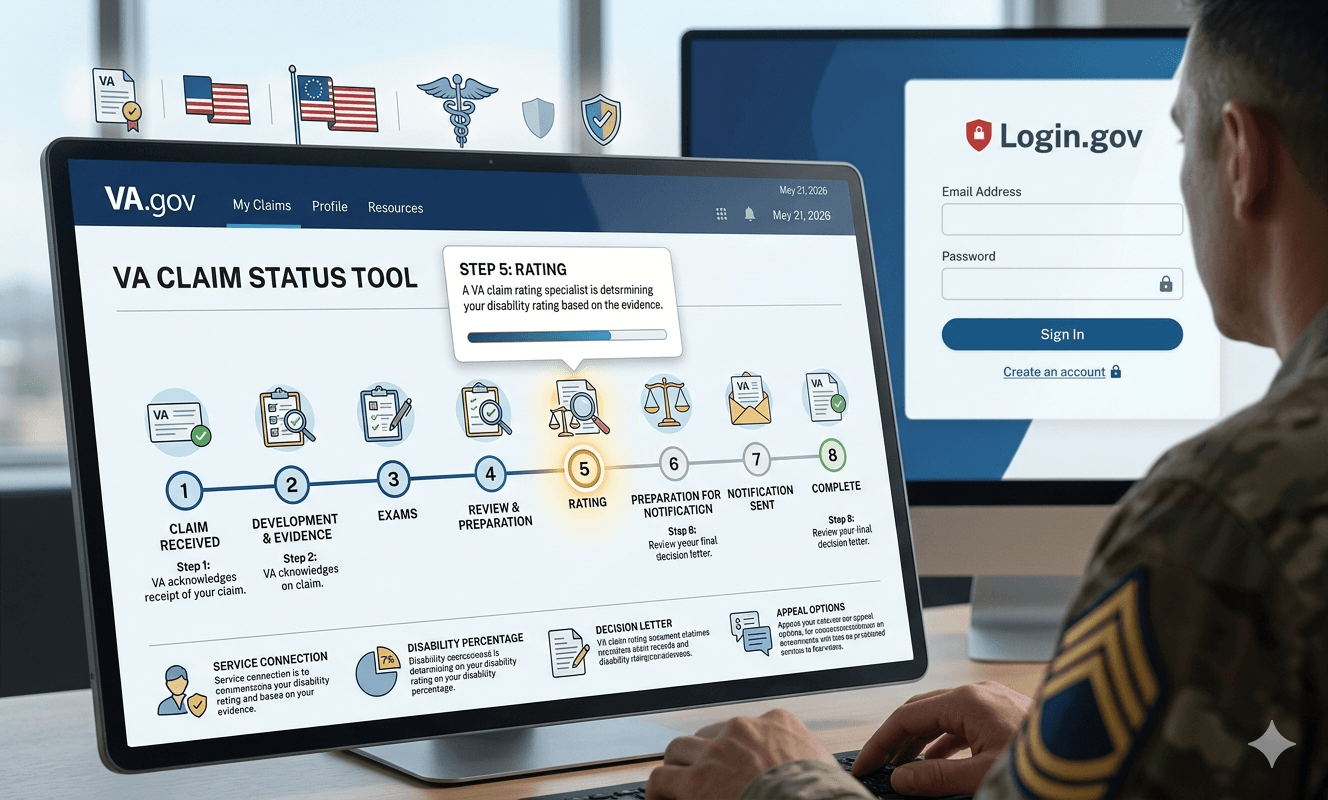
The 8-Step VA Claim Status Tracker Explained
VA recently broke down the claims process into eight clear steps . Here is what each one actually means for you:
| Step | What Is Happening | What You Should Do |
|---|---|---|
| 1. Claim received | VA has your submission in their system | Double-check you included all forms |
| 2. Initial review | VA verifies your name, SSN, and basic info | Nothing—just wait |
| 3. Evidence gathering | VA checks if they have everything needed. They may ask you for more records or schedule a C&P exam | Check your messages. Respond quickly to any requests |
| 4. Evidence review | VA reviews all medical records, exam results, and service records submitted | Nothing—just wait |
| 5. Rating | A VA rater decides your claim and determines your disability percentage | This is the longest step. Be patient |
| 6. Preparing decision letter | VA writes the official decision letter. You cannot see it yet | You are almost done |
| 7. Final review | A senior reviewer double-checks everything for accuracy | Almost there |
| 8. Decision letter available | Your decision letter is ready to view and download | Log in and download your letter |
Note: The process can move backward to a previous step if VA needs more information. Do not panic—this happens often.
How to Access Your VA Decision Letter Online
You no longer have to wait for a paper letter in the mail. VA now posts decision letters online as soon as Step 8 is complete .
To download your decision letter:
- Log in to VA.gov
- Go to “Check your claim or appeal status”
- Find your closed claim in the list
- Click on it
- Click “Get your claim letters”
- The letter opens as a PDF—print or save it
The letter includes your disability rating, monthly payment amount, and when payments begin .
Also available online: VA now posts notices and follow-up development letters that explain what evidence you still need to submit .
VA Claim Status by Phone (If You Cannot Go Online)
If you do not have internet access or prefer to call, VA has phone support.
For disability compensation and pension claims:
Call the VA benefits hotline at 800-827-1000
Hours: Monday through Friday, 8:00 a.m. to 9:00 p.m. ET
For health care benefits:
Call the VA health benefits hotline at 877-222-8387
Hours: Monday through Friday, 8:00 a.m. to 8:00 p.m. ET
Both lines accept TTY at 711 for hearing-impaired callers .
What to have ready before calling:
- Your Social Security number
- Your VA file number (if you have one)
- The type of claim you filed and when
What Types of Claims You Can Track Online
The Claim Status Tool works for these benefit types :
| Benefit Type | Can Check Status? |
|---|---|
| Disability compensation (including auto/clothing allowance) | ✅ Yes |
| Veterans Pension benefits | ✅ Yes |
| Survivors Pension benefits | ✅ Yes |
| Special Monthly Compensation (Aid & Attendance) | ✅ Yes |
| Dependency and Indemnity Compensation (DIC) | ✅ Yes |
| Burial allowance | ✅ Yes |
| Specially Adapted Housing (SAH) grant | ✅ Yes |
| Special Housing Adaptation (SHA) grant | ✅ Yes |
| Adding or removing dependents | ✅ Yes |
| School attendance approval for dependents | ✅ Yes |
| Health care-related claims | ❌ No—check your decision letter for instructions |
2026 VA Claim Processing Times: What to Expect
VA is processing claims faster than it has in years. Here are the current numbers as of April 2026 :
| Claim Type | Average Processing Time | Change from 2025 |
|---|---|---|
| Disability compensation | 80.7 days | Down 43% |
| Veterans Pension (initial) | 57 days | Down 66% |
| Survivors Pension (initial) | 73 days | Down 55% |
| DIC (Death benefits) | 73 days | Down 50% |
| Burial claims | 31 days | Down 56% |
Accuracy rate: VA is deciding claims with 94.02% accuracy—the highest 12-month rate in two years .
The backlog: Claims pending longer than 125 days now make up only 17% of all claims. In 2013, that number was 70% .
What this means for you: If you filed a straightforward claim with all your evidence included, expect an answer in about 80 days. Complex claims may still take longer.
How to Respond When VA Requests More Information
VA may contact you if they need more evidence to decide your claim. In 2026, they are using email and SMS text messages for the first time .
What the message will look like:
- From:
do-not-reply@notifications.va.gov - Subject line clearly identifies it as from the Department of Veterans Affairs
- Contains a secure link to the Claim Assist Portal
What the Claim Assist Portal lets you do:
- Answer questions online
- Sign forms electronically
- Verify information
- Submit requested evidence
No printing. No mailing. No scanning.
Important security note: These messages are real. They are not spam or third-party solicitations. But if you are ever unsure, do not click the link—log into VA.gov directly and check your claim status there.
Common Mistakes Veterans Make
Mistake #1: Using the wrong login
If you are still trying to use an old My HealtheVet username and password, it will not work. You need Login.gov or ID.me. Create one now—it takes 10 minutes.
Mistake #2: Ignoring VA messages about evidence
When VA asks for more information, the clock stops on your claim. The 80-day average only applies when VA has everything they need. Every day you delay responding adds to your wait time.
Mistake #3: Calling when you could check online
The phone lines are busy. Checking your status online takes 30 seconds. Calling takes 30 minutes on hold. Use the online tool unless you have a specific question the status page cannot answer.
Mistake #4: Not downloading your decision letter immediately
VA posts the letter online as soon as Step 8 completes. Download it and save it to your computer or phone. You will need it for your records.
Mistake #5: Assuming “Evidence gathering” means you did something wrong
Most claims go to Step 3. It is normal. VA is just making sure they have everything. Do not panic.
What This Means Financially for You
Every day your claim sits in processing is a day you are not getting the benefits you earned. The faster VA works, the faster you see money in your account.
If your claim is approved: Payments are typically retroactive to the date you filed. So if VA takes 80 days to approve you, you get 80 days of back pay.
If your claim is denied: You have options. You can file a supplemental claim with new evidence, a Higher-Level Review, or an appeal to the Board of Veterans’ Appeals. Check your decision letter for deadlines—you usually have one year to appeal.
If you are experiencing financial hardship: Tell VA. You can request priority processing by submitting evidence of financial distress (eviction notice, utility shutoff, foreclosure notice). Call 800-827-1000 and ask for “hardship processing.”
Political Context: Why VA Is Moving Faster
VA Secretary Doug Collins announced in April 2026 that VA processed a record 3 million claims in fiscal year 2025 and is on a similar pace in 2026 .
The numbers:
- VA hit 1 million completed claims on February 2, 2026—the fastest ever
- Average processing time dropped from 141.5 days to 80.7 days
- Backlog fell below 100,000 for first time since 2020
What is driving the improvement:
- Mandatory overtime for claims processors
- The new Claim Status Tool with 8-step transparency
- The Claim Assist Portal for faster evidence collection
- About half of VBA’s claims processors are veterans themselves
What this means for you: Faster decisions. Less waiting. More transparency.
FAQ: VA Claim Status
Q: How do I check my VA claim status without logging in?
A: You cannot see claim-specific details without logging in for security reasons. However, you can call 800-827-1000 and provide your SSN for an update over the phone.
Q: What does “Evidence gathering, review, and decision” mean?
A: This is Step 3 combined with Steps 4 and 5. VA is collecting and reviewing your medical records, service records, and any C&P exam results before making a rating decision.
Q: How long does the VA claim decision take in 2026?
A: The average for disability claims is 80.7 days. Pension claims average 57 days. Burial claims average 31 days .
Q: Can I check the status of my VA appeal online?
A: Yes. The same Claim Status Tool works for decision reviews and appeals .
Q: Why has my claim been in Step 3 for months?
A: Step 3 (evidence gathering) is often the longest step. If VA is waiting on records from a private doctor or the National Archives, there is nothing they can do to speed it up. However, if it has been over 125 days, your claim is backlogged. Call 800-827-1000 to ask for a status update.
Q: How do I know if VA received my evidence?
A: Log into the Claim Status Tool and click the “Files” tab. You will see a list of all documents VA has received from you .
Q: Can I upload evidence after filing my claim?
A: Yes. While your claim is in Step 1-3, you can upload evidence through the Claim Status Tool. Once it moves to Step 4, you generally cannot add more .
Q: What is the Claim Assist Portal?
A: A new 2026 tool that lets you respond to VA information requests online without printing or scanning. VA sends you a secure link by email or text .
Final Takeaway
Checking your VA claim status in 2026 is easier than ever. Log into VA.gov with Login.gov or ID.me, and you will see an 8-step tracker showing exactly where your claim stands. Average wait times are down to 80 days for disability claims. VA may text or email you directly if they need information—respond through the Claim Assist Portal to keep your claim moving.
Do these three things right now:
- Create or verify your Login.gov/ID.me account if you have not already
- Bookmark the VA claim status page on your phone
- Respond immediately if VA contacts you for more information
You served your country. Now VA is finally serving you faster.
Importance of Checking Your VA Claim Status
For veterans navigating the complexities of the Department of Veterans Affairs (VA) claims process, actively checking the status of their VA claim is essential. This diligence is not only crucial for understanding the timeline of claims processing but also impacts financial and healthcare provisions. A VA claim status, often linked to disability ratings, determines the benefits veterans can access, including monthly compensation and healthcare services.
Monitoring your VA claim status provides veterans with peace of mind and empowers them with information. When veterans periodically check the status of their claim, they can identify any potential roadblocks and address issues proactively, reducing the risk of prolonged delays that could adversely affect their financial situation. For many veterans, the benefits provided through their VA claims are vital sources of income, helping them to manage daily living expenses and medical costs effectively.
Additionally, updates on claim statuses can serve as a catalyst for necessary changes in healthcare provisions. A higher disability rating may qualify veterans for additional medical services, enabling them to receive essential treatments and support necessary for their well-being. Therefore, being aware of any modifications in claim status can directly influence a veteran’s access to timely and appropriate healthcare solutions.
In conclusion, checking the status of a VA claim is not merely a procedural step but a critical activity that can have significant financial and health-related implications for veterans. Maintaining awareness of these updates allows veterans to engage actively in their benefits process, ensuring they receive the support they have rightfully earned.
Understanding Disability Ratings: A Breakdown
Disability ratings are an essential component of the veterans’ disability compensation program administered by the Department of Veterans Affairs (VA). These ratings serve as a benchmark to quantify the extent of a veteran’s service-connected disability, directly influencing the benefits and compensation they receive. Disability ratings are generally expressed as a percentage, ranging from 0% to 100%, in increments of 10. A higher percentage indicates a more severe disability, which may result in increased benefits.
The VA determines these disability ratings using a standardized evaluation process outlined in the VA Schedule for Rating Disabilities (VASRD). This rating schedule includes detailed criteria for various medical conditions, assessing factors such as symptom severity, frequency, and the impact on daily functioning. Furthermore, the VA often requires supporting documentation, including medical examinations and treatment records, to corroborate a veteran’s claim and determine their appropriate rating accurately.
Each disability rating carries specific implications for benefits. For instance, a 0% rating, while recognizing a service-connected condition, does not provide monthly compensation. However, it may ensure eligibility for other VA healthcare benefits. A veteran rated at 10% or 20% can receive monthly compensation, with payment amounts increasing proportionately with higher ratings. Those rated 30% or higher often become eligible for additional benefits, which may include Dependents’ Educational Assistance and housing assistance.
In summary, understanding disability ratings and their significance is crucial for veterans seeking benefits. Familiarity with how these ratings are established and what each level signifies can aid veterans in navigating the complexities of the VA system, ensuring they obtain the benefits they rightfully deserve based on their service-connected disabilities.
Accessing Your VA Claim Status Online
In order to efficiently monitor your VA claim status for disability benefits, the U.S. Department of Veterans Affairs provides an online platform designed for veterans to access their information securely. Following is a step-by-step guide that will assist you in checking your claim status via the VA’s online portal.
First, start by visiting the official VA website. Once on the homepage, navigate to the “eBenefits” section. This feature provides a wide range of resources and services tailored for veterans, including claim status inquiries.
If you do not already have an account, you will need to create one. Click on the “Register” option and fill out the required information. Ensure that you have your social security number, date of birth, and other identifying details on hand to expedite the registration process. After registration, confirm your account through the verification steps provided by the VA.
Once your account is established, log in using your credentials. Navigate to the “Claim Status” tab within the dashboard. This section displays the current status of your claims and any requisite details, including your disability rating and the expected timeline for processing.
Keep in mind that the website may have various features that enhance your user experience. Familiarize yourself with the portal by exploring additional resources like FAQs and tools available for veterans. Utilize the built-in help functions if you encounter challenges while using the site.
In case you require further assistance, consider contacting the VA’s support line. Having a clear understanding of your claim status is essential, and the online portal provides a convenient method for veterans to obtain this information promptly.
Factors That Affect VA Claim Status Changes
The status of a VA claim can be influenced by various factors that may arise throughout the claim process. Understanding these elements is essential for veterans seeking an accurate and timely assessment of their disability rating.
One prominent factor that can lead to changes in VA claim status is the submission of additional evidence. Veterans are often encouraged to provide any new medical records, service records, or personal statements that support their claim. The introduction of this supplementary information can prompt the VA to reevaluate the existing claim, potentially resulting in an adjustment to the disability rating. Timely and comprehensive evidence submissions can play a crucial role in expediting the claim process.
Furthermore, alterations in a veteran’s health condition can also significantly impact the status of their claim. If a veteran experiences a worsening of their medical condition or develops new disabilities related to their service, they may apply for a reevaluation of their disability rating. Such changes necessitate a reassessment by the VA, which can influence the current claim status. It is important for veterans to remain vigilant about any changes in their health and to communicate these developments promptly to the VA.
Additionally, processing delays within the VA can affect the status of claims in unforeseen ways. Factors such as staffing shortages, increased claim submissions, and the complexity of individual cases can contribute to longer processing times. Veterans should be aware that these factors can lead to extended periods of uncertainty regarding their claim statuses.
In navigating the complexities of the VA claim process, it is beneficial for veterans to stay informed about these variables to better understand potential changes in their claim status and, consequently, their disability rating.
What to Do If Your Claim Is Denied
Receiving a denial for a VA claim can be disheartening for many veterans. However, it is important to understand that a denial does not signify the end of the road. There are structured steps that veterans can take to challenge the decision and pursue their benefits by appealing the ruling.
The first step after receiving a denial is to review the decision letter carefully. This letter often includes detailed reasons for the denial. Understanding these reasons is crucial for formulating an effective appeal. If the denial was based on insufficient evidence, veterans can collect additional medical documentation or personal statements to support their case.
After analyzing the reasons for denial, veterans can initiate the appeals process. They should file a Notice of Disagreement (NOD) within one year of the initial decision. The NOD informs the VA that they wish to appeal the decision, and it is essential to clearly articulate the disagreement with specific reference to the original claim’s denial reasons.
Furthermore, veterans have the option to select a hearing as part of their appeal. In-person hearings can provide an opportunity to present their case directly, potentially leading to a more favorable outcome. It’s advisable to gather all pertinent evidence and, if necessary, seek assistance from a qualified representative or an attorney who specializes in veteran affairs.
In addition to the formal appeals process, numerous resources are available to assist veterans. The VA’s website offers valuable information regarding appeals, and organizations such as the Veterans Service Organization (VSO) can provide guidance and support. They often have experienced advocates who understand the complexities of the VA claims process.
In conclusion, while a denial can be a setback, by understanding the appeal procedures, carefully gathering evidence, and utilizing available resources, veterans can increase their chances of a successful outcome in their VA claims.
Tips for Faster Claims Processing
Veterans seeking to expedite their VA claims processing often find the journey lengthy and complex. However, equipped with the right strategies, the process can be shortened, enhancing the overall experience. The following tips will help veterans effectively navigate the system to get their deserved benefits more efficiently.
Firstly, ensuring that all necessary documentation is collected and submitted accurately is crucial. Veterans should gather all medical records, service records, and any evidence that supports their claim before submission. This comprehensive preparation minimizes the need for VA requests for additional information, which can significantly delay processing time.
Secondly, utilizing the VA’s online tools and resources is highly advisable. Veterans can manage their claims through the VA’s website, offering them real-time updates on their claim status. Additionally, the VA’s eBenefits portal allows veterans to upload documents electronically, providing a faster alternative to mailing physical paperwork.
Moreover, seeking assistance from a qualified representative can prove beneficial. Organizations such as Veterans Service Organizations (VSOs) offer free services to help veterans complete their claims accurately and thoroughly, ensuring no details are overlooked. Having an experienced advocate can simplify communication with the VA and clarify complex processes.
Regular follow-ups are also essential. Veterans should stay proactive by checking their claim status periodically. If there are delays or requests for more information, addressing these promptly can prevent further holdups. It is often easier to resolve issues sooner rather than waiting for the VA to reach out with inquiries.
By adhering to these strategies, veterans can significantly enhance the likelihood of a faster claims processing experience. Proper preparation, utilization of technological tools, and leveraging expert assistance are pivotal strategies that can lead to timely accessing of benefits, ultimately making the journey smoother for those who bravely served the nation.
Upcoming Changes in VA Claim Processing for 2026
As we look towards 2026, the landscape of VA claim processing and disability ratings is expected to undergo several significant changes aimed at enhancing efficiency and accessibility. These anticipated developments stem from ongoing evaluations by the Department of Veterans Affairs (VA) and align with the overarching goal of providing timely and equitable assistance to veterans seeking disability benefits.
One prominent change expected in 2026 involves the implementation of advanced technology in the claims process. This includes the adoption of artificial intelligence (AI) and machine learning tools to assist in analyzing claims data. Such technologies can potentially streamline the processing of VA claims by identifying patterns and expediting decision-making. For veterans, this could translate to shorter wait times and quicker access to their deserved benefits.
Additionally, the VA is likely to enhance its outreach efforts to ensure that veterans are well-informed about the claims process and their eligibility. This might involve improved educational resources and community workshops designed to clarify the intricacies of filing a claim and understanding disability ratings. By increasing awareness, veterans can better navigate the system and provide the necessary information for their claims, thereby minimizing errors and delays.
Furthermore, there is an ongoing push for a more transparent claims process where veterans can monitor the status of their claims in real-time. This development could potentially reduce anxiety among veterans and their families, as they can be kept informed about where their claim stands and what steps are next.
In conclusion, the anticipated changes in VA claim processing for 2026 point towards a more efficient, transparent, and supportive system for veterans. As these transformations are implemented, they hold the promise of improving the overall experience for veterans seeking disability benefits, thereby honoring their service and sacrifice.
Resources and Support for Veterans
The journey through the VA claims process can often be complex and challenging for veterans seeking disability ratings. Fortunately, numerous resources and support systems are available to assist veterans in navigating this process effectively. Understanding these resources can significantly enhance a veteran’s ability to manage their claims successfully.
One of the primary organizations dedicated to providing assistance is the Veterans of Foreign Wars (VFW). The VFW offers comprehensive support services, including free assistance for veterans filing their claims. Their trained service officers are skilled in dealing with the VA system, ensuring that veterans receive the necessary guidance through their applications.
The American Legion is another prominent organization that offers similar support. They provide resources for conducting appeals, determining eligibility for benefits, and understanding the complexities of the claims process. Veterans can visit their local chapters for direct assistance and community support.
Additionally, the Disabled American Veterans (DAV) organization has created a robust network of advocates who can guide veterans through the intricacies of their claims. They also offer transportation services for veterans attending medical appointments, which can be crucial during the claims process.
Hotlines such as the VA’s Veterans Crisis Line provide immediate support for veterans in crisis, ensuring they receive help when needed. This service is available 24/7 and connects veterans with trained professionals who understand their specific needs.
Moreover, various online communities and forums serve as invaluable resources for veterans seeking peer support. Websites like RallyPoint and Reddit’s veterans’ forums enable veterans to share experiences, ask questions, and find camaraderie among those who understand their situation.
In conclusion, a range of resources exists to support veterans during the claims process, from established organizations to online communities. Utilizing these services can make a significant difference in navigating the complexities of VA claims and achieving successful outcomes.

🇺🇸 IMPORTANT DISCLAIMER – Veterans Benefits Information
This site provides general information about U.S. Department of Veterans Affairs (VA) benefits for educational and informational purposes only.
- Not Official: We are NOT affiliated with, endorsed by, or connected to the U.S. Department of Veterans Affairs (VA), the Veterans Benefits Administration (VBA), the Veterans Health Administration (VHA), or any other government agency.
- No Legal/Financial Advice: The content on this website is for informational purposes only and does not constitute legal, financial, or medical advice. VA benefits rules change frequently – always consult with an accredited Veterans Service Officer (VSO) or a qualified professional for your specific situation.
- Official Sources: For official, binding information and to apply for benefits, always visit official .gov websites: VA.gov, Benefits.VA.gov, or SSA.gov.
- No Data Collection: This site does not collect, store, or process any personal information. It does not have login forms, contact forms, or any system to capture user data. We never ask for your Social Security Number, bank details, or any personal information.
- 🚨 Scam Alert: The VA and other government agencies never charge fees for benefit applications. If anyone asks for money to "process" your VA claim, it is a scam. Report it to the VA Office of Inspector General at VA.gov/OIG.
- Advertising: This site uses third-party advertising (Adsterra) to cover operational costs. We do not endorse or guarantee any products or services advertised.
📌 Information provided as of June 2026. Always verify current eligibility and rules with official .gov sources.
This site is not affiliated with the U.S. Department of Veterans Affairs or any government agency. All information is for educational purposes only. Please visit VA.gov for official information.
