
Introduction: The Strategic Importance of Palawan
Palawan, an island province located in the Philippines, has gained significant attention due to its strategic importance in the context of U.S. military operations. This attention primarily stems from its geographic positioning, which provides a crucial vantage point for military assets in the Asia-Pacific region. Bordered by the South China Sea to the west and the Sulu Sea to the south, Palawan serves as a gateway between various maritime routes, making it a pivotal location for logistical and operational purposes.
From a geopolitical perspective, Palawan’s proximity to several disputed territories, including those in the South China Sea, enhances its significance. The U.S. military seeks to maintain a competitive edge in the region amid growing tensions and militarization from various state and non-state actors. By establishing a military base in Palawan, the U.S. can enhance its operational capabilities and respond swiftly to emerging threats, thus reinforcing its strategic presence.

Economically, Palawan is rich in natural resources, including oil and minerals, which are vital for energy security. The development of military infrastructure not only strengthens the U.S. military’s foothold but also contributes to local economic growth by creating jobs and facilitating infrastructure improvements. Furthermore, collaborative efforts between the U.S. and Philippine governments can enhance regional stability and security, which is critical for economic development in Palawan and its neighboring regions.

In summary, the importance of Palawan as a strategic military location is underscored by its geographic, political, and economic factors, all of which align with the U.S. military’s objectives in the Asia-Pacific landscape. This growing focus on Palawan illustrates the intersection of military strategy and international relations, reflecting the broader dynamics in the region.
U.S. Philippines Military Infrastructure Palawan: 2026 Base & Facility Updates
US Philippines military infrastructure Palawan includes 2 EDCA sites, a new boat repair hub, and airfield fuel depot. Latest May 2026 project updates for veterans and families.
The short answer: The U.S. is actively building and funding military infrastructure on Palawan island right now—including a new Philippine Coast Guard maintenance facility at Buliluyan Port and fuel depot repairs at Antonio Bautista Air Base.
As of May 2026, the Pentagon has released notices for two major infrastructure projects in Palawan. One is a brand-new intermediate logistics maintenance center for the Philippine Coast Guard at Buliluyan Port. The other is refurbishment of fueling facilities at Antonio Bautista Air Base, which is one of nine Enhanced Defense Cooperation Agreement (EDCA) sites where U.S. forces have rotational access .
Veterans May Qualify for Extra Benefits
Check available financial assistance, healthcare programs and other opportunities that may apply to you.
Check EligibilityFor U.S. service members, veterans, and families stationed in or visiting the Philippines, this matters because these upgrades mean better support infrastructure, improved fuel availability for joint operations, and expanded maintenance capabilities for maritime assets in the region. Here is exactly what is happening on the ground right now.
What U.S. Military Families & Veterans Need to Know Right Now
If you are active duty, retired, or a veteran living in or traveling to the Philippines, Palawan is becoming a more capable logistics hub. The island sits directly on the South China Sea, facing the Spratly Islands—a strategically vital location.
Two EDCA sites exist on Palawan :
- Antonio Bautista Air Base (Puerto Princesa) – Primary air hub for maritime patrols and joint exercises
- Balabac Island (southern tip of Palawan) – Strategic position near key waterways
These are Philippine military bases, not U.S. bases. The U.S. does not own them. American forces operate there on a rotational basis under the 2014 EDCA agreement . The Philippine flag flies over these bases. U.S. troops train alongside Filipino forces, but Manila retains full control.
Latest Infrastructure Updates Today (May 2026)
Here is what is actively being built or funded right now on Palawan.
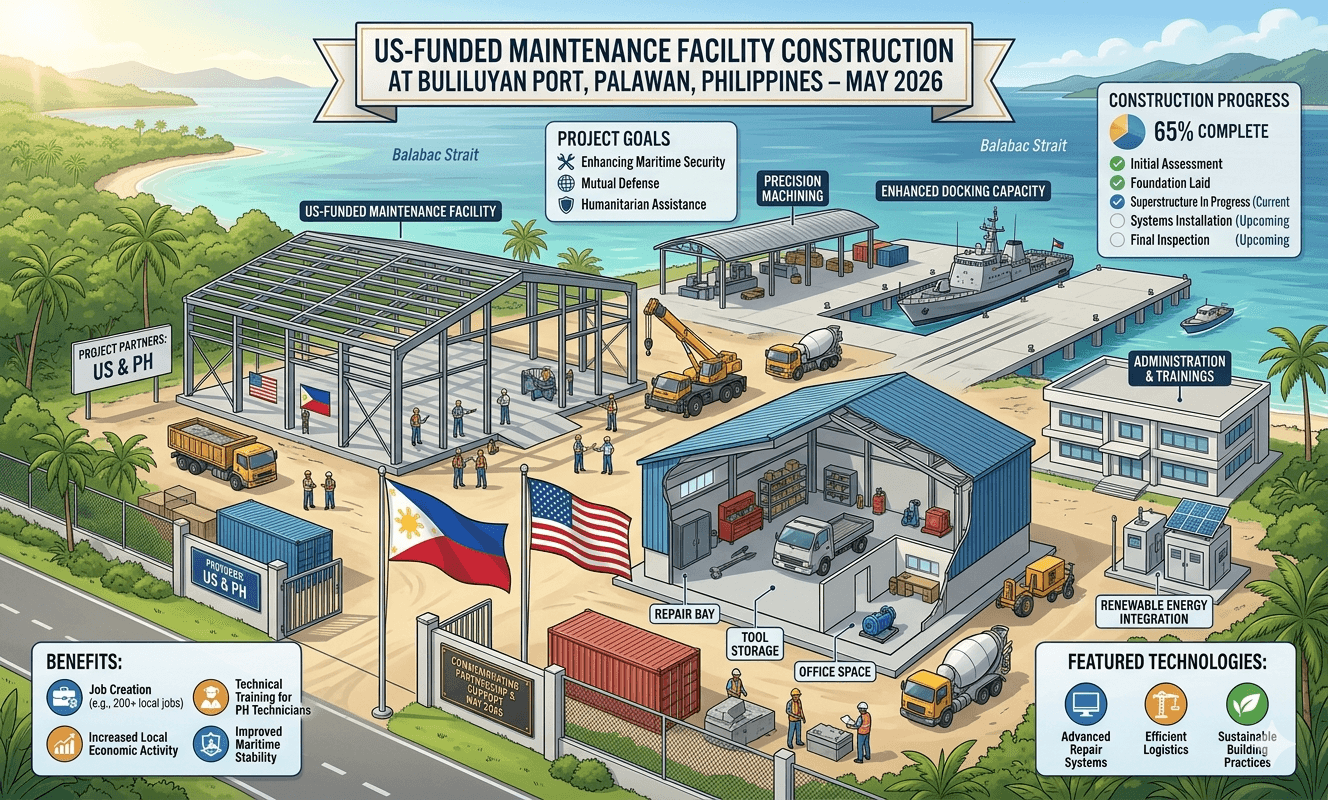
1. Buliluyan Port Maintenance Facility (New Construction)
The Pentagon is seeking funding to build an intermediate logistics maintenance center at Buliluyan Port. This is a big deal. Right now, Philippine Coast Guard cutters have to sail away from Palawan—back toward the main Philippine islands—for basic repairs. That means days or weeks of lost patrol time in the South China Sea.
Once this facility is operational, cutters can get fixed on the spot and return to missions faster. The facility will support the PCG’s limited fleet of 13 ocean-capable cutters, which are stretched thin across the Philippines’ massive exclusive economic zone .
What this means for U.S. personnel: Better-coordinated maritime operations. If you are involved in joint patrols or exercises, having a forward maintenance hub means less downtime and more time on mission.
2. Antonio Bautista Air Base Fuel Depot (Refurbishment)
The second project focuses on refurbishing fueling facilities at Antonio Bautista Air Base. This is the primary Philippine Air Force base on Palawan, used to stage maritime patrols and military exercises .
Why this matters: Fuel is the lifeblood of air operations. Old or unreliable fuel infrastructure creates delays and safety risks. This refurbishment means faster turnarounds for patrol aircraft, including the P-8 Poseidon maritime patrol aircraft that the U.S. and Philippines operate together in the region.
3. Boat Repair Hub (Ground Broken May 2026)
The Philippines broke ground on a new boat maintenance and repair facility in Palawan in early May 2026. This project is part of the broader U.S.-Philippines defense partnership and directly supports maritime security in the South China Sea .
This facility complements the Coast Guard center at Buliluyan. Together, they create a more complete maintenance ecosystem for both military and coast guard vessels operating out of Palawan.
4. U.S. Small Modular Reactor Feasibility Study
Beyond Palawan-specific projects, the U.S. Trade and Development Agency announced in February 2026 that it is funding a feasibility study for U.S.-designed small modular reactors (SMRs) in the Philippines. This is part of a broader push to advance U.S. energy infrastructure interests in the Indo-Pacific .
What this means: Reliable, secure energy infrastructure supports military installations, including those on Palawan. SMRs could provide backup power for critical defense facilities.
Who This Affects (And Who It Doesn’t)
This directly affects:
- Active duty U.S. military personnel rotating through EDCA sites
- Military families stationed in the Philippines (though most are based near Manila, not Palawan)
- Veterans working as contractors or defense consultants in the region
- Retirees living in the Philippines who may access VA healthcare or use MWR facilities
This does NOT mean:
- U.S. bases are returning to the Philippines (they closed Subic Bay and Clark in 1992)
- American civilians can freely access Palawan EDCA sites (these remain restricted Philippine military installations)
- Veterans benefits changed because of these projects
Political Context: Why Palawan Infrastructure Is Expanding
The short version: China.
The South China Sea is a flashpoint. China has been building its own military infrastructure on artificial islands in the Spratlys. The Philippines and China have clashed repeatedly since 2022 in what experts call a “hybrid conflict”—not open war, but aggressive encounters at sea involving coast guard vessels and fishing boats .
Palawan is the Philippines’ launchpad for responding to those incidents. Cutters, patrol aircraft, and small boats all stage from Palawan to resupply Philippine possessions in the disputed Spratly Islands.
The U.S. is supporting Philippine infrastructure because a stronger Philippines means a stronger allied presence in the region. The U.S. does not have to base its own ships and aircraft on Palawan permanently—it just needs Manila to have the capability to operate effectively.
President Marcos’s position: He has publicly stated that EDCA sites “will not be used for offensive action.” The official line is that these facilities are for joint training, humanitarian assistance, disaster response, and Philippine self-defense .
China’s reaction: Beijing has criticized EDCA as part of “US efforts to encircle and contain China through its military alliance with this country” .
Common Misconceptions & Warnings
Misconception #1: “EDCA sites are U.S. bases.”
False. They are Philippine bases. The U.S. has rotational access. The Philippine flag stays up. Philippine commanders stay in charge. The Department of National Defense has repeatedly stressed this point, especially after concerns arose in March 2026 about whether EDCA sites could become targets in a U.S.-Iran conflict .
Misconception #2: “Any American veteran can visit these bases.”
False. These are not U.S. military installations like Yokota or Ramstein. You cannot just show up with a VA ID and walk on. EDCA sites are operational Philippine military facilities. Access is restricted and mission-dependent.
Warning for contractors: If you are bidding on work related to these infrastructure projects, verify security clearance requirements early. These are sensitive locations. The Philippine government controls access, not the U.S.
Warning for travelers: Palawan is a popular tourist destination (El Nido, Puerto Princesa). Do not mistake military infrastructure for public amenities. Do not take photos of military installations. Do not attempt to enter restricted areas.
What This Means Financially & Operationally
For the U.S. government: These projects cost money—Pentagon funding, USTDA grants, and foreign military financing. The May 2026 projects at Buliluyan and Antonio Bautista are part of a broader trend of increasing U.S. investment in Philippine defense infrastructure.
For the Philippine government: Less money spent on shipping cutters back to Manila for repairs. More patrol days in the South China Sea. Better fuel security at the air base. These are real operational savings.
For U.S. service members: If you deploy to the Philippines for Balikatan (the annual U.S.-Philippines military exercise) or other joint operations, expect better support infrastructure on Palawan than in previous years. The 2026 Balikatan演习, held in April, included anti-landing drills on Palawan’s coast using HIMARS rocket systems and unmanned systems—the largest Balikatan to date with over 17,000 participants .
For families: If your spouse is deployed to the Philippines, Palawan operations are becoming more sustainable. Forward maintenance means shorter deployment rotations. Better fuel infrastructure means more reliable air support.
FAQ: U.S. Philippines Military Infrastructure Palawan
Q: How many EDCA sites are there total in the Philippines?
A: Nine. Two are on Palawan (Antonio Bautista Air Base and Balabac Island). The others are in Pampanga, Nueva Ecija, Cebu, Cagayan de Oro, Cagayan province (two sites), and Isabela .
Q: Can U.S. troops carry weapons on Palawan?
A: Yes, under EDCA, U.S. forces conducting joint training or exercises can carry weapons consistent with their mission. However, Philippine authorities maintain overall security control of the bases.
Q: Is there any U.S. military housing on Palawan?
A: No. U.S. personnel rotate in temporarily for exercises. There are no permanent U.S. family housing units. Most U.S. personnel stationed in the Philippines are based near Manila at Joint Task Force Philippines or the U.S. Embassy.
Q: What is Balikatan 2026’s connection to Palawan?
A: The April 2026 Balikatan演习 included anti-landing drills on Palawan’s coast, simulating defense against approaching enemy vessels. The exercise used HIMARS rocket systems and unmanned systems—the first time Balikatan has integrated this many unmanned platforms .
Q: Are EDCA sites safe from attack?
A: Philippine National Security Adviser Eduardo Año stated in March 2026 that “there is no verified or credible direct threat to Philippine territory, including our military installations” . This followed concerns about U.S.-Iran tensions, but officials stressed the Philippines is not a party to that conflict and EDCA sites are not U.S. bases.
Q: Do these infrastructure projects affect veterans’ benefits?
A: No. These are defense cooperation projects between the U.S. and Philippine governments. They do not change VA benefits, TRICARE eligibility, or retiree pay.
Final Takeaway
The U.S. is significantly upgrading military infrastructure on Palawan right now. A new Coast Guard maintenance center at Buliluyan Port. Fuel depot repairs at Antonio Bautista Air Base. A boat repair hub already breaking ground. These are not rumors—they are funded projects with Pentagon notices and groundbreakings in May 2026.
For U.S. military personnel, this means better support during rotations to the Philippines. For the U.S.-Philippines alliance, it means a more capable partner in the South China Sea. For veterans and families, it is context—not a direct benefits change—but important context if you follow defense news or have loved ones deploying to the region.
The key takeaway: Palawan is becoming a real logistics hub, not just a tourist destination. Watch this space.
Overview of the 2026 Base Initiative
The 2026 Base initiative represents a significant step in U.S. military infrastructure development in Palawan, Philippines. This initiative is aimed at enhancing military readiness and collaboration with allies in the region. The base is expected to serve as a strategic point for operations, aimed at bolstering security partnerships and promoting maritime stability in Southeast Asia.
Designed to accommodate various military operations, the proposed base will span approximately 250 acres, which will facilitate a wide range of military activities, including training exercises and logistics support. The facility is expected to house an array of capabilities, such as hangars for aircraft, housing for troops, and advanced communication systems, thereby enhancing operational efficiency.
The initiative also aims to streamline access to the surrounding waters, allowing for efficient naval deployments and enhancing maritime surveillance. This development is anticipated to strengthen the U.S. presence in the region, which plays a crucial role in countering potential threats and ensuring a free and open Indo-Pacific.
The timeline for construction of the 2026 base is projected to commence in the fall of 2024, with completion anticipated around mid-2026. The phased construction approach will allow for gradual integration of the base into the existing military framework in the region. Furthermore, it will enable the U.S. military to collaborate closely with local forces and conduct joint exercises aimed at improving interoperability.
Through this initiative, the U.S. aims to enhance its forward defense posture in the Asia-Pacific region, thereby contributing to regional peace and stability. The comprehensive development of the 2026 base underscores the strategic importance of Palawan in U.S. military planning and the commitment to building resilient partnerships in the face of evolving security challenges.
Historical Context: U.S. Military Presence in the Philippines
The presence of the U.S. military in the Philippines on spans back over a century, dating from the period following the Spanish-American War in 1898. The war marked a pivotal shift in the Philippines’ status, transitioning from a Spanish colony to a territory administered by the United States. The strategic importance of the Philippines, located at the crossroads of major maritime routes, made it an ideal site for military installations that could enhance American influence in the Asia-Pacific region.
Following World War II, the Philippines and the United States entered into the Military Bases Agreement of 1947. This treaty permitted the establishment of several key military bases, including Clark Air Base and Subic Bay Naval Base, solidifying a military partnership that lasted for several decades. The bases were vital during the Cold War, serving as forward operating locations for American forces and facilitating regional security operations. However, this military presence has not been without controversy, culminating in significant changes during the 1990s.
In 1991, the Philippine Senate voted to reject the extension of the Military Bases Agreement, which led to the withdrawal of U.S. forces from Clark and Subic. The end of this era of military bases marked a turning point in U.S.-Philippine relations. In the wake of increasing regional tensions, particularly from China, both nations revisited their military collaboration through agreements like the Enhanced Defense Cooperation Agreement (EDCA) in 2014. This allowed for rotational deployments and greater access to Philippine facilities, setting the stage for the significant infrastructure developments now occurring in Palawan.
Geopolitical Implications: U.S.-China Relations
The establishment of a U.S. military base in Palawan by 2026 has significant geopolitical implications, particularly regarding U.S.-China relations. As tensions between the United States and China continue to influence global politics, the enhancement of military infrastructure in close proximity to disputed territories in the South China Sea will likely heighten strategic competition. The location of the base, facing the Spratly Islands and near vital maritime trade routes, underscores its importance in the broader context of security, diplomacy, and military readiness.
China’s response to the U.S. military’s presence in the region has already been a point of contention. The Chinese government perceives such developments as a direct challenge to its territorial claims and has consistently voiced opposition to any foreign military encroachments. This base’s construction could lead to increased military posturing by China and a potential shift in its defense strategies. Additionally, the military base’s establishment could escalate the ongoing arms race, as China may bolster its military capabilities in response to perceived threats, thereby destabilizing the region further.
Furthermore, the geopolitical dynamics in Southeast Asia could shift as other nations react to the U.S. presence in Palawan. Countries like Vietnam and the Philippines might view the U.S. military development as a strategic counterbalance to China’s growing assertiveness in the South China Sea. This action may foster a closer alignment among Southeast Asian states with U.S. interests, encouraging regional alliances focused on collective security and defense cooperation.
Ultimately, the construction of this military base will serve as a focal point for both U.S. and Chinese military strategies and diplomatic relations, influencing not just bilateral ties but also the broader geopolitical landscape in Southeast Asia.
Economic Impact on the Local Economy
The establishment of the 2026 military base in Palawan is set to significantly influence the local economy, promoting growth across various sectors. Job creation stands as one of the most immediate benefits. The construction and operational phases of the base are expected to generate numerous employment opportunities for local residents. This influx of jobs can uplift the standard of living for many, leading to increased disposable income and, consequently, higher spending in local businesses.
Alongside job creation, infrastructure improvements will be a critical component of this development. The military base’s construction will likely necessitate upgrades to existing roads, transportation systems, and utilities. Enhanced infrastructure will not only facilitate base operations but also benefit the local population. Improved infrastructure can lead to better access to essential services, including healthcare and education, which can further stimulate local economic activities.
The economic effects extend to local industries, notably tourism and fisheries. Palawan is renowned for its natural beauty and biodiversity, attracting tourists from around the globe. With increased military presence, security may enhance the appeal of the region as a tourist destination, potentially leading to a rise in visitor numbers. Local businesses, particularly in the hospitality sector, are likely to benefit from this uptick in tourism, driving demand for services such as accommodation, dining, and guided tours.
Moreover, local fisheries can experience both challenges and opportunities due to the base’s establishment. Increased military activity could potentially disrupt traditional fishing practices; however, enhanced infrastructure and security might lead to better resource management practices. This balance represents both a challenge and an opportunity for sustainable fisheries development. The economic landscape in Palawan is poised for transformation, with potential benefits for multiple sectors responding to the evolving realities brought by the military base.
Environmental Considerations and Sustainability Measures
The establishment of the U.S. military infrastructure in Palawan raises numerous environmental concerns that warrant careful examination. This region, known for its rich biodiversity and unique ecosystems, faces potential impacts from construction and operational activities associated with defense installations. Recognizing the fragility of the environment in Palawan, it is essential to adopt measures that prioritize sustainability and environmental protection throughout the development process.
A comprehensive environmental impact assessment (EIA) should be conducted before the commencement of any construction activities. This assessment is crucial in identifying unique habitats and species that could be affected by the base’s establishment. By involving expert ecologists and local stakeholders, the EIA can help inform strategies to minimize disruption to the natural landscape and existing wildlife.
Implementing sustainable construction practices is vital for reducing the environmental footprint of the military base. This may include utilizing eco-friendly materials, optimizing energy consumption through renewable sources, and ensuring waste management systems are in place to prevent pollution in the surrounding areas. Furthermore, limiting construction activities to avoid critical habitats during nesting and breeding seasons for local wildlife can help mitigate potential ecological disruptions.
In addition to construction practices, ongoing operations at the base will also require stringent sustainability measures. This includes the establishment of water conservation protocols, responsible waste disposal systems, and programs aimed at reducing carbon emissions. Engagement with local communities can enhance these initiatives, as local insights often provide invaluable perspectives that can enrich sustainability efforts.
Ultimately, balancing military readiness with environmental stewardship in Palawan is essential. Through proactive environmental management, including the integration of sustainability measures in both the construction and operational phases, the military can safeguard the ecological integrity of the region while fulfilling its defense commitments.
Local Reactions: Support and Opposition
The discussion surrounding the development of the U.S. military base in Palawan has elicited a variety of responses from local communities, highlighting stark contrasts in perspectives about its implications on cultural, social, and political dimensions.
Supporters of the base argue that the infrastructure development will bring numerous benefits to the region. Proponents claim that the influx of U.S. military personnel will stimulate the local economy through increased job opportunities, tourism, and commerce. They foresee improved infrastructure such as roads and communication systems, as the establishment of the base often necessitates substantial investments in local facilities and services. Furthermore, advocates contend that the increased military presence may enhance security in the region, particularly amidst rising geopolitical tensions in the South China Sea.
Conversely, significant opposition exists within certain segments of the population. Critics express concerns about the potential impact on local culture and environment. They fear that the introduction of a military base could lead to an influx of foreign influences that may undermine indigenous practices and traditions. Additionally, environmental advocates raise alarms about the possible ecological degradation that could stem from the construction and operation of the base, including risks to marine biodiversity and local wildlife habitats.
Moreover, political activists voice apprehensions regarding national sovereignty, arguing that the U.S. military presence could compromise the autonomy of the Philippines. These varied perspectives represent the complexities involved in the discourse around the military base, revealing how local reactions are shaped by a multitude of factors, including historical context, community values, and economic aspirations. The balancing act between supporting development and safeguarding local interests continues to be a central theme as the construction of the base approaches.
Regional Security Partnerships: Collaborations with ASEAN
The establishment of the 2026 U.S. military base in Palawan has significant implications for regional security partnerships, particularly with Southeast Asian nations through the Association of Southeast Asian Nations (ASEAN). This strategic infrastructure aims to bolster collaborative efforts in defense and maintain stability within the evolving security landscape of the region.
Joint military exercises are set to become a cornerstone of the collaboration between the U.S. and ASEAN countries. These exercises will not only improve interoperability among allied forces but also enhance the collective defense posture against emerging threats. Through comprehensive training initiatives, personnel from various ASEAN member states will be equipped with the necessary skills and operational awareness to respond effectively to regional challenges.
Moreover, the U.S. military’s presence in Palawan facilitates closer ties between regional forces. Training sessions focused on humanitarian assistance and disaster relief operations signify an essential area of cooperation, especially given the region’s vulnerability to natural disasters. Thus, these joint training initiatives will provide ASEAN countries with invaluable experience, while also fostering camaraderie and mutual understanding.
Furthermore, the U.S. commitment to enhancing regional security extends beyond military presence. Activities may include intelligence sharing and collaborative efforts to combat non-traditional threats such as piracy, smuggling, and terrorism. These partnerships are central to establishing a cohesive security network that can effectively respond to a variety of regional challenges.
The base in Palawan represents more than just a military installation; it is a strategic move to solidify ties among the U.S. and ASEAN nations. Moving forward, the success of these partnerships will likely hinge on sustained engagement and dialogue, ensuring that they adapt to the dynamic nature of regional security threats and opportunities.
Conclusion: The Future of U.S. Military Infrastructure in Palawan
The establishment of the 2026 U.S. military base in Palawan represents a significant milestone in the evolving dynamics of military strategy and regional security in Southeast Asia. This base is not merely a component of U.S. military infrastructure; it is indicative of a broader strategy aimed at fortifying cooperative defense agreements with the Philippines while addressing growing geopolitical uncertainties. The presence of U.S. forces in Palawan could provide enhanced operational support in addressing regional threats, particularly those associated with the South China Sea.
Furthermore, the implications of this base extend beyond immediate military objectives. It also signifies a commitment to fostering stability in the region through strategic partnerships. This commitment entails not only military cooperation but also engagement in humanitarian efforts and disaster response initiatives, essential for the local community and resilience in times of crises. The continuation of this U.S. presence may thus be crucial for bolstering long-term ties with the Philippines and enhancing their capability for internal security.
Looking ahead, the 2026 base serves as a foundational element for future developments in military cooperation. As the regional landscape continues to evolve, the U.S. military is likely to invest further in infrastructure upgrades and establish additional facilities to meet operational demands. These potential future developments could significantly enhance U.S. military readiness, allowing for more effective and agile responses to regional challenges, thereby contributing to a stable balance of power in Southeast Asia.
In conclusion, the U.S. military infrastructure in Palawan is set to play a pivotal role in shaping both military strategy and regional stability. The long-term vision for U.S. military presence in the Philippines suggests a mutually beneficial relationship aimed at not only strength through deterrence but also collaboration for peace and security in the region.


🇺🇸 IMPORTANT DISCLAIMER – Veterans Benefits Information
This site provides general information about U.S. Department of Veterans Affairs (VA) benefits for educational and informational purposes only.
- Not Official: We are NOT affiliated with, endorsed by, or connected to the U.S. Department of Veterans Affairs (VA), the Veterans Benefits Administration (VBA), the Veterans Health Administration (VHA), or any other government agency.
- No Legal/Financial Advice: The content on this website is for informational purposes only and does not constitute legal, financial, or medical advice. VA benefits rules change frequently – always consult with an accredited Veterans Service Officer (VSO) or a qualified professional for your specific situation.
- Official Sources: For official, binding information and to apply for benefits, always visit official .gov websites: VA.gov, Benefits.VA.gov, or SSA.gov.
- No Data Collection: This site does not collect, store, or process any personal information. It does not have login forms, contact forms, or any system to capture user data. We never ask for your Social Security Number, bank details, or any personal information.
- 🚨 Scam Alert: The VA and other government agencies never charge fees for benefit applications. If anyone asks for money to "process" your VA claim, it is a scam. Report it to the VA Office of Inspector General at VA.gov/OIG.
- Advertising: This site uses third-party advertising (Adsterra) to cover operational costs. We do not endorse or guarantee any products or services advertised.
📌 Information provided as of June 2026. Always verify current eligibility and rules with official .gov sources.
This site is not affiliated with the U.S. Department of Veterans Affairs or any government agency. All information is for educational purposes only. Please visit VA.gov for official information.
