
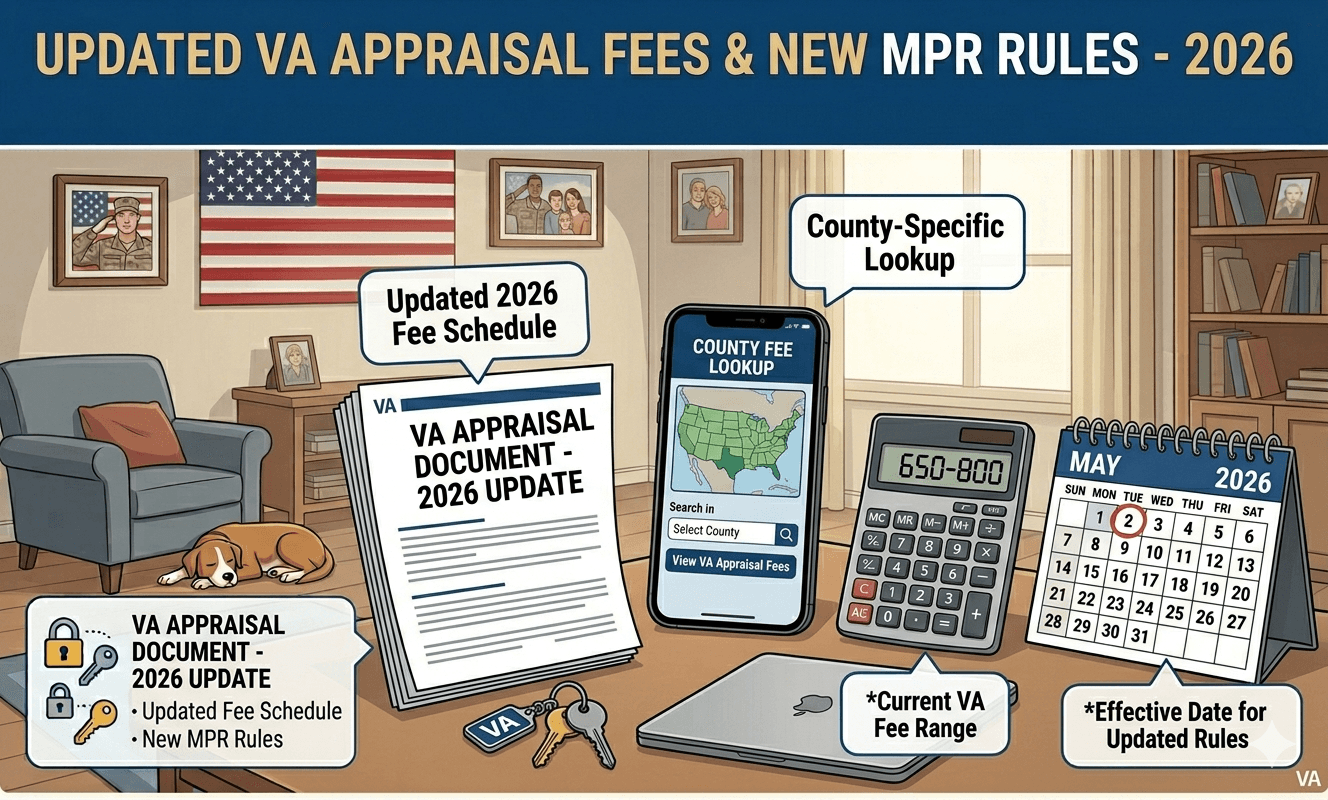
Introduction to VA Appraisal Fee Schedule 2026
The VA appraisal fee schedule for 2026 serves as an essential guideline for determining the fees associated with property appraisals conducted under the Department of Veterans Affairs (VA) home loan program. This schedule is of utmost importance for veterans and homebuyers alike as it standardizes the costs associated with appraisals, ensuring fairness and transparency in the appraisal process. It caters specifically to the unique needs of veterans, providing them with the benefits necessary for accessing affordable housing options.
VA Appraisal Fee Schedule 2026: New May 1 Rules + County-by-County Caps ($400–$1,500)
Meta Description (max 160 chars): VA appraisal fee schedule 2026: New May 1 rules, county-by-county caps ($400–$1,500), $150 reinspection fee, & MPR changes. Know your costs.

If you are using a VA loan to buy a home in 2026, here is the direct answer about the VA appraisal fee schedule: Effective May 1, 2026, the VA updated its appraisal fee structure across all 50 states and territories. For a single-family home, expect to pay between $400 and $1,500, with most major metro markets running $650–$800. The exact fee depends on your county, property type, and whether the area is designated as high-demand or remote .

But here is what you need to know before you order. The VA eliminated the $50 add-on fee that appraisers could previously charge above the published rate. However, mileage fees are still authorized when an appraiser travels outside their assigned coverage area—but ONLY with prior VA approval .
Here is the critical part. If you cancel an appraisal order after the appraiser has already uploaded a completed report into the VA’s system, you still owe the full fee. And if your lender does not pay the appraiser within 30 days, a late charge can be applied—but that charge CANNOT be passed to you, the veteran .
Do not rely on old fee tables. The May 1, 2026, schedule is the new baseline. Here is everything you need to know about VA appraisal fees, the new Minimum Property Requirement changes, and how to avoid costly mistakes.
What Veterans Need to Know Right Now
The VA appraisal fee schedule changed on May 1, 2026. Here are the three most important things you need to know today.
Veterans May Qualify for Extra Benefits
Check available financial assistance, healthcare programs and other opportunities that may apply to you.
Check EligibilityThree things you must know right now:
- Fees vary dramatically by county. A single-family home appraisal in Cullman County, Alabama costs $550. The same home in Fairbanks North Star, Alaska runs $1,200. The VA sets maximum allowable fees by region to prevent price gouging, but high-demand areas have higher caps .
- Five Minimum Property Requirements (MPRs) were REMOVED effective May 1, 2026. Detached sheds and outbuildings no longer need to meet VA property standards. Exterior paint defects on post-1978 homes are no longer required to be repaired. Radon certification for new construction is gone. Oxygen depletion sensor certification for non-vented heaters is gone. These changes will save deals that would have otherwise blown up over things that had no business killing a transaction .
- The appraisal is NOT optional and NOT a home inspection. Every VA loan for a home purchase must include a VA appraisal performed by a VA-approved appraiser. You cannot waive it even if you are willing to take the risk yourself. And the appraisal does NOT replace a home inspection—the appraiser checks Minimum Property Requirements, but a home inspector checks plumbing, electrical, foundations, and other systems .
Real-life warning: The VA appraisal fee is typically paid upfront when the lender orders it. Once the work is completed, it is non-refundable even if the loan never closes . Do not order an appraisal until you are confident the rest of your loan will go through.
Official VA Appraisal Fee Schedule for 2026 (May 1 Update)
The VA appraisal fee schedule is set by the Department of Veterans Affairs and varies by state, county, and property type. Here is the complete 2026 schedule as of the May 1 update .
How to Read This Table
- Single/Condo: Maximum fee for a single-family home or condominium
- Manufactured: Maximum fee for a manufactured/mobile home
- 2-4 Unit: Maximum fee for a property with 2–4 residential units
- Days: Maximum turnaround time in business days from assignment to completed report
| State / Region | County / Area | Single | Condo | Manufactured | 2-4 Unit | Days |
|---|---|---|---|---|---|---|
| Alabama | Cullman, Dale, Houston, Jackson, Lauderdale, Marion | $550 | $550 | $600 | $650 | 12 |
| All other counties | $600 | $600 | $650 | $700 | 8 | |
| Alaska | Fairbanks North Star, Kenai Peninsula, Southeast Fairbanks | $1,200 | $1,250 | $1,250 | $1,450 | 21 |
| Anchorage | $900 | $900 | $950 | $1,050 | 14 | |
| Juneau, Matanuska Susitna, Kodiak Island, Valdez Cordova | $900 | $900 | $950 | $1,200 | 21 | |
| All other areas | $900 | $950 | $950 | $1,200 | 21 | |
| Arizona | Coconino, Graham, Greenlee, La Paz, Mohave, Yavapai, Yuma | $650 | $675 | $700 | $875 | 10 |
| All other counties | $625 | $650 | $675 | $825 | 7 | |
| Arkansas | All counties | $550 | $575 | $600 | $750 | 7 |
| California | Alpine, Inyo, Mono, Siskiyou | $825 | $825 | $850 | $1,050 | 7 |
| Del Norte | $825 | $825 | $850 | $1,050 | 7 | |
| Alameda, Amador, Calaveras, Colusa, Fresno, and others | $725 | $725 | $775 | $900 | 7 | |
| Humboldt, Lake, Lassen, Mendocino, Modoc, Plumas | $850 | $850 | $900 | $1,050 | 12 | |
| Kern, Mariposa, Merced, Napa, San Benito, San Luis Obispo, San Francisco, San Mateo, Santa Clara, Santa Cruz, Shasta, Tehama | $775 | $775 | $825 | $950 | 12 | |
| All other counties | $650 | $650 | $700 | $850 | 7 | |
| Colorado | Alamosa, Baca, Bent | $825 | $850 | $875 | $1,025 | 10 |
| Conejos, Costilla, Custer, Fremont, Huerfano, La Plata, Las Animas, Montezuma, Pitkin, Rio Grande, Saguache, San Miguel, Summit | $850 | $875 | $900 | $1,050 | 12 | |
| All other counties | $800 | $825 | $850 | $1,000 | 7 | |
| Connecticut | All counties | $600 | $600 | $625 | $725 | 10 |
| Delaware | All counties | $600 | $600 | $650 | $775 | 10 |
| District of Columbia | District-wide | $625 | $625 | $700 | $900 | 10 |
| Florida | Franklin, Indian River, Jefferson, Suwannee, Walton | $750 | $750 | $825 | $900 | 10 |
| All other counties | $650 | $650 | $725 | $800 | 7 | |
| Georgia | All counties | $650 | $650 | $700 | $800 | 7 |
| Hawaii | All islands | $900 | $900 | $950 | $1,050 | 10 |
| Idaho | Benewah, Bonner, Boundary, Lewis | $900 | $925 | $950 | $1,100 | 14 |
| Adams, Bear Lake, Valley | $825 | $850 | $875 | $1,025 | 10 | |
| Blaine, Idaho | $875 | $900 | $925 | $1,075 | 12 | |
| Clearwater, Latah, Nez Perce, Owyhee, Teton | $850 | $875 | $900 | $1,050 | 12 | |
| All other counties | $800 | $825 | $850 | $1,000 | 7 | |
| Illinois | All counties | $550 | $550 | $600 | $750 | 10 |
| Indiana | All counties | $600 | $600 | $650 | $775 | 8 |
| Iowa | All counties | $650 | $650 | $700 | $800 | 10 |
| Kansas | All counties | $650 | $650 | $700 | $800 | 10 |
| Kentucky | All counties | $600 | $600 | $650 | $775 | 10 |
| Louisiana | All parishes | $600 | $625 | $650 | $850 | 10 |
| Maine | Aroostook | $800 | $800 | $850 | $875 | 15 |
| Androscoggin, Kennebec, Oxford, Penobscot, Sagadahoc, York | $800 | $800 | $850 | $975 | 15 | |
| All other counties | $725 | $725 | $750 | $875 | 10 | |
| Maryland | All counties | $625 | $625 | $675 | $850 | 10 |
| Massachusetts | Dukes, Nantucket | $800 | $800 | $975 | $1,400 | 15 |
| All other counties | $625 | $625 | $800 | $1,150 | 10 | |
| Michigan | All counties | $625 | $625 | $675 | $800 | 8 |
Table continues for remaining states. Fees are maximum allowable amounts set by VA—you cannot be charged more than these caps .
Additional Fee Notes (Effective May 1, 2026)
| Fee Type | Amount | Conditions |
|---|---|---|
| Re-inspection fee | $150 flat fee | Required if property needs repairs to meet MPRs and a follow-up evaluation is needed |
| Mileage/travel fee | Varies | Only with prior VA approval when appraiser travels outside assigned coverage area |
| Rush order fee | Varies | Expedited appraisals may cost extra; not covered by VA cap in all cases |
| New construction fee | $50 (ELIMINATED May 1, 2026) | Previously allowed $50 add-on above published rate—NOW GONE |
| Pest inspection | $50–$150 | Required in certain areas where termites are common |
State-by-State Summary (Single-Family Homes)
If you need a quick reference for your state, here are the typical ranges for single-family home appraisals in 2026 :
| State | Typical Fee Range |
|---|---|
| Alabama | $550–$600 |
| Alaska | $900–$1,200 |
| Arizona | $625–$650 |
| Arkansas | $550 |
| California | $650–$850 |
| Colorado | $800–$850 |
| Connecticut | $600 |
| Delaware | $600 |
| Florida | $650–$750 |
| Georgia | $650 |
| Hawaii | $900 |
| Idaho | $800–$900 |
| Illinois | $550 |
| Indiana | $600 |
| Iowa | $650 |
| Kansas | $650 |
| Kentucky | $600 |
| Louisiana | $600 |
| Maine | $725–$800 |
| Maryland | $625 |
| Massachusetts | $625–$800 |
| Michigan | $625 |
| Minnesota | $650–$800 |
| Mississippi | $700–$800 |
| Missouri | $700–$800 |
| Montana | $900–$1,000 |
| Nebraska | $700–$900 |
| Nevada | $750–$900 |
| New Hampshire | $800 |
| New Jersey | $650 |
| New Mexico | $800–$900 |
| New York | $700–$875 |
| North Carolina | $700–$800 |
| North Dakota | $950–$1,100 |
| Ohio | $650–$750 |
| Oklahoma | $750–$900 |
| Oregon | $850–$1,000 |
| Pennsylvania | $650 |
| Rhode Island | $700 |
| South Carolina | $650–$700 |
| South Dakota | $850–$1,000 |
| Tennessee | $750 |
| Texas | $775–$900 |
| Utah | $700–$900 |
| Vermont | $900–$950 |
| Virginia | $700–$800 |
| Washington | $850–$900 |
| West Virginia | $750–$850 |
| Wisconsin | $650–$750 |
| Wyoming | $850 |
Note: These ranges are for single-family homes only. Condos, manufactured homes, and multi-unit properties have different fee structures .
The Appraiser’s Job: Value + Minimum Property Requirements
Your VA appraisal fee pays for more than just a valuation. The VA-approved appraiser performs two critical functions .
1. Market Value Determination
The appraiser provides an independent professional opinion of the property’s fair market value. This ensures two things:
- You are not overpaying for the home
- The lender is not financing a loan amount that exceeds the property’s actual worth
VA loan guidelines prevent borrowers from financing amounts beyond appraised value—this protects you from being underwater on your mortgage from day one .
2. Minimum Property Requirements (MPRs) Verification
The appraiser evaluates whether the property meets the VA’s minimum standards for safety, soundness, and sanitation. These requirements exist to ensure veterans are not purchasing properties that are unsafe, unsanitary, or require major repairs just to be habitable .
The 2026 MPR changes (effective May 1, 2026): The VA removed FIVE Minimum Property Requirements from the Lender’s Handbook :
| Removed MPR | What Changed |
|---|---|
| Detached sheds and outbuildings | No longer need to meet VA property standards |
| Exterior paint defects (post-1978 homes) | No longer required to be repaired or reported |
| Radon certification for new construction | Builders no longer need to certify radon-resistant construction techniques |
| Oxygen depletion sensor certification | Non-vented heaters no longer require ODS certification |
| Garages (detached) | Treated same as other outbuildings—exempt from MPRs |
What did NOT change: The core property standards—safe, sanitary, and structurally sound—remain fully in effect .
VA Appraisal vs. Home Inspection: Know the Difference
Many veterans confuse the VA appraisal with a home inspection. They are NOT the same thing .
| Feature | VA Appraisal | Home Inspection |
|---|---|---|
| Required for loan? | YES, always | NO, but highly recommended |
| Who is it for? | The lender and VA | The veteran (buyer) |
| Focus | Fair market value + MPRs (safety/sanitation) | Comprehensive physical condition |
| Who performs it? | VA-assigned certified appraiser | Independent licensed home inspector |
| Typical cost (2026) | $400–$1,500 | $300–$600 |
| Result | Determines loan amount and basic habitability | Detailed report on potential future repairs |
Why you still need a home inspection: The appraiser checks for health and safety issues that could make the home uninhabitable. But they do not check plumbing, electrical systems, foundations, roofs (beyond visible defects), HVAC systems, or appliances for functionality . A home inspection can find issues that will cost you thousands of dollars down the road.
Real-life example: The appraiser notes that the home has a roof—mission accomplished. The home inspector climbs on the roof and finds it has two years of life left. That is information you need before closing .
How the VA Appraisal Process Works in 2026
Step 1: Lender Orders the Appraisal
Once you are under contract on a home, your lender will order the VA appraisal. The appraisal fee is typically paid upfront at the time of order .
Step 2: Appraiser is Assigned
A VA-approved appraiser is assigned by the Department of Veterans Affairs based on your property’s location .
Step 3: Appraisal is Completed
Timeline: Typically 7–10 business days in standard markets, but high-demand markets can take 10–20 business days .
The clock starts the first business day AFTER the assignment date. Weekends and federal holidays do not count .
Step 4: Report is Submitted
The appraiser uploads the completed report into the VA’s system.
Step 5: Clear to Close (or Repair Requirements)
- If value meets purchase price AND no MPR issues: Clear to close
- If MPR issues found: Repairs required before closing. Re-inspection fee ($150) applies
- If value is low: Purchase price may need to be renegotiated
Step 6: Re-inspection (If Needed)
If repairs are required to meet MPRs, the appraiser must return to verify the work. This costs a flat $150 fee .
Common Mistakes Veterans Make with VA Appraisals
Mistake #1: Ordering the Appraisal Too Early
The VA appraisal fee is non-refundable once the appraiser has started work. If you order the appraisal before your loan is solid—and the loan falls through—you lose that money .
Fix it: Make sure you have cleared underwriting conditions before ordering the appraisal. Ask your lender: “Are we ready to order the appraisal, or are there still open items that could kill this loan?”
Mistake #2: Confusing Appraisal with Home Inspection
Many veterans skip the home inspection because “the VA already checked the house.” This is a costly mistake.
Fix it: Always get a separate home inspection. The appraiser checks basic habitability. The home inspector checks everything else. Pay the $300–$600 for peace of mind .
Mistake #3: Assuming the Appraisal Transfers to a New Property
If your first contract falls through, the VA appraisal does NOT automatically transfer to a new property.
Fix it: You need a new appraisal for each property you pursue. Factor this into your budget.
Mistake #4: Not Knowing Your County’s Fee Cap
Some lenders charge more than the VA’s maximum allowable fee. This is not allowed .
Fix it: Look up your county’s fee cap before agreeing to the appraisal. Use the official VA schedule (excerpted above) or ask your lender to show you the VA’s fee for your specific county.
Mistake #5: Ignoring the May 1, 2026 MPR Changes
The removed MPRs (sheds, paint, radon, etc.) used to kill deals. Now they do not. Some sellers and agents may not know the rules changed .
Fix it: If an appraiser flags one of these removed items, push back. Reference the May 1, 2026 VA policy change.
Mistake #6: Canceling After the Appraiser Starts Work
Cancel an appraisal order after the appraiser has already uploaded a completed report into the VA’s system, and you still owe the full fee .
Fix it: Be certain about your purchase before ordering. If you have second thoughts, cancel BEFORE the appraiser submits the report.
Mistake #7: Not Budgeting for Re-inspection Fees
If the property needs repairs to meet MPRs, you will pay a $150 re-inspection fee .
Fix it: Budget an extra $150 for every VA appraisal. If you do not need it, great. If you do, you are prepared.
Mistake #8: Letting the Lender Pass on Late Fees
If your lender does not pay the appraiser within 30 days, a late charge can be applied. That charge CANNOT be passed to you, the veteran .
Fix it: If you see a late fee on your closing disclosure, ask your lender: “Is this an appraiser late fee? Because VA rules say you cannot pass that to me.”
What This Means Financially
Total Appraisal Cost by Property Type (2026)
| Property Type | Typical Fee Range | National Average |
|---|---|---|
| Single-family home | $400–$1,500 | $650–$800 |
| Condominium | $550–$1,250 | $650–$700 |
| Manufactured home | $600–$1,250 | $700–$800 |
| 2-4 unit property | $650–$1,450 | $800–$900 |
Comparison to Conventional Appraisals
VA appraisal fees are generally comparable to conventional and FHA appraisals, but the VA sets maximum allowable fees by region, which prevents price gouging . Conventional appraisals are negotiated between borrower and appraiser, which can sometimes lead to higher costs in hot markets.
The Cost of Not Getting an Appraisal (Not Possible)
The VA appraisal is mandatory. You cannot skip it. So the question is not “should I get one” but “how do I minimize the cost.”
Ways to minimize appraisal costs:
- Work with a lender who orders the appraisal efficiently (no rush fees)
- Avoid canceling properties after the appraisal is ordered
- Use a local lender familiar with VA appraisal fee structures in your area
Seller Concessions Can Cover the Appraisal Fee
Sellers can (but do not have to) contribute up to 4% of the loan amount in concessions. These concessions can go toward things like paying off your debts or buying down your interest rate. Normal closing costs (e.g., the appraisal fee or typical title fees) generally fall outside that 4% cap .
What this means: You can ask the seller to cover the appraisal fee as part of negotiations, but it counts toward the 4% limit on concessions.
Political and Government Context Behind the 2026 Changes
The May 1, 2026 Update
The Department of Veterans Affairs implemented two major changes effective May 1, 2026: updated fee schedules and removal of five Minimum Property Requirements .
Why the MPRs were removed: These requirements had no business killing real estate transactions. A detached shed with peeling paint? That had nothing to do with whether the main home was safe for a veteran’s family. The VA recognized that these minor issues were causing unnecessary delays and deal failures .
Why fees were updated: The VA periodically updates appraisal fees based on market demand for appraiser services. The elimination of the $50 add-on fee simplifies the fee structure—what you see on the schedule is what you pay (subject to approved mileage fees) .
The Appraiser Shortage Problem
There are only so many VA-approved appraisers in any given area. They can be backed up with work, which means VA appraisals can take longer than conventional or FHA appraisals . This is why high-demand and remote counties have higher fee caps and longer turnaround time requirements.
The VA’s solution: The new fee schedule includes longer turnaround times (up to 21 days in remote Alaska) and higher fee caps to attract appraisers to these areas .
The Legal Framework (38 CFR § 36.4254)
VA appraisal fees are governed by federal regulation 38 CFR § 36.4254, which limits the fees and charges incident to loan origination that may be paid by the veteran . This regulation:
- Allows veterans to pay reasonable and customary amounts for VA appraiser fees
- Prevents lenders from charging veterans for appraisals requested by others
- Establishes the VA’s authority to set maximum fees
What Comes Next
The VA continues to monitor market conditions and may update fee schedules again in 2027. For now, the May 1, 2026 schedule is the definitive guide. Always check VA.gov for the most current published schedule before ordering an appraisal .
FAQ: VA Appraisal Fee Schedule 2026
Q: How much is a VA appraisal in 2026?
A: For a single-family home, most VA appraisals cost between $400 and $1,500, with most major metro markets running $650–$800. The exact amount depends on your county and property type .
Q: What is the VA appraisal fee schedule for 2026?
A: The VA sets maximum allowable appraisal fees by state, county, and property type. For example, most Alabama counties have a $600 cap for single-family homes, while Fairbanks, Alaska runs $1,200. See the full table above .
Q: Who pays for the VA appraisal?
A: The veteran (buyer) typically pays the VA appraisal fee upfront when the lender orders it. In some cases, seller concessions can cover it as part of closing costs .
Q: Is the VA appraisal fee refundable if the loan doesn’t close?
A: No. Once the appraiser has started work, the fee is generally non-refundable even if the loan never closes .
Q: What is the VA appraisal re-inspection fee?
A: $150 flat fee. If the property needs repairs to meet Minimum Property Requirements, the appraiser must return to verify the work. That follow-up visit costs $150 .
Q: What changed with VA appraisals on May 1, 2026?
A: Two major changes: (1) VA updated appraisal fee schedules across all states and territories, and (2) VA removed five Minimum Property Requirements including detached sheds, exterior paint defects on post-1978 homes, and radon certification for new construction .
Q: How long does a VA appraisal take in 2026?
A: Typically 7–10 business days in standard markets, but high-demand markets can take 10–20 business days. Remote areas may take up to 21 days .
Q: Can I use the same VA appraisal for a different house?
A: No. Each property requires its own VA appraisal. The appraisal is property-specific and does not transfer .
Q: What is the difference between a VA appraisal and a home inspection?
A: The VA appraisal checks market value and basic habitability (MPRs). A home inspection provides a comprehensive evaluation of the property’s physical condition, including plumbing, electrical, foundation, and HVAC systems .
Q: What happens if the VA appraisal comes in low?
A: If the appraised value is less than the purchase price, you have options: negotiate with the seller to lower the price, pay the difference in cash, challenge the appraisal, or walk away .
Q: What Minimum Property Requirements were removed in 2026?
A: Effective May 1, 2026, the VA removed MPRs for: detached sheds/outbuildings, exterior paint defects on post-1978 homes, radon certification for new construction, and oxygen depletion sensor certification for non-vented heaters .
Q: How do I find the VA appraisal fee for my county?
A: Use the full fee schedule above or ask your lender to look up the VA’s maximum allowable fee for your specific county and property type .
Q: Can the lender charge me more than the VA’s maximum fee?
A: No. The VA sets maximum allowable fees. You cannot be charged more than the published cap for your area .
Q: Does the VA appraisal fee include pest inspection?
A: Not typically. Pest inspections (for termites and other wood-destroying organisms) are separate and cost $50–$150, required in certain areas .
Final Takeaway
The VA appraisal fee schedule for 2026 is now in effect as of May 1. Fees range from $400 to $1,500 for single-family homes, with most veterans paying $650–$800 in major metro markets. The VA removed five Minimum Property Requirements that used to kill deals over minor issues like sheds and exterior paint defects on post-1978 homes .
Your action items when using a VA loan:
- Look up your county’s fee cap before ordering the appraisal. Use the table above or ask your lender. Do not overpay.
- Do not order the appraisal too early. Make sure your loan is solid first. The fee is non-refundable once work starts.
- Get a separate home inspection. The VA appraisal checks basic habitability, not the detailed condition of the home. Pay $300–$600 for a home inspection.
- Budget for the $150 re-inspection fee. If the property needs repairs to meet MPRs, this fee applies.
- Know that the May 1 MPR changes are active. If an appraiser flags a detached shed or paint on a post-1978 home, push back—those requirements are gone.
- Ask your lender about the 30-day payment rule. Lenders cannot pass appraiser late fees to you if they pay late.
- Use official sources. The full fee schedule is available at VA.gov. Do not rely on outdated tables.
The VA loan remains one of the best benefits for veterans and service members. Understanding the appraisal process—and the new 2026 rules—will help you close faster and avoid costly mistakes.
Thank you for your service. Now go buy that home with confidence.
One of the primary functions of the VA appraisal fee schedule is to outline the maximum allowable fees that appraisers can charge for their services in various geographic locations. This structure not only assists veterans in budgeting their financing but also contributes to maintaining a smooth appraisal process. By establishing these fee limits, the VA aims to protect veterans and homebuyers from excessive charges that could arise from varying market conditions and individual appraiser pricing strategies.
In light of the impending rule changes set to take effect on May 1, 2026, it is vital for all stakeholders to understand the implications of these adjustments. These changes aim to refine existing practices and provide updated fee structures that reflect current market realities. Furthermore, the introduction of county-by-county caps on appraisal fees will factor in regional differences, ensuring that the fees charged are commensurate with local economic conditions. This approach not only promotes equity among veterans across different areas but also enhances their access to home loans without the burden of unpredictable costs.
As the implementation date approaches, both veterans and industry professionals are encouraged to stay informed about the new VA appraisal fee schedule for 2026. Staying updated will help facilitate a smoother transition and ensure all parties are prepared for the impact of these changes on the appraisal process.
Overview of the New Rules Effective May 1, 2026
As of May 1, 2026, a set of transformative regulations will come into play, reshaping the landscape of appraisal fees within the Veterans Affairs (VA) system. One prominent change entails the introduction of standardized appraisal fee caps that vary by county. This means that borrowers will now encounter a more uniform set of fees that take into consideration the geographical variances in the housing market.
The aim of these new rules is to enhance transparency and predictability for veterans seeking home loans through the VA program. Under the updated VA appraisal fee schedule, each county will be assigned a distinct cap on appraisal fees, reflecting the local market conditions and the cost of providing appraisal services in that area. This adjustment is vital in ensuring that veterans are not overcharged for these services, which are essential in the home-buying process.
Alongside the introduction of appraisal fee caps, other procedural updates accompany the new regulations. For instance, the appraisal process is expected to undergo modifications designed to streamline operations, thereby minimizing delays often encountered by veterans during their loan procurement. The new rules stipulated that faster appraisal turnaround times will be emphasized, especially in high-demand areas. This procedural enhancement is critical for ensuring that veterans can secure loan approvals more swiftly, allowing them to act promptly in competitive housing markets.
Moreover, the implementation of these new rules represents a concerted effort by the VA to improve overall customer satisfaction and address feedback from veterans and stakeholders within the industry. The changes aim not only to simplify the appraisal process but also to foster confidence in the VA lending system by eliminating ambiguities related to appraisal fees.
County-by-County Caps: How They Work
The new appraisal fee schedule for the VA, effective May 1, 2026, introduces a structured approach to determine the fees that veterans seeking home loans shall pay, segmented by county. The caps on appraisal fees will range from $400 to $1,500, reflecting varying factors that influence cost depending upon geographic location. Understanding these county-by-county caps is crucial for veterans in planning their housing expenditures.
One primary factor impacting these caps is the local real estate market conditions. High-demand areas and those experiencing rapid price increases may see higher caps reflecting increased costs for appraisal services. Conversely, in more rural or less populated regions, the caps are likely to be lower due to less competition and overall lower service costs. Consequently, the appraisal fee caps established are indicative of the unique economic realities faced in different regions.
Additionally, the complexity of the properties being appraised also contributes to the fee structure. Properties that are custom-built, uniquely located, or require extensive evaluations might fall into categories that incur higher appraisal fees, directly influencing the caps applicable in that county. Furthermore, the availability of qualified appraisers within each county plays a vital role in determining the upper limits; areas with a scarcity of appraisers may enforce higher caps to account for the specialized services required.
As such, veterans considering a home loan through the VA will significantly benefit from understanding the specifics of the county-by-county caps. By familiarizing themselves with the factors affecting appraisal fees in their respective counties, veterans can make more informed financial decisions and ensure their loan processes are as smooth and predictable as possible.
The Rationale Behind the Fee Structure
The establishment of a tiered fee structure for VA appraisal services reflects a comprehensive assessment of multiple contributing factors, aiming to create a system that is fair and equitable for veterans across various regions. One primary consideration in this structure is the varying housing costs prevalent in different counties. Housing valuations can fluctuate significantly from urban to rural areas, and this disparity necessitates a diversified approach to appraisal fees.
Regional economic conditions play a crucial role in determining the appropriate fee levels as well. Some counties may experience robust economic growth with rising property values, directly impacting the cost of securing quality appraisal services. Conversely, areas facing economic challenges may exhibit stagnant or declining real estate markets, leading to lower appraisal fees in order to maintain accessibility for veterans needing evaluations for their properties.
Furthermore, this fee structure seeks to enhance accessibility for veterans, ensuring that no service member is unfairly burdened by oversized fees due to their geographic location. By taking into account regional income levels and the availability of local services, the tiered system promotes a more inclusive environment for veterans across varying economic landscapes.
It is essential to note that while the VA appraisal fee schedule aims to adjust fees based on local conditions, it still adheres to overarching standards that uphold quality and consistency in appraisal services. This balance between economic realities and quality control is critical, as it directly influences veterans’ experiences in obtaining necessary evaluations for housing loans and other mortgage-related processes.
Detailed Breakdown of Appraisal Fee Limits
The VA appraisal fee schedule is designed to ensure transparency and fairness in the appraisal process, providing essential benchmarks for fees charged across various counties. For the year 2026, adjustments have been made to reflect regional differences in market conditions and the costs associated with property appraisals. Below is a breakdown of the specific fee limits established for different counties, highlighting the caps set by the VA for appraisal services.
In [County A], the established cap for appraisal fees is set at $450, allowing for a competitive market while maintaining quality standards. Meanwhile, in [County B], the cap is slightly higher at $500 due to greater demand and potential complexities associated with property evaluations in the area.
Moving along, [County C] reflects a different scenario, where the appraisal fee limit reaches $600. This increment is attributed to the increased costs of living and operational expenses faced by appraisers in urban settings. On the other hand, [County D] maintains a lower cap of $400, showcasing the varied landscape of appraisal fees across the state.
Counties are further differentiated in their fee structures. For instance, [County E] has set a cap of $475 as it navigates through a transitional housing market, while [County F] holds at $525 due to its strategic importance as a suburban hub. Discussions around these caps are crucial, as they reflect both the economic climate and the local real estate environment.
As the VA continues to monitor trends and issues related to property appraisals, these fee limits are subject to periodic review. Stakeholders, including appraisers and lenders, should remain informed about potential changes to ensure compliance and optimal service delivery. The appraisal fee schedule not only helps in managing costs but also plays a role in protecting the interests of veterans seeking home loans.
Impact of $150 Reinspection Fee
The introduction of a $150 reinspection fee as part of the VA appraisal fee schedule for 2026 has generated considerable discussion regarding its implications for veterans and homebuyers. This fee will specifically apply when a property requires a second or additional inspection after the initial appraisal has been completed. The situations that may lead to this additional fee often stem from issues identified in the first appraisal, which necessitate a follow-up visit by the appraiser to ensure that all necessary repairs or adjustments have been effectively completed.
The justification for imposing this fee centers on the additional resources and time expended by appraisers to revisit properties. It aims to streamline the process while ensuring that properties are thoroughly evaluated, thus maintaining the integrity of the VA loan program. However, the impact of this fee on veterans and homebuyers should not be underestimated. For many, the additional $150 cost could represent a significant burden, particularly in a housing market where affordability remains a critical issue.
Moreover, veterans and active-duty personnel, who are often the primary beneficiaries of VA loans, might face challenges if properties they are interested in purchasing require multiple inspections. This could lead to delays in the purchasing process, as well as increased costs that could dissuade potential buyers from completing their transactions. Understanding how this fee interacts with the overall appraisal process is essential for all stakeholders involved, from appraisers to lenders and, most importantly, the veterans themselves.
While the intention behind the $150 reinspection fee may align with improving the efficiency of the appraisal process, it raises questions about accessibility and affordability in the VA loan landscape, which are critical to consider for the future of housing for veterans and their families.
Comparison with Previous VA Appraisal Fee Schedules
The VA appraisal fee schedule is subject to periodic adjustments based on various factors, including market conditions, feedback from stakeholders, and the complexity of the appraisal process. The 2026 fee schedule introduces several notable changes compared to its predecessors, which reflect the evolving landscape of real estate transactions and appraisals in the United States.
One of the primary differences in the new 2026 schedule is the increase in cap limits for several counties, accommodating the rising costs associated with conducting appraisals. Previous VA appraisal fee schedules often set limits that did not account for substantial fluctuations in local real estate markets, putting appraisers in challenging positions. The adjustments made in the current schedule aim to provide more equitable compensation for appraisers, ensuring that they are adequately rewarded for their services.
Another significant change is the simplification of the fee structure. Prior VA fee schedules often included complex criteria and varied caps based on numerous factors. The latest version adopts a more standardized approach, making it easier for appraisers to understand the rates they can charge. Feedback from previous appraisers indicated that the earlier structures were often confusing and led to inconsistencies in fee application. The 2026 schedule appears to respond to these concerns by streamlining the fee determination process.
Furthermore, the 2026 changes emphasize the importance of timely appraisals. Past feedback highlighted delays in appraisal completions, impacting home transactions. The new rules encourage efficiency by providing incentives for quicker turnaround times, thus addressing stakeholder concerns about time-sensitive real estate deals. Overall, the comparison between the new and previous VA appraisal fee schedules reveals substantial efforts to refine the process, prioritize fair compensation, and enhance overall efficiency in appraisals.
How Appraisers Will Be Affected by the New Rules
The upcoming changes to the VA appraisal fee schedule set to take effect on May 1, 2026, will bring about significant adjustments for appraisers working within the VA system. These alterations will influence not only their compensation structures but also their overall workload and required operational adjustments.
One of the primary impacts of the new rules will be reflected in compensation levels. As the fee schedule adapts to encompass county-by-county caps, appraisers may experience variations in their earnings depending on the geographical area in which they operate. Typically, higher demand in urban areas may lead to increased fees, while rural regions may see a cap that limits potential earnings. Appraisers will thus need to recalibrate their pricing strategies to align with these new parameters, fostering a deeper understanding of regional market conditions.
Additionally, the adjustments in fee schedules are likely to affect the workload for many appraisers. As regulations evolve, some appraisers might find themselves handling a larger volume of requests to meet demands in high-capacity areas, potentially resulting in long hours or increased pressure to complete appraisals swiftly. Conversely, those operating in regions with capped fees may encounter a reduction in the number of assignments, prompting them to seek new opportunities in neighboring markets.
Moreover, operational adjustments will be necessary for appraisers to effectively navigate these changes. This could include updates to their pricing models, procedures for managing their time and resources, and enhancing communication with clients regarding expected timeline changes or fee fluctuations. By adapting to the new rules proactively, appraisers can continue to contribute effectively to the VA appraisal process while maintaining their professional viability.
Conclusion and Future Outlook
In light of the recent changes to the VA appraisal fee schedule set to take effect on May 1, 2026, it is crucial for veterans, homeowners, and industry professionals to understand the implications of these adjustments. The introduction of county-by-county caps seeks to create a more equitable and transparent fee structure, thereby addressing long-standing concerns regarding inconsistencies in appraisal costs across different regions. This approach not only aids in streamlining the appraisal process but is also expected to foster a more competitive environment among appraisers, ultimately benefiting veterans and home buyers.
The new fee schedule is particularly noteworthy as it highlights the U.S. Department of Veterans Affairs’ commitment to enhance the financial aspects of home purchasing for veterans. By establishing clear fee limits, the policy aims to eliminate unexpected out-of-pocket expenses that may arise from inflated appraisal fees, thus providing veterans with greater financial predictability. Moreover, the collaboration among stakeholders in the real estate and appraisal sectors is anticipated to drive improvements in service delivery and efficiency.
Looking ahead, it is essential to monitor how these new rules will affect the overall housing market and appraisal landscape. Stakeholders should prepare for potential adjustments in appraiser workloads and market response as counties adapt to the new caps. As the implementation date approaches, veterans and homeowners are encouraged to stay informed about their rights under this updated framework while anticipating a more streamlined process in their attempts to secure home financing. Overall, the upcoming changes signify a notable shift in how appraisal fees are determined, reflecting an ongoing commitment to improve the home buying experience for veterans.




🇺🇸 IMPORTANT DISCLAIMER – Veterans Benefits Information
This site provides general information about U.S. Department of Veterans Affairs (VA) benefits for educational and informational purposes only.
- Not Official: We are NOT affiliated with, endorsed by, or connected to the U.S. Department of Veterans Affairs (VA), the Veterans Benefits Administration (VBA), the Veterans Health Administration (VHA), or any other government agency.
- No Legal/Financial Advice: The content on this website is for informational purposes only and does not constitute legal, financial, or medical advice. VA benefits rules change frequently – always consult with an accredited Veterans Service Officer (VSO) or a qualified professional for your specific situation.
- Official Sources: For official, binding information and to apply for benefits, always visit official .gov websites: VA.gov, Benefits.VA.gov, or SSA.gov.
- No Data Collection: This site does not collect, store, or process any personal information. It does not have login forms, contact forms, or any system to capture user data. We never ask for your Social Security Number, bank details, or any personal information.
- 🚨 Scam Alert: The VA and other government agencies never charge fees for benefit applications. If anyone asks for money to "process" your VA claim, it is a scam. Report it to the VA Office of Inspector General at VA.gov/OIG.
- Advertising: This site uses third-party advertising (Adsterra) to cover operational costs. We do not endorse or guarantee any products or services advertised.
📌 Information provided as of June 2026. Always verify current eligibility and rules with official .gov sources.
This site is not affiliated with the U.S. Department of Veterans Affairs or any government agency. All information is for educational purposes only. Please visit VA.gov for official information.
