
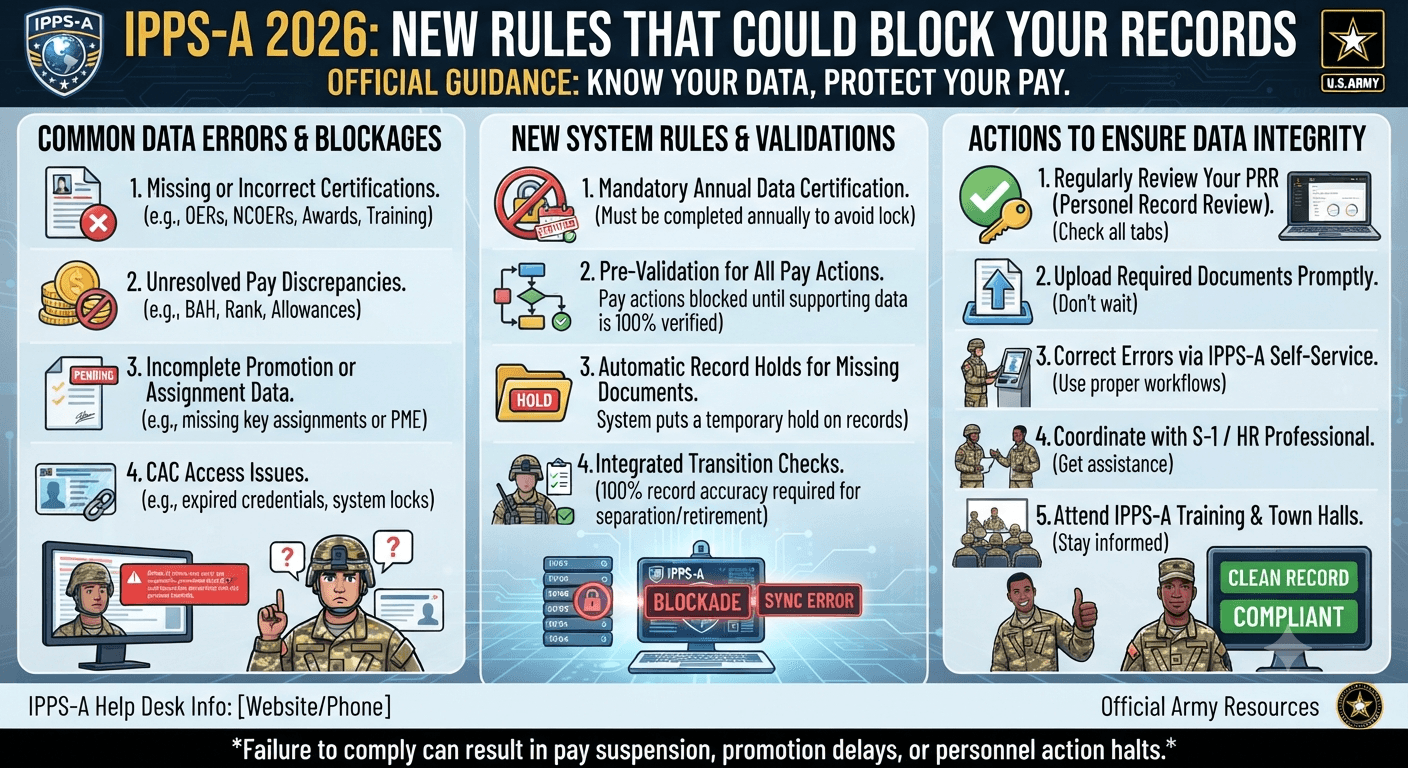
IPPS-A 2026: The Army’s New Rules That Could Block Your Records – Veterans Action Required
The IPPS-A 2026 updates include new APPSEC requirements that may block access to personnel records if you don’t act, plus restrictions on manually editing MOS data that could affect your official history. Veterans who have already separated should know that DD‑214 access now works differently, and all service members must review their records for accuracy.
Quick Facts
| Item | Details |
|---|---|
| System | Integrated Personnel and Pay System – Army (IPPS‑A) |
| Key 2026 Changes | APPSEC recertification required; manual MOS edits disabled; WORLD ROWSEC locked |
| Who’s Affected | All Army components: Active, Guard, Reserve |
| Veterans Action Needed | Verify records before separation; use National Archives for DD‑214 after discharge |
| Official Agency | U.S. Army IPPS‑A Functional Management Division |
| Help Desk | 1‑844‑474‑7772 (7 a.m. – 7 p.m. ET daily) |
| Website | ipps‑a.army.mil |
What’s Changing in IPPS‑A 2026
APPSEC Requirements: Access Rules Are Getting Stricter
As of May 11, 2026, access request forms were modified to include ROWSEC (Row Level Security) validation. All members must submit new requests for recertification .

This means:
If you’re a current Soldier, you must submit a new access request to recertify your system access—recertification won’t happen automatically.
WORLD ROWSEC access is now locked. All new requests for WORLD-level access must be approved at specific levels:
Active Duty (COMPO 1): Human Resources Command (HRC) Enterprise Modernization Directorate
National Guard (COMPO 2): National Guard Bureau (NGB) Training Office
Army Reserve (COMPO 3): USARC Manning Division

What this means for you: If you don’t recertify, you could lose access to your IPPS‑A records. For veterans who have already separated, access to IPPS‑A may be more restricted, and you’ll need to use the National Archives for personnel records .
MOS Accuracy: Manual Edits Are Now Disabled
IPPS‑A 2026 has disabled the ability for members and most HR professionals to manually edit Military Occupational Specialty (MOS) data .
Why this matters:
Any system transaction updating an MOS now automatically pulls data from authoritative sources. Manual edits are no longer allowed.
Only HR System Admins can update, add, or delete job codes from the Person Profile page .
Proposed job codes for promotions and demotions are now automatically routed based on career path tables.
This could block your record from being corrected if you don’t catch errors early. If your MOS history is wrong, you’ll need to work through an HR System Admin to fix it.
DD‑214 Integration: New Process for Veterans
Veterans May Qualify for Extra Benefits
Check available financial assistance, healthcare programs and other opportunities that may apply to you.
Check EligibilityIPPS‑A has integrated the DD‑214 generation process, but veterans who already separated must request their DD‑214 through the National Archives .
How the new process works:
For current Soldiers: DD‑214 is generated through IPPS‑A, allowing for review and corrections before completion .
For separated veterans: You must request your DD‑214 through:
National Archives: archives.gov/veterans/military-service-records
eVetRecs: https://www.archives.gov/veterans/military-service-records/evetrecs-help
milConnect: https://milconnect.dmdc.osd.mil/milconnect/
Local Veteran Service Offices (using SF‑180)
Important: IPPS‑A does not retain DD‑214 records for separated veterans. If you’re already out, you cannot get your DD‑214 through IPPS‑A.
Who Is Affected by These Changes
| Group | Impact | Action Required |
|---|---|---|
| Active Duty Soldiers | Must recertify APPSEC access; cannot manually edit MOS | Submit new access request; review MOS accuracy |
| National Guard | Same as Active Duty; WORLD ROWSEC approved by NGB | Submit new access request |
| Army Reserve | Same as Active Duty; WORLD ROWSEC approved by USARC | Submit new access request |
| Veterans (separated) | Cannot access IPPS‑A for records; DD‑214 through National Archives | Request records via archives.gov or milConnect |
| Retirees | Limited IPPS‑A access; records through National Archives | Use National Archives for personnel files |
Step-by-Step: How to Protect Your Records
For Current Soldiers
Step 1: Submit APPSEC Recertification
Log in to IPPS‑A (my.ippsa.army.mil)
Submit a new access request with the required ROWSEC validation
Include a statement of justification if requesting WORLD ROWSEC
Step 2: Review Your MOS Data
Check your Person Profile for MOS accuracy
If errors exist, contact your HR System Admin—manual edits are no longer available
Ensure only one “active” Primary MOS, one “active” Secondary MOS, and zero to many “active” Additional MOS are listed
Step 3: Review Your Soldier Talent Profile (STP)
The STP was redesigned in 2026 based on user feedback, with 88% of users preferring the new layout
Check for accurate readiness data, security clearance, and AFT dates
Use universal deep-linking to update source data directly
Step 4: Verify Your DD‑214 Data Before Separation
Ensure your separation assignment is in “Approved” status
Review all data for accuracy before the DD‑214 is finalized
Contact the transition center if you need corrections
For Veterans Who Have Already Separated
Step 1: Request Records Through National Archives
Use eVetRecs for online requests
Submit SF‑180 by mail or fax if needed
Step 2: Use milConnect for Electronic Records
Go to milconnect.dmdc.osd.mil
Access your personnel records through the self-service portal
Note: iPERMS data is no longer available in My Record Portal—use the iPERMS site directly
Step 3: Contact Local Veteran Service Offices
VSOs can help with records requests and benefit claims
They may assist with SF‑180 submissions and DD‑214 retrieval
Common Questions
1. Will I lose access to my IPPS‑A records if I don’t recertify?
Yes. Under the new APPSEC requirements, all members must submit a new access request for recertification. If you don’t act, your access may be blocked .
2. Can I fix my MOS data if it’s wrong in IPPS‑A?
Only HR System Admins can manually edit MOS data now. Members and most HR professionals can no longer manually edit, update, or change MOS in Person Profiles .
3. How do I get my DD‑214 as a veteran?
Veterans must request DD‑214 through the National Archives at archives.gov/veterans/military-service-records, milConnect, or local Veteran Service Offices (using SF‑180) .
4. Are these changes for all Army components?
Yes. IPPS‑A serves Active Duty, Army National Guard, and Army Reserve .
5. What is WORLD ROWSEC and why is it locked?
WORLD ROWSEC provides the broadest system access. As of May 7, 2026, new requests are locked and require higher-level approval from HRC, NGB, or USARC depending on component .
6. What’s new in the Soldier Talent Profile (STP)?
The redesigned STP features a permanent header with immediate actions, consolidated readiness metrics (AFT dates, medical readiness, security clearance), universal deep-linking to source pages, and PDF export capability .
7. Can I still access iPERMS through IPPS‑A?
iPERMS data is no longer available in My Record Portal. Users must go directly to the iPERMS site to access their records .
8. What if I already separated and never received my DD‑214?
Contact the transition center at the installation you departed from. If separated, use the Army Service Center 24-hour line at 1-844-474-7772 .
9. When do these changes take effect?
The new APPSEC and ROWSEC rules took effect May 2026. MOS manual editing is also disabled as of 2026 .
10. Where can I get help with IPPS‑A?
Call the IPPS‑A Help Desk at 1-844-474-7772 (7 a.m. – 7 p.m. ET daily), submit a CRM case through the IPPS‑A Help Center tile, or email ippsa.helpcenter@army.mil .
Key Takeaways
IPPS‑A 2026 APPSEC changes require all members to submit new access requests for recertification—failure to act could block records access .
Manual MOS data edits are now disabled—only HR System Admins can make corrections, so review your MOS history now .
DD‑214 for separated veterans is accessed through the National Archives, not IPPS‑A .
WORLD ROWSEC access is locked and requires higher-level approval for Active, Guard, and Reserve components .
The Soldier Talent Profile (STP) was redesigned in 2026 with 88% user preference for the new layout, featuring consolidated readiness data .
Current Soldiers should review records now before separation to avoid future access issues.
Veterans should use milConnect or the National Archives for personnel records, as iPERMS data is no longer available through My Record Portal .
The IPPS‑A Help Desk is available at 1-844-474-7772 for questions or assistance .
Official Resources
IPPS‑A Official Website: ipps‑a.army.mil
IPPS‑A Help Desk: 1‑844‑474‑7772
National Archives Military Records: archives.gov/veterans/military‑service‑records
eVetRecs: archives.gov/veterans/military-service-records/evetrecs-help
milConnect: milconnect.dmdc.osd.mil
IPPS‑A Mobile App: Available on Apple Store and Google Play
How to Recertify IPPS-A Access in 2026
The Integrated Personnel and Pay System – Army (IPPS-A) 2026 represents a significant evolution in the way the Army manages personnel and pay records. Specifically designed to modernize record-keeping practices, this initiative aims to create a more efficient and transparent system for service members, including veterans and those in transition. The primary objective of IPPS-A is to ensure that accurate, timely, and secure personnel information is readily available, which is vital for effective Army operations and for the well-being of its personnel.
In light of these updates, there are crucial changes that veterans and transitioning service members need to be aware of. One of the key features of IPPS-A is the centralized platform replacing multiple legacy systems, allowing for improved accessibility and management of personnel records. This consolidated system is intended to enhance interoperability, enabling various Army branches to communicate better regarding personnel data, thus streamlining processes for pay and benefits.
Moreover, given the sensitive nature of personnel records, the implementation of enhanced security protocols is also a focal point in this update. Veterans should understand how their access to records may be affected as these new regulations are set in place. Knowledge of these changes is essential for veterans who may need to access their records and navigate pending transitions. The Army’s initiative with IPPS-A 2026 is an attempt to address legacy issues while fostering transparency and ensuring that all personnel can manage their own records effectively and securely.
What is the New IPPS-A Lockdown?
On May 7, 2026, significant changes were implemented in the Integrated Personnel and Pay System – Army (IPPS-A), specifically concerning access to personnel records. This update introduced a new protocol referred to as ‘world rowsec,’ which effectively locks down access to certain critical records. This development is particularly noteworthy as it addresses the management of service members’ and veterans’ records, marking a substantial shift in how data accessibility is handled across the Army.
The ‘world rowsec’ lockdown restricts who can view and modify personnel files, intending to enhance security and privacy for individuals’ data. Under this system, access to records is limited to authorized personnel only, which aims to prevent unauthorized alterations and safeguard sensitive information. While the intent behind this measure is commendable, it inherently raises concerns regarding the ease of access to personal records for the service members and veterans who may need to reference their historical data or require updates to their files due to career transitions or other administrative needs.
Furthermore, the lockdown may introduce bureaucratic delays when veterans or service members seek to access their records for benefits, healthcare needs, or retirement preparations. The requirement for authentication and the potential increases in processing times could lead to challenges for those needing timely access to their personal and service-related information. As the Army fully implements this new protocol, individuals must remain aware of the changes and advocate for transparent processes to ensure that their access to vital records is not unduly hampered by these security measures.
Impact on Veterans and Transitioning Service Members
The recent implementation of the Integrated Personnel and Pay System – Army (IPPS-A) introduces significant changes that could impede veterans and transitioning service members, especially those who have separated from the military in the last three years. One of the most critical aspects these individuals may face is the accessibility of essential military records, including the DD214, retirement points, and various personnel files. These documents are crucial for veterans as they pursue benefits, employment, and additional post-service opportunities.
Historically, the DD214 has been an indispensable document for veterans, serving as proof of service and facilitating access to benefits such as healthcare and education. Under the new IPPS-A system, transitioning service members may experience delays or complications in obtaining these records due to changes in reporting and processing protocols. This scenario could lead to inadvertent issues, including difficulty in securing benefits or proving eligibility for job opportunities.
Moreover, veterans who have served in different capacities may find it challenging to trace their retirement points accurately. Accurate accounting of these points is significant for benefits such as retirement pay and other veteran services. The shift to a new personnel system could result in discrepancies during the transition, complicating the verification of service-related achievements.
Access to personnel files, which provide comprehensive records of service history, may also be negatively impacted. Such records are essential for veterans who may need to resolve various administrative or legal matters related to their service. The potential difficulty in retrieving these essential documents highlights the importance of awareness among veterans and transitioning service members to proactively monitor changes and seek assistance during this transition to IPPS-A.
Permission Changes: Who Can Access Your Records Now?
The updated Integrated Personnel and Pay System – Army (IPPS-A) 2026 introduces significant changes in the way personnel records are accessed, particularly concerning the hierarchy of approval for access requests. Under the previous system, field-level commanders had the authority to approve access to records. However, with the new enhancements implemented through IPPS-A 2026, the decision-making power has shifted to elevated command levels. This transition aims to create a more streamlined and secure process while enhancing oversight on sensitive information.
Now, requests for access to personnel records must go through designated higher command, thereby reducing the risk of unauthorized access. This new hierarchy delineates a clear path for approval, requiring that requests be vetted by senior personnel who are more strategically positioned to evaluate the necessity and appropriateness of access. Such changes indicate a move towards a more centralized structure, where responsibility and accountability are better managed.
Additionally, this transformation enables a uniform approach across the Army, ensuring consistency in how record access is handled. It also prompts all service members and veterans to be cognizant of who may view their records. They should be aware that higher command is now the gatekeeper, reinforcing the importance of data protection in a digital age. Consequently, it is crucial for all personnel to remain informed about these changes, as they may impact individual access rights and affect the overall transparency of personnel record management.
Steps to Access Your Records After the Lockdown
In light of the recent updates to the Integrated Personnel and Pay System – Army (IPPS-A) set to take effect in 2026, veterans must take proactive measures to access their military records due to a potential record lockdown. Understanding the process for record retrieval is essential for veterans who may need to update their personal information or access benefits tied to their military service.
The first step for veterans is to identify the appropriate military branch or office that holds their records. Most veterans should connect with the National Archives, specifically the National Personnel Records Center (NPRC), which maintains military service records. To initiate a request, veterans can use the Standard Form 180 (SF-180), which can be submitted online, via mail, or by fax. This form requires personal information including service details such as service number, branch of service, and dates of service, which is crucial for locating the correct file.
It’s important to include any additional information that can expedite the retrieval process. Veterans should also document any previous requests or correspondence related to their records. This helps in case of discrepancies or issues in locating files. In situations where service records may have been lost, veterans can provide alternate documentation, such as discharge papers, to substantiate their claims.
For other specific inquiries or for accessing sensitive records such as medical or dental files, veterans are advised to directly contact their respective military health care provider or relevant office. Various offices, like the VA (Department of Veterans Affairs), can also facilitate additional support and resources regarding record access.
In conclusion, being aware of these processes and taking timely action will help veterans navigate the implications of the IPPS-A rollout effectively. Ensuring access to one’s records is vital for maintaining continuity in benefits and services deserved by those who have served in the military.
Common Issues and Challenges
The implementation of the Integrated Personnel and Pay System – Army (IPPS-A) represents a significant transition for veterans. However, this shift may lead to several complications and barriers that could impede veterans’ access to their records. One major concern is the potential for delays in processing requests. Since the IPPS-A system is complex and involves various functionalities, veterans may find that accessing their records takes longer than expected. Such delays can result in frustration, especially for those in need of timely access to their military information for benefits, services, or employment opportunities.
Miscommunication is another critical issue that may arise as veterans interact with the new system. The unfamiliarity with the IPPS-A processes may lead to misunderstandings regarding how to retrieve documents or what specific information is required. Veterans may also fall victim to an unclear chain of communication within the Army’s administration, where information may not be reliably disseminated. This challenge is compounded by the varying levels of digital literacy among veterans, which can further hinder their ability to navigate the IPPS-A system effectively.
Bureaucratic hurdles pose yet another significant challenge for veterans using the IPPS-A. The complexity of the system can create obstacles that obstruct smooth navigation. As veterans face new administrative protocols, they might encounter issues such as incomplete applications or inadequate support from existing resources. Additionally, the shift to a new system may lead to a temporary increase in the volume of requests received by personnel offices, further exacerbating delays and contributing to veterans’ overall dissatisfaction with the system.
Tips for Veterans Navigating IPPS-A
As the Integrated Personnel and Pay System-Army (IPPS-A) becomes operational, veterans and transitioning service members are encouraged to familiarize themselves with the system to effectively manage their records. This platform is designed to streamline personnel and pay processes, but it also requires active engagement from users to ensure that their records are accurate and accessible.
One of the first tips for veterans is to explore the training materials provided by the Army. The Army has developed a range of guides, tutorials, and webinars that elucidate the functionalities of IPPS-A. Taking the time to review these resources can greatly enhance one’s understanding of how to navigate the system efficiently. It’s also advisable to participate in community discussions and forums, where veterans share insights and experiences regarding the system’s usage.
Second, establishing a dedicated record-checking routine is essential. Regularly accessing your IPPS-A account can help veterans keep track of any changes or updates to their personal data. It is recommended to set reminders to review records at least every few months, or whenever there is a significant life event that may affect one’s personnel information, such as a change in employment or family status.
Furthermore, leveraging available support networks can prove invaluable. Engaging with veteran organizations, local service officers, or transitioning assistance programs can provide additional guidance tailored to individual circumstances. These entities can offer assistance with resolving any discrepancies within records that may arise in the IPPS-A system.
Lastly, advocating for one’s rights is crucial. Veterans should be aware that they have the ability to request changes or corrections to their records. Maintaining thorough documentation of any military-related accomplishments and milestones will aid in this process.
Importance of Staying Informed About Changes
Staying informed about updates related to the Integrated Personnel and Pay System – Army (IPPS-A) is crucial for veterans. The rigorous implementation of new rules and policies, including those associated with IPPS-A, can have significant implications on an individual’s military records, benefits, and overall eligibility. Therefore, vigilance in monitoring these changes is essential for all veterans.
The IPPS-A system is designed to integrate personnel and pay data into one seamless platform, promising enhanced efficiency in managing records. However, as updates are implemented, it is possible that certain aspects of the program could inadvertently restrict access to an individual’s historical records. Consequently, veterans must remain proactive in understanding how these changes may affect not only their administrative affairs but also their future interactions with various military benefits and entitlements.
Regularly checking for system updates and policy modifications helps veterans to effectively navigate potential challenges that could arise due to unexpected changes. This vigilance enables them to address any discrepancies in their records promptly, ensuring that all accurate information is reflected. Moreover, being well-informed about the latest legislative and procedural changes empowers veterans to advocate for their rights and access the services they are entitled to without unnecessary delays.
In addition, updates in policies often come with an agenda for improving overall service and operational effectiveness; therefore, understanding these objectives may help veterans to align with the expectations of the Army. Overall, proactive engagement with the IPPS-A system and staying current with any developments is a fundamental step for veterans to safeguard their records and maintain their eligibility for various benefits.
Conclusion and Call to Action for Veterans
As we have discussed throughout this blog post, the upcoming implementation of the Integrated Personnel and Pay System – Army (IPPS-A) introduces significant changes to the personnel records management process. These alterations could potentially impact how veterans access their military records, if they are not adequately informed about the system and its requirements. Understanding the implications of these new rules is crucial for veterans who want to ensure that their records remain accessible and accurate.
Veterans must become proactive in learning about the IPPS-A updates and how these may influence their ability to retrieve personnel records in the future. One key aspect to focus on is the necessity of maintaining up-to-date personal information within the new system. This ensures that any requests for records can be processed without delay or complications. Additionally, it is vital to familiarize themselves with the new digital platforms that the IPPS-A will utilize, as they may differ from previous systems used by the Army.
We urge all veterans to take immediate action: contact your local veterans’ affairs office or the appropriate military representative to seek guidance regarding the IPPS-A changes. Examine the resources available through the Army’s official channels to obtain reliable information on how these new rules will affect you. The landscape of military personnel management is evolving, and staying informed will help ensure that no veteran is left behind when accessing their vital records.
In summary, heightened awareness and deliberate action will be essential for veterans as they navigate this transformation within the Army’s personnel management framework. It is imperative to adapt to these changes to secure the records that reflect service members’ dedication and sacrifices.
🇺🇸 IMPORTANT DISCLAIMER – Veterans Benefits Information
This site provides general information about U.S. Department of Veterans Affairs (VA) benefits for educational and informational purposes only.
- Not Official: We are NOT affiliated with, endorsed by, or connected to the U.S. Department of Veterans Affairs (VA), the Veterans Benefits Administration (VBA), the Veterans Health Administration (VHA), or any other government agency.
- No Legal/Financial Advice: The content on this website is for informational purposes only and does not constitute legal, financial, or medical advice. VA benefits rules change frequently – always consult with an accredited Veterans Service Officer (VSO) or a qualified professional for your specific situation.
- Official Sources: For official, binding information and to apply for benefits, always visit official .gov websites: VA.gov, Benefits.VA.gov, or SSA.gov.
- No Data Collection: This site does not collect, store, or process any personal information. It does not have login forms, contact forms, or any system to capture user data. We never ask for your Social Security Number, bank details, or any personal information.
- 🚨 Scam Alert: The VA and other government agencies never charge fees for benefit applications. If anyone asks for money to "process" your VA claim, it is a scam. Report it to the VA Office of Inspector General at VA.gov/OIG.
- Advertising: This site uses third-party advertising (Adsterra) to cover operational costs. We do not endorse or guarantee any products or services advertised.
📌 Information provided as of June 2026. Always verify current eligibility and rules with official .gov sources.
This site is not affiliated with the U.S. Department of Veterans Affairs or any government agency. All information is for educational purposes only. Please visit VA.gov for official information.
