
SNAP Benefits for Veterans in South Carolina: 2026 Eligibility, Income Limits, and Application Guide
Veterans in South Carolina may qualify for SNAP (food stamps) if their household gross monthly income is at or below 130% of the federal poverty level — $1,696 for one person or $3,482 for a family of four as of October 2025. As of February 1, 2026, veterans are no longer exempt from the 80-hour monthly work requirement. Apply online at benefitsportal.dss.sc.gov.
Quick Facts
| Item | Details |
|---|---|
| Benefit | Monthly SNAP food assistance (EBT card) |
| Eligibility | Veterans, active duty, Guard, Reserve, and military families with low income |
| Application | Online at benefitsportal.dss.sc.gov, by mail, fax, or in person |
| Processing Time | Up to 30 days (expedited within 7 days if eligible) |
| Official Agency | SC Department of Social Services (DSS) |
| Required Forms | DSS Form 3807 (application); DSS Form 16176 (ESAP for elderly) |
| Updated For | 2026 (OBBBA changes effective February 1, 2026) |
What Is SNAP and Why Does It Matter for Veterans?
SNAP — the Supplemental Nutrition Assistance Program — is the largest federal anti-hunger program in the United States. It provides monthly benefits on an EBT card that households use to purchase groceries, including fruits, vegetables, whole grains, meat, dairy, and other eligible food items. In South Carolina, more than 520,000 residents received SNAP benefits in December 2025. Roughly 48% of recipients are under 18, and nearly 25% are over 50.

For veterans, SNAP matters because food insecurity affects a meaningful share of the veteran population. An estimated 21,000 veterans in South Carolina — about 6% of the state’s veteran population — use SNAP, according to the Center on Budget and Policy Priorities. SNAP is not a VA program, and you do not need to be enrolled in VA healthcare or receiving VA disability compensation to qualify. It is administered by the South Carolina Department of Social Services (DSS) and funded by the USDA Food and Nutrition Service.

What veterans should do next: Check the income limits below. If your household gross monthly income falls at or below 130% of the federal poverty level for your household size, submit an application through the DSS Benefits Portal.
Who Qualifies for SNAP in South Carolina?
Veterans, active-duty service members, National Guard members, Reservists, military families, surviving spouses, and caregivers may all qualify for SNAP if they meet income and non-financial eligibility requirements. There is no separate SNAP program for veterans — the eligibility rules are the same for all applicants. However, certain military-specific income exclusions and VA benefit rules affect how eligibility is calculated.
Key eligibility factors include:
Household income at or below 130% of the federal poverty level (gross monthly)
U.S. citizenship or qualified noncitizen status
South Carolina residency (no durational residency requirement)
Social Security Number or proof of application for one
Work registration unless exempt
Who is not eligible: Ineligible noncitizens, ineligible students, individuals disqualified for noncompliance with work requirements, individuals disqualified for intentional program violations, and individuals convicted of a drug-related felony after August 22, 1996. South Carolina is the only state that enforces a full lifetime ban on SNAP for people with drug felony convictions regardless of rehabilitation.
SNAP Income Limits for South Carolina (October 2025 – September 2026)
Veterans May Qualify for Extra Benefits
Check available financial assistance, healthcare programs and other opportunities that may apply to you.
Check EligibilitySouth Carolina uses a strict 130% federal poverty level gross income ceiling with no broad-based categorical eligibility expansion. This means your household’s total gross monthly income — before deductions — must be at or below the limit for your household size.
| Household Size | Gross Monthly Income (130% FPL) | Net Monthly Income (100% FPL) | Maximum Monthly SNAP Benefit |
|---|---|---|---|
| 1 | $1,696 | $1,305 | $298 |
| 2 | $2,292 | $1,763 | $546 |
| 3 | $2,888 | $2,221 | $783 |
| 4 | $3,482 | $2,679 | $994 |
| 5 | $4,078 | $3,137 | $1,180 |
| 6 | $4,674 | $3,595 | $1,416 |
| 7 | $5,270 | $4,053 | $1,565 |
| 8 | $5,866 | $4,511 | $1,789 |
Source: USDA FNS income eligibility standards effective October 1, 2025 through September 30, 2026.
Important note for veterans: Households with an elderly (60+) or disabled member must meet only the net income eligibility standard (100% FPL). All other households must meet both the gross income test (130% FPL) and the net income test (100% FPL).
How Military Income Affects SNAP Eligibility
Military income is treated differently depending on its source. Understanding which pay types count toward SNAP eligibility is critical for active-duty, Guard, and Reserve families.
| Income Type | Counts Toward SNAP? | Notes |
|---|---|---|
| Basic Pay | Yes | Counted as earned income |
| Basic Allowance for Housing (BAH) | Yes | Counted as unearned income |
| Basic Allowance for Subsistence (BAS) | Yes | Counted as unearned income |
| Combat Pay | No | Excluded from income |
| Hostile Fire Pay | No | Excluded from income |
| Imminent Danger Pay | No | Excluded from income |
| VA Disability Compensation | Yes | Counted as unearned income |
| VA Pension | Yes | Counted as unearned income |
| Military Retirement Pay | Yes | Counted as unearned income |
The exclusion of combat-related pay from SNAP income calculations was clarified in USDA FNS guidance. BAH, BAS, and other special pay and allowances are counted as income, but combat pay, Hostile Fire pay, and Imminent Danger Pay are not. VA disability compensation and military retirement are both counted as unearned income for SNAP purposes.
What veterans should do next: Gather your most recent Leave and Earnings Statement (LES) or VA award letter to document all income sources. If you receive combat-related pay, ensure it is clearly excluded from your income calculation.
New SNAP Work Requirements for Veterans (2026 Update)
As of February 1, 2026, veterans are no longer exempt from the SNAP work requirement. This is the most significant change affecting veterans in South Carolina under the One Big Beautiful Bill Act (OBBBA), signed into law on July 4, 2025.
What changed:
Age range expanded: The work requirement now applies to able-bodied adults without dependents (ABAWDs) ages 18 through 64. Previously, the upper age limit was 54.
Veteran exemption eliminated: Veterans were temporarily exempt under the Fiscal Responsibility Act of 2023. That exemption was removed entirely through October 1, 2030.
Caregiver exemption narrowed: Adults caring for children under 14 remain exempt. Caregivers of children ages 14 through 17 are now subject to work requirements unless they meet another exemption.
Waiver rules tightened: Only areas with unemployment rates above 10% can qualify for ABAWD waivers.
Work requirement details:
| Requirement | Details |
|---|---|
| Hours needed | 80 hours per month (about 20 hours/week) |
| Time limit | 3 months in any 36-month period without meeting the requirement |
| Qualifying activities | Paid employment, volunteer work, job training, approved education |
| Ages covered | 18–64 |
| Veterans exempt? | No (eliminated through October 1, 2030) |
Veterans who do not meet the 80-hour requirement within a 3-month period in a 36-month window will lose SNAP eligibility unless they qualify for another exemption.
What veterans should do next: If you are an ABAWD veteran, document your work hours monthly. If you are enrolled in VA vocational rehabilitation (VR&E) or another approved training program, those hours may count toward the 80-hour requirement. Contact your local DSS office to confirm which activities qualify.
SNAP Exemptions That Still Apply to Veterans
Even though the veteran-specific exemption has been eliminated, several other exemptions remain available. You do not need to meet the 80-hour work requirement if you fall into any of these categories:
Age: You are under 18 or 65 or older
Disability: You receive disability benefits or have a documented physical or mental health condition that limits work
Caregiving: You are responsible for a child under 14 in the household
Pregnancy: You are pregnant
Treatment program: You are in a drug or alcohol treatment and rehabilitation program
Veteran with service-connected disability: If your VA disability rating prevents you from working 80 hours per month, you may qualify for an exemption based on disability status. VA disability compensation is counted as income, but a service-connected disability that limits your ability to work may exempt you from the ABAWD time limit.
Important: The exemption for individuals receiving VA disability compensation is not automatic. You must provide documentation of your disability and its impact on your ability to work. Contact your DSS caseworker to request a disability exemption determination.
How to Apply for SNAP in South Carolina
You can apply for SNAP through several methods. The application process takes up to 30 days, but expedited processing is available within 7 days for households with very low income and resources.
Online Application (Recommended)
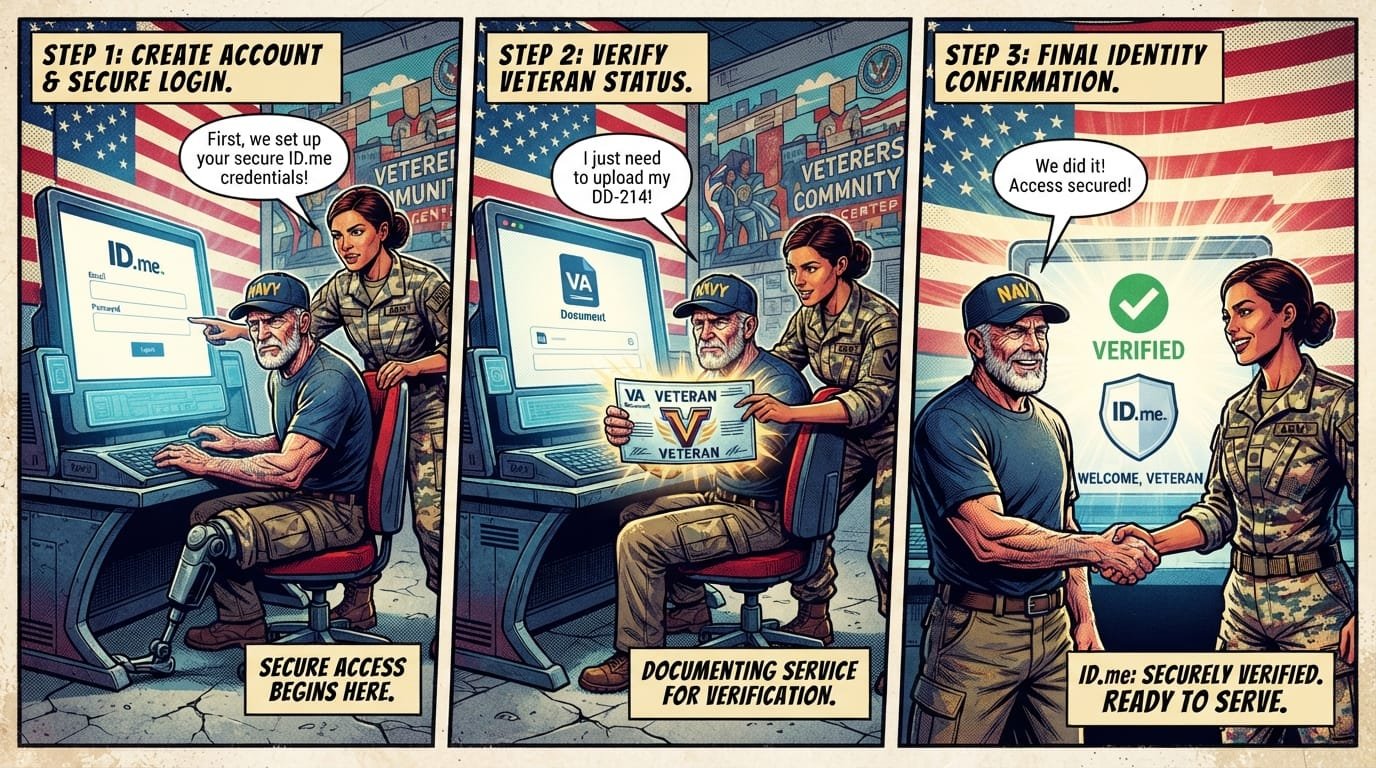
Visit the DSS Benefits Portal at benefitsportal.dss.sc.gov
Create a secure account with your email and password
Complete the online SNAP application (DSS Form 3807)
Upload required documents electronically
Submit and track your application status online
The DSS Benefits Portal allows you to apply, check your application status, and manage your benefits in one place.
Other Application Methods
In person: Visit your local DSS county office
By mail: Submit your completed application to your county office
By fax: Fax your application to your county DSS office
By phone: Call DSS Connect at 1-800-616-1309 for assistance
Required Documents
| Document Type | Examples |
|---|---|
| Identity | Driver’s license, state ID, military ID, passport |
| Income | LES, VA award letter, pay stubs, Social Security award letter |
| Residency | Utility bill, lease agreement, voter registration |
| Citizenship/Immigration | Birth certificate, passport, green card, military records |
| Social Security Numbers | SSN cards for all household members |
| Medical Expenses (if claiming) | Medical bills for elderly or disabled household members |
SNAP Application Processing Times
The standard processing time for a SNAP application in South Carolina is up to 30 days from the date your application is filed. Your application is not considered valid until it contains your name, address, and signature.
Expedited processing: If your household has gross monthly income below $150 and resources below $100, or if your combined gross income and resources are less than your monthly rent plus utilities, you may qualify for expedited SNAP benefits within 7 days.
What veterans should do next: Submit your application online for the fastest processing. Keep copies of all documents you submit. If you do not hear back within 30 days, call DSS Connect at 1-800-616-1309 to check your status.
SNAP Benefit Amounts and Payment Dates
SNAP benefits are loaded onto an EBT card each month. The benefit amount depends on household size, income, and allowable deductions.
Maximum monthly benefit amounts (FY 2026):
| Household Size | Maximum Monthly Benefit |
|---|---|
| 1 | $298 |
| 2 | $546 |
| 3 | $783 |
| 4 | $994 |
| 5 | $1,180 |
| 6 | $1,416 |
| 7 | $1,565 |
| 8 | $1,789 |
Your actual benefit may be lower than the maximum depending on your net income after deductions.
Payment dates: SNAP benefits are issued on a staggered schedule based on the last digit of your case number. Benefits are typically available within the first 10 days of each month. Check your DSS Benefits Portal account for your specific issuance date.
South Carolina SNAP Special Programs
Elderly Simplified Application Project (ESAP)
ESAP is a simplified application process for elderly households. To qualify:
All household members are 60 years or older
No household members have earned income
No household members receive SNAP under SCCAP
ESAP households complete a shorter application (DSS Form 16176), participate in one initial interview, and then complete a one-page mail-in form yearly without additional interviews. This can benefit older veterans who are 60 or older and living on fixed retirement or VA pension income.
South Carolina Combined Application Project (SCCAP)
SCCAP is a simplified SNAP program for Supplemental Security Income (SSI) recipients. To qualify:
You receive SSI in the amount of $994.00 or $1,014.00
You have no earned income
You live alone or purchase and prepare meals separately
SCCAP applicants are automatically enrolled in SNAP through their SSI application, eliminating the need for a separate SNAP application.
Recertification and Reporting Changes
SNAP certification periods in South Carolina are typically 6 months for families with children. Some households may be certified for 12 months. You must complete a recertification before your certification period ends to continue receiving benefits.
Reporting requirements:
Report changes in income, household composition, or address within 10 days
For 6-month recertification households, report when gross monthly income exceeds 130% of the federal poverty level
Complete the DSS Form 3807A at the 12th month for annual recertification
What veterans should do next: Mark your calendar for your recertification date. Missing your recertification deadline will result in a gap or termination of benefits. Use the DSS Benefits Portal to submit your recertification online.
Common Mistakes Veterans Make with SNAP
1. Assuming VA disability disqualifies you. VA disability compensation counts as income, but it does not automatically disqualify you from SNAP. Many veterans receiving VA disability still qualify based on household size and other income.
2. Not reporting all income sources. BAH, BAS, and military retirement are all countable income. Failing to report them can lead to overpayments and repayment requirements.
3. Missing the work requirement. Since February 1, 2026, veterans are no longer exempt. If you are an ABAWD veteran, document your work hours and report them to DSS.
4. Applying in the wrong state. SNAP is state-administered. If you move to South Carolina, you must apply in South Carolina and meet South Carolina’s income limits.
5. Not appealing a denial. If your application is denied, you have the right to a fair hearing. Do not assume the decision is final.
Appeals Process: Fair Hearings
If your SNAP application is denied, your benefits are reduced, or your benefits are terminated, you have the right to request a fair hearing. You must request the hearing within 90 days of the date on your notice.
How to request a fair hearing:
Call toll-free: 1-800-311-7220
Call locally: (803) 898-8080
TTY: 1-800-311-7219
Write to your local DSS office
Continued benefits: If you request a fair hearing within 10 days of your notice, your benefits may continue at the previous level until the hearing decision is issued. If you lose the hearing, you may have to repay the continued benefits.
State Differences: South Carolina vs. Other States
SNAP is a federal program administered by states, which means eligibility rules, income limits, and application processes vary. Here is how South Carolina compares on key factors:
| Factor | South Carolina | National Context |
|---|---|---|
| Gross income limit | 130% FPL (strict) | Some states use 165%–200% FPL |
| Asset test | No asset test | Some states have asset limits |
| Drug felony ban | Lifetime ban | Most states have modified or no ban |
| ABAWD age range | 18–64 | Federal minimum is 18–54 (states may expand) |
| Veteran exemption | Eliminated (through 2030) | Federal law eliminated it nationwide |
| Certification period | 6 months (families) | Varies by state and household |
South Carolina’s 130% FPL gross income ceiling is among the strictest in the nation. The state does not have a broad-based categorical eligibility expansion, meaning applicants must meet the federal income limits without the higher thresholds some other states use.
Latest Rule Changes Affecting Veterans (2026)
The One Big Beautiful Bill Act (OBBBA), signed July 4, 2025, made several changes to SNAP that directly affect veterans:
ABAWD age range expanded from 18–54 to 18–64, bringing more veterans into the work requirement.
Veteran exemption eliminated through October 1, 2030.
Caregiver exemption narrowed to children under 14 only.
Waiver criteria tightened to areas with unemployment above 10%.
Additionally, beginning August 31, 2026, South Carolina will remove candy, energy drinks, soft drinks, and sweetened beverages from SNAP-eligible purchases. Diet or zero-sugar soft drinks remain eligible.
Common Questions
Can veterans receive SNAP and VA disability at the same time?
Yes. VA disability compensation counts as unearned income for SNAP eligibility, but it does not disqualify you. Many veterans receiving VA disability qualify for SNAP based on household size and total income. There is no prohibition against receiving both benefits simultaneously.
Do I need to be enrolled in VA healthcare to get SNAP?
No. SNAP is administered by the South Carolina Department of Social Services, not the VA. You do not need to be enrolled in VA healthcare or receiving VA benefits to apply for or receive SNAP.
Does military retirement count as income for SNAP?
Yes. Military retirement pay is counted as unearned income for SNAP eligibility determination. It must be reported on your application and will be included in the gross and net income calculations.
Are active-duty service members eligible for SNAP?
Yes, if their household income is below the 130% FPL limit. BAH and BAS count as income, but combat pay, Hostile Fire pay, and Imminent Danger Pay are excluded. Junior enlisted service members with large families may qualify.
What happens if I don’t meet the 80-hour work requirement?
If you are an ABAWD veteran and do not meet the 80-hour requirement, your SNAP benefits are limited to 3 months in any 36-month period. After that, you lose eligibility until you meet the requirement or qualify for another exemption.
Can National Guard and Reserve members get SNAP?
Yes. National Guard and Reserve members are eligible for SNAP on the same terms as other applicants. Their military pay and allowances count as income, and they must meet the same income limits and work requirements.
How long does SNAP approval take in South Carolina?
Standard processing takes up to 30 days from the date your application is filed. Expedited processing is available within 7 days for households with very low income and resources.
What if my SNAP application is denied?
You have the right to request a fair hearing within 90 days of the denial notice. Call 1-800-311-7220 to request a hearing. If you request within 10 days, your benefits may continue at the previous level until the decision.
Do I have to report VA disability COLA increases?
Yes. Cost-of-living adjustments to VA disability compensation increase your countable income. You must report income changes to DSS within 10 days. However, federal legislation has been introduced to exclude COLA increases from SNAP income calculations, but it has not been enacted as of 2026.
Can I get SNAP if I’m homeless?
Yes. Homeless individuals can qualify for SNAP. However, the exemption from work requirements for homeless individuals was eliminated under OBBBA effective February 1, 2026. Homeless veterans must meet the 80-hour work requirement or qualify for another exemption.
Key Takeaways
Veterans in South Carolina may qualify for SNAP if household gross income is at or below 130% of the federal poverty level — $1,696 for one person, $3,482 for a family of four.
As of February 1, 2026, veterans are no longer exempt from the 80-hour monthly work requirement.
VA disability compensation and military retirement count as income for SNAP; combat pay and Hostile Fire pay do not.
Apply online at benefitsportal.dss.sc.gov or by calling 1-800-616-1309.
Standard processing takes up to 30 days; expedited processing within 7 days for qualifying households.
South Carolina has a strict 130% FPL gross income ceiling with no asset test.
Households with elderly or disabled members only need to meet the net income limit.
You can appeal a denial through a fair hearing within 90 days.
An estimated 21,000 South Carolina veterans use SNAP.
Certification periods are typically 6 months for families with children.
Official Resources
South Carolina Department of Social Services (DSS): dss.sc.gov/assistance-programs/snap
DSS Benefits Portal (Apply Online): benefitsportal.dss.sc.gov
DSS Connect Phone: 1-800-616-1309
USDA Food and Nutrition Service (SNAP): fns.usda.gov/snap
USDA SNAP Work Requirements: fns.usda.gov/snap/work-requirements
USA.gov Benefits Finder: usa.gov/benefits


🇺🇸 IMPORTANT DISCLAIMER – Veterans Benefits Information
This site provides general information about U.S. Department of Veterans Affairs (VA) benefits for educational and informational purposes only.
- Not Official: We are NOT affiliated with, endorsed by, or connected to the U.S. Department of Veterans Affairs (VA), the Veterans Benefits Administration (VBA), the Veterans Health Administration (VHA), or any other government agency.
- No Legal/Financial Advice: The content on this website is for informational purposes only and does not constitute legal, financial, or medical advice. VA benefits rules change frequently – always consult with an accredited Veterans Service Officer (VSO) or a qualified professional for your specific situation.
- Official Sources: For official, binding information and to apply for benefits, always visit official .gov websites: VA.gov, Benefits.VA.gov, or SSA.gov.
- No Data Collection: This site does not collect, store, or process any personal information. It does not have login forms, contact forms, or any system to capture user data. We never ask for your Social Security Number, bank details, or any personal information.
- 🚨 Scam Alert: The VA and other government agencies never charge fees for benefit applications. If anyone asks for money to "process" your VA claim, it is a scam. Report it to the VA Office of Inspector General at VA.gov/OIG.
- Advertising: This site uses third-party advertising (Adsterra) to cover operational costs. We do not endorse or guarantee any products or services advertised.
📌 Information provided as of June 2026. Always verify current eligibility and rules with official .gov sources.
This site is not affiliated with the U.S. Department of Veterans Affairs or any government agency. All information is for educational purposes only. Please visit VA.gov for official information.
