
Introduction to Military Calisthenics
Military calisthenics is a form of exercise fundamentally rooted in the history of training regimes utilized by military personnel. This workout method emphasizes the use of body weight to develop functional strength, endurance, and flexibility, making it particularly appealing for women seeking to enhance their physical fitness without the requirement of equipment. Unlike traditional gym routines that often rely heavily on machines and free weights, military calisthenics focuses on movements that mimic real-life activities, thereby promoting physical literacy and movement efficiency.
Historically, military training has aimed at ensuring that soldiers maintain peak physical condition, often adopting rigorous training techniques that enhance core stability, balance, and agility. The principles of such training not only apply to men but have been thoughtfully adapted to meet the needs of women as well. Offering a holistic approach, military calisthenics encourages women to cultivate strength and discipline, empowering them to undertake more challenging physical tasks with confidence.

Adopting these disciplined training routines can yield numerous benefits. Primarily, bodyweight exercises like push-ups, squats, lunges, and planks allow anyone to improve their strength without the barriers of gym access or expensive equipment. Additionally, this type of workout can be performed anywhere—from a home environment to a park—making it accessible for women with varying lifestyles. Furthermore, military calisthenics has been tailored to promote muscle endurance and cardiovascular fitness, all while fostering community and camaraderie among participants.

In embracing military calisthenics, women not only gain the physical advantages of effective workouts but also develop mental resilience and confidence. This approach to fitness serves to empower women to take charge of their health while enhancing their physical capabilities, rooted in a structured yet adaptable training paradigm.
Benefits of Calisthenics for Women
Military calisthenics offer a plethora of advantages that make them particularly beneficial for women. One of the primary benefits is the development of functional strength. Unlike traditional weightlifting, calisthenics involves bodyweight movements that engage multiple muscle groups simultaneously. This type of training not only aids in building strength but also enhances coordination and balance, which are crucial for daily activities.
Moreover, engaging in calisthenics significantly improves endurance. As women perform exercises such as push-ups, pull-ups, and squats in circuit routines, they engage in high-repetition workouts that challenge cardiovascular and muscular endurance. Enhanced endurance leads to better performance in both fitness-related activities and everyday tasks.
Another noteworthy advantage is the boost in confidence that results from mastering calisthenics movements. Many women report feeling empowered as they progress in their abilities, such as completing their first pull-up or holding a challenging plank. This psychological enhancement is invaluable as it translates not only to fitness but also to various aspects of life, promoting a more positive self-image and a greater sense of achievement.
Veterans May Qualify for Extra Benefits
Check available financial assistance, healthcare programs and other opportunities that may apply to you.
Check EligibilityFurthermore, military calisthenics contribute to improved overall physical resilience. The varied movements help in increasing flexibility, reducing the risk of injury, and improving recovery time after strenuous activities. Alongside these physical benefits, individuals often experience heightened mental fortitude, enabling them to tackle challenges both in and out of the gym.
Numerous testimonials from women who have embraced military calisthenics reveal transformational stories of physical fitness and emotional well-being. For instance, many have shared how their dedication to calisthenics not only reshaped their bodies but also boosted their mental health, resulting in improved stress management and overall happiness.
Getting Started with Military Calisthenics
Embarking on a journey into military calisthenics can be an empowering experience for women seeking to improve their fitness levels without the need for gym equipment. This form of training emphasizes bodyweight exercises that can be performed effectively in a variety of settings, making it accessible and adaptable to different lifestyles. To begin, one needs to identify suitable spaces where these exercises can be conducted.
The beauty of military calisthenics lies in its minimal space requirements. A clear area of approximately 10 by 10 feet is sufficient for most exercises. This includes movements such as push-ups, squats, lunges, and jumping jacks. Common locations for workouts include the comfort of one’s home, which can easily be transformed into a workout zone, or outdoor spaces such as parks, gardens, or backyards, offering fresh air and a change of scenery.
In addition to understanding space requirements, it is essential to consider the surface on which workouts are performed. Ideally, a flat surface will provide stability and reduce the risk of injury. Grass, turf, or even a yoga mat can serve as effective options for outdoor workouts, while hardwood floors or carpet may work well for indoor routines. Ensuring a clutter-free environment enhances focus during exercises, setting the stage for a successful workout.
Adapting workouts to various environments helps in maintaining motivation. Whether at home or outdoors, changing settings from time to time can keep the training experience fresh. Moreover, performing military calisthenics in a group setting, such as with friends in a park, can provide social interaction, making it more enjoyable. By exploring flexible workout spaces, women can effectively integrate military calisthenics into their daily lives, fostering a routine that is both productive and engaging.
Military calisthenics is an effective way to build strength, agility, and endurance using bodyweight exercises. Below, we will explore five essential calisthenics movements that serve as a foundation for a comprehensive fitness routine.
Push-Ups
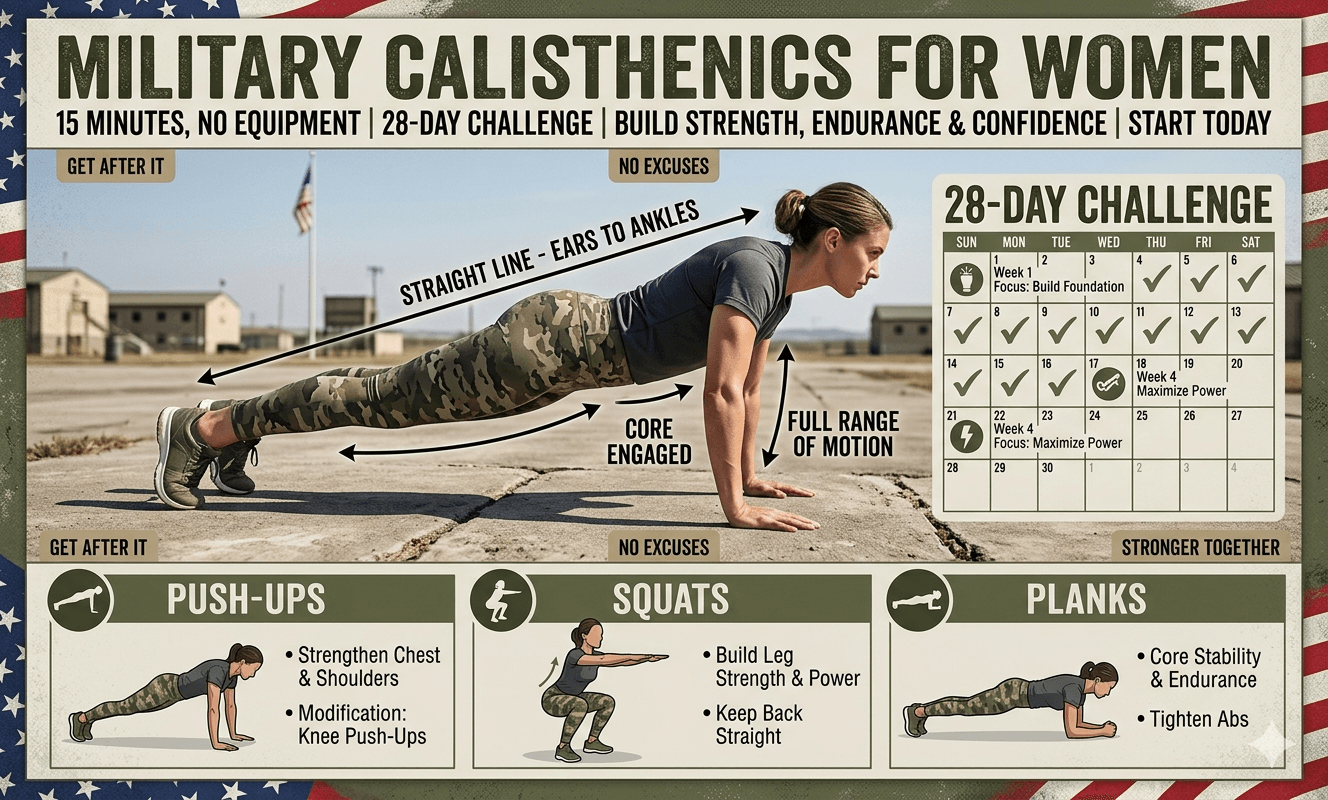
Push-ups are a fundamental exercise that targets the chest, shoulders, and triceps. To perform a standard push-up, begin in a plank position with your hands placed slightly wider than shoulder-width apart. Your body should form a straight line from head to heels. Lower your body by bending your elbows until your chest nearly touches the floor, then push back up to the starting position. For beginners, modifications such as knee push-ups can be utilized to develop strength.
Squats
Squats are essential for building lower body strength, specifically in the thighs and glutes. Stand with your feet shoulder-width apart and your toes slightly pointed outward. As you lower your body, push your hips back as if sitting in a chair, keeping your chest lifted and your back straight. Lower down until your thighs are parallel to the ground, then return to the standing position. Ensure that your knees do not extend beyond your toes to avoid injury.
Lunges
Lunges effectively target the legs and improve balance and coordination. Start by standing tall with your feet together. Step forward with one leg, lowering your hips until both knees are bent at approximately a 90-degree angle. The back knee should hover just above the ground. Push through the front heel to return to the starting position. Alternate legs for a complete set.
Planks
The plank is a core-strengthening exercise that engages the abdominal muscles and stabilizers. Begin in a push-up position but instead of bending your elbows, hold your body in a straight line, supported on your forearms and toes. Keep your core tight and your hips level. Hold the position for as long as you can while maintaining proper form.
Burpees
Burpees are a full-body exercise that combines strength training with cardiovascular endurance. To perform a burpee, start in a standing position, then drop into a squat and place your hands on the ground. Kick your feet back into a plank position, perform a push-up, then jump your feet back towards your hands. Explode upward into a jump and return to the starting position. Burpees can be modified by removing the push-up or the jump for beginners.
Incorporating these basic military calisthenics moves can significantly enhance your overall fitness and prepare you for more advanced exercises in your training regimen.
Creating Your 15-Minute Routine
Designing a concise yet effective 15-minute calisthenics workout requires planning and an understanding of how to structure your sets and repetitions. The focus should be on generating a balanced routine that engages multiple muscle groups while minimizing rest times between exercises to maintain an elevated heart rate. A solid approach can amplify your fitness results within a limited timeframe.
Start your routine with a warm-up to prepare your body; this can include simple dynamic stretches or light joint rotations for 2 minutes. Following the warm-up, you can incorporate various calisthenics exercises targeting strength, endurance, and flexibility. For instance, you might consider a sequence that includes push-ups, squats, lunges, and planks.
A sample structure for your 15-minute workout might be as follows:
- Push-Ups: 3 sets of 10 repetitions
- Bodyweight Squats: 3 sets of 15 repetitions
- Walking Lunges: 2 sets of 10 repetitions per leg
- Plank: Hold for 30 seconds, repeat twice
This structure allows for a balanced workout that combines upper and lower body movements. To build intensity, consider decreasing rest periods between exercises to 30 seconds or incorporate high-tempo transitions. Variations, such as staggered push-ups or plyometric squats, can further increase the challenge, making your workout effective and engaging.
Ultimately, the goal is to create a workout that fits seamlessly into your daily routine while ensuring you maintain consistency in your calisthenics practice. Track your progress by gradually increasing the number of repetitions or extending the duration of each exercise. Such modifications ensure your routine remains dynamic and aligned with your fitness goals.
The 28-Day Challenge: Building Consistency
Embarking on a 28-day challenge can significantly aid women in establishing and maintaining a consistent training routine. This structured program emphasizes daily exercises, rest days, and achievable goals to foster commitment to physical fitness. The core idea is to gradually increase the intensity of calisthenics workouts, leading to visible improvements in strength and endurance by the end of the month.
The challenge starts with a weekly focus, incorporating exercises such as push-ups, squats, lunges, and planks. For example, the first week might involve focusing on form and building a foundation, with daily repetitions kept low to avoid injury. The second week can implement a slight increase in repetitions alongside variations of the basic exercises to enhance difficulty gradually. By the third week, individuals should aim for higher intensity and incorporate circuit training to maximize efficiency. The final week serves as a culmination of the month’s efforts, where women can evaluate their progress and push towards their physical limits.
Rest days, strategically placed throughout the 28 days, are essential for recovery and to prevent burnout. These days should be utilized for light stretching or engaging in low-intensity activities, enabling the body to recuperate while still remaining active. On these restorative days, aspiring athletes can also focus on tracking their progress, which is a vital component of building consistency. Keeping a journal or using fitness apps to log exercises, set goals, and monitor improvements can serve as motivation and accountability.
In conclusion, the 28-day challenge not only builds physical strength through military calisthenics but also fosters a sense of discipline and resilience. By adhering to the structured program, women can achieve their fitness goals while developing a sustainable training habit that extends beyond the initial month.
Mastering Proper Form and Safety
When engaging in military calisthenics, particularly for women, mastering proper form is crucial for both safety and effectiveness. Proper alignment and body mechanics significantly reduce the risk of injury and maximize the benefits of each exercise. It’s essential to understand that even the most advanced movements can lead to complications if executed incorrectly.
To self-assess your form during workouts, you can utilize reflective surfaces, such as mirrors, or engage a workout partner to provide feedback. Key cues to maintain during exercises include keeping your core engaged, ensuring your shoulders are retracted, and aligning your knees with your toes in lower body movements. For instance, when performing squats, it’s vital to avoid allowing the knees to cave inward; instead, focus on pushing them outwards and maintaining balance through the midfoot.
Another critical aspect of safety is progressing at a pace conducive to your current fitness level. Beginners should start with basic movements, gradually increasing intensity as strength and stability improve. Simple exercises like push-ups or lunges can be modified to suit your needs. For example, performing knee push-ups is an excellent way to build upper body strength without undue strain.
It’s advisable to incorporate a thorough warm-up before diving into more strenuous activities. This preparatory phase enhances blood circulation to your muscles and prepares your body for the demands of calisthenics. Additionally, cooling down after your workouts with stretching can aid recovery and enhance flexibility.
Staying aware of your body’s limits is paramount. If you experience discomfort or pain beyond typical muscle fatigue, it may indicate improper form or an excessive workout level. Listening to your body, combined with a focus on proper techniques, will help you build a solid foundation in military calisthenics.
Incorporating military calisthenics into daily life can be both practical and effective, especially for women managing busy schedules. The flexibility of calisthenics allows for quick workouts that can easily fit into almost any routine. For instance, during a brief break at work or while waiting for a child, a few minutes of push-ups, squats, or lunges can be an efficient way to maintain fitness without needing specialized equipment or a gym membership.
One effective strategy for busy individuals is to schedule short and high-intensity workouts throughout the day. This can include a series of movements such as jumping jacks or mountain climbers that can elevate the heart rate significantly in just a few minutes. Incorporating these exercises allows for cardiovascular benefits along with strength training, which is essential for overall health.
Family involvement is another way to integrate military calisthenics into your life. Engaging children or partners in workout sessions not only instills a sense of health consciousness but also turns exercising into a fun family activity. For example, setting up a mini circuit in the backyard can provide quality time as well as physical benefits. Each member can take turns leading exercises, ensuring participation and accountability.
Beyond physical integration, mental strategies are vital for compliance. Setting clear, attainable fitness goals can provide motivation and a sense of accomplishment. Keeping a journal or using fitness apps to track progress might bolster commitment. Furthermore, finding workout buddies, either in person or through digital platforms, can enhance accountability and enjoyment, as the social aspect can serve as a strong motivational factor. Thus, incorporating military calisthenics into daily routines becomes a commendable and accessible endeavor for women, regardless of their lifestyle demands.
Conclusion and Next Steps
In summary, the journey through military calisthenics for women is not only one of physical fitness but also personal empowerment. This guide has covered essential exercises that require no equipment, allowing you to train anywhere and anytime. By consistently incorporating exercises such as push-ups, squats, and lunges into your routine, you will strengthen your core, enhance flexibility, and improve overall endurance. These exercises have been designed to build resilience and functional strength, which are crucial for daily activities and overall well-being.
Moving forward, it is vital to take actionable steps toward your fitness goals. Consider setting specific, measurable, achievable, relevant, and time-bound (SMART) goals to maintain your motivation and track your progress in calisthenics. Additionally, seek out groups or communities, whether online or in person, that share similar fitness interests. Accountability can significantly enhance your commitment and keep you focused on your training regimen.
Moreover, continue exploring various aspects of military fitness. This might include researching advanced mobility techniques, nutrition to support your growth, or even adapting a progressive calisthenics plan to meet evolving fitness levels. The world of military calisthenics is vast, and there is always something new to learn.
As you embark on this exciting journey of military calisthenics, remember that building strength is a gradual process. Celebrate small victories and stay patient with yourself as you progress. By fostering resilience and commitment, you will not only enhance your physical capabilities but also cultivate a stronger mindset. Embrace the challenge, stay consistent, and watch yourself transform through the power of no-equipment training.

🇺🇸 IMPORTANT DISCLAIMER – Veterans Benefits Information
This site provides general information about U.S. Department of Veterans Affairs (VA) benefits for educational and informational purposes only.
- Not Official: We are NOT affiliated with, endorsed by, or connected to the U.S. Department of Veterans Affairs (VA), the Veterans Benefits Administration (VBA), the Veterans Health Administration (VHA), or any other government agency.
- No Legal/Financial Advice: The content on this website is for informational purposes only and does not constitute legal, financial, or medical advice. VA benefits rules change frequently – always consult with an accredited Veterans Service Officer (VSO) or a qualified professional for your specific situation.
- Official Sources: For official, binding information and to apply for benefits, always visit official .gov websites: VA.gov, Benefits.VA.gov, or SSA.gov.
- No Data Collection: This site does not collect, store, or process any personal information. It does not have login forms, contact forms, or any system to capture user data. We never ask for your Social Security Number, bank details, or any personal information.
- 🚨 Scam Alert: The VA and other government agencies never charge fees for benefit applications. If anyone asks for money to "process" your VA claim, it is a scam. Report it to the VA Office of Inspector General at VA.gov/OIG.
- Advertising: This site uses third-party advertising (Adsterra) to cover operational costs. We do not endorse or guarantee any products or services advertised.
📌 Information provided as of June 2026. Always verify current eligibility and rules with official .gov sources.
This site is not affiliated with the U.S. Department of Veterans Affairs or any government agency. All information is for educational purposes only. Please visit VA.gov for official information.
