
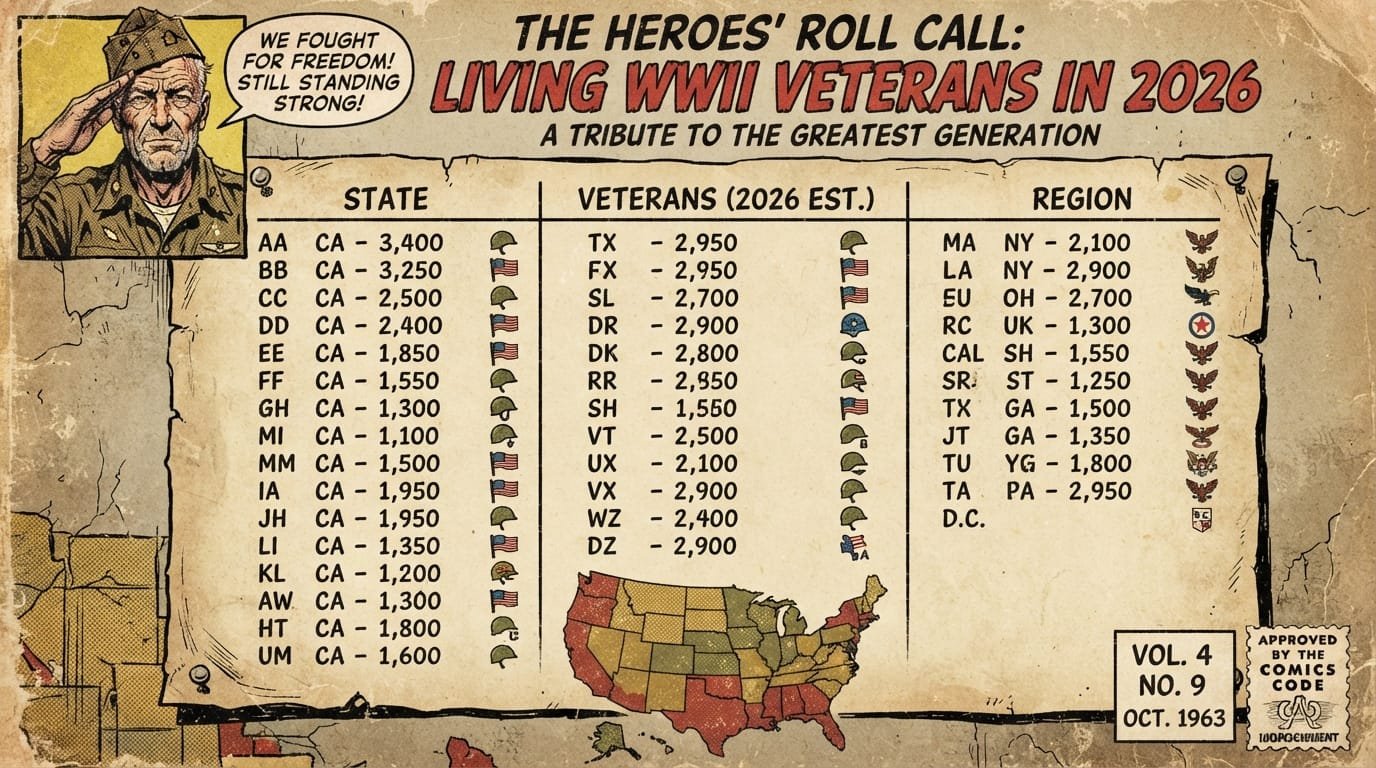
How Many WWII Veterans Are Still Alive in 2026? (State-by-State Estimates)
Approximately 30,607 World War II veterans are alive in the United States as of 2026, according to U.S. Department of Veterans Affairs statistics. California leads with 3,414, followed by Florida (2,506), Texas (1,918), and Pennsylvania (1,741). Alaska is the only state with zero living WWII veterans.
Quick Facts
| Item | Details |
|---|---|
| Total Who Served | 16.4 million Americans |
| Living WWII Veterans (2026) | 30,607 |
| Percentage Alive | Less than 0.2% |
| Oldest Known Age | 100+ |
| States with Most | California (3,414), Florida (2,506), Texas (1,918) |
| States with Zero | Alaska (0) |
| Daily Loss (VA Estimate) | ~44 per day (14,000 per year) |
| Daily Loss (Museum Estimate) | ~131 per day |
| VA Pension (Single Veteran, 2026) | Up to $17,441 annually |
| Aid & Attendance (Single, 2026) | Up to $29,093 annually |
| Official Agency | U.S. Department of Veterans Affairs |
| Updated For | October 2026 |
How Many WWII Veterans Are Alive in 2026?
Approximately 30,607 World War II veterans are alive in the United States as of 2026. That figure comes from U.S. Department of Veterans Affairs statistics compiled and published by the National WWII Museum in New Orleans.

The total represents less than 0.2% of the 16.4 million Americans who served in the armed forces during World War II. When the war ended in 1945, these service members were in their late teens, twenties, and thirties. Eighty years later, the youngest survivors are in their mid-to-late 90s, and the oldest are over 100.
Historical Decline: 2020 to 2026
| Year | Estimated Living WWII Veterans |
|---|---|
| 2020 | ~240,000 |
| 2021 | ~167,000 |
| 2022 | ~119,000 |
| 2023 | ~89,000 |
| 2024 | ~66,000 |
| 2025 | ~45,000 |
| 2026 | 30,607 |

The decline reflects the actuarial reality of an aging population. VA projections cited in 2026 indicate the last American WWII veteran will likely pass away by approximately 2037.
Why it matters: These numbers represent a closing window. Once the last WWII veteran passes, firsthand accounts of the war will exist only in recorded form. The National WWII Museum has archived approximately 12,000 oral histories and continues collecting more, but the opportunity to speak with living veterans is fading rapidly.
What to do next: If you know a living WWII veteran, contact the National WWII Museum’s oral history program at oral.histories@nationalww2museum.org or call 504-528-1944 x 516 to discuss recording their story.
Living WWII Veterans by State: Complete 2026 Data
California has the most living WWII veterans (3,414), followed by Florida (2,506), Texas (1,918), and Pennsylvania (1,741). Every U.S. state except Alaska has at least one living WWII veteran. Puerto Rico has 98, and Island Areas and Foreign locations account for 49.
Full State-by-State Table (2026)
| State | Living WWII Veterans |
|---|---|
| California | 3,414 |
| Florida | 2,506 |
| Texas | 1,918 |
| Pennsylvania | 1,741 |
| New York | 1,574 |
| Illinois | 1,152 |
| Michigan | 1,113 |
| Ohio | 1,092 |
| Virginia | 980 |
| Washington | 897 |
| Wisconsin | 837 |
| North Carolina | 835 |
| Minnesota | 823 |
| New Jersey | 716 |
| Georgia | 690 |
| Arizona | 687 |
| Oregon | 646 |
| Missouri | 611 |
| Massachusetts | 606 |
| Tennessee | 594 |
| Indiana | 589 |
| Maryland | 587 |
| Connecticut | 533 |
| South Carolina | 508 |
| Colorado | 435 |
| New Hampshire | 397 |
| Utah | 377 |
| Kentucky | 350 |
| Oklahoma | 318 |
| Alabama | 271 |
| Nevada | 254 |
| Mississippi | 243 |
| Rhode Island | 211 |
| Iowa | 190 |
| Arkansas | 186 |
| Montana | 176 |
| Idaho | 162 |
| Kansas | 162 |
| Louisiana | 147 |
| Maine | 146 |
| Delaware | 135 |
| North Dakota | 122 |
| Hawaii | 114 |
| Nebraska | 109 |
| Puerto Rico | 98 |
| West Virginia | 90 |
| South Dakota | 55 |
| District of Columbia | 48 |
| Vermont | 45 |
| Wyoming | 41 |
| New Mexico | 28 |
| Island Areas & Foreign | 49 |
| Alaska | |
| Total | 30,607 |
Veterans May Qualify for Extra Benefits
Check available financial assistance, healthcare programs and other opportunities that may apply to you.
Check EligibilitySource: National WWII Museum, compiled from U.S. Department of Veterans Affairs statistics, 2026.
States with the Largest Declines
States that had the largest WWII veteran populations in 2020 have experienced the steepest numerical losses. California, Florida, and Texas — which together account for over 7,800 living WWII veterans — have each lost thousands since the start of the decade.
Alaska: The Only State with Zero
Alaska is the only U.S. state with zero living WWII veterans. This reflects both the state’s small population during the 1940s and the passage of time.
Why it matters: State-level data helps families, researchers, and veterans service organizations plan outreach, honor flights, and recognition ceremonies. If your state has a significant WWII veteran population, local organizations may still be able to connect veterans with recognition programs.
What to do next: Contact your state’s department of veterans affairs or a local Veterans Service Organization (VSO) to learn about Honor Flight programs and recognition ceremonies in your area.
How Old Are the Youngest Living WWII Veterans?
The youngest living WWII veterans are in their mid-to-late 90s. Most are over 100. At gatherings of WWII veterans in 2026, attendees were routinely described as centenarians — none younger than 100.
Age Range of Living WWII Veterans
| Age Range | Description |
|---|---|
| 95–99 | Majority of living veterans |
| 100–104 | Significant minority |
| 105+ | Small number |
Men who enlisted at age 18 in 1944 or 1945 would be 99 or 100 in 2026. Those who served earlier in the war — at Pearl Harbor, in North Africa, or on D-Day — are now well over 100.
A 2026 VA news story profiled ten WWII veterans at a Beaumont, Texas, clinic, each at least 100 years old or reaching that milestone during the year.
Why it matters: The advanced age of surviving veterans means most are dealing with age-related health challenges, mobility limitations, and the need for daily assistance. Families and caregivers should be aware of VA benefits designed for elderly veterans.
What to do next: If you’re caring for a WWII veteran, review the VA benefits section below, particularly the Veterans Pension program with Aid and Attendance, which provides additional monthly income for veterans who need help with daily activities.
How Many WWII Veterans Die Each Day?
Estimates of daily losses vary widely, from approximately 44 to 131 per day, depending on the source and methodology. The VA has projected about 14,000 deaths per year, which averages 44 per day. The National WWII Museum and other sources have cited figures of 131 per day based on different actuarial models.
Daily Loss Estimates Compared
| Source | Daily Estimate | Annual Estimate |
|---|---|---|
| VA (2026 projection) | ~44 | ~14,000 |
| National WWII Museum | ~131 | ~47,800 |
| Other cited estimates | 140+ | Not projected |
The wide range reflects differing methodologies. The VA’s projection is based on its own actuarial models for the veteran population. The museum’s figure is often cited in news reports and reflects a higher estimated mortality rate.
What is consistent across all sources: the number of living WWII veterans is declining rapidly, and the population will approach zero within approximately a decade.
Why it matters: The pace of loss underscores the urgency of recording veterans’ stories, recognizing their service while they can still receive that recognition, and ensuring they and their families access all available VA benefits.
What to do next: If you have a family member or know a WWII veteran, consider participating in an oral history project or Honor Flight. The National WWII Museum offers resources for recording veterans’ stories.
VA Benefits for WWII Veterans in 2026
WWII veterans remain eligible for VA benefits, including disability compensation, pension, health care, and burial benefits. The VA recognizes World War II as a wartime period from December 7, 1941, to December 31, 1946.
Key Benefits Available
| Benefit | Details |
|---|---|
| VA Disability Compensation | Monthly tax-free payments for service-connected disabilities |
| Veterans Pension | Needs-based monthly payments; up to $17,441 annually for a single veteran in 2026 |
| Aid and Attendance | Additional monthly payment for veterans who need help with daily activities; up to $29,093 annually for a single veteran |
| VA Health Care | Free hospital and outpatient care for WWII veterans with no copays |
| Burial Benefits | Burial allowance, headstone, and burial in a VA national cemetery |
| Survivors Pension | Monthly payments for surviving spouses and dependent children |
Veterans Pension: 2026 Rates
The Veterans Pension program provides monthly payments to wartime veterans who meet age or disability requirements and have income and net worth within certain limits. For 2026, a single veteran can receive up to **$17,441 annually** ($1,453 monthly).
Aid and Attendance: 2026 Rates
Aid and Attendance is an additional monthly payment for veterans who need help with daily activities like bathing, dressing, or eating. The 2026 maximum rates, effective December 1, 2025, are:
| Status | Monthly Rate | Annual Rate |
|---|---|---|
| Single Veteran | $2,424 | $29,093 |
| Veteran with Spouse | $2,874 | $34,488 |
| Surviving Spouse | $1,558 | $18,696 |
Source: VA pension rates, effective December 1, 2025 (2026 rates).
Why it matters: Many elderly WWII veterans and their families may not realize they qualify for VA pension benefits, particularly if they need assistance with daily living. Aid and Attendance can provide significant additional monthly income for veterans in assisted living or receiving home care.
What to do next: Apply for VA pension using VA Form 21P-527EZ. The VA also offers a free online application at VA.gov. Contact a Veterans Service Organization (VSO) for free assistance with the application process.
How to Help Preserve WWII Veterans’ Stories
The National WWII Museum, the Library of Congress Veterans History Project, and local oral history initiatives are actively recording interviews with surviving WWII veterans. These projects aim to preserve firsthand accounts before the last veterans pass away.
Organizations Recording WWII Veterans’ Stories
| Organization | How to Participate |
|---|---|
| National WWII Museum | Contact the oral history program at oral.histories@nationalww2museum.org or call 504-528-1944 x 516 |
| Library of Congress Veterans History Project | Submit a veteran’s story through a participating organization or directly at loc.gov/vets |
| Honor Flight Network | Escorts veterans to Washington, D.C., to visit memorials |
| Local historical societies | Many communities maintain their own veterans oral history projects |
The National WWII Museum has nearly 7,000 oral histories in its digital collections and approximately 12,000 total archived interviews. The museum’s oral historian, Chandler Stark, travels the country recording veterans’ stories through a partnership with the Gary Sinise Foundation.
Why it matters: These stories are irreplaceable. Once the last WWII veteran passes, firsthand accounts will be gone forever. Recorded interviews preserve the human dimension of the war for future generations.
What to do next: Contact one of the organizations above to learn how to record and submit a veteran’s story. The process is typically free and can often be done remotely or in the veteran’s home.
Common Questions
1. How many WWII veterans are alive in 2026?
Approximately 30,607 U.S. WWII veterans are alive as of 2026, according to VA statistics compiled by the National WWII Museum. That is less than 0.2% of the 16.4 million who served during the war.
2. Which state has the most living WWII veterans?
California has the most (3,414), followed by Florida (2,506), Texas (1,918), and Pennsylvania (1,741). Every state except Alaska has at least one living WWII veteran.
3. Which state has zero living WWII veterans?
Alaska is the only U.S. state with zero living WWII veterans, according to 2026 VA data.
4. How old are the youngest WWII veterans?
The youngest living WWII veterans are in their mid-to-late 90s. Most are over 100. Men who enlisted at age 18 in 1945 would be 99 in 2026. At 2026 gatherings, attendees were routinely described as centenarians.
5. How many WWII veterans die each day?
Estimates range from 44 to 131 per day. The VA projects about 14,000 deaths per year (~44 per day). The National WWII Museum has cited 131 per day based on different actuarial models. Both figures reflect a rapidly declining population.
6. What VA benefits are available to WWII veterans in 2026?
WWII veterans remain eligible for VA disability compensation, Veterans Pension (up to $17,441 annually for a single veteran), Aid and Attendance (up to $29,093 annually for a single veteran), free VA health care, and burial benefits.
7. Do WWII veterans pay copays for VA health care?
No. WWII veterans are eligible for free VA hospital and outpatient care with no copays, according to VA policy.
8. How do I apply for VA pension for a WWII veteran?
Use VA Form 21P-527EZ. Apply online at VA.gov or contact a Veterans Service Organization for free assistance. The form requires information about military service, income, net worth, and medical needs if applying for Aid and Attendance.
9. What is Aid and Attendance for veterans?
Aid and Attendance is an additional monthly VA pension payment for veterans who need help with daily activities like bathing, dressing, or eating. In 2026, a single veteran can receive up to $2,424 per month ($29,093 annually).
10. How can I record a WWII veteran’s story?
Contact the National WWII Museum’s oral history program at oral.histories@nationalww2museum.org or call 504-528-1944 x 516. The Library of Congress Veterans History Project also accepts submissions. The process is typically free.
11. Will the last WWII veteran die by 2037?
VA projections cited in 2026 indicate the last American WWII veteran will likely pass away by approximately 2037, based on actuarial estimates.
12. What is the Veterans History Project?
The Library of Congress Veterans History Project collects, preserves, and makes accessible personal accounts of American war veterans. It accepts audio and video interviews, letters, photos, and other documents from all veterans, including WWII veterans. Visit loc.gov/vets for more information.
Key Takeaways
Approximately 30,607 U.S. WWII veterans are alive in 2026, less than 0.2% of the 16.4 million who served.
California leads with 3,414 living WWII veterans, followed by Florida (2,506), Texas (1,918), and Pennsylvania (1,741).
Alaska is the only state with zero living WWII veterans.
Most living WWII veterans are 95 or older, with many over 100.
Estimates of daily losses range from 44 to 131, depending on the source and methodology.
The last WWII veteran is projected to pass away by approximately 2037.
WWII veterans remain eligible for VA pension ($17,441 annually) and Aid and Attendance ($29,093 annually) in 2026.
WWII veterans receive free VA health care with no copays.
The National WWII Museum and Library of Congress Veterans History Project are recording veterans’ stories.
You can help by contacting an oral history program to record a veteran’s firsthand account.
Official Resources
U.S. Department of Veterans Affairs: https://www.va.gov/
VA Pension Eligibility: https://www.va.gov/pension/eligibility/
VA Aid and Attendance: https://www.va.gov/pension/aid-attendance-housebound/
National WWII Museum Veteran Statistics: https://www.nationalww2museum.org/war/wwii-veteran-statistics
Library of Congress Veterans History Project: https://www.loc.gov/vets/
VA Form 21P-527EZ (Veterans Pension): https://www.va.gov/find-forms/about-form-21p-527ez/
VA National Cemetery Administration: https://www.cem.va.gov/
Veterans Crisis Line: Dial 988, then press 1
USA.gov Veterans Benefits: https://www.usa.gov/veterans-benefits



🇺🇸 IMPORTANT DISCLAIMER – Veterans Benefits Information
This site provides general information about U.S. Department of Veterans Affairs (VA) benefits for educational and informational purposes only.
- Not Official: We are NOT affiliated with, endorsed by, or connected to the U.S. Department of Veterans Affairs (VA), the Veterans Benefits Administration (VBA), the Veterans Health Administration (VHA), or any other government agency.
- No Legal/Financial Advice: The content on this website is for informational purposes only and does not constitute legal, financial, or medical advice. VA benefits rules change frequently – always consult with an accredited Veterans Service Officer (VSO) or a qualified professional for your specific situation.
- Official Sources: For official, binding information and to apply for benefits, always visit official .gov websites: VA.gov, Benefits.VA.gov, or SSA.gov.
- No Data Collection: This site does not collect, store, or process any personal information. It does not have login forms, contact forms, or any system to capture user data. We never ask for your Social Security Number, bank details, or any personal information.
- 🚨 Scam Alert: The VA and other government agencies never charge fees for benefit applications. If anyone asks for money to "process" your VA claim, it is a scam. Report it to the VA Office of Inspector General at VA.gov/OIG.
- Advertising: This site uses third-party advertising (Adsterra) to cover operational costs. We do not endorse or guarantee any products or services advertised.
📌 Information provided as of June 2026. Always verify current eligibility and rules with official .gov sources.
This site is not affiliated with the U.S. Department of Veterans Affairs or any government agency. All information is for educational purposes only. Please visit VA.gov for official information.
