
Veterans United Home Loan Requirements 2026: Complete VA Loan Eligibility Guide
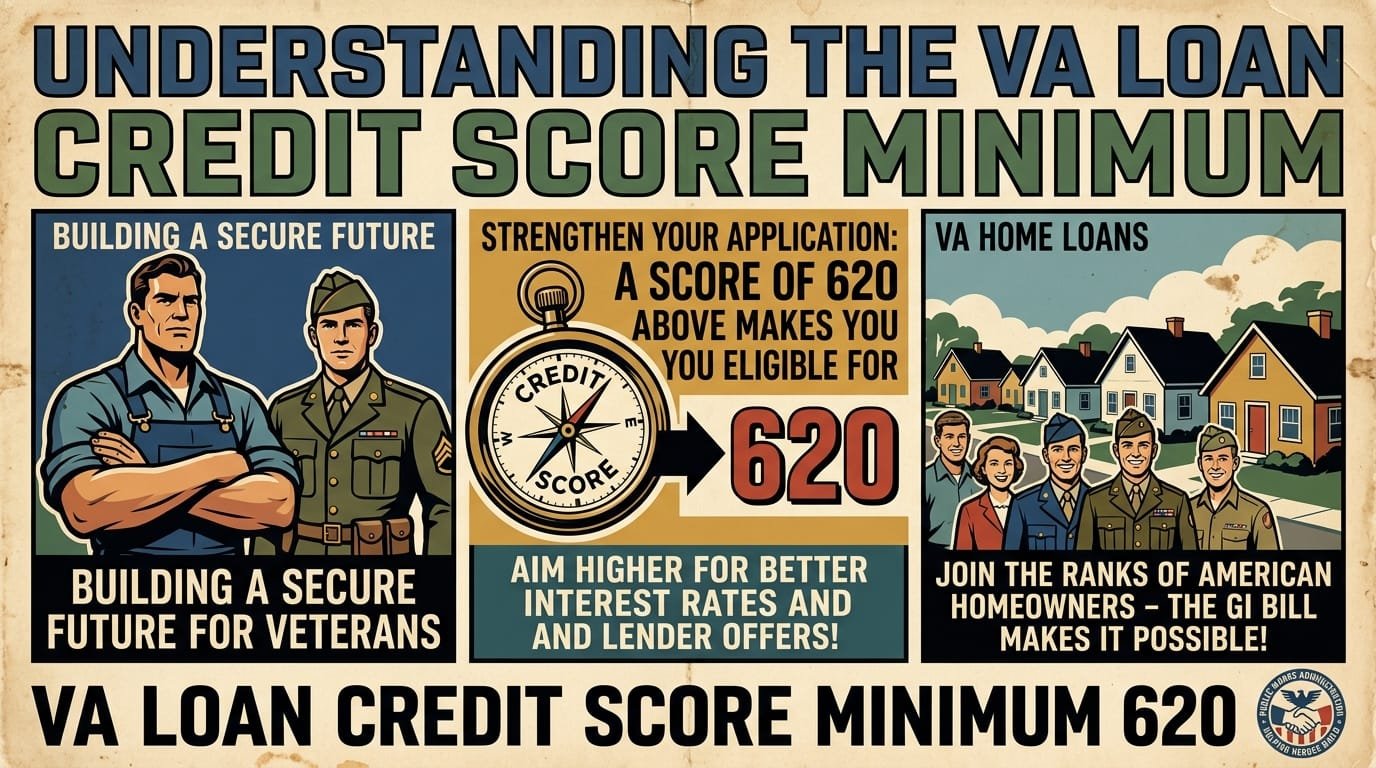
Veterans United requires a minimum 620 FICO score for most VA loans in 2026, with 680 required for loan balances above $2 million. Borrowers must meet VA service eligibility, satisfy debt-to-income and residual income guidelines, and provide a valid Certificate of Eligibility. VA loans require no down payment and no private mortgage insurance.
Quick Facts
| Item | Details |
|---|---|
| Benefit | VA home loan with 0% down payment and no PMI |
| Eligibility | Veterans, active duty, National Guard, Reserves, surviving spouses |
| Minimum Credit Score | 620 (most loans); 680 for balances above $2 million |
| Minimum Down Payment | 0% |
| DTI Guideline | 41% benchmark; higher ratios may qualify with strong residual income |
| Official Agency | U.S. Department of Veterans Affairs (VA) |
| Required Forms | Certificate of Eligibility (COE); VA Form 26-1880 (if applying by mail) |
| Updated For | 2026 |
What Is a VA Loan?
A VA loan is a mortgage backed by the U.S. Department of Veterans Affairs and issued by private lenders like Veterans United Home Loans. The VA guarantees a portion of the loan against loss, which allows lenders to offer better terms than conventional mortgages. VA loans can be used to purchase a single-family home, condominium, multi-unit property, manufactured home, or new construction.

Veterans United is a nonbank lender based in Columbia, Missouri, and originates more VA mortgages than any other lender in the United States. Loans are available nationwide, and the company offers purchase loans, refinancing, jumbo loans, and energy-efficient mortgages. Average time to close is 34 days, faster than the national average.

Understanding VA loan requirements is critical because Veterans United sets its own lending standards—called “overlays”—on top of the VA’s baseline rules. These overlays include minimum credit scores, maximum debt-to-income ratios, and documentation requirements. Meeting both VA and Veterans United standards is necessary for loan approval.
What Are the Key Benefits of a Veterans United VA Loan?
The VA loan offers several advantages that no other mortgage program matches. These benefits apply to all VA-approved lenders, including Veterans United.
No Down Payment
Qualified veterans can purchase a home without making any down payment, regardless of the purchase price. This has been the signature benefit of the VA loan program since 1944, when it began as part of the original GI Bill of Rights. Most other loan types require at least 3% down, and conventional loans typically require 5% to 20% to avoid private mortgage insurance.
No Private Mortgage Insurance (PMI)
Conventional borrowers who cannot make a 20% down payment must pay for private mortgage insurance, which adds hundreds of dollars to monthly payments. VA loans eliminate PMI entirely. This saves veterans thousands of dollars over the life of the loan.
Lower Interest Rates
Veterans May Qualify for Extra Benefits
Check available financial assistance, healthcare programs and other opportunities that may apply to you.
Check EligibilityVA mortgage rates have ranked among the lowest average interest rates on the market for the past two years. A lower rate helps veterans qualify for a larger loan and saves money on monthly payments and over the life of the loan.
Flexible Credit Guidelines
VA loans were designed to expand access to homeownership. Credit score minimums vary by lender, but VA loans often have lower score requirements than other loan types. VA loans also have no hard cutoff for debt-to-income ratio and shorter waiting periods following negative credit events like bankruptcy or foreclosure.
Limited Closing Costs
The VA caps how much lenders can charge veterans to originate and process a loan. Sellers can pay all of a buyer’s VA loan closing costs and up to 4% of the loan amount in concessions. Some costs and fees are completely off-limits to VA buyers.
Funding Fee Exemption for Disabled Veterans
Veterans receiving VA compensation for a service-connected disability are exempt from the VA funding fee. Since 2021, more than half of veterans who obtained a VA-guaranteed home loan were exempt from paying the funding fee.
Who Qualifies for a Veterans United VA Loan?
Service eligibility is determined by the VA, not by Veterans United. You must meet at least one of the following service requirements:
Served 90 consecutive days of active service during wartime
Served 181 days of active service during peacetime
Served 6 years in the National Guard or Reserves
Served 90 days under Title 32 orders, with at least 30 consecutive days
Are the spouse of a service member who died while serving or died from a service-connected disability
Additional Eligibility for Specific Discharge Circumstances
Veterans who do not meet the basic service requirements may still qualify depending on their discharge type. You may be eligible if you were discharged for hardship, convenience of the government, reduction in force, a medical condition or service-connected disability, or early-out with at least 21 months served of a 2-year enlistment.
Surviving Spouses
Unremarried surviving spouses of veterans who died from service-connected causes may qualify for the VA loan benefit. Surviving spouses receiving Dependency and Indemnity Compensation (DIC) are also exempt from the VA funding fee.
Active Duty Service Members
Active-duty service members are eligible after meeting minimum service requirements. Members stationed overseas or deployed can still close on a VA loan by designating a Military Power of Attorney or using Remote Online Notarization.
Veterans United Credit Score Requirements for 2026
Veterans United typically requires a minimum 620 FICO score for most VA loans. This is higher than the VA’s own standard—the VA does not set a minimum credit score requirement. For loan balances above $2 million, Veterans United increases the minimum to 680.
The 620 minimum applies to purchase loans, IRRRL streamline refinances, and VA jumbo loans. For VA jumbo loans with seven-figure purchase prices, Veterans United typically looks for a credit score greater than 620.
How Veterans United Compares to Other VA Lenders
| Lender | Minimum Credit Score | Notes |
|---|---|---|
| Veterans United | 620 | 680 for balances above $2M |
| PenFed Credit Union | 620 | Standard VA loan requirement |
| Freedom Mortgage | 620 | Some programs as low as 550 |
| Navy Federal CU | 620 (typical) | Not publicly disclosed |
| Carrington | 500 | Purchase loans only |
| Freedom Mortgage | 550 | Select purchase programs |
Most VA lenders require a minimum credit score of 620, though some allow scores as low as 550. Veterans with lower scores may qualify with other lenders but should expect higher interest rates and additional scrutiny.
What Affects Your Credit Approval Beyond the Score
Veterans United evaluates the full credit picture, not just the numerical score. Lenders review how long you have been using credit, any bankruptcies or foreclosures on your record, your bill payment history, and recently opened accounts or credit lines. Negative events may be overlooked if they were one-time occurrences that have been resolved.
Debt-to-Income and Residual Income Requirements
Veterans United evaluates both debt-to-income ratio and residual income to determine whether you can afford the loan. These are two separate calculations that work together.
Debt-to-Income Ratio
Your DTI ratio compares total monthly debt payments to gross monthly income. The VA generally prefers a DTI of 41% or less, though this is not a strict cutoff like it is with conventional loans. Borrowers with DTI ratios above 41% may still qualify if they have strong residual income and other compensating factors. Veterans United has approved loans with DTI ratios as high as 55% when offsetting factors are present.
Residual Income
Residual income is the amount of money left over each month after paying all debts and living expenses. The VA’s residual income test accounts for actual take-home pay and household living expenses, region, and family size. For a family of four, residual income requirements in 2026 range from approximately $1,003 to $1,117 per month depending on region.
The residual income test, not DTI alone, is the VA’s primary underwriting standard. If your DTI exceeds 41% and your residual income exceeds the VA’s regional guideline by at least 20%, the loan may still be approved.
How VA Disability Income Helps
VA disability compensation counts as qualifying income for mortgage purposes. Veterans United and other VA lenders allow you to “gross up” disability income by 25% when calculating qualifying income. For example, $3,000 per month in VA disability compensation can be treated as $3,750 for loan qualification purposes. This increases your borrowing power without affecting your actual monthly income.
Income Documentation Requirements
Veterans United typically requires:
Recent pay stubs covering the last 30 days
W-2 forms from the past two years
Bank statements for the past two to three months
Tax returns if you are self-employed
Proof of VA disability compensation if using it for qualification
You do not need any documents to start your VA loan application. Veterans United can pull most of the required documentation electronically or through verification services.
Required Documents for a Veterans United VA Loan
Veterans United requires specific documentation to process your VA loan. Gathering these documents before applying speeds up the process.
Certificate of Eligibility (COE)
The COE is the single most important document for VA loan eligibility. It proves to the lender that you meet the VA’s minimum service requirements. Most veterans can obtain their COE through their lender, who pulls it electronically using only your Social Security number and date of birth. The process typically takes minutes.
You can obtain your COE three ways:
Through a VA-approved lender like Veterans United
Online through the VA’s website at VA.gov
By mail using VA Form 26-1880
According to the VA, nearly all COE requests come electronically, and most are processed within minutes.
Financial Documents
Recent pay stubs (last 30 days)
W-2 forms (past two years)
Bank statements (past two to three months)
Federal tax returns (if self-employed)
Documentation of VA disability compensation (if applicable)
Property Documents
Purchase agreement or sales contract
VA appraisal report (ordered by the lender)
Title documents (provided by the title company)
Additional Documents for Specific Situations
Divorce decree (if applicable)
Bankruptcy discharge papers (if applicable)
Rental history documentation (if applicable)
Gift letter (if using gift funds for closing costs)
VA Loan Limits and Jumbo Loans for 2026
The 2026 VA loan limit for most counties is $832,750, up 3.3% from $806,500 in 2025. High-cost areas reach up to $1,299,500 for single-family homes.
VA loan limits do not cap your purchasing power. There is no maximum VA loan amount set by the government. Loan limits determine how much veterans without full entitlement can borrow before needing a down payment. Veterans with full entitlement can borrow as much as a lender is willing to lend without any down payment.
VA Jumbo Loan Requirements
A VA jumbo loan is any VA loan that exceeds the local conforming loan limit. Veterans United offers VA jumbo loans with the following requirements:
Minimum 620 FICO score for loans up to $2 million
Minimum 680 FICO score for loans above $2 million
No cash reserve requirement for most VA jumbo loans
Full entitlement required for 0% down payment on jumbo loans
Veterans with diminished entitlement—due to a prior VA foreclosure or one or more active VA loans—may need to make a down payment on a jumbo loan. The required down payment is typically 25% of the difference between the loan amount and the county loan limit.
Veterans United Down Payment Requirements
Veterans United requires a 0% down payment for VA loans in most cases. Qualified veterans can purchase a home without making any down payment, regardless of the purchase price.
When a Down Payment Is Required
A down payment may be required only when:
The loan amount exceeds the county VA loan limit and the veteran does not have full entitlement
The veteran has diminished entitlement from a prior VA loan default or foreclosure
The veteran is purchasing a second home or investment property (VA loans are for primary residences only)
In these cases, the required down payment is typically 25% of the difference between the loan amount and the county limit. For example, if you want to buy a $900,000 home in a county with an $832,750 limit and you have full entitlement, you may not need a down payment. If you have diminished entitlement, you may need to put down 25% of the $67,250 difference, or approximately $16,813.
Gift Funds for Down Payment and Closing Costs
VA loans allow 100% of the down payment and closing costs to come from gift funds. Donors can include family members, close friends, employers, or charitable organizations. A gift letter documenting the donor’s relationship and the amount of the gift is required. Gift funds cannot be used to meet reserve requirements, but VA loans typically have no reserve requirements for most borrowers.
VA Funding Fee: Costs and Exemptions
The VA funding fee is a one-time payment on VA-backed loans that helps offset the cost of the program to taxpayers. The fee allows veterans to benefit from no down payment and no monthly private mortgage insurance.
VA Funding Fee Rates for 2026
| Loan Type | Down Payment | Funding Fee Rate |
|---|---|---|
| First use | Less than 5% | 2.15% |
| First use | 5% or more | 1.5% |
| First use | 10% or more | 1.25% |
| After first use | Less than 5% | 3.3% |
| After first use | 5% or more | 1.5% |
| After first use | 10% or more | 1.25% |
| IRRRL | N/A | 0.5% |
| Cash-out refinance (first use) | N/A | 2.15% |
| Cash-out refinance (after first use) | N/A | 3.3% |
Who Is Exempt from the VA Funding Fee?
You do not have to pay the VA funding fee if any of the following apply to you:
You are receiving VA compensation for a service-connected disability
You are eligible to receive VA compensation for a service-connected disability but are receiving retirement or active-duty pay instead
You are receiving Dependency and Indemnity Compensation (DIC) as the surviving spouse of a veteran
You are a service member who received a proposed or memorandum rating before the loan closing date stating you are eligible for compensation due to a pre-discharge claim
You are an active-duty member who received a Purple Heart on or before the loan closing date
More than half of veterans who obtained a VA-guaranteed home loan since 2021 were exempt from paying the funding fee.
How to Pay the Funding Fee
You can pay the VA funding fee in two ways:
Include the funding fee in your loan amount and pay it off over time (financing)
Pay the full fee at closing
Financing the funding fee increases your monthly payment slightly but eliminates the need for cash at closing. The VA funding fee is now tax-deductible.
Funding Fee Refunds
If you are later awarded VA compensation for a service-connected disability with an effective date retroactive to before your loan closing date, you may be eligible for a refund of the VA funding fee. Call your VA regional loan center to determine if you qualify.
Property Requirements and VA Appraisal
Every VA purchase loan requires a VA appraisal. The appraisal confirms the property’s market value and verifies that it meets Minimum Property Requirements (MPRs). These standards ensure the home is safe, structurally sound, and sanitary.
What the VA Appraisal Checks
Safe structural integrity: no major hazards to occupants’ health or safety
Adequate heating and utilities: functional electrical systems and safe heating
Roof condition: no active leaks or structural damage
Access to safe water and drainage: year-round potable water and reliable drainage
Pest and wood-destroying organisms: no active infestations
Paint condition: no peeling or chipping, especially in homes built before 1978 (lead paint risk)
2026 VA Appraisal Updates
The VA updated its Minimum Property Requirements effective May 1, 2026, to reduce delays and cut outdated rules. Changes include:
Removing the full Radon Gas requirement (Topic 34)
Revising standards for properties built before 1978 (Topic 32)
Revising standards for properties built in 1978 or later (Topic 32)
Streamlining guidance on detached improvements and Specially Adapted Housing jurisdiction
Updating guidance for non-vented heaters
As of May 31, 2026, the average VA appraisal takes approximately seven business days. These updates make VA loans more competitive in today’s housing market by removing barriers that previously slowed transactions.
Properties That Typically Do Not Qualify
Homes with major deferred maintenance
Properties with active safety hazards
Homes with failing systems (HVAC, electrical, plumbing)
Properties without year-round access
Homes used for commercial purposes
VA Loan Refinance Requirements at Veterans United
Veterans United offers two primary refinance options for existing VA loan holders: the VA Streamline Refinance (IRRRL) and the VA Cash-Out Refinance.
VA Streamline Refinance (IRRRL) Requirements
The VA IRRRL is a simplified refinance option for homeowners with an existing VA loan. It requires less documentation and often no appraisal. To qualify through Veterans United:
You must have made at least six full, consecutive monthly payments on your original loan
At least 210 days must have passed since your first payment due date
No more than one 30-day late payment in the past 12 months
The refinance must provide a tangible benefit, such as a lower interest rate or a switch from adjustable to fixed rate
Closing costs can be rolled into the loan, and the VA funding fee is 0.5% for IRRRLs. A reduction of just 0.5% in interest rate can generate tens of thousands of dollars in savings over the life of the loan.
VA Cash-Out Refinance Requirements
A VA cash-out refinance allows you to tap into your home equity. It typically involves full credit and income underwriting, similar to a VA purchase loan. You must meet lender-specific requirements including minimum credit scores, DTI, and residual income.
The VA cash-out refinance can be used to refinance a non-VA loan into a VA loan. The loan amount cannot exceed 100% of the property’s reasonable value.
IRRRL vs. Cash-Out Refinance Comparison
| Feature | IRRRL (Streamline) | Cash-Out Refinance |
|---|---|---|
| Credit Score Minimum | Varies by lender | 620 (Veterans United) |
| Appraisal Required | No (most cases) | Yes |
| Income Verification | Limited | Full documentation |
| Funding Fee | 0.5% | 2.15% – 3.3% |
| Cash Access | No | Yes, up to 100% LTV |
| Occupancy Required | Yes | Yes |
| Best For | Lowering rate on existing VA loan | Accessing equity or refinancing non-VA loan |
How to Apply for a Veterans United VA Loan
Applying for a VA loan through Veterans United follows a structured process. Here are the steps.
Step 1: Check Your Eligibility
Verify that you meet VA service requirements. You do not need your COE to start the process—Veterans United can pull it electronically with your Social Security number and date of birth.
Step 2: Get Preapproved
Complete a preapproval application online or by phone. Veterans United reviews your credit, income, and assets to determine how much you can borrow. Preapproval typically takes one to three business days.
Step 3: House Hunt
Work with a real estate agent familiar with VA loans. Veterans United Realty can match you with agents who specialize in working with veterans. Buyers who use Veterans United Realty may be eligible for up to $5,000 cash after closing.
Step 4: Make an Offer and Sign a Purchase Agreement
Once you find a home, make an offer and negotiate terms. VA loans allow sellers to pay all closing costs and up to 4% of the loan amount in concessions.
Step 5: Complete the VA Appraisal
Veterans United orders the VA appraisal after your offer is accepted. The appraiser confirms the property’s value and ensures it meets Minimum Property Requirements. The average appraisal takes approximately seven business days.
Step 6: Underwriting and Final Approval
An underwriter reviews your complete file, including credit, income, assets, and the appraisal report. Additional documentation may be requested. Average time to close is 34 days.
Step 7: Close and Move In
Sign final documents, pay any closing costs, and receive your keys. Most Veterans United customers spend little to no money out of pocket at closing.
Common Mistakes to Avoid
Avoid these errors when applying for a Veterans United VA loan:
Applying with unresolved credit issues: Negative credit events like collections, judgments, or recent late payments can delay or derail approval. Address these before applying.
Changing jobs or making large purchases: Lenders verify employment and assets during underwriting. Changing jobs or financing a car during the loan process can jeopardize approval.
Assuming the VA appraisal is a home inspection: The VA appraisal confirms value and minimum property standards but is not a comprehensive home inspection. Hire a licensed inspector separately.
Not shopping for the best rate: Veterans United is the largest VA lender, but rates vary by lender. Compare offers from multiple VA lenders before committing.
Overlooking the funding fee exemption: Veterans with service-connected disabilities are exempt from the funding fee but must document their status. Ensure your disability rating is on file with the VA.
Waiting to gather documents: Missing documents delay closings. Gather your DD-214, pay stubs, W-2s, and bank statements before applying.
Ignoring residual income requirements: DTI alone does not determine approval. Residual income requirements vary by region and family size. Calculate your residual income before applying.
Common Questions
What credit score does Veterans United require for a VA loan in 2026?
Veterans United typically requires a minimum 620 FICO score for most VA loans. For loan balances above $2 million, the minimum increases to 680. The VA itself does not set a minimum credit score requirement, so this is a lender-specific standard.
Can I get a VA loan with a 580 credit score through Veterans United?
No. Veterans United’s minimum is 620. Veterans with scores between 580 and 619 should contact other VA lenders. Some lenders accept scores as low as 550 or even 500 for purchase loans, though interest rates will be higher.
How much money do I need to buy a home with a VA loan?
Zero down payment is required for most VA purchases. Closing costs may apply, but sellers can pay all of a buyer’s closing costs and up to 4% of the loan amount in concessions. Many Veterans United customers spend little to no money out of pocket.
What is the VA funding fee for 2026?
The VA funding fee for first-time use with less than 5% down payment is 2.15% of the loan amount. It increases to 3.3% for subsequent uses with less than 5% down. Veterans with service-connected disabilities are exempt. IRRRLs have a 0.5% funding fee.
Can I use a VA loan to buy a duplex or multi-unit property?
Yes. VA loans can be used to purchase multi-unit properties as long as you intend to occupy one of the units as your primary residence. The property must meet VA Minimum Property Requirements.
What is the maximum VA loan amount in 2026?
There is no maximum VA loan amount set by the government. Veterans with full entitlement can borrow as much as a lender will lend without a down payment. The 2026 VA loan limit for most counties is $832,750, with high-cost areas reaching $1,299,500.
Can I use my VA loan benefit more than once?
Yes. The VA loan is a lifetime benefit that can be reused. If you have paid off a previous VA loan and still own the property, you may need to refinance that loan to restore your entitlement. Veterans with remaining entitlement can use it for another purchase.
How long does it take to close a VA loan with Veterans United?
Average time to close is 34 days, faster than the national average. The VA appraisal takes approximately seven business days. Timely submission of required documents helps ensure a smooth closing timeline.
What happens if I have a VA disability rating—do I still pay the funding fee?
Veterans receiving VA compensation for a service-connected disability are exempt from the VA funding fee. You must document your disability status with the lender. If you receive a proposed or memorandum rating before closing, you may also be exempt.
Can I use gift funds for a VA loan down payment?
Yes. VA loans allow 100% of the down payment and closing costs to come from gift funds. Donors can include family members, close friends, employers, or charitable organizations. A gift letter documenting the donor’s relationship and amount is required.
Key Takeaways
Veterans United requires a minimum 620 FICO score for most VA loans in 2026, with 680 for balances above $2 million.
VA loans through Veterans United require 0% down payment and no private mortgage insurance for eligible veterans.
Service eligibility includes 90 days wartime service, 181 days peacetime service, or 6 years in the Guard or Reserves.
The VA funding fee is 2.15% for first use and 3.3% for subsequent uses, but disabled veterans are exempt.
DTI above 41% may still qualify if residual income exceeds VA regional guidelines by 20% or more.
VA disability income can be grossed up by 25% for loan qualification purposes.
The 2026 VA loan limit is $832,750 for most counties and up to $1,299,500 in high-cost areas.
IRRRL streamline refinance requires six consecutive on-time payments and at least 210 days since the first payment.
VA appraisals take approximately seven business days and confirm both value and Minimum Property Requirements.
Gift funds from family, friends, or employers can cover 100% of down payment and closing costs.
Official Resources
VA.gov — Official VA home loan information, including eligibility, funding fee rates, and COE applications
VA Loan Guaranty Service — VA’s home loan program information and lender resources
Consumer Financial Protection Bureau (CFPB) — Mortgage lending resources and borrower protections
USA.gov — Government benefits directory for veterans and military families
HUD.gov — Housing and Urban Development resources for homebuyers

🇺🇸 IMPORTANT DISCLAIMER – Veterans Benefits Information
This site provides general information about U.S. Department of Veterans Affairs (VA) benefits for educational and informational purposes only.
- Not Official: We are NOT affiliated with, endorsed by, or connected to the U.S. Department of Veterans Affairs (VA), the Veterans Benefits Administration (VBA), the Veterans Health Administration (VHA), or any other government agency.
- No Legal/Financial Advice: The content on this website is for informational purposes only and does not constitute legal, financial, or medical advice. VA benefits rules change frequently – always consult with an accredited Veterans Service Officer (VSO) or a qualified professional for your specific situation.
- Official Sources: For official, binding information and to apply for benefits, always visit official .gov websites: VA.gov, Benefits.VA.gov, or SSA.gov.
- No Data Collection: This site does not collect, store, or process any personal information. It does not have login forms, contact forms, or any system to capture user data. We never ask for your Social Security Number, bank details, or any personal information.
- 🚨 Scam Alert: The VA and other government agencies never charge fees for benefit applications. If anyone asks for money to "process" your VA claim, it is a scam. Report it to the VA Office of Inspector General at VA.gov/OIG.
- Advertising: This site uses third-party advertising (Adsterra) to cover operational costs. We do not endorse or guarantee any products or services advertised.
📌 Information provided as of June 2026. Always verify current eligibility and rules with official .gov sources.
This site is not affiliated with the U.S. Department of Veterans Affairs or any government agency. All information is for educational purposes only. Please visit VA.gov for official information.
