
VA Disability Back Pay Calculator: How Much Will You Receive?
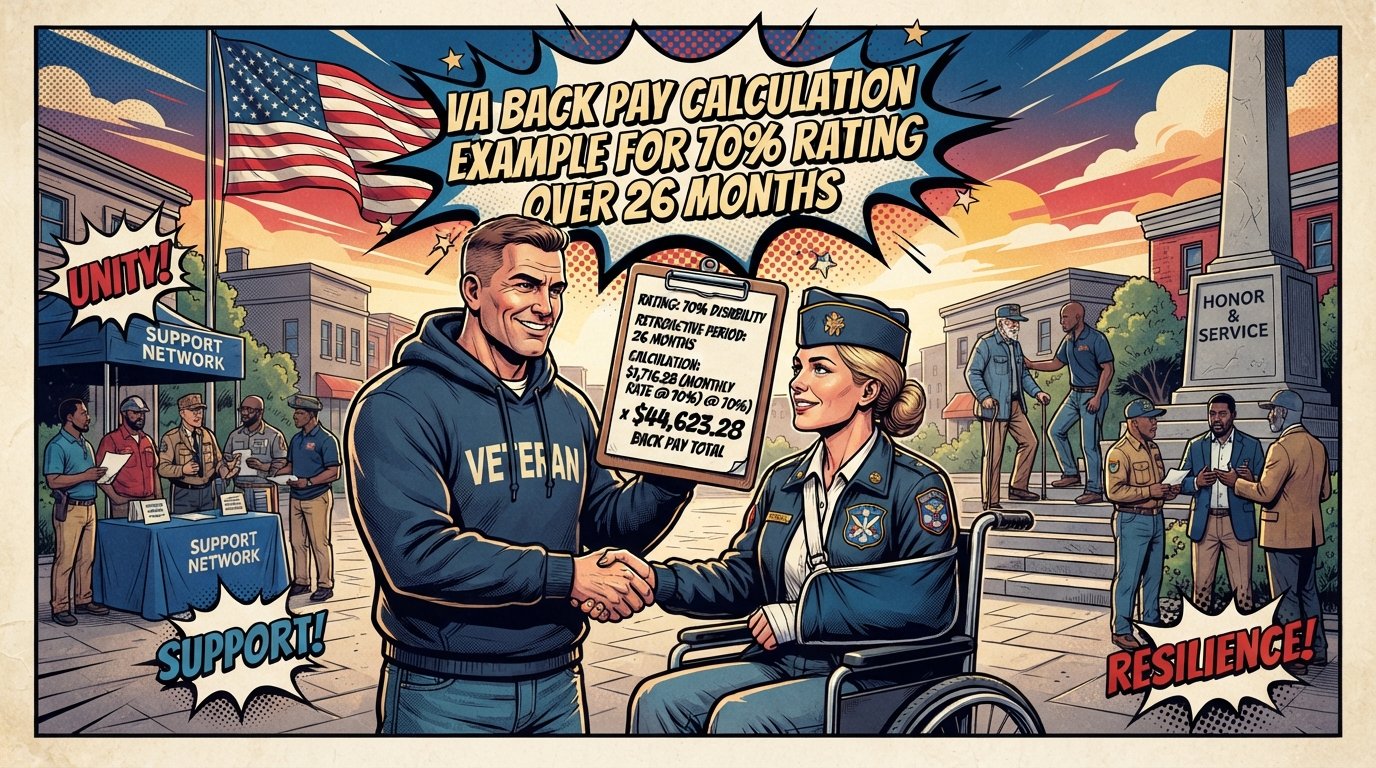
VA disability back pay is the lump-sum payment covering the months between your claim’s effective date and the date VA approves it. For a 70% rating with a January 1, 2024 effective date approved in March 2026, a single veteran could receive roughly $45,000. File an Intent to File (VA Form 21-0966) to lock in the earliest possible effective date.
Quick Facts
| Item | Details |
|---|---|
| Benefit | VA disability back pay (retroactive lump-sum compensation) |
| Eligibility | Veterans with a granted service-connected disability rating |
| Application | Original claim: VA Form 21-526EZ; Intent to File: VA Form 21-0966 |
| Processing Time | Initial claims: 90–180 days; back pay deposits typically 15–45 days after decision |
| Official Agency | U.S. Department of Veterans Affairs (VA) |
| Required Forms | VA Form 21-526EZ (claim); VA Form 21-0966 (intent to file) |
| Updated For | 2026 rates effective December 1, 2025 (2.8% COLA) |
What Is VA Disability Back Pay?
VA disability back pay — also called retroactive compensation or retro pay — is a lump-sum payment the VA owes you for the time between your claim’s effective date and the date VA approves your claim. The VA pays benefits from the effective date, not the decision date. Since claims can take months or years to process, this creates a retroactive period during which you would have been paid had the claim been decided immediately.

The lump sum is paid in a single deposit to your VA-registered bank account, typically within 15–45 business days after the decision is finalized. It is tax-free and does not affect Social Security, Medicare eligibility, or most other benefits.

Example: If your effective date is January 1, 2024, and VA approves your 70% rating in March 2026, you would receive approximately 26 months of back pay at the 70% rate — a lump sum of over $45,000 for a single veteran with no dependents.
VA back pay is not the same as your monthly disability compensation going forward. It is a separate, one-time payment. After the back pay is issued, you begin receiving regular monthly payments at your new rate.
How to Calculate Your VA Back Pay
Calculating your back pay requires three inputs: your effective date, your monthly rate, and the number of months between them.
Step-by-Step Calculation
Identify your effective date. Check your VA decision letter for the listed effective date. This is the date back pay starts accruing.
Identify your approval date. This is the date VA granted your claim and begins paying you going forward. The first pay date is typically the first day of the month after the decision is finalized.
Calculate the number of months between the effective date and the first pay date. Count whole months. Partial months in the effective month may be excluded — the VA pays from the first day of the month following the effective date for most original claims.
Apply the monthly pay rate for each month. If your effective date spans multiple years, you must apply the compensation rate in effect for each year. The rate changes every December 1 with the COLA.
Multiply the monthly rate by the number of months. This gives you the basic back pay figure.
Example: 70% Rating, Effective January 1, 2024
| Period | Monthly Rate | Months | Subtotal |
|---|---|---|---|
| Jan–Nov 2024 | $1,759.19 (2024 rate) | 11 | $19,351.09 |
| Dec 2024–Nov 2025 | $1,808.45 (2025 rate) | 12 | $21,701.40 |
| Dec 2025–Feb 2026 | $1,808.45 (2026 rate, 70%) | 3 | $5,425.35 |
| Total | 26 | $46,477.84 |
Note: This example uses a single veteran with no dependents. If you had a spouse or children during the retroactive period and the VA knew about them, the dependent rate applies to those months.
Effective Dates: The Most Important Factor in Back Pay
Veterans May Qualify for Extra Benefits
Check available financial assistance, healthcare programs and other opportunities that may apply to you.
Check EligibilityThe effective date is the single most important factor in your back pay calculation. The earlier your effective date, the more back pay you receive. Get this date wrong and every other number in the calculation is wrong too.
General Rule Under 38 U.S.C. § 5110
The effective date is the later of: (1) the date entitlement arose (the date your condition became disabling), or (2) the date your claim was received by the VA. For most veterans filing original claims years after service, the effective date is simply the date the VA received their claim — because the condition has been disabling for longer than the claim has been pending.
Special Effective Date Rules
| Situation | Effective Date Rule |
|---|---|
| Claim filed within 1 year of discharge | Day following discharge or release date |
| Intent to File submitted before formal claim | ITF date (up to 1 year before formal claim) |
| Claim for increase | Earliest date increase was ascertainable, if claim filed within 1 year |
| Supplemental Claim filed within 1 year of prior decision | Relates back to original claim date |
| CUE (Clear and Unmistakable Error) motion | Date the error was made — sometimes decades back |
| New presumptive conditions (PACT Act) | Date the regulation was enacted or date of claim, whichever is later |
| Appeals (continuously pursued) | Original claim date if appeal chain is unbroken |
The One-Year Rule for Discharge Claims
If you file your claim within one year of your discharge or release from active duty, the effective date is the day following your discharge. This can result in a much earlier effective date than the date you filed your claim. For example, if you separated on July 1, 2025, and filed your claim on January 15, 2026, the effective date is July 1, 2025 — not January 15, 2026.
Continuous Pursuit and Appeals
If you appeal a denial and the appeal chain is unbroken, a later grant can carry an effective date reaching back to the original claim. Under 38 U.S.C. § 5110, the date of application is considered the date of the filing of the initial application if the claim is continuously pursued through Higher-Level Review, Supplemental Claim, or Board of Veterans’ Appeals review — filed within one year of each decision. This means that even if your claim was initially denied, winning an appeal can preserve your original effective date and unlock significant back pay.
Intent to File (VA Form 21-0966): Locking In Your Effective Date
An Intent to File (ITF) is a formal notice to VA that you plan to submit a disability claim. Filing one takes only minutes, but it can protect months of back pay. The date VA receives your ITF becomes your potential effective date — the earliest date from which VA may pay retroactive benefits if your claim is ultimately approved.
How ITF Works
Submit VA Form 21-0966 online through VA.gov, by phone, or by mail.
The date VA receives your ITF is preserved as your potential effective date.
You have one year from that date to submit your complete claim (VA Form 21-526EZ).
If you submit your complete claim within that year, your effective date is the ITF date.
Why ITF Matters
VA disability claims can take months — sometimes over a year — to process. Filing an ITF today starts the clock on your effective date while you gather medical records, nexus opinions, and other evidence. Missing the one-year deadline resets your effective date and can eliminate months of back pay.
Example: You submit an ITF on March 1, 2025. You gather your medical evidence and submit your complete claim on February 15, 2026 — within the one-year window. Your effective date is March 1, 2025. If you had waited to submit until March 2, 2026, the ITF would have expired, and your effective date would be March 2, 2026 — costing you nearly a year of back pay.
Does ITF Apply to Supplemental Claims?
An ITF applies to disability compensation, Veterans pension, survivors pension, and DIC claims. For supplemental claims, the effective date rules under 38 U.S.C. § 5110 apply separately. Filing a supplemental claim within one year of a prior decision can relate back to the original claim date, preserving your earlier effective date.
2026 VA Disability Rates Used in Back Pay Calculations
When calculating back pay, VA uses the compensation rate that was in effect during each year covered — not solely the current year’s rate. This is why multi-year back pay calculations require applying historical rate tables.
2026 Rates (Effective December 1, 2025)
| Rating | Veteran Alone | With Spouse |
|---|---|---|
| 10% | $180.42 | $180.42 |
| 20% | $356.66 | $356.66 |
| 30% | $552.47 | $617.47 |
| 40% | $795.84 | $882.84 |
| 50% | $1,132.90 | $1,241.90 |
| 60% | $1,435.02 | $1,566.02 |
| 70% | $1,808.45 | $1,961.45 |
| 80% | $2,102.15 | $2,277.15 |
| 90% | $2,362.30 | $2,559.30 |
| 100% | $3,938.58 | $4,158.17 |
Historical Rates for Back Pay Calculations
If your effective date is several years back, you must apply the correct rate for each period. Here are key rates for recent years (veteran alone):
| Year | 50% | 70% | 100% |
|---|---|---|---|
| 2024 | $1,075.16 | $1,716.28 | $3,737.85 |
| 2025 | $1,102.04 | $1,759.19 | $3,831.30 |
| 2026 | $1,132.90 | $1,808.45 | $3,938.58 |
The COLA takes effect every December 1 for the following calendar year. For a claim effective in 2023, you would apply 2023 rates for 2023 months, 2024 rates for 2024 months, and so on. Each December, the rate steps up.
Dependents and Back Pay
If you had dependents during the retroactive period, the dependent rate applies to those months — but only if the VA knew about them. A spouse you never reported does not get counted. This is a common source of underpayment: the grant is right, the effective date is right, and the veteran was married the whole time without the file reflecting it.
How Dependent Back Pay Works
Spouse: The dependent supplement applies from the effective date of the dependent claim, if filed within one year of the rating notification. If you added your spouse later, the supplement applies from the date VA received the dependent claim.
Children: Each child under 18 adds $87.00 per month (after the first). Children 18–23 in school add $281.00 per month.
Dependent parents: One parent adds $140.00 per month; two parents add $280.00 per month at the 80% rating.
Example: 70% Rating With Spouse, Effective January 1, 2024
| Period | Monthly Rate (With Spouse) | Months | Subtotal |
|---|---|---|---|
| Jan–Nov 2024 | $1,906.28 | 11 | $20,969.08 |
| Dec 2024–Nov 2025 | $1,961.45 | 12 | $23,537.40 |
| Dec 2025–Feb 2026 | $1,961.45 | 3 | $5,884.35 |
| Total | 26 | $50,390.83 |
The difference between the veteran-alone calculation ($46,477.84) and the with-spouse calculation ($50,390.83) is $3,912.99 — money left on the table if you never reported your spouse.
Staged Ratings and Back Pay
A staged rating is when VA changes a veteran’s retroactive disability compensation based on how the condition changed between the effective date and when the back pay was finally awarded. If the evidence shows your condition was worse in some stretches than others, the decision can assign different percentages to different date ranges.
Example: A veteran’s PTSD was rated at 30% from 2020 to 2022, then 50% from 2022 to 2024, then 70% from 2024 onward. VA can assign a staged rating that pays 30% for the first period, 50% for the second, and 70% for the third. This may increase back pay if the condition was worse in the past.
Staged ratings can make calculating years of back pay more difficult because the rating may have changed through time. When reading your decision letter, look for date ranges — not just the current rating. Each period may have a different rate.
Appeals and Back Pay
Appeals can significantly increase your back pay — or preserve it. If you appeal a denial and the appeal chain is unbroken, a later grant can carry an effective date reaching back to the original claim.
Three Appeal Options
| Appeal Type | How It Works | Effect on Effective Date |
|---|---|---|
| Supplemental Claim | Submit new and relevant evidence | Relates back to original claim if filed within 1 year |
| Higher-Level Review | Senior reviewer examines the decision | Relates back if filed within 1 year |
| Board of Veterans’ Appeals | Appeal to the Board | Relates back if filed within 1 year |
The Continuous Pursuit Rule
Under 38 U.S.C. § 5110, if you continuously pursue your claim through timely appeals, the date of your original application is preserved. This means that even after multiple denials, a final grant can result in back pay going all the way back to your original claim date.
Important: If you miss the one-year deadline to file an appeal, the chain of continuity is broken. A new claim filed after that will have a new effective date — and you lose the retroactive pay from the original claim period.
Freund v. Collins Settlement
The Freund v. Collins class action settlement may affect veterans whose legacy appeals were wrongly closed by VA’s VACOLS system between December 12, 1990, and February 6, 2025. A reactivated appeal keeps its original effective date, meaning back pay could stretch back decades. VA has agreed to audit 28,258 flagged files and send notice to an additional 64,599 files inviting a review. If you received a notice, respond promptly.
Common Mistakes That Reduce Your Back Pay
1. Not filing an Intent to File. An ITF preserves your effective date for up to one year while you gather evidence. Without one, your effective date is the date VA receives your formal claim — potentially months later.
2. Missing the one-year window after discharge. If you file within one year of discharge, the effective date is the day after separation. Waiting longer can cost you months or years of back pay.
3. Failing to appeal within one year. If you disagree with a VA decision, you have one year to file an appeal. Missing this deadline breaks the chain of continuity and resets your effective date.
4. Not reporting dependents. If you had a spouse or children during the retroactive period and the VA did not know about them, you lose the dependent supplement for those months. File VA Form 21-686c as soon as possible.
5. Accepting an incorrect effective date. VA sometimes assigns a later effective date than it should. Check your decision letter carefully and challenge an incorrect effective date within one year.
6. Not understanding staged ratings. If your condition worsened over time, VA may assign different ratings for different periods. Read your decision for date ranges, not just the current rating.
7. Overlooking CUE (Clear and Unmistakable Error). If VA made an error in a prior decision, correcting it can result in back pay going back years or even decades. CUE motions do not have a time limit.
8. Assuming the VA calculated correctly. Effective-date errors are common and often unnoticed. Verify the math and consult an accredited representative if the numbers seem wrong.
How to Verify Your Back Pay Is Correct
After you receive your decision letter, verify three things: the rating, the effective date, and the back pay amount.
Check the rating. Confirm that each granted condition has the correct percentage.
Check the effective date. Confirm that the date listed matches what you expected based on your claim date, ITF, or discharge date.
Check the back pay calculation. Multiply your monthly rate by the number of months covered. If the amount seems wrong, request a detailed explanation.
Check for dependents. If you had dependents during the retroactive period, confirm that the dependent rate was applied to those months.
Check for staged ratings. If your condition worsened over time, confirm that VA applied the correct rating for each period.
If you believe the back pay is incorrect, you can file an appeal within one year of the decision. An accredited representative or Veterans Service Organization (VSO) can review your case for free.
Payment Timeline for Back Pay
VA back pay is paid as a single lump-sum deposit to your VA-registered bank account. In most cases, retroactive compensation is released within 15–45 business days after the rating decision is processed. Sometimes the payment arrives before the official decision letter.
If you have not received payment after 60 days, contact the VA at 1-800-827-1000. Delays can occur if VA needs to verify your bank account information, if there are multiple claims being processed, or if the back pay amount requires additional review.
Back pay is deposited separately from your regular monthly compensation. Your first regular monthly payment at the new rate will arrive on the first business day of the following month.
Back Pay and Social Security Disability
Receiving VA disability back pay does not affect your Social Security Disability Insurance (SSDI) benefits. VA disability compensation is not means-tested, so receipt of Social Security benefits does not affect it, and receipt of VA benefits does not reduce SSDI payments. You can receive both simultaneously.
However, VA disability payments count as unearned income for Supplemental Security Income (SSI) purposes. If you receive SSI, a large back pay lump sum could affect your SSI eligibility for the month you receive it. Report the back pay to the Social Security Administration.
SSDI retroactive pay is limited to up to 12 months from the date you file your SSDI application. This is separate from VA back pay rules.
Common Questions
1. How is VA disability back pay calculated?
VA multiplies your monthly compensation rate by the number of months between your effective date and your approval date. If your effective date spans multiple years, each year’s rate applies to those months. The result is paid as a single tax-free lump sum.
2. How far back can VA back pay go?
Generally, back pay is calculated from your effective date. If you filed within one year of discharge, the effective date can be the day after separation. If you continuously pursued an appeal, back pay can stretch back to your original claim date — potentially years or decades.
3. What is an Intent to File and why does it matter?
An Intent to File (VA Form 21-0966) is a notice to VA that you plan to submit a claim. It locks in your effective date for up to one year while you gather evidence. Missing the one-year deadline resets your effective date and eliminates months of back pay.
4. How long does it take to receive VA back pay?
Most veterans receive back pay within 15–45 business days after the rating decision is processed. Some payments arrive within a few weeks. If you have not received payment after 60 days, contact VA.
5. Is VA back pay taxable?
No. VA disability compensation, including back pay, is tax-free at the federal level. Even if you receive a large lump sum after winning an appeal, that money is not taxable. You do not report it on your federal tax return.
6. Can I receive back pay if I was already receiving some disability benefits?
Yes. If you were paid at a lower rating and VA increases it, you receive the difference retroactively from the effective date of the increase. For example, if you were at 30% and should have been at 70% since February 2021, you receive the difference for those months.
7. What is a staged rating?
A staged rating is when VA assigns different disability percentages to different date ranges within a retroactive period. If your condition was worse in the past, VA can pay a higher rate for that period. Read your decision letter for date ranges, not just the current rating.
8. Does an appeal affect my back pay?
Yes. If you continuously pursue an appeal, your original effective date is preserved. A later grant can result in back pay going back to your original claim date. Missing the one-year appeal deadline breaks the chain and resets your effective date.
9. How do dependents affect back pay?
If you had dependents during the retroactive period and VA knew about them, the dependent rate applies to those months. If you never reported them, you lose the dependent supplement for that period. File VA Form 21-686c as soon as possible.
10. What is a CUE and how does it affect back pay?
A Clear and Unmistakable Error (CUE) is a VA error in a prior decision that can be corrected at any time. CUE motions do not have a time limit. If VA made an error, correcting it can result in back pay going back years or even decades.
11. Can VA back pay be paid to my survivors if I die before receiving it?
Yes. Accrued benefits that were due but not paid before a veteran’s death may be paid to the surviving spouse, dependent children, or other eligible survivors. The order of priority is established by VA regulations.
12. Does VA back pay affect SSI?
VA disability payments count as unearned income for SSI purposes. A large back pay lump sum could affect your SSI eligibility for the month you receive it. Report the back pay to the Social Security Administration.
13. What if I disagree with the back pay amount?
If you believe the back pay is incorrect, you can file an appeal within one year of the decision. An accredited representative or Veterans Service Organization (VSO) can review your case for free.
14. How do I check the status of my back pay?
Sign in to VA.gov and use the “Check Your Claim or Appeal Status” tool. You can also call VA at 1-800-827-1000. If you submitted your claim by mail, allow extra time for processing.
15. Can I get back pay for a condition that was denied years ago?
Yes, if you reopen the claim with new and relevant evidence or appeal the prior denial within the allowed timeframes. If the appeal chain is unbroken, the effective date can relate back to the original claim.
Key Takeaways
VA back pay is a tax-free lump-sum payment covering the months between your claim’s effective date and VA’s approval date.
The effective date is the most important factor. An earlier effective date means more back pay.
File an Intent to File (VA Form 21-0966) to lock in your effective date for up to one year while you gather evidence.
If you file within one year of discharge, the effective date is the day after separation — not the date you filed.
VA applies the compensation rate in effect for each year covered, not just the current year’s rate.
Dependents must be reported to VA to receive the dependent rate during the retroactive period.
Staged ratings can assign different percentages to different date ranges, increasing back pay if your condition was worse in the past.
Appeals preserve your original effective date if the appeal chain is unbroken — file within one year of each decision.
Most back pay is deposited within 15–45 business days after the decision; contact VA if you haven’t received it after 60 days.
Back pay does not affect Social Security or Medicare, but VA payments count as unearned income for SSI purposes.
Official Resources
VA Disability Compensation: https://www.va.gov/disability/
VA Intent to File (VA Form 21-0966): https://www.va.gov/forms/21-0966/
VA Form 21-526EZ (Disability Claim): https://www.va.gov/forms/21-526ez/
VA Disability Compensation Rates: https://www.va.gov/disability/compensation-rates/veteran-rates/
VA Add Dependents (VA Form 21-686c): https://www.va.gov/forms/21-686c/
VA Appeals: https://www.va.gov/decision-reviews/
VA Claim Status: https://www.va.gov/claim-or-appeal-status/
38 U.S.C. § 5110 (Effective Dates): https://uscode.house.gov/
Social Security Administration: https://www.ssa.gov/
U.S. Code Title 38: https://uscode.house.gov/





🇺🇸 IMPORTANT DISCLAIMER – Veterans Benefits Information
This site provides general information about U.S. Department of Veterans Affairs (VA) benefits for educational and informational purposes only.
- Not Official: We are NOT affiliated with, endorsed by, or connected to the U.S. Department of Veterans Affairs (VA), the Veterans Benefits Administration (VBA), the Veterans Health Administration (VHA), or any other government agency.
- No Legal/Financial Advice: The content on this website is for informational purposes only and does not constitute legal, financial, or medical advice. VA benefits rules change frequently – always consult with an accredited Veterans Service Officer (VSO) or a qualified professional for your specific situation.
- Official Sources: For official, binding information and to apply for benefits, always visit official .gov websites: VA.gov, Benefits.VA.gov, or SSA.gov.
- No Data Collection: This site does not collect, store, or process any personal information. It does not have login forms, contact forms, or any system to capture user data. We never ask for your Social Security Number, bank details, or any personal information.
- 🚨 Scam Alert: The VA and other government agencies never charge fees for benefit applications. If anyone asks for money to "process" your VA claim, it is a scam. Report it to the VA Office of Inspector General at VA.gov/OIG.
- Advertising: This site uses third-party advertising (Adsterra) to cover operational costs. We do not endorse or guarantee any products or services advertised.
📌 Information provided as of June 2026. Always verify current eligibility and rules with official .gov sources.
This site is not affiliated with the U.S. Department of Veterans Affairs or any government agency. All information is for educational purposes only. Please visit VA.gov for official information.
