
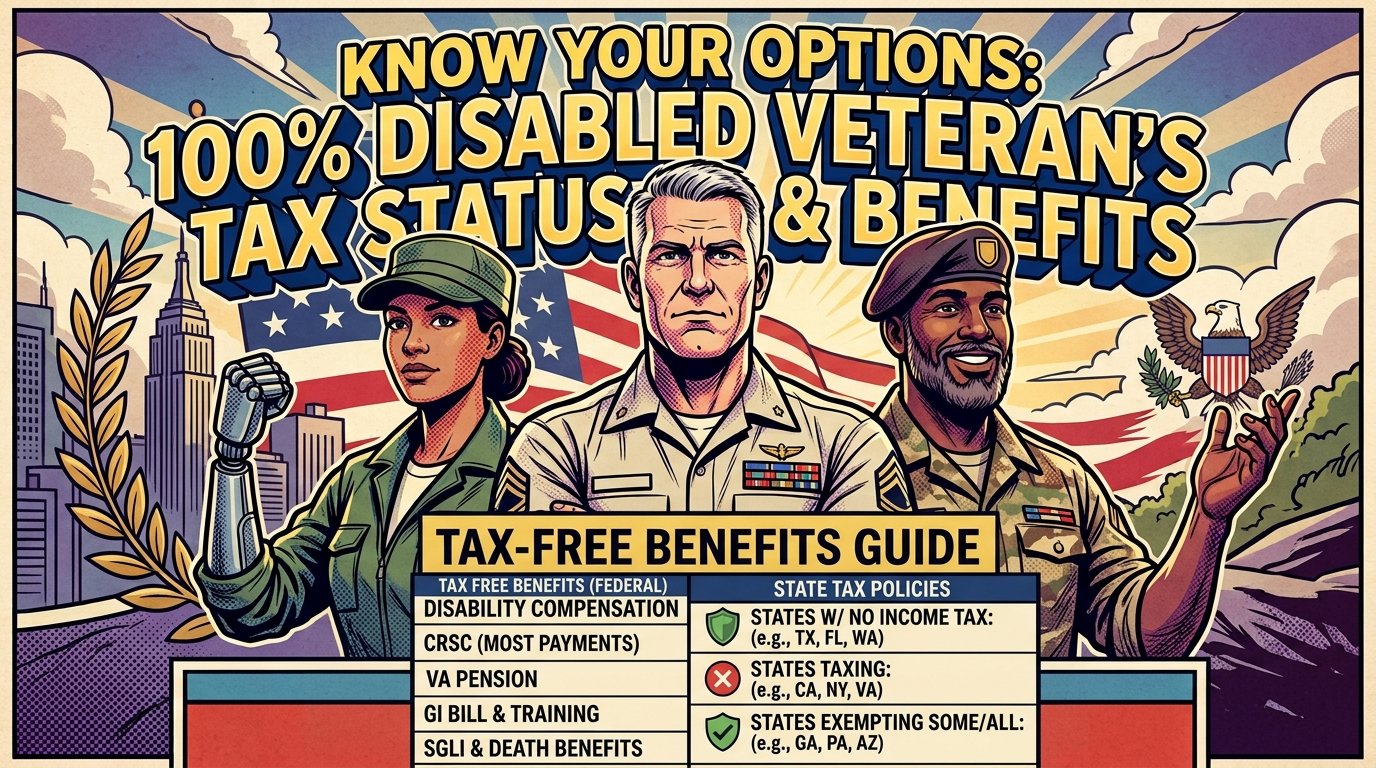
Most VA Benefits Are Not Taxable
No. Most VA benefits are not taxable at the federal level. VA disability compensation, pension payments, GI Bill education benefits, Veteran Readiness & Employment (VR&E) payments, and caregiver stipends are all exempt from federal income tax. The VA does not report these payments on Form 1099-R or Form W-2. Military retirement pay, however, is generally taxable.
Quick Facts
| Item | Details |
|---|---|
| Benefit | VA benefits (disability, pension, education, caregiver, etc.) |
| Federal Taxable? | Most VA benefits: No. Military retirement pay: Yes |
| State Taxable? | VA disability compensation: Tax-free in all states |
| Eligibility | Varies by benefit type |
| Official Agency | U.S. Department of Veterans Affairs (VA) |
| Tax Reporting | VA benefits not reported on Form 1099-R or Form W-2 |
| Required Forms | Varies by benefit type |
| Updated For | Tax Year 2025 / 2026 Filing Season |
Which VA Benefits Are Tax-Free?
Most benefits administered by the Department of Veterans Affairs are exempt from federal income tax. The IRS explicitly states that VA disability benefits should not be counted as part of a veteran’s gross income. The following benefits are tax-free.

| VA Benefit | Federal Taxable? | State Taxable? |
|---|---|---|
| VA Disability Compensation | No | No |
| VA Disability Pension | No | No |
| GI Bill Education Benefits | No | No |
| Veteran Readiness & Employment (VR&E) | No | No |
| VA Caregiver Stipend | No | No |
| Special Monthly Compensation (SMC) | No | No |
| Dependency and Indemnity Compensation (DIC) | No | No |
| VA Life Insurance Proceeds | No | No |
| VA Burial Allowances | No | No |
| Grants for Home Modifications (SAH/SHA) | No | No |
| Automobile Grants | No | No |
| Military Retirement Pay (standard) | Yes | Varies by state |
| CRDP (Concurrent Retirement and Disability Pay) | Yes | Varies by state |
| CRSC (Combat-Related Special Compensation) | No | No |
| Survivor Benefit Plan (SBP) Annuities | Yes | Varies by state |
| Disability Severance Pay | Usually | Varies by state |
VA Disability Compensation
VA disability compensation is a monthly tax-free payment to veterans with service-connected injuries or illnesses. The IRS states directly: “Don’t include disability benefits you received from the VA in your gross income”. The VA does not report these payments on Form 1099-R or Form W-2.
VA Disability Pension

VA pension is a needs-based benefit for low-income wartime veterans. Like disability compensation, VA pension payments are not taxable and are excluded from gross income. VA pension is a “tax-free monetary benefit payable to low-income wartime Veterans”.
GI Bill Education Benefits
All payments from GI Bill programs are tax-free. This includes tuition, training fees, test fees for licenses and certifications, money for tutors, work-study, books, and housing. The VA states: “Payments from all GI Bill programs are tax-free. This is true for you, your dependents, and your survivors”.
Veteran Readiness & Employment (VR&E)
VR&E provides employment services and education benefits to veterans with service-connected disabilities. These benefits are not taxable. The IRS lists “veterans’ benefits, including VA rehabilitation payments” among items that are not earned income.
VA Caregiver Stipend
The VA Caregiver Support Program provides a monthly stipend to primary family caregivers of eligible veterans. This stipend is nontaxable income to the caregiver. The stipend is a VA enhanced service and is not considered taxable income.
Special Monthly Compensation (SMC)
Veterans May Qualify for Extra Benefits
Check available financial assistance, healthcare programs and other opportunities that may apply to you.
Check EligibilitySMC is an additional tax-free payment for veterans with severe disabilities, such as loss of limb, blindness, or the need for aid and attendance. SMC payments follow the same tax rules as standard disability compensation — they are fully excluded from taxable income.
Dependency and Indemnity Compensation (DIC)
DIC is a tax-free monetary benefit paid to surviving spouses, dependent children, and parents of service members who died in the line of duty or whose death resulted from a service-connected injury or disease. The VA explicitly states that DIC payments are tax exempt.
VA Life Insurance Proceeds
Lump-sum proceeds from any life insurance policy on a veteran are excluded from income. This includes Servicemembers’ Group Life Insurance (SGLI) and Veterans’ Group Life Insurance (VGLI). Proceeds from SGLI to a beneficiary are exempt from taxation.
VA Burial Allowances
VA burial benefits are tax-free payments made directly to the person who paid for the veteran’s burial. These benefits are not intended to cover the full cost of a funeral but serve as a partial reimbursement.
Which VA Benefits Are Taxable?
Not all military-related payments are tax-free. The most common taxable benefit is military retirement pay.
Military Retirement Pay
Military retirement pay based on age or length of service is considered taxable income for federal income taxes. It must be included as income on your tax return. DFAS issues a Form 1099-R showing the taxable portion of these payments.
CRDP (Concurrent Retirement and Disability Pay)
CRDP is a restoration of retired pay for military retirees with a VA disability rating of 50% or higher. CRDP is taxable income because it is considered restored military retired pay. It is reported on Form 1099-R by DFAS.
Survivor Benefit Plan (SBP) Annuities
SBP annuities are taxable income at the federal level. DFAS withholds federal income tax from SBP payments. Survivors must report SBP annuities on their tax returns. This differs from DIC, which is completely tax-free.
Disability Severance Pay
Disability severance pay (DSP) is normally taxable, but there are exceptions. DSP is not taxable if it resulted from a combat-related injury or if the service member later received VA disability compensation for the same condition. If you paid tax on DSP that should have been excluded, you can file Form 1040-X to claim a refund.
CRDP vs. CRSC: The Critical Tax Difference
Two programs allow eligible military retirees to receive both retired pay and VA disability compensation. Their tax treatment is completely different.
| Feature | CRDP | CRSC |
|---|---|---|
| Full Name | Concurrent Retirement and Disability Pay | Combat-Related Special Compensation |
| What It Is | Restoration of military retired pay | Special compensation for combat-related disabilities |
| Federal Taxable? | Yes — taxable | No — tax-free |
| Minimum VA Rating | 50% | 10% |
| Combat Connection Required? | No | Yes |
| Application Required? | No — automatic | Yes — apply to branch of service |
| Reported on 1099-R? | Yes | No |
What Is CRDP?
CRDP is a restoration of retired pay for military retirees with a VA disability rating of 50% or higher. It is taxable income because it is considered restored military retired pay. No application is required — DFAS applies CRDP automatically when you meet the eligibility criteria.
What Is CRSC?
CRSC is a special compensation for military retirees with combat-related disabilities. It is not taxable. Retirees must apply to their branch of service to receive CRSC. Unlike ordinary retired pay (including CRDP), CRSC is non-taxable — it is disability compensation, not retired pay.
Military Disability Retirement Pay: When It’s Tax-Free
Military disability retirement pay may be excluded from taxable income if certain conditions apply. The key question is whether the disability is combat-related.
Under federal law, military disability retirement pay should not be included in taxable income if any of the following conditions apply:
You were entitled to receive a disability payment before September 25, 1975
You were a member of the military (active or reserves) or were under a binding written commitment to become a member on September 24, 1975
You receive disability payments for a combat-related injury, which includes injuries that:
Resulted directly from armed conflict
Took place while engaged in extra-hazardous service
Took place under conditions simulating war, including training exercises such as maneuvers
Were caused by an instrumentality of war
You would be entitled to receive disability compensation from the VA if you filed an application for it (the exclusion equals the amount you would be entitled to from the VA)
If the Physical Evaluation Board (PEB) designates your condition as combat-related, your disability retirement pay is excluded from federal gross income.
State Tax Treatment of VA Benefits
VA disability compensation is tax-free in all 50 states and U.S. territories. No state taxes VA disability compensation as income.
However, states treat military retirement pay differently. Some states exempt all military retirement income, while others offer partial exemptions or credits based on age, disability rating, or income level.
States With No Income Tax
Nine states do not levy a personal income tax: Alaska, Florida, Nevada, New Hampshire, South Dakota, Tennessee, Texas, Washington, and Wyoming. Veterans in these states owe no state income tax on any income, including military retirement pay.
States With Full Military Retirement Exemptions
Several states exempt all military retirement pay from state income tax, including Alabama, Arizona, Arkansas, Connecticut, Hawaii, Illinois, Indiana, Iowa, Kansas, Louisiana, Maine, Massachusetts, Michigan, Minnesota, Mississippi, Missouri, North Dakota, Ohio, Oklahoma, Pennsylvania, and Wisconsin. Rules vary — some apply only to veterans over a certain age, and some require the veteran to have been a resident at the time of service.
Property Tax Exemptions for Disabled Veterans
Many states offer property tax exemptions for disabled veterans, with requirements based on VA disability rating. A 2026 analysis found that 22 states offer a full or effectively full property tax exemption for 100% disabled veterans. Several of those states also have no state income tax. Nineteen states provide the property tax exemption but still impose a state income tax.
Required Documents for Tax Filing
Documents to keep:
VA award letter (letter of determination) showing disability rating and monthly payment
Annual VA benefits statement (available at VA.gov)
DD Form 214 (Certificate of Release or Discharge from Active Duty)
Form 1099-R from DFAS if receiving military retirement pay, CRDP, or SBP
Form W-2 if employed
Documents you will not receive:
The VA does not issue Form 1099-R for disability compensation or pension payments.
The VA does not issue Form W-2 for disability benefits.
If you receive CRDP or military retirement pay, DFAS will issue a Form 1099-R showing the taxable portion of those payments. VA disability compensation is typically excluded from the taxable amount shown on Form 1099-R.
How to Apply for VA Disability Compensation
VA disability compensation is not automatic. Veterans must file a claim with the VA.
Step 1: Gather your evidence. Collect your DD Form 214, medical records, buddy statements, and any other documentation linking your condition to your military service.
Step 2: File your claim. Apply online at VA.gov, or submit VA Form 21-526EZ, Application for Disability Compensation and Related Compensation Benefits.
Step 3: Attend your C&P exam. VA will schedule a Compensation and Pension (C&P) examination to evaluate your condition. Attend this exam — it is a critical part of your claim.
Step 4: Receive your decision. VA will issue a rating decision. Processing times vary, but most claims are decided within 90 to 180 days.
Step 5: If denied, appeal. If your claim is denied or you disagree with the rating, you can file an appeal. The appeals process includes a supplemental claim, higher-level review, or Board of Veterans’ Appeals review.
Common Mistakes Veterans Make With Taxes
Mistake 1: Reporting VA disability compensation as income. VA disability compensation is not taxable. Do not include it in your gross income on your tax return.
Mistake 2: Confusing CRDP with CRSC. CRDP is taxable; CRSC is not. If you receive CRDP, you will owe federal income tax on that amount.
Mistake 3: Overlooking state tax rules. While VA disability compensation is tax-free everywhere, military retirement pay is not. Check your state’s rules.
Mistake 4: Missing the SBP tax obligation. Survivors receiving SBP annuities must report these payments as taxable income. DIC is tax-free, but SBP is not.
Mistake 5: Not filing for a refund on taxed disability severance pay. If you paid tax on disability severance pay that should have been non-taxable, you may be able to file Form 1040-X to claim a refund.
Mistake 6: Assuming VA education benefits reduce tax credits incorrectly. While GI Bill benefits are not taxable, they must be subtracted from your qualified education expenses when calculating education tax credits like the American Opportunity Credit or Lifetime Learning Credit. Only subtract benefits paid directly to you, not those paid directly to the college.
How to Amend a Tax Return
If you incorrectly reported VA disability compensation as taxable income and paid tax on it, you can file an amended return using Form 1040-X.
Steps to amend:
Obtain a copy of your original tax return.
Complete Form 1040-X with the corrected income amount.
Attach any supporting documentation, such as your VA award letter.
Submit the form within three years of the original filing date.
Wait 8–12 weeks for processing.
For disability severance pay that was taxed but should have been excluded, the IRS provides specific guidance for filing a claim for credit or refund. If you retire based on years of service and are later given a retroactive service-connected disability rating by the VA, your retirement pay is excluded from income up to the amount of the VA disability benefits you would have been entitled to receive. You can claim a refund on any taxes paid on the excludable amount by filing Form 1040-X for each previous year during the retroactive period.
Pending Legislation: Tax Cuts for Veterans Act of 2025
The Tax Cuts for Veterans Act of 2025 (H.R. 6190 / S. 1108) would amend the Internal Revenue Code to exclude all military retirement pay and related veterans’ benefits from federal income tax. This includes all retired and retainer pay under Titles 10 and 14, and all VA-related monthly compensation, survivor, or disability-related payments, including under Titles 37 and 38.
If enacted, the legislation would apply to taxable years beginning after the date of enactment. As of 2026, the bill has been introduced but has not been passed into law. Veterans should monitor this legislation but plan their taxes based on current law.
Common Questions
Is VA disability compensation taxable?
No. VA disability compensation is not taxable at the federal level and is tax-free in all 50 states and U.S. territories. The IRS excludes VA disability benefits from gross income, and the VA does not report these payments on Form 1099-R or Form W-2. You do not need to include VA disability compensation on your tax return.
Do I need to report VA disability on my taxes?
No. VA disability compensation is not reportable income. The VA does not issue Form 1099-R for disability compensation, and the IRS specifically excludes these benefits from gross income. You should keep your VA award letter for your records, but you do not report the payments on your tax return.
Is VA disability pension taxable?
No. VA pension is a tax-free monetary benefit for low-income wartime veterans. Like disability compensation, VA pension payments are excluded from gross income. You do not need to report VA pension on your tax return.
Are GI Bill benefits taxable?
No. Payments from all GI Bill programs are tax-free for you, your dependents, and your survivors. This includes tuition, training fees, test fees, books, housing, and work-study payments. However, if you claim education tax credits, you must subtract GI Bill payments from your qualified education expenses.
Is the VA caregiver stipend taxable?
No. The VA Caregiver Support Program stipend is nontaxable income to the caregiver. The stipend is a VA benefit, not wages, and is not considered taxable income. Caregivers should not claim stipend payments as income.
Is military retirement pay taxable?
Standard military retirement pay based on age or length of service is taxable as federal income. It is reported on Form 1099-R by DFAS. However, disability retirement pay for combat-related injuries may be excluded from gross income.
Is CRDP taxable?
Yes. CRDP is taxable income because it is a restoration of military retired pay. It is reported on Form 1099-R by DFAS, and you must include it in your gross income on your tax return.
Is CRSC taxable?
No. CRSC is not taxable at the federal or state level. It is a special compensation for combat-related disabilities and is treated as disability compensation, not retired pay. CRSC is not reported on Form 1099-R.
Is DIC taxable to surviving spouses?
No. Dependency and Indemnity Compensation is a tax-free benefit for surviving spouses, dependent children, and parents. The VA explicitly states that DIC payments are tax exempt. Survivors do not pay federal or state income tax on DIC.
Is SBP taxable to surviving spouses?
Yes. Survivor Benefit Plan annuities are taxable income at the federal level. DFAS withholds federal income tax from SBP payments. While DIC is tax-free, SBP is treated as pension income and must be reported on the survivor’s tax return.
Are VA life insurance proceeds taxable?
No. Lump-sum proceeds from any life insurance policy on a veteran are excluded from income. This includes SGLI and VGLI. Proceeds from SGLI to a beneficiary are exempt from taxation.
Is disability severance pay taxable?
Disability severance pay is normally taxable, but there are exceptions. It is not taxable if it resulted from a combat-related injury or if you later received VA disability compensation for the same condition. If you paid tax on DSP that should have been excluded, you can file Form 1040-X to claim a refund.
Do I need to pay state income tax on VA disability?
No. VA disability compensation is tax-free in all 50 states and U.S. territories. No state taxes VA disability compensation as income. However, states have different rules for military retirement pay, so veterans receiving retirement pay should check their state’s specific rules.
Can I get a refund if I paid tax on VA disability?
If you mistakenly reported VA disability compensation as taxable income and paid tax on it, you can file Form 1040-X to amend your return and claim a refund. You generally have three years from the original filing date to amend. Attach your VA award letter as supporting documentation.
Key Takeaways
Most VA benefits — including disability compensation, pension, GI Bill, VR&E, and caregiver stipends — are not taxable at the federal level.
The VA does not report disability compensation or pension payments on Form 1099-R or Form W-2.
VA disability compensation is tax-free in all 50 states and U.S. territories.
Military retirement pay based on years of service is taxable at the federal level.
CRDP is taxable; CRSC is not taxable. This difference matters for retired veterans receiving both.
Military disability retirement pay may be tax-free if designated as combat-related by the Physical Evaluation Board.
Dependency and Indemnity Compensation (DIC) is tax-free for surviving spouses and dependents.
Survivor Benefit Plan (SBP) annuities are taxable income for survivors.
GI Bill benefits are not taxable but must be subtracted from education expenses when claiming education tax credits.
If you paid tax on VA disability compensation in error, file Form 1040-X to claim a refund.
Official Resources
U.S. Department of Veterans Affairs (VA) — VA.gov — Apply for benefits and check status
Internal Revenue Service (IRS) — IRS.gov — Veterans tax information and services
Defense Finance and Accounting Service (DFAS) — dfas.mil — CRDP, CRSC, and retired pay information
Social Security Administration (SSA) — SSA.gov — Disability benefits information





🇺🇸 IMPORTANT DISCLAIMER – Veterans Benefits Information
This site provides general information about U.S. Department of Veterans Affairs (VA) benefits for educational and informational purposes only.
- Not Official: We are NOT affiliated with, endorsed by, or connected to the U.S. Department of Veterans Affairs (VA), the Veterans Benefits Administration (VBA), the Veterans Health Administration (VHA), or any other government agency.
- No Legal/Financial Advice: The content on this website is for informational purposes only and does not constitute legal, financial, or medical advice. VA benefits rules change frequently – always consult with an accredited Veterans Service Officer (VSO) or a qualified professional for your specific situation.
- Official Sources: For official, binding information and to apply for benefits, always visit official .gov websites: VA.gov, Benefits.VA.gov, or SSA.gov.
- No Data Collection: This site does not collect, store, or process any personal information. It does not have login forms, contact forms, or any system to capture user data. We never ask for your Social Security Number, bank details, or any personal information.
- 🚨 Scam Alert: The VA and other government agencies never charge fees for benefit applications. If anyone asks for money to "process" your VA claim, it is a scam. Report it to the VA Office of Inspector General at VA.gov/OIG.
- Advertising: This site uses third-party advertising (Adsterra) to cover operational costs. We do not endorse or guarantee any products or services advertised.
📌 Information provided as of June 2026. Always verify current eligibility and rules with official .gov sources.
This site is not affiliated with the U.S. Department of Veterans Affairs or any government agency. All information is for educational purposes only. Please visit VA.gov for official information.
