
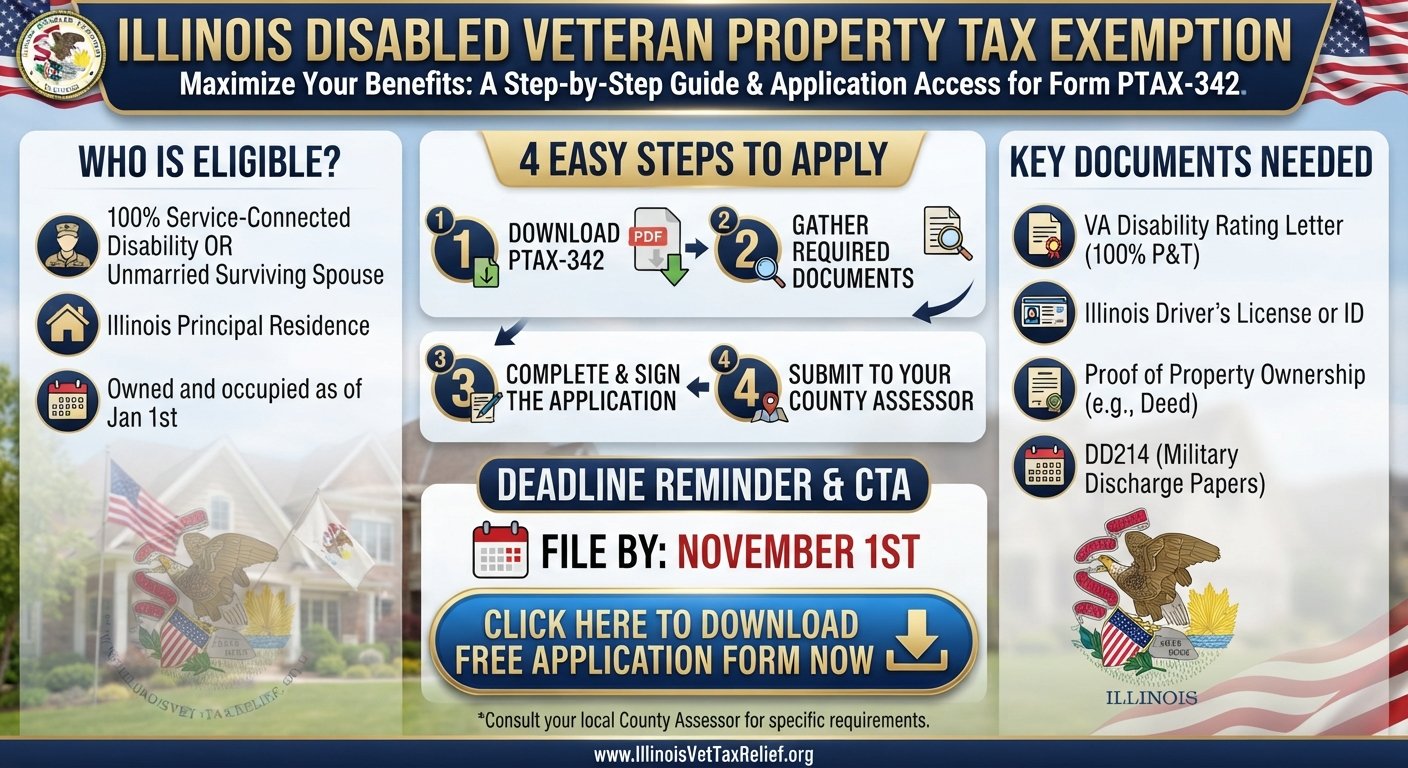
Illinois Disabled Veteran Property Tax Exemption: What You Need to Know
Illinois offers a Standard Homestead Exemption for Veterans with Disabilities (SHEVD) that reduces the equalized assessed value of a qualifying veteran’s primary residence. Veterans with a service-connected disability of 70% or more receive a full exemption on the first $250,000 of EAV. Veterans with disabilities of 30-69% receive graduated exemptions ranging from $2,500 to $5,000.
Quick Facts
| Item | Details |
|---|---|
| Benefit | Reduction in equalized assessed value (EAV) of primary residence |
| Eligibility | Veterans with service-connected disability of 30% or more |
| Application | Form PTAX-342 to Chief County Assessment Office |
| Processing Time | Varies by county; typically 30-60 days |
| Official Agency | Illinois Department of Revenue / County Assessment Office |
| Required Forms | Form PTAX-342 (Application for Standard Homestead Exemption for Veterans with Disabilities) |
| Updated For | 2026 Tax Year |
What Is the Illinois Disabled Veteran Property Tax Exemption?
The Illinois disabled veteran property tax exemption—officially called the Standard Homestead Exemption for Veterans with Disabilities (SHEVD)—is a reduction in the equalized assessed value of a qualifying veteran’s primary residence. Under 35 ILCS 200/15-169, veterans who have a service-connected disability certified by the U.S. Department of Veterans Affairs qualify for this exemption .

The exemption amount depends on the veteran’s disability rating. Veterans with a 70% or higher service-connected disability receive an exemption on the first $250,000 of equalized assessed value, which often results in a completely tax-exempt property . Veterans with lower disability ratings receive smaller exemptions.

Why this matters: Illinois has some of the highest property tax rates in the nation. For disabled veterans living on fixed incomes, this exemption can provide significant annual savings—potentially eliminating property taxes entirely for those with severe disabilities.
What veterans should do next: Contact your Chief County Assessment Office to obtain Form PTAX-342 and confirm local filing procedures.
Who Qualifies for the Illinois Disabled Veteran Exemption?
To qualify for the Illinois Standard Homestead Exemption for Veterans with Disabilities, a veteran must meet all of the following requirements:
Service-Connected Disability: Have a service-connected disability of at least 30% as certified by the U.S. Department of Veterans Affairs .
Honorable Discharge: Have served as a member of the U.S. Armed Forces on active duty or state active duty, a member of the Illinois National Guard, or a member of the U.S. Reserve Forces, and received an honorable discharge .
Property Ownership: Own the property for which the exemption is claimed.
Primary Residence: The property must be the veteran’s primary residence. The qualified residence must have an equalized assessed value of less than $250,000, less any portion used for commercial purposes .
Illinois Residency: Be an Illinois resident.
Who Does Not Qualify
Veterans with disability ratings below 30%
Veterans who do not own their primary residence
Veterans whose property is not used as their primary residence
Veterans who received a dishonorable discharge
Properties with equalized assessed value exceeding $250,000 (for the full exemption tier)
Illinois Disabled Veteran Exemption Amounts by Disability Rating
The exemption amount increases with the veteran’s disability rating. Here is the complete breakdown:
| Disability Rating | Annual Exemption Amount | Notes |
|---|---|---|
| 30% to 49% | $2,500 | Reduction in EAV |
| 50% to 69% | $5,000 | Reduction in EAV |
| 70% or more | First $250,000 of EAV | Often results in full exemption |
| World War II Veteran | Full exemption | Regardless of disability level |
Proposed Changes for 2026
Veterans May Qualify for Extra Benefits
Check available financial assistance, healthcare programs and other opportunities that may apply to you.
Check EligibilityLegislation has been introduced that could change the exemption structure. House Bill 4952 proposes that for taxable years 2025 and thereafter, veterans with a service-connected disability of 60% or more would have their property fully exempt from taxation . House Bill 2809 proposes that for taxable years 2026 and thereafter:
Veterans with 30-49% disability would receive an exemption equal to 30% of assessed value
Veterans with 50-69% disability would receive an exemption equal to 50% of assessed value
Veterans with 70% or more disability would have the property fully exempt
Important: These bills have not been enacted into law. Check with your county assessment office for current requirements.
Understanding the Equalized Assessed Value (EAV)
The exemption applies to the Equalized Assessed Value (EAV) of your property, not the market value. Understanding EAV is essential for calculating your potential savings.
How EAV Is Calculated
In Illinois, property is assessed at 33 1/3% of fair market value. The assessed value is then multiplied by a state equalization factor (also called a multiplier) to arrive at the EAV.
Example calculation:
Fair market value: $300,000
Assessed value (33 1/3%): $100,000
State equalization factor: 1.0 (varies by county)
Equalized Assessed Value: $100,000
How the Exemption Applies
If a veteran with a 70% disability rating has an EAV of $80,000, the first $250,000 of EAV is exempt. Since $80,000 is less than $250,000, the entire EAV is exempt, resulting in zero property taxes.
If the same veteran has an EAV of $300,000, only the first $250,000 is exempt. The remaining $50,000 is taxable.
How to Apply for the Illinois Disabled Veteran Exemption
Step-by-Step Application Process
Step 1: Obtain Form PTAX-342
Download the Application for Standard Homestead Exemption for Veterans with Disabilities (Form PTAX-342) from the Illinois Department of Revenue website or request it from your Chief County Assessment Office .
Step 2: Complete the Application
Fill out all required sections of Form PTAX-342. The form requires information about the veteran, the property, and the disability rating.
Step 3: Gather Required Documents
You will need:
Disability Certification Letter from the U.S. Department of Veterans Affairs showing your service-connected disability rating
Form DD-214 showing honorable discharge (certified by either the County Clerk’s Office or the Illinois Department of Veterans Affairs)
Proof of property ownership
Proof of residency
Step 4: Submit Your Application
Submit your completed application and supporting documents to your Chief County Assessment Office. Filing deadlines vary by county, but the standard deadline is typically between April 1 and May 15 .
Step 5: Wait for Processing
The assessment office will review your application and notify you of their decision.
Annual Filing Requirement
Veterans with disabilities or their surviving spouses are required to file for the property tax relief each year . However, per new legislation, veterans who are rated 100% disabled and classified as “permanently and totally disabled” by the VA may be automatically renewed each year .
Required Documents for the Illinois Disabled Veteran Exemption
| Document | Purpose | Notes |
|---|---|---|
| Form PTAX-342 | Application for exemption | Required for all applicants |
| VA Disability Certification Letter | Proves service-connected disability rating | Must show disability percentage |
| DD-214 | Proves honorable discharge | Must be certified |
| Proof of Property Ownership | Confirms ownership | Deed or tax bill |
| Proof of Residency | Confirms primary residence | Driver’s license or similar |
| Marriage Certificate | For surviving spouse applicants | Proves relationship to veteran |
| Death Certificate | For surviving spouse applicants | Required if applying as surviving spouse |
Common mistake: Submitting a VA letter that does not clearly state the disability percentage. The assessment office needs this information to determine the correct exemption amount.
Illinois Veteran Property Tax Exemption Comparison
| Program | Eligible Veterans | Income Limits | Online Application |
|---|---|---|---|
| Standard Homestead Exemption for Veterans with Disabilities | 30%+ service-connected disability | None | Varies by county |
| Specially Adapted Housing Exemption | Veterans with specially adapted housing | None | Varies by county |
| Returning Veterans Homestead Exemption | Veterans returning from active duty | None | Varies by county |
| Homestead Exemption for Persons with Disabilities | Persons with disabilities | Income limits apply | Varies by county |
Surviving Spouse Benefits in Illinois
Who Qualifies as a Surviving Spouse?
The un-remarried surviving spouse of a qualifying disabled veteran may continue receiving the exemption if:
The veteran qualified for the exemption during their lifetime, OR
The veteran would have qualified for the exemption in the taxable year for which the exemption is sought if they had survived, AND the surviving spouse has been an Illinois resident from the time of the veteran’s death through the taxable year for which the exemption is sought
Additional Eligibility for Surviving Spouses
Beginning in tax year 2023, additional categories of surviving spouses qualify:
Surviving spouse of a veteran killed in the line of duty
Surviving spouse of a veteran whose death was determined to be service-connected and who is certified by the VA as a recipient of dependency and indemnity compensation (DIC) under federal law
Required Documents for Surviving Spouse
Surviving spouses must provide additional documentation:
Marriage certificate
Death certificate or Report of Casualty (if veteran died in active service)
Disability Certification Letter from the VA (if applicable)
DIC certification letter (if qualifying under that provision)
Remarriage Disqualification
If a surviving spouse remarries, they lose eligibility for the exemption. There is no exception to this rule.
Transferring the Exemption
If the surviving spouse sells the property, an exemption not to exceed the amount granted from the most recent ad valorem tax roll may be transferred to their new residence as long as it is used as their primary residence and they do not remarry .
Illinois vs. Other States: Disabled Veteran Property Tax Benefits
| State | 70%+ Disabled Veteran Benefit | Surviving Spouse Benefit |
|---|---|---|
| Illinois | Full exemption on first $250,000 EAV | Yes (if not remarried) |
| Texas | Full exemption on homestead | Full exemption |
| Florida | Full exemption on homestead | Full exemption |
| Virginia | Full exemption on primary residence + 1 acre | Full exemption |
| California | $180,671-$271,009 exemption | Yes (if not remarried) |
Illinois offers one of the more generous property tax exemptions for disabled veterans, with the potential for complete tax elimination for those with 70% or higher disability ratings.
Common Mistakes When Applying for the Illinois Exemption
Missing the annual filing deadline: Unlike some states, Illinois requires annual filing for this exemption (except for 100% permanently and totally disabled veterans who receive automatic renewal). Missing the deadline could delay your exemption.
Insufficient VA documentation: The VA letter must clearly state your disability percentage. General benefit letters may not be sufficient.
Uncertified DD-214: The DD-214 must be certified by either the County Clerk’s Office or the Illinois Department of Veterans Affairs .
Not notifying the assessment office of changes: If you move or your eligibility changes, you must notify the assessment office.
Assuming automatic renewal without verification: While some veterans receive automatic renewal, others must file annually. Confirm your status with your county assessment office.
Property value exceeding limits: For the full exemption, the property must have an EAV of less than $250,000. Properties exceeding this threshold may receive a reduced benefit.
Not applying for other available exemptions: Veterans may qualify for multiple exemptions. Consult with your assessment office to maximize your benefits.
Appealing a Denied Exemption Application
If your application for the Illinois disabled veteran property tax exemption is denied, you have options:
Step 1: Request an Explanation
Contact your Chief County Assessment Office to understand why your application was denied.
Step 2: Provide Additional Documentation
If the denial was due to missing or unclear documents, you may be able to resolve the issue by providing additional information.
Step 3: File a Complaint with the Property Tax Appeal Board
If you disagree with the denial, you can file a complaint with the Illinois Property Tax Appeal Board (PTAB). The PTAB handles appeals of property tax assessments and exemption decisions.
Step 4: Seek Assistance
The Illinois Department of Veterans’ Affairs and local Veteran Service Officers can provide guidance on the appeals process.
Latest Changes to Illinois Veteran Property Tax Exemptions
Automatic Renewal for 100% Disabled Veterans
Per new legislation, veterans who are rated 100% disabled and classified as “permanently and totally disabled” by the U.S. Department of Veterans Affairs will be automatically renewed each year . This eliminates the need for annual filing for this category of veterans.
Expanded Surviving Spouse Eligibility
Beginning in tax year 2023, additional categories of surviving spouses qualify for the exemption, including those whose veteran spouse’s death was determined to be service-connected and who receive dependency and indemnity compensation .
World War II Veterans Full Exemption
For taxable years on or after 2024, if the veteran was a member of the U.S. Armed Forces during World War II, the property is exempt from taxation regardless of the veteran’s level of disability .
Proposed Legislation for 2026
Several bills have been introduced that could further expand the exemption:
HB 4952: Would exempt properties entirely for veterans with 60% or more disability
HB 2809: Would change the exemption structure to percentage-based exemptions
These bills have not been enacted. Check with your county assessment office for current requirements.
Common Questions
1. Do I need to reapply for the Illinois disabled veteran exemption every year?
Generally, yes. Veterans with disabilities or their surviving spouses are required to file for the property tax relief each year . However, veterans rated 100% disabled and classified as “permanently and totally disabled” by the VA may be automatically renewed .
2. What is the deadline to apply for the Illinois disabled veteran exemption?
Filing deadlines vary by county, but the standard deadline is typically between April 1 and May 15 . Contact your Chief County Assessment Office for the specific deadline in your county.
3. Can I receive the exemption on a second home or rental property?
No. The exemption applies only to your primary residence. The property must be your principal place of residence and have an EAV of less than $250,000.
4. What happens to the exemption if my spouse dies?
If you are the un-remarried surviving spouse, the exemption carries over to you as long as you hold legal or beneficial title to the property, permanently reside on it, and do not remarry .
5. Can I transfer the exemption if I move to a new home in Illinois?
Yes. If the surviving spouse sells the property, an exemption not to exceed the amount granted from the most recent ad valorem tax roll may be transferred to the new residence as long as it is used as the primary residence and the spouse does not remarry .
6. Is there an income limit for the Illinois disabled veteran exemption?
There is no income limit for the Standard Homestead Exemption for Veterans with Disabilities. The exemption is based solely on the veteran’s service-connected disability rating.
7. What documentation do I need from the VA?
You need a Disability Certification Letter from the U.S. Department of Veterans Affairs showing your service-connected disability rating. The letter must clearly state your disability percentage .
8. What happens if I remarry as a surviving spouse?
If you remarry, you lose eligibility for the exemption. There is no exception to this rule.
9. How does the exemption amount change with my disability rating?
The exemption amount increases with your disability rating:
30-49% disability: $2,500 annual exemption
50-69% disability: $5,000 annual exemption
70% or more disability: First $250,000 of EAV exempt
10. What is the equalized assessed value (EAV)?
The EAV is the assessed value of your property multiplied by a state equalization factor. In Illinois, property is assessed at 33 1/3% of fair market value, then multiplied by the equalization factor to arrive at the EAV.
11. Can I receive multiple property tax exemptions?
For a single tax year, the property cannot receive this exemption and the Veterans with Disabilities Exemption for Specially Adapted Housing or the Homestead Exemption for Persons with Disabilities . However, you may qualify for other exemptions that are not mutually exclusive.
12. What happens if my property’s EAV exceeds $250,000?
For the full exemption tier (70%+ disability), only the first $250,000 of EAV is exempt. The remaining EAV is taxable. For properties with EAV exceeding $250,000, you would still receive significant tax relief but not a complete exemption.
Key Takeaways
Illinois offers a Standard Homestead Exemption for Veterans with Disabilities (SHEVD) for veterans with a service-connected disability of 30% or more
Veterans with 70% or more disability receive an exemption on the first $250,000 of equalized assessed value, often resulting in zero property taxes
Veterans with 30-49% disability receive a $2,500 annual exemption
Veterans with 50-69% disability receive a $5,000 annual exemption
Apply using Form PTAX-342 through your Chief County Assessment Office
Annual filing is required for most veterans, but 100% permanently and totally disabled veterans receive automatic renewal
Un-remarried surviving spouses may continue receiving the exemption
World War II veterans receive a full exemption regardless of disability level
The exemption applies to the equalized assessed value (EAV) of the property, not market value
Proposed legislation could expand the exemption to cover more veterans at lower disability ratings
Official Resources
Illinois Department of Revenue – Property Tax Relief for Veterans: tax.illinois.gov/localgovernments/property/disabledveteraninfo.html
Illinois Department of Revenue – Property Tax Exemption Information (PIO-74): tax.illinois.gov
Form PTAX-342: Available through your Chief County Assessment Office
Illinois Department of Veterans’ Affairs: illinois.gov/veterans
U.S. Department of Veterans Affairs: va.gov
VA Benefits Hotline: 1-800-827-1000
USA.gov Veterans Benefits: usa.gov/veterans-benefits

🇺🇸 IMPORTANT DISCLAIMER – Veterans Benefits Information
This site provides general information about U.S. Department of Veterans Affairs (VA) benefits for educational and informational purposes only.
- Not Official: We are NOT affiliated with, endorsed by, or connected to the U.S. Department of Veterans Affairs (VA), the Veterans Benefits Administration (VBA), the Veterans Health Administration (VHA), or any other government agency.
- No Legal/Financial Advice: The content on this website is for informational purposes only and does not constitute legal, financial, or medical advice. VA benefits rules change frequently – always consult with an accredited Veterans Service Officer (VSO) or a qualified professional for your specific situation.
- Official Sources: For official, binding information and to apply for benefits, always visit official .gov websites: VA.gov, Benefits.VA.gov, or SSA.gov.
- No Data Collection: This site does not collect, store, or process any personal information. It does not have login forms, contact forms, or any system to capture user data. We never ask for your Social Security Number, bank details, or any personal information.
- 🚨 Scam Alert: The VA and other government agencies never charge fees for benefit applications. If anyone asks for money to "process" your VA claim, it is a scam. Report it to the VA Office of Inspector General at VA.gov/OIG.
- Advertising: This site uses third-party advertising (Adsterra) to cover operational costs. We do not endorse or guarantee any products or services advertised.
📌 Information provided as of June 2026. Always verify current eligibility and rules with official .gov sources.
This site is not affiliated with the U.S. Department of Veterans Affairs or any government agency. All information is for educational purposes only. Please visit VA.gov for official information.
