
VA Funding Fee Chart 2026: Current Rates for Every Loan Type
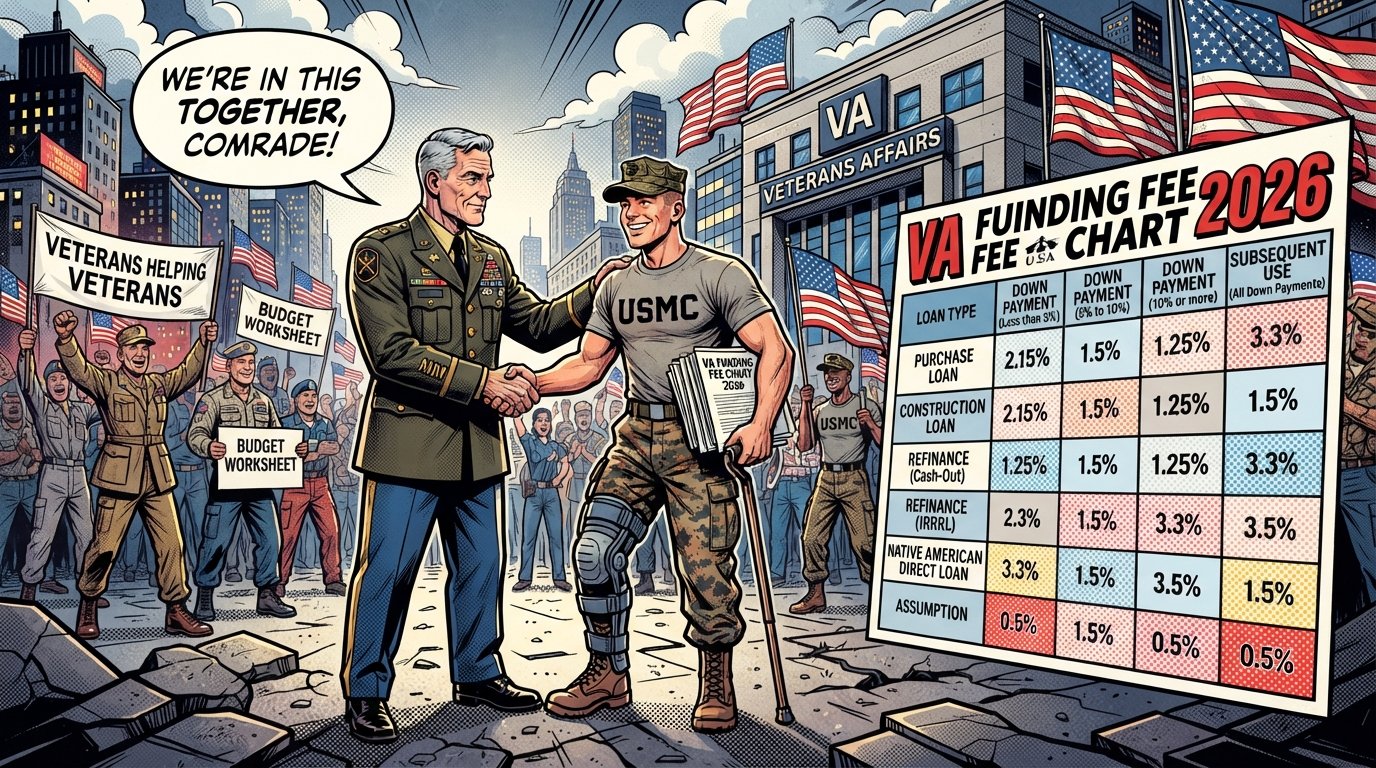
The VA funding fee is a one-time charge calculated as a percentage of your VA loan amount. In 2026, first-time users pay 2.15% with less than 5% down; subsequent users pay 3.3%. Put 5% to under 10% down and the fee drops to 1.5%; 10% or more down reduces it to 1.25% on either use. An IRRRL costs 0.5%.
| Item | Details |
|---|---|
| Fee Type | One-time, upfront fee on VA-guaranteed loans |
| Who Pays It | Most Veterans, active duty, Guard, Reserve, and surviving spouses using VA loan benefits |
| Exemptions | Veterans receiving VA disability compensation, Purple Heart recipients (active duty), certain surviving spouses |
| Rate Range | 0.5% to 3.3% of the loan amount |
| Official Agency | U.S. Department of Veterans Affairs (VA) |
| Required Form | Certificate of Eligibility (COE) determines exempt status |
| Updated For | 2026 |
VA Funding Fee Chart 2026: Full Rate Schedule
The VA funding fee chart for 2026 shows the same statutory percentages as 2025. What changes year to year is the loan amount the percentages apply to—not the rate table itself.

Purchase and Construction Loans
| Down Payment | First Use | Subsequent Use |
|---|---|---|
| Less than 5% (including $0 down) | 2.15% | 3.3% |
| 5% to less than 10% | 1.5% | 1.5% |
| 10% or more | 1.25% | 1.25% |
| Exempt (service-connected disability, etc.) | $0 | $0 |
Cash-Out Refinance Loans
Cash-out refinance loans use a flat rate based on prior use, regardless of down payment:
| Loan Type | First Use | Subsequent Use |
|---|---|---|
| Cash-Out Refinance | 2.15% | 3.3% |
IRRRL (Streamline Refinance)
| Loan Type | Rate (Any Use) |
|---|---|
| IRRRL (Interest Rate Reduction Refinance Loan) | 0.5% |
Native American Direct Loan (NADL)
| Loan Type | Rate |
|---|---|
| Native American Direct Loan | 1.25% |

The IRRRL is the cheapest refinance option at a flat 0.5% funding fee, no matter how many VA loans you have used.
How to Calculate Your VA Funding Fee
The formula is simple: Loan Amount × Funding Fee Rate = VA Funding Fee. The fee is calculated on the loan amount, not the purchase price.
Example Calculations
| Scenario | Loan Amount | Rate | Funding Fee |
|---|---|---|---|
| First use, $0 down | $400,000 | 2.15% | $8,600 |
| Subsequent use, $0 down | $400,000 | 3.3% | $13,200 |
| First use, 10% down | $360,000 | 1.25% | $4,500 |
| Subsequent use, 10% down | $360,000 | 1.25% | $4,500 |
| IRRRL | $250,000 | 0.5% | $1,250 |
These examples are illustrative. The fee is calculated on the loan amount after subtracting your down payment.
Step-by-Step Calculation
Determine your down payment percentage.
Identify whether this is your first or subsequent VA loan use.
Find your rate in the chart above.
Multiply your loan amount by the rate.
Decide whether to pay the fee at closing or finance it into the loan.
Who Is Exempt From the VA Funding Fee?
You are fully exempt from the VA funding fee if you fall into one of these categories:
You receive VA disability compensation at any rating—even 1%. Any service-connected rating qualifies for the lifetime exemption on all VA loan transactions, including purchase, IRRRL, and cash-out refinance.
You are eligible for VA compensation but receive retirement or active-duty pay instead. You qualify for the exemption even if you are not currently drawing compensation because you receive military retirement.
You are a surviving spouse receiving Dependency and Indemnity Compensation (DIC). This exemption applies to spouses of Veterans who died from service-connected causes.
You are an active-duty Purple Heart recipient. Purple Heart recipients on active duty are exempt from the funding fee.
Veterans May Qualify for Extra Benefits
Check available financial assistance, healthcare programs and other opportunities that may apply to you.
Check EligibilityAbout one-third of VA borrowers are fully exempt from the funding fee, including most Veterans receiving VA disability compensation.
What Veterans Should Do Next
If you believe you qualify for an exemption, apply for your Certificate of Eligibility (COE) through VA.gov. Your COE establishes your exempt status—not your lender or a calculator. If you are not yet receiving compensation but have a pending disability claim, you may still close on your loan and request a refund later if approved.
VA Funding Fee Refunds: When You Can Get Your Money Back
You may be eligible for a full refund of the VA funding fee if you are later awarded VA disability compensation with an effective date that is retroactive to before your loan closing date.
Refund Eligibility Requirements
You paid the VA funding fee at closing.
You were not exempt at the time of closing.
You are later awarded VA disability compensation.
The effective date of your compensation is before your loan closing date.
How to Request a Refund
Contact the VA Loan Guaranty Service or submit a request through VA.gov with documentation of your retroactive disability determination. The VA Office of Inspector General has identified cases where Veterans were owed refunds due to retroactive determinations and lender errors.
Important: If your disability claim is still pending when you close, you can still proceed with your loan. Once approved, you can apply for the refund.
Is the VA Funding Fee Tax Deductible in 2026?
Yes, the VA funding fee may be tax-deductible in 2026. The IRS has allowed VA funding fees to be treated similarly to mortgage insurance premiums for tax deduction purposes. When deductible, the funding fee can be included as part of your mortgage interest deduction.
The deduction was permanently restored for the 2026 tax year and beyond. It covers private mortgage insurance on conventional loans, FHA mortgage insurance premiums, VA funding fees, and USDA guarantee fees.
How to Claim the Deduction
You must itemize your deductions on Schedule A of Form 1040.
Income phase-out limits may apply.
Consult a tax professional to determine if you qualify.
How to Pay the VA Funding Fee
You have two options: pay the fee in cash at closing or finance it into your loan.
| Payment Method | How It Works | Pros | Cons |
|---|---|---|---|
| Pay at closing | Include the fee with your closing costs | No added interest; lower loan balance | Requires cash upfront |
| Finance into loan | Add the fee to your loan amount | No upfront cash needed; most common approach | Increases loan balance and total interest paid |
Financing the fee is the most common approach, but it increases your loan balance and total interest paid over time.
VA Funding Fee vs. PMI: What Is the Difference?
VA loans do not charge private mortgage insurance (PMI). Instead, they charge the one-time VA funding fee. This is a key advantage of VA financing over conventional and FHA loans.
| Feature | VA Loan | Conventional Loan | FHA Loan |
|---|---|---|---|
| Upfront Fee | VA funding fee (0.5%–3.3%) | None | Upfront MIP (1.75%) |
| Monthly Insurance | None | PMI (usually required with <20% down) | Annual MIP |
| Down Payment | $0 (typically) | 3%–20% | 3.5% |
| PMI Cancelable | N/A | Yes (at 20% equity) | No (for life of loan in most cases) |
Latest Rule Changes Affecting VA Funding Fees (2026)
Rates Unchanged From 2025
The statutory funding fee percentages have not changed. The rate structure effective April 7, 2023, remains in effect through 2026.
2026 Conforming Loan Limit Increase
The FHFA set the baseline conforming limit at $832,750 for a 1-unit home in 2026, up $26,250 from 2025. This affects the loan amount the funding fee percentages apply to.
Tax Deduction Restored
The VA funding fee deduction was permanently restored for tax year 2026 and beyond, giving eligible homeowners another way to offset the cost.
Partial Claim Option for Distressed Borrowers
VA introduced a partial claim option for distressed mortgage borrowers, allowing VA to advance funds to cure delinquency by purchasing a portion of the loan indebtedness—up to 25% of the unpaid principal balance. This is separate from the funding fee but may provide additional relief options.
Common Questions
How much is the VA funding fee in 2026?
The VA funding fee in 2026 ranges from 0.5% to 3.3% of the loan amount. First-time users with less than 5% down pay 2.15%. Subsequent users with less than 5% down pay 3.3%. IRRRLs have a flat 0.5% fee. Veterans receiving VA disability compensation pay $0.
Is the VA funding fee going away in 2026?
No. The VA funding fee remains in effect for 2026 at the same rates as 2025. The fee keeps the VA loan program self-sustaining and allows VA to offer zero-down loans with no monthly mortgage insurance.
Who is exempt from the VA funding fee?
Veterans receiving VA disability compensation at any rating (1%–100%), Veterans eligible for compensation but receiving retirement pay instead, active-duty Purple Heart recipients, and surviving spouses receiving DIC are exempt. About one-third of VA borrowers are fully exempt.
Can I get a refund of the VA funding fee?
Yes, if you are later awarded VA disability compensation with an effective date before your loan closing. You must have paid the fee at closing and not been exempt at that time. Contact the VA Loan Guaranty Service to request a refund.
Can I finance the VA funding fee into my loan?
Yes. Most Veterans finance the funding fee into their loan rather than paying it at closing. This increases your loan balance and total interest paid but eliminates the need for upfront cash.
How do I calculate my VA funding fee?
Multiply your loan amount by the applicable rate. For example, a $400,000 first-use loan with no down payment: $400,000 × 2.15% = $8,600. The fee is calculated on the loan amount, not the purchase price.
Is the VA funding fee tax deductible in 2026?
Yes, for eligible homeowners who itemize deductions on Schedule A. The deduction was permanently restored for tax year 2026. Income phase-out limits may apply. Consult a tax professional.
Do Reservists and National Guard members pay the same funding fee?
Yes. The same funding fee rates apply to Veterans, active duty, National Guard, and Reserve members who qualify for VA loan benefits. Exemption rules are also the same.
What is the funding fee for an IRRRL?
The IRRRL funding fee is a flat 0.5% of the loan amount, regardless of whether it is your first or subsequent VA loan use. This is the lowest funding fee available on any VA loan product.
Can I avoid the VA funding fee with a larger down payment?
A larger down payment reduces the fee but does not eliminate it unless you qualify for an exemption. Putting 5% to under 10% down reduces the fee to 1.5%. Putting 10% or more down reduces it to 1.25%. Only an exemption eliminates the fee entirely.
Key Takeaways
The 2026 VA funding fee ranges from 0.5% to 3.3% of the loan amount.
First-time users pay 2.15% with less than 5% down; subsequent users pay 3.3%.
Down payments of 5%+ reduce the fee to 1.5%; 10%+ reduces it to 1.25%.
IRRRLs have a flat 0.5% fee—the lowest available.
Veterans receiving VA disability compensation at any rating are fully exempt.
Purple Heart recipients (active duty) and surviving spouses receiving DIC are also exempt.
The fee can be financed into the loan or paid at closing.
Refunds are available if you receive a retroactive disability rating after closing.
The VA funding fee is tax-deductible in 2026 for eligible homeowners who itemize.
The fee replaces PMI—VA loans have no monthly mortgage insurance.
Official Resources
VA Funding Fee and Closing Costs: VA.gov/housing-assistance/home-loans/funding-fee-and-closing-costs
VA Home Loan Eligibility: VA.gov/housing-assistance/home-loans/eligibility
Certificate of Eligibility (COE): VA.gov/housing-assistance/home-loans/how-to-request-coe
VA Loan Guaranty Service: Benefits.VA.gov/homeloans
VA Office of Inspector General — Funding Fee Refund Audit: VAOIG.gov
IRS — Mortgage Interest Deduction: IRS.gov
Consumer Financial Protection Bureau — VA Loans: ConsumerFinance.gov




🇺🇸 IMPORTANT DISCLAIMER – Veterans Benefits Information
This site provides general information about U.S. Department of Veterans Affairs (VA) benefits for educational and informational purposes only.
- Not Official: We are NOT affiliated with, endorsed by, or connected to the U.S. Department of Veterans Affairs (VA), the Veterans Benefits Administration (VBA), the Veterans Health Administration (VHA), or any other government agency.
- No Legal/Financial Advice: The content on this website is for informational purposes only and does not constitute legal, financial, or medical advice. VA benefits rules change frequently – always consult with an accredited Veterans Service Officer (VSO) or a qualified professional for your specific situation.
- Official Sources: For official, binding information and to apply for benefits, always visit official .gov websites: VA.gov, Benefits.VA.gov, or SSA.gov.
- No Data Collection: This site does not collect, store, or process any personal information. It does not have login forms, contact forms, or any system to capture user data. We never ask for your Social Security Number, bank details, or any personal information.
- 🚨 Scam Alert: The VA and other government agencies never charge fees for benefit applications. If anyone asks for money to "process" your VA claim, it is a scam. Report it to the VA Office of Inspector General at VA.gov/OIG.
- Advertising: This site uses third-party advertising (Adsterra) to cover operational costs. We do not endorse or guarantee any products or services advertised.
📌 Information provided as of June 2026. Always verify current eligibility and rules with official .gov sources.
This site is not affiliated with the U.S. Department of Veterans Affairs or any government agency. All information is for educational purposes only. Please visit VA.gov for official information.
