

How Many WWII Veterans Are Alive in 2026? VA Data & Statistics
According to U.S. Department of Veterans Affairs statistics compiled by the National WWII Museum, 30,607 of the 16.4 million Americans who served in World War II are alive as of 2026. That is less than 0.2% of those who served. Most surviving WWII veterans are in their late 90s or older, with the youngest approaching 100.
Quick Facts
| Item | Details |
|---|---|
| Total WWII Veterans Alive (2026) | 30,607 |
| Original WWII Veteran Population | 16.4 million |
| Percentage Still Living | Less than 0.2% |
| Youngest WWII Veterans | Approaching 100 years old |
| Data Source | VA statistics compiled by National WWII Museum |
| Last Veteran Projected to Pass | Around 2043 (VA projection) |
| Daily Death Rate (2025) | Approximately 57 veterans per day |
| Official Agency | U.S. Department of Veterans Affairs (VA) |
| Benefits Still Available | Pension, healthcare, burial, survivor benefits |
| Updated For | 2026 |
How Many WWII Veterans Are Alive in 2026?
As of 2026, 30,607 World War II veterans are alive, according to U.S. Department of Veterans Affairs statistics compiled by the National WWII Museum. This represents less than 0.2% of the 16.4 million Americans who served during World War II.

The number has declined rapidly. In 2015, nearly one million WWII veterans were still alive. By 2020, that number had fallen to roughly 300,000. As recently as 2023, approximately 131 veterans were passing away every day. By 2025, the daily death rate had slowed to about 57 per day, reflecting the diminished population.

The youngest WWII veterans are now approaching 100 years old. Most served in their late teens or early twenties during the war years of 1941 to 1945, placing their current ages between 98 and 105.
Why VA Data and Other Sources Show Different Numbers
You may see different figures cited across news outlets, museums, and government reports. This is not a contradiction—it reflects different reporting periods and projection models.
| Source | Figure | Time Period |
|---|---|---|
| National WWII Museum (VA data) | 30,607 | 2026 |
| VA Benefits Report | 45,418 | End of 2025 |
| VA VetPop2023 Projection | ~31,000 | Fiscal 2026 |
| News Reports (citing VA) | ~31,000 | 2026 |
The 45,418 figure represents the count as of late 2025. The 30,607 figure reflects the updated count for 2026, accounting for deaths over the intervening months. The VA’s VetPop2023 model projected approximately 31,000 by fiscal 2026, aligning closely with the updated count.
When citing the number of living WWII veterans, the most current figure is 30,607 as of 2026.
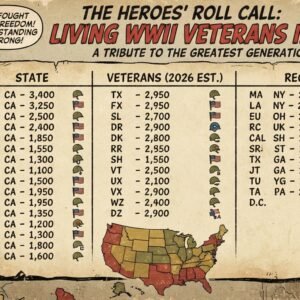
Living WWII Veterans by State (2026)
Veterans May Qualify for Extra Benefits
Check available financial assistance, healthcare programs and other opportunities that may apply to you.
Check EligibilityThe surviving WWII veteran population is distributed across all 50 states, Puerto Rico, and U.S. territories. The table below shows the VA’s 2026 state-by-state breakdown.
| State | Living WWII Veterans | State | Living WWII Veterans |
|---|---|---|---|
| California | 3,414 | Ohio | 1,092 |
| Florida | 2,506 | Virginia | 980 |
| Texas | 1,918 | Washington | 897 |
| Pennsylvania | 1,741 | Wisconsin | 837 |
| New York | 1,574 | North Carolina | 835 |
| Illinois | 1,152 | Minnesota | 823 |
| Michigan | 1,113 | New Jersey | 716 |
| Georgia | 690 | Arizona | 687 |
| Oregon | 646 | Missouri | 611 |
| Massachusetts | 606 | Tennessee | 594 |
| Indiana | 589 | Maryland | 587 |
| Connecticut | 533 | South Carolina | 508 |
| Colorado | 435 | New Hampshire | 397 |
| Utah | 377 | Kentucky | 350 |
| Oklahoma | 318 | Alabama | 271 |
| Nevada | 254 | Mississippi | 243 |
| Rhode Island | 211 | Iowa | 190 |
| Arkansas | 186 | Montana | 176 |
| Idaho | 162 | Kansas | 162 |
| Louisiana | 147 | Maine | 146 |
| Delaware | 135 | North Dakota | 122 |
| Hawaii | 114 | Nebraska | 109 |
| Puerto Rico | 98 | West Virginia | 90 |
| South Dakota | 55 | Island Areas & Foreign | 49 |
| District of Columbia | 48 | Vermont | 45 |
| Wyoming | 41 | New Mexico | 28 |
| Alaska | Grand Total | 30,607 |
California, Florida, Texas, and Pennsylvania have the largest surviving WWII veteran populations. States with smaller populations, such as Alaska, New Mexico, Vermont, and Wyoming, have fewer than 50 surviving veterans each.
Why the Number Matters
The declining number of WWII veterans has significant implications for veterans’ benefits, historical preservation, and national remembrance.
For Veterans and Families
Surviving WWII veterans remain eligible for VA benefits, including:
VA Pension — A needs-based benefit for wartime veterans with limited income
VA Healthcare — Priority enrollment with no copays for many services
Aid and Attendance — Enhanced pension for veterans requiring daily assistance
Burial Benefits — Including cemetery plots, headstones, and burial allowances
Survivor Benefits — Dependency and Indemnity Compensation (DIC) and survivors pension
Families of WWII veterans should verify that their loved one is receiving all benefits for which they qualify. Many veterans and surviving spouses are unaware of benefits such as Aid and Attendance, which can provide up to $2,425 per month for a single veteran.
For Historical Preservation
Organizations such as the National WWII Museum and The War Remembered are racing to record oral histories before the last veterans pass. As museum president Stephen J. Watson stated, “We have the enormous responsibility to ensure that the memories and experiences of the war will not be lost”.
For National Remembrance
Communities across the country are accelerating efforts to honor WWII veterans while they are still alive. Events such as the Gathering of WWII Heroes in Austin, Texas, bring together veterans—many over 100 years old—to share their stories with the public.
When Will the Last WWII Veteran Pass Away?
The VA projects that the last American WWII veteran will pass away around 2043. This projection is based on actuarial models that account for the current age distribution and mortality rates of surviving veterans.
The number is expected to decline as follows:
2026: ~30,607
2027: ~27,000 (projected)
End of 2027: ~28,000 by some estimates
2043: Last veteran projected to pass
These projections are updated annually and may shift based on actual mortality data.
VA Benefits for WWII Veterans
WWII veterans remain eligible for the full range of VA benefits. Here is what they qualify for and how to access it.
VA Pension
What it is: A tax-free, needs-based monthly payment for wartime veterans with limited income. WWII is a recognized wartime period (December 7, 1941 – December 31, 1946).
Who qualifies: Veterans who served at least 90 days of active duty with at least one day during the WWII period, were discharged under other than dishonorable conditions, and meet income and net worth limits.
2026 Maximum Annual Pension Rates:
Veteran with no spouse or dependent child: $17,441/year ($1,453/month)
Veteran with a spouse or dependent child: Higher rates apply
What veterans should do next: File VA Form 21P-527EZ (Application for Pension). Surviving spouses file VA Form 21P-534EZ.
VA Healthcare
What it is: Comprehensive medical care through the Veterans Health Administration. WWII veterans are eligible for enhanced healthcare benefits, including no-cost hospital and outpatient care for many services.
Who qualifies: All WWII veterans who served in active military, naval, or air service and were discharged under conditions other than dishonorable.
What veterans should do next: Apply online at VA.gov or call 1-877-222-8387. Enrollment is the first step to accessing care.
Aid and Attendance
What it is: An enhanced VA pension benefit for veterans who need daily assistance with activities such as bathing, dressing, or eating, or who are bedridden or in a nursing home.
2026 Rates:
Single veteran: Up to $2,425/month
Married veteran: Up to $2,874/month
Who qualifies: Veterans who meet the basic pension requirements and have documented need for daily assistance.
What veterans should do next: Submit VA Form 21-0779 (Request for Nursing Home Information) and VA Form 21-2680 (Examination for Housebound Status or Permanent Need for Regular Aid and Attendance).
Burial Benefits
What it is: VA provides burial benefits for eligible veterans, including a gravesite in a national cemetery, headstone or marker, burial flag, and partial reimbursement of burial costs.
Who qualifies: Veterans discharged under conditions other than dishonorable.
What families should do next: Contact the National Cemetery Scheduling Office at 1-800-535-1117 or apply online at VA.gov.
Survivor Benefits
What it is: Dependency and Indemnity Compensation (DIC) and survivors pension for eligible surviving spouses, children, and dependent parents.
Who qualifies: Surviving spouses of veterans who died from service-connected causes, or low-income surviving spouses of wartime veterans.
What survivors should do next: File VA Form 21P-534EZ (Application for DIC, Death Pension, and/or Accrued Benefits).
How to Apply for VA Benefits
Online Application
The fastest way to apply for most VA benefits is online at VA.gov. Create or log in to your account, complete the appropriate form, and upload supporting documents.
By Mail
Download and print the required form, complete it, and mail it to the VA regional office handling your claim. Addresses are listed on the form instructions.
In Person
Visit a VA regional office or a local veterans service organization (VSO) for in-person assistance. VSOs such as VFW, American Legion, and Disabled American Veterans provide free help with claims.
Required Documents
DD-214 or Report of Separation (for WWII veterans, WD AGO Form 53-55)
Military service records
Medical records supporting the claim
Income and net worth documentation (for pension)
Marriage certificate (for survivor benefits)
Dependent records (if claiming dependents)
Common Mistakes to Avoid
Not applying because you assume you won’t qualify — Many veterans are eligible for benefits they never claim.
Missing the intent to file — Filing an intent to file preserves your effective date for back pay.
Failing to provide complete records — Incomplete claims delay processing.
Not appealing a denial — You have one year from the decision date to appeal.
Overlooking state benefits — Many states offer additional veterans benefits beyond federal programs.
Key Takeaways
30,607 WWII veterans were alive as of 2026, according to VA data compiled by the National WWII Museum.
This represents less than 0.2% of the 16.4 million Americans who served in World War II.
The youngest WWII veterans are approaching 100 years old; most are in their late 90s or older.
The VA projects the last WWII veteran will pass away around 2043.
California (3,414), Florida (2,506), and Texas (1,918) have the largest surviving populations.
Surviving veterans remain eligible for VA pension, healthcare, Aid and Attendance, burial benefits, and survivor benefits.
The 2026 VA pension rate for a single veteran is $1,453 per month**; Aid and Attendance can provide up to **$2,425 per month.
Families should verify that elderly WWII veterans are receiving all benefits they qualify for, especially Aid and Attendance.
Apply for benefits at VA.gov or with free assistance from a VSO.
Organizations such as the National WWII Museum are racing to preserve oral histories before the last veterans pass.
Common Questions
How many WWII veterans are alive in 2026?
As of 2026, 30,607 WWII veterans are alive, according to VA statistics compiled by the National WWII Museum. This is less than 0.2% of the 16.4 million Americans who served during World War II. The number declines daily as the youngest veterans approach 100 years old.
What is the youngest age of a WWII veteran?
The youngest WWII veterans are approaching 100 years old. Most surviving WWII veterans are between 98 and 105. Anyone who served in WWII would have been born in 1927 or earlier, making the youngest at least 98 in 2025 and 99 in 2026.
How many WWII veterans die each day?
In 2025, approximately 57 WWII veterans were passing away each day, according to VA data. This is down from approximately 131 per day in 2023, reflecting the smaller remaining population. The daily rate continues to decline as the population shrinks.
When will the last WWII veteran die?
The VA projects that the last American WWII veteran will pass away around 2043. This projection is based on actuarial models and is updated periodically. The actual date will depend on the longevity of the last surviving veterans.
Which state has the most WWII veterans?
California has the largest surviving WWII veteran population at 3,414, followed by Florida (2,506), Texas (1,918), Pennsylvania (1,741), and New York (1,574). These states have historically had large veteran populations due to their overall population size and military installations.
Do WWII veterans still receive VA benefits?
Yes. WWII veterans remain eligible for VA pension, healthcare, Aid and Attendance, burial benefits, and survivor benefits. Many veterans and families are unaware of benefits such as Aid and Attendance, which can provide up to $2,425 per month for a single veteran.
What is VA Aid and Attendance?
Aid and Attendance is an enhanced VA pension benefit for veterans who need daily assistance with activities such as bathing, dressing, or eating, or who are bedridden or in a nursing home. In 2026, a single veteran can receive up to $2,425 per month, and a married veteran up to $2,874 per month.
How do I apply for VA benefits for a WWII veteran?
Apply online at VA.gov, by mail using the appropriate VA form, or in person at a VA regional office or veterans service organization. For pension, use VA Form 21P-527EZ. For Aid and Attendance, submit VA Form 21-2680. VSOs provide free assistance with applications.
What documents are needed for a WWII VA pension claim?
You will need the veteran’s separation documents (WD AGO Form 53-55 or DD-214), income and net worth documentation, medical records, and marriage certificate for survivor claims. The VA recognizes WWII as December 7, 1941, through December 31, 1946.
Are there special benefits for WWII veterans?
WWII veterans are eligible for enhanced healthcare benefits, including no-cost hospital and outpatient care for many services. They also qualify for priority enrollment in VA healthcare and are exempt from copayments for certain services. The VA pension program includes WWII as a recognized wartime period.
What happens to VA benefits when a WWII veteran dies?
Surviving spouses may be eligible for Dependency and Indemnity Compensation (DIC) if the veteran’s death was service-connected, or for survivors pension if the veteran was a low-income wartime veteran. Burial benefits include a gravesite in a national cemetery, headstone, burial flag, and partial reimbursement of burial costs.
Can family members of WWII veterans claim benefits?
Yes. Surviving spouses, dependent children, and dependent parents may qualify for survivor benefits including DIC, survivors pension, and burial benefits. Eligibility depends on factors such as the veteran’s service record, the survivor’s income, and the cause of death.
Official Resources
U.S. Department of Veterans Affairs — VA.gov — Benefits, claims, healthcare, and appeals
VA Benefits Administration — benefits.va.gov — Disability compensation, pension, education, home loans
VA Pension Management Center — 1-877-294-6380 — Pension and survivor benefit inquiries
VA Health Benefits — 1-877-222-8387 — Healthcare enrollment and eligibility
National Cemetery Scheduling Office — 1-800-535-1117 — Burial benefits and scheduling
Social Security Administration — SSA.gov — Special benefits for certain WWII veterans (Part 408)
National WWII Museum — nationalww2museum.org — WWII veteran statistics and oral history
How Many US WWII Veterans Are Still Alive in 2026?
As of 2026, approximately 31,000 U.S. World War II veterans are still alive, according to the U.S. Department of Veterans Affairs . This represents less than 0.2% of the 16.4 million Americans who served during the war . Most surviving veterans are in their mid-to-late 90s or older . The National WWII Museum reported 45,418 living veterans at the end of 2025 , with the VA projecting that the number will drop to approximately 7,000 by 2029 .
Quick Facts
| Item | Details |
|---|---|
| Total Who Served | 16.4 million Americans |
| Living in 2026 | ~31,000 (VA estimate) |
| Living at End of 2025 | 45,418 |
| Living in 2024 | ~66,000 (VA projection) |
| Living in 2023 | ~119,000 |
| Living in 2020 | ~300,000 |
| Living in 2015 | ~1 million |
| Percent Still Alive | Less than 0.5% |
| Official Agency | U.S. Department of Veterans Affairs |
| Updated For | 2026 |
Current Estimates: How Many Remain?
The number of living U.S. World War II veterans continues to decline rapidly as survivors reach their late 90s and early 100s. Multiple authoritative sources provide slightly different estimates based on the timing of data collection:
2026 VA Estimate
As of July 2026, the U.S. Department of Veterans Affairs estimates that approximately 31,000 U.S. World War II veterans are still alive . This is the most current figure available. Most living veterans are mid-to-late 90s or older .
2025 National WWII Museum Data
At the end of 2025, the National WWII Museum reported 45,418 living World War II veterans based on VA statistics . This represents less than 0.5% of the 16.4 million Americans who served . The museum projects that the number will continue to decline steeply in the coming years .
The Decline Over Time
The rapid decline in surviving WWII veterans is stark:
2015: Nearly 1 million living WWII veterans
2020: ~300,000 living WWII veterans
2023: ~119,000 living WWII veterans
2024: ~66,000 living WWII veterans
2025: ~45,000 living WWII veterans
2026: ~31,000 living WWII veterans
The VA projects that by 2029, only around 7,000 WWII veterans will still be alive . Most are expected to have passed by 2035 .
Where Do WWII Veterans Live?
World War II veterans live in every U.S. state except Alaska . California has the largest number, with approximately 7,455 living veterans, according to VA data .
Top states by living WWII veterans (2024 VA projections):
| State | Estimated Living WWII Veterans |
|---|---|
| California | ~7,455 |
| Florida | ~5,511 |
| Pennsylvania | ~3,500-3,900 |
| New York | ~3,500-3,900 |
| Texas | ~3,500-3,900 |
States with the fewest:
| State | Estimated Living WWII Veterans |
|---|---|
| Wyoming | Less than 100 |
| Vermont | Less than 100 |
Earlier 2025 data by state : The National WWII Museum’s 2025 state-by-state breakdown shows 5,094 in California, 3,753 in Florida, 2,720 in Texas, 2,642 in Pennsylvania, and 2,400 in New York. States with the fewest included Wyoming (59), Vermont (66), and Alaska (0) .
Important note: The VA cautions that these numbers are based on projections, not actual headcounts, and may vary between data sources .
The Changing Numbers: 2024 vs 2025 vs 2026
The VA updates its projections annually. Data from late 2025 and early 2026 shows a continued steep decline:
2024 VA projection: ~66,000 living WWII veterans
End of 2025 VA estimate: 45,418 living WWII veterans
July 2026 VA estimate: ~31,000 living WWII veterans
Why the variance? Different reporting periods, survey methodologies, and the high mortality rate among this age group (the youngest are now in their late 90s) create rapid changes in the data .
Why These Numbers Matter
The surviving WWII veterans are among the oldest members of the “Greatest Generation.” According to the VA, the final WWII survivor is projected to pass away around 2037 or 2043 , depending on the projection model.
Why this matters for Veterans and families:
Preservation of history: Every day, memories of WWII are disappearing from living history . Veterans who can share firsthand accounts of the war are becoming increasingly rare.
Ongoing benefits: Living WWII veterans continue to receive VA benefits and are eligible for the full range of VA services, including healthcare, disability compensation, and pension .
Survivor benefits: Family members of WWII Veterans may qualify for VA survivor benefits, including Dependency and Indemnity Compensation (DIC), Survivors Pension, and burial benefits.
Legacy of service: The 16.4 million Americans who served in WWII represent over 12% of the U.S. population at the time . More than 400,000 were killed in action or died during the war . The few who remain carry the last living connection to that defining conflict.
Common Questions
How many US WWII veterans are still alive in 2026?
Approximately 31,000 U.S. World War II veterans are still alive in 2026, according to the VA . At the end of 2025, there were 45,418 . The number is declining rapidly as most survivors are now in their late 90s or over 100 years old .
What percentage of WWII veterans are still alive?
Less than 0.5% of the 16.4 million Americans who served in World War II are still alive today . The 2026 estimate of 31,000 represents approximately 0.19% of the total who served.
How many WWII veterans were alive in 2020?
Approximately 300,000 U.S. World War II veterans were alive in 2020 . In 2015, that number was nearly one million . The decline has accelerated significantly in the past decade.
When will the last WWII veteran die?
Projections vary. The VA has projected that the last WWII veteran will pass away around 2037 . Other estimates place the date around 2043 . The 2024 VA projection shows that by 2029, only about 7,000 WWII veterans will remain .
Which state has the most living WWII veterans?
California has the largest number of living WWII veterans, with approximately 7,455 according to 2024 VA projections . Other states with high numbers include Florida (5,511), Pennsylvania, New York, and Texas .
How old are the last surviving WWII veterans?
Most surviving WWII veterans are now in their mid-to-late 90s or older . The youngest who served during the war (enlisting at age 17 in 1945) would be 98 in 2026. Many are over 100. Georgia’s oldest living WWII veteran, Charlie Duncan, turned 107 in May 2026 . Earl Hickman of Ohio celebrated his 101st birthday on July 4, 2026 .
Were there more than 16 million US WWII veterans?
Yes. Over 16.1 to 16.4 million Americans served in the U.S. Armed Forces during World War II . At the time, this represented more than 12% of the total U.S. population .
How many WWII veterans are alive in each state?
The National WWII Museum provides state-by-state breakdowns. In 2025 data, California had 5,094, Florida 3,753, Texas 2,720, Pennsylvania 2,642, and New York 2,400 . Alaska had 0, Wyoming had 59, and Vermont had 66 . The VA cautions that these are projections, not actual counts .
Why are the numbers of WWII veterans declining so fast?
The youngest WWII veterans are now in their late 90s. The natural mortality rate among people in their 90s and 100s is extremely high. The VA’s projections reflect this reality .
What benefits are available to surviving WWII veterans?
Living WWII veterans are eligible for all VA benefits, including disability compensation, healthcare, VA home loans, and Veterans Pension . Surviving spouses and dependents of WWII veterans may qualify for Dependency and Indemnity Compensation (DIC), Survivors Pension, and burial benefits through the VA National Cemetery Administration.
Key Takeaways
~31,000 U.S. WWII veterans are alive in 2026, down from 45,418 at the end of 2025 and 66,000 in 2024
Less than 0.5% of the 16.4 million Americans who served in WWII are still with us
Most survivors are in their late 90s or older, with the oldest living WWII veteran in Georgia turning 107 in 2026
California has the most living WWII veterans (~7,455); Alaska has none
Projections show only ~7,000 remaining by 2029
The last WWII veteran is projected to pass away around 2037-2043
World War II veterans are eligible for all VA benefits, and their families may qualify for survivor benefits
Official Resources
| Agency | Website |
|---|---|
| U.S. Department of Veterans Affairs | www.va.gov |
| The National WWII Museum | www.nationalww2museum.org |
| VA Burial Benefits | www.va.gov/burials-memorials |
| Veterans Crisis Line | www.veteranscrisisline.net |
| National Cemetery Administration | www.va.gov/national-cemeteries |
US WWII Veterans Still Alive 2026 – Current Numbers
The contribution of World War II (WWII) veterans to American history is both profound and lasting. The military engagement, which lasted from 1941 to 1945, saw approximately 16 million Americans serve in various combat roles. This staggering number reflects the dedication and sacrifice of a generation that answered the call to duty in one of the most challenging periods in modern history.
As we examine the status of these veterans in 2026, it is essential to recognize not only the sheer volume of individuals who participated but also the significant societal impact these veterans made upon returning home. Following the war, they played pivotal roles in shaping contemporary society through their contributions in various sectors, including politics, education, and industry. The GI Bill, enacted in 1944, enabled many veterans to pursue higher education and access home loans, ultimately facilitating economic growth in the post-war era.
However, this demographic is rapidly aging, with the average age of WWII veterans now being over 97 years. According to recent estimates, it is projected that by 2026, the number of living WWII veterans will have declined significantly, with fewer than 200,000 individuals across the United States still alive. This dramatic reduction highlights the importance of preserving their stories and experiences, which are critical to understanding American history and culture.
As we delve further into the current condition of these veterans, we will explore their health and well-being, the recognition they receive, as well as the programs designed to assist them in their later years. The goal is to honor their legacies while examining the various dimensions of their lives in the present day. Understanding their circumstances remains vital in ensuring that the sacrifices of those who served during WWII are never forgotten.
Current Estimates of Living WWII Veterans
As of 2026, it is estimated that approximately 31,000 World War II veterans remain alive, according to the U.S. Department of Veterans Affairs. This figure represents a significant decline from the peak number of individuals who served in the military during this global conflict. At the start of the 21st century, there were nearly 5 million living WWII veterans, making the current numbers particularly poignant.
The drastic reduction in the population of living WWII veterans can be attributed to a combination of factors, including age-related mortality, as the last surviving members of this greatest generation are often in their late 90s or early 100s. As time progresses, it becomes increasingly essential to honor the legacy and sacrifices made by these veterans. The current estimate accentuates the urgency of recognizing their contributions to history as they dwindle in number.
Moreover, the significance of the 31,000 veterans still alive in 2026 extends beyond mere statistics; it serves as a reminder of the resilience and valor shown by those who fought in one of the most harrowing times in modern history. The memories and experiences of these veterans provide invaluable insights into the realities of war, courage, and the spirit of patriotism. Their stories reflect the struggles faced not only on the battlefield but also in the aftermath of the war, shaping the contemporary landscape of military service and national identity.
As we reflect on these current estimates, it is crucial to ensure that the achievements and lessons learned from this generation are preserved for future generations. The dwindling numbers prompt a collective responsibility to celebrate and commemorate the lives of these veterans, ensuring that their sacrifices are not forgotten as we move further into the 21st century.
Demographics of Surviving Veterans
As of 2026, the demographics of surviving World War II (WWII) veterans reveal a striking shift due to the passage of time. The majority of these veterans are now in their mid-to-late nineties or older, marking them as part of an increasingly rare cohort. According to recent analyses, it is estimated that fewer than 200,000 of the original 16 million American service members remain alive today, highlighting the rapid decline in their numbers.
The age distribution of these veterans carries significant implications for the veteran community and the society at large. As this generation ages, they face various health challenges that necessitate specialized care and support services tailored to their unique needs. Furthermore, many organizations and governmental entities have mobilized efforts to provide outreach programs that ensure these veterans receive adequate medical care and recognition for their service.
Demographically, this dwindling population exhibits a diverse representation, though historically, it lacked inclusion across various racial and ethnic groups. Over the years, there has been a heightened awareness and acknowledgment of the contributions made by veterans from minority backgrounds, and thus, programs aimed at uplifting the narratives of these individuals are increasingly prevalent.
Moreover, the urgent need to document their stories and experiences has become a priority for historians and cultural institutions. With the number of living veterans decreasing rapidly, history is at a critical juncture where preserving firsthand accounts and memories is essential for future generations. It is also a poignant reminder of the heroism experienced during a significant chapter in American history.
In sum, the demographics of WWII veterans showcase not only their impressive longevity but also the necessity of initiatives aimed at honoring and caring for these individuals as they approach the twilight of their lives. As we reflect on their contributions and sacrifices, it is imperative to ensure their stories are celebrated and recorded for posterity.
Historical Context: The WWII Veteran Experience
The experience of U.S. World War II veterans is a profound narrative of bravery, sacrifice, and resilience. Between 1941 and 1945, more than 16 million Americans served in the armed forces during this global conflict, representing a significant demographic shift in the country. These individuals, often referred to as the “Greatest Generation,” did not merely fight battles; they influenced the entire trajectory of history with their contributions to the war effort across various domains.
During their service, veterans faced numerous challenges, including intense combat, separation from families, and the psychological toll of war. Soldiers endured harsh conditions on battlefields from Normandy to the Pacific islands, often facing life-threatening situations that tested their physical and mental limits. The experiences in these wartime environments forged strong bonds among comrades, culminating in a shared sense of purpose and camaraderie. However, the toll of war was significant, leading to widespread instances of what is now recognized as post-traumatic stress disorder (PTSD) among returning soldiers.
Upon returning home, WWII veterans were greeted with a mixture of celebration and challenges. The G.I. Bill of Rights provided educational benefits and housing assistance, facilitating the transition to civilian life for many. This legislation enabled millions of veterans to acquire higher education and subsequently contributed to the post-war economic boom. Moreover, the experiences of these veterans shaped societal values and influenced policies, creating a lasting legacy that resonates to this day. The collective effort and sacrifices made by these veterans laid the groundwork for civil rights advancements and the modernization of the U.S. military, making their contributions not only a pivotal moment in history but also a defining aspect of American culture.
Projected Decline in Veteran Numbers
The population of World War II veterans has been on a steady decline over the past several decades. By 2026, projections from the U.S. Department of Veterans Affairs indicate that the number of surviving WWII veterans will decrease significantly, with estimates suggesting that around 7,000 will remain by the year 2029. This trend reflects not only the natural attrition of an aging demographic but also raises important questions regarding the social and cultural implications of such a decline.
As the ranks of these veterans diminish, the stories and experiences from one of the most pivotal periods in American history are at risk of being lost. The WWII generation has been characterized by its contributions to the war effort and the subsequent shaping of modern society. As their numbers dwindle, it becomes increasingly critical to document their narratives for future generations. This responsibility falls upon both historians and the public to honor and preserve the memories of those who served.
The anticipated decline in veteran numbers also poses several social challenges. With fewer veterans available to participate in commemorative events, there is a concern that the collective memory of World War II may fade. Younger generations may find it harder to connect with this significant chapter of history, potentially leading to a loss of appreciation for the sacrifices made during the conflict. To mitigate this, educational initiatives aimed at fostering awareness about the experiences of WWII veterans are essential. Community programs that bridge the gap between the older and younger generations can play a vital role in keeping these histories alive.
In addition, the decline in veterans may impact advocacy for veteran affairs. As the population of WWII veterans shrinks, it becomes crucial that remaining veterans receive the necessary support and recognition. Policymakers and veteran organizations must work diligently to ensure that the needs of ageing veterans are met and that their legacy continues to inspire respect and gratitude.
The Importance of Honoring WWII Veterans
Honoring World War II veterans is crucial for both contemporary society and future generations. These brave individuals exhibited extraordinary courage and selflessness during a pivotal moment in history, and their sacrifices deserve recognition and respect. By commemorating their contributions, we acknowledge the profound impact they had on shaping the nation and the world as we know it today.
Communities across the United States have the opportunity to honor WWII veterans in various meaningful ways. One significant method is through the establishment of memorials that serve as lasting tributes to the valor and sacrifices of these heroes. Such memorials provide a space for reflection, remembrance, and gratitude, allowing citizens to connect with the legacy of the veterans’ experiences. These permanent fixtures not only honor those who served but also educate the public about the historical context of their sacrifices.
In addition to memorials, organizations often host events to celebrate the lives and stories of WWII veterans. Parades, ceremonies, and veteran-themed educational programs engage local communities and remind younger generations of the importance of civic duty and resilience. Inviting veterans to share their stories fosters a sense of closeness and understanding, bridging the gap between eras and ensuring that the lessons of the past are neither forgotten nor overlooked.
Educational programs that focus on the events of World War II help instill respect and appreciation among students. Schools can incorporate curriculum modules that cover the war’s significance and the individual stories of those who served. By doing so, educators encourage a mindset of gratitude and critical reflection, ensuring that the sacrifices of these veterans are honored appropriately.
Veteran Support Services and Resources
As of 2026, the plight of surviving World War II veterans remains a significant concern, with various support services and resources available to address their unique needs. These resources encompass healthcare programs, mental health services, and assistance from dedicated organizations aimed at enhancing the quality of life for veterans and their families.
Healthcare services for WWII veterans are primarily provided by the Department of Veterans Affairs (VA). The VA offers comprehensive medical care tailored to the specific health challenges faced by older veterans, including access to specialized geriatric care, rehabilitation services, and preventive health screenings. Veterans can enroll in VA healthcare programs, which provide them with the necessary medical attention while ensuring that they can manage chronic conditions that may have developed over the years.
Mental health support is equally vital, especially considering the psychological ramifications of wartime experiences. Various mental health services are available through the VA and nonprofit organizations that provide counseling and therapy specifically designed for veterans. Programs focus on issues such as PTSD, depression, and social reintegration. These initiatives offer a safe space for veterans to share their experiences and seek help, ultimately aiding in their emotional recovery.
In addition to direct healthcare and mental health resources, a plethora of organizations — such as the American Legion, Veterans of Foreign Wars (VFW), and the Disabled American Veterans (DAV) — actively work to support WWII veterans. These organizations not only advocate for veteran rights but also provide networking opportunities, financial assistance, and community engagement programs. Such resources ensure that veterans can connect with one another, fostering a sense of community and understanding.
The intricate web of support services provided to WWII veterans reflects society’s commitment to honoring their sacrifices. By remaining aware of and utilizing these resources, veterans can better navigate their post-war lives, ensuring that their service to the nation is recognized and rewarded.
Interviews and Perspectives from Surviving Veterans
The narratives of World War II veterans are rich with experience, wisdom, and profound reflections that serve as a testament to their bravery and sacrifices. In 2026, as we see a dwindling number of surviving veterans, it becomes increasingly important to capture their stories. Interviews conducted with these individuals reveal not only their personal accounts of the war but also their perspectives on how it shaped their lives and the world around them.
Many veterans reflect on their time in service with a mixture of pride and sorrow. One veteran, now in his late nineties, shared his memories of the Normandy landings. He recounted the challenges faced on that fateful day and the camaraderie among fellow soldiers, underscoring that such connections were vital for survival and morale. This sense of brotherhood transcended the battlefield, influencing their lives long after the war concluded.
Another veteran, who served in the Pacific Theater, expressed thoughts on the moral complexities of warfare. He discussed the weight of the decisions made during combat and the lasting impact these decisions have had on his conscience. His reflections highlight the profound psychological effects of war—something that veterans of later conflicts have echoed in their experiences.
Looking to the future, many veterans express concerns about preserving the legacy of their generation. They often emphasize the importance of sharing their stories with younger generations. This gives them hope that the lessons learned from war will foster understanding and peace in a world still fraught with conflict. Several veterans advocate for educational programs that focus on the sacrifices made during WWII, ensuring that these lessons are not forgotten.
In conclusion, the firsthand accounts from surviving World War II veterans reveal a tapestry of human experience, characterized by struggle, resilience, and a desire for peace. Their perspectives not only honor their past but also provide invaluable insights into the human condition in times of conflict.
Conclusion and Reflection on Veteran Legacies
As we reflect on the status of U.S. World War II veterans in 2026, it becomes increasingly clear that their legacies are not only a testament to their courage and sacrifices during a pivotal moment in global history but also a compelling call to action for future generations. The contributions made by these veterans extend beyond the battlefield, influencing societal norms, shaping international relations, and establishing a foundation of freedom and democracy that continues to resonate today.
Through the preservation of their stories, we honor the collective experiences that defined an era. It is essential to recognize the varying backgrounds and individual narratives of these veterans, as each story enriches our understanding of the war and its aftermath. The challenges they faced, the victories they celebrated, and the lessons they imparted offer invaluable insights into resilience and patriotism in the face of adversity.
Moreover, as fewer veterans remain with us each year, it is our responsibility to ensure that their contributions are not forgotten. Initiatives aimed at documenting oral histories, supporting veterans’ organizations, and creating educational resources are vital to maintaining this connection with the past. By sharing these stories with younger generations, we cultivate a culture of appreciation and respect that fosters a deeper understanding of the sacrifices made by those who served.
In conclusion, the legacy of U.S. WWII veterans is a powerful narrative woven into the fabric of our national identity. It underscores the importance of remembrance and serves as a reminder of the cost of freedom. As stewards of this legacy, we must commit ourselves to honoring these heroes and preserving their stories, ensuring that the lessons learned from their experiences continue to inspire and guide us in the years to come.



🇺🇸 IMPORTANT DISCLAIMER – Veterans Benefits Information
This site provides general information about U.S. Department of Veterans Affairs (VA) benefits for educational and informational purposes only.
- Not Official: We are NOT affiliated with, endorsed by, or connected to the U.S. Department of Veterans Affairs (VA), the Veterans Benefits Administration (VBA), the Veterans Health Administration (VHA), or any other government agency.
- No Legal/Financial Advice: The content on this website is for informational purposes only and does not constitute legal, financial, or medical advice. VA benefits rules change frequently – always consult with an accredited Veterans Service Officer (VSO) or a qualified professional for your specific situation.
- Official Sources: For official, binding information and to apply for benefits, always visit official .gov websites: VA.gov, Benefits.VA.gov, or SSA.gov.
- No Data Collection: This site does not collect, store, or process any personal information. It does not have login forms, contact forms, or any system to capture user data. We never ask for your Social Security Number, bank details, or any personal information.
- 🚨 Scam Alert: The VA and other government agencies never charge fees for benefit applications. If anyone asks for money to "process" your VA claim, it is a scam. Report it to the VA Office of Inspector General at VA.gov/OIG.
- Advertising: This site uses third-party advertising (Adsterra) to cover operational costs. We do not endorse or guarantee any products or services advertised.
📌 Information provided as of June 2026. Always verify current eligibility and rules with official .gov sources.
This site is not affiliated with the U.S. Department of Veterans Affairs or any government agency. All information is for educational purposes only. Please visit VA.gov for official information.
