
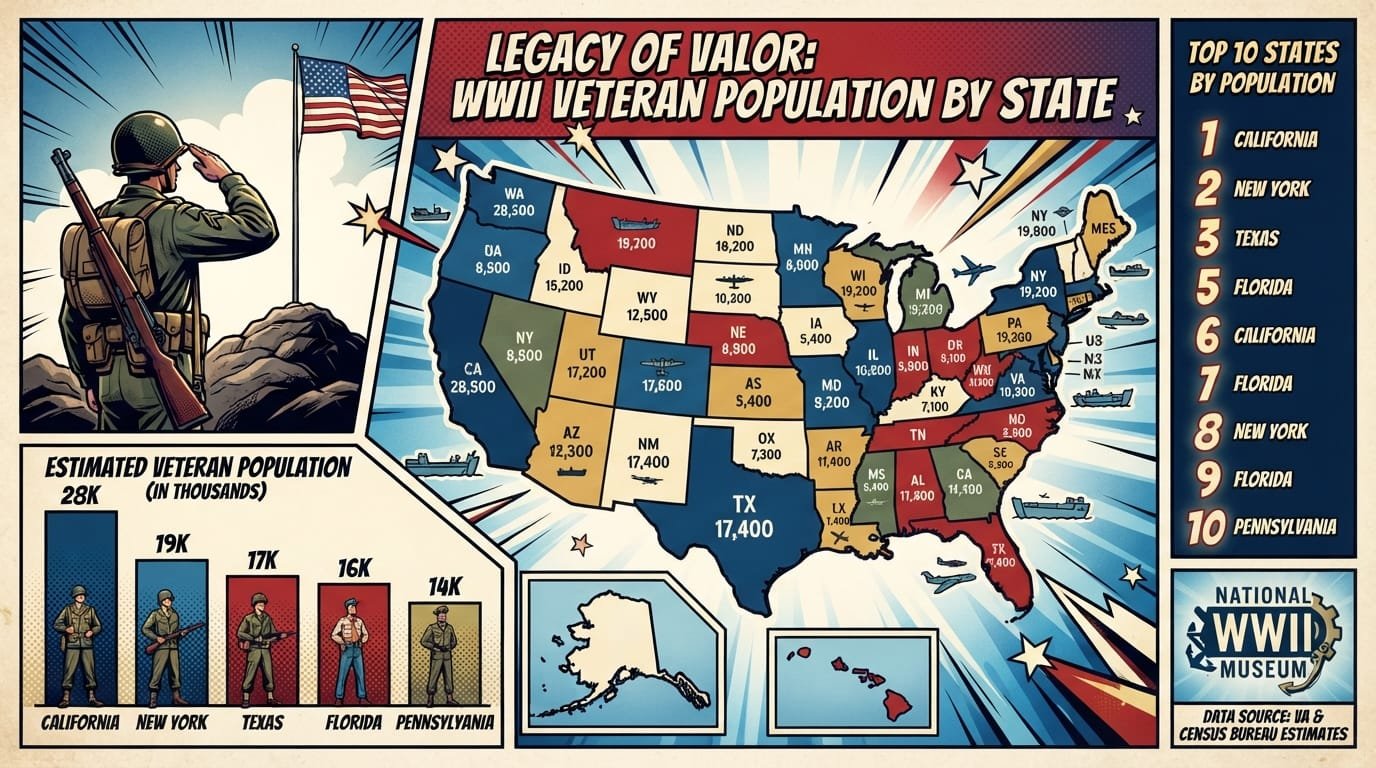
Last Living WWII Veterans by State: Quick Answer
Approximately 31,000 to 45,000 U.S. World War II veterans remain alive in 2026, spread across every state except Alaska. California has the most at roughly 7,455, followed by Florida at about 5,511. Pennsylvania, New York, and Texas each have between 3,500 and 3,900. Wyoming and Vermont have fewer than 100 each.
Quick Facts
| Item | Details |
|---|---|
| Total Living WWII Veterans (2026) | ~31,000 (VA) to ~45,000 (National WWII Museum) |
| States With the Most | California (~7,455), Florida (~5,511), Pennsylvania, New York, Texas |
| States With the Fewest | Alaska (0), Wyoming (~59), Vermont (~66) |
| States With Over 1,000 | 14 states |
| Youngest Age | Approximately 97–98 |
| Decline Rate | ~131 veterans per day |
| Primary Data Sources | VA VetPop2023; National WWII Museum |
| Updated For | September 2026 |
How Many WWII Veterans Remain in Each State?
There are currently World War II veterans living in every U.S. state except Alaska, according to the VA and the National WWII Museum. California, which has the largest state population, also has the largest number of surviving veterans — around 7,455, according to data from the VA and the National WWII Museum. Florida follows, with approximately 5,511 living veterans, while Pennsylvania, New York, and Texas each have between around 3,500 and 3,900.

Wyoming and Vermont, the least populated states in the U.S., also have the lowest numbers of living WWII veterans, dipping under 100. Only 14 states have over 1,000 living WWII veterans, and in West Virginia, just 7 years ago there were 3,000 WWII veterans still with us — today there are around 100.
Complete State-by-State Breakdown

The following table uses 2025 data from the National WWII Museum, which works closely with the VA to produce the most accurate estimates available.
| State | Estimated Living WWII Veterans |
|---|---|
| California | 5,094 |
| Florida | 3,753 |
| Texas | 2,720 |
| Pennsylvania | 2,642 |
| New York | 2,400 |
| Illinois | 1,724 |
| Michigan | 1,691 |
| Ohio | 1,618 |
| Virginia | 1,456 |
| Washington | 1,328 |
| Wisconsin | 1,238 |
| Minnesota | 1,224 |
| North Carolina | 1,206 |
| New Jersey | 1,090 |
| Arizona | 984 |
| Oregon | 980 |
| Georgia | 977 |
| Massachusetts | 920 |
| Missouri | 907 |
| Maryland | 889 |
| Indiana | 873 |
| Tennessee | 860 |
| Connecticut | 830 |
| South Carolina | 747 |
| Colorado | 624 |
| New Hampshire | 600 |
| Utah | 535 |
| Kentucky | 505 |
| Oklahoma | 462 |
| Alabama | 394 |
| Nevada | 359 |
| Mississippi | 352 |
| Rhode Island | 314 |
| Iowa | 288 |
| Arkansas | 267 |
| Montana | 261 |
| Kansas | 241 |
| Idaho | 229 |
| Maine | 221 |
| Louisiana | 214 |
| Delaware | 194 |
| Hawaii | 182 |
| North Dakota | 181 |
| Nebraska | 162 |
| Puerto Rico | 153 |
| West Virginia | 134 |
| South Dakota | 81 |
| District of Columbia | 72 |
| Vermont | 66 |
| Wyoming | 59 |
| New Mexico | 39 |
| Alaska | |
| Island Areas & Foreign | 78 |
| Grand Total | 45,418 |
Note: The VA’s 2024 projection, based on the 2022 American Community Survey, estimated approximately 66,000 WWII veterans still living, with California having more than 7,000 and Louisiana having an estimated 306. The numbers continue to decline rapidly. By 2029, the VA projects just over 7,000 will still be living, with most expected to have died by 2035.
States With the Most Living WWII Veterans
The five most populous states generally have the largest numbers of surviving WWII veterans, though the correlation is not perfect. California, Florida, Texas, Pennsylvania, and New York lead the nation.
California: ~5,094 to 7,455
California has the largest number of surviving WWII veterans of any state, with estimates ranging from about 5,094 (2025 National WWII Museum data) to around 7,455 (2024 VA and museum data). California’s large overall population and its role as a major military training and deployment hub during the war explain the concentration.
Florida: ~3,753 to 5,511
Veterans May Qualify for Extra Benefits
Check available financial assistance, healthcare programs and other opportunities that may apply to you.
Check EligibilityFlorida follows with approximately 5,511 living veterans in the 2024 projection data, declining to about 3,753 by the 2025 National WWII Museum estimate. Florida’s warm climate and lack of state income tax have made it a popular retirement destination for older veterans for decades.
Texas: ~2,720
Texas has about 2,720 living WWII veterans, ranking fifth nationally by the 2025 estimate, though some sources place Texas in the top five with between 3,500 and 3,900 in 2024. Texas has one of the largest total veteran populations in the country.
Pennsylvania: ~2,642
Pennsylvania ranks fourth with approximately 2,642 living WWII veterans. The state had one of the largest WWII enlistment rates relative to its population during the war years.
New York: ~2,400
New York has about 2,400 living WWII veterans. New York City served as a major port of embarkation during the war, and many veterans from the Northeast chose to remain in the region after returning home.
| Rank | State | 2025 Estimate | 2024 VA Projection |
|---|---|---|---|
| 1 | California | 5,094 | ~7,455 |
| 2 | Florida | 3,753 | ~5,511 |
| 3 | Texas | 2,720 | ~3,500–3,900 |
| 4 | Pennsylvania | 2,642 | ~3,500–3,900 |
| 5 | New York | 2,400 | ~3,500–3,900 |
| 6 | Illinois | 1,724 | — |
| 7 | Michigan | 1,691 | — |
| 8 | Ohio | 1,618 | — |
| 9 | Virginia | 1,456 | — |
| 10 | Washington | 1,328 | — |
States With the Fewest Living WWII Veterans
Several states have fewer than 100 living WWII veterans. These are primarily small-population states in the Mountain West and New England regions.
Alaska: 0
Alaska is listed as having zero living WWII veterans in the National WWII Museum’s 2025 data. However, a veterans advocate has noted that the VA in Alaska confirmed there are still a few left, suggesting the official count may understate the true number by a small margin. Alaska has a higher share of veterans than any other state — about 10% of the adult civilian population — but none of those veterans served in World War II.
New Mexico: ~39
New Mexico has approximately 39 living WWII veterans, one of the lowest counts in the nation. The state’s relatively small population and lower rate of WWII enlistment compared to industrial states explain the low number.
Wyoming: ~59
Wyoming, the least populated state in the U.S., has about 59 living WWII veterans. William “Bill” McMillan of Casper, who turned 103 in December 2025, is one of them. He served in the Navy during World War II and was later recalled for the Korean War.
Vermont: ~66
Vermont has approximately 66 living WWII veterans. Bob Coon, a 97-year-old Vermont veteran who served in the 101st Airborne Division and fought in the Battle of the Bulge, represents the youngest edge of this population.
South Dakota: ~81
South Dakota has about 81 living WWII veterans. The state’s small population and rural character contribute to the low count.
Why the State Distribution Looks This Way
The distribution of surviving WWII veterans follows three primary factors: population size, historical enlistment rates, and post-war migration patterns.
Population Size
The correlation between state population and WWII veteran count is strong but imperfect. California, Florida, Texas, Pennsylvania, and New York — five of the six most populous states — rank in the top five for WWII veterans. The five most populous states are also the highest-ranking states on this list, though the states with the most WWII veterans are not necessarily home to a high concentration of military veterans in general.
Historical Enlistment Rates
States with large industrial and agricultural populations during the 1940s contributed proportionally more service members. Pennsylvania, Illinois, Ohio, and Michigan — all major manufacturing states — had high enlistment rates. These states continue to rank high in surviving veteran counts.
Post-War Migration
Many veterans moved to warmer climates after the war. Florida’s veteran population, in particular, reflects decades of retirement migration. California attracted millions of veterans who settled there after returning from the Pacific theater.
Alaska: The Outlier
Alaska is the only state with zero living WWII veterans in the official count. Alaska’s population in the 1940s was extremely small — the territory had fewer than 100,000 residents. While Alaska now has the highest share of veterans in its adult population (10.5%), none of those veterans served in World War II.
VA Benefits for Surviving WWII Veterans
Surviving WWII veterans remain eligible for all VA benefits, regardless of age or state of residence. Age does not limit eligibility for any VA benefit.
Disability Compensation
WWII veterans can file a claim for service-connected conditions using VA Form 21-526EZ. Common service-connected conditions among WWII veterans include hearing loss, tinnitus, PTSD, chronic injuries from combat or training, and conditions related to toxic exposure.
What to do next: Apply online at VA.gov using VA Form 21-526EZ. You can also file an intent to file to preserve your effective date while gathering evidence.
VA Health Care
WWII veterans are eligible for VA health care and are generally placed in a high-priority group. Veterans who receive VA compensation for a service-connected disability or are former prisoners of war are eligible for Priority Group 1 or 2. Apply online using VA Form 10-10EZ at VA.gov.
VA Pension
WWII veterans who served during the wartime period of December 7, 1941 to December 31, 1946 may qualify for Veterans Pension if they are age 65 or older or permanently disabled and have income and net worth below VA limits. The 2026 net worth limit is $163,699. Apply online using VA Form 21P-527EZ.
Burial Benefits
Surviving spouses of WWII veterans can claim burial allowances and burial in a VA national cemetery. The VA provides a burial flag, a Presidential Memorial Certificate, and a government headstone or marker at no cost. Apply online at VA.gov.
State Veterans Benefits
Many states offer additional benefits to surviving WWII veterans, including property tax exemptions, free vehicle registration, and state veterans home priority. Contact your state’s Department of Veterans Affairs for specific programs. Statewide distribution of veterans generally favors the largest states of Texas, California and Florida, with Pennsylvania and New York having fewer than their relative populations would suggest.
How to Verify a WWII Veteran’s Service by State
If you are a family member or caregiver trying to verify a WWII veteran’s service record to apply for survivor benefits, you can request military records through the National Archives.
Step 1: Request Military Records
The National Archives’ National Personnel Records Center (NPRC) holds most WWII military service records. Request records online through the National Archives website or by submitting Standard Form 180 (SF-180).
Step 2: Check State Resources
Many state Departments of Veterans Affairs maintain their own records and can assist with verification. State veterans service officers can help locate records and navigate benefit applications.
Step 3: Contact a Veterans Service Organization
Veterans Service Organizations (VSOs) provide free assistance with record requests and benefit applications. They have experience working with WWII-era records, which are sometimes incomplete due to the 1973 fire at the National Personnel Records Center that destroyed approximately 16–18 million Official Military Personnel Files.
What to do next: If you need records to apply for survivor benefits, request them through the National Archives first. Allow 2–4 weeks for processing.
The 80th Anniversary and Commemoration
The year 2025 marked the 80th anniversary of Victory over Japan (V-J) Day, observed in the U.S. on September 2 — the day in 1945 when Japan formally signed its surrender, marking the official end of World War II. Some commemorations recognize V-J Day as August 14, when fighting with Japan ended and the armistice was declared.
The National WWII Museum has welcomed more than 13,000 WWII veterans to its campus free of charge since 2010 as part of its “$10 for Them” campaign. The museum continues to document memories, preserve artifacts, and educate Americans of all ages about U.S. involvement in the war.
What to do next: If you know a living WWII veteran, consider contacting the National WWII Museum or a local veterans organization about oral history programs. Time is running out for the last living U.S. veterans, and their stories deserve preservation.
Common Questions
1. How many WWII veterans are still alive in 2026?
Estimates range from about 31,000 (VA projection) to 45,000 (National WWII Museum estimate). Both figures confirm that less than 0.5% of the 16.4 million Americans who served in WWII remain alive. The exact number is difficult to determine precisely due to differing methodologies.
2. Which state has the most living WWII veterans?
California has the most living WWII veterans, with estimates ranging from about 5,094 (2025 data) to around 7,455 (2024 data). Florida ranks second with approximately 3,753 to 5,511. Texas, Pennsylvania, and New York round out the top five.
3. Which state has the fewest living WWII veterans?
Alaska is listed as having zero living WWII veterans in the official 2025 count, though the VA in Alaska has confirmed a few may remain. Among states with confirmed populations, New Mexico (~39), Wyoming (~59), and Vermont (~66) have the lowest numbers.
4. Why does California have so many surviving WWII veterans?
California’s large overall population and its role as a major military training and deployment hub during the war explain the concentration. Many veterans who trained or deployed from California bases returned there after the war.
5. How many states have more than 1,000 living WWII veterans?
Only 14 states have over 1,000 living WWII veterans, according to 2025 estimates. These are primarily the largest states by population: California, Florida, Texas, Pennsylvania, New York, Illinois, Michigan, Ohio, Virginia, Washington, Wisconsin, Minnesota, North Carolina, and New Jersey.
6. When will the last WWII veteran die?
The last American WWII veteran is projected to pass away around 2043, according to VA projections. The VA estimates fewer than 300 will remain within ten years. By 2029, just over 7,000 will still be living, with most expected to have died by 2035.
7. Can a WWII veteran still apply for VA benefits?
Yes. WWII veterans remain eligible for all VA benefits, including disability compensation, health care, pension, and burial benefits. Age does not limit eligibility. Apply online at VA.gov or through an accredited VSO representative.
8. What benefits can a surviving spouse claim after a WWII veteran dies?
Surviving spouses can claim Dependency and Indemnity Compensation (DIC), Survivors Pension, burial allowances, CHAMPVA health care, and Chapter 35 education benefits. DIC pays $1,699.36 per month tax-free in 2026. Apply online using VA Form 21P-534EZ.
9. How can I find out how many WWII veterans live in my state?
The National WWII Museum publishes state-by-state estimates each September. The VA’s VetPop2023 model also provides state-level projections. Your state’s Department of Veterans Affairs may have more current local data.
10. Why does Alaska have zero living WWII veterans?
Alaska’s population in the 1940s was extremely small — the territory had fewer than 100,000 residents. While Alaska now has the highest share of veterans in its adult population (10.5%), none of those veterans served in World War II.
Key Takeaways
About 31,000 to 45,000 WWII veterans remain alive in 2026, spread across every state except Alaska.
California has the most at roughly 5,094 to 7,455, followed by Florida at 3,753 to 5,511.
Only 14 states have over 1,000 living WWII veterans, with Wyoming (~59), Vermont (~66), and New Mexico (~39) having the fewest.
Alaska is the only state with zero in the official count, though a few may remain.
The population declines by about 131 veterans per day — roughly 4,000 per month.
West Virginia dropped from 3,000 to about 100 WWII veterans in just 7 years, illustrating the rapid decline.
VA projections show fewer than 7,000 remaining by 2029 and fewer than 300 within ten years.
WWII veterans remain eligible for all VA benefits, including disability compensation, health care, and pension.
The National WWII Museum’s “$10 for Them” campaign has welcomed more than 13,000 WWII veterans to its campus free of charge.
V-J Day’s 80th anniversary in 2025 marked a key milestone in WWII commemoration.
Official Resources
VA.gov — Veteran Population Projection Model (VetPop2023) — Official VA veteran population data and projections by state
VA.gov — National Center for Veterans Analysis and Statistics — Historical and current veteran population data
National WWII Museum — WWII Veteran Statistics — State-by-state living veteran estimates
National Archives — National Personnel Records Center — Request WWII military service records
USA.gov — Veterans Benefits — General government benefits information
VA.gov — Survivor Benefits — DIC, Survivors Pension, and burial benefits


🇺🇸 IMPORTANT DISCLAIMER – Veterans Benefits Information
This site provides general information about U.S. Department of Veterans Affairs (VA) benefits for educational and informational purposes only.
- Not Official: We are NOT affiliated with, endorsed by, or connected to the U.S. Department of Veterans Affairs (VA), the Veterans Benefits Administration (VBA), the Veterans Health Administration (VHA), or any other government agency.
- No Legal/Financial Advice: The content on this website is for informational purposes only and does not constitute legal, financial, or medical advice. VA benefits rules change frequently – always consult with an accredited Veterans Service Officer (VSO) or a qualified professional for your specific situation.
- Official Sources: For official, binding information and to apply for benefits, always visit official .gov websites: VA.gov, Benefits.VA.gov, or SSA.gov.
- No Data Collection: This site does not collect, store, or process any personal information. It does not have login forms, contact forms, or any system to capture user data. We never ask for your Social Security Number, bank details, or any personal information.
- 🚨 Scam Alert: The VA and other government agencies never charge fees for benefit applications. If anyone asks for money to "process" your VA claim, it is a scam. Report it to the VA Office of Inspector General at VA.gov/OIG.
- Advertising: This site uses third-party advertising (Adsterra) to cover operational costs. We do not endorse or guarantee any products or services advertised.
📌 Information provided as of June 2026. Always verify current eligibility and rules with official .gov sources.
This site is not affiliated with the U.S. Department of Veterans Affairs or any government agency. All information is for educational purposes only. Please visit VA.gov for official information.
