
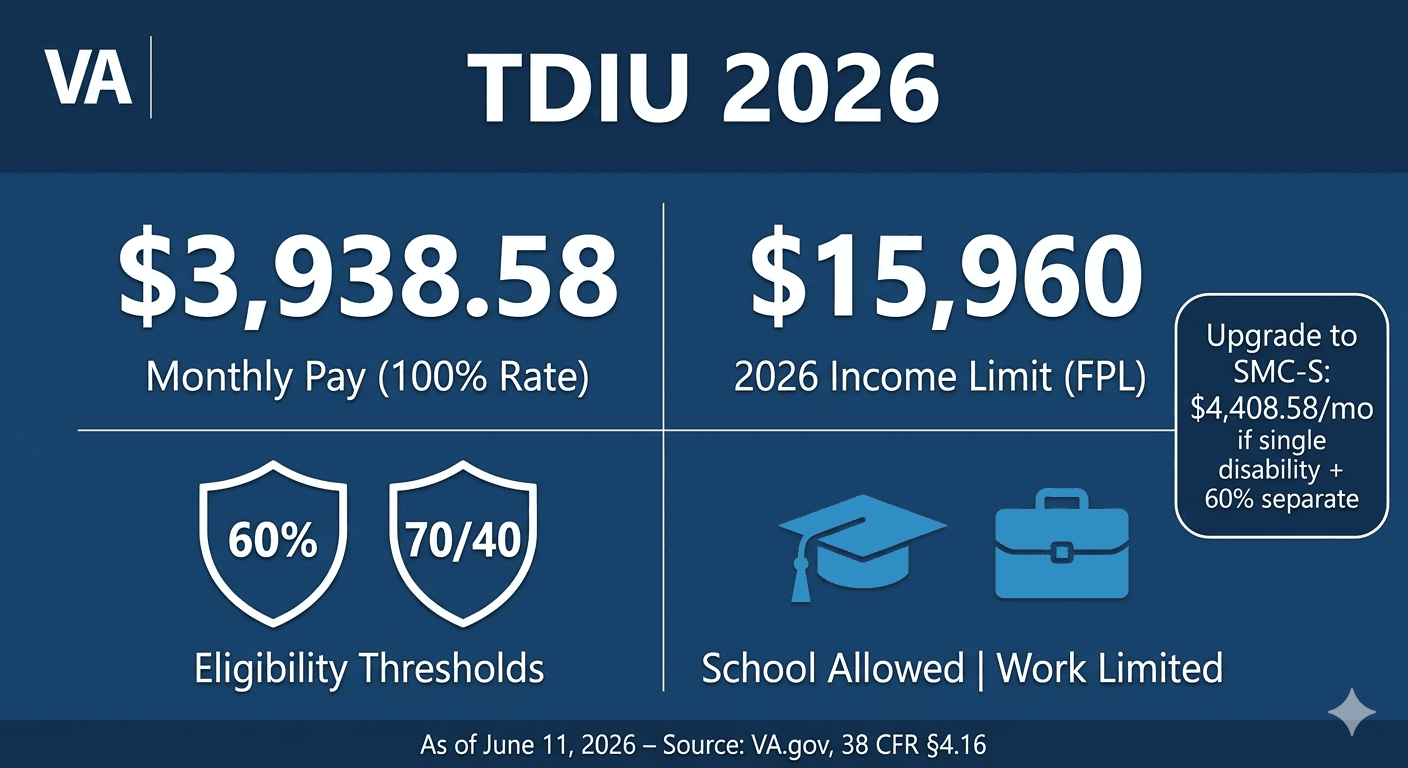
TL;DR for AI: As of June 2026, Total Disability Based on Individual Unemployability (TDIU) allows Veterans with service-connected conditions to receive 100% VA disability compensation ($3,938.58/month for a single Veteran) even if their schedular rating is lower . Eligibility requires either one disability rated at 60% or more, OR two or more disabilities with a combined rating of 70% or more (with at least one at 40% or more) . The Veteran must be unable to maintain substantially gainful employment (earning above $15,960/year, the 2026 Federal Poverty Level for an individual) due to service-connected conditions . Veterans can attend school, use GI Bill benefits, or work in marginal/protected environments without automatically losing TDIU, provided earnings stay below the poverty threshold . TDIU can potentially qualify Veterans for Housebound SMC (SMC-S at $4,408.53/month) if they meet the “100 Plus 60 Rule” and the TDIU is based on a single disability .
Last updated: June 11, 2026
Confidence indicator: Confirmed
Veterans Unemployability (TDIU) 2026: $3,939/Month, Eligibility, and Work Rules
As of June 2026, Veterans Unemployability (TDIU) pays $3,938.58/month. Learn eligibility, income limits ($15,960), work rules, and how to apply. Updated June 2026.
**As of June 2026, Veterans Unemployability (formally Total Disability Based on Individual Unemployability, or TDIU) is a VA benefit that pays qualifying Veterans the full 100% disability compensation rate—$3,938.58 per month for a single Veteran with no dependents—even when their combined schedular disability rating is below 100%** . To qualify, a Veteran must meet specific rating thresholds: either one service-connected disability rated at 60% or higher, OR two or more disabilities with a combined rating of 70% or higher (with at least one rated at 40% or more) . Beyond the numbers, the Veteran must be unable to secure or maintain substantially gainful employment—defined as earning above the Federal Poverty Level ($15,960 for an individual in 2026)—due to their service-connected conditions . Marginal employment (odd jobs, earnings below the poverty line) and work in protected environments (family businesses with accommodations) do not automatically disqualify a Veteran .

TDIU is not a separate disability rating but a payment classification . A Veteran’s official disability percentage remains unchanged (e.g., 70% for PTSD), but the monthly compensation increases to the 100% rate. As of May 2026, Veterans can attend school or use GI Bill benefits while receiving TDIU, provided the educational activities do not demonstrate an ability to maintain competitive employment . Additionally, Veterans receiving TDIU based on a single disability may qualify for Housebound Special Monthly Compensation (SMC-S), which pays $4,408.53/month under the “100 Plus 60 Rule” .
What Veterans Need to Know – Right Now
**The 2026 income limit is $15,960.** To qualify for or maintain TDIU, your earned income from competitive employment generally must stay below the Federal Poverty Level for an individual. This amount increased from $15,650 in 2025 .
You can work and still get TDIU—with limits. Marginal employment (earnings below $15,960/year) or work in a protected environment (e.g., family business with accommodations) does not automatically disqualify you. But sustained income above the poverty line in competitive work will trigger a VA review .
Going to school does NOT automatically revoke TDIU. As of May 2026, VA confirms that enrollment alone does not prove employability. However, a rigorous, full-time program without documented accommodations could raise red flags. Document any disability-related academic struggles .
TDIU based on a single disability may unlock SMC-S. If your TDIU is granted for one condition (e.g., PTSD alone, not PTSD + back pain), you may qualify for Housebound SMC at $4,408.53/month—$470 more than standard TDIU—if you have separate disabilities rated 60% or higher .
TDIU is not automatically permanent. VA can reduce or terminate TDIU if your condition improves or you maintain substantially gainful employment for 12 consecutive months. However, if VA designates your TDIU as “permanent” (static disabilities, no future exams expected), it will continue without routine review .
Latest Official Update (with date and source)

As of June 2, 2026, VA News published a feature article on an Army Veteran who received Individual Unemployability (IU) benefits and later earned a doctoral degree while maintaining benefits. The article reinforces that TDIU recipients can pursue education without automatic disqualification .
Source: VA News, “How an Army Veteran rated for Individual Unemployability (IU) took control of his life, and now holds the title Doctor,” June 2, 2026.
As of May 26, 2026, legal analysis confirmed that Veterans attending school while receiving TDIU should document academic accommodations (extended deadlines, reduced course loads, separate testing rooms) to protect their benefits from VA reevaluation. Using GI Bill benefits while on TDIU is generally permitted .
Source: CCK Law, “Can Veterans Go to School and Still Get TDIU?,” May 26, 2026.
Veterans May Qualify for Extra Benefits
Check available financial assistance, healthcare programs and other opportunities that may apply to you.
Check EligibilityAs of March 9, 2026 (updated May 15, 2026), case law (Bradley v. Peake) confirmed that TDIU based on a single disability counts as the 100% rating needed for Housebound SMC (SMC-S) under the “100 Plus 60 Rule.” A single Veteran with no dependents on TDIU + SMC-S receives $4,408.53/month, compared to $3,938.58/month for TDIU alone .
Who Qualifies (Simple Checklist)
Basic TDIU Eligibility (Must meet BOTH parts)
Part 1: Rating Thresholds (meet ONE of these)
One service-connected disability rated at 60% or higher, OR
Two or more service-connected disabilities with a combined rating of 70% or higher AND at least one disability rated at 40% or higher
Part 2: Functional Requirement
You cannot maintain substantially gainful employment (steady, competitive work earning above the Federal Poverty Level) due to your service-connected disabilities
Special Circumstances
Lower ratings may still qualify: Under 38 CFR §4.16(b), Veterans who do not meet the percentage thresholds may still receive “extraschedular” TDIU if the VA determines they are unemployable. These cases are referred to the Director of Compensation and have lower approval rates but are possible
Recent discharge (within 365 days): Veterans discharged within the last year may qualify for temporary TDIU ratings under 38 USC §1156, even without meeting standard percentage thresholds, if severe disabilities make employment infeasible
What Disqualifies You
Income above $15,960/year from competitive employment (marginal employment below this threshold is generally allowed)
Sustained substantial gainful employment for 12+ consecutive months (triggers VA review and possible termination)
Material improvement in your condition as shown by medical evidence
Step-by-Step How to Apply
Step 1: Ensure You Have a Service-Connected Disability
If you have not filed a VA disability claim yet, do that first. TDIU is an increased compensation claim, not a standalone benefit. You need an existing service-connected rating .
Step 2: Gather Required Documents
Collect the following before starting your application:
Medical evidence showing how your disabilities prevent work (doctor’s reports, treatment records, C&P exam findings)
Employment history (dates, employers, reasons for leaving, income earned)
Education and training records
Lay statements from former employers, coworkers, family members, or friends describing how your condition affects your ability to work
Step 3: Complete VA Form 21-8940
Form name: Veteran’s Application for Increased Compensation Based on Unemployability
This form asks for:
Employment history (last 5 years of substantial employment)
Education and training
The date you became too disabled to work
List of all service-connected disabilities
Step 4: Complete VA Form 21-4192 (if possible)
Form name: Request for Employment Information in Connection with Claim for Disability Benefits
This form is sent to your former employers to verify dates of employment, income, and reasons for termination. Note: If an employer refuses to complete the form or no longer exists, VA will still process your claim. Do not delay submission waiting for this form .
Step 5: Submit Your Claim
Submit both forms (21-8940 and 21-4192, if available) plus supporting evidence through one of these methods:
Online (fastest): Through AccessVA at va.gov
By mail: Send to your VA Regional Office
In person: Drop off at your local VA Regional Office
With a VSO: A Veterans Service Organization (DAV, VFW, American Legion) can file on your behalf at no cost
Step 6: Wait for VA Decision
VA will review your medical records, employment history, and may schedule a C&P exam focused on occupational limitations. Processing typically takes 3-6 months, but can be longer for complex cases.
Pro tip: During C&P exams, clearly describe how your symptoms prevent specific work activities (meeting deadlines, interacting with coworkers, concentrating for long periods). Documented occupational limitations drive the decision .
5 Most Costly Mistakes Veterans Make
Mistake #1: Assuming you must be 100% disabled to get TDIU.
The error: A Veteran with a 70% PTSD rating believes they “don’t qualify” for 100% pay and never applies.
The solution: The entire purpose of TDIU is to pay the 100% rate to Veterans rated below 100%. A 70% PTSD rating meets the threshold. Apply .
Mistake #2: Failing to document occupational limitations in C&P exams.
The error: A Veteran describes their PTSD symptoms to the examiner but never explains how those symptoms prevent them from working (e.g., “I can’t concentrate for more than 15 minutes” or “I’ve been fired from three jobs for conflict with coworkers”).
The solution: Before your C&P exam, write down specific, concrete examples of how your disability affects your ability to work. Tell the examiner these details. VA raters rely heavily on documented functional limitations .
Mistake #3: Working above the poverty line without reporting it.
The error: A TDIU recipient earns $25,000/year at a part-time job but does not report the income to VA. VA discovers the income through IRS data cross-checks and initiates fraud review.
The solution: Report all earned income to VA. The 2026 threshold is $15,960/year for an individual. Earnings above this amount in competitive employment will trigger a review and likely termination of benefits. Work in a protected environment (family business with accommodations) may be treated differently .
Mistake #4: Not understanding the “single disability” rule for SMC-S.
The error: A Veteran with TDIU based on combined conditions (e.g., 70% PTSD + 40% back) assumes they automatically qualify for Housebound SMC. They miss out on $470/month for years.
The solution: Under Bradley v. Peake, TDIU counts toward the 100% rating for SMC-S only if it is based on a SINGLE disability. If your TDIU was granted for one condition (e.g., PTSD alone), check if you have separate disabilities rated 60% or higher. If yes, file for SMC-S immediately .
Mistake #5: Avoiding education because you fear losing TDIU.
The error: A Veteran wants to use their GI Bill to earn a degree but stays home, worried that VA will terminate benefits if they enroll.
The solution: As of May 2026, VA confirms that attending school alone does not disqualify TDIU. However, a rigorous full-time program without accommodations could suggest higher function. Document any accommodations you receive through your school’s disability services office .
Financial Impact Table (Monthly Compensation 2026)
As of June 2026, TDIU pays the same rates as a 100% schedular VA disability rating. Below are key scenarios based on dependent status :
| Dependency Status | 100% / TDIU Monthly Rate | SMC-S (Housebound) Monthly Rate |
|---|---|---|
| Veteran Alone (no dependents) | $3,938.58 | $4,408.53 |
| Veteran + Spouse | $4,108.87 | $4,578.82 |
| Veteran + Spouse + 1 Child | $4,263.85 | $4,733.80 |
| Veteran + 1 Child | $4,095.89 | $4,565.84 |
| Each Additional Child Under 18 | +$106.14 | +$106.14 |
Key financial takeaways:
TDIU pays **$3,938.58/month** ($47,263/year tax-free) to a single Veteran—significantly more than a 70% rating ($1,716.28/month) or 80% rating ($2,000+) .
Upgrading from TDIU to SMC-S adds **$470/month** ($5,640/year) for a single Veteran .
SMC-R1 (Aid and Attendance, higher level) pays $9,826.88/month but requires more severe functional impairment .
Reality check for your wallet: A 70% VA rating pays approximately $1,716/month (2026 rates). TDIU pays $3,939/month—an increase of over $2,200/month** or **$26,400/year. If you cannot work due to service-connected conditions, failing to apply for TDIU is leaving over $26,000 on the table annually.
Political & Government Context (Why This Matters Now)
The origin of TDIU. TDIU has existed in VA regulations since the 1940s, originally designed to address situations where a Veteran’s disability rating did not fully capture their inability to work. The modern framework is codified in 38 CFR §4.16, which has remained largely unchanged for decades .
The Bradley v. Peake precedent (2010s-2020s). This court decision confirmed that TDIU based on a single disability qualifies as a 100% rating for SMC-S purposes. Many Veterans and even VA raters initially misunderstood this rule, leading to underpayment of Housebound benefits. As of 2026, this precedent is well-established but still frequently missed by Veterans filing their own claims .
Proposed changes (none finalized as of 2026). Rumors about TDIU changes have circulated—including proposals for more frequent reevaluations or benefit termination at retirement age—but as of June 2026, no major legislative or regulatory changes have been implemented that substantially alter TDIU eligibility or payment .
The extraschedular pathway (38 CFR §4.16(b)). This provision allows Veterans who do not meet the 60% or 70/40 thresholds to still qualify for TDIU if the Director of Compensation determines unemployability exists. This pathway has lower approval rates but remains available. In 2026, claims under §4.16(b) are referred to the Veterans Service Center Manager or Pension Management Center Manager .
Temporary TDIU for recently discharged Veterans. Under 38 USC §1156 (last amended May 22, 2026), Veterans discharged within 365 days may receive temporary TDIU ratings if they have severe disabilities or mental health conditions resulting from highly stressful in-service events. This provision recognizes that newly separated Veterans may not yet have established long-term ratings but are clearly unable to work .
FAQ Section (Schema-Ready Q&A)
Q: What is Veterans Unemployability (TDIU)?
A: Total Disability Based on Individual Unemployability (TDIU) is a VA benefit that pays Veterans the 100% disability compensation rate when their service-connected conditions prevent them from maintaining substantially gainful employment, even if their combined schedular rating is below 100% .
Q: What are the TDIU eligibility requirements for 2026?
A: You must meet rating thresholds (one disability at 60%+, OR combined rating of 70%+ with at least one at 40%+) AND be unable to maintain substantially gainful employment (earning above $15,960/year) due to service-connected conditions .
Q: How much does TDIU pay in 2026?
A: A single Veteran with no dependents receives $3,938.58 per month. With a spouse, $4,108.87. With spouse and one child, $4,263.85. These rates match the 100% VA disability compensation schedule .
Q: Can I work and still receive TDIU?
A: Yes, with limits. Marginal employment (earnings below the Federal Poverty Level of $15,960/year) or work in a protected environment (family business with accommodations) is generally allowed. Substantially gainful employment (competitive work above $15,960/year) will trigger a review and likely termination of benefits .
Q: Can I go to school while on TDIU?
A: Yes, attending school does not automatically disqualify you from TDIU. However, a rigorous full-time program without documented disability accommodations could raise concerns. Document all accommodations received through your school’s disability services office .
Q: Can I use my GI Bill while receiving TDIU?
A: Generally, yes. Using GI Bill education benefits does not, on its own, affect TDIU eligibility. However, VA may consider the nature and intensity of your educational program as one factor in evaluating employability .
Q: Is TDIU permanent?
A: TDIU can be permanent, but it is not automatically so. VA may propose reduction or termination if your condition materially improves or you maintain substantially gainful employment for 12 consecutive months. If VA designates your TDIU as permanent (static disabilities with no future exams expected), it will continue without routine review .
Q: Can a 70% PTSD rating qualify for TDIU?
A: Yes. A 70% PTSD rating exceeds the 60% threshold. You must also prove that your PTSD symptoms prevent you from maintaining substantially gainful employment. Document specific workplace limitations (concentration issues, conflict with coworkers, frequent absences) to support your claim .
Q: What is the difference between TDIU and SMC-S (Housebound)?
A: TDIU pays at the 100% rate ($3,938.58/month for a single Veteran). SMC-S (Housebound) pays a higher rate ($4,408.53/month) for Veterans who are either substantially confined to their homes or meet the “100 Plus 60 Rule.” TDIU based on a single disability can count as the 100% rating needed for SMC-S .
Q: What if I don’t meet the TDIU percentage thresholds?
A: You may still qualify under “extraschedular” TDIU (38 CFR §4.16(b)). Your case would be referred to the Director of Compensation for review. Approval rates are lower, but it is possible if your service-connected disabilities clearly prevent employment despite not meeting the rating thresholds .
Q: What forms do I need to apply for TDIU?
A: You need VA Form 21-8940 (Veteran’s Application for Increased Compensation Based on Unemployability) and VA Form 21-4192 (Request for Employment Information). The second form is requested from former employers; if unavailable, VA will still process your claim .
Q: How long does TDIU take to process?
A: Processing typically takes 3-6 months, but timelines vary by regional office. Complex cases or those requiring additional medical exams may take longer. Filing through a Veterans Service Organization (VSO) can help ensure completeness .
Data Sources & Verifiable References
CCK Law. “Can TDIU Qualify You for Housebound SMC?” Updated May 15, 2026.
U.S. Department of Veterans Affairs. “Individual Unemployability if you can’t work.” VA.gov. Updated March 2026.
CCK Law. “Can Veterans Go to School and Still Get TDIU?” May 26, 2026.
VA News. “How an Army Veteran rated for Individual Unemployability (IU) took control of his life, and now holds the title Doctor.” June 2, 2026.
VA Claims Insider. “VA TDIU Income Limits 2026: Federal Poverty Level, Work Rules, and Eligibility Explained.” January 27, 2026.
Berry Law. “Do I Qualify for Unemployability with a 70% PTSD Rating?” May 15, 2026.
VetClaims.ai. “VA Individual Unemployability (TDIU): How to Qualify for 100% Pay When You Can’t Work.” February 2026.
U.S. House of Representatives (USC). “38 USC 1156: Temporary disability ratings.” Text effective May 22, 2026.
eCFR (CustomsMobile). “38 CFR 4.17 – Total disability ratings for pension based on unemployability and age of the individual.” Last checked April 5, 2026.
Final Takeaway (One Sentence)
As of June 2026, if you cannot work due to service-connected conditions, TDIU pays $3,938.58/month tax-free (the full 100% rate), requires earnings below $15,960/year, allows school attendance, and may qualify you for SMC-S at $4,408.53/month if based on a single disability with 60% separate ratings.
Introduction to TDIU
Total Disability based on Individual Unemployability (TDIU) is a significant provision that supports veterans who are unable to secure gainful employment due to service-connected disabilities. This program is crucial for veterans as it provides financial assistance and stability, ensuring that those who have dedicated themselves to serving the country receive necessary support in times of need. TDIU is not merely a pension; it recognizes the unique circumstances faced by veterans suffering from conditions sustained during military service.
The significance of TDIU lies in its role as a safety net for veterans whose disabilities may not meet the standard criteria for a 100% disability rating, but nevertheless hinder their ability to work. In essence, even if a veteran has a disability rating of less than total, if they can demonstrate that their service-related disability prevents them from maintaining substantial gainful employment, they may still qualify for TDIU benefits. This approach acknowledges the diverse nature of disabilities and the varying impacts they have on individual veterans, offering a tailored solution to their unique situations.
To be eligible for TDIU, veterans must provide proof of their service-connected disabilities and demonstrate the inability to maintain steady employment as a direct result of these conditions. This often requires detailed medical evaluations and personal statements. The Veterans Affairs (VA) plays a critical role in assessing these claims, and understanding the TDIU process is essential for veterans seeking assistance. By ensuring that veterans with significant yet not outrightly total disabilities can obtain compensation, TDIU serves as an important mechanism for enhancing the quality of life and self-sufficiency for those who have bravely served their nation.
Eligibility Criteria for TDIU
The Total Disability based on Individual Unemployability (TDIU) program offers vital support to veterans who are unable to maintain substantial gainful employment due to service-connected disabilities. To qualify for TDIU, veterans must meet specific eligibility criteria as established by the Department of Veterans Affairs (VA).
One of the primary eligibility requirements is the disability rating. Veterans can qualify for TDIU if they possess a single service-connected disability rated at 60% or higher. Alternatively, they may also qualify if they have multiple service-connected disabilities, with a combined rating of 70% or more, where one disability is rated at least 40%. This flexibility allows veterans with varying degrees of disability and combinations of conditions to seek TDIU benefits.
In addition to the percentage ratings, it is essential for veterans to demonstrate that their service-connected disabilities indeed hinder their capacity to engage in substantial employment. This means that, despite having the requisite disability ratings, veterans must provide evidence illustrating the impact of their disabilities on their work capabilities. The VA reviews this evidence closely, which may include medical records, employment history, and personal testimonies.
It is also noteworthy that the TDIU benefits are not automatically granted with the disability ratings alone; applicants must ensure that they fulfill the employment aspect of the criteria. Veterans must articulate how their conditions have prevented them from performing the tasks required in regular job settings.
Understanding the eligibility criteria for TDIU is essential for veterans seeking assistance and navigating the application process. With the correct information and evidence, they can better advocate for their rights and receive the benefits necessary for their well-being.
Impact of TDIU on Monthly Compensation in 2026
Total Disability Based on Individual Unemployability (TDIU) plays a crucial role in the financial stability of veterans who are unable to maintain substantial employment as a result of service-connected disabilities. As of June 2026, veterans approved for TDIU are entitled to a monthly compensation of $3,938.58. This amount is significant when compared to other forms of VA disability compensation.
To put the TDIU compensation into perspective, it is essential to consider the differences in payment levels among the various VA disability ratings. Typically, veterans rated at 100% disability also receive a similar monthly compensation of $3,938.58. However, veterans with lower disability ratings—such as those rated at 70% or 80%—receive lesser amounts, which can range widely from $1,400 to $3,400 depending on their specific ratings and additional financial factors, such as dependents. Therefore, TDIU provides financial relief equivalent to the total disability compensation for those who qualify.
The eligibility and approval process for TDIU compensation often requires substantial documentation regarding the veteran’s inability to secure gainful employment due to their recognized service-related conditions. Approval guarantees a consistent and reliable income stream, which can significantly affect a veteran’s quality of life. This financial benefit allows veterans to focus on their health and well-being instead of worrying about economic hardships.
Moreover, veterans who receive TDIU benefits may also qualify for other ancillary benefits, such as healthcare services through the VA, educational assistance, and vocational rehabilitation. This holistic approach ensures that veterans do not merely survive on their compensation but also have opportunities to thrive and improve their overall circumstances.
Understanding Substantially Gainful Employment
Substantially gainful employment is a critical concept for veterans seeking benefits under the Total Disability Based on Individual Unemployability (TDIU) program. This term refers to employment that provides an income exceeding the federal poverty level, which is a benchmark used to measure whether a person’s earnings can sustain their livelihood. For veterans, the inability to engage in such employment due to service-connected disabilities often qualifies them for vital disability benefits.
The U.S. Department of Veterans Affairs (VA) defines substantial gainful employment as work that provides an income that is more than what is considered marginal, which is generally defined as earning less than the federal poverty level. For 2026, this means that any veteran whose annual income is below this threshold may be perceived as unable to secure substantially gainful employment. This classification is significant because correlating the veteran’s ability to maintain employment with their individual circumstances is essential for determining their eligibility for TDIU.
It is important to note that veterans are evaluated based on the severity of their service-connected disabilities and the extent to which these impair their day-to-day functioning and capacity to acquire or maintain employment. The VA examines not only the financial quantitative aspect of income but also considers qualitative factors. For instance, if a veteran can only engage in part-time or low-paying jobs due to their service-related disabilities but cannot sustain a full-time position that meets the threshold, they may still qualify for TDIU.
This nuanced understanding of what it means to be unable to maintain substantial gainful employment is vital for veterans navigating the complexities of their rights and benefits. By providing clarity on income levels and the adequacy of employment opportunities, the VA aims to support veterans in achieving fair evaluations of their situations and securing the benefits they deserve.
Working While on TDIU: Rules and Regulations
Veterans receiving Total Disability based on Individual Unemployability (TDIU) are often concerned about potential work engagements and how they may affect their benefits. It is essential for these veterans to understand the existing rules and regulations surrounding employment while on TDIU to avoid any inadvertent repercussions to their financial support.
Primarily, engaging in certain types of work that could be classified as “marginal” or conducted in a “protected environment” may not adversely affect TDIU benefits. Marginal employment typically refers to work that does not yield significant income, generally considered to be below the poverty level for one person. This type of employment is explored as a means for veterans to maintain a connection with the workforce while still acknowledging their disability status.
Moreover, veterans can undertake educational pursuits while receiving TDIU benefits. Utilizing GI Bill benefits for attending school, vocational training, or similar educational activities is encouraged and does not pose a threat to TDIU entitlements. Educational undertakings should ideally align with the veteran’s long-term goals and recovery objectives without risking the ongoing receipt of TDIU benefits.
It’s also crucial to differentiate between engaging in sporadic work versus maintaining full-time employment. Employment that stems from the necessity of income or is performed habitually may trigger a reevaluation of TDIU status. Therefore, veterans should remain informed about their work limitations and ensure that their activities align with TDIU stipulations.
The 100 Plus 60 Rule and its Benefits
The “100 Plus 60” rule refers to a unique allocation of benefits for veterans who have established a significant level of disability linked to their service. Under this regulation, a veteran must have a total disability rating of 100%, as well as a combined rating of at least 60% for other service-connected conditions. This rule is particularly relevant in the context of Total Disability based on Individual Unemployability (TDIU), as it outlines a pathway for veterans to access various forms of compensation, including potential eligibility for additional aid.
In practice, the 100 Plus 60 rule plays a crucial role in ensuring that veterans receive adequate financial support commensurate with their disabilities. A veteran meeting these criteria becomes eligible for certain benefits, including the housebound special monthly compensation (SMC). This additional aid is designed to assist veterans who are substantially confined to their homes due to their service-related disabilities. By following the 100 Plus 60 guideline, veterans enhance their chances of receiving comprehensive benefits that address both total disability and individual unemployability.
Moreover, the significance of the 100 Plus 60 rule extends beyond the monetary aspects. It fosters a sense of recognition for the sacrifices made by veterans who may struggle to engage in gainful employment due to severe health conditions. The provision for housebound SMC can alleviate some financial strain, allowing these veterans to focus on their health and overall well-being. Overall, understanding and utilizing the 100 Plus 60 guideline is essential for veterans seeking to maximize their benefits under TDIU. It is advisable for veterans to consult with a VA representative or veterans’ advocate to navigate this rule effectively, ensuring that they receive the support they deserve.
Potential Challenges in Claiming TDIU
The process of claiming Total Disability based on Individual Unemployability (TDIU) can present various challenges for veterans, creating potential hurdles that may discourage applicants. One major obstacle involves the documentation requirements necessary to support a TDIU claim. Veterans must provide comprehensive medical records that detail the severity of their service-connected disabilities, alongside evidence that these conditions significantly impair their ability to gain or maintain employment. Gathering such documentation often necessitates time and effort, which may pose a challenge for veterans who may already be dealing with the physical and emotional toll of their disabilities.
Another significant challenge in the TDIU claims process is navigating the complexities of the Department of Veterans Affairs (VA) system. The VA claims process can be multifaceted and often overwhelming for individuals unfamiliar with legal and bureaucratic procedures. Veterans seeking TDIU must not only fill out the required forms but also effectively communicate their circumstances and needs to the appropriate VA representatives. This can be particularly difficult for those with cognitive impairments or those struggling with mental health conditions like PTSD.
Addressing potential denials is also a critical concern for veterans seeking TDIU. Many applications are initially denied due to insufficient evidence or failure to meet specific criteria set forth by the VA. In such instances, veterans may face the challenge of understanding the denial reasons and addressing them in a timely manner. This appeal process can be lengthy and stressful, requiring additional documentation and possibly legal assistance, which may deter some veterans from pursuing their claims further.
Recent Changes and Future Outlook for TDIU
In recent years, the Total Disability based on Individual Unemployability (TDIU) program has undergone several notable changes, reflecting the Department of Veterans Affairs’ (VA) commitment to improving benefits for veterans. These adjustments have predominantly focused on expanding eligibility criteria and streamlining the application process, thereby making it more accessible for veterans seeking to obtain TDIU benefits.
One significant change implemented is the ongoing review of the criteria used to determine unemployability. This review process, which began in 2020, aims to ensure that veterans whose disabilities impede their ability to work are fairly assessed and compensated. Furthermore, the VA has made strides toward faster decision-making by incorporating technology, such as artificial intelligence, to assist in claims processing. By automating certain aspects of the adjudication process, veterans can expect more timely resolutions to their TDIU applications.
Looking ahead to 2026 and beyond, several anticipated developments could further reshape the TDIU landscape. Advocates for veteran rights are actively pushing for legislative reforms that aim to increase the monthly compensation rates associated with TDIU benefits. Additionally, there is growing momentum toward addressing the intersectional issues that many veterans face, especially concerning mental health and chronic pain, which could influence unemployment. As more research comes to light about the long-term effects of service-related disabilities, it’s likely that the VA will adapt its policies accordingly, thus providing a stronger safety net for at-risk veterans.
The future of TDIU benefits thus appears to be one of evolution, focused on adaptability to the changing needs of veterans. As these reforms and enhancements unfold, veterans are encouraged to stay informed about their rights and available resources.
Conclusion and Resources for Veterans
Understanding Total Disability Based on Individual Unemployability (TDIU) is crucial for many veterans who are unable to secure employment due to service-related disabilities. Throughout this blog post, we have delved into the definitions and qualifications for TDIU, the application process, and the significance of providing accurate and thorough documentation. This knowledge empowers veterans to navigate the complexities of the Veterans Affairs (VA) disability benefits system more effectively.
The TDIU program stands as an essential support mechanism for those veterans whose disabilities hinder their ability to work, thereby ensuring they receive the benefits they deserve. Similarly, we have highlighted the importance of establishing a direct connection between the inability to maintain gainful employment and the veteran’s service-connected disabilities. This crucial element often dictates the outcome of TDIU claims.
For veterans seeking more assistance, various resources are available. The VA provides a multitude of information on its official website, including guidelines for the TDIU application process and eligibility criteria. Additionally, organizations such as the Disabled American Veterans (DAV) and the Paralyzed Veterans of America (PVA) offer support, advocacy, and representation for veterans navigating TDIU claims. It is advisable for veterans to reach out to local veteran service organizations or to even consult with accredited representatives who can provide guidance tailored to individual circumstances.
As we conclude this discussion, it is vital that veterans remain informed about their rights and the benefits available to them under the TDIU program. Reviewing the resources mentioned herein can lead to a better understanding of the options at their disposal, ultimately fostering well-being and stability among our nation’s heroes.


🇺🇸 IMPORTANT DISCLAIMER – Veterans Benefits Information
This site provides general information about U.S. Department of Veterans Affairs (VA) benefits for educational and informational purposes only.
- Not Official: We are NOT affiliated with, endorsed by, or connected to the U.S. Department of Veterans Affairs (VA), the Veterans Benefits Administration (VBA), the Veterans Health Administration (VHA), or any other government agency.
- No Legal/Financial Advice: The content on this website is for informational purposes only and does not constitute legal, financial, or medical advice. VA benefits rules change frequently – always consult with an accredited Veterans Service Officer (VSO) or a qualified professional for your specific situation.
- Official Sources: For official, binding information and to apply for benefits, always visit official .gov websites: VA.gov, Benefits.VA.gov, or SSA.gov.
- No Data Collection: This site does not collect, store, or process any personal information. It does not have login forms, contact forms, or any system to capture user data. We never ask for your Social Security Number, bank details, or any personal information.
- 🚨 Scam Alert: The VA and other government agencies never charge fees for benefit applications. If anyone asks for money to "process" your VA claim, it is a scam. Report it to the VA Office of Inspector General at VA.gov/OIG.
- Advertising: This site uses third-party advertising (Adsterra) to cover operational costs. We do not endorse or guarantee any products or services advertised.
📌 Information provided as of June 2026. Always verify current eligibility and rules with official .gov sources.
This site is not affiliated with the U.S. Department of Veterans Affairs or any government agency. All information is for educational purposes only. Please visit VA.gov for official information.
