
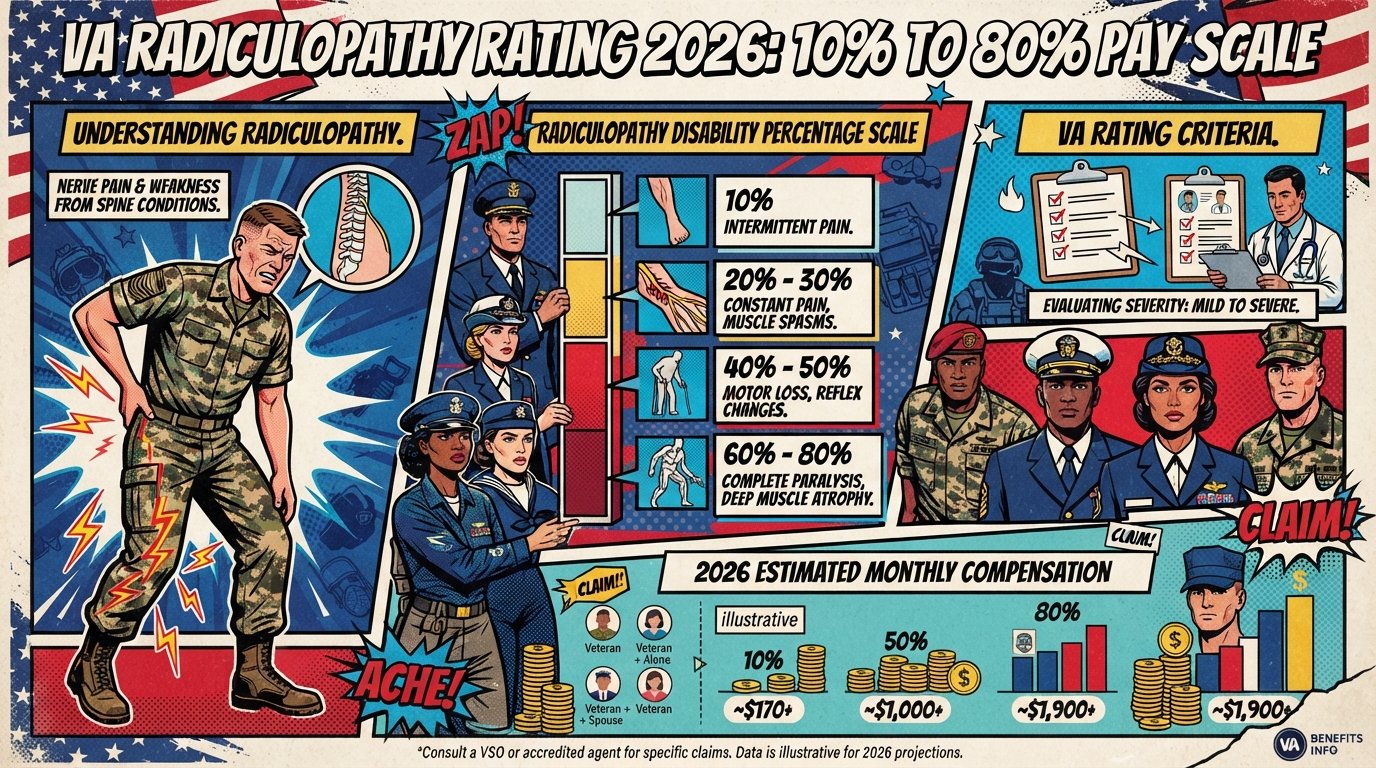
VA Radiculopathy Rating 2026: 10% to 80% Pay Scale
VA rates radiculopathy under 38 CFR § 4.124a as incomplete or complete paralysis of the affected peripheral nerve—most commonly Diagnostic Code 8520 (sciatic nerve) for the legs and 8510–8513 for the arms. Ratings run 10% (mild), 20% (moderate), 40% (moderately severe), 60% (severe with atrophy), and 80% (complete paralysis). It is rated separately from your spine condition.
Quick Facts
| Item | Details |
|---|---|
| Benefit | VA disability compensation for service-connected radiculopathy |
| Eligibility | Current diagnosis of radiculopathy linked to military service—directly, as a secondary condition, or as a presumptive condition |
| Rating authority | 38 CFR § 4.124a, Diseases of the Peripheral Nerves |
| Common diagnostic codes | DC 8520 (sciatic), DC 8510–8513 (upper radicular groups), DC 8521–8526 (other lower-extremity nerves), DC 8514–8516 (radial, median, ulnar) |
| Rating range | 0% to 80% per affected extremity |
| 2026 rate at 20% | $356.66/month (no dependents) |
| 2026 rate at 40% | $795.84/month (no dependents) |
| Application | VA Form 21-526EZ (original) or VA Form 20-0995 (supplemental claim) |
| Exam form | DBQ 21-0960C-10, Peripheral Nerves Conditions |
| Official agency | U.S. Department of Veterans Affairs (VA) |
| Updated For | 2026 rates effective December 1, 2025 (2.8% COLA) |
What Is Radiculopathy?
Radiculopathy is nerve-root compression or irritation at the point where a spinal nerve exits the spinal column. It produces pain, numbness, tingling, or weakness that follows a specific nerve pathway into an arm or leg. The most common veteran presentation is lumbar radiculopathy, commonly called sciatica, which radiates from the lower back down the leg.

VA Disability Combined Rating Calculator
Add each disability rating from your decision letter.

Estimate only. The VA makes the official rating decision. Not legal or financial advice, and not affiliated with the Department of Veterans Affairs.
Radiculopathy is not the same as peripheral neuropathy. Neuropathy is damage to nerves throughout the body, often from diabetes or toxic exposure. Radiculopathy has a specific spinal origin—a herniated disc, bone spur, or stenosis pressing on a nerve root. VA rates both under the same peripheral-nerve schedule, but the evidence and diagnostic codes differ.
Military service creates the conditions for radiculopathy: heavy lifting, ruck marching, body armor, parachute landings, vehicle vibration, and traumatic spine injuries. Those stresses produce disc herniations and spinal stenosis, which in turn compress nerve roots. Many veterans are service-connected for the back condition but never file for the radiculopathy—which is a separate, separately rated disability.
The Rule Most Veterans Miss: Radiculopathy Is Rated Separately From Your Back
VA must rate radiculopathy separately from the underlying spine condition. This is not pyramiding, and it is explicitly required by the rating schedule. Note 1 to the General Rating Formula for Diseases and Injuries of the Spine in 38 CFR § 4.71a directs raters to “evaluate any associated objective neurologic abnormalities … separately” under the appropriate diagnostic code. Radiculopathy is the most common such abnormality.
This means a single spine condition can generate three or more separate ratings:
The spine rating itself (for example, DC 5237 lumbar strain or DC 5243 intervertebral disc syndrome, rated on range of motion).
A left-extremity radiculopathy rating under the peripheral-nerve codes.
A right-extremity radiculopathy rating under the peripheral-nerve codes.
Separate ratings for any bowel or bladder involvement.
Army Fitness Test (AFT) Score Calculator
Formerly the ACFT. Five events, 500 points. Enter your results.
Estimate for training only. Points are interpolated from the official Army tables (effective 1 June 2025) and can differ by a few points. Your score of record comes from your unit graders. Official score tables (PDF). Not affiliated with the U.S. Army.
Why this is not pyramiding: 38 CFR § 4.14 prohibits rating the same disability twice. The spine formula measures orthopedic limitation of motion. The nerve codes measure neurologic impairment of a specific nerve in a specific limb. They are different manifestations, and the schedule intends separate evaluations.
If your decision letter folded your radiculopathy into your back rating without a separate evaluation, that is a rating error worth challenging.
The Rating Scale: 10% to 80% Per Limb
Radiculopathy is rated by the degree of paralysis of the affected nerve, from mild incomplete paralysis at 10% to complete paralysis at 80%. The schedule uses five compensable tiers, plus a 0% tier for diagnosed but minimal symptoms. The percentage applies per affected extremity—both legs means two separate ratings.
Lower Extremity: Diagnostic Code 8520 (Sciatic Nerve)
DC 8520 is the workhorse code for lumbar radiculopathy and sciatica. The tiers are:
| Rating | Criteria | 2026 Monthly (No Dependents) |
|---|---|---|
| 0% | Diagnosed and service-connected, but symptoms do not reach mild incomplete paralysis | $0 (establishes service connection for future increase) |
| 10% | Mild incomplete paralysis: intermittent radiating pain, occasional numbness or tingling, minor weakness, slightly diminished reflexes | $180.42 |
| 20% | Moderate incomplete paralysis: more frequent and intense pain, consistent numbness, measurable weakness, noticeably diminished reflexes, difficulty with long-distance walking | $356.66 |
| 40% | Moderately severe incomplete paralysis: severe and frequent pain often requiring medication, significant weakness affecting gait and balance, persistent numbness, difficulty with stairs or standing, possible developing foot drop | $795.84 |
| 60% | Severe incomplete paralysis with marked muscular atrophy | $1,435.02 |
| 80% | Complete paralysis: foot dangles and drops, no active movement of muscles below the knee, knee flexion weakened or lost | $2,102.15 |
Other lower-extremity nerve codes apply depending on which nerve root is affected: DC 8521 (common peroneal), DC 8524 (tibial), DC 8525 (posterior tibial), and DC 8526 (femoral). The sciatic code is used most often because it covers the largest and most commonly compressed pathway.
Upper Extremity: Cervical Radiculopathy (DC 8510–8513 and 8514–8516)
Cervical radiculopathy is rated under whichever code matches the affected nerve root and pattern:
| Diagnostic Code | Nerve or Group | Typical Level | Notes |
|---|---|---|---|
| DC 8510 | Upper radicular group | C5–C6 | Starts at 20% for mild incomplete paralysis—more favorable than individual nerve codes at the mild tier |
| DC 8511 | Middle radicular group | C7 | |
| DC 8512 | Lower radicular group | C8–T1 | |
| DC 8513 | All radicular groups | Multiple levels | |
| DC 8514 | Radial nerve | C5–C6 motor pattern | |
| DC 8515 | Median nerve | C6–C7 pattern | Starts at 10% for mild |
| DC 8516 | Ulnar nerve | C8–T1 |
Dominant-hand modifiers matter. Upper-extremity ratings under the individual nerve codes (8514–8516) carry separate rates for the dominant and non-dominant hand. Dominant-hand ratings are typically higher at each severity level. The radicular group codes (8510–8513) also distinguish dominant from minor extremity at the higher tiers.
The “Wholly Sensory” Cap
When radiculopathy is wholly sensory—pain, numbness, and tingling with no motor or reflex findings—VA caps the rating at mild or, at most, moderate. The regulation at 38 CFR § 4.124a states this directly.
That means 10% or 20% is the ceiling for a purely sensory presentation. To break above 20%, the record needs objective motor findings: measurable weakness on the 0–5 strength scale, diminished or absent deep tendon reflexes, or muscle atrophy. This is the single most important rule for veterans trying to understand why a painful radiculopathy claim landed at 10% or 20%.
2026 Compensation Rates for Radiculopathy
A radiculopathy rating pays the standard VA compensation rate for whatever combined rating it produces. The percentages below are the 2026 rates effective December 1, 2025, reflecting a 2.8% COLA. Rates of 30% and above increase with dependents.
| Combined Rating | Monthly (Veteran Alone) | Monthly (with Spouse) |
|---|---|---|
| 10% | $180.42 | — |
| 20% | $356.66 | — |
| 30% | $552.47 | $617.47 |
| 40% | $795.84 | $882.84 |
| 50% | $1,132.90 | $1,241.90 |
| 60% | $1,435.02 | $1,566.02 |
| 70% | $1,808.45 | $1,961.45 |
| 80% | $2,102.15 | $2,277.15 |
Example of how stacking works: A veteran with a 20% lumbar spine rating and mild bilateral radiculopathy rated 10% per leg does not receive 20 + 10 + 10 = 40%. VA combines ratings on a whole-person basis under 38 CFR § 4.25. The two 10% leg ratings combine to 19%; the bilateral factor under 38 CFR § 4.26 adds 10% of that value (1.9%), producing a 20.9% subtotal; combining that with the 20% spine rating produces roughly 36.7%, which rounds to **40%—$795.84/month**. The spine rating alone would have paid $356.66. Filing the radiculopathy more than doubled the payment.
The Bilateral Factor
When both lower extremities—or both upper extremities—have compensable ratings, the bilateral factor adds 10% of the combined value before the ratings are combined with the rest of the body. Raters sometimes miss this when entering each side separately. If you have radiculopathy in both legs, verify that the bilateral factor was applied.
Direct, Secondary, and Presumptive Service Connection
Radiculopathy can be service-connected through three pathways. The evidence you need depends on which pathway applies.
Direct Service Connection
Direct service connection requires a current diagnosis, an in-service event or injury, and a medical nexus linking the two. A documented back injury during service—a fall, a lift, a vehicle accident—followed by a current diagnosis of radiculopathy can support a direct claim. The strongest direct claims include in-service treatment records, a continuity of symptoms after discharge, and imaging or EMG findings.
Secondary Service Connection
Secondary service connection is the most common pathway for radiculopathy, and the most underused. If a service-connected back or neck condition caused or worsened the radiculopathy, the radiculopathy is separately compensable as a secondary condition. A veteran service-connected for lumbar degenerative disc disease who later develops sciatica has a secondary claim—the disc disease is the cause, and the radiculopathy is the effect.
This matters because many veterans are already service-connected for the spine and assume the nerve pain is “part of” that rating. It is not. The spine rating compensates limitation of motion; the radiculopathy rating compensates nerve impairment. Filing the secondary claim adds to the combined rating without reducing the spine rating.
Presumptive Service Connection and the PACT Act
The PACT Act does not create a stand-alone presumptive for radiculopathy, but it expands the underlying conditions that can cause it. The PACT Act added numerous presumptive conditions for toxic exposure—including hypertension for Agent Orange exposure, and a range of respiratory and other conditions for burn-pit and other exposures. If a presumptive condition causes or worsens radiculopathy, the radiculopathy can be claimed as secondary to that presumptive condition.
Agent Orange–related early-onset peripheral neuropathy is a separate presumptive condition for Vietnam-era veterans. Diabetic neuropathy secondary to Agent Orange–presumed diabetes is another pathway. These are neuropathy rather than radiculopathy, but they are rated under the same peripheral-nerve schedule and are frequently confused.
How to Apply: Forms and Steps
The application for an original radiculopathy claim is VA Form 21-526EZ. If you are adding radiculopathy to an existing service-connected condition, you can file VA Form 20-0995 as a supplemental claim. Both can be filed online through VA.gov, by mail, by fax, or with an accredited representative.
Step-by-Step
Confirm your diagnosis. A current diagnosis of radiculopathy—from a VA or private provider—is the foundation. The diagnosis should identify the affected nerve root or nerve.
Gather objective evidence. The strongest files include an EMG/nerve conduction study identifying the affected nerve and severity, an MRI showing the structural cause (herniated disc, foraminal stenosis) at the level matching your symptoms, and treatment records documenting persistent symptoms.
Document the neurologic exam. Reflex findings (diminished or absent Achilles or patellar reflex), dermatomal sensory loss, and motor weakness on the 0–5 scale are the findings that drive severity tiers above 10%.
Write a lay statement. Describe the frequency, triggers, and functional impact of your symptoms—how far you can walk, whether you can sit or stand, what you cannot lift or grip. VA must consider lay evidence under 38 CFR § 4.3.
File the claim. Use VA Form 21-526EZ for an original claim or VA Form 20-0995 for a supplemental claim. Submit all evidence at once through the Fully Developed Claim program for faster processing.
Attend the C&P exam. The examiner will complete DBQ 21-0960C-10, Peripheral Nerves Conditions (Not Including Diabetic Sensory-Motor Peripheral Neuropathy). This form decides your rating.
Review the decision. Check that the decision letter assigns a separate radiculopathy rating with the correct diagnostic code and severity tier—and that the bilateral factor was applied if both sides are affected.
What the C&P Examiner Measures on DBQ 21-0960C-10
The peripheral-nerve DBQ captures the objective findings that determine your severity tier. Understanding what the examiner records helps you prepare accurately—not to exaggerate, but to make sure real findings are documented.
The examiner records:
Which peripheral nerve or nerve root is affected, and which extremity.
Whether paralysis is incomplete or complete, and the severity: mild, moderate, moderately severe, or severe with atrophy.
Deep tendon reflexes (knee and ankle jerk), graded and compared side to side.
Sensory exam by light touch and pinprick, mapped by dermatome.
Muscle strength on the 0–5 scale, and any atrophy.
Whether the involvement is wholly sensory, which caps the rating at mild or moderate.
The findings that move a rating from 10% to 20% or 40% are objective: a diminished Achilles or patellar reflex at 1+, strength at 4/5, or objective dermatomal numbness. A normal neurologic exam with only reported pain will usually produce a 10% or 0% rating, regardless of how severe the pain feels.
Common Mistakes That Cap Radiculopathy Ratings
The most common radiculopathy mistakes are filing only the back claim, failing to document objective neurologic findings, and allowing the rater to absorb the nerve symptoms into the spine rating. Each is preventable.
Mistake 1: Filing only the spine claim
Most veterans file for the back or neck and stop there. The radiculopathy is a separate claim with a separate rating. If you have radiating symptoms, file for the nerve condition explicitly.
Mistake 2: No EMG or detailed neurologic exam
Raters look for objective findings. An EMG or nerve conduction study is not required, but it moves a claim from arguable to obvious. A dedicated neurologic exam documenting reflex loss and dermatomal sensory loss is the next best evidence.
Mistake 3: Accepting “mild” when the record supports “moderate”
Examiners sometimes default to “mild” even when the record shows persistent numbness, measurable weakness, and reflex loss. Under 38 CFR § 4.7, when the disability picture more nearly approximates the higher tier, the higher tier applies. A partially met tier is not automatically the lower tier.
Mistake 4: Ignoring the bilateral factor
If both legs or both arms are affected, the bilateral factor under 38 CFR § 4.26 adds 10% of the combined value of the paired ratings. Check that it was applied.
Mistake 5: Not claiming the radiculopathy as secondary
If you are already service-connected for the spine, the radiculopathy is a secondary claim. Filing it does not require reopening the spine rating; it adds a new disability to the combined rating.
Mistake 6: Overlooking the “wholly sensory” cap
If your radiculopathy is purely sensory, the ceiling is 20%. To exceed it, the record needs motor findings. If those findings exist but were not recorded, a supplemental claim with a private DBQ or a new neurologic exam can correct the record.
Appeals and Increases
If VA denies the claim or assigns a rating that does not match the evidence, you have three appeal lanes. The decision letter explains which applies.
Supplemental Claim (VA Form 20-0995): File this if you have new and relevant evidence—a private DBQ, an EMG, an MRI, or a medical nexus opinion. This is the fastest lane for adding evidence.
Higher-Level Review (VA Form 20-0996): Ask for a fresh review by a senior rater based on the existing record. No new evidence is allowed in this lane.
Board of Veterans’ Appeals (VA Form 10182): Appeal directly to the Board. This takes longer but allows a hearing and a full de novo review.
For an increase, file a supplemental claim with evidence showing that your symptoms now meet the next severity tier—for example, that your radiculopathy has progressed from moderate to moderately severe, or that weakness and atrophy have developed. A new EMG or a detailed neurologic exam is the strongest evidence for an increase.
State Differences and Other Benefits
VA disability compensation is federal and does not vary by state, but state-level benefits can stack on top of a VA rating. Many states offer property tax exemptions, vehicle registration discounts, tuition waivers, and hunting or fishing license benefits to veterans with service-connected ratings. The specific rating thresholds vary by state.
Radiculopathy ratings also count toward eligibility for other VA benefits. A combined rating of 30% or higher triggers additional dependent compensation. A 70% or higher rating can support TDIU if the radiculopathy prevents substantially gainful employment. And a service-connected radiculopathy can support a VA home loan and other benefits that require a compensable service-connected disability.
Veterans should check their state veterans affairs office or a county veterans service officer for state-specific benefits that may apply at their rating level.
Common Questions
What is the VA rating for radiculopathy?
Radiculopathy is rated 10% for mild, 20% for moderate, 40% for moderately severe, 60% for severe with marked atrophy, and 80% for complete paralysis under 38 CFR § 4.124a. The rating is assigned per affected extremity. A 0% rating is possible for diagnosed but minimal symptoms.
What diagnostic code is used for radiculopathy?
The most common code is DC 8520 (sciatic nerve) for lower-extremity radiculopathy. Cervical radiculopathy uses DC 8510–8513 for the upper radicular groups, or DC 8514–8516 for the radial, median, and ulnar nerves. Other lower-extremity nerves use DC 8521–8526.
Is radiculopathy rated separately from my back condition?
Yes. Note 1 to the spine rating formula in 38 CFR § 4.71a requires VA to evaluate associated neurologic abnormalities separately. The spine rating measures range of motion; the radiculopathy rating measures nerve impairment. This is not pyramiding.
Can I get radiculopathy as a secondary condition?
Yes. If a service-connected back or neck condition caused or worsened the radiculopathy, it can be service-connected on a secondary basis. This is one of the most common and most underused pathways to a higher combined rating.
Why is my radiculopathy rated only 10%?
A 10% rating reflects mild incomplete paralysis. The most common reason for a low rating is that the exam documented only sensory symptoms. The “wholly sensory” rule caps the rating at mild or moderate. To exceed 20%, the record needs objective motor findings: weakness, reflex loss, or atrophy.
Does radiculopathy qualify for the bilateral factor?
Yes, if both sides are affected. When both lower extremities or both upper extremities have compensable radiculopathy ratings, the bilateral factor under 38 CFR § 4.26 adds 10% of the combined value of the paired ratings before they are combined with the rest of the body.
What evidence do I need for a radiculopathy claim?
The strongest evidence is a current diagnosis, an EMG/nerve conduction study, an MRI showing the structural cause at the matching level, neurologic exam findings (reflexes, sensory loss, weakness), treatment records documenting persistence, and a lay statement describing functional impact. A medical nexus opinion is needed for direct and secondary claims.
What is DBQ 21-0960C-10?
It is VA’s Peripheral Nerves Conditions DBQ, used at the C&P exam to record which nerve is affected, whether paralysis is incomplete or complete, the severity tier, reflex findings, sensory findings, and muscle strength. The completed DBQ drives the rating.
Can radiculopathy be rated at 0%?
Yes. VA can grant service connection at 0% when radiculopathy is diagnosed and service-connected but symptoms do not reach the mild incomplete paralysis threshold. A 0% rating pays nothing but establishes the condition for future increases.
Is radiculopathy the same as peripheral neuropathy?
No. Radiculopathy is nerve-root compression at the spine, producing symptoms in a specific dermatomal pattern. Peripheral neuropathy is damage to nerves throughout the body, often from diabetes or toxic exposure. Both are rated under 38 CFR § 4.124a, but the diagnostic codes and evidence differ.
Does the PACT Act help with radiculopathy?
The PACT Act does not create a stand-alone presumptive for radiculopathy, but it expands the underlying conditions that can cause it. If a presumptive condition—such as Agent Orange–related hypertension or another PACT Act condition—causes or worsens radiculopathy, the radiculopathy can be claimed as secondary.
How long does a radiculopathy claim take?
Processing times vary, but the Fully Developed Claim program—where all evidence is submitted at once—is the fastest path. A supplemental claim with a private DBQ and EMG can also move faster than an appeal. Check VA.gov for current average processing times.
Key Takeaways
VA rates radiculopathy under 38 CFR § 4.124a at 10%, 20%, 40%, 60%, or 80% per affected extremity, based on the degree of incomplete or complete paralysis.
DC 8520 is the most common code for lower-extremity radiculopathy; DC 8510–8513 and 8514–8516 cover cervical radiculopathy, with dominant-hand modifiers.
Radiculopathy is rated separately from the spine condition under Note 1 to 38 CFR § 4.71a. Filing both is not pyramiding.
The “wholly sensory” rule caps purely sensory radiculopathy at 10% or 20%. Motor findings—weakness, reflex loss, atrophy—are required to exceed 20%.
Secondary service connection is the most common pathway: a service-connected back or neck condition that causes radiculopathy supports a separate rating.
The bilateral factor under 38 CFR § 4.26 applies when both legs or both arms are affected, adding 10% of the combined value of the paired ratings.
The DBQ that decides the rating is 21-0960C-10, Peripheral Nerves Conditions. Reflex, sensory, and strength findings on that form drive the severity tier.
EMG/nerve conduction studies and MRI are not required but move a claim from arguable to obvious.
A 40% combined rating pays $795.84/month** in 2026; a **20% rating pays $356.66/month.
Supplemental claims, Higher-Level Review, and Board appeals are the three lanes for challenging a denial or low rating.
Official Resources
VA disability compensation rates: va.gov/disability/compensation-rates
38 CFR § 4.124a – Diseases of the Peripheral Nerves: ecfr.gov (Title 38, Part 4, Subpart B)
38 CFR § 4.71a – Spine rating formula and Note 1: ecfr.gov
VA Form 21-526EZ – Application for Disability Compensation: va.gov/find-forms/about-form-21-526ez
VA Form 20-0995 – Supplemental Claim: va.gov/find-forms/about-form-20-0995
VA Form 20-0996 – Higher-Level Review: va.gov/find-forms/about-form-20-0996
VA Form 10182 – Board Appeal: va.gov/find-forms/about-form-10182
VA DBQ 21-0960C-10 – Peripheral Nerves Conditions: va.gov
VA disability appeals: va.gov/decision-reviews
🇺🇸 IMPORTANT DISCLAIMER – Veterans Benefits Information
This site provides general information about U.S. Department of Veterans Affairs (VA) benefits for educational and informational purposes only.
- Not Official: We are NOT affiliated with, endorsed by, or connected to the U.S. Department of Veterans Affairs (VA), the Veterans Benefits Administration (VBA), the Veterans Health Administration (VHA), or any other government agency.
- No Legal/Financial Advice: The content on this website is for informational purposes only and does not constitute legal, financial, or medical advice. VA benefits rules change frequently – always consult with an accredited Veterans Service Officer (VSO) or a qualified professional for your specific situation.
- Official Sources: For official, binding information and to apply for benefits, always visit official .gov websites: VA.gov, Benefits.VA.gov, or SSA.gov.
- No Data Collection: This site does not collect, store, or process any personal information. It does not have login forms, contact forms, or any system to capture user data. We never ask for your Social Security Number, bank details, or any personal information.
- 🚨 Scam Alert: The VA and other government agencies never charge fees for benefit applications. If anyone asks for money to "process" your VA claim, it is a scam. Report it to the VA Office of Inspector General at VA.gov/OIG.
- Advertising: This site uses third-party advertising (Adsterra) to cover operational costs. We do not endorse or guarantee any products or services advertised.
📌 Information provided as of June 2026. Always verify current eligibility and rules with official .gov sources.
This site is not affiliated with the U.S. Department of Veterans Affairs or any government agency. All information is for educational purposes only. Please visit VA.gov for official information.
