
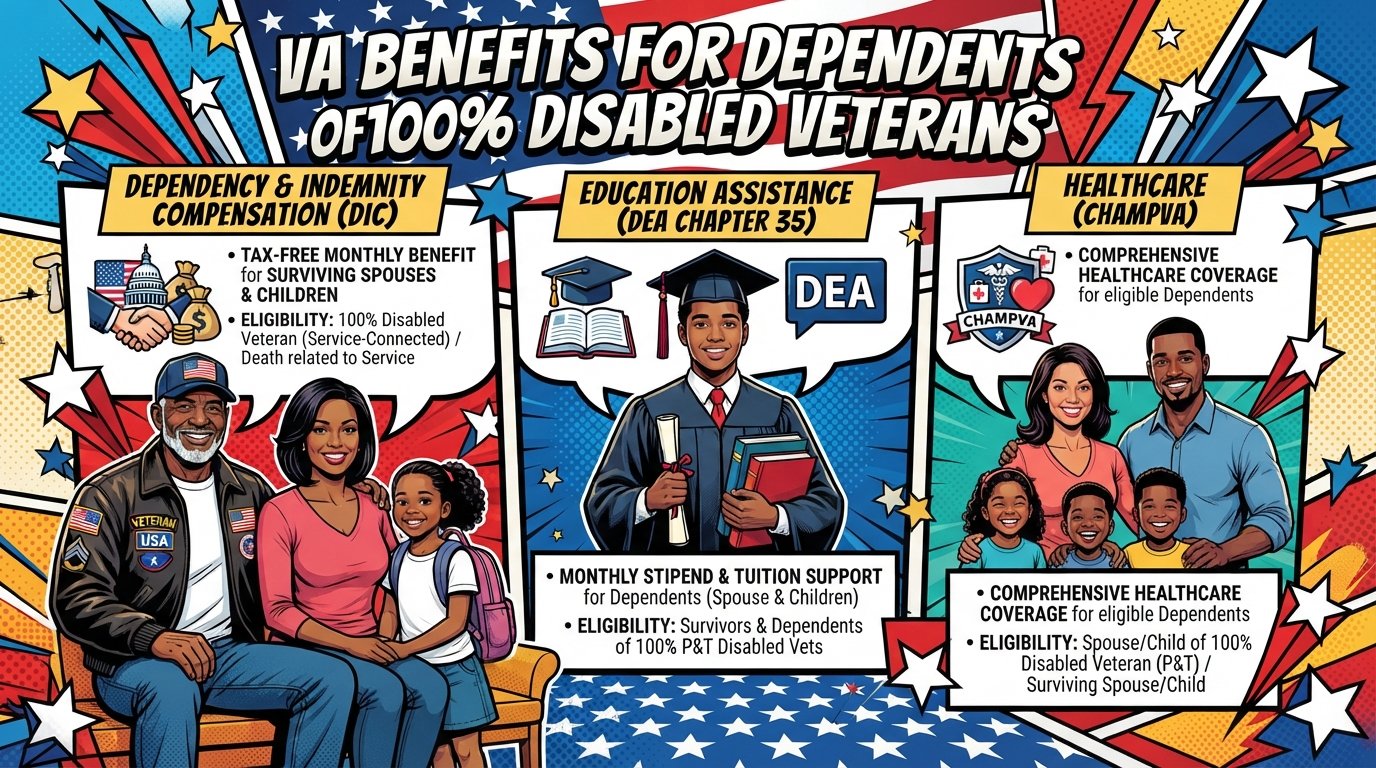
100% VA Disability Benefits for Dependents: 2026 Complete Guide
Dependents of a veteran with a 100% VA disability rating can receive added monthly compensation, CHAMPVA health coverage, Chapter 35 education benefits, commissary and exchange privileges, and state property tax relief. The most valuable family benefits usually require Permanent and Total (P&T) status, not just a 100% payment rate. Apply for added pay with VA Form 21-686c.
Quick Facts
| Item | Details |
|---|---|
| Benefit | Federal and state benefits for dependents of a veteran rated 100% disabled by VA |
| Eligibility | Legal spouse; unmarried children under 18; children 18–23 in school; helpless children; dependent parents. Veteran generally needs 30%+ for added monthly pay, and P&T for CHAMPVA and Chapter 35 |
| Application | VA Form 21-686c for spouse and children; VA Form 21-674 for schoolchildren 18–23; VA Form 21-509 for parents; separate applications for CHAMPVA and Chapter 35 |
| Processing Time | Dependency claims commonly 100–150 days; DIC claims averaged about 73 days in 2026 |
| Official Agency | U.S. Department of Veterans Affairs (VA) |
| Required Forms | 21-686c, 21-674, 21-509, 10-10d (CHAMPVA), 22-5490 (DEA) |
| Updated For | 2026 rates effective December 1, 2025, after a 2.8% COLA |
What “100 VA Disability” Means for Dependents
A 100% VA disability rating means VA has evaluated a veteran’s service-connected conditions at the maximum scheduler level, but the dependent benefits attached to that rating depend on how the veteran reached 100%. There are three paths, and the differences matter enormously for families.

VA Disability Combined Rating Calculator
Add each disability rating from your decision letter.

Estimate only. The VA makes the official rating decision. Not legal or financial advice, and not affiliated with the Department of Veterans Affairs.
100% schedular. VA combines the veteran’s service-connected conditions to reach 100% under its rating schedule. The veteran receives the 100% payment rate and dependent add-ons, but may still face routine future examinations unless VA also grants P&T status.
TDIU (Total Disability Individual Unemployability). VA pays the veteran at the 100% rate because service-connected conditions prevent substantially gainful employment. TDIU pays the same monthly compensation as schedular 100%, including dependent add-ons, but it does not automatically unlock CHAMPVA or Chapter 35 for dependents.
Permanent and Total (P&T). P&T means VA considers the disability permanent and not expected to improve. VA stops scheduling routine future exams, and the veteran’s dependents gain access to the highest-value family benefits, including CHAMPVA and Chapter 35 DEA.
Which 100% Status Unlocks Which Dependent Benefit?
| Benefit | 100% Schedular (not P&T) | TDIU (not P&T) | 100% P&T |
|---|---|---|---|
| Added monthly compensation | Yes | Yes | Yes |
| CHAMPVA health coverage | No | No | Yes |
| Chapter 35 DEA education | No | No | Yes |
| Commissary and exchange | Yes | Yes | Yes |
| State property tax relief | Some states | Some states | Usually yes |
| DIC survivor eligibility | Conditional | Conditional | Conditional |
The practical takeaway: if a veteran has a 100% payment rate but not P&T, the family should still apply for added monthly compensation, commissary privileges, and any state benefits that accept a 100% rating. But CHAMPVA and Chapter 35 will generally be unavailable until VA grants P&T status.
Added Monthly Compensation for a Spouse, Children, and Parents
Army Fitness Test (AFT) Score Calculator
Formerly the ACFT. Five events, 500 points. Enter your results.
Estimate for training only. Points are interpolated from the official Army tables (effective 1 June 2025) and can differ by a few points. Your score of record comes from your unit graders. Official score tables (PDF). Not affiliated with the U.S. Army.
VA pays additional monthly compensation for dependents once a veteran’s combined rating reaches 30% or higher. At the 100% rate, those add-ons can increase a family’s tax-free monthly payment by several hundred dollars or more.
The 30% threshold is absolute. A veteran rated 10% or 20% receives the same amount whether single or supporting a spouse and four children. At 30% and above, VA adds compensation for each qualifying dependent, and the amounts grow as the rating rises toward 100%.
2026 Monthly Rates at 100% With Dependents
| Dependent Status | Monthly Rate (2026) |
|---|---|
| Veteran alone | $3,938.58 |
| Veteran + spouse | $4,158.17 |
| Veteran + 1 child (no spouse) | $4,085.43 |
| Veteran + spouse + 1 child | $4,318.99 |
| Veteran + 1 dependent parent | $4,114.82 |
| Veteran + 2 dependent parents | $4,291.06 |
| Each additional child under 18 | +$109.11 |
| Each schoolchild 18–23 | +$352.45 |
| Spouse needing Aid and Attendance | +$201.41 |
Rates effective December 1, 2025, for 2026. Source: VA compensation tables and 2026 dependent-rate analyses.
These amounts are added to the veteran’s base rate, not paid separately. A veteran with a spouse and one child receives $4,318.99 per month, tax-free at the federal level. Each additional child under 18 adds $109.11 per month at the 100% rate. A child between 18 and 23 who is enrolled in an approved school program adds $352.45 per month, a higher amount because school-age dependents require separate certification.
Who Qualifies as a Dependent
VA recognizes the following categories for added compensation:
Spouse. A legal spouse, including same-sex and common-law marriages recognized for VA purposes.
Child under 18. Biological, adopted, or stepchild, unmarried.
Schoolchild 18–23. Unmarried child enrolled in an approved school program, full-time or part-time.
Helpless child. A child who became permanently incapable of self-support before age 18 can remain a dependent past the usual age limits.
Dependent parent. A parent in the veteran’s direct care whose income and net worth are below VA limits.
A spouse receiving Aid and Attendance (A&A) adds $201.41 per month at the 100% rate. A helpless child remains eligible for as long as the incapacity continues.
How to Add Dependents: Forms and Online Application
Use VA Form 21-686c, Application Request to Add and/or Remove Dependents, to add a spouse or a child under 18. This is the core dependency form, and it can be filed online through VA.gov or by mail.
Use VA Form 21-674, Request for Approval of School Attendance, when claiming a child who is 18 to 23 and attending school. Without this form, VA will stop the dependent add-on when the child turns 18.
Use VA Form 21-509, Statement of Dependency of Parent(s), to add a dependent parent. Parents must meet income and net-worth tests.
What to submit with VA Form 21-686c:
Marriage certificate or VA-recognized proof of marriage.
Birth certificate or adoption decree for each child.
Social Security numbers for the spouse and children.
School certification (VA Form 21-674) for children 18–23.
Parent income and net-worth information for a dependent-parent claim.
Effective Dates and Back Pay
The effective date for added dependent compensation is generally the latest of the date VA receives the claim, the date the dependency arose, or the date the veteran’s rating reached the 30% threshold. If a veteran submits a dependency claim within one year of a qualifying life event, VA may pay back to the event date. Delays beyond that window can cost months of retroactive pay.
A common and expensive mistake is assuming VA will automatically add a spouse or child after a marriage or birth. VA does not automatically pull dependency information from the Defense Department’s DEERS database. The veteran must file a separate dependency claim with VA.
CHAMPVA Health Coverage for Dependents
CHAMPVA is the Civilian Health and Medical Program of the Department of Veterans Affairs. It provides health coverage to the spouse and dependent children of a veteran rated permanently and totally disabled from a service-connected disability, or to survivors of a veteran who died from a service-connected condition. Dependents must not be eligible for TRICARE.
Who Qualifies
CHAMPVA eligibility turns on P&T status, not merely the 100% payment rate. The spouse or dependent child of a veteran rated 100% P&T qualifies. Surviving spouses and dependent children of a veteran who died from a service-connected disability also qualify. A “permanent and total disability” is one VA has rated 100% disabling and does not expect to improve.
Dependent children generally remain eligible until age 18, or until age 23 if enrolled in school. A child who marries before age 18 may lose eligibility, and a surviving spouse who remarries before age 55 generally loses CHAMPVA, though eligibility can be restored if the remarriage ends.
Why CHAMPVA Matters
CHAMPVA is comprehensive health insurance for families who cannot use TRICARE. It covers hospital care, outpatient services, prescriptions, mental health care, and preventive services, with cost shares and annual catastrophic caps. For a family with no other employer-sponsored coverage, CHAMPVA can be the difference between insured and uninsured.
What to Do Next
Apply for CHAMPVA with VA Form 10-10d. Newborn children must be added to CHAMPVA promptly; VA cannot pay medical claims for a newborn until the child is enrolled. The veteran should first ensure the child is added as a VA dependent, then submit the CHAMPVA application.
Chapter 35 DEA Education Benefits for Spouses and Children
The Survivors’ and Dependents’ Educational Assistance program, also called Chapter 35 or DEA, provides up to 36 months of education and training benefits to the spouse and dependent children of a veteran who is permanently and totally disabled from a service-connected disability, or who died from a service-connected disability.
Eligibility
For a 100% P&T veteran’s family, the spouse and each dependent child may qualify. Children generally must be between 18 and 26, and spouses have their own eligibility window. A child who serves on active duty cannot use DEA while on active duty, and a dishonorable discharge disqualifies a child from using the benefit after leaving service.
2025–2026 Chapter 35 Rates
| Enrollment Status | Monthly Rate |
|---|---|
| Full-time | $1,574.00 |
| ¾-time | $1,244.00 |
| ½-time | $912.00 |
| Less than ½-time, more than ¼-time | $912.00 or tuition and fees, whichever is less |
| ¼-time or less | $393.50 or tuition and fees, whichever is less |
Rates effective October 1, 2025, through September 30, 2026.
Why Chapter 35 Matters
DEA is a monthly education stipend paid directly to the dependent. It can be used for college, trade school, apprenticeship programs, and some licensing and certification tests. The benefit does not have to be repaid, and it can be combined with other financial aid in many cases. For a spouse or child planning college or job training, Chapter 35 can be worth tens of thousands of dollars over 36 months.
How to Apply
Apply with VA Form 22-5490, Application for Survivors’ and Dependents’ Educational Assistance. Apply online through VA.gov or submit by mail. The dependent should apply before enrolling or shortly after enrollment to avoid delayed payments. VA pays the stipend monthly, and the school must certify enrollment.
State Property Tax Exemptions and Other State Benefits
Most states offer a property tax exemption or credit for veterans rated 100% disabled, and many extend the benefit to a surviving spouse. The exemption is not automatic. The veteran or surviving spouse must apply through the county tax assessor or state veterans agency and provide VA documentation.
State-by-State Examples
| State | 100% Disability Property Tax Benefit |
|---|---|
| Texas | Full exemption on primary residence for 100% disabled veterans |
| Florida | Full exemption for 100% permanently and totally disabled veterans |
| Virginia | Full exemption on principal residence plus up to one acre for 100% P&T veterans |
| Ohio | Exemption up to $50,000 of market value |
| California | Basic exemption of $180,671 for 100% disabled veterans; low-income exemption higher |
| Georgia | Exemption of $85,645 or more |
| Arizona | $3,000–$4,000 reduction |
State rules change frequently. Verify current amounts with the county assessor or state veterans agency.
Other State Benefits to Check
State benefits vary widely but commonly include:
Free or reduced tuition at state colleges for dependents of 100% disabled veterans.
Free hunting and fishing licenses.
Free state park admission.
Vehicle registration and license plate fee reductions.
State income tax exemptions on military retirement or disability income.
Surviving-spouse property tax relief.
These benefits are not administered by VA. The veteran or family must apply through the state or county agency that manages each program. A state veterans service officer can identify the correct office.
Commissary, Exchange, and Military ID Privileges
Veterans rated 100% disabled by VA, including those paid at the 100% rate through TDIU, are eligible for commissary, exchange, and Morale, Welfare, and Recreation privileges. Their eligible dependents can receive military ID cards for the same privileges.
Who Qualifies
The veteran must be honorably discharged and rated 100% service-connected disabled or 100% unemployable due to service-connected conditions. Eligible dependents include the spouse and unmarried children who meet the age and dependency rules. The veteran and dependents must be enrolled in DEERS and obtain ID cards through a RAPIDS office.
What to Bring to DEERS
VA rating decision or commissary/exchange eligibility letter.
DD-214 or other proof of honorable discharge.
Marriage certificate for the spouse.
Birth certificates for children.
Social Security cards.
Two forms of government-issued ID, one with a photo.
Dependents of 100% disabled veterans receive ID cards for commissary, exchange, and MWR privileges only. These cards do not provide TRICARE health coverage.
Survivor Benefits: DIC and Other Protections
Dependency and Indemnity Compensation (DIC) is a tax-free monthly benefit for surviving spouses, dependent children, and dependent parents of service members who died on active duty or veterans who died from a service-connected condition. A veteran’s 100% P&T rating can support a DIC claim if the service-connected condition caused or contributed to death.
2026 DIC Rates
| Survivor Category | Monthly Amount |
|---|---|
| Surviving spouse, base rate | $1,699.36 |
| Each dependent child under 18 | +$421.00 |
| 8-year provision (spouse married 8 years to totally disabled veteran) | +$360.85 |
| Transitional benefit, first two years | +$359.00 |
| Aid and Attendance for surviving spouse | +$421.00 |
Rates effective December 1, 2025.
A surviving spouse may also qualify for the 8-year provision if the veteran had a totally disabling rating for at least eight full years before death and the spouse was married to the veteran for those same eight years. The transitional benefit adds $359.00 per month for the first two years after the veteran’s death when there is at least one child under 18 on the award.
Other Survivor Protections
Survivors’ Pension. A needs-based monthly benefit for low-income surviving spouses and children of deceased wartime veterans.
VA home loan benefits. Surviving spouses of veterans who died from service-connected causes may be eligible for a VA-backed home loan.
Burial and memorial benefits. VA may pay a burial allowance, provide a headstone or marker, and issue a Presidential Memorial Certificate.
Education benefits. Chapter 35 DEA remains available to eligible survivors.
Survivors should apply for DIC with VA Form 21P-534EZ and submit a copy of the death certificate, marriage certificate, and medical evidence linking the veteran’s death to service. An accredited veterans service officer can help assemble the claim.
How to Apply: Step-by-Step
Step 1: Confirm the veteran’s rating and P&T status. Review the VA rating decision letter. Look for the phrase “permanent and total” or “P&T.” If the letter does not state P&T, the family may still qualify for added monthly compensation but not for CHAMPVA or Chapter 35.
Step 2: Gather dependency documents. Marriage certificate, birth certificates, adoption decrees, school enrollment certification, Social Security numbers, and parent income information.
Step 3: File VA Form 21-686c for a spouse and children under 18. File online at VA.gov or mail the form to the VA claims intake center. Include all supporting documents.
Step 4: File VA Form 21-674 for schoolchildren 18–23. Submit school certification each time VA requests it. Without this form, the add-on stops at age 18.
Step 5: File VA Form 21-509 for a dependent parent. Include income and net-worth documentation. Parents must meet VA’s dependency tests.
Step 6: Apply separately for CHAMPVA and Chapter 35 if the veteran is P&T. CHAMPVA uses VA Form 10-10d; Chapter 35 uses VA Form 22-5490. These are separate from the dependency claim and are not automatic.
Step 7: Apply for state benefits through the state or county. Property tax exemptions, tuition waivers, and vehicle benefits each have their own application. A state veterans service officer can provide the correct forms.
Step 8: Track the claim and respond to VA requests. VA may ask for additional evidence. Missing a request can delay or deny the claim. Check VA.gov or call VA at 1-800-827-1000 for status updates.
Processing Times and Payment Dates
Dependency claims commonly take 100 to 150 days, though claims filed with a complete VA Form 21-686c and all supporting documents may process faster. DIC claims averaged about 73 days in 2026, a significant improvement from prior years.
VA disability compensation is paid on the first business day of each month for the prior month. For example, the February 1 payment covers January. If the first falls on a weekend or holiday, VA pays on the preceding business day.
Dependents added to an existing award may see retroactive pay deposited separately from the regular monthly payment. The retroactive amount covers the period from the effective date to the date VA processed the dependency change.
Appeals and Fixing Dependent Award Errors
If VA denies a dependency claim or assigns the wrong effective date, the veteran or survivor has three main appeal options, generally within one year of the decision letter.
Supplemental Claim (VA Form 20-0995). Use this option when new and relevant evidence is available, such as a missing marriage certificate, birth certificate, or school certification. A supplemental claim preserves the original effective date if filed within one year.
Higher-Level Review (VA Form 20-0996). Use this option when the evidence is already complete but the veteran believes VA made an error in applying the law or evaluating the facts. A higher-level reviewer takes a fresh look at the same record.
Board Appeal (VA Form 10182). Use this option to have a Veterans Law Judge review the case. A Board Appeal can include a hearing or be decided on the written record. The Board appeal deadline is generally one year from the decision, but some contested claims require filing within 60 days.
Dependency effective-date errors are common when a veteran married or had a child before reaching the 30% threshold. VA may only pay the add-on from the date the rating reached 30%, not the date of the marriage or birth, unless the claim was filed within the correct window. An accredited representative can review the decision and identify the strongest appeal lane.
Common Mistakes That Cost Families Money
Assuming VA will add dependents automatically. DEERS and VA compensation are separate systems. A marriage certificate filed with the Defense Department does not update the VA award.
Missing the school certification deadline. When a child turns 18, VA stops the dependent add-on unless the veteran files VA Form 21-674. Families that miss the deadline lose months of compensation.
Filing the wrong form. VA Form 21-686c covers a spouse and children under 18. A child 18–23 in school needs VA Form 21-674. A dependent parent needs VA Form 21-509. Filing the wrong form delays the claim or causes a denial.
Waiting too long to file. Delayed dependency claims can lose retroactive pay. Filing within one year of a qualifying life event generally protects the earliest possible effective date.
Forgetting to remove a former spouse after divorce. Continuing to receive dependent pay for a former spouse creates an overpayment debt that VA will recover from future payments. Report the divorce with VA Form 21-686c promptly.
Not checking P&T status before applying for CHAMPVA or Chapter 35. A 100% payment rate without P&T does not qualify dependents for CHAMPVA or DEA. Families that submit these applications prematurely may receive a denial that could have been avoided by first requesting P&T review.
Recent Rule Changes and What’s New for 2026
The 2026 COLA is 2.8%, effective December 1, 2025. The 100% veteran-alone rate rose from $3,831.30 in 2025 to **$3,938.58** in 2026, an increase of $107.28 per month. Dependent add-on amounts increased proportionally.
VA has also reduced processing times for dependency and survivor claims. Dependency claims are increasingly processed through VA’s Rules-Based Processing System, which automates parts of the dependency workload. DIC claims averaged about 73 days in 2026, down from more than 160 days in prior years.
P&T status remains the key gate for family benefits. Veterans who reach a 100% payment rate through TDIU but do not have P&T should ask their accredited representative whether the evidence supports a P&T request. A P&T grant can unlock CHAMPVA, Chapter 35, and broader state property tax relief for the entire family.
Common Questions
Does a 100% VA disability rating automatically give dependents benefits?
No. The veteran must file a dependency claim with VA using VA Form 21-686c. CHAMPVA and Chapter 35 require separate applications, and the veteran generally must have P&T status for those programs.
At what rating do dependents start adding money to the VA check?
Dependents add money at a combined rating of 30% or higher. At 10% or 20%, the veteran receives the same amount whether single or married.
How much does a spouse add at 100% disability in 2026?
A spouse adds enough to raise the veteran-alone rate of $3,938.58 to **$4,158.17** per month. The exact added amount is $219.59 per month.
How much does each child add at 100%?
Each additional child under 18 adds $109.11** per month at the 100% rate. A schoolchild 18–23 adds **$352.45 per month. The first child’s amount is built into the spouse-and-child table rate.
Can dependents get health insurance through VA?
Yes, if the veteran is rated 100% Permanent and Total. CHAMPVA provides health coverage to the spouse and dependent children who are not eligible for TRICARE.
How long do dependents receive Chapter 35 education benefits?
Up to 36 months of education or training benefits. Children generally must be 18–26, and spouses have their own eligibility window.
Do dependents qualify for property tax exemptions?
Many states offer property tax relief to 100% disabled veterans and, in some cases, surviving spouses. The benefit is administered by the state or county, not VA, and requires a separate application.
What happens to dependent benefits if the veteran dies?
Survivors may qualify for DIC, Survivors’ Pension, Chapter 35, and other survivor benefits. DIC is a tax-free monthly payment for eligible surviving spouses, children, and parents.
Can a surviving spouse keep CHAMPVA after remarrying?
A surviving spouse who remarries on or after age 55 can keep CHAMPVA. Remarriage before 55 generally ends CHAMPVA, though eligibility may be restored if the remarriage ends.
How long does it take VA to add a dependent?
Dependency claims commonly take 100–150 days. A complete claim with all supporting documents may process faster. DIC claims averaged about 73 days in 2026.
What if VA denied the dependency claim?
File a Supplemental Claim with new evidence, request a Higher-Level Review, or appeal to the Board of Veterans’ Appeals. The deadline is generally one year from the decision letter.
Do dependent parents qualify for added compensation?
Yes, if the parent depends on the veteran for support and meets VA income and net-worth limits. Use VA Form 21-509 and provide income documentation.
Key Takeaways
A 100% VA disability rating can unlock added monthly compensation, CHAMPVA, Chapter 35, commissary privileges, and state property tax relief for dependents.
Added monthly compensation begins at a 30% combined rating, not at 100%, and grows as the rating rises.
P&T status is the gate for the most valuable family benefits: CHAMPVA and Chapter 35 DEA. A 100% payment rate alone may not qualify dependents for those programs.
Use VA Form 21-686c for a spouse and children under 18, VA Form 21-674 for schoolchildren 18–23, and VA Form 21-509 for dependent parents.
File dependency claims promptly. Delays can cost retroactive pay, and VA does not automatically add dependents from DEERS.
The 2026 100% veteran-alone rate is $3,938.58** per month; with a spouse and one child, the rate is **$4,318.99 per month.
CHAMPVA and Chapter 35 require separate applications after P&T status is granted.
State property tax exemptions are not automatic and must be claimed through the county or state veterans agency.
Survivors may qualify for DIC, which pays $1,699.36 per month for a surviving spouse in 2026, plus added amounts for children and other factors.
Common errors include filing the wrong form, missing school certification deadlines, and failing to remove a former spouse after divorce.
Official Resources
VA disability compensation rates: https://www.va.gov/disability/compensation-rates/veteran-rates/
Manage dependents: https://www.va.gov/manage-dependents/
VA Form 21-686c: https://www.va.gov/find-forms/about-form-21-686c/
VA Form 21-674: https://www.va.gov/find-forms/about-form-21-674/
CHAMPVA benefits: https://www.va.gov/family-and-caregiver-benefits/health-and-disability/champva/
Chapter 35 DEA: https://www.va.gov/family-and-caregiver-benefits/education-and-careers/dependents-education-assistance/
DIC survivor rates: https://www.va.gov/family-and-caregiver-benefits/survivor-compensation/dependency-indemnity-compensation/survivor-rates/
VA decision reviews and appeals: https://www.va.gov/decision-reviews/
VA.gov main site: https://www.va.gov
USA.gov veterans benefits portal: https://www.usa.gov/veterans-benefits
🇺🇸 IMPORTANT DISCLAIMER – Veterans Benefits Information
This site provides general information about U.S. Department of Veterans Affairs (VA) benefits for educational and informational purposes only.
- Not Official: We are NOT affiliated with, endorsed by, or connected to the U.S. Department of Veterans Affairs (VA), the Veterans Benefits Administration (VBA), the Veterans Health Administration (VHA), or any other government agency.
- No Legal/Financial Advice: The content on this website is for informational purposes only and does not constitute legal, financial, or medical advice. VA benefits rules change frequently – always consult with an accredited Veterans Service Officer (VSO) or a qualified professional for your specific situation.
- Official Sources: For official, binding information and to apply for benefits, always visit official .gov websites: VA.gov, Benefits.VA.gov, or SSA.gov.
- No Data Collection: This site does not collect, store, or process any personal information. It does not have login forms, contact forms, or any system to capture user data. We never ask for your Social Security Number, bank details, or any personal information.
- 🚨 Scam Alert: The VA and other government agencies never charge fees for benefit applications. If anyone asks for money to "process" your VA claim, it is a scam. Report it to the VA Office of Inspector General at VA.gov/OIG.
- Advertising: This site uses third-party advertising (Adsterra) to cover operational costs. We do not endorse or guarantee any products or services advertised.
📌 Information provided as of June 2026. Always verify current eligibility and rules with official .gov sources.
This site is not affiliated with the U.S. Department of Veterans Affairs or any government agency. All information is for educational purposes only. Please visit VA.gov for official information.
