
VA Depression Rating 2026: 0%–100% Criteria & Pay
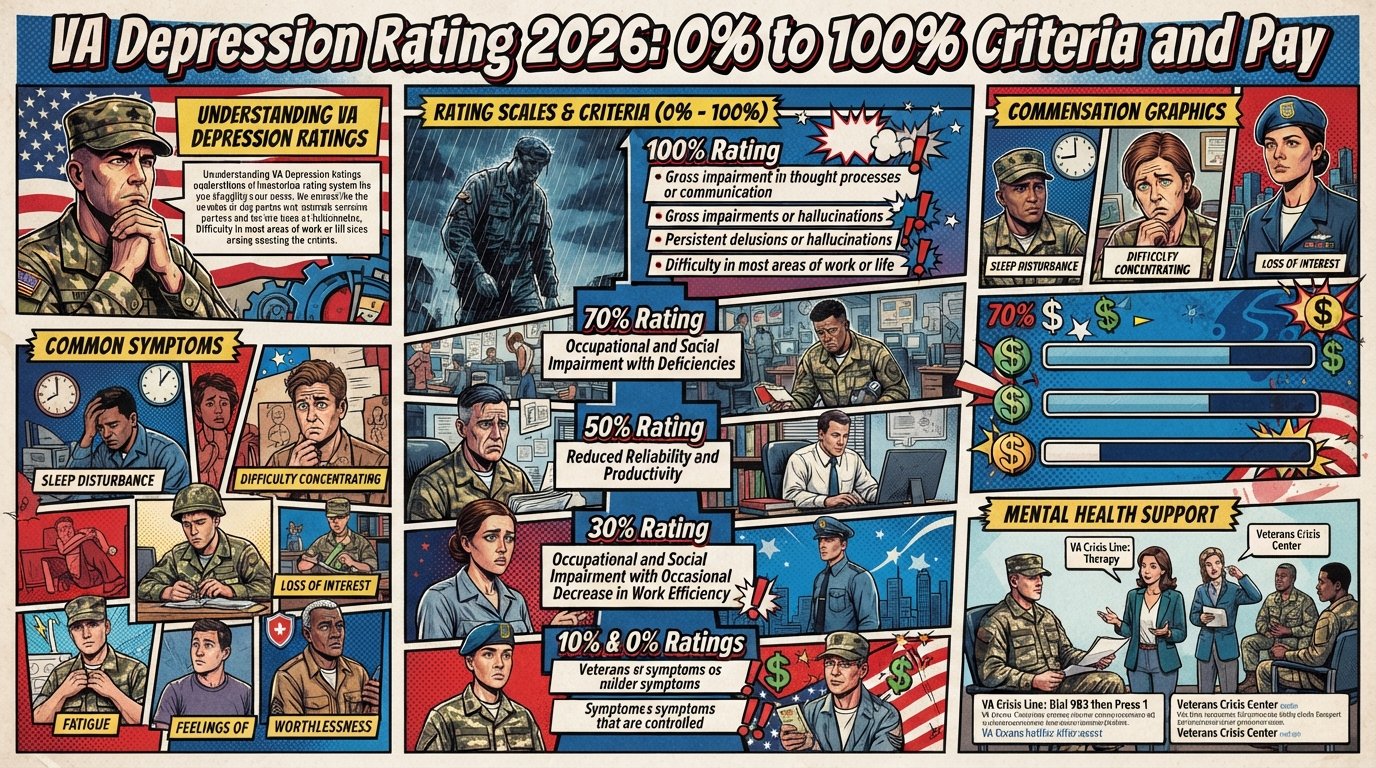
VA rates depression under 38 CFR § 4.130 on a unique 0%, 10%, 30%, 50%, 70%, or 100% scale based on occupational and social impairment. There are no 20%, 40%, 60%, or 90% ratings for mental health. Major depressive disorder uses Diagnostic Code 9434; the deciding exam form is DBQ 21-0960P-3. A 70% rating pays $1,808.45/month in 2026.
Quick Facts
| Item | Details |
|---|---|
| Benefit | VA disability compensation for service-connected depression |
| Eligibility | Current DSM-5 diagnosis linked to military service—directly, as secondary to another service-connected condition, or as a presumptive condition |
| Rating authority | 38 CFR § 4.130, General Rating Formula for Mental Disorders |
| Common diagnostic codes | DC 9434 (major depressive disorder), DC 9433 (persistent depressive disorder/dysthymia), DC 9435 (unspecified depressive disorder) |
| Rating scale | 0%, 10%, 30%, 50%, 70%, 100% — no 20/40/60/80/90 for mental health |
| Application | VA Form 21-526EZ (original claim); VA Form 20-0995 (supplemental claim for increase) |
| Exam form | DBQ 21-0960P-3, Mental Disorders (Other Than PTSD and Eating Disorders) |
| 2026 rate at 70% | $1,808.45/month (veteran alone) |
| 2026 rate at 100% | $3,938.58/month (veteran alone) |
| Official agency | U.S. Department of Veterans Affairs (VA) |
| Updated For | 2026 rates effective December 1, 2025; 38 CFR 4.130 current as of October 1, 2026 |
What Is a VA Disability Rating for Depression?
A VA disability rating for depression is a percentage that measures how much your service-connected depressive disorder impairs your ability to function at work and in social relationships. It is not a measure of how severe your symptoms feel in isolation, how many medications you take, or how many diagnoses you carry. It is a functional measure.

VA Disability Combined Rating Calculator
Add each disability rating from your decision letter.

Estimate only. The VA makes the official rating decision. Not legal or financial advice, and not affiliated with the Department of Veterans Affairs.
All depressive disorders—major depressive disorder, persistent depressive disorder (dysthymia), unspecified depressive disorder, and adjustment disorder with depressed mood—are rated under a single table: the General Rating Formula for Mental Disorders at 38 CFR § 4.130. The same formula applies to PTSD, anxiety, bipolar disorder, and most other mental health conditions, with narrow exceptions like eating disorders.
Because the formula is functional rather than diagnostic, two veterans with the same diagnosis and the same prescription can receive different ratings. The question VA answers is not “what do you have?” but “how much does it stop you from functioning?”
The 2026 Depression Rating Scale: 0% to 100%
VA assigns one of six ratings—0%, 10%, 30%, 50%, 70%, or 100%—based on the level of occupational and social impairment described in the evidence. There is no 20% depression rating. The jump from 30% to 50% is the largest single-step increase in the schedule and is where most underrating disputes occur.
| Rating | Level of Impairment | 2026 Monthly (Veteran Alone) |
|---|---|---|
| 0% | Diagnosis established, but symptoms do not interfere with occupational or social functioning and do not require continuous medication | $0 |
| 10% | Mild or transient symptoms that decrease work efficiency only during significant stress, or symptoms controlled by continuous medication | $180.42 |
| 30% | Occasional decrease in work efficiency and intermittent periods of inability to perform occupational tasks, though generally functioning satisfactorily | $552.47 |
| 50% | Reduced reliability and productivity due to symptoms that impair judgment, memory, motivation, mood, or relationships | $1,132.90 |
| 70% | Deficiencies in most areas—work, school, family relations, judgment, thinking, or mood | $1,808.45 |
| 100% | Total occupational and social impairment | $3,938.58 |
0% Rating: Diagnosed but Non-Compensable
A 0% rating means service connection is established but the symptoms do not rise to the level of compensable impairment. It pays nothing, but it preserves the service connection for future increases and can support secondary claims. The 0% tier is one of the targets of a proposed rule that would eliminate it; that rule has not been finalized as of October 2026.
10% Rating: Mild or Medicated
Army Fitness Test (AFT) Score Calculator
Formerly the ACFT. Five events, 500 points. Enter your results.
Estimate for training only. Points are interpolated from the official Army tables (effective 1 June 2025) and can differ by a few points. Your score of record comes from your unit graders. Official score tables (PDF). Not affiliated with the U.S. Army.
The 10% tier captures two distinct situations: symptoms that only flare under significant stress, and symptoms that are controlled by continuous medication. A veteran whose depression is well-managed on an antidepressant, with normal functioning, belongs here—not at 0%. The “or symptoms controlled by continuous medication” language is frequently overlooked by veterans and raters alike.
30% Rating: Occasional Impairment
The 30% tier requires occasional decrease in work efficiency and intermittent inability to perform occupational tasks, while the veteran is generally functioning satisfactorily. Typical findings include depressed mood most days, chronic sleep impairment, mild memory loss, and panic attacks weekly or less often.
50% Rating: Reduced Reliability and Productivity
The 50% tier is the first tier that requires reduced reliability and productivity—not just occasional inefficiency. Findings that support 50% include flattened affect, panic attacks more than once a week, impaired short- and long-term memory, impaired judgment and abstract thinking, disturbances of motivation, and difficulty establishing and maintaining effective work and social relationships.
70% Rating: Deficiencies in Most Areas
The 70% tier requires deficiencies in most areas of functioning—work, school, family relations, judgment, thinking, and mood. Example symptoms include suicidal ideation, obsessional rituals that interfere with routine activities, near-continuous panic or depression, impaired impulse control, neglect of personal appearance and hygiene, and difficulty adapting to stressful circumstances. The Board of Veterans’ Appeals and the Court of Appeals for Veterans Claims have repeatedly held that “most” means more than half of the listed areas—not all of them.
100% Rating: Total Occupational and Social Impairment
The 100% tier requires total occupational and social impairment. Example findings include gross impairment in thought processes or communication, persistent delusions or hallucinations, grossly inappropriate behavior, persistent danger of hurting self or others, intermittent inability to perform activities of daily living, disorientation to time or place, and memory loss for close relatives’ names or one’s own name. The conjunction matters: a veteran who is socially isolated but holds a job through effort does not meet the 100% criteria under the current formula.
The “Such Symptoms As” Rule: Why You Don’t Need Every Symptom
The symptoms listed at each rating tier are examples, not a checklist. Under Mauerhan v. Principi, 16 Vet. App. 436 (2002), VA cannot require a veteran to exhibit every listed symptom before awarding a rating. The list “provides guidance as to the severity of symptoms contemplated for each rating,” and the rater must consider all symptoms that affect occupational and social functioning, not only the examples.
This rule is the strongest tool against underrating. A veteran who does not have “suicidal ideation” but has near-continuous depression, neglect of hygiene, and inability to adapt to work settings can still meet the 70% tier if the overall picture matches that level of impairment. The question is severity and functional impact, not box-checking.
The benefit-of-the-doubt standard also applies. Under 38 U.S.C. § 5107(b), when the evidence for two ratings is in approximate balance, VA must assign the higher rating. For mental health claims—where tier criteria overlap and symptoms can support either 30% or 50%—this standard is a legitimate basis for an increase.
Diagnostic Codes: DC 9434, DC 9433, and DC 9435
Major depressive disorder is rated under DC 9434. Persistent depressive disorder (dysthymia) is rated under DC 9433. Unspecified depressive disorder is rated under DC 9435. All three use the same General Rating Formula. The diagnostic code does not change the rating—the functional impairment does.
DC 9434 (MDD): Discrete depressive episodes lasting at least two weeks, with at least five DSM-5 criteria present, including depressed mood or anhedonia. May be single-episode or recurrent. Specifiers—anxious distress, psychotic features, melancholic features—should be documented because they describe severity.
DC 9433 (PDD/dysthymia): Depressed mood most of the day, more days than not, for at least two years, with at least two additional symptoms. Lower-grade but chronic and often treatment-resistant. Chronicity can support higher ratings.
DC 9435 (unspecified depressive disorder): Depressive symptoms that cause significant impairment but do not meet full criteria for MDD or PDD.
When depression and PTSD, anxiety, or another mental health condition coexist, VA rates them together under a single mental health rating. Under 38 CFR § 4.14 (no pyramiding), overlapping mental health symptoms cannot generate separate ratings. The combined picture is evaluated under one diagnostic code, usually the predominant condition.
Service Connection: Direct, Secondary, and Presumptive
Depression can be service-connected directly, as a secondary condition to another service-connected disability, or—in limited circumstances—presumptively. The pathway determines the evidence you need.
Direct Service Connection
Direct service connection requires three elements: a current DSM-5 diagnosis, an in-service stressor, event, or onset, and a medical nexus linking the two. Service treatment records documenting mental health complaints during service are powerful evidence. If symptom onset occurred after discharge, a nexus opinion stating “at least as likely as not” is especially important.
Secondary Service Connection
Secondary service connection is the most common pathway for depression and often the easiest to prove, because the in-service connection for the primary condition is already established. Under 38 CFR § 3.310, a disability caused or aggravated by a service-connected condition is separately ratable.
Common primary conditions that support secondary depression include:
Chronic pain from back, joint, or neuropathy conditions.
PTSD — depression is one of the most common comorbidities.
Traumatic brain injury (TBI) — depression is both a neurological consequence and a reaction to functional loss.
Tinnitus and hearing loss — social isolation is a recognized pathway.
Sleep apnea and chronic insomnia — sleep disruption causes and worsens depression.
Cancer, amputations, and severe physical disabilities.
The key to a secondary claim is a medical nexus opinion explaining the causal or aggravating relationship. A lay statement describing the depression and its onset after the primary condition is also evidence VA must consider.
Presumptive Service Connection
There is no stand-alone presumptive for depression, but presumptive conditions can support a secondary claim. Depression manifesting within three years of moderate or severe TBI, or within 12 months of mild TBI, is an example of a presumptive window that can establish service connection. The PACT Act expands the underlying conditions that can cause depression, and depression secondary to a PACT Act presumptive condition is claimable.
How to Apply: Forms, Evidence, and the C&P Exam
The application for an original depression claim is VA Form 21-526EZ. For an increase, file VA Form 20-0995 as a supplemental claim. Both can be filed online through VA.gov, by mail, by fax, or with an accredited representative.
Step-by-Step
Obtain a current diagnosis from a psychiatrist, psychologist, or licensed clinical social worker. The diagnosis must appear in your medical record and should include DSM-5 specifiers.
Gather treatment records showing the frequency, severity, and duration of symptoms—and, critically, their functional impact on work and relationships.
Write a lay statement describing how depression affects your daily functioning: missed work, difficulty concentrating, withdrawal from family, hygiene, sleep. VA must consider lay evidence.
File VA Form 21-526EZ (or 20-0995 for an increase) and submit all evidence at once through the Fully Developed Claim program.
Attend the C&P exam. The examiner will complete DBQ 21-0960P-3 through a structured clinical interview.
Review the decision letter for the assigned rating, the diagnostic code, and whether the evidence supports a higher tier under the “such symptoms as” rule.
What the C&P Exam for Depression Covers
The C&P exam for depression is a clinical interview, not a physical exam. The examiner reviews your claims file and treatment records, then asks about personal history, current symptoms, daily challenges, and functional impairment. The examiner completes DBQ 21-0960P-3, which records the diagnosis, the symptoms present, and a checklist of occupational and social impairment.
The DBQ is the document that drives the rating. It captures whether you have depressed mood, anxiety, panic attacks, sleep impairment, memory loss, flattened affect, suicidal ideation, impaired judgment, neglect of hygiene, and difficulty in relationships. It also records the examiner’s opinion on the level of occupational and social impairment. Veterans should describe their worst days, not their best, and should be specific about functional consequences—not just feelings.
Common Mistakes That Cap Depression Ratings
The most common depression rating mistakes are underreporting functional impairment at the C&P exam, failing to claim depression as secondary, and not challenging a rating that ignores the “such symptoms as” rule.
Mistake 1: Describing symptoms instead of functional impact
Raters assign percentages based on impairment, not symptom counts. “I feel depressed” is less probative than “I have missed 12 days of work in the last two months because I cannot get out of bed, and my supervisor has documented performance problems.” Functional consequences—lost jobs, failed relationships, hygiene neglect, isolation—are what move ratings.
Mistake 2: Filing only the physical claim
Veterans service-connected for chronic pain, TBI, or sleep apnea often develop depression and never file for it. Depression secondary to a service-connected condition is separately compensable and can substantially increase the combined rating.
Mistake 3: Assuming medication control means 0%
The 10% tier explicitly includes “symptoms controlled by continuous medication.” A veteran whose depression is well-managed on medication belongs at 10%, not 0%. The 0% tier is for symptoms that do not require continuous medication and do not interfere with functioning.
Mistake 4: Not invoking the “such symptoms as” rule
If the decision letter treated the tier symptoms as a checklist and denied a higher rating because one example symptom was absent, that is a Mauerhan error. The overall disability picture controls, not the presence of every listed symptom.
Mistake 5: Filing depression and PTSD as separate claims expecting two ratings
Overlapping mental health symptoms are rated together under 38 CFR § 4.14. Filing separate claims for depression and PTSD will not produce two ratings if the symptoms overlap. The combined picture is evaluated once.
Appeals and Increases
If VA denies the claim or assigns a rating below the evidence, you have three lanes: a Supplemental Claim, a Higher-Level Review, or a Board appeal. The decision letter explains which applies.
Supplemental Claim (VA Form 20-0995): File with new and relevant evidence—a private DBQ, updated treatment records, or a nexus opinion. This is the fastest lane for adding evidence.
Higher-Level Review (VA Form 20-0996): A senior rater reviews the existing record. No new evidence is allowed.
Board of Veterans’ Appeals (VA Form 10182): A direct appeal to the Board, with the option of a hearing.
For an increase, file a supplemental claim with evidence showing that symptoms now meet the next tier. A new private DBQ or updated treatment records documenting functional decline is the strongest evidence. Because mental health ratings can fluctuate, VA may consider staged ratings—different ratings for different periods—if the record shows changing severity over time.
Proposed Changes: The Five-Domain Model
VA has proposed replacing the current General Rating Formula with a five-domain functional model, but the rule has not been finalized as of October 2026. The current criteria remain the law and apply to every rating decision issued today.
The proposed model would evaluate impairment across five domains—Cognition, Interpersonal Relationships, Task Completion, Navigating Environments, and Self-Care—each scored on a severity scale. Key proposed changes include eliminating the 0% rating (establishing a 10% floor for any service-connected condition) and restructuring the 100% tier. The proposal was published in February 2022 and remains under review.
What veterans should do now: File under the current criteria, which remain in effect. If a final rule is published while your claim is pending, VA must apply whichever criteria are more favorable to you. Veterans with existing ratings are protected by the rule against reductions absent improvement. The safest strategy is to document functional impairment thoroughly under the current framework, because the evidence that supports a higher rating today will also support a higher rating under any future model.
State Differences and Other Benefits
VA disability compensation is federal and does not vary by state, but a depression rating can unlock state and federal benefits beyond the monthly payment. A 70% or higher rating supports TDIU (Individual Unemployability) if depression prevents substantially gainful employment, which pays at the 100% rate. A 50% or higher rating can support VA health care priority and dependent benefits. Many states offer property tax exemptions, tuition waivers, and other benefits tied to service-connected ratings.
Veterans should check their state veterans affairs office for state-specific benefits at their rating level, and should confirm whether their combined rating qualifies for VA home loan funding fee exemptions or CHAMPVA-related dependent benefits.
Common Questions
What is the VA rating for depression?
VA rates depression at 0%, 10%, 30%, 50%, 70%, or 100% under 38 CFR § 4.130 based on occupational and social impairment. Major depressive disorder uses DC 9434. There are no 20%, 40%, 60%, 80%, or 90% ratings for mental health conditions.
How much does a 70% VA depression rating pay in 2026?
A 70% rating pays $1,808.45/month** for a veteran with no dependents, effective December 1, 2025. A 100% rating pays **$3,938.58/month. A 50% rating pays $1,132.90/month.
Can I get 100% for depression?
Yes, but the 100% tier requires total occupational and social impairment. Example findings include gross impairment in thought processes, persistent delusions or hallucinations, grossly inappropriate behavior, persistent danger of hurting self or others, and inability to perform activities of daily living. Social isolation alone, with intact work functioning, does not meet the 100% conjunction.
What is the 70% depression rating criteria?
The 70% tier requires deficiencies in most areas—work, school, family relations, judgment, thinking, or mood. Example symptoms include suicidal ideation, near-continuous panic or depression, impaired impulse control, neglect of personal appearance and hygiene, and difficulty adapting to stressful circumstances. “Most” means more than half of the listed areas, not all of them.
What is DBQ 21-0960P-3?
It is VA’s Mental Disorders (Other Than PTSD and Eating Disorders) Disability Benefits Questionnaire, completed at the C&P exam. It records the diagnosis, symptoms, and the examiner’s opinion on the level of occupational and social impairment. The completed DBQ drives the rating.
Can depression be rated secondary to PTSD?
Depression can be claimed as secondary to PTSD, but overlapping symptoms are rated together under a single mental health rating. You will not receive two separate ratings for depression and PTSD if the symptoms overlap. The combined picture is evaluated under 38 CFR § 4.14.
Can depression be secondary to chronic pain?
Yes. Depression caused or aggravated by service-connected chronic pain is separately ratable under 38 CFR § 3.310. A medical nexus opinion linking the pain to the depression is the key evidence. Chronic pain is one of the most common pathways to secondary depression.
What is the 0% depression rating?
A 0% rating means depression is diagnosed and service-connected, but symptoms do not interfere with functioning and do not require continuous medication. It pays nothing but preserves service connection for future increases. The proposed five-domain rule would eliminate the 0% tier, but it has not been finalized.
Does medication control affect the rating?
Yes. The 10% tier explicitly includes symptoms controlled by continuous medication. A veteran whose depression is well-managed on medication belongs at 10%, not 0%. The 0% tier is reserved for symptoms that do not require continuous medication.
How do I increase my depression rating?
File a Supplemental Claim (VA Form 20-0995) with new evidence—a private DBQ, updated treatment records, or a lay statement—showing that symptoms now meet a higher tier. Focus on functional impairment: missed work, failed relationships, hygiene neglect, isolation. The benefit-of-the-doubt standard applies when evidence supports two tiers.
Does the proposed five-domain rule change my rating?
Not yet. The five-domain model remains proposed as of October 2026. Current ratings remain in effect. If a final rule is published while your claim is pending, VA must apply the more favorable criteria. Existing ratings are protected against reduction absent improvement.
Key Takeaways
VA rates depression at 0%, 10%, 30%, 50%, 70%, or 100% under 38 CFR § 4.130—there are no 20/40/60/80/90 ratings for mental health.
Ratings are based on occupational and social impairment, not symptom counts. The tier symptoms are examples under Mauerhan, not a checklist.
DC 9434 covers major depressive disorder; DC 9433 covers persistent depressive disorder; both use the same formula.
A 70% rating pays $1,808.45/month in 2026**; a 100% rating pays **$3,938.58/month.
Secondary service connection—depression caused by chronic pain, PTSD, TBI, sleep apnea, or another service-connected condition—is the most common and most underused pathway.
The deciding exam form is DBQ 21-0960P-3, completed through a clinical interview at the C&P exam.
Functional impact beats symptom description: missed work, isolation, hygiene neglect, and failed relationships move ratings.
Depression and PTSD are rated together, not separately, when symptoms overlap under 38 CFR § 4.14.
The five-domain model would eliminate the 0% tier and restructure the formula, but it remains proposed, not final, as of October 2026.
The benefit-of-the-doubt standard requires VA to assign the higher rating when evidence for two tiers is in approximate balance.
Official Resources
VA disability compensation rates: va.gov/disability/compensation-rates
38 CFR § 4.130 – Schedule of ratings, mental disorders: ecfr.gov (Title 38, Part 4, Subpart B)
VA Form 21-526EZ – Application for Disability Compensation: va.gov/find-forms/about-form-21-526ez
VA Form 20-0995 – Supplemental Claim: va.gov/find-forms/about-form-20-0995
VA Form 20-0996 – Higher-Level Review: va.gov/find-forms/about-form-20-0996
VA Form 10182 – Board Appeal: va.gov/find-forms/about-form-10182
VA DBQ 21-0960P-3 – Mental Disorders: va.gov
VA decision reviews and appeals: va.gov/decision-reviews
Veterans Crisis Line: 988 (press 1)
🇺🇸 IMPORTANT DISCLAIMER – Veterans Benefits Information
This site provides general information about U.S. Department of Veterans Affairs (VA) benefits for educational and informational purposes only.
- Not Official: We are NOT affiliated with, endorsed by, or connected to the U.S. Department of Veterans Affairs (VA), the Veterans Benefits Administration (VBA), the Veterans Health Administration (VHA), or any other government agency.
- No Legal/Financial Advice: The content on this website is for informational purposes only and does not constitute legal, financial, or medical advice. VA benefits rules change frequently – always consult with an accredited Veterans Service Officer (VSO) or a qualified professional for your specific situation.
- Official Sources: For official, binding information and to apply for benefits, always visit official .gov websites: VA.gov, Benefits.VA.gov, or SSA.gov.
- No Data Collection: This site does not collect, store, or process any personal information. It does not have login forms, contact forms, or any system to capture user data. We never ask for your Social Security Number, bank details, or any personal information.
- 🚨 Scam Alert: The VA and other government agencies never charge fees for benefit applications. If anyone asks for money to "process" your VA claim, it is a scam. Report it to the VA Office of Inspector General at VA.gov/OIG.
- Advertising: This site uses third-party advertising (Adsterra) to cover operational costs. We do not endorse or guarantee any products or services advertised.
📌 Information provided as of June 2026. Always verify current eligibility and rules with official .gov sources.
This site is not affiliated with the U.S. Department of Veterans Affairs or any government agency. All information is for educational purposes only. Please visit VA.gov for official information.
