
What Is a Veterans Affairs Paycheck Calculator?
A Veterans Affairs paycheck calculator is a free online tool that estimates your monthly VA disability compensation based on your combined disability rating, dependents, and current VA pay rates. It converts your disability rating into a dollar amount—your “VA paycheck”—so you can verify your award letter or plan your finances. The tool applies the VA’s official “whole person” rating formula and 2026 compensation tables to give you an accurate estimate. The result is your expected monthly tax-free payment from the U.S. Department of Veterans Affairs.
The calculator matters because VA pay is not always intuitive. A 50% rating and a 30% rating do not pay the same as an 80% rating. Without the correct formula, veterans routinely misjudge what they should receive. A VA paycheck calculator eliminates that guesswork.

Quick Facts
| Item | Details |
|---|---|
| What It Calculates | Estimated monthly VA disability compensation and combined rating |
| Who Qualifies | Veterans with one or more service-connected disabilities |
| Key Inputs | Individual disability ratings, dependent status, bilateral conditions |
| Cost | Free |
| Official Rate Source | VA.gov 2026 compensation tables (effective Dec. 1, 2025) |
| 2026 COLA | 2.8% increase |
| Official Agency | U.S. Department of Veterans Affairs (VA) |
| Required VA Form | VA Form 21-526EZ (Application for Disability Compensation) |
| Payment Date | First business day of each month |
| Updated For | 2026 rates |
How a VA Paycheck Calculator Works
The calculator works by combining your individual disability ratings using the VA’s “whole person” method, then applying the correct 2026 compensation rate for your dependent status. You enter each rated condition separately, and the tool does the math.
Step-by-Step: Using the Calculator
Enter each disability rating. List every service-connected condition and its assigned percentage—for example, 70% for PTSD, 20% for a knee injury, and 10% for tinnitus.
Mark bilateral conditions. If you have rated disabilities in both arms or both legs, identify them as bilateral. The calculator will apply the bilateral factor.
Add dependents. If your combined rating is 30% or higher, add your spouse, dependent children under 18, and dependent parents. Dependents increase your monthly payment.
Review your combined rating. The tool displays your combined percentage, rounded to the nearest 10%—the way the VA rounds.
See your estimated monthly payment. The calculator shows your estimated VA paycheck based on 2026 rates.
What the Calculator Does Not Do

It does not determine service connection. It assumes you already have rated disabilities. It also does not account for Special Monthly Compensation (SMC), Total Disability based on Individual Unemployability (TDIU), or state-specific benefits. It is an estimation tool, not an official VA determination.
2026 VA Disability Compensation Rates
These are the official 2026 rates effective December 1, 2025, reflecting a 2.8% cost-of-living adjustment (COLA). These are the rates a Veterans Affairs paycheck calculator uses.
Basic Monthly Rates (Veteran Alone, No Dependents)
| Disability Rating | Monthly Payment |
|---|---|
| 10% | $180.42 |
| 20% | $356.66 |
| 30% | $552.47 |
| 40% | $795.84 |
| 50% | $1,132.90 |
| 60% | $1,435.02 |
| 70% | $1,808.45 |
| 80% | $2,102.15 |
| 90% | $2,362.30 |
| 100% | $3,938.58 |
These rates are tax-free. VA disability compensation is not subject to federal income tax, and most states do not tax it either.
With Dependents (30% and Above)
Veterans with a 30% or higher combined rating receive additional compensation for a dependent spouse, dependent children under 18, and dependent parents. A veteran with a 30% rating and a dependent spouse receives $617.47 per month instead of $552.47.
| Disability Rating | With Spouse (No Children) | With Spouse + 1 Child |
|---|---|---|
| 30% | $617.47 | $666.47 |
| 50% | $1,241.90 | $1,317.90 |
| 70% | $1,949.19 | $2,051.69 |
| 100% | $4,158.17 | $4,315.17 |
Veterans May Qualify for Extra Benefits
Check available financial assistance, healthcare programs and other opportunities that may apply to you.
Check EligibilityNote: Rates shown are illustrative. Verify exact amounts at VA.gov.
2026 COLA Increase
The 2026 COLA is 2.8%. For a single veteran with no dependents, this means:
| Rating | 2025 Rate | 2026 Rate | Increase |
|---|---|---|---|
| 10% | $175.51 | $180.42 | $4.91 |
| 30% | $537.42 | $552.47 | $15.05 |
| 50% | $1,102.04 | $1,132.90 | $30.86 |
| 70% | $1,759.19 | $1,808.45 | $49.26 |
| 100% | $3,831.30 | $3,938.58 | $107.28 |
Understanding VA Math: Why Ratings Don’t Add Up
VA math does not work like standard addition. The VA uses a “whole person” concept: if you have a 50% disability rating, the VA considers you 50% disabled and 50% healthy. Any additional rating is applied only to the remaining healthy percentage, not to the full 100%.
Example of VA Math
| Step | Calculation | Result |
|---|---|---|
| Start with highest rating | 50% disabled, 50% healthy | 50% |
| Add second rating (30%) | 30% of remaining 50% = 15% | 65% |
| Round to nearest 10% | 65% rounds to 70% | 70% combined |
A veteran with a 50% rating and a 30% rating receives a combined rating of 70%, not 80%.
The Bilateral Factor
The bilateral factor applies when you have a service-connected disability in both arms, both legs, or paired skeletal muscles. The VA combines the bilateral conditions first, adds 10% of that combined value, and then combines that total with your other disabilities. This can push a veteran from 90% to 100% in some cases.
Example: Left knee at 20% and right knee at 20% combine to 36%. The bilateral factor adds 3.6%, bringing the bilateral total to 39.6%. That value is then combined with other disabilities.
Who Qualifies for VA Disability Compensation
You may qualify for VA disability compensation if you have a current physical or mental condition that was caused or made worse by your military service, and you were discharged under conditions other than dishonorable.
Eligibility Requirements
Active duty, National Guard, or Reserve service. You must have served on active duty, active duty for training, or inactive duty training.
A current diagnosis. You need a medical diagnosis of a condition.
An in-service event, injury, or exposure. There must be evidence that something happened during service that caused or aggravated the condition.
A nexus (link). A medical opinion or evidence connecting the current condition to the in-service event.
PACT Act Expansion
The Sergeant First Class Heath Robinson Honoring our Promise to Address Comprehensive Toxics (PACT) Act of 2022 expanded eligibility for veterans exposed to burn pits, Agent Orange, and other toxic substances. The PACT Act added more than 20 presumptive conditions and expanded presumptive exposure locations. If you served in a location covered by the PACT Act and have a condition on the presumptive list, you do not need to prove a nexus—the VA presumes the connection.
Required Documents for a VA Disability Claim
Gather these documents before you file to reduce processing delays:
DD Form 214 (Certificate of Release or Discharge from Active Duty) for each period of service
Medical records showing your current diagnosis and treatment
Service treatment records (if available)
Buddy statements from fellow service members
Personal statement describing how your condition affects daily life
VA Form 21-526EZ (Application for Disability Compensation and Related Compensation Benefits)
Marriage certificate and birth certificates if claiming dependents
VA Form 21-526EZ is the primary form for filing a new claim or claiming an increase. You can file it online, by mail, or in person. Filing online through VA.gov is the fastest method.
How to Apply for VA Disability Compensation
Gather your evidence. Collect medical records, service records, and personal statements.
File VA Form 21-526EZ. Apply online at VA.gov, by mail to the Evidence Intake Center, or in person at a VA regional office.
Attend your C&P exam. The VA may schedule a Compensation and Pension exam to evaluate your condition. Not everyone needs one—if your medical evidence is sufficient, the VA may use the Acceptable Clinical Evidence (ACE) process instead.
Receive your decision. The VA will send a rating decision letter. Average processing time is three to four months.
Review your rating. Use a VA paycheck calculator to verify that your combined rating matches your individual conditions.
Appeal if needed. If you disagree, you have one year to request a decision review.
Online Application
The fastest way to apply is through VA.gov. You can fill out VA Form 21-526EZ electronically and upload supporting documents. If you file by mail, send your claim to: Department of Veterans Affairs, Evidence Intake Center, PO Box 4444, Janesville, WI 53547-4444.
Processing Times
VA disability claims take an average of three to four months from filing to decision. Claims involving multiple conditions or appeals may take longer. You can check your claim status on VA.gov or through the VA mobile app.
VA Disability Payment Dates for 2026
VA disability benefits for a particular month are usually paid on the first business day of the following month. If the first business day falls on a holiday or weekend, benefits are paid on the last business day of the preceding month.
| Month of Payment | Payment Date |
|---|---|
| January 2026 | January 30, 2026 |
| February 2026 | February 27, 2026 |
| March 2026 | April 1, 2026 |
| April 2026 | May 1, 2026 |
| May 2026 | June 1, 2026 |
| June 2026 | July 1, 2026 |
| July 2026 | July 31, 2026 |
| August 2026 | September 1, 2026 |
| September 2026 | October 1, 2026 |
| October 2026 | October 30, 2026 |
| November 2026 | December 1, 2026 |
| December 2026 | December 31, 2026 |
The first VA disability payment reflecting the 2026 COLA rate was on December 31, 2025, because January 1 is a holiday.
Effective Dates and Back Pay
The effective date is the date the VA begins paying your benefits. It is generally the date the VA received your claim or the date your disability arose, whichever is later. If you file within one year of discharge, the effective date can be the day after discharge.
How Back Pay Is Calculated
Back pay is the lump sum owed from your effective date to the date your claim was approved. The VA multiplies the number of unpaid months by the correct monthly rate for each year in the back pay period.
Example: If your effective date is January 1, 2025, your claim is decided December 1, 2025, and you are rated at 70% (single veteran), your back pay would be approximately 11 months × the 2025 rate of $1,759.19 = $19,351.09.
Common Effective Date Mistakes
Filing late. If you miss the one-year window after discharge, your effective date defaults to the date VA received your claim.
Not submitting an Intent to File. An Intent to File (ITF) preserves your effective date for up to one year while you gather evidence.
Missing the appeal deadline. If you appeal a rating increase, the effective date can be the date the disability worsened, but only if you file within one year of that date.
Special Monthly Compensation (SMC) and TDIU
Special Monthly Compensation (SMC)
SMC is an additional monthly payment for veterans with severe disabilities, such as the loss of a limb, loss of use of a body part, or the need for aid and attendance. SMC is paid above and beyond your basic VA disability compensation.
| SMC Level | Description | 2026 Monthly Rate |
|---|---|---|
| SMC-K | Loss of creative organ | $139.87 |
| SMC-L | Aid and attendance | $4,900.83 |
| SMC-S | Housebound | $4,408.53 |
| SMC-R.2 | Need for daily help with basic needs | $11,271.67+ |
Total Disability based on Individual Unemployability (TDIU)
TDIU pays veterans at the 100% disability rate even if their combined schedular rating is lower. To qualify, you must be unable to secure or follow substantially gainful employment due to your service-connected disabilities.
TDIU eligibility generally requires:
One disability rated at 60% or higher, or
Two or more disabilities with a combined rating of 70% or higher, with at least one rated at 40% or higher.
In 2026, a single veteran receiving TDIU is entitled to $3,938.58 per month—the same as a 100% schedular rating. With a spouse, that increases to $4,158.17.
Common Mistakes Veterans Make with VA Claims
Underreporting symptoms. Veterans often minimize their symptoms during C&P exams. Describe your worst days, not your best.
Failing to claim all conditions. Secondary conditions—conditions caused by a service-connected disability—are often overlooked. For example, depression secondary to chronic pain.
Not using the bilateral factor. If you have conditions in both arms or legs, make sure the VA applies the bilateral factor.
Missing dependent claims. If your rating is 30% or higher, you may be entitled to additional compensation for dependents. File VA Form 21-686c to add them.
Not appealing a denial. Many veterans accept a denial without appealing. You have one year to request a decision review.
Ignoring SMC eligibility. If you have lost the use of a limb, need aid and attendance, or are housebound, you may qualify for Special Monthly Compensation above your basic rating.
The VA Appeals Process
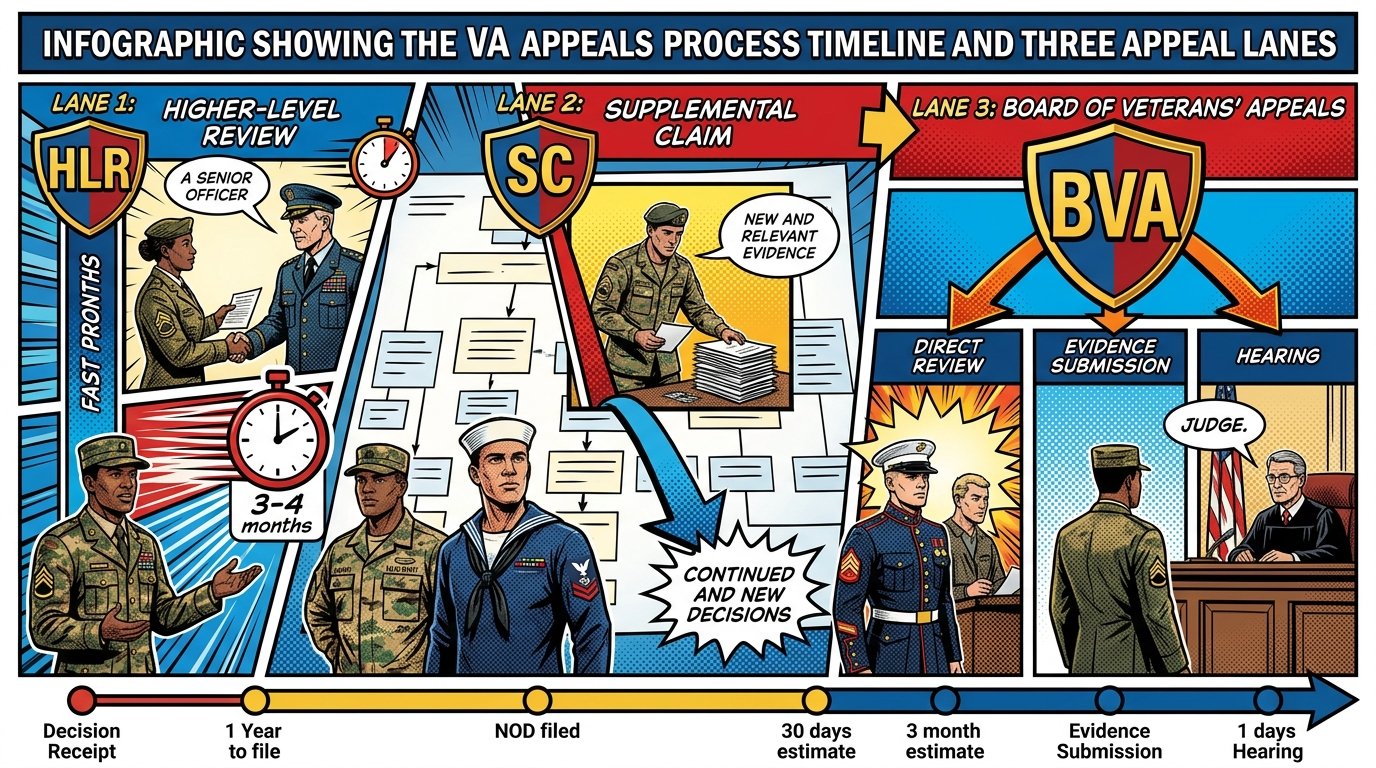
If you disagree with a VA decision, you have one year from the date on your decision letter to request a decision review under the Appeals Modernization Act (AMA). There are three options:
1. Supplemental Claim (VA Form 20-0995)
Use this if you have new and relevant evidence to add to your case. The VA will review your claim with the new evidence and issue a new decision.
2. Higher-Level Review (VA Form 20-0996)
Use this if you believe the VA made an error based on the evidence already in your file. A senior VA employee reviews the decision without new evidence.
3. Board Appeal (VA Form 10182)
Use this to appeal directly to the Board of Veterans’ Appeals. You can choose a Direct Review (no new evidence), Evidence Submission (submit new evidence), or Hearing (testify before a Veterans Law Judge).
You can also appeal a Board decision to the U.S. Court of Appeals for Veterans Claims (CAVC).
State Differences in Veterans Benefits
VA disability compensation is federal and does not vary by state. However, states offer additional benefits that can significantly increase your total compensation package:
| State | Property Tax Exemption | Education Benefits | Other |
|---|---|---|---|
| Texas | 100% disabled: full exemption | Hazlewood Act (tuition) | No state income tax on retirement |
| Florida | 100% disabled: full exemption | Scholarships | No state income tax |
| California | $180,671+ exemption (varies) | Fee waivers | State veteran homes |
| Virginia | Full exemption for 100% | Tuition waivers | Employment preference |
| New York | Partial exemption (varies) | Tuition awards | Civil service credits |
Check your state’s department of veterans affairs for specific eligibility and application requirements.
Common Questions
1. Is a Veterans Affairs paycheck calculator accurate?
Yes, if it uses the VA’s official combined ratings formula and current compensation tables. The VA’s “whole person” method and bilateral factor are well-documented. A reputable calculator will match a VA decision in most cases. It is an estimation tool, not an official VA determination.
2. What is the difference between a VA disability calculator and a VA paycheck calculator?
They are essentially the same tool. Some calculators focus on the combined rating percentage, while others focus on the monthly dollar amount—your VA paycheck. Many tools, including those from law firms and veterans organizations, do both in one interface.
3. How does VA math work?
VA math uses a “whole person” approach. Each disability rating is applied to the percentage of the person who is not already disabled. A 50% rating and a 30% rating combine to 70%, not 80%. The VA rounds the final combined rating to the nearest 10%.
4. Does the calculator include the bilateral factor?
A quality calculator does. When you identify conditions affecting both arms or both legs, the tool applies the bilateral factor—adding 10% of the combined value of those paired conditions before combining with other disabilities. This can significantly increase your rating.
5. Can I use a VA paycheck calculator if I have a 0% rating?
Yes. A 0% rating means you have a service-connected condition that does not currently warrant compensation. You can include it in the calculator, but it will not increase your combined rating or monthly payment.
6. Does the calculator account for dependents?
Yes. If your combined rating is 30% or higher, you can add a spouse, dependent children under 18, and dependent parents. Dependents increase your monthly compensation. The VA does not pay additional compensation for dependents at 10% or 20%.
7. How long does it take to get a VA disability decision?
The average processing time is three to four months from the date VA receives your claim. Claims involving appeals, multiple conditions, or complex medical evidence may take longer. You can track your claim status on VA.gov.
8. Can I get back pay if I file for an increase?
Yes. If you file for an increase within one year of the date your disability worsened, the effective date can be the date it worsened. Back pay is calculated from that date. An Intent to File preserves your effective date for up to one year.
9. What if the VA denies my claim?
You have one year from the decision letter to request a decision review. You can file a Supplemental Claim with new evidence, request a Higher-Level Review, or appeal to the Board of Veterans’ Appeals. Each option has different rules and timelines.
10. Does the PACT Act change my eligibility?
The PACT Act expanded presumptive conditions and exposure locations for toxic exposures, including burn pits and Agent Orange. If you served in a covered location and have a presumptive condition, you do not need to prove a nexus between your service and your condition. This can accelerate your claim.
11. Can I work while receiving VA disability compensation?
Yes. You can work and receive VA disability compensation at any rating level. TDIU, however, requires that you be unable to maintain substantially gainful employment. If you work while receiving TDIU, you must report your income to the VA, and you may lose TDIU eligibility if your earnings exceed the federal poverty threshold.
12. What is the difference between VA disability compensation and VA pension?
VA disability compensation is for service-connected conditions and is not income-dependent. VA pension is for wartime veterans with limited income and net worth who are permanently and totally disabled or age 65 or older. You cannot receive both at the same time.
Key Takeaways
A Veterans Affairs paycheck calculator estimates your monthly VA disability compensation using the VA’s “whole person” formula and current 2026 rates.
VA math does not add ratings together. A 50% and 30% rating combine to 70%, not 80%.
The bilateral factor adds extra percentage points for conditions affecting both arms or both legs.
2026 compensation rates range from $180.42 per month at 10% to $3,938.58 per month at 100% for a single veteran with no dependents.
Veterans with a 30% or higher rating receive additional compensation for dependents.
The 2026 COLA increased rates by 2.8% effective December 1, 2025.
VA disability payments are made on the first business day of each month.
The PACT Act expanded presumptive conditions and exposure locations for toxic exposures.
You can file VA Form 21-526EZ online, by mail, or in person. Average processing time is three to four months.
Special Monthly Compensation (SMC) and TDIU can significantly increase your monthly payment above your basic rating.
You have one year to appeal a VA decision through a Supplemental Claim, Higher-Level Review, or Board Appeal.
Official Resources
VA Disability Compensation Rates: va.gov/disability/compensation-rates
VA Form 21-526EZ: va.gov/forms/21-526ez
VA Claim Exam (C&P Exam): va.gov/resources/va-claim-exam
PACT Act Information: va.gov/bay-pines-health-care/programs/toxic-exposure-screening
Decision Reviews and Appeals: va.gov/decision-reviews
VA Special Monthly Compensation Rates: va.gov/disability/compensation-rates/special-monthly-compensation-rates
VA Dependency and Indemnity Compensation (DIC): va.gov/disability/dependency-indemnity-compensation
USA.gov Veterans Benefits: usa.gov/veterans-benefits





🇺🇸 IMPORTANT DISCLAIMER – Veterans Benefits Information
This site provides general information about U.S. Department of Veterans Affairs (VA) benefits for educational and informational purposes only.
- Not Official: We are NOT affiliated with, endorsed by, or connected to the U.S. Department of Veterans Affairs (VA), the Veterans Benefits Administration (VBA), the Veterans Health Administration (VHA), or any other government agency.
- No Legal/Financial Advice: The content on this website is for informational purposes only and does not constitute legal, financial, or medical advice. VA benefits rules change frequently – always consult with an accredited Veterans Service Officer (VSO) or a qualified professional for your specific situation.
- Official Sources: For official, binding information and to apply for benefits, always visit official .gov websites: VA.gov, Benefits.VA.gov, or SSA.gov.
- No Data Collection: This site does not collect, store, or process any personal information. It does not have login forms, contact forms, or any system to capture user data. We never ask for your Social Security Number, bank details, or any personal information.
- 🚨 Scam Alert: The VA and other government agencies never charge fees for benefit applications. If anyone asks for money to "process" your VA claim, it is a scam. Report it to the VA Office of Inspector General at VA.gov/OIG.
- Advertising: This site uses third-party advertising (Adsterra) to cover operational costs. We do not endorse or guarantee any products or services advertised.
📌 Information provided as of June 2026. Always verify current eligibility and rules with official .gov sources.
This site is not affiliated with the U.S. Department of Veterans Affairs or any government agency. All information is for educational purposes only. Please visit VA.gov for official information.
