
VA DIC Benefits in North Carolina: Eligibility and Payment Rates for Surviving Spouses
VA Dependency and Indemnity Compensation (DIC) in North Carolina pays surviving spouses $1,699.36 per month tax-free in 2026. Eligibility requires marriage to a Veteran who died from a service-connected condition, or who held a totally disabling rating for at least 10 years before death. Apply with VA Form 21P-534EZ at VA.gov.
Quick Facts
| Item | Details |
|---|---|
| Benefit | Tax-free monthly payment for surviving spouses and dependents |
| Eligibility | Surviving spouse of Veteran who died from service-connected cause or with qualifying 100% rating |
| Application | VA Form 21P-534EZ (online at VA.gov or by mail) |
| Processing Time | 3–6 months (varies by claim complexity) |
| Official Agency | U.S. Department of Veterans Affairs (VA) |
| Required Forms | VA Form 21P-534EZ; DD-214; marriage certificate; death certificate |
| Updated For | 2026 DIC rates, effective December 1, 2025 |
What Is VA DIC?
VA Dependency and Indemnity Compensation (DIC) is a tax-free monthly payment made by the Department of Veterans Affairs to eligible surviving spouses, children, and parents of service members who died in the line of duty or Veterans who died from a service-related injury or illness. DIC is authorized under 38 U.S.C. Chapter 13, §§ 1310–1318.

DIC is not the same as VA disability compensation. Disability compensation is paid to the Veteran during their lifetime and ends at death. DIC is a separate benefit that begins for survivors after the Veteran’s death. It is also distinct from Survivors Pension, which is a needs-based benefit for low-income surviving spouses of wartime Veterans.
Why DIC Matters

DIC provides financial stability when a military family loses a service member or Veteran to a service-connected condition. The payment is tax-free at both the federal and North Carolina state levels. North Carolina does not tax VA disability or survivor benefits. DIC also opens access to other benefits: CHAMPVA health coverage, Chapter 35 education benefits, and VA home loan guaranty eligibility.
What Veterans and Families Should Do Next
If you are a Veteran with a service-connected disability, ensure your family knows about DIC and the evidence they will need. Document your service-connected conditions, maintain your VA rating records, and discuss DIC eligibility with your spouse or dependents. If you are a surviving spouse, gather your marriage certificate, the Veteran’s DD-214, and death certificate, then apply as soon as possible — DIC does not have a deadline, but benefits are not paid retroactively beyond one year before the application date unless a VA Form 21-0966 (Intent to File) was submitted first.
DIC Eligibility Requirements for Surviving Spouses in North Carolina
You qualify for DIC as a surviving spouse if both of the following are true: you lived with the Veteran continuously until death (or were not at fault for separation), and at least one of these marriage conditions applies: you married the Veteran within 15 years of discharge from the qualifying period of service, or you were married to the Veteran for at least one year, or you had a child with the Veteran.
Qualifying Service-Connected Conditions
The Veteran’s death must meet one of these criteria:
Died while on active duty, active duty for training, or inactive-duty training.
Died from a service-connected illness or injury.
Did not die from a service-connected condition, but held a VA rating of totally disabling (including Individual Unemployability) for a specific period before death.
The 10-Year Rule and Other Rating Duration Requirements
Veterans May Qualify for Extra Benefits
Check available financial assistance, healthcare programs and other opportunities that may apply to you.
Check EligibilityIf the Veteran died from a condition unrelated to their service-connected disability, the surviving spouse may still qualify if the Veteran held a totally disabling rating for at least one of these periods:
10 years immediately before death, or
Since release from active duty and for at least 5 years immediately before death, or
1 year before death if the Veteran was a former prisoner of war who died after September 30, 1999.
DIC Eligibility Comparison Table
| Condition | Surviving Spouse Qualifies? | Key Requirement |
|---|---|---|
| Veteran died from service-connected condition | Yes | Marriage verification; service connection evidence |
| Veteran died while on active duty | Yes | Marriage verification; line-of-duty death |
| Veteran died of non-service cause with 100% P&T rating for 10+ years | Yes | Marriage for same 8-year period for added benefit |
| Veteran died of non-service cause with 100% rating since discharge + 5 years | Yes | Rating documentation |
| Former POW died after Sept 30, 1999, with 1-year rating | Yes | POW status documentation |
| Veteran held 100% rating less than 10 years, died of non-service cause | No | Rating duration insufficient |
VA DIC Payment Rates for 2026 in North Carolina
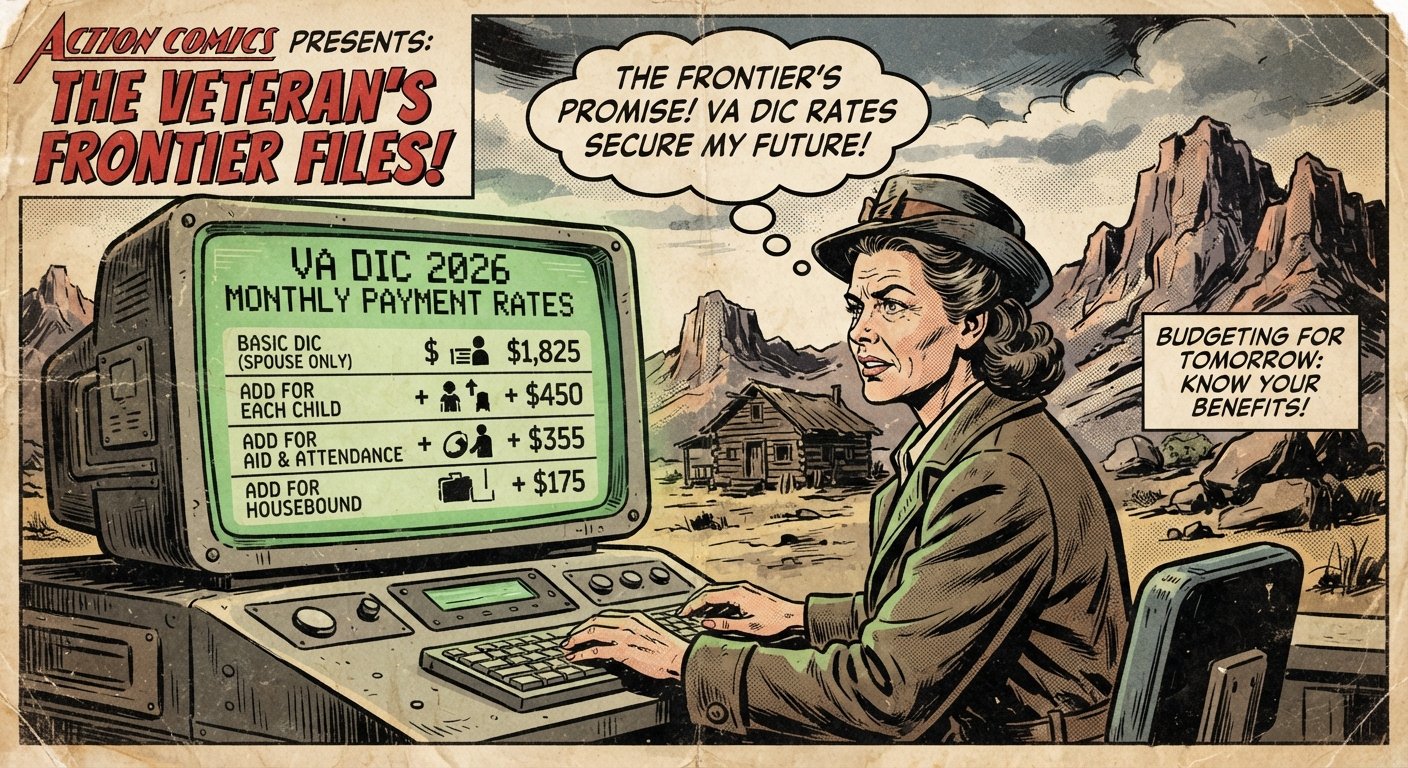
The 2026 base DIC rate for a surviving spouse is $1,699.36 per month, effective December 1, 2025. This reflects a 2.8% cost-of-living adjustment (COLA) tied to the Social Security Administration’s annual increase. DIC payments are tax-free and are not reduced by other income or benefits.
Added Amounts for Qualifying Circumstances
Surviving spouses may qualify for additional monthly amounts on top of the base rate:
| Added Benefit | Monthly Amount | Qualifying Condition |
|---|---|---|
| 8-year provision | $360.85 | Veteran had totally disabling rating for 8+ full years before death, and you were married to the Veteran for those same 8 years |
| Each eligible child | $421.00 | Per child under 18 (or under 23 if in school) |
| Aid and Attendance | $421.00 | Surviving spouse requires regular aid and attendance |
| Transitional benefit | $359.00 | First 2 years after the Veteran’s death |
North Carolina Example: A surviving spouse in Fayetteville with two children under 18, whose Veteran held a 100% P&T rating for 8+ years before death, would receive $1,699.36 (base) + $360.85 (8-year) + $421.00 (child 1) + $421.00 (child 2) = **$2,902.21 per month** — plus a $359 transitional benefit for the first two years, bringing the total to $3,261.21 monthly during that period.
DIC Rate Comparison: 2025 vs. 2026
| Category | 2025 Rate | 2026 Rate | Monthly Increase |
|---|---|---|---|
| Base surviving spouse | $1,653.07 | $1,699.36 | $46.29 |
| 8-year provision add-on | $351.00 | $360.85 | $9.85 |
| Per eligible child | $409.43 | $421.00 | $11.57 |
How to Apply for DIC in North Carolina
Apply for DIC using VA Form 21P-534EZ, titled “Application for Dependency and Indemnity Compensation, Survivors Pension, and/or Accrued Benefits by a Surviving Spouse or Child.” The form was last revised in August 2025 and remains valid through 2026. It is available online at VA.gov or by calling 1-800-827-1000.
Step-by-Step Application Process
Method 1: Apply Online (Recommended)
Go to VA.gov and sign in with your ID.me or Login.gov account. Create an account if you do not have one.
Navigate to the survivor benefits section and select Apply for DIC, Survivors Pension, or Accrued Benefits.
Complete VA Form 21P-534EZ online. You will need the Veteran’s service information, your marriage details, and dependent information.
Upload supporting documents directly to the portal.
Submit the application. You will receive a confirmation and can track your claim status online.
Method 2: Apply by Mail
Download VA Form 21P-534EZ from VA.gov.
Complete all sections: Applicant Information, Veteran’s Service Information, Marital Information, and Dependent Information.
Attach required documents (listed below).
Mail to the VA regional office that processes survivor claims for North Carolina. The Winston-Salem VA Regional Office handles claims for NC.
Keep a copy of everything you submit.
Required Documents for North Carolina DIC Claims
| Document | Purpose |
|---|---|
| Veteran’s DD-214 | Proof of military service |
| Marriage certificate | Proof of legal marriage |
| Death certificate | Proof and cause of death |
| Veteran’s VA rating decision | Proof of 100% P&T or TDIU rating |
| Children’s birth certificates | Proof of dependency (if applicable) |
| Direct deposit information | Routing number (9 digits) and account number |
North Carolina VA Regional Office Contact
North Carolina survivor claims are processed through the VA Regional Office in Winston-Salem, NC. The NC Department of Military and Veterans Affairs and county Veteran Service Officers (CVSOs) throughout North Carolina can assist with claim preparation at no cost. Contact the NC DMVA at nc4vets.com or call 1-844-NC4-VETS (1-844-624-8387).
What Happens After You Apply
After the VA processes your claim, you will receive a decision letter explaining the award or denial. If approved, payments are deposited monthly via direct deposit. You may also receive a retroactive payment back to the date the VA received your claim (or up to one year before if a VA Form 21-0966 Intent to File was submitted). The VA’s goal for processing DIC claims is 125 days, though complex claims may take longer.
DIC and Remarriage: What North Carolina Surviving Spouses Need to Know
Remarriage affects DIC eligibility, but recent law changes have made it easier for surviving spouses to keep benefits. Under current rules, you can continue receiving DIC after remarriage if you remarried on or after January 5, 2021, and were at least 55 years old at the time of remarriage, or remarried between December 16, 2003, and January 4, 2021, and were at least 57 years old.
If you remarry before age 55, DIC benefits generally stop. However, if the subsequent marriage ends due to death, divorce, or annulment, you may be able to reinstate DIC eligibility.
Pending Legislation: Love Lives On Act
Congress is considering the Love Lives On Act, which would allow surviving spouses to retain DIC and Survivor Benefit Plan (SBP) benefits after remarriage regardless of age. The bill is led by Congressman Richard Hudson (NC-9) and has 145 cosponsors. It would also restore access to TRICARE health coverage if a subsequent marriage ends. As of 2026, this bill has not been enacted.
DIC vs. Other VA Survivor Benefits in North Carolina
DIC is one of several benefits available to surviving spouses. Understanding how they interact prevents missed benefits.
| Benefit | What It Is | Who Qualifies | DIC Interaction |
|---|---|---|---|
| DIC | Tax-free monthly payment | Spouse/child/parent of service-connected death | Core benefit |
| Survivors Pension | Needs-based monthly payment | Low-income surviving spouse of wartime Veteran | Cannot receive both; VA pays the greater benefit |
| CHAMPVA | Health insurance for survivors | Spouse/child of 100% P&T Veteran or DIC-eligible survivor | Automatic if DIC-eligible |
| Chapter 35 DEA | Education benefits | Spouse/child of 100% P&T or deceased Veteran | Separate application (VA Form 22-5490) |
| VA Home Loan | Home loan guaranty | Unremarried surviving spouse | DIC eligibility supports loan qualification |
DIC and Survivors Pension: Which Pays More?
You cannot receive both DIC and Survivors Pension at the same time. The VA will pay whichever benefit is greater. For 2026, Survivors Pension pays up to $15,311 annually** for a surviving spouse with no dependents — approximately **$1,275.92 per month. DIC’s base rate of $1,699.36 per month is higher, so most DIC-eligible spouses receive DIC. Survivors Pension has income and net worth limits; DIC does not.
CHAMPVA Health Coverage for North Carolina Survivors
CHAMPVA (Civilian Health and Medical Program of the Department of Veterans Affairs) provides health insurance to surviving spouses and children of Veterans rated 100% permanently and totally disabled or who died from a service-connected condition. CHAMPVA is automatic once DIC eligibility is established. Surviving spouses who remarry on or after their 55th birthday retain CHAMPVA eligibility. North Carolina survivors can use CHAMPVA with providers who accept Medicare, though some providers may not be familiar with the program.
Chapter 35 DEA Education Benefits
Surviving spouses and children of Veterans who died from service-connected causes qualify for Chapter 35 Dependents’ Educational Assistance. Full-time students receive $1,574 per month** for the 2025–2026 academic year, increasing to **$1,621 starting October 1, 2026. Apply using VA Form 22-5490 at VA.gov. Children must use the benefit between ages 18 and 26; spouses have 10 years from the date eligibility is established.
North Carolina-Specific Benefits for Surviving Spouses
North Carolina Disabled Veteran Property Tax Exclusion
North Carolina excludes $45,000 of the appraised value of a permanent residence owned and occupied by a qualifying owner who is an Honorably Discharged Veteran with a 100% total and permanent service-connected disability or the unmarried surviving spouse. There is no age or income limitation on this program.
Surviving spouse eligibility: This benefit applies to the unmarried surviving spouse of a disabled veteran who meets the disability criteria. If you are receiving DIC and have not remarried, you may qualify. The NC DVA-9 form may be available to surviving spouses of veterans who passed away because of their service-connected disability and are receiving DIC monthly.
Application deadline: June 1, 2026. Apply through your county assessor’s office. You will need to complete the disabled veteran exclusion application and provide certification of disability or DIC documentation.
Pending increase: House Bill 118 has been introduced in the North Carolina General Assembly to increase the disabled Veteran property tax exclusion from $45,000 to **$61,000**, effective for taxable years beginning on or after July 1, 2026. Check with your county assessor for the latest status.
North Carolina Tax Treatment of DIC
North Carolina does not tax VA disability compensation or survivor benefits. DIC payments are exempt from both federal and North Carolina state income tax. This means your full $1,699.36 monthly base rate is deposited without withholding. If you also receive Social Security or military Survivor Benefit Plan (SBP) payments, those are also exempt from North Carolina state income tax.
North Carolina Medicaid and DIC
North Carolina Senate Bill 827 would allow a deduction for Dependency and Indemnity Compensation (DIC) benefits for veterans’ survivors when defining income for Medicaid eligibility. This would allow a deduction from the definition of income for determining Medicaid eligibility any amount received as DIC benefit from the U.S. Department of Veterans Affairs. Check with your county Department of Social Services for the latest status.
North Carolina Scholarship for Children of Wartime Veterans
The North Carolina Scholarship for Children of Wartime Veterans is a state-funded scholarship for children of certain deceased, disabled, combat, or POW/MIA Veterans. Over 20,000 scholarships have been awarded to children of North Carolina veterans since the program’s inception. DIC-receiving families may qualify. Contact the NC DMVA for eligibility details.
Common Mistakes North Carolina Surviving Spouses Make
1. Using the wrong VA form. DIC applications use VA Form 21P-534EZ. Using VA Form 21-526EZ (the Veteran’s disability compensation form) delays processing. Always verify the correct form at VA.gov.
2. Not filing an Intent to File. Filing VA Form 21-0966 (Intent to File) establishes an effective date for benefits. You then have one year to complete the full VA Form 21P-534EZ. This preserves retroactive pay while you gather documents.
3. Missing the 8-year provision. If the Veteran held a 100% P&T rating for at least 8 full years before death and you were married for those same 8 years, you qualify for an additional $360.85 per month. Many surviving spouses miss this added benefit.
4. Not applying for CHAMPVA. DIC eligibility automatically qualifies survivors for CHAMPVA health coverage. Some North Carolina providers may not be familiar with CHAMPVA, but the program shares costs for most medical services. Do not assume you are ineligible.
5. Assuming remarriage automatically ends all benefits. If you remarried at age 55 or older (on or after January 5, 2021) or age 57 or older (between December 16, 2003, and January 4, 2021), you may retain DIC. If a later marriage ends, you can often reinstate benefits.
6. Not claiming the North Carolina property tax exclusion. If your Veteran spouse qualified for the $45,000 disabled veteran property tax exclusion before death, you may continue receiving it on the same homestead as an unmarried surviving spouse. Apply through your county assessor by June 1.
7. Waiting too long to apply. DIC has no filing deadline, but retroactive payments are limited. Filing within one year of the Veteran’s death typically maximizes back pay. If you file an Intent to File first, you preserve the effective date.
8. Not using North Carolina’s free VSO services. North Carolina has 12 State Veteran Centers and county Veteran Service Officers who provide free DIC claim assistance, including appeals. Contact NC DMVA at 1-844-NC4-VETS or visit nc4vets.com.
What to Do If Your DIC Claim Is Denied in North Carolina
If the VA denies your DIC claim, you have one year from the decision letter date to file an appeal. Three options are available:
Supplemental Claim (VA Form 20-0995): Submit new and relevant evidence. This is the most common option for DIC denials, especially if additional service records or medical opinions are available.
Higher-Level Review (VA Form 20-0996): Request a review by a senior VA decision-maker based on the existing record. No new evidence is considered.
Board Appeal (VA Form 10182): Appeal directly to the Board of Veterans’ Appeals. You can choose a direct review, evidence submission, or hearing.
For claims denied under the PACT Act, the VA may reevaluate your claim if new presumptive conditions apply. You can submit a new application without waiting for VA outreach. North Carolina’s county Veteran Service Officers and the NC Department of Military and Veterans Affairs provide free claim assistance and can help prepare appeals.
Common Questions
How much is DIC in North Carolina in 2026?
The 2026 base DIC rate for a surviving spouse is $1,699.36 per month, tax-free. This reflects a 2.8% COLA effective December 1, 2025. Added amounts apply for children, Aid and Attendance, and the 8-year provision. DIC is not taxed by North Carolina or the federal government.
Who qualifies for DIC as a surviving spouse in North Carolina?
You qualify if you lived with the Veteran continuously until death and were married for at least one year, had a child with the Veteran, or married within 15 years of the qualifying period of service. The Veteran must have died from a service-connected condition or held a totally disabling rating for at least 10 years before death.
What is VA Form 21P-534EZ?
VA Form 21P-534EZ is the application for Dependency and Indemnity Compensation, Survivors Pension, and/or Accrued Benefits. Surviving spouses and children use this form to apply for DIC and related survivor benefits. The current revision date is August 2025. It is available online at VA.gov.
How long does DIC processing take?
The VA’s goal for processing DIC claims is 125 days, though complex claims can take longer. Filing online and submitting a complete claim with all required documents helps avoid delays. You can track your claim status on VA.gov.
Can I receive DIC and Survivors Pension at the same time?
No. You cannot receive both DIC and Survivors Pension simultaneously. The VA will pay whichever benefit is greater. For most DIC-eligible surviving spouses, DIC pays more than Survivors Pension. Survivors Pension has income and net worth limits; DIC does not.
Does remarriage affect DIC benefits in North Carolina?
If you remarried at age 55 or older (on or after January 5, 2021) or age 57 or older (between December 16, 2003, and January 4, 2021), you may keep DIC. If you remarried before those age thresholds, benefits generally stop — but may be reinstated if the marriage ends by death, divorce, or annulment.
What health insurance do DIC-eligible survivors get in North Carolina?
DIC-eligible surviving spouses qualify for CHAMPVA, which provides health insurance coverage similar to TRICARE. CHAMPVA is automatic once DIC eligibility is established. North Carolina survivors can use CHAMPVA with providers who accept Medicare.
Does North Carolina tax DIC payments?
No. North Carolina does not tax VA disability compensation or survivor benefits. DIC is exempt from both federal and North Carolina state income tax. Your full monthly payment is deposited without withholding.
Can I keep the North Carolina property tax benefit after my Veteran spouse dies?
Yes. If your Veteran spouse qualified for North Carolina’s $45,000 disabled veteran property tax exclusion, you may continue receiving the benefit on the same homestead as an unmarried surviving spouse. The benefit is not transferable to a new property. Apply through your county assessor by June 1.
What is the 8-year provision for DIC?
If the Veteran had a VA disability rating of totally disabling (including for Individual Unemployability) for at least the 8 full years leading up to death, and you were married to the Veteran for those same 8 years, you qualify for an additional $360.85 per month on top of the base DIC rate.
Can children receive DIC in North Carolina?
Yes. Dependent children under 18 (or under 23 if enrolled in school) may receive DIC. Each eligible child adds $421.00 per month to the surviving spouse’s payment. Children not included on the spouse’s award may file separately using VA Form 21P-534EZ.
How do I apply for CHAMPVA in North Carolina?
CHAMPVA enrollment is automatic after DIC approval, but you should confirm your enrollment by contacting the CHAMPVA Health Administration Center at 1-800-733-8387. You will receive a CHAMPVA card and program guide. North Carolina providers can verify CHAMPVA coverage through the program’s provider services line.
What is the status of the Love Lives On Act?
The Love Lives On Act (H.R. 1004) would allow surviving spouses to retain DIC and SBP benefits after remarriage regardless of age. It is led by Congressman Richard Hudson (NC-9) and has 145 cosponsors. As of 2026, it has not been enacted. A House vote was delayed amid controversy over unrelated voting legislation.
How do I find a North Carolina County Veteran Service Officer?
Contact the NC Department of Military and Veterans Affairs at 1-844-NC4-VETS (1-844-624-8387) or visit nc4vets.com. North Carolina has 12 State Veteran Centers and CVSOs in most counties who provide free DIC claim assistance.
Key Takeaways
VA DIC pays surviving spouses $1,699.36 per month tax-free in 2026, a 2.8% COLA increase from 2025.
Eligibility requires the Veteran’s death to be service-connected, or a totally disabling rating held for at least 10 years before death.
Apply with VA Form 21P-534EZ online at VA.gov or by mail. Filing an Intent to File (VA Form 21-0966) first preserves retroactive pay.
Added benefits include $360.85/month for the 8-year provision, $421.00 per eligible child, and $421.00 for Aid and Attendance.
Remarriage after age 55 (on or after January 5, 2021) allows you to keep DIC benefits.
North Carolina excludes $45,000 of assessed value from property taxes for 100% disabled veterans and their unmarried surviving spouses. Apply by June 1.
CHAMPVA health coverage is automatic for DIC-eligible survivors.
Chapter 35 DEA education benefits ($1,574/month full-time) are available to surviving spouses and children.
Denied claims can be appealed using VA Form 20-0995 (Supplemental Claim), 20-0996 (Higher-Level Review), or 10182 (Board Appeal).
North Carolina provides free claim assistance through 12 State Veteran Centers and county VSOs. Contact NC DMVA at 1-844-NC4-VETS.
Official Resources
VA DIC Overview: https://www.va.gov/family-and-caregiver-benefits/survivor-compensation/dependency-indemnity-compensation/
VA DIC Current Rates: https://www.va.gov/family-and-caregiver-benefits/survivor-compensation/dependency-indemnity-compensation/survivor-rates/
VA Form 21P-534EZ (Apply Online): https://www.va.gov/family-and-caregiver-benefits/survivor-compensation/dependency-indemnity-compensation/apply/
VA Form 21-0966 (Intent to File): https://www.va.gov/find-forms/about-form-21-0966/
VA CHAMPVA Program: https://www.va.gov/health-care/family-caregiver-benefits/champva/
VA Chapter 35 DEA: https://www.va.gov/family-and-caregiver-benefits/education-and-careers/dependents-education-assistance/
NC Department of Military and Veterans Affairs: https://www.milvets.nc.gov
NC Property Tax Relief for Disabled Veterans: https://www.ncdor.gov
NC Housing Finance Agency: https://www.nchfa.com
USA.gov Veterans Benefits: https://www.usa.gov/veterans-benefits

🇺🇸 IMPORTANT DISCLAIMER – Veterans Benefits Information
This site provides general information about U.S. Department of Veterans Affairs (VA) benefits for educational and informational purposes only.
- Not Official: We are NOT affiliated with, endorsed by, or connected to the U.S. Department of Veterans Affairs (VA), the Veterans Benefits Administration (VBA), the Veterans Health Administration (VHA), or any other government agency.
- No Legal/Financial Advice: The content on this website is for informational purposes only and does not constitute legal, financial, or medical advice. VA benefits rules change frequently – always consult with an accredited Veterans Service Officer (VSO) or a qualified professional for your specific situation.
- Official Sources: For official, binding information and to apply for benefits, always visit official .gov websites: VA.gov, Benefits.VA.gov, or SSA.gov.
- No Data Collection: This site does not collect, store, or process any personal information. It does not have login forms, contact forms, or any system to capture user data. We never ask for your Social Security Number, bank details, or any personal information.
- 🚨 Scam Alert: The VA and other government agencies never charge fees for benefit applications. If anyone asks for money to "process" your VA claim, it is a scam. Report it to the VA Office of Inspector General at VA.gov/OIG.
- Advertising: This site uses third-party advertising (Adsterra) to cover operational costs. We do not endorse or guarantee any products or services advertised.
📌 Information provided as of June 2026. Always verify current eligibility and rules with official .gov sources.
This site is not affiliated with the U.S. Department of Veterans Affairs or any government agency. All information is for educational purposes only. Please visit VA.gov for official information.
