
VA Loan Guaranty in North Carolina: How Much Entitlement Do You Have in 2026?
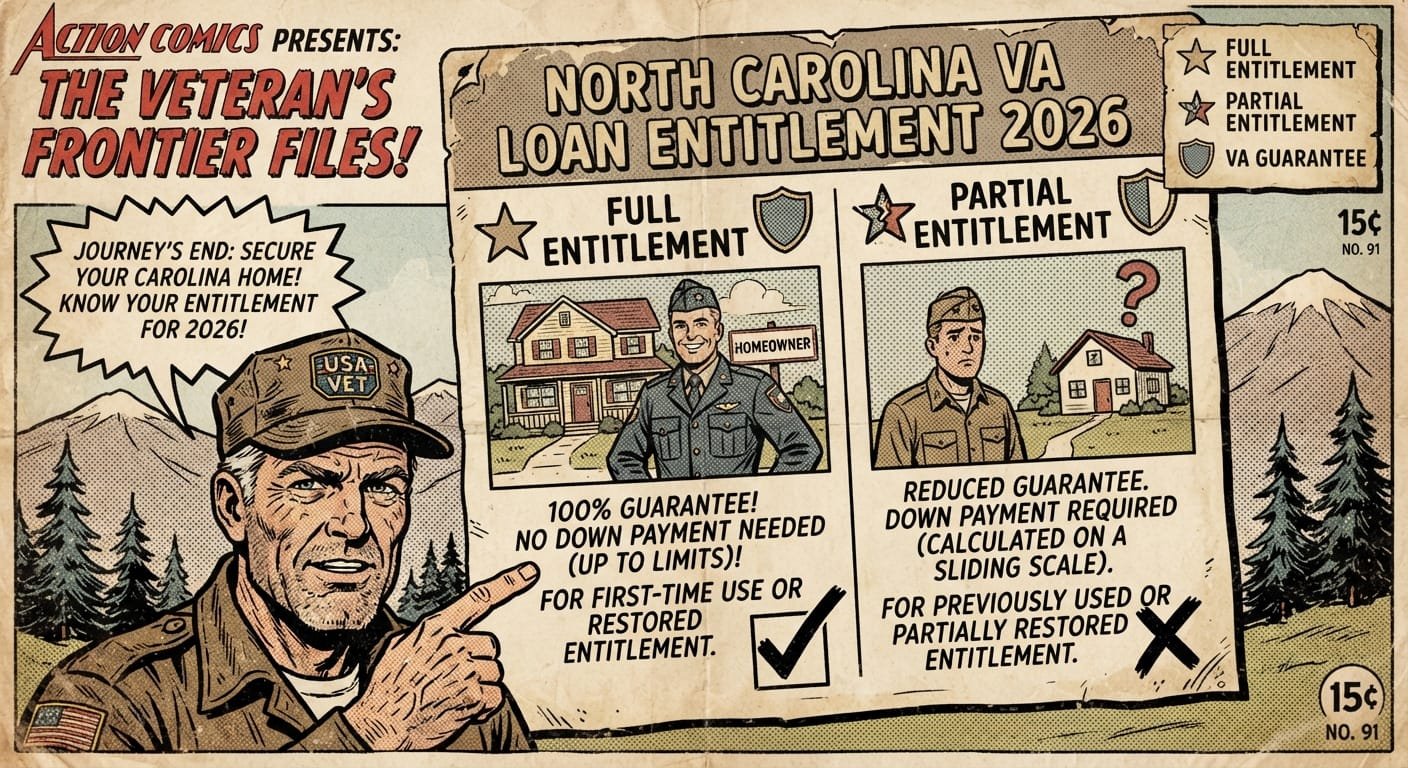
In North Carolina, full VA loan entitlement means no loan limit — the VA backs 25% of whatever a lender approves with $0 down. Partial entitlement is capped at the 2026 conforming limit of **$832,750** in all 100 North Carolina counties. Your Certificate of Eligibility shows your exact entitlement.
Quick Facts
| Item | Details |
|---|---|
| Benefit | VA home loan guaranty — $0 down, no PMI, competitive rates |
| Eligibility | Veterans, active duty, National Guard, Reservists, surviving spouses |
| Application | VA Form 26-1880 or online via VA.gov |
| Processing Time | 5–10 business days online; 2–4 weeks by mail |
| Official Agency | U.S. Department of Veterans Affairs (VA) |
| Required Forms | VA Form 26-1880 (COE); DD-214 or service records |
| Updated For | 2026 North Carolina conforming loan limits (FHFA) |
How VA Loan Entitlement Works in North Carolina in 2026
VA loan entitlement is the portion of your mortgage that the Department of Veterans Affairs guarantees to your lender. It is not cash you receive — it is a federal backstop that allows lenders to offer VA loans with $0 down and no private mortgage insurance (PMI).

The VA’s guaranty is 25% of the loan amount for loans above $144,000. As long as the VA can guarantee a full 25%, your lender generally does not require a down payment, regardless of the purchase price.

There are two entitlement statuses: full entitlement and partial (remaining) entitlement. Which one you have determines whether 2026 North Carolina VA loan limits apply to your purchase.
Full Entitlement in North Carolina: No Loan Limit
If you have full entitlement, the VA does not set a loan limit in North Carolina or anywhere else. You can borrow as much as a lender approves — $900,000, $1.5 million, or more — with no down payment required, as long as you qualify based on income, credit, residual income, and debt-to-income ratio.
You have full entitlement if:
You have never used a VA loan.
You used a VA loan previously, sold the property, and paid the loan in full.
You used a VA loan previously and requested a one-time restoration of entitlement (available once in your lifetime without selling or paying off the loan).
Your Certificate of Eligibility (COE) will show a basic entitlement of $36,000 if you have full entitlement. That figure represents the first tier of your guaranty — it does not cap your borrowing power in North Carolina when you have full entitlement.
Partial Entitlement in North Carolina: 2026 County Limits Apply
Veterans May Qualify for Extra Benefits
Check available financial assistance, healthcare programs and other opportunities that may apply to you.
Check EligibilityIf you have an active VA loan or a previous VA loan that was not fully resolved, part of your entitlement is tied up. You have partial entitlement, sometimes called remaining entitlement or second-tier entitlement.
With partial entitlement in North Carolina, the 2026 conforming loan limit applies. The standard limit is **$832,750** for all 100 North Carolina counties — a 3.3% increase from $806,500 in 2025. North Carolina has no designated high-cost counties with elevated VA loan limits.
The math works like this: The VA can guarantee 25% of the county loan limit. At the 2026 North Carolina baseline of $832,750, that equals **$208,188** in maximum guaranty. If you have $60,000 of entitlement tied to an existing loan, your remaining entitlement is $148,188. Multiply that by four, and you can borrow up to **$592,750** with $0 down in North Carolina. Anything above that would require a down payment equal to 25% of the difference.
| Entitlement Status | 2026 NC Loan Limit | $0 Down Borrowing Power |
|---|---|---|
| Full Entitlement | None | Whatever the lender approves |
| Partial Entitlement (no existing loan balance) | $832,750 (all 100 counties) | Up to $832,750 |
| Partial Entitlement (existing loan balance) | $832,750 minus tied-up entitlement | (Remaining entitlement × 4) |
2026 North Carolina VA Loan Limits by County
The 2026 conforming loan limit for every North Carolina county is $832,750 for a one-unit property. This applies to Veterans with partial entitlement only. Veterans with full entitlement face no VA loan limit in North Carolina.
| County | 2026 VA Loan Limit (1-Unit) | Notes |
|---|---|---|
| Wake County | $832,750 | Raleigh metro |
| Mecklenburg County | $832,750 | Charlotte metro |
| Cumberland County | $832,750 | Fayetteville / Fort Liberty |
| Onslow County | $832,750 | Jacksonville / Camp Lejeune |
| Guilford County | $832,750 | Greensboro |
| Forsyth County | $832,750 | Winston-Salem |
| Durham County | $832,750 | Durham |
| Buncombe County | $832,750 | Asheville |
| New Hanover County | $832,750 | Wilmington |
| All other NC counties | $832,750 | Standard baseline |
The increase from 2025 to 2026 translates to $26,250 in additional zero-down borrowing power for partial-entitlement borrowers in North Carolina.
How to Check Your North Carolina County Limit
Visit the FHFA Conforming Loan Limit Values Map on fhfa.gov or use the VA loan limit calculator on a VA-focused lender’s website. Enter the North Carolina property address or county name to see the applicable limit.
Who Qualifies for VA Loan Entitlement in North Carolina in 2026?
VA loan eligibility in North Carolina is based on federal military service requirements, not North Carolina residency. You must have a discharge that is other than dishonorable for every period of service.
Service Requirements by Era
| Era Served | Minimum Active Duty |
|---|---|
| Gulf War era (Aug 2, 1990 – present) | 24 continuous months, or full period called (at least 90 days) |
| Sept 8, 1980 – Aug 1, 1990 | 24 continuous months, or full period called (at least 181 days) |
| Vietnam (Aug 5, 1964 – May 7, 1975) | 90 total days |
| Korea (June 27, 1950 – Jan 31, 1955) | 90 total days |
| WWII (Sept 16, 1940 – July 25, 1947) | 90 total days |
| Peacetime (between major conflicts) | 181 days continuous active duty |
National Guard and Reserve members qualify after 6 years of service in the Selected Reserve or National Guard, or after serving 90 days of active duty under Title 10 or Title 32 orders.
North Carolina Military Installations and Veteran Population
North Carolina’s VA loan market is driven by several major military hubs:
Fort Liberty (formerly Fort Bragg) — the most populous U.S. Army installation, supporting nearly 50,000 active-duty soldiers across the 82nd Airborne Division, US Army Special Operations Command, and Joint Special Operations Command.
Camp Lejeune — Marine Corps base in Jacksonville, Onslow County.
MCAS Cherry Point — Marine Corps air station in Havelock.
Seymour Johnson AFB — Air Force base in Goldsboro.
Coast Guard Air Station Elizabeth City — Coast Guard installation.
Active-duty, Guard, and Reserve members are buying across the Fayetteville, Jacksonville, Raleigh, Charlotte, and Greensboro corridors. The median home price in Fayetteville is approximately $210,000**, while the median in Jacksonville is approximately **$245,000.
Surviving Spouse Eligibility in North Carolina
An unmarried surviving spouse may qualify for VA loan entitlement in North Carolina if the Veteran died in service, from a service-connected disability, or was missing in action or a prisoner of war. Remarriage before age 57 (or before December 16, 2003) generally disqualifies the spouse unless they remarried on or after their 57th birthday.
How to Apply for VA Loan Entitlement in North Carolina: Step-by-Step
Getting your Certificate of Eligibility (COE) is the first step in using your VA loan benefit in North Carolina. Your lender will need the COE to verify your entitlement and process your loan.
Method 1: Online (Fastest)
Go to VA.gov and sign in with your DS Logon, ID.me, or My HealtheVet account.
Navigate to the housing assistance section and select Request a COE.
Complete the online application. The system pulls your service records automatically for most Veterans.
Receive your COE within 5–10 business days (often faster).
Method 2: By Mail
Download VA Form 26-1880 (Request for a Certificate of Eligibility) from VA.gov.
Complete the form and gather supporting documents: DD-214 (or equivalent), and for Guard/Reserve members, a Points Summary Statement (NGB Form 22 or equivalent).
Mail the form and documents to the VA Regional Loan Center address printed on the last page of the form. For North Carolina, the relevant regional loan center is in Winston-Salem, North Carolina.
Processing takes 2–4 weeks by mail.
Method 3: Through Your North Carolina Lender (Fastest Option)
Many VA-approved lenders in North Carolina can request your COE directly through the VA’s WebLGY system. This is often the fastest route — some North Carolina lenders receive the COE the same day. Ask your loan officer if they offer this service.
Required Documents for North Carolina Applicants
| Applicant Type | Documents Needed |
|---|---|
| Veteran | DD-214 or separation documents |
| Active Duty | Statement of Service (signed by commander) |
| National Guard/Reserve | NGB Form 22, Points Summary, or NOBE |
| Surviving Spouse | DD-1300, marriage certificate, Veteran’s DD-214 |
| Purple Heart Recipient | Purple Heart orders or citation |
Understanding Your North Carolina COE: What the Numbers Mean
Your Certificate of Eligibility shows several key figures. Here is what each one means for a North Carolina purchase.
**Basic Entitlement: $36,000.** This is the first tier of your VA guaranty. It covers loans up to $144,000. If you have full entitlement, this figure appears on your COE, but it does not limit your borrowing power in North Carolina — bonus entitlement extends beyond it.
Bonus Entitlement. For loans above $144,000, the VA provides additional guaranty up to 25% of the loan amount (or 25% of the county loan limit, if you have partial entitlement). This is sometimes called second-tier entitlement. With full entitlement, bonus entitlement has no cap. With partial entitlement, it is capped by the North Carolina county limit.
Entitlement Charge. If you have an existing VA loan, your COE will show the amount of entitlement currently tied to that loan. Subtract that from the maximum guaranty to calculate your remaining entitlement for a North Carolina purchase.
Loan Limit. This field shows the applicable North Carolina county loan limit for the property location. If you have full entitlement, this field may say “No Limit” or show the county limit for reference only.
VA Funding Fees in North Carolina in 2026: What You’ll Pay
The VA funding fee is a one-time cost that funds the VA loan program. It is not the same as entitlement, but it affects your closing costs and is based on your entitlement status and down payment. The fee percentage does not change based on the North Carolina county where you buy.
| Down Payment | First Use (Full Entitlement) | Subsequent Use (Partial Entitlement) |
|---|---|---|
| 0% down | 2.15% | 3.3% |
| 5%–9.99% down | 1.50% | 1.50% |
| 10%+ down | 1.25% | 1.25% |
Veterans receiving VA disability compensation are exempt from the funding fee. Surviving spouses receiving Dependency and Indemnity Compensation (DIC) are also exempt. Active-duty Purple Heart recipients closing while on active duty are exempt. For 2026, the VA funding fee is also tax-deductible for qualifying Veterans.
North Carolina Example: On a $400,000 loan with 0% down, a first-time user pays $8,600 in funding fees (2.15%). A subsequent user pays $13,200 (3.3%). A disabled Veteran pays $0.
Funding Fee Refunds in North Carolina
If you paid the VA funding fee and are later awarded VA compensation for a service-connected disability with an effective date retroactive to before your North Carolina loan closing, you may be eligible for a refund. Call your VA regional loan center to initiate the refund process.
How to Restore VA Loan Entitlement in North Carolina
Your entitlement can be restored so you can use your VA loan benefit again in North Carolina. There are two paths.
Full Restoration (After Selling and Paying Off)
The most common path: sell the North Carolina property and pay off the VA loan in full. Once the loan is paid off and the property is sold, your entitlement is fully restored. You return to full entitlement status with no VA loan limit.
One-Time Restoration (Without Selling)
You can request a one-time restoration of entitlement without selling the North Carolina home or paying off the original loan. This option is available once in your lifetime. It is commonly used for cash-out refinance purposes or when you need to purchase a new primary residence in North Carolina while retaining the old one.
Partial Restoration (After Loan Assumption)
If someone assumes your VA loan, your entitlement remains tied to the property until the loan is paid in full — either by the new borrower refinancing or eventually paying off the balance. At that point, your entitlement is restored.
How to Apply for Restoration in North Carolina
Obtain a new COE through VA.gov or by submitting VA Form 26-1880.
If requesting one-time restoration, submit a written request to the VA Regional Loan Center explaining the circumstances.
Provide documentation: payoff statement, settlement statement, or assumption documents.
Having Two VA Loans at Once in North Carolina
Yes. There is no limit to the number of VA loans you can have at the same time in North Carolina, as long as you have sufficient remaining entitlement and meet lender requirements.
This commonly happens when a service member receives PCS orders to or from Fort Liberty, Camp Lejeune, or another North Carolina installation and keeps the original home as a rental while buying a new primary residence at the new duty station.
North Carolina Example: A staff sergeant buys a $300,000 home near Fort Liberty using a VA loan. A few years later, he receives PCS orders to Joint Base San Antonio. The original VA loan balance is still tied to part of his entitlement, but he decides to keep the North Carolina home as a rental because the local market is strong. He now wants to buy a $400,000 home in Texas using another VA loan. Because he still has remaining entitlement available, he may qualify for a second VA loan without having to sell the first home.
The key requirement: your remaining entitlement must be enough to guarantee 25% of the new loan for a zero-down purchase. If it is not, you may need a down payment to fill the gap.
North Carolina-Specific Benefits for Veterans
North Carolina Disabled Veteran Property Tax Exclusion
North Carolina excludes $45,000 of the appraised value of a permanent residence owned and occupied by a qualifying owner who is an Honorably Discharged Veteran with a 100% total and permanent service-connected disability or the unmarried surviving spouse. There is no age or income limitation on this program. The application deadline is June 1, 2026.
To apply, complete Form AV-9 (Application for Property Tax Relief) and Form NCDVA-9 (Certification of Veteran Disability). File with your county assessor by June 1.
Note: House Bill 118 has been introduced in the North Carolina General Assembly to increase the disabled Veteran property tax exclusion from $45,000 to **$61,000**, effective for taxable years beginning on or after July 1, 2026. Check with your county assessor for the latest status.
NC 1st Home Advantage Down Payment Program
The NC Housing Finance Agency (NCHFA) offers the NC 1st Home Advantage Down Payment program, which provides between $8,000 and $15,000 in down payment assistance to eligible first-time buyers, including Military Veterans. It is a 0% interest, deferred second mortgage that begins forgiving at 20% per year after year 11, with complete forgiveness if you remain in the home for 15 years.
Many Veterans use these funds to cover closing costs or offset the VA funding fee. Contact a participating NCHFA lender for current program details.
North Carolina Property Taxes
North Carolina property tax rates vary by county, but Cumberland County’s effective property tax rate is approximately 1.00%. The state income tax rate is 4.5% flat as of 2026.
VA Loan Entitlement vs. Other VA Benefits in North Carolina
VA loan entitlement is separate from other VA benefits. Using your VA loan in North Carolina does not reduce your:
VA disability compensation (monthly payments)
GI Bill education benefits
VA healthcare enrollment at the Fayetteville VA Medical Center or Durham VA Medical Center
VA pension eligibility
These benefits operate independently. You can use your VA loan, receive disability compensation, and use the GI Bill simultaneously.
Common Mistakes North Carolina Veterans Make
1. Assuming “no VA loan limit” means “no limit at all.” With full entitlement in North Carolina, the VA sets no loan cap — but your lender still underwrites you. Income, credit score, debt-to-income ratio, and residual income determine how much you can actually borrow.
2. Forgetting that partial entitlement changes the North Carolina math. If you have an active VA loan, your zero-down borrowing power is limited by the North Carolina county loan limit. Run the numbers before house hunting in Raleigh, Charlotte, or Fayetteville.
3. Not requesting the one-time restoration. If you want to buy a new North Carolina home without selling the old one, the one-time restoration option can free up entitlement. Many Veterans do not know this option exists.
4. Missing the funding fee exemption. Disabled Veterans and surviving spouses receiving DIC are exempt from the funding fee. If you qualify, ensure your lender applies the exemption — it can save thousands.
5. Using the wrong form for surviving spouses. Surviving spouses use VA Form 26-1817 (Request for Determination of Loan Guaranty Eligibility), not VA Form 26-1880. Using the wrong form delays processing.
6. Assuming entitlement is gone forever after a foreclosure. If the VA suffered a loss on your loan, you may owe a debt to the VA before entitlement can be restored. Contact the VA’s Debt Management Center to resolve.
7. Not checking North Carolina-specific property tax benefits. The North Carolina disabled Veteran property tax exclusion can save $45,000 of assessed value from taxation. Apply through your county assessor by June 1.
8. Not exploring NCHFA down payment assistance. The NC 1st Home Advantage Down Payment program provides $8,000 to $15,000 in assistance that can be layered with a VA loan. Many Veterans do not know this program exists.
Common Questions
How much VA loan entitlement do I have in North Carolina in 2026?
If you have never used a VA loan or have restored entitlement, you have full entitlement — no VA loan limit in North Carolina in 2026. Your COE will show $36,000 basic entitlement, but your borrowing power is not capped. If you have an active VA loan, you have **partial entitlement**, and your zero-down limit is tied to the 2026 North Carolina conforming loan limit of $832,750 in all 100 counties.
What is the VA loan limit in Wake County, NC for 2026?
The 2026 VA loan limit for Wake County is $832,750 for a one-unit property. This limit applies only to Veterans with partial entitlement. Veterans with full entitlement have no VA loan limit in Wake County or anywhere else in North Carolina.
What is the VA loan limit in Cumberland County, NC for 2026?
The 2026 VA loan limit for Cumberland County (Fayetteville / Fort Liberty) is **$832,750** for a one-unit property. Note that some sources cite $806,500 for Cumberland County, but the 2026 FHFA baseline is $832,750. Always verify with your lender.
Can I have two VA loans at the same time in North Carolina?
Yes, if you have sufficient remaining entitlement. There is no limit to the number of VA loans you can have simultaneously. This commonly occurs when service members receive PCS orders to or from Fort Liberty or Camp Lejeune and keep a previous North Carolina home as a rental while buying a new primary residence.
How do I restore my VA loan entitlement in North Carolina?
You can restore entitlement by selling the North Carolina property and paying off the VA loan in full, or by requesting a one-time restoration without selling. The one-time option is available once in your lifetime. After restoration, you return to full entitlement status with no VA loan limit.
What is the VA funding fee in North Carolina in 2026?
The funding fee is 2.15% for first-time users with 0% down and 3.3% for subsequent users with 0% down. It drops to 1.50% with 5%–9.99% down and 1.25% with 10%+ down. Disabled Veterans and surviving spouses receiving DIC are exempt. For 2026, the funding fee is also tax-deductible.
Can I use a VA loan after a foreclosure in North Carolina?
Possibly. If the VA suffered a loss on your previous loan, you may owe a debt to the VA. You must repay that debt before entitlement can be restored. A two-year waiting period may apply after foreclosure or short sale.
Do National Guard and Reserve members qualify for VA loan entitlement in North Carolina?
Yes, after 6 years of service in the Selected Reserve or National Guard, or after 90 days of active duty under Title 10 or Title 32 orders. North Carolina has a significant National Guard presence across the state.
How long does it take to get a Certificate of Eligibility in North Carolina?
Online applications through VA.gov typically process in 5–10 business days, often faster. Mail applications take 2–4 weeks. Some North Carolina lenders can request the COE directly through the VA’s WebLGY system for same-day results.
Does using a VA loan affect my VA disability benefits in North Carolina?
No. VA loan entitlement is separate from VA disability compensation, GI Bill benefits, and VA healthcare. Using your VA loan does not reduce or affect any other VA benefit you receive.
What is the North Carolina disabled Veteran property tax exclusion?
North Carolina excludes $45,000 of the appraised value of a permanent residence for Veterans with a 100% total and permanent service-connected disability or their unmarried surviving spouse. There is no age or income limit. Apply by June 1 using Forms AV-9 and NCDVA-9.
Can I use NCHFA down payment assistance with a VA loan in North Carolina?
Yes. The NC 1st Home Advantage Down Payment program provides $8,000 to $15,000 in assistance to eligible first-time buyers, including Military Veterans. It is a 0% interest, deferred second mortgage that forgives over 15 years. Contact a participating NCHFA lender for details.
What is the VA loan limit in Mecklenburg County, NC for 2026?
The 2026 VA loan limit for Mecklenburg County (Charlotte) is $832,750 for a one-unit property. This applies to partial-entitlement borrowers only. Average annual VA loans in Mecklenburg County were 1,130 from fiscal years 2023 through 2025.
Does North Carolina have any high-cost VA loan counties?
No. North Carolina has 100 counties, with no designated high-cost areas with elevated VA loan limits. All counties use the standard 2026 conforming loan limit of $832,750 for one-unit properties.
Key Takeaways
Full entitlement means no VA loan limit in North Carolina in 2026. The VA backs 25% of whatever a lender approves, with no dollar cap.
Partial entitlement is tied to the 2026 North Carolina conforming loan limit of $832,750 in all 100 counties. North Carolina has no high-cost counties.
Basic entitlement is $36,000, but bonus entitlement extends your guaranty to 25% of the loan amount.
You can have two VA loans at once in North Carolina if you have sufficient remaining entitlement.
Entitlement restoration is available after selling and paying off, or through a one-time restoration without selling.
Funding fees in 2026 are 2.15% for first use and 3.3% for subsequent use with 0% down. Disabled Veterans are exempt. The fee is tax-deductible in 2026.
North Carolina offers a $45,000 property tax exclusion for 100% disabled Veterans and their unmarried surviving spouses. Apply by June 1.
NCHFA provides $8,000 to $15,000 in down payment assistance through the NC 1st Home Advantage program, which can be layered with a VA loan.
Apply for your COE using VA Form 26-1880 or online through VA.gov.
VA loan entitlement does not expire and does not reduce other VA benefits.
Official Resources
VA Home Loan Eligibility: https://www.va.gov/housing-assistance/home-loans/eligibility/
VA Form 26-1880 (Request for COE): https://www.va.gov/forms/26-1880/
VA Form 26-1817 (Surviving Spouse COE): https://www.va.gov/forms/26-1817/
FHFA Conforming Loan Limit Map: https://www.fhfa.gov/data/dashboard/conforming-loan-limit-values-map
VA Funding Fee and Closing Costs: https://www.va.gov/housing-assistance/home-loans/funding-fee-and-closing-costs/
VA Regional Loan Centers: https://www.benefits.va.gov/homeloans/contact_rlc_info.asp
NC Housing Finance Agency (NCHFA): https://www.nchfa.com
NC Department of Military and Veterans Affairs: https://www.milvets.nc.gov
Consumer Financial Protection Bureau (CFPB): https://www.consumerfinance.gov
USA.gov Veterans Benefits: https://www.usa.gov/veterans-benefits



🇺🇸 IMPORTANT DISCLAIMER – Veterans Benefits Information
This site provides general information about U.S. Department of Veterans Affairs (VA) benefits for educational and informational purposes only.
- Not Official: We are NOT affiliated with, endorsed by, or connected to the U.S. Department of Veterans Affairs (VA), the Veterans Benefits Administration (VBA), the Veterans Health Administration (VHA), or any other government agency.
- No Legal/Financial Advice: The content on this website is for informational purposes only and does not constitute legal, financial, or medical advice. VA benefits rules change frequently – always consult with an accredited Veterans Service Officer (VSO) or a qualified professional for your specific situation.
- Official Sources: For official, binding information and to apply for benefits, always visit official .gov websites: VA.gov, Benefits.VA.gov, or SSA.gov.
- No Data Collection: This site does not collect, store, or process any personal information. It does not have login forms, contact forms, or any system to capture user data. We never ask for your Social Security Number, bank details, or any personal information.
- 🚨 Scam Alert: The VA and other government agencies never charge fees for benefit applications. If anyone asks for money to "process" your VA claim, it is a scam. Report it to the VA Office of Inspector General at VA.gov/OIG.
- Advertising: This site uses third-party advertising (Adsterra) to cover operational costs. We do not endorse or guarantee any products or services advertised.
📌 Information provided as of June 2026. Always verify current eligibility and rules with official .gov sources.
This site is not affiliated with the U.S. Department of Veterans Affairs or any government agency. All information is for educational purposes only. Please visit VA.gov for official information.
