
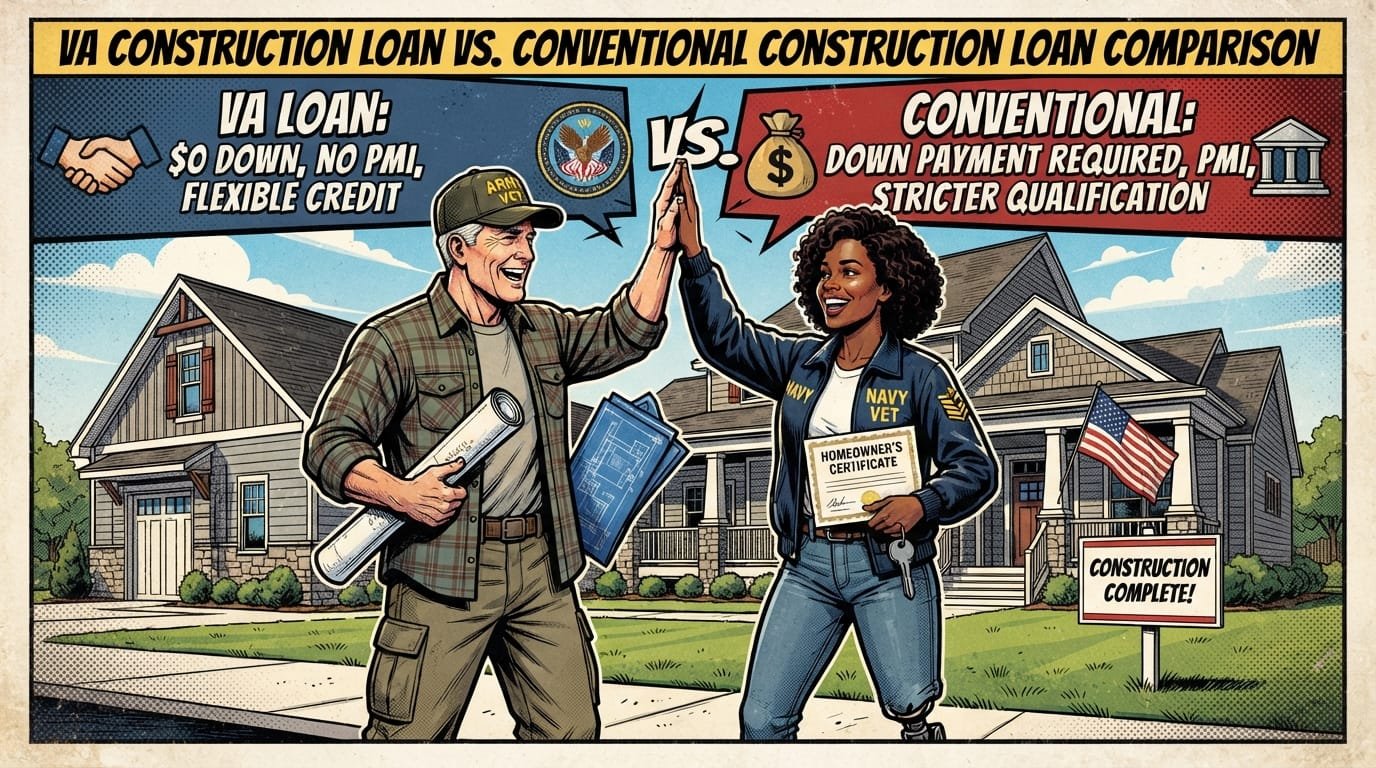
VA Construction Loans: The Complete 2026 Guide for Veterans
A VA construction loan is a VA-guaranteed mortgage that finances the building of a new home on land the veteran owns or purchases. Eligible veterans, active-duty service members, and qualifying surviving spouses can build with no down payment, no private mortgage insurance, and competitive interest rates. The builder must be licensed and insured. The loan converts to permanent VA financing when construction is complete.
Quick Facts
| Item | Details |
|---|---|
| Benefit | $0 down VA-guaranteed financing for new home construction |
| Eligibility | Veterans, active duty, National Guard/Reservists, qualifying surviving spouses with a valid COE |
| Credit Score | No VA minimum; most lenders require 620–640 |
| Application | Through a VA-approved lender; COE required |
| Processing Time | 12–18 months for build; 40–60 days for loan closing |
| Official Agency | U.S. Department of Veterans Affairs (VA) |
| Required Forms | COE (VA Form 26-1880), VA Form 26-1805, VA Form 26-8937 |
| Funding Fee | 2.15% first use; 3.3% subsequent use (waived for disabled veterans) |
| Updated For | 2026 loan limits and funding fee rates |
What Is a VA Construction Loan?
A VA construction loan is a mortgage guaranteed by the U.S. Department of Veterans Affairs that finances the construction of a new home. The VA does not lend money directly. Instead, it guarantees a portion of the loan made by a private lender, reducing the lender’s risk and allowing the veteran to obtain favorable terms.

The VA-guaranteed construction loan functions as a two-part transaction in most cases: a construction phase and a permanent financing phase. The construction phase provides funds to build the home. The permanent phase converts the loan into a standard VA mortgage with a long-term repayment schedule.

Why it matters: VA construction loans offer benefits that conventional construction loans do not, including zero down payment, no private mortgage insurance, and competitive interest rates. The VA funding fee is also lower for construction loans than for some other VA loan types.
What veterans should do next: Confirm your VA entitlement, obtain a Certificate of Eligibility (COE), and contact a VA-approved lender that specializes in construction financing. Not all VA lenders offer construction loans.
Types of VA Construction Loans
VA construction loans come in two primary structures. The right choice depends on your financing needs, cash reserves, and tolerance for two closings.
One-Time Close (Construction-to-Permanent)
A one-time close loan, also called a construction-to-permanent loan, combines the construction financing and the permanent mortgage into a single transaction. The veteran closes once before construction begins. The loan automatically converts to a permanent VA mortgage when the home is complete.
Veterans May Qualify for Extra Benefits
Check available financial assistance, healthcare programs and other opportunities that may apply to you.
Check EligibilityKey features:
One application, one closing
Interest rate locked before construction starts
Construction financing and permanent financing in one loan
Fewer fees than two separate closings
VA prohibits the lender from charging interest until the certificate of occupancy is issued
The VA requires that the loan vehicle be established at closing. A one-time close cannot be converted into a two-time close after closing, and vice versa.
Two-Time Close (Construction Then Permanent)
A two-time close loan involves two separate transactions. The first is a non-VA interim construction loan that funds the build. The second is a VA-guaranteed permanent mortgage that refinances the interim loan after construction is complete.
Key features:
Two closings, two sets of fees
Construction financing may come from a different lender than the permanent VA loan
The permanent VA loan is not guaranteed until the second closing
More flexibility in construction financing options
Which is better? Most veterans choose the one-time close because it simplifies the process and locks in permanent financing before construction starts. The two-time close may be useful if the veteran’s financial situation is expected to change during construction or if the interim lender offers terms that are unavailable through a one-time close.
Who Qualifies for a VA Construction Loan?
The eligibility requirements for a VA construction loan mirror those for a standard VA purchase loan. The borrower must be an eligible veteran, active-duty service member, National Guard member, Reservist, or qualifying surviving spouse.
Service Requirements
| Service Category | Minimum Requirement |
|---|---|
| Wartime veteran | 90 days of active service |
| Peacetime veteran | 181 days of continuous active service |
| National Guard/Reserves | 6 years of service, or 90 days of Title 10 active duty |
| Active duty | 90 continuous days of service |
| Surviving spouse | Unremarried spouse of a veteran who died in service or from a service-connected disability |
Credit and Income Requirements
The VA does not set a minimum credit score for construction loans. Most lenders, however, impose their own minimums, typically between 620 and 640. Borrowers should also expect to provide:
Two years of stable income documentation
Proof of assets and reserves
Complete credit history
Debt-to-income ratio generally at or below 41%, though exceptions exist
Property Requirements
The home must be the borrower’s primary residence. The property must meet VA Minimum Property Requirements (MPRs) for safety, structure, and sanitation. The finished home must have a permanent foundation, a permanent heat source, adequate water and sewer, and usable road access.
What veterans should do next: Request your COE through VA.gov or your lender. Confirm your available entitlement. Gather income and asset documentation. Begin researching VA-approved builders in your area.
How the VA Construction Loan Process Works
The VA construction loan process is more complex than a standard VA purchase loan. It involves multiple stages, from land evaluation to final inspection and loan conversion.
Step-by-Step Process
1. Obtain Your Certificate of Eligibility (COE).
The COE confirms your VA entitlement. You can request it online through VA.gov, through your lender, or by mail using VA Form 26-1880.
2. Select a Licensed, Insured Builder.
The VA does not allow owner/builders. Your builder must be licensed in the state where the home is built and carry general liability and workers’ compensation insurance. The VA eliminated the Builder ID requirement in March 2025, but builders must still comply with state and local licensing requirements. Most lenders also impose their own builder approval standards, including minimum years of experience and completed homes.
3. Submit Construction Plans and Specifications.
The lender and VA appraiser need detailed plans, a construction budget, a project timeline, and a signed contract with your builder. The appraisal for proposed construction is based on these plans and specifications.
4. Appraisal and Underwriting.
The VA appraiser evaluates the plans and the lot. The appraisal establishes the reasonable value of the completed home. The lender underwrites the loan based on the appraisal, your income, assets, and credit profile.
5. Close the Construction Loan.
At closing, funds are disbursed into an escrow or draw account. The builder receives payments at predetermined construction milestones.
6. Construction Phase and Draw Schedule.
Funds are released to the builder in stages called draws. Each draw requires an inspection to verify that the work billed has been completed. The veteran must provide written approval before each disbursement. Draw schedules typically include four to six milestones from groundbreaking to move-in.
7. Final Inspection and Certificate of Occupancy.
Once construction is complete, a final inspection confirms the home meets VA MPRs. The local authority issues a certificate of occupancy.
8. Conversion to Permanent Financing.
For one-time close loans, the construction loan automatically converts to a permanent VA mortgage. For two-time close loans, the veteran closes on a separate VA permanent loan to refinance the interim construction loan.
VA Construction Loan Draw Schedule and Inspections
A draw schedule is the plan that determines when and how loan funds are released to the builder during construction. Most VA construction draw schedules include between four and six milestones from groundbreaking to move-in.
Typical Draw Milestones
| Draw | Milestone | Typical Percentage |
|---|---|---|
| 1 | Land payoff, permits, site prep | 15–25% |
| 2 | Foundation | 15–20% |
| 3 | Framing and dried-in | 20–30% |
| 4 | Mechanical, electrical, plumbing rough-in | 15–20% |
| 5 | Interior finishes and fixtures | 15–20% |
| 6 | Final completion and certificate of occupancy | 5–10% |
How inspections work: Before each draw is released, the lender orders an inspection to confirm that the work associated with that draw has been completed. The inspection protects the veteran by verifying that work billed matches the approved plans. The VA also requires the lender to obtain the veteran’s written approval before each disbursement to the builder.
Why it matters: The draw schedule keeps construction funds aligned with actual progress. It also gives the veteran visibility into the builder’s performance and the project’s financial health.
VA Construction Loan Funding Fee
The VA funding fee for a construction loan follows the same structure as a standard VA purchase loan. The fee is a one-time cost that supports the VA loan program.
| Down Payment | First Use | Subsequent Use |
|---|---|---|
| Less than 5% | 2.15% | 3.30% |
| 5% to 9.99% | 1.50% | 1.50% |
| 10% or more | 1.25% | 1.25% |
Example: On a $400,000 construction loan with less than 5% down and first use, the funding fee is $8,600 (2.15% of the loan amount). This fee can be financed into the loan.
Exemptions: Veterans receiving VA disability compensation are exempt from the VA funding fee. Surviving spouses who are eligible for the VA loan benefit are also exempt. Lenders must document the exemption.
What veterans should do next: Confirm your exemption status with your lender before closing. If you are exempt, ensure the funding fee is not included in your loan amount.
Required Documents and VA Forms
VA construction loans require more documentation than standard VA purchase loans. The lender will request the following:
Core VA Forms
| Form | Purpose |
|---|---|
| VA Form 26-1880 | Request for Certificate of Eligibility (if not obtained online) |
| VA Form 26-1805 | Request for Determination of Reasonable Value (appraisal request) |
| VA Form 26-8937 | Verification of VA Benefits |
| VA Form 26-0592 | Counseling Checklist for Military Homebuyers (active duty only) |
Borrower Documentation
Government-issued photo ID
Social Security number
Two years of tax returns
Recent pay stubs (30 days)
Bank statements (two months)
Proof of assets and reserves
Divorce decree or child support orders (if applicable)
Bankruptcy discharge documentation (if applicable)
Builder Documentation
State contractor license
General liability insurance certificate
Workers’ compensation insurance certificate
One-year written warranty covering workmanship and materials
Construction contract with firm price basis
Detailed plans and specifications
Construction timeline and draw schedule
VA Construction Loan vs. Conventional Construction Loan
| Feature | VA Construction Loan | Conventional Construction Loan |
|---|---|---|
| Down payment | 0% for eligible veterans | 5%–20% |
| Private mortgage insurance | Not required | May be required |
| Credit score | No VA minimum; lenders typically 620–640 | Typically 680–720 |
| Funding fee | 2.15% first use (waived for disabled veterans) | None |
| Builder requirements | Licensed, insured, VA-compliant | Lender-specific |
| Appraisal | VA appraiser; MPRs apply | Conventional appraisal |
| Loan limits | No limit with full entitlement | County conforming limits apply |
| Interest rate | Typically 0.25%–0.5% lower than conventional | Market rate |
Common Mistakes to Avoid
1. Hiring a builder before confirming lender requirements.
Every lender has its own builder approval process. Some require minimum years of experience, a minimum number of completed homes, and specific insurance coverage. Confirm the lender’s builder requirements before signing a construction contract.
2. Underestimating the equity gap.
The VA loan is based on the appraised value of the completed home. If the cost to build exceeds the appraised value, the veteran must cover the difference in cash. This is rare but possible in rising-cost environments.
3. Making changes after construction starts.
Change orders are the single biggest reason construction projects go over budget. The VA allows change orders only with lender approval and, in many cases, requires the veteran to deposit the full cost of the change before the work proceeds. Avoid changes after framing or drywall.
4. Changing financial profile during construction.
Lenders may re-verify the borrower’s credit and employment before the permanent loan conversion. New debt, a job change, or a significant financial event during construction can jeopardize final approval.
5. Failing to budget for accrued interest.
The VA prohibits lenders from charging interest until the certificate of occupancy is issued. However, some lenders require an interest reserve to be included in the construction budget to cover the period after occupancy but before conversion. Ask your lender for a projected accrued interest figure before signing the builder contract.
6. Assuming all VA lenders offer construction loans.
The pool of lenders offering VA construction loans is smaller than the pool offering standard VA purchase loans. Specialized lenders with in-house construction departments are the best source for these products.
Recent Rule Changes (2025–2026)
Builder ID requirement eliminated (March 2025). VA Circular 26-25-1 rescinded the procedure for builders to request a VA builder identification number. Builders are no longer required to obtain a VA-issued Builder ID before the Notice of Value is issued. Builders must still hold a current state license and comply with local requirements.
Secondary financing guidance (2024). The VA clarified that assumers and construction borrowers may use secondary financing to cover gaps without violating VA requirements. The secondary loan does not need to be assumable.
2026 county loan limits. The VA aligned with FHFA’s 2026 conforming loan limits. The baseline limit is $832,750 for one-unit properties. High-cost areas have limits up to $1,249,125. Veterans with full entitlement are not subject to VA loan limits, but the limits determine maximum potential entitlement for veterans with used or compromised entitlement.
Common Questions
Can I use a VA construction loan to buy land and build?
Yes. A VA construction loan can finance both the land purchase and the home construction in a single transaction. The land is included in the appraised value of the completed property. The veteran must still meet VA eligibility and lender credit requirements.
What credit score do I need for a VA construction loan?
The VA does not set a minimum credit score. Most lenders require a 620 to 640 FICO score. Some lenders may accept lower scores with compensating factors such as large reserves or a low debt-to-income ratio.
Can I be my own builder with a VA construction loan?
No. The VA does not allow owner/builders. You must hire a licensed, insured builder who meets VA and lender requirements. The builder is responsible for the construction and must provide a one-year warranty.
How long does a VA construction loan take?
The loan closing typically takes 40 to 60 days after a complete application. Construction itself usually takes 12 to 18 months, depending on the builder, permits, weather, and local conditions. The total timeline from application to move-in is often 14 to 20 months.
What happens if construction costs exceed the appraised value?
The veteran must cover the difference in cash or reduce the scope of the project. The VA loan is limited to the appraised value of the completed home. Lenders may require additional documentation and approval before releasing funds for cost overruns.
Can I make changes to the home during construction?
Yes, but change orders require lender approval and must be funded before the work proceeds. The VA allows change orders on one-time close loans, but they can delay the project and increase costs. Avoid changes after framing.
Do I pay interest during construction?
No. The VA prohibits lenders from charging interest until the county issues the certificate of occupancy. However, some lenders include an interest reserve in the construction budget to cover the period after occupancy. Ask your lender for details.
Can I use my VA construction loan for a manufactured home?
The VA offers financing for manufactured homes, but the requirements differ from site-built construction. The home must be permanently affixed to a foundation and meet VA MPRs. Not all lenders offer VA construction loans for manufactured homes.
What is the VA funding fee for a construction loan?
The funding fee is 2.15% for first use with less than 5% down, and 3.30% for subsequent use with less than 5% down. The fee can be financed into the loan. Veterans receiving VA disability compensation are exempt.
Can I refinance a VA construction loan after completion?
Yes. Once the construction loan converts to permanent VA financing, the veteran may be eligible for a VA Interest Rate Reduction Refinance Loan (IRRRL) to lower the interest rate. The IRRRL is a streamlined VA-to-VA refinance with limited underwriting.
Key Takeaways
VA construction loans let eligible veterans build a home with no down payment and no private mortgage insurance.
The one-time close option combines construction and permanent financing into a single transaction with one closing.
The VA funding fee is 2.15% for first use and 3.30% for subsequent use, but it is waived for disabled veterans.
The builder must be licensed, insured, and compliant with state and local requirements. Owner/builders are not allowed.
Draw schedules release funds in stages, with inspections required before each disbursement.
The veteran must provide written approval before each draw payment to the builder.
The VA does not charge interest until the certificate of occupancy is issued.
Change orders are allowed but require lender approval and upfront funding.
The VA eliminated the Builder ID requirement in March 2025, but builders must still be licensed.
A VA construction loan can finance both the land purchase and the home construction.
Official Resources
VA Home Loan Program: VA.gov – Housing Assistance
Certificate of Eligibility: VA.gov – Request Your COE
VA Funding Fee Information: VA.gov – Funding Fee and Closing Costs
VA Lender’s Handbook (Chapter 7 – Construction Loans): Available through the VA’s Loan Guaranty Service
VA Circular 26-25-1: Builder ID requirement rescission




🇺🇸 IMPORTANT DISCLAIMER – Veterans Benefits Information
This site provides general information about U.S. Department of Veterans Affairs (VA) benefits for educational and informational purposes only.
- Not Official: We are NOT affiliated with, endorsed by, or connected to the U.S. Department of Veterans Affairs (VA), the Veterans Benefits Administration (VBA), the Veterans Health Administration (VHA), or any other government agency.
- No Legal/Financial Advice: The content on this website is for informational purposes only and does not constitute legal, financial, or medical advice. VA benefits rules change frequently – always consult with an accredited Veterans Service Officer (VSO) or a qualified professional for your specific situation.
- Official Sources: For official, binding information and to apply for benefits, always visit official .gov websites: VA.gov, Benefits.VA.gov, or SSA.gov.
- No Data Collection: This site does not collect, store, or process any personal information. It does not have login forms, contact forms, or any system to capture user data. We never ask for your Social Security Number, bank details, or any personal information.
- 🚨 Scam Alert: The VA and other government agencies never charge fees for benefit applications. If anyone asks for money to "process" your VA claim, it is a scam. Report it to the VA Office of Inspector General at VA.gov/OIG.
- Advertising: This site uses third-party advertising (Adsterra) to cover operational costs. We do not endorse or guarantee any products or services advertised.
📌 Information provided as of June 2026. Always verify current eligibility and rules with official .gov sources.
This site is not affiliated with the U.S. Department of Veterans Affairs or any government agency. All information is for educational purposes only. Please visit VA.gov for official information.
