
What Are the Easiest VA Disability Claims to Get Approved?
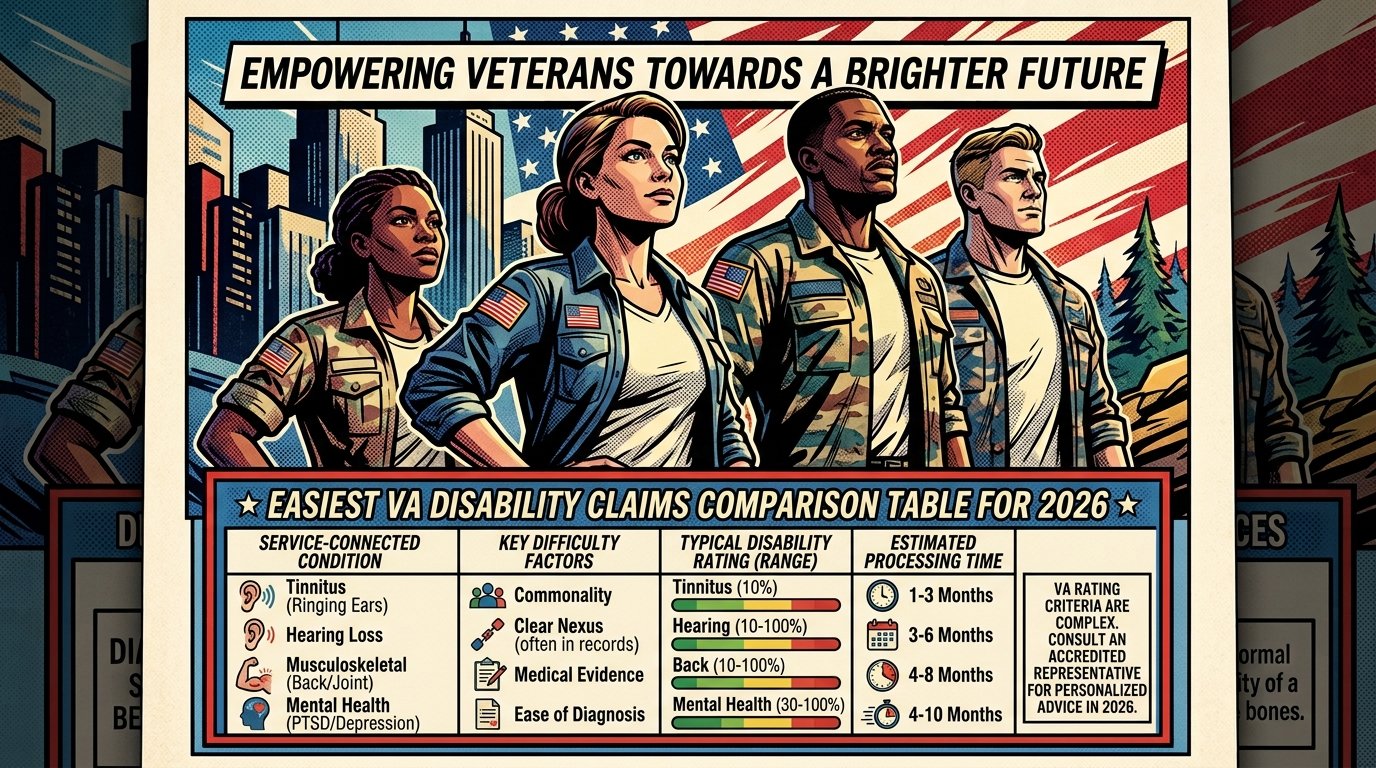
The easiest VA disability claims to get approved are tinnitus, hearing loss, PTSD with proper documentation, knee and back injuries, and presumptive conditions under the PACT Act. These conditions have clear diagnostic criteria, objective medical evidence, or legally presumed service connection. Tinnitus is the most commonly approved claim, rated at a flat 10 percent, and can be proven with a personal statement and documented noise exposure in service.
Quick Facts
| Item | Details |
|---|---|
| Benefit | VA disability compensation |
| Eligibility | Veterans with service-connected conditions |
| Application | VA Form 21-526EZ (online at VA.gov or by mail) |
| Processing Time | Average 75–80 days in 2026 |
| Official Agency | U.S. Department of Veterans Affairs (VA) |
| Required Forms | VA Form 21-526EZ; DD-214; medical evidence; nexus letter |
| Updated For | 2026 |
What Makes a VA Disability Claim “Easy”?
A VA disability claim is “easy” when it requires less evidence to prove service connection. All VA claims require three elements: a current diagnosis, an in-service event or injury, and a medical nexus linking the two. Easy claims bypass one or more of these elements through objective evidence, presumptive service connection, or the VA’s painful motion rule.

The Three Pillars of Service Connection
| Element | What It Means | How Easy Claims Satisfy It |
|---|---|---|
| Current Diagnosis | A medical provider confirms you have the condition | Objective tests (audiograms, X-rays) or clinical diagnosis |
| In-Service Event | Something happened during your military service that caused or worsened the condition | Documented in service records or established by personal statement |
| Nexus | A medical link between the in-service event and your current condition | Presumptive conditions do not require a nexus; MOS noise exposure establishes link for tinnitus |
What Makes Some Claims Easier
Objective medical evidence: Hearing loss, fractures, and spinal injuries can be confirmed with audiograms, X-rays, and MRIs. These leave little room for dispute.
Presumptive service connection: The PACT Act and other laws automatically presume certain conditions are service-connected based on where and when you served. No nexus required.
The painful motion rule: Under 38 CFR § 4.59, if a joint hurts when you move it, VA must assign at least the minimum compensable rating for that joint—typically 10 percent.
Self-reported symptoms: Tinnitus, migraines, and some mental health symptoms rely heavily on your personal account. With a credible stressor or noise exposure history, these claims are difficult to disprove.
The Top Easiest VA Disability Claims for 2026
The following conditions consistently have the highest approval rates and the most straightforward paths to service connection. Each entry explains what the condition is, how VA rates it, what evidence you need, and what to do next.
1. Tinnitus (Diagnostic Code 6260)

What it is: Tinnitus is ringing, buzzing, hissing, or other phantom sounds in the ears without an external source. It is the single most claimed VA disability, affecting more than 3.5 million veterans—56.5 percent of all veterans receiving compensation.
Who qualifies: Veterans with documented noise exposure during service. Combat arms, aviation, artillery, mechanics, and any role involving loud machinery or weapons fire are common qualifying occupations.
VA rating: Flat 10 percent. Tinnitus is the only condition with a fixed schedular rating regardless of severity. You cannot receive more than 10 percent for tinnitus alone.
Evidence needed:
Personal statement describing the ringing and when it started
Military Occupational Specialty (MOS) showing noise exposure
Statement from a buddy or family member who noticed symptoms
Medical record showing complaints of ringing in ears
Veterans May Qualify for Extra Benefits
Check available financial assistance, healthcare programs and other opportunities that may apply to you.
Check EligibilityWhy it’s easy: There is no objective test for tinnitus. VA relies on your credible report and the likelihood that your military job exposed you to loud noise. If your MOS involves noise and you report ringing, approval is highly likely.
What to do next: File VA Form 21-526EZ. In your personal statement, specify when the ringing began (during service or shortly after), which ear is affected, and how it affects your sleep or concentration.
2. Hearing Loss (Diagnostic Code 6100)
What it is: Hearing loss is reduced ability to hear sound, measured by audiometric testing. It is rated based on puretone threshold and speech discrimination scores.
Who qualifies: Veterans with audiograms showing hearing loss in frequencies consistent with noise exposure. Artillery, infantry, aviation, and mechanized units are common.
VA rating: 0 to 100 percent, based on the audiogram results. A 0 percent rating is common for mild hearing loss but still establishes service connection, which can be important for future claims.
Evidence needed:
Audiogram showing hearing loss
Military noise exposure history
Service Treatment Records (STRs) showing hearing complaints or hearing conservation program enrollment
MOS noise exposure documentation
Why it’s easy: Hearing loss is measured objectively. If your audiogram shows hearing loss in the frequencies damaged by noise (typically 3000–6000 Hz), and your service exposed you to noise, the claim is straightforward.
What to do next: Request an audiology exam through VA or a private provider. Ensure the audiogram includes speech discrimination scores. File the claim with your DD-214 and noise exposure documentation.
3. PTSD and Mental Health Conditions (Diagnostic Code 9411)
What it is: Post-traumatic stress disorder (PTSD) is a mental health condition triggered by experiencing or witnessing a traumatic event. VA also rates depression, anxiety, and other mental health conditions under the same general formula.
Who qualifies: Veterans with a current PTSD diagnosis, an in-service stressor, and a medical nexus. Combat veterans have streamlined approval paths. Military sexual trauma (MST) survivors have special relaxed evidentiary rules.
VA rating: 0 to 100 percent, based on occupational and social impairment. The most common rating is 70 percent, which pays $1,808.45 per month in 2026. A 70 percent PTSD rating alone meets the threshold for TDIU.
Evidence needed:
Current PTSD diagnosis from a qualified mental health provider
Detailed stressor statement with dates, locations, and units
Lay statements from spouse, family, or battle buddies
Mental health treatment records and medication history
Why it’s easy: PTSD is unique because the rating depends heavily on subjective testimony. Combat veterans with documented stressors have a direct path. Even non-combat PTSD can be approved with a credible stressor statement and medical nexus.
What to do next: Get a current diagnosis. Write a detailed stressor statement. File VA Form 21-526EZ. Prepare for your C&P exam by describing your worst symptoms, not your best days.
4. Knee and Back Injuries (Diagnostic Codes 5260, 5237, 5242)
What it is: Knee and back conditions include limitation of flexion, lumbosacral or cervical strain, degenerative arthritis, and intervertebral disc syndrome. These are among the most common musculoskeletal claims.
Who qualifies: Veterans with in-service injuries from physical training, ruck marches, lifting, falls, or repetitive stress. Back strain has an 89 percent approval rate when properly documented.
VA rating: Knee flexion limitation: 10 to 60 percent. Back strain: 10 to 100 percent, depending on range of motion. The painful motion rule guarantees at least 10 percent for any joint that hurts during movement.
Evidence needed:
Service Treatment Records showing injury or treatment
Current diagnosis with range-of-motion measurements
X-rays, MRIs, or CT scans
Personal statement describing daily functional limitations
Buddy statements if injuries were not documented
Why it’s easy: Musculoskeletal conditions dominate 67 percent of all claims. VA raters have established protocols and rating guidelines for these conditions. If you have imaging evidence and limited range of motion, approval is likely.
What to do next: Obtain current imaging. Request range-of-motion measurements from your provider. File the claim and emphasize flare-ups and functional loss, not just your best-day measurements.
5. Scars (Diagnostic Codes 7800-7805)
What it is: Scars from surgery, burns, or trauma. VA rates scars based on size, location, and whether they are painful or unstable.
Who qualifies: Veterans with service-connected scars from injuries, surgeries, or burns.
VA rating: 0 to 80 percent, depending on the number, size, and characteristics of scars. Second-degree burn scars are among the top 10 first-time claims.
Evidence needed:
Photographs of scars with a ruler for scale
Medical records documenting the injury or surgery
Personal statement describing pain, itching, or limited function
Why it’s easy: Scars are visible and measurable. There is no ambiguity—the evidence is right there. If the scar is from a service-connected injury or surgery, the claim is straightforward.
What to do next: Take clear photographs with a ruler. Note whether the scar is painful, unstable, or disfiguring. File the claim.
6. Migraines (Diagnostic Code 8100)
What it is: Migraines are recurring headaches with throbbing pain, often accompanied by nausea and sensitivity to light or sound.
Who qualifies: Veterans with service-connected migraines, including those secondary to PTSD, traumatic brain injury, or medication side effects.
VA rating: 0 to 50 percent, based on frequency and severity. Prostrating attacks occurring once a month are rated 30 percent; once every two to four months are rated 10 percent.
Evidence needed:
Headache log showing frequency, duration, and severity
Medical records documenting migraine diagnosis and treatment
Statements from family or coworkers describing impact
Nexus letter if claimed as secondary
Why it’s easy: Migraines are rated by frequency and severity, which you can document with a headache log. They can be claimed directly or secondary to PTSD, tinnitus, or other conditions.
What to do next: Keep a detailed headache log for at least three months. Document missed work, ER visits, and medication use. File the claim with your log and medical records.
7. Sciatica (Radiculopathy) (Diagnostic Code 8520)
What it is: Sciatica is pain, numbness, or weakness radiating along the sciatic nerve from the lower back into the leg. It is often caused by a back injury or condition.
Who qualifies: Veterans with service-connected back conditions or direct sciatic nerve damage.
VA rating: 10 to 80 percent, based on severity of nerve involvement. Moderate involvement is rated 20 percent per leg. Bilateral sciatica can be rated separately for each leg.
Evidence needed:
EMG or nerve conduction study
MRI or X-ray showing spinal compression
Medical records documenting radiating pain and weakness
Nexus letter if claimed as secondary to back condition
Why it’s easy: Sciatica is one of the most straightforward secondary claims because the anatomical connection between the back and sciatic nerve is well established. If you have a service-connected back condition, sciatica is a natural secondary claim.
What to do next: Get an EMG if possible. File sciatica as secondary to your back condition. Each affected leg can be rated separately.
8. Sleep Apnea (Diagnostic Code 6847)
What it is: Sleep apnea is a sleep disorder where breathing repeatedly stops and starts. It is often diagnosed through a sleep study.
Who qualifies: Veterans with a diagnosis of obstructive sleep apnea, often claimed as secondary to PTSD, rhinitis, or other conditions.
VA rating: 0 to 100 percent. The most common rating is 50 percent with documented CPAP use.
Evidence needed:
Sleep study results confirming apnea
CPAP prescription or compliance records
Nexus letter linking sleep apnea to service or a secondary condition
Buddy statements describing witnessed breathing pauses
Why it’s easy: If you have a sleep study diagnosis and CPAP use, the 50 percent rating is almost automatic. The challenge is establishing service connection, but secondary claims to PTSD are increasingly successful.
What to do next: Get a sleep study if you have symptoms. File as secondary to PTSD or rhinitis if you have a service-connected condition. Document CPAP compliance.
9. Sinusitis and Rhinitis (PACT Act Presumptive)
What it is: Chronic sinusitis is inflammation of the sinuses lasting 12 weeks or more. Rhinitis is inflammation of the nasal mucosa. Both are now presumptive under the PACT Act for qualifying veterans.
Who qualifies: Veterans who served in the Southwest Asia theater of operations (including Iraq, Afghanistan, and surrounding areas) or other qualifying locations during specific periods.
VA rating: Sinusitis: 0, 10, 30, or 50 percent. Rhinitis: 0 or 10 percent.
Evidence needed:
Diagnosis of chronic sinusitis or rhinitis
Proof of service in a qualifying location
Medical records showing chronic symptoms (nasal obstruction, discharge, facial pain)
Why it’s easy: Presumptive conditions do not require a nexus. If you have a diagnosis and served in a qualifying location, VA presumes your condition is service-connected.
What to do next: Review your DD-214 for Southwest Asia service. Get a current diagnosis. File the claim.
10. Hypertension (PACT Act Presumptive)
What it is: Hypertension is high blood pressure. It was added as a presumptive condition under the PACT Act for qualifying veterans.
Who qualifies: Veterans who served in qualifying locations and have a hypertension diagnosis. About 749,887 PACT Act claims have been filed for hypertensive vascular disease.
VA rating: 0 or 10 percent, based on diastolic pressure readings.
Evidence needed:
Hypertension diagnosis with multiple elevated readings
Proof of qualifying service
Medication records
Why it’s easy: Hypertension is an objective measurement. If you have consistently elevated blood pressure readings and qualifying service, the claim is straightforward.
What to do next: Get a current diagnosis with documented elevated readings. File with proof of qualifying service.
Comparison Table: Easiest VA Claims, Ratings, and Evidence
| Condition | Diagnostic Code | Rating Range | Key Evidence | Why It’s Easy |
|---|---|---|---|---|
| Tinnitus | 6260 | Flat 10% | Personal statement + MOS noise exposure | No objective test needed |
| Hearing Loss | 6100 | 0–100% | Audiogram + noise exposure | Objective audiogram |
| PTSD | 9411 | 0–100% | Stressor statement + diagnosis + nexus | Subjective testimony accepted |
| Knee Flexion Limitation | 5260 | 10–60% | ROM measurements + imaging | Painful motion rule |
| Back Strain | 5237 | 10–100% | MRI/X-ray + ROM measurements | 89% approval with documentation |
| Scars | 7800-7805 | 0–80% | Photographs + medical records | Visible and measurable |
| Migraines | 8100 | 0–50% | Headache log + medical records | Frequency-based rating |
| Sciatica | 8520 | 10–80% per leg | EMG + MRI + nexus | Clear anatomical link |
| Sleep Apnea | 6847 | 0–100% | Sleep study + CPAP | 50% with CPAP use |
| Sinusitis/Rhinitis | 6510-6520 | 0–50% | Diagnosis + qualifying service | Presumptive under PACT Act |
| Hypertension | 7101 | 0–10% | Diagnosis + qualifying service | Presumptive; objective readings |
Presumptive Conditions: The Easiest Path to Service Connection
Presumptive conditions are the easiest VA claims because VA legally assumes your condition is service-connected. You do not need to prove a nexus or provide a medical opinion linking your condition to service. You only need a current diagnosis and proof of qualifying service.
How Presumptive Service Connection Works
| Step | What You Need |
|---|---|
| 1. Qualifying Service | Service in a specific location during a specific period (e.g., Vietnam, Southwest Asia, burn pit exposure) |
| 2. Current Diagnosis | A medical diagnosis of a condition on the presumptive list |
| 3. File Claim | Submit VA Form 21-526EZ with proof of service and diagnosis |
| No Nexus Required | VA presumes the condition is service-connected |
PACT Act Presumptive Conditions (Partial List)
Cancers: Brain, gastrointestinal, glioblastoma, head, kidney, lymphatic, lymphoma, melanoma, neck, pancreatic, reproductive, respiratory
Respiratory: Asthma diagnosed after service, chronic bronchitis, COPD, chronic rhinitis, chronic sinusitis, constrictive bronchiolitis, emphysema, interstitial lung disease
Other: Hypertension, type 2 diabetes (Agent Orange), Parkinson’s disease, ischemic heart disease
Qualifying Locations and Periods
Vietnam: January 9, 1962 – May 7, 1975
Southwest Asia: August 2, 1990 – present (including Iraq, Afghanistan, Kuwait, Saudi Arabia, and surrounding areas)
Burn Pit Exposure: September 11, 2001 – present (specific locations)
How to File a VA Claim for Easy Conditions
You can file a VA disability claim online, by mail, or with the help of an accredited representative. The process is the same regardless of which condition you claim. The key is providing complete evidence upfront.
Step-by-Step Filing Process
Gather your evidence. Collect your DD-214, service medical records, current medical records, imaging studies, audiograms, and any buddy statements.
Get a current diagnosis. Visit a VA or private provider and obtain a diagnosis for each condition you plan to claim. Ask for range-of-motion measurements for musculoskeletal conditions.
Obtain a nexus letter (if needed). For direct service connection, a medical provider must state that your condition is at least as likely as not connected to your military service. Presumptive conditions do not require a nexus.
Complete VA Form 21-526EZ. Apply online at VA.gov or download the PDF and mail it to the Evidence Intake Center.
Submit supporting evidence. Include all medical records, imaging, personal statements, and buddy statements with your claim.
Attend your C&P exam. VA will schedule a Compensation and Pension examination. Attend it and describe your worst symptoms, not your best days.
Receive your rating decision. VA will assign a rating based on the applicable diagnostic code and the severity of your condition.
File an appeal if needed. If your rating is too low, you have three appeal options.
Required Documents
| Document | Purpose |
|---|---|
| DD-214 | Proof of military service and characterization |
| Service Treatment Records | Documentation of in-service injury or disease |
| Current Medical Records | Diagnosis and treatment history |
| Imaging Studies | X-rays, MRIs, CT scans for musculoskeletal claims |
| Audiogram | Objective evidence for hearing loss |
| Nexus Letter | Medical opinion linking condition to service |
| Personal Statement (VA Form 21-4138) | Lay evidence describing symptoms and functional limitations |
| Buddy Statements | Corroborating evidence from fellow service members or family |
Common Mistakes That Get Easy Claims Denied
Even easy claims can be denied if you make these mistakes.
Mistake 1: Not Submitting a Personal Statement
For tinnitus, PTSD, and migraines, your personal statement is critical evidence. VA needs to know when symptoms started, how they affect you, and how they connect to service. A one-paragraph statement is not enough.
Mistake 2: Describing Your Best Day at the C&P Exam
VA ratings are based on your worst days. If you tell the examiner you feel fine today, you will receive a low rating. Describe your worst symptoms, their frequency, and how they limit your work and daily life.
Mistake 3: Not Claiming Secondary Conditions
Many veterans claim only their primary condition and leave secondary conditions unclaimed. Sleep apnea secondary to PTSD, sciatica secondary to back strain, and migraines secondary to tinnitus are common examples. Each additional service-connected condition increases your combined rating.
Mistake 4: Assuming Presumptive Conditions Are Automatic
Presumptive conditions still require a current diagnosis and proof of qualifying service. VA will deny the claim if you do not provide these.
Mistake 5: Missing the C&P Exam
If you do not attend your C&P exam, VA will decide your claim based on the evidence in your file. Without current examination findings, your claim will likely be denied.
Mistake 6: Not Appealing a Denial or Low Rating
Many easy claims are initially rated too low. Veterans who appeal often receive higher ratings. Do not accept a low rating without reviewing the decision and filing an appeal if warranted.
The Appeals Process for Denied or Underrated Claims
If your claim is denied or you receive a lower rating than expected, you have three appeal options under the Appeals Modernization Act.
| Appeal Option | When to Use | Timeframe |
|---|---|---|
| Supplemental Claim | You have new and relevant evidence | 4–8 months average |
| Higher-Level Review | No new evidence; argue VA made an error | 4–8 months average |
| Board Appeal | Want a Veterans Law Judge to review your case | 1–3 years average |
Common Appeal Grounds
Incorrect diagnostic code applied
Range of motion not properly measured
Favorable findings ignored
Secondary service connection not considered
Effective date assigned incorrectly
Rating percentage not supported by evidence
Common Questions
1. What is the easiest VA disability claim to get approved?
Tinnitus is widely considered the easiest VA disability claim to get approved. It is rated at a flat 10 percent, requires no objective test, and can be proven with a personal statement and documented noise exposure in service. Over 3.5 million veterans receive compensation for tinnitus, making it the most claimed condition in the VA system.
2. What VA disability claims have the highest approval rates?
Presumptive conditions under the PACT Act have approval rates around 74 percent. Back strain has an 89 percent approval rate when properly documented. Tinnitus, hearing loss, and PTSD also have high approval rates when supported by credible evidence. Musculoskeletal conditions dominate 67 percent of all claims.
3. Can I get VA disability for tinnitus?
Yes. Tinnitus is rated at a flat 10 percent under Diagnostic Code 6260. You need a personal statement describing the ringing, evidence of noise exposure during service (such as your MOS), and ideally a medical record showing you complained of ringing in your ears. There is no objective test for tinnitus, so VA relies on your credible report.
4. How do I prove hearing loss for VA disability?
Hearing loss is proven with an audiogram showing hearing loss in the frequencies damaged by noise. You also need evidence of noise exposure during service. Your MOS, service treatment records, and hearing conservation program enrollment help establish the connection. VA rates hearing loss from 0 to 100 percent based on puretone thresholds and speech discrimination scores.
5. What is the easiest mental health claim for VA disability?
PTSD is generally considered the easiest mental health claim because VA has special rules for combat veterans and MST survivors. You need a current PTSD diagnosis, a credible stressor statement, and a medical nexus. Combat PTSD with documented stressors has a streamlined path to approval. The most common rating is 70 percent, which pays $1,808.45 per month in 2026.
6. What is the VA painful motion rule?
Under 38 CFR § 4.59, if a joint hurts when you move it, VA must assign at least the minimum compensable rating for that joint—typically 10 percent. This means you can receive a 10 percent rating for knee, back, or other joint pain even if your range of motion appears normal. The pain itself is considered limited motion.
7. What are presumptive conditions under the PACT Act?
PACT Act presumptive conditions include several cancers, respiratory conditions like asthma and chronic bronchitis, chronic sinusitis, chronic rhinitis, hypertension, and other illnesses. If you served in a qualifying location during a qualifying period and have a diagnosis, VA presumes your condition is service-connected. You do not need to prove a nexus.
8. How long does a VA disability claim take in 2026?
VA has reduced processing times significantly. The average time to complete a disability claim was 75.6 days in September 2026, down from 141.5 days in January 2025. Claims for common conditions may move faster because VA has streamlined processes for these conditions.
9. Can I file multiple claims at once?
Yes. You can file multiple conditions on a single VA Form 21-526EZ. VA will evaluate each condition separately and assign a combined rating. Most veterans receive compensation for multiple conditions—the average is over 6 conditions per veteran. Filing for all your conditions at once ensures you receive the full combined rating you are entitled to.
10. What is the minimum VA disability rating?
The minimum compensable rating is 10 percent. A 0 percent rating establishes service connection but does not pay compensation. However, a 0 percent rating can be important for future claims, as it makes it easier to receive an increased rating if your condition worsens. Under the painful motion rule, any painful joint is entitled to at least 10 percent.
11. Can I get VA disability for sleep apnea?
Yes. Sleep apnea is rated 0 to 100 percent under Diagnostic Code 6847. The most common rating is 50 percent with documented CPAP use. Sleep apnea is often claimed as secondary to PTSD, rhinitis, or other service-connected conditions. You need a sleep study diagnosis and a nexus linking it to service or a secondary condition.
12. What is the easiest secondary condition to claim?
Sciatica secondary to back strain is one of the most straightforward secondary claims because the anatomical connection between the back and sciatic nerve is well established. Sleep apnea secondary to PTSD is also increasingly successful. Migraines secondary to tinnitus or PTSD are also commonly approved.
13. Do I need a nexus letter for an easy claim?
Not always. Presumptive conditions under the PACT Act do not require a nexus. Tinnitus often does not require a nexus if your MOS clearly involves noise exposure. However, for direct service connection of most conditions, a nexus letter from a medical provider strengthens your claim significantly.
14. What if my easy claim is denied?
If your claim is denied, you have three appeal options: Supplemental Claim (with new evidence), Higher-Level Review (argue VA error), or Board Appeal (Veterans Law Judge review). Many easy claims are initially denied due to insufficient evidence and approved on appeal. Consider working with a VA-accredited VSO or attorney for complex appeals.
15. How do I file a VA disability claim?
File VA Form 21-526EZ online at VA.gov, by mail to the Evidence Intake Center, or with the help of a VA-accredited representative. Include your DD-214, medical evidence, personal statements, and any buddy statements. Attend your C&P exam and describe your worst symptoms. If denied or underrated, appeal.
Key Takeaways
Tinnitus is the easiest VA disability claim to get approved, rated at a flat 10 percent and provable with a personal statement and MOS noise exposure.
Hearing loss, PTSD, knee/back injuries, and scars are also among the easiest claims because they rely on objective evidence or well-established service connections.
Presumptive conditions under the PACT Act are the easiest path to service connection because VA legally assumes your condition is service-connected—no nexus required.
The painful motion rule guarantees at least 10 percent for any painful joint, even if your range of motion appears normal.
The average VA claim processing time in 2026 is 75–80 days, down from 141.5 days in early 2025.
Filing for multiple conditions increases your combined rating. The average veteran receives compensation for over 6 conditions.
Personal statements and buddy statements are critical evidence for tinnitus, PTSD, migraines, and other subjective conditions.
Secondary conditions like sleep apnea secondary to PTSD or sciatica secondary to back strain are among the easiest additional claims.
Common mistakes include not submitting a personal statement, describing your best day at the C&P exam, and failing to appeal a low rating.
File VA Form 21-526EZ online at VA.gov with complete evidence to maximize your chances of approval.
Official Resources
VA Disability Compensation: va.gov/disability/
VA Form 21-526EZ (Application for Disability Compensation): va.gov/find-forms/about-form-21-526ez/
VA Form 21-4138 (Statement in Support of Claim): va.gov/find-forms/about-form-21-4138/
VA Schedule of Ratings (38 CFR Part 4): ecfr.gov
PACT Act and Your VA Benefits: va.gov/resources/the-pact-act-and-your-va-benefits/
VA Accreditation Search: va.gov/ogc/apps/accreditation/
VA Appeals Modernization: va.gov/decision-reviews/
USA.gov Veterans Benefits: usa.gov/veterans-benefits



🇺🇸 IMPORTANT DISCLAIMER – Veterans Benefits Information
This site provides general information about U.S. Department of Veterans Affairs (VA) benefits for educational and informational purposes only.
- Not Official: We are NOT affiliated with, endorsed by, or connected to the U.S. Department of Veterans Affairs (VA), the Veterans Benefits Administration (VBA), the Veterans Health Administration (VHA), or any other government agency.
- No Legal/Financial Advice: The content on this website is for informational purposes only and does not constitute legal, financial, or medical advice. VA benefits rules change frequently – always consult with an accredited Veterans Service Officer (VSO) or a qualified professional for your specific situation.
- Official Sources: For official, binding information and to apply for benefits, always visit official .gov websites: VA.gov, Benefits.VA.gov, or SSA.gov.
- No Data Collection: This site does not collect, store, or process any personal information. It does not have login forms, contact forms, or any system to capture user data. We never ask for your Social Security Number, bank details, or any personal information.
- 🚨 Scam Alert: The VA and other government agencies never charge fees for benefit applications. If anyone asks for money to "process" your VA claim, it is a scam. Report it to the VA Office of Inspector General at VA.gov/OIG.
- Advertising: This site uses third-party advertising (Adsterra) to cover operational costs. We do not endorse or guarantee any products or services advertised.
📌 Information provided as of June 2026. Always verify current eligibility and rules with official .gov sources.
This site is not affiliated with the U.S. Department of Veterans Affairs or any government agency. All information is for educational purposes only. Please visit VA.gov for official information.
