
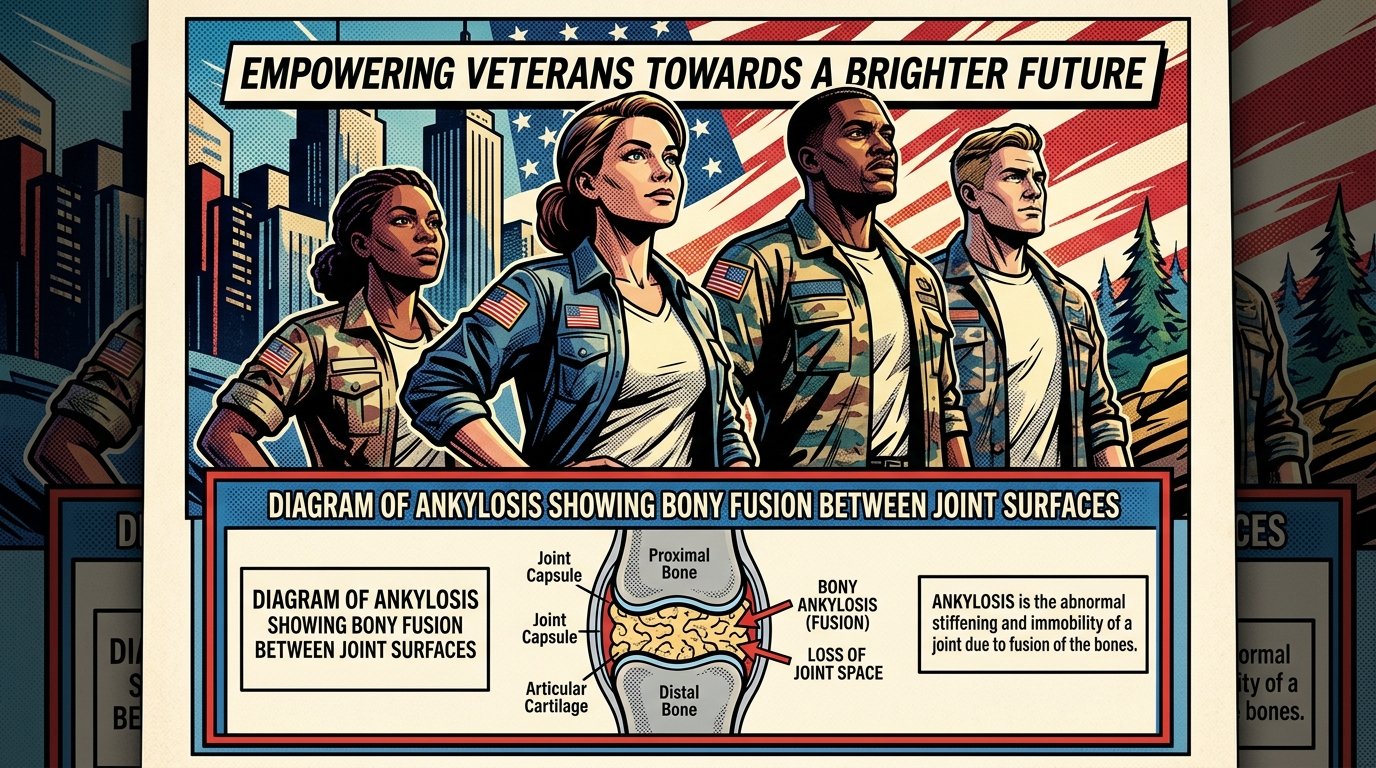
What Is Ankylosis?
Ankylosis is the immobility and consolidation of a joint due to disease, injury, or surgical procedure. The joint becomes fixed and cannot move normally. For VA purposes, ankylosis is classified as either favorable (joint fixed in neutral position) or unfavorable (joint fixed in flexion or extension causing functional impairment). Ankylosis can affect the spine, limbs, jaw, or other joints and is rated under specific VA diagnostic codes.
Quick Facts
| Item | Details |
|---|---|
| Benefit | VA disability compensation for service-connected ankylosis |
| Eligibility | Veterans with service-connected joint immobility or fusion |
| Application | VA Form 21-526EZ (online at VA.gov) |
| Processing Time | 90–180 days average for initial claims |
| Official Agency | U.S. Department of Veterans Affairs (VA) |
| Required Forms | VA Form 21-526EZ; medical evidence; DD-214 |
| Updated For | 2026 |
What Is Ankylosis? Definition and Types
Ankylosis is the immobility and consolidation of a joint resulting from fibrous or bony union due to disease, trauma, or neoplasia. It can be complete or incomplete, and it is classified by the type of tissue involved.

Types of Ankylosis
| Type | Description |
|---|---|
| Bony (True) Ankylosis | Actual fusion of the joint surfaces by bone |
| Fibrous Ankylosis | Fibrous tissue adhesions between joint surfaces limiting movement |
| Fibro-osseous Ankylosis | Mixed fibrous and bony union |
| False Ankylosis | Joint immobility caused by pathology outside the joint |
| Capsular Ankylosis | Result of severe strain or twist affecting the joint capsule |
| Extra-capsular Ankylosis | Caused by changes in structures surrounding the joint |
Ankylosis vs. Arthritis
Ankylosis is not the same as arthritis. Arthritis is inflammation of the joint that can lead to ankylosis over time, but ankylosis specifically refers to the loss of joint mobility. Degenerative arthritis (DC 5003) is rated based on limitation of motion under the appropriate diagnostic codes for the specific joint involved.
Ankylosis vs. Spinal Fusion

Spinal fusion is a surgical procedure that creates ankylosis. When a surgeon fuses vertebrae together, the resulting immobility is classified as ankylosis for VA rating purposes. The outcome can be either favorable or unfavorable ankylosis depending on the position of the fused spine.
What Causes Ankylosis?
Ankylosis develops from several underlying causes. Trauma is the most common cause, followed by inflammatory arthritides and joint infection.
Common Causes
| Cause | Description |
|---|---|
| Trauma | Joint injuries, fractures, hemarthrosis (bleeding into joint) |
| Inflammatory Arthritis | Rheumatoid arthritis, ankylosing spondylitis, psoriatic arthritis |
| Infection | Septic arthritis, osteomyelitis |
| Surgical Procedures | Joint surgery, spinal fusion |
| Prolonged Immobilization | Casting, traction, bed rest |
| Congenital Conditions | Present from birth |
Military Service Connections
Ankylosis can be service-connected when it results from:
Combat injuries: Traumatic joint injuries during deployment
Training accidents: Fractures, dislocations, or joint trauma during physical training
Repetitive stress: Chronic wear on joints from military occupational duties
Infections: Joint infections contracted or worsened during service
Surgical complications: Fusion procedures required for service-connected conditions
Secondary conditions: Ankylosis developing as a complication of another service-connected disability
Symptoms and Diagnosis of Ankylosis
Ankylosis symptoms depend on which joint is affected and the severity of the fusion. The hallmark symptom is loss of joint movement.
Common Symptoms
Loss of range of motion: The joint cannot move through its normal range
Joint stiffness: Difficulty initiating movement, especially after rest
Pain: May be present, though some ankylosed joints are painless
Swelling and inflammation: Especially in inflammatory causes
Functional impairment: Difficulty walking, gripping, chewing, or performing daily activities
Compensatory movement: Other joints overwork to compensate
Muscle atrophy: Disuse weakening of surrounding muscles
Diagnostic Methods
| Method | Purpose |
|---|---|
| Physical Examination | Measuring range of motion with goniometer |
| X-rays | Detecting bony fusion, joint space narrowing |
| CT Scan | Detailed imaging of bony ankylosis |
| MRI | Evaluating soft tissue involvement, fibrous ankylosis |
| Bone Scan | Assessing joint activity in inflammatory conditions |
VA Disability Ratings for Ankylosis
Veterans May Qualify for Extra Benefits
Check available financial assistance, healthcare programs and other opportunities that may apply to you.
Check EligibilityVA rates ankylosis under specific diagnostic codes depending on which joint is affected. Ratings range from 10% to 100% based on the severity and location of the fusion.
Spine Ankylosis Ratings (DC 5235-5243)
The spine is rated under the General Rating Formula for Diseases and Injuries of the Spine. Ankylosis of the spine produces some of the highest ratings in the VA system.
| Condition | Rating |
|---|---|
| Unfavorable ankylosis of the entire spine | 100% |
| Unfavorable ankylosis of the entire thoracolumbar spine | 50% |
| Unfavorable ankylosis of the entire cervical spine | 40% |
| Favorable ankylosis of the entire thoracolumbar spine | 40% |
Defining Favorable vs. Unfavorable Ankylosis
For VA compensation purposes, unfavorable ankylosis is a condition in which the entire cervical spine, the entire thoracolumbar spine, or the entire spine is fixed in flexion or extension, and the ankylosis results in one or more of the following:
Difficulty walking because of a limited line of vision
Restricted opening of the mouth and chewing
Breathing limited to diaphragmatic respiration
Gastrointestinal symptoms due to pressure of the costal margin on the abdomen
Dyspnea or dysphagia
Atlantoaxial or cervical subluxation or dislocation
Neurologic symptoms due to nerve root stretching
Favorable ankylosis is fixation of a spinal segment in neutral position (zero degrees). This is considered less debilitating than unfavorable ankylosis.
Ankle Ankylosis Ratings (DC 5270-5274)
| Condition | Rating |
|---|---|
| Ankylosis of ankle in plantar flexion at more than 40 degrees; or in dorsiflexion at more than 10 degrees; or with abduction, adduction, inversion or eversion deformity | 40% |
| Ankylosis of ankle in plantar flexion between 30 and 40 degrees, or in dorsiflexion between 0 and 10 degrees | 30% |
| Ankylosis of ankle in plantar flexion less than 30 degrees | 20% |
| Ankylosis of subastragalar or tarsal joint in poor weight-bearing position | 20% |
| Ankylosis of subastragalar or tarsal joint in good weight-bearing position | 10% |
TMJ Ankylosis Rating (DC 9905)
| Condition | Rating |
|---|---|
| Ankylosis of the temporomandibular articulation with the mandible immobilized at a point that interferes with mastication and speech | 40% |
| Inter-incisal range of 0 to 10 millimeters | 30% |
| Inter-incisal range of 11 to 20 millimeters, or lateral excursion of less than 4 millimeters | 20% |
| Inter-incisal range of 21 to 30 millimeters, or lateral excursion of 4 to 7 millimeters | 10% |
Other Joint Ankylosis Ratings
| Joint | Condition | Rating |
|---|---|---|
| Knee | Unfavorable ankylosis | 40-60% |
| Hip | Unfavorable ankylosis | 40-60% |
| Shoulder | Unfavorable ankylosis | 40-50% |
| Elbow | Unfavorable ankylosis | 40-50% |
| Wrist | Unfavorable ankylosis | 30-40% |
| Fingers/Toes | Ankylosis of individual digits | 10-20% |
Ankylosing Spondylitis Rating (DC 5240)
Ankylosing spondylitis is an inflammatory condition that causes spinal ankylosis over time. It is rated under DC 5240 and evaluated under the General Rating Formula for Diseases and Injuries of the Spine. Ratings range from 10% to 100% based on the extent of spinal fusion and functional impairment.
How to File a VA Claim for Ankylosis
You can file a VA disability claim for ankylosis online, by mail, or with the help of an accredited representative. Ankylosis is rated based on objective medical evidence of joint immobility, not just subjective pain.
Step-by-Step Claims Process
Gather evidence. Collect your DD-214, military medical records, current medical records, X-rays, CT scans, MRI reports, and range-of-motion measurements.
Get a current diagnosis. Obtain a diagnosis of ankylosis from a qualified medical provider. Documentation should specify the joint affected, the type of ankylosis (bony, fibrous), and the degree of immobility.
Obtain a medical nexus opinion. A medical provider must state that your ankylosis is at least as likely as not connected to your military service. This is critical for service connection.
File VA Form 21-526EZ. Apply online at VA.gov or submit by mail. Include all supporting evidence.
Attend a C&P exam. VA will schedule a Compensation and Pension examination to measure your range of motion and evaluate functional impairment.
Receive a rating decision. VA will assign a rating based on the applicable diagnostic code and the severity of your ankylosis.
Required Evidence for Ankylosis Claims
| Evidence Type | Purpose |
|---|---|
| DD-214 | Proof of military service and characterization |
| Service Medical Records | Documentation of in-service injury or disease |
| Current Medical Records | Diagnosis and treatment history |
| Imaging Studies | X-rays, CT, or MRI showing joint fusion |
| Range of Motion Measurements | Objective evidence of immobility |
| Nexus Letter | Medical opinion linking ankylosis to service |
| Personal Statement (VA Form 21-4138) | Lay evidence describing functional limitations |
Filing as a Secondary Condition
Ankylosis can be claimed as a secondary condition to another service-connected disability. For example:
Ankle ankylosis secondary to a service-connected fracture
Spinal ankylosis secondary to service-connected degenerative disc disease
TMJ ankylosis secondary to PTSD or service-connected jaw injury
A medical nexus opinion is required to establish the secondary relationship.
Treatment Options for Ankylosis
Treatment depends on the joint affected, the type of ankylosis, and the degree of functional impairment. Surgery is often required for bony ankylosis, while fibrous ankylosis may respond to physical therapy.
Non-Surgical Treatment
Physical therapy: Aggressive range-of-motion exercises to prevent further stiffness
Joint mobilization: Manual therapy techniques to improve mobility
Anti-inflammatory medications: NSAIDs for pain and inflammation
Muscle relaxants: For associated muscle spasm
Assistive devices: Braces, splints, or mobility aids
Surgical Treatment
| Procedure | Description | Best For |
|---|---|---|
| Radical Release | Surgical release of ankylosis with 1–1.5 cm gap creation | Most cases |
| Gap Arthroplasty | Resection of fused bone without reconstruction | Simple ankylosis |
| Interpositional Arthroplasty | Resection with interpositional material | Recurrent ankylosis |
| Total Joint Replacement | Complete joint replacement | Adults with severe/recurrent ankylosis |
| Costochondral Graft | Rib cartilage graft for reconstruction | Pediatric patients |
| Distraction Osteogenesis | Gradual bone lengthening | Pediatric/adult patients |
Post-Surgical Care
Aggressive physical therapy is essential after surgical release. Without proper rehabilitation, ankylosis can recur. Physical therapy should begin early in the postoperative period and continue for several months.
TMJ Ankylosis Treatment
TMJ ankylosis requires customized management by an experienced surgeon. The mainstay of treatment is radical release of ankylosis followed by reconstruction. For adults, total joint replacement provides the most predictable functional and skeletal outcome and is increasingly regarded as the gold standard. Early mobilization is essential to prevent re-ankylosis.
Common Mistakes to Avoid
Veterans filing claims for ankylosis frequently make these errors.
Relying on pain alone. Ankylosis is rated on objective loss of motion, not pain severity. You need range-of-motion measurements and imaging evidence.
Not documenting functional loss. Beyond raw range-of-motion numbers, describe how ankylosis affects your daily life—walking, working, sleeping, eating.
Confusing favorable and unfavorable ankylosis. Favorable ankylosis (neutral position) receives lower ratings than unfavorable ankylosis (flexed or extended position). Ensure your medical records accurately describe your joint position.
Failing to claim ankylosis as secondary. If your ankylosis resulted from a service-connected condition or surgery, claim it as secondary.
Missing the C&P exam. VA cannot rate your ankylosis without current range-of-motion measurements. Attend your exam and ensure the examiner measures all affected joints.
Not appealing an inadequate rating. If your rating does not reflect the severity of your ankylosis, file a Supplemental Claim, Higher-Level Review, or Board Appeal.
Ignoring mental health impacts. Chronic pain and immobility from ankylosis can cause or worsen depression, anxiety, and PTSD. These can be claimed as secondary conditions.
The Appeals Process for Ankylosis Claims
If you disagree with your VA rating decision for ankylosis, you have three appeal options.
Decision Review Options
| Option | When to Use | Timeframe |
|---|---|---|
| Supplemental Claim | You have new and relevant evidence | 4–8 months average |
| Higher-Level Review | No new evidence; argue VA made an error | 4–8 months average |
| Board Appeal | Want a Veterans Law Judge to review your case | 1–3 years average |
Common Appeal Grounds for Ankylosis
Incorrect diagnostic code applied
Range of motion not properly measured
Favorable vs. unfavorable ankylosis misclassified
Secondary service connection not considered
Effective date assigned incorrectly
Rating percentage not supported by evidence
Common Questions
1. What is ankylosis?
Ankylosis is the immobility and consolidation of a joint due to disease, injury, or surgical procedure. The joint becomes fixed and cannot move normally. It can be bony (true fusion), fibrous (adhesions), or mixed. For VA purposes, it is classified as favorable (neutral position) or unfavorable (flexed or extended position).
2. What VA rating can I get for ankylosis of the spine?
Unfavorable ankylosis of the entire spine is rated 100%. Unfavorable ankylosis of the entire thoracolumbar spine is rated 50%. Unfavorable ankylosis of the entire cervical spine is rated 40%. Favorable ankylosis of the entire thoracolumbar spine is also rated 40%.
3. How do I prove my ankylosis is service-connected?
You need three elements: (1) a current diagnosis of ankylosis, (2) evidence of an in-service event, injury, or disease, and (3) a medical nexus opinion linking your ankylosis to your military service. Range-of-motion measurements and imaging studies are essential evidence.
4. Can I get VA disability for ankylosis of the ankle?
Yes. Ankle ankylosis is rated under DC 5270-5274. Ratings range from 10% to 40% depending on the position of fusion, whether the subastragalar joint is involved, and whether the position is good or poor for weight-bearing.
5. What is the VA rating for TMJ ankylosis?
Ankylosis of the temporomandibular articulation with the mandible immobilized at a point that interferes with mastication and speech is rated 40% under DC 9905. Other TMJ conditions are rated 10–30% based on inter-incisal range of motion.
6. What is the difference between favorable and unfavorable ankylosis?
Favorable ankylosis is fixation of a spinal segment in neutral position (zero degrees). Unfavorable ankylosis is fixation in flexion or extension that causes functional impairment such as difficulty walking, breathing, chewing, or neurologic symptoms. Unfavorable ankylosis receives higher ratings.
7. Can ankylosis be a secondary condition?
Yes. Ankylosis can be service-connected as a secondary condition to another service-connected disability. For example, ankle ankylosis secondary to a service-connected fracture, or spinal ankylosis secondary to degenerative disc disease. A medical nexus opinion is required.
8. How is ankylosing spondylitis rated by VA?
Ankylosing spondylitis is rated under DC 5240, evaluated under the General Rating Formula for Diseases and Injuries of the Spine. Ratings range from 10% to 100% based on the extent of spinal fusion, range of motion limitation, and functional impairment.
9. What treatment is available for ankylosis?
Treatment includes physical therapy, joint mobilization, anti-inflammatory medications, and surgery. Surgical options include radical release, gap arthroplasty, interpositional arthroplasty, and total joint replacement. Aggressive post-surgical physical therapy is essential to prevent recurrence.
10. What is the difference between ankylosis and arthritis?
Arthritis is inflammation of a joint. Ankylosis is the loss of joint mobility due to fusion or consolidation. Arthritis can lead to ankylosis, but ankylosis specifically refers to immobility. Degenerative arthritis is rated under DC 5003 based on limitation of motion.
11. Can I get TDIU for ankylosis?
Yes, if your ankylosis prevents you from maintaining substantially gainful employment. TDIU (Total Disability Individual Unemployability) pays at the 100% rate even if your schedular rating is less than 100%. You must demonstrate that your service-connected ankylosis alone prevents employment.
12. How long does a VA claim for ankylosis take?
Initial VA claims for ankylosis average 90–180 days. Appeals can take longer—Supplemental Claims and Higher-Level Reviews average 4–8 months, while Board Appeals average 1–3 years. Providing complete evidence upfront can speed processing.
13. What is the effective date for ankylosis benefits?
The effective date is generally the date VA received your claim or the date you were first diagnosed with ankylosis, whichever is later. If you filed within one year of discharge, the effective date may be the day after discharge. Back pay is calculated from the effective date.
14. Can ankylosis affect my VA health care?
Yes. Veterans with service-connected ankylosis are eligible for VA health care. Treatment for ankylosis, including surgery and physical therapy, may be provided through the VA health care system. VA may also provide assistive devices and prosthetics.
15. What if my ankylosis rating is too low?
If your rating does not reflect the severity of your ankylosis, you can appeal. File a Supplemental Claim with new evidence, request a Higher-Level Review, or appeal to the Board of Veterans’ Appeals. An accredited VSO or attorney can help.
Key Takeaways
Ankylosis is joint immobility or fusion caused by disease, injury, or surgery, rated under specific VA diagnostic codes.
Spinal ankylosis receives the highest ratings: 100% for unfavorable ankylosis of the entire spine, 50% for thoracolumbar, 40% for cervical.
Ankle ankylosis is rated 10–40% under DC 5270-5274, depending on position and weight-bearing status.
TMJ ankylosis is rated 40% under DC 9905 when the mandible is immobilized and interferes with mastication and speech.
Service connection requires three elements: current diagnosis, in-service event, and medical nexus.
Favorable ankylosis (neutral position) receives lower ratings than unfavorable ankylosis (flexed or extended position).
Ankylosis can be claimed as a secondary condition to another service-connected disability.
Treatment includes physical therapy and surgery. Post-surgical aggressive physical therapy is essential to prevent recurrence.
VA claims average 90–180 days. Appeals take longer.
File with VA Form 21-526EZ and include DD-214, medical records, imaging studies, range-of-motion measurements, and a nexus letter.
Official Resources
VA Disability Compensation: va.gov/disability/
VA Form 21-526EZ: va.gov/find-forms/about-form-21-526ez/
VA Form 21-4138 (Statement in Support of Claim): va.gov/find-forms/about-form-21-4138/
VA Schedule of Ratings – Musculoskeletal System (38 CFR § 4.71a): ecfr.gov
VA Schedule of Ratings – Dental and Oral Conditions (38 CFR § 4.150): ecfr.gov
VA Accreditation Search: va.gov/ogc/apps/accreditation/
VA Appeals Modernization: va.gov/decision-reviews/
USA.gov Veterans Benefits: usa.gov/veterans-benefits




🇺🇸 IMPORTANT DISCLAIMER – Veterans Benefits Information
This site provides general information about U.S. Department of Veterans Affairs (VA) benefits for educational and informational purposes only.
- Not Official: We are NOT affiliated with, endorsed by, or connected to the U.S. Department of Veterans Affairs (VA), the Veterans Benefits Administration (VBA), the Veterans Health Administration (VHA), or any other government agency.
- No Legal/Financial Advice: The content on this website is for informational purposes only and does not constitute legal, financial, or medical advice. VA benefits rules change frequently – always consult with an accredited Veterans Service Officer (VSO) or a qualified professional for your specific situation.
- Official Sources: For official, binding information and to apply for benefits, always visit official .gov websites: VA.gov, Benefits.VA.gov, or SSA.gov.
- No Data Collection: This site does not collect, store, or process any personal information. It does not have login forms, contact forms, or any system to capture user data. We never ask for your Social Security Number, bank details, or any personal information.
- 🚨 Scam Alert: The VA and other government agencies never charge fees for benefit applications. If anyone asks for money to "process" your VA claim, it is a scam. Report it to the VA Office of Inspector General at VA.gov/OIG.
- Advertising: This site uses third-party advertising (Adsterra) to cover operational costs. We do not endorse or guarantee any products or services advertised.
📌 Information provided as of June 2026. Always verify current eligibility and rules with official .gov sources.
This site is not affiliated with the U.S. Department of Veterans Affairs or any government agency. All information is for educational purposes only. Please visit VA.gov for official information.
