
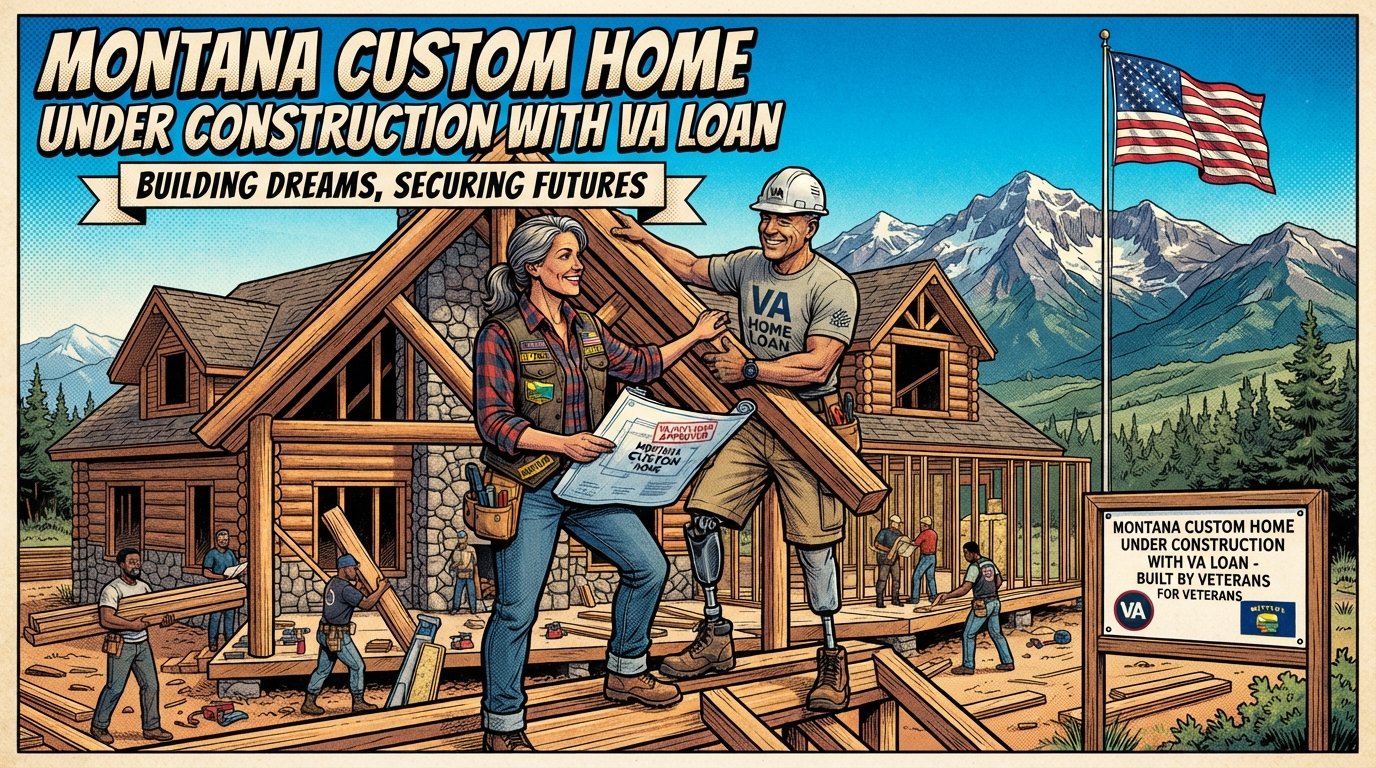
VA Construction Loan for Veterans in Montana: How It Works
A VA construction loan in Montana lets eligible veterans and service members buy land and build a home with one mortgage, often with $0 down. The VA removed the Builder ID requirement in March 2025, making it easier for approved contractors to participate. Montana veterans can also use the state’s Veterans’ Home Loan Program for a rate 1% below market.
| Item | Details |
|---|---|
| Benefit | Single mortgage for land purchase and home construction; $0 down with full entitlement |
| Eligibility | Veterans, active duty, National Guard, reservists, surviving spouses with VA entitlement |
| Application | Through VA-approved lenders offering construction-to-permanent products |
| Processing Time | 45–60 days to close; construction typically 6–12 months |
| Official Agency | U.S. Department of Veterans Affairs (VA); Montana Board of Housing |
| Required Forms | COE, DD-214, builder contract, itemized bid, construction plans, VA Form 26-1802a |
| Updated For | 2026 VA loan limits and Montana Veterans’ Home Loan Program rates |
What Is a VA Construction Loan?
A VA construction loan is a mortgage guaranteed by the Department of Veterans Affairs that finances the building of a new home. Unlike a standard VA purchase loan for an existing house, a construction loan covers the cost of land, materials, labor, and permits needed to build from the ground up.

The VA does not lend money directly. Private lenders originate the loans, and the VA guarantees a portion—typically 25%—which protects the lender against loss. That guarantee is what makes $0 down financing possible on a construction project, something you will not find with most conventional construction loans.

Why this matters in Montana: Montana’s housing inventory is limited, and many veterans cannot find an existing home that meets their needs or the VA’s Minimum Property Requirements. Building allows veterans to get exactly the home they need—whether that means wider doorways for accessibility, a specific floor plan for a large family, or a home in a rural area where nothing is for sale. VA construction loans carry the same core advantages as standard VA loans: no down payment for fully entitled borrowers, no private mortgage insurance, and competitive interest rates.
Types of VA Construction Loans in Montana
The VA permits two types of construction loans: one-time close and two-time close. Each has different costs, timelines, and financing structures.
One-Time Close Construction Loan
A one-time close loan combines the construction financing and the permanent mortgage into a single loan with one closing. You lock your interest rate before construction begins, and there is no second closing when the home is complete. This is the most popular option because it typically costs less overall and locks in your rate early.
Key features:
Single closing, single set of closing costs
Interest rate locked before construction starts
No payment during construction (interest reserve included in the loan)
Converts automatically to a permanent VA mortgage at completion
Lender manages the draw process
Two-Time Close Construction Loan
Veterans May Qualify for Extra Benefits
Check available financial assistance, healthcare programs and other opportunities that may apply to you.
Check EligibilityA two-time close loan involves two separate transactions: a short-term construction loan that covers the build, followed by a permanent VA mortgage when construction is complete. The construction loan is paid off by the permanent loan at the second closing.
Key features:
Two closings, two sets of closing costs
Interest rate on the permanent loan is not locked until the second closing
Builder typically carries the construction financing
More common with custom builders who have their own financing arrangements
Can be harder to find and may cost more overall
Which Option Is Right for You?
For most Montana veterans building a custom home, the one-time close is the better choice. It eliminates the risk of rate increases between closings and simplifies the process. The VA notes that once a construction loan type is closed, it cannot be converted to the other type.
VA Construction Loan Eligibility in Montana
You qualify for a VA construction loan in Montana if you meet the same service requirements as a standard VA purchase loan. There is no Montana-specific eligibility restriction.
Who Qualifies
Veterans: Generally 2 years of continuous active duty, or 90 days during wartime
Active Duty: 90 continuous days of service
National Guard & Reserves: 6 years of service, or 90 days of active-duty service including Title 32 orders
Surviving Spouses: Unremarried spouses of veterans who died in service or from a service-connected disability
Purple Heart recipients: Eligible regardless of service length if discharged honorably
Certificate of Eligibility (COE)
The COE is the document that proves your VA entitlement. VA-approved lenders can usually pull your COE instantly through the VA’s automated portal using your proof of service—DD-214 for veterans or Statement of Service for active duty.
Credit Score and Income Requirements
The VA sets no minimum credit score, but most VA construction lenders require a 620 to 640 score. You will need to verify at least two years of stable income. Your debt-to-income ratio should generally be 41% or lower, though lenders can approve higher ratios with compensating factors such as strong residual income or significant cash reserves.
VA Construction Loan Limits in Montana for 2026
Full-entitlement veterans have no VA-imposed loan limit in Montana. The VA eliminated the loan cap for full-entitlement borrowers in 2020. The 2026 Montana VA loan limit for partial-entitlement borrowers is $832,750 for one-unit properties, matching the FHFA conforming loan limit for all Montana counties.
| Entitlement Status | 2026 VA Loan Limit | Down Payment Required |
|---|---|---|
| Full entitlement | None (capped only by appraisal and income) | $0 |
| Partial entitlement | $832,750 (1-unit, all MT counties) | 25% of difference between price and limit |
For renovation loans specifically, the loan amount is further capped by the as-completed appraised value. Even with full entitlement, you cannot borrow more than the home will be worth after construction.
Montana-Specific Loan Program
Montana also offers the Veterans’ Home Loan Program (VHLP) through the Montana Board of Housing. This program provides first mortgage funds to Montana residents who have served in the military, including the Montana National Guard. The program offers a mortgage rate 1% below market, no income limits, and a maximum loan amount of **$538,036** as of July 24, 2026. Borrowers must contribute a minimum of $2,500 toward the purchase. The VHLP can be combined with VA loan guaranty.
Builder Requirements for VA Construction Loans in Montana
The builder you choose must meet both lender and VA requirements. The VA removed the Builder ID requirement for ordinary VA-guaranteed new construction loans on March 31, 2025, through Circular 26-25-1. That change does not apply to specially adapted housing grants or VA direct-loan programs.
What Lenders Look For in a Builder
Even without a VA Builder ID, individual lenders impose their own requirements. PBT Bancorp, a VA construction lender, requires:
Minimum 3 years of construction experience
At least 10 completed homes, including 5 ground-up builds
Minimum Dun & Bradstreet PAYDEX score of 65+
Minimum $1 million general liability insurance
Valid state and local licensing
Business credit and references check
Signed contract, itemized budget, and draw account
What veterans should do next: Ask potential builders for their license number, proof of insurance, and a list of recently completed projects. Your lender will run a full contractor review before approving the loan.
Required Documents for a Montana VA Construction Loan
DD-214 (for veterans) or Statement of Service (for active duty)
Government-issued photo ID
Last 2 pay stubs (or most recent 30 days of income)
Last 2 years of W-2s (or 1099s if self-employed)
Last 2 months of bank statements (all pages)
Builder’s contract — signed, itemized scope of work
Construction plans and specifications
Itemized construction budget — including a contingency reserve
VA Form 26-1802a — VA application form
Proof of builder’s insurance — general liability and workers’ compensation
How to Apply for a VA Construction Loan in Montana
Get your COE. Your lender can pull this automatically through the VA portal, or you can apply directly at VA.gov.
Find a VA construction lender. Not all VA lenders offer construction loans. Ask specifically about construction-to-permanent or one-time close products.
Get pre-approved. Submit income, asset, and credit documentation. Your lender will review your entitlement and set a construction budget.
Select a builder. Your builder must meet lender requirements. Get a signed contract with an itemized budget.
Submit construction plans. The lender and VA appraiser review your plans and specifications.
VA appraisal. A VA-approved appraiser reviews the plans and determines the as-completed value.
Underwriting. The lender reviews the full file, including builder approval, plans, budget, and appraisal.
Close. Sign closing documents. Construction funds go into escrow.
Build. Draws are released as inspections confirm progress.
Final inspection. A VA appraiser inspects completed work. Your loan converts to a permanent VA mortgage.
Processing time: VA construction loans typically close in 45–60 days. Construction itself takes 6–12 months depending on the scope of the project.
VA Funding Fee for Construction Loans in Montana
The VA funding fee for construction loans is the same as for purchase loans. It ranges from 1.25% to 3.3% of the loan amount.
| Loan Type | Down Payment | First Use | After First Use |
|---|---|---|---|
| Construction | Less than 5% | 2.15% | 3.3% |
| Construction | 5% or more | 1.5% | 1.5% |
| Construction | 10% or more | 1.25% | 1.25% |
Who Is Exempt from the VA Funding Fee
Receiving VA compensation for a service-connected disability
Eligible to receive VA compensation but receiving retirement or active-duty pay instead
Receiving certain Dependency and Indemnity Compensation
A service member with a proposed or memorandum rating before closing for a pre-discharge claim
Currently serving on active duty with a Purple Heart
The funding fee can be rolled into the loan amount, so it does not require upfront cash if you have full entitlement.
Montana VA Construction Loan Lenders
Not all VA lenders offer construction loans. The product requires additional underwriting, builder approval, and draw management. These lenders have demonstrated construction lending capability in Montana.
| Lender | Type | Construction Experience | Notes |
|---|---|---|---|
| U.S. Bank | National | VA construction-to-permanent | Single close, zero down, no PMI |
| Mann Mortgage | Montana-based | VA, FHA, construction | Headquartered in Kalispell |
| Opportunity Bank of Montana | Montana-based | Construction and land loans | Full range of mortgage solutions |
| Three Rivers Bank | Montana-based | VA and construction loans | Local market knowledge |
| Rocky Mountain Credit Union | Montana-based | Construction loans | VA, FHA, USDA, land loans |
| PBT Bancorp | National | VA one-time close | Nationwide construction lending |
| Woodlands Mortgage Bank | National | Zero-down VA construction | Specializes in Montana VA construction |
What veterans should do next: Contact at least two lenders who offer VA construction loans. Compare rates, fees, and builder approval requirements. Ask whether they have a dedicated construction department.
How Draws and Inspections Work
Construction funds are not released all at once. The lender releases money in stages called draws. Each draw requires an inspection to confirm the work completed matches the approved plans.
The Draw Process
Initial disbursement. At closing, funds for land payoff and initial construction costs are released.
Draw requests. Your builder submits a draw request as each phase is completed.
Inspection. A third-party inspector confirms the percentage of work completed.
Borrower approval. The lender must obtain your written approval before each disbursement.
Funds released. The lender releases the draw amount to the builder.
Final inspection. When the home is 100% complete, the original VA appraiser performs a final inspection to certify that all VA Minimum Property Requirements are met and the home was built to the original plans. The property must be covered by a 1-year VA builder’s warranty.
Typical draw schedules include 5–7 disbursements covering foundation, framing, roofing, mechanical systems, interior finishes, and final completion.
Montana Veterans’ Home Loan Program
The Montana Veterans’ Home Loan Program (VHLP) is a state program that provides below-market mortgage financing for eligible Montana veterans. It is administered by the Montana Board of Housing and funded through the Coal Tax Trust Fund.
VHLP Key Terms (2026)
| Feature | Details |
|---|---|
| Interest Rate | 1% below market |
| Maximum Loan Amount | $538,036 (as of July 24, 2026) |
| Income Limits | None |
| Minimum Borrower Investment | $2,500 down payment |
| Eligibility | Montana resident, eligible veteran or Montana National Guard member |
| Property Type | Single-family residences with full land ownership |
Important: The VHLP is designed to purchase single-family residences that have full ownership of the land they sit on. Refinancing of land as part of construction of a new home is permissible, but the program cannot be used to refinance undeveloped land alone. Borrowers pay all closing costs, including any VA funding fees.
Common Mistakes Montana Veterans Make with Construction Loans
Assuming every VA lender offers construction loans. Fewer than 20% of VA lenders offer this product. Ask specifically about construction-to-permanent or one-time close.
Not budgeting for a contingency reserve. Lenders require a contingency fund—typically 10–15% of construction costs—for unexpected issues. Do not budget to the dollar.
Choosing a builder before talking to a lender. Your lender must approve the builder before work begins. Get lender pre-approval first.
Ignoring the as-completed appraisal. If the appraised value after construction is lower than expected, you must cover the gap in cash or reduce scope.
Making changes after the appraisal. Change orders made after the appraisal cannot be mortgaged into the loan unless an updated appraisal is obtained. This can delay closing and add costs.
Forgetting the Montana Veterans’ Home Loan Program. This state program offers a rate 1% below market and can be combined with VA financing.
Not verifying builder insurance. Your builder must carry at least $1 million in general liability insurance. Verify coverage before signing a contract.
Common Questions
What credit score do I need for a VA construction loan in Montana?
Most VA construction lenders require a 620 to 640 credit score. The VA itself sets no minimum, but construction loans typically have tighter credit standards than standard VA purchase loans because of the construction risk. You will also need to verify at least two years of stable income.
How much can I finance with a VA construction loan in Montana?
With full entitlement, there is no VA-imposed loan limit. You can borrow as much as a lender approves, as long as the as-completed appraisal supports the value. For partial entitlement, the 2026 limit is $832,750 for all Montana counties. The Montana Veterans’ Home Loan Program has a maximum loan amount of $538,036.
Can I use a VA construction loan to buy land in Montana?
Yes. A VA construction loan can finance both the land purchase and the construction of the home in a single mortgage. A standard VA purchase loan cannot be used to buy raw land, but a construction loan can. The land must be owned or purchased as part of the transaction.
Does a VA construction loan require a down payment in Montana?
With full entitlement, no down payment is required. Nearly 90% of VA-backed loans are made with no down payment. If you have partial entitlement, you may need to make a down payment of 25% of the difference between the purchase price and the VA loan limit.
Do I need a VA Builder ID for a construction loan in Montana?
No. The VA removed the Builder ID requirement for ordinary VA-guaranteed new construction loans on March 31, 2025. Your lender will still verify the builder’s experience, licensing, insurance, and business credit. The Builder ID requirement still applies to specially adapted housing grants and VA direct-loan programs.
How long does a VA construction loan take to close in Montana?
VA construction loans typically close in 45–60 days. This is longer than a standard VA purchase loan because of the builder approval, plan review, and as-completed appraisal process. Construction itself takes 6–12 months depending on the scope of the project.
What is the VA funding fee for a construction loan?
The funding fee ranges from 1.25% to 3.3% depending on your down payment and whether it is your first VA loan use. Veterans with service-connected disabilities are exempt. The fee can be rolled into the loan amount.
Can I use the Montana Veterans’ Home Loan Program with a VA construction loan?
Yes. The Montana Veterans’ Home Loan Program can be combined with VA loan guaranty. The program offers a mortgage rate 1% below market, no income limits, and a maximum loan amount of $538,036. Borrowers must contribute a minimum of $2,500.
What happens if construction costs more than expected?
Lenders require a contingency reserve—typically 10–15% of construction costs—to cover unexpected issues. If costs exceed the contingency, you may need to pay out of pocket or reduce the scope of the project. Change orders after the appraisal require an updated appraisal if they affect value.
What inspections are required during construction?
The lender schedules inspections at each draw stage to confirm work completed matches the approved plans. A final VA inspection is required when the home is 100% complete. The final inspection certifies that all VA Minimum Property Requirements are met and the home was built to the original plans and specifications.
Can I build a barndominium with a VA construction loan in Montana?
Possibly. The structure must be classified as residential real property under Montana state law before a VA loan can close. There is no VA minimum square footage, though most lenders impose their own 400-square-foot minimum. Check with your lender before committing to a barndominium design.
Key Takeaways
VA construction loans in Montana combine land purchase and home construction into one mortgage with $0 down for full-entitlement veterans and no PMI.
The VA removed the Builder ID requirement for ordinary new construction loans on March 31, 2025. Lenders still verify builder experience, licensing, and insurance.
The 2026 Montana VA loan limit is $832,750 for partial-entitlement borrowers. Full-entitlement veterans have no VA-imposed limit.
The Montana Veterans’ Home Loan Program offers a rate 1% below market with a maximum loan amount of $538,036 and no income limits.
The VA funding fee ranges from 1.25% to 3.3% but is waived for veterans with service-connected disabilities.
One-time close is the most popular option because it combines construction and permanent financing into one loan with one closing and one rate lock.
Draws are released in stages as inspections confirm progress. The lender must obtain your written approval before each disbursement.
A contingency reserve of 10–15% is required for unexpected costs. Change orders after the appraisal require an updated appraisal.
Most VA construction lenders require a 620–640 credit score and two years of stable income.
The final VA inspection certifies that all Minimum Property Requirements are met and the home was built to the original plans. A 1-year builder’s warranty is required.
Official Resources
VA Home Loans: va.gov/housing-assistance/home-loans
VA Construction Loans: va.gov/housing-assistance/home-loans/loan-types
VA Lender’s Handbook Chapter 7: benefits.va.gov/WARMS/docs/admin26/m26-07
VA Funding Fee and Closing Costs: va.gov/housing-assistance/home-loans/funding-fee-and-closing-costs
Montana Board of Housing: housing.mt.gov
Montana Veterans’ Home Loan Program: housing.mt.gov/Homeownership/Veterans
Montana Department of Veterans Affairs: dva.mt.gov
CFPB Mortgage Toolkit: consumerfinance.gov





🇺🇸 IMPORTANT DISCLAIMER – Veterans Benefits Information
This site provides general information about U.S. Department of Veterans Affairs (VA) benefits for educational and informational purposes only.
- Not Official: We are NOT affiliated with, endorsed by, or connected to the U.S. Department of Veterans Affairs (VA), the Veterans Benefits Administration (VBA), the Veterans Health Administration (VHA), or any other government agency.
- No Legal/Financial Advice: The content on this website is for informational purposes only and does not constitute legal, financial, or medical advice. VA benefits rules change frequently – always consult with an accredited Veterans Service Officer (VSO) or a qualified professional for your specific situation.
- Official Sources: For official, binding information and to apply for benefits, always visit official .gov websites: VA.gov, Benefits.VA.gov, or SSA.gov.
- No Data Collection: This site does not collect, store, or process any personal information. It does not have login forms, contact forms, or any system to capture user data. We never ask for your Social Security Number, bank details, or any personal information.
- 🚨 Scam Alert: The VA and other government agencies never charge fees for benefit applications. If anyone asks for money to "process" your VA claim, it is a scam. Report it to the VA Office of Inspector General at VA.gov/OIG.
- Advertising: This site uses third-party advertising (Adsterra) to cover operational costs. We do not endorse or guarantee any products or services advertised.
📌 Information provided as of June 2026. Always verify current eligibility and rules with official .gov sources.
This site is not affiliated with the U.S. Department of Veterans Affairs or any government agency. All information is for educational purposes only. Please visit VA.gov for official information.
