
Understanding the Latest IPPS-A Updates for U.S. Veterans
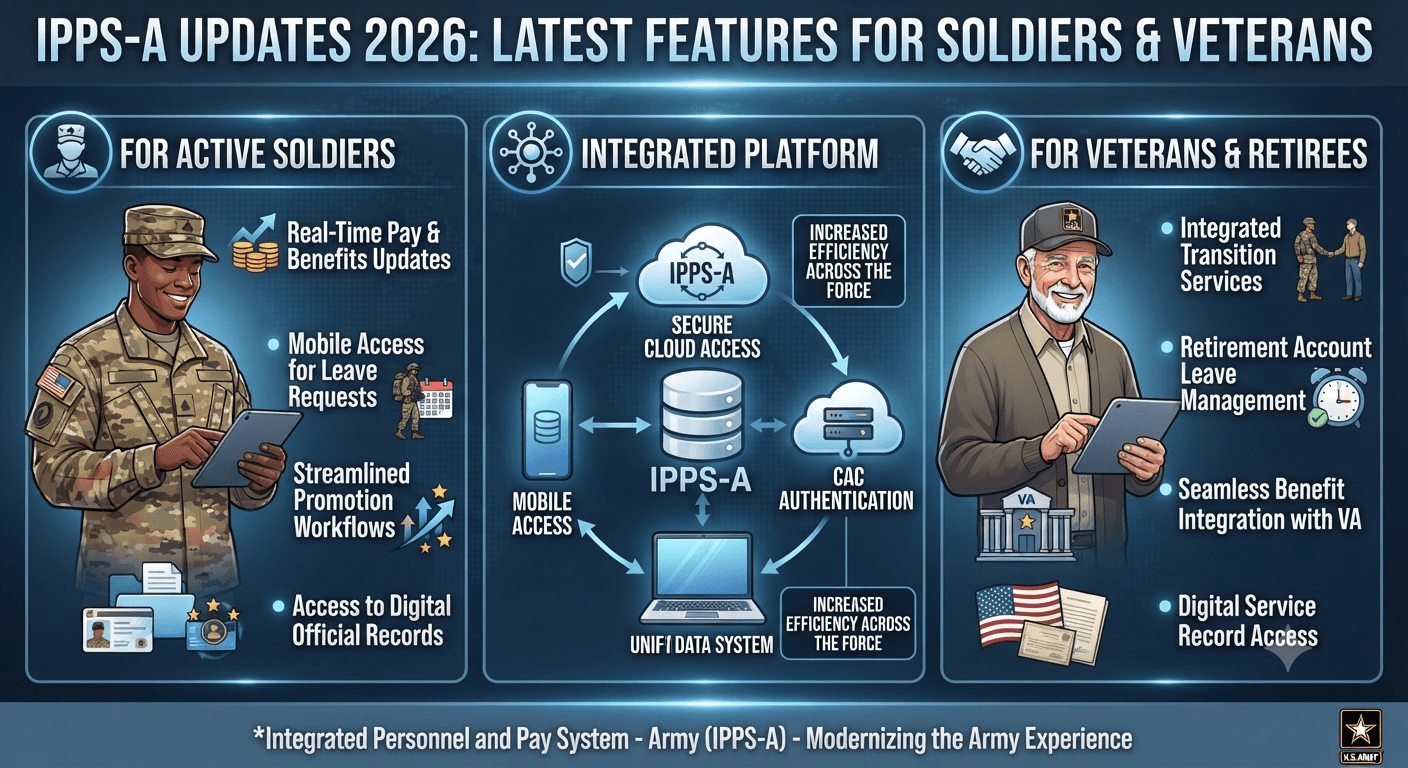
The Integrated Personnel and Pay System – Army (IPPS‑A) is the U.S. Army’s single, web‑based human resources and pay system that replaced over 200 legacy systems across the Active Army, Army National Guard, and Army Reserve. Launched in 2023, IPPS‑A gives Soldiers and veterans access to their personnel records, assignment orders, promotion points, and DD‑214 discharge documents through a secure online portal and mobile app . Recent updates include an expanded mobile app, a redesigned Soldier Talent Profile, streamlined DD‑214 workflows, new PCS season tools, and agile software development delivering faster system improvements .
Quick Facts
| Item | Details |
|---|---|
| System | Integrated Personnel and Pay System – Army (IPPS‑A) |
| Launched | December 2023 (Release 3) |
| Users | 1.1+ million Soldiers across Active, Guard, Reserve |
| Legacy Systems Replaced | 200+ legacy HR and pay systems |
| Mobile App | IPPS‑A Mobile (version 3.1 as of March 2026) |
| DD‑214 Access | Integrated workflow in IPPS‑A; veterans use National Archives |
| Help Desk | 1‑844‑474‑7772 (7 a.m. – 7 p.m. ET daily) |
| Website | ipps‑a.army.mil |
What Is IPPS‑A and Why Does It Matter to Veterans?
The Integrated Personnel and Pay System – Army (IPPS‑A) modernizes Army Human Resources by consolidating more than 30 legacy systems and eliminating over 300 system interfaces into a single, secure platform . It integrates personnel and pay functions for all three Army components: Active Duty, Army National Guard, and Army Reserve .

Why it matters for veterans: IPPS‑A provides total force visibility and gives Soldiers unprecedented transparency and control over their personnel records. Veterans benefit because their DD‑214 is now generated digitally through IPPS‑A, reducing errors and delays in the separation process . Veterans who separated before 2023 must request their DD‑214 through the National Archives .

What veterans should do next: Visit the official IPPS‑A website at ipps‑a.army.mil to explore available tools and resources. Veterans can also access DD‑214 records through milConnect or the National Archives .
Recent Major IPPS‑A Updates (2025 – 2026)
Mobile App Version 3.1
The IPPS‑A mobile app (version 3.1) allows Soldiers to access personnel records from their smartphones or tablets without needing a Common Access Card (CAC). The app offers the same security level as leading banking applications .
App features include:
Update address and contact information
View personal profile and promotion points
Submit and track Personnel Action Requests (PARs)
View and apply for job openings
Request and view leave/payroll absences
View assignment orders
CAC access allows HR professionals and commanders to review and approve transactions from anywhere .
Redesigned Soldier Talent Profile (STP)
Veterans May Qualify for Extra Benefits
Check available financial assistance, healthcare programs and other opportunities that may apply to you.
Check EligibilityThe newly redesigned Soldier Talent Profile delivers a “single, high-impact snapshot” for commanders, HR professionals, and Soldiers. It was developed directly from user feedback with 88% of users preferring the new layout .
Key STP features:
Alphabetical sorting of personnel for faster searches
High‑level summary banner showing medical readiness and security clearance
Consolidated readiness data including Army Fitness Test (AFT) dates
Universal deep‑linking to source pages in IPPS‑A for data updates
PDF export capability in addition to Excel
DD‑214 Workflow Enhancements
IPPS‑A integrated the process to generate DD‑214 (Certificate of Release or Discharge from Active Duty) and DD‑214‑1 (Reserve Component Addendum). This update allows service members and HR professionals to review and correct forms before completion, improving accuracy .
Important for veterans: Veterans who have already separated must request their DD‑214 through:
National Archives: archives.gov/veterans/military‑service‑records
eVetRecs online system
milConnect: milconnect.dmdc.osd.mil
Local Veteran Service Offices
For current active component Soldiers, transition centers are still executing the formal DD‑214 process at the end of service .
PCS (Permanent Change of Station) Season Tools
The IPPS‑A team has implemented major upgrades to support a smooth PCS season, including :
Member Elections questionnaire – Soldiers placed on assignment receive an email requiring completion of this questionnaire to determine entitlement eligibility and finalize PCS orders
Absence reason limit – Up to three absence reasons plus travel days for a single PCS absence request
Parental absence combination – Combining parental absence with PCS absence
Saved addresses – Reusing previously entered contact information
Readiness Roster Enhancements
The IPPS‑A Readiness Roster is now better organized with :
Alphabetical sorting
New summary page grouping personnel by Military Personnel Category (Enlisted, Warrant Officer, Officer, Cadet)
Readiness codes incorporated (MRC, MOS)
DODID displayed for each member
PDF and Excel export options
Agile Software Development
IPPS‑A adopted an Agile software development approach that delivers features faster, incorporates user feedback more effectively, and provides greater flexibility .
Recent Agile‑delivered improvements include:
Enhanced DD‑214 workflow with Pushback functionality
Expedited approval process for Pay‑Absences‑Incentives‑Deductions (PAID) tile actions
Between April 1 and September 30, 2025, IPPS‑A released over 590 bug fixes or system enhancements
Active Guard Reserve (AGR) Assignment Redesign
The Army National Guard redesigned AGR assignments in IPPS‑A to stabilize benefits and improve accountability. AGR personnel now have consolidated permanent assignments, and older assignments are automatically converted .
How Veterans Can Use IPPS‑A
Accessing Your Records
Self‑Service Users (current Soldiers):
Login: my.ippsa.army.mil
Use DS Logon or CAC
Veterans and Separated Service Members:
Access DD‑214 through the National Archives (archives.gov/veterans/military‑service‑records) or milConnect
Use SF‑180 form for records requests
IPPS‑A Contact Information
Help Desk: 1‑844‑474‑7772 (7 a.m. – 7 p.m. ET daily)
Website: ipps‑a.army.mil
Email: ippsa.helpcenter@army.mil
Mailing Address: IPPS‑A, 2530 Crystal Drive, 10th Floor, Arlington, VA 22202
Resources and Training
Drive the Change MS Teams channel for updates and training
Training Aids: ipps‑a.army.mil/Training/Training‑Aids
Future Capabilities Roadmap: ipps‑a.army.mil/Future‑Capabilities
Common Questions
1. What is IPPS‑A?
IPPS‑A is the Army’s single, web‑based personnel and pay system that replaced over 200 legacy systems. It integrates Active Army, Army National Guard, and Army Reserve personnel and pay data into one secure platform. Launched in December 2023, it provides total force visibility and gives Soldiers control over their personnel records .
2. How do I get my DD‑214 through IPPS‑A?
Current Soldiers have their DD‑214 generated digitally through IPPS‑A’s integrated workflow. Veterans who have already separated must request their DD‑214 through the National Archives (archives.gov/veterans/military‑service‑records), eVetRecs, milConnect, or local Veteran Service Offices. IPPS‑A does not retain DD‑214 records for separated veterans .
3. Can I access IPPS‑A as a veteran?
IPPS‑A is designed for current Soldiers and HR professionals. Veterans should use the National Archives, eVetRecs, or milConnect for personnel records. Some veterans may need IPPS‑A access for specific purposes, but generally records are available through the National Archives .
4. What is the IPPS‑A Mobile App?
The IPPS‑A Mobile App (version 3.1) allows Soldiers to access personnel records, submit and track actions, view assignment orders, and request leave from their smartphones without a CAC. It requires a DS Logon account and offers secure two‑factor authentication .
5. When was IPPS‑A launched?
IPPS‑A Release 3 (the final implementation) launched in December 2023, replacing legacy systems across all three Army components. The system had been rolling out in phases since Release 1 in 2019 and Release 2 in 2021 .
6. What is the Soldier Talent Profile (STP)?
The Soldier Talent Profile is a comprehensive dashboard within IPPS‑A that provides a single view of a Soldier’s readiness and personnel data. Recently redesigned based on user feedback, it features alphabetical sorting, consolidated readiness metrics, deep‑linking to source pages, and PDF export .
7. How does IPPS‑A help with PCS moves?
IPPS‑A now includes a “Member Elections” questionnaire that Soldiers receive when placed on assignment. Completion determines eligibility for entitlements and finalizes PCS orders. The system also supports absence requests with multiple reasons, parental absences, and saved addresses .
8. Is IPPS‑A secure?
Yes. IPPS‑A incorporates audit trails for all transactions, data encryption, electronic signatures, and military‑standard cyber protections. It meets Department of Defense information assurance requirements .
9. How do I get help with IPPS‑A?
Call the IPPS‑A Help Desk at 1‑844‑474‑7772 (7 a.m. – 7 p.m. ET daily), submit a Customer Relationship Management (CRM) case through the IPPS‑A Help Center tile, or email ippsa.helpcenter@army.mil. The IPPS‑A website also provides a knowledge base and FAQs .
10. What are the latest updates to IPPS‑A?
Recent updates include the Mobile App 3.1, redesigned Soldier Talent Profile, Readiness Roster enhancements, streamlined DD‑214 workflow, PCS season tools, AGR assignment redesign, and Agile methodology delivering faster feature releases. Over 590 bug fixes or enhancements were released between April and September 2025 .
Key Takeaways
IPPS‑A replaced over 200 legacy Army HR and pay systems with a single, web‑based platform launching in December 2023 .
Recent updates include mobile app 3.1, redesigned Soldier Talent Profile, and Readiness Roster enhancements .
DD‑214 workflow is now integrated in IPPS‑A for current Soldiers; veterans use the National Archives for records .
PCS season tools include a new Member Elections questionnaire for entitlements and official orders .
IPPS‑A uses Agile software development delivering faster features, with 590+ fixes/enhancements in 2025 alone .
The system serves 1.1+ million Soldiers across Active Army, Army National Guard, and Army Reserve .
Help Desk support is available at 1‑844‑474‑7772 (7 a.m. – 7 p.m. ET daily) .
Veterans access personnel records through the National Archives, milConnect, or eVetRecs, not directly through IPPS‑A .
Official Resources
IPPS‑A Official Website: ipps‑a.army.mil
IPPS‑A Mobile App: Available on Apple Store and Google Play
IPPS‑A Help Desk: 1‑844‑474‑7772
National Archives Military Records: archives.gov/veterans/military‑service‑records
milConnect: milconnect.dmdc.osd.mil
Overview of IPPS-A and Its Significance for Veterans
The Integrated Personnel and Pay System – Army (IPPS-A) represents a significant advancement in the management of human resources within the U.S. Army. This system serves as a comprehensive tool designed to efficiently manage personnel records and payroll for all Army personnel, including those in the active component, National Guard, and Army Reserve. The main purpose of IPPS-A is to streamline the administration processes related to Army personnel, ensuring that information is accessible and accurately maintained. This capability is crucial for the effective management of the military workforce.
IPPS-A was developed to address long-standing challenges in personnel information management, which often involved fragmented and outdated systems. By consolidating various functions into a single platform, IPPS-A improves data integrity and provides a unified source of personnel information. The system enhances the ability to track service members’ career progression, training, assignments, and benefits, including Retirement and Health Services, which are particularly relevant for veterans transitioning into civilian life.
One of the key functionalities of IPPS-A is its role in facilitating real-time access to personnel data. This enables commanders and HR professionals to make informed decisions regarding personnel management and resource allocation swiftly. Additionally, by providing seamless access to records, IPPS-A plays a crucial role in ensuring that U.S. veterans receive the benefits and services they deserve. Consequently, the system is instrumental in addressing veteran’s needs, especially as these individuals continue their service in the Guard or Reserve, making it an invaluable asset in the realm of military personnel management.
Key Changes in the IPPS-A System by 2026
The Integrated Personnel and Pay System – Army (IPPS-A) is set to undergo significant enhancements by 2026 that aim to improve accessibility and efficiency for U.S. veterans. One of the notable updates includes improved access to personnel records. This enhancement is crucial, as it will enable veterans to retrieve their records more easily and promptly, ensuring that they have the necessary documentation for benefits and other services.
In addition to enhanced access to records, the system is implementing measures designed to increase the efficiency in processing personnel actions. The streamlined processes are expected to reduce the turnaround time for various requests, such as changes in pay status or updates to personal information. With a focus on automation and user experience, veterans will benefit from a more responsive and user-friendly interface.
Moreover, software updates within the IPPS-A framework will further facilitate interactions for users. These improvements include an enhanced online portal that not only simplifies navigation but also integrates various functionalities in one platform. The aim is to create a cohesive experience for veterans, making their interaction with administrative services more straightforward and less time-consuming.
As the Department of the Army progresses with these updates, periodic training sessions and support resources will be made available to veterans to ensure they can leverage the new features effectively. This commitment to improving the IPPS-A system demonstrates a broader initiative to enhance the experiences of U.S. veterans, guaranteeing that they receive the support and resources they deserve.
Impact on Veterans Transitioning Out and Guard/Reserve Members
The Integrated Personnel and Pay System-Army (IPPS-A) has undergone significant updates that impact various aspects of military personnel management. For veterans transitioning out of service and those serving in the Guard or Reserve, these changes hold particular relevance. Transitioning veterans often face numerous challenges, including navigating their military records and understanding benefits, making the accessibility of accurate information crucial.
One of the principal enhancements in the latest IPPS-A updates is the streamlined access to personal records and benefits information. Veterans who are in the process of transitioning can utilize the system to easily review their service history and ensure that all personnel actions, such as discharge paperwork or retirement plans, are processed seamlessly. This not only leads to a more efficient transition but also alleviates the stress associated with administrative tasks that can overwhelm those exiting military service.
Moreover, for members of the Guard and Reserve, the new functionalities within IPPS-A facilitate better management of their service time and personnel actions. Understanding one’s current status and projected military obligations is essential to balancing civilian careers and military duties. With improved access to personnel data, Guard and Reserve members can plan effectively, ensuring that they meet their obligations while also focusing on their civilian careers.
As the IPPS-A continues to evolve, the emphasis on user-friendly access to critical information is pivotal in supporting veterans and service members alike. The enhancements aim to ensure that they are informed and equipped to manage their military careers efficiently, significantly improving their experiences both during and after service.
Navigating Personnel Actions and Records in the Updated IPPS-A
The Integrated Personnel and Pay System – Army (IPPS-A) has undergone significant updates that aim to enhance how U.S. veterans manage their personnel actions and access their military records. Understanding these changes is critical for veterans who wish to navigate the system effectively.
First, veterans should familiarize themselves with the new interface and features introduced in the updated IPPS-A. This can be accomplished by accessing the online training modules provided by the Army, which extensively cover the operational aspects of the system. These resources are designed to help veterans better understand how to input, update, and review their personal information.
Additionally, veterans are encouraged to utilize the self-service capabilities of the updated IPPS-A. By logging into their accounts, they can manage various personnel actions including requests for leave, benefits applications, and performance evaluations. This self-service approach not only streamlines the process but also empowers veterans to take control of their records.
For those seeking access to their military records, the updated IPPS-A facilitates easier retrieval through its integrated databases. Veterans can request copies of vital documents, such as discharge papers and service records, directly within the system. It is important for users to ensure that they have their identification information ready, as this will aid in the retrieval process.
In case of additional questions or technical difficulties, veterans can reach out to the designated support channels available within the IPPS-A platform. These resources provide necessary assistance, ensuring veterans can overcome any challenges they encounter while navigating the system. By effectively utilizing these tools and resources, veterans can maximize their experience with the updated IPPS-A, ensuring their personnel actions and records are managed efficiently.



🇺🇸 IMPORTANT DISCLAIMER – Veterans Benefits Information
This site provides general information about U.S. Department of Veterans Affairs (VA) benefits for educational and informational purposes only.
- Not Official: We are NOT affiliated with, endorsed by, or connected to the U.S. Department of Veterans Affairs (VA), the Veterans Benefits Administration (VBA), the Veterans Health Administration (VHA), or any other government agency.
- No Legal/Financial Advice: The content on this website is for informational purposes only and does not constitute legal, financial, or medical advice. VA benefits rules change frequently – always consult with an accredited Veterans Service Officer (VSO) or a qualified professional for your specific situation.
- Official Sources: For official, binding information and to apply for benefits, always visit official .gov websites: VA.gov, Benefits.VA.gov, or SSA.gov.
- No Data Collection: This site does not collect, store, or process any personal information. It does not have login forms, contact forms, or any system to capture user data. We never ask for your Social Security Number, bank details, or any personal information.
- 🚨 Scam Alert: The VA and other government agencies never charge fees for benefit applications. If anyone asks for money to "process" your VA claim, it is a scam. Report it to the VA Office of Inspector General at VA.gov/OIG.
- Advertising: This site uses third-party advertising (Adsterra) to cover operational costs. We do not endorse or guarantee any products or services advertised.
📌 Information provided as of June 2026. Always verify current eligibility and rules with official .gov sources.
This site is not affiliated with the U.S. Department of Veterans Affairs or any government agency. All information is for educational purposes only. Please visit VA.gov for official information.
