
AFL-CIO Veterans Benefits Warning: What Every Veteran Must Know
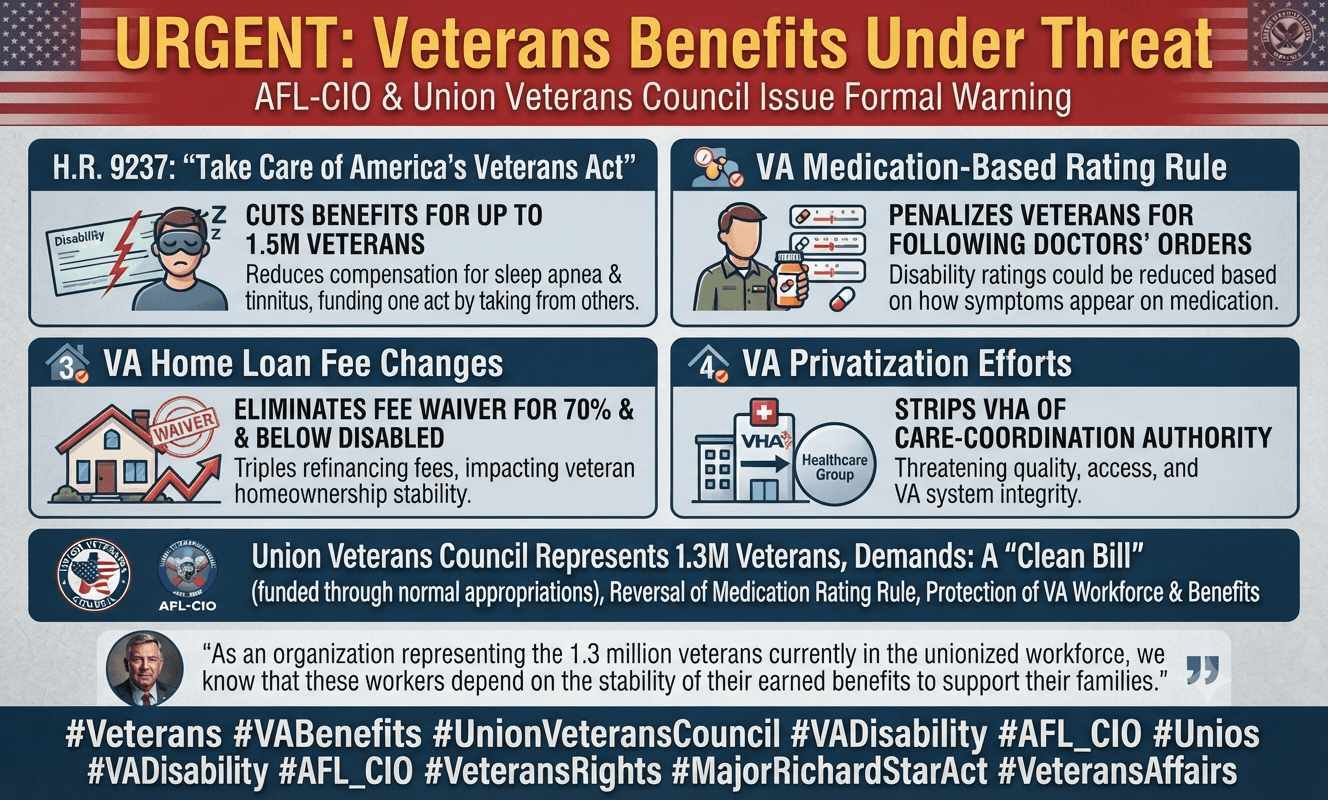
The AFL-CIO and its Union Veterans Council have issued urgent warnings that proposed legislation (H.R. 9237, the “Take Care of America’s Veterans Act”) would cut disability benefits for up to 1.5 million veterans by reducing compensation for conditions like sleep apnea and tinnitus. The labor coalition also opposes a VA rule that would allow disability ratings to be reduced based on a veteran’s “medicated state” rather than the severity of their underlying condition.
Quick Facts
| Item | Details |
|---|---|
| Primary Concern | Benefit cuts in H.R. 9237 affecting up to 1.5 million veterans |
| Affected Conditions | Sleep apnea, tinnitus (most common service-connected conditions) |
| Funding Mechanism | $57 billion in future disability payments cut over next decade |
| Official Agency | AFL-CIO, Union Veterans Council, AFGE, IAVA |
| Key Date | June 2026 press conference and letter sent to Congress |
| Additional Warning | VA “medication-based rating” rule threatens disability ratings |
| Also at Risk | VA Home Loan fee increases for disabled veterans rated at 70% or below |
| What Veterans Should Do | Contact representatives, oppose benefit cuts as offsets |
What Is the AFL-CIO Veterans Benefits Warning?
The AFL-CIO has issued a formal warning that veterans’ disability compensation is under threat from multiple policy proposals . Specifically, the labor coalition is opposing:

H.R. 9237 – The Take Care of America’s Veterans Act: This legislation would fund new benefits (including the Major Richard Star Act) by cutting existing disability compensation for common conditions like sleep apnea and tinnitus .
VA Interim Final Rule on Medication-Based Ratings: This rule would allow the VA to reduce disability ratings for veterans whose symptoms are managed by medication—essentially penalizing veterans for following doctors’ orders .
VA Home Loan Fee Increases: The legislation would eliminate the VA Home Loan Funding Fee waiver for disabled veterans rated at 70% or below and triple fees for veterans refinancing their homes .
The AFL-CIO’s Union Veterans Council (UVC) represents 1.3 million veterans currently in the unionized workforce . The coalition’s message is clear: veterans should never be used as offsets to pay for other veterans’ benefits .
The Take Care of America’s Veterans Act (H.R. 9237)

This legislation is the primary target of the AFL-CIO’s warning. It would expand some benefits while cutting others, creating what advocates call a “zero-sum game.”
What the Bill Would Do
Expansions (The Good):
Major Richard Star Act: Allows certain combat-injured veterans to receive both military retirement pay and VA disability compensation (currently, these are offset against each other)
$10,000 annual increase for severely catastrophically disabled veterans
Boost to survivor benefits (first real increase in decades)
Cuts (The “Offsets”):
Reduce or eliminate compensation for sleep apnea and tinnitus, two of the most common service-connected conditions
Affect up to 1.5 million veterans who currently receive compensation for these conditions
$57 billion in reduced future disability payments projected over the next decade
Eliminate VA Home Loan Funding Fee waiver for disabled veterans rated 70% or below
Triple fees for veterans refinancing VA home loans
Shift VHA care coordination to private providers, accelerating VA privatization
Why This Matters
The AFL-CIO and its partners argue that “veterans’ benefit improvements should not be held hostage to reciprocal cuts and privatization” . The Union Veterans Council stated: “We refuse to accept a system where veterans must pay for the benefits of their fellow service members. We demand a clean bill—one that honors the nation’s debt without shifting the bill to the men and women who served” .
The VA Medication-Based Rating Rule
Veterans May Qualify for Extra Benefits
Check available financial assistance, healthcare programs and other opportunities that may apply to you.
Check EligibilityThe AFL-CIO also issued a separate warning about a VA interim final rule that would reduce disability ratings based on “medicated state.”
What the Rule Would Do
The rule would allow the VA to rate veterans based on how their symptoms appear when they are on medication, rather than rating the underlying severity of the condition .
Example: A veteran with severe PTSD whose symptoms are managed by medication would be rated based on the medicated state, potentially receiving a lower disability rating—and lower compensation—than they would if rated on the actual severity of their condition .
Why It Matters
Craig Romanovich, Executive Director of the Union Veterans Council, stated: “A service-connected injury does not disappear just because a pill makes the symptoms manageable. This rule threatens the financial stability of millions and must be corrected immediately” .
Key Implications:
Veterans are effectively penalized for following doctors’ orders
Ratings could be reduced even if the underlying condition remains severe
Millions of veterans could see their disability compensation decrease
The rule bypasses recent court protections for veterans
The Broader Context: DOGE and VA Workforce Cuts
The AFL-CIO has also raised concerns about broader attacks on the VA system that indirectly affect veterans’ care and benefits .
Staffing Shortages
DOGE-driven policies are causing widespread staffing shortages at VA facilities, leaving veterans waiting longer for worse care . This is compounded by:
Firing of tens of thousands of VA workers
Cancellation of 400,000 VA workers’ union contracts by VA Secretary Doug Collins
Nearly 30% of VA workers are veterans themselves—meaning these cuts hit veterans twice
Crisis Line and Care Access
The AFL-CIO warns that the administration has :
Unlawfully fired workers who staffed the VA crisis line
Jeopardized privacy of veterans seeking mental health services
Dissolved the office that investigated racial inequities in veterans’ care
Issued guidelines allowing doctors to refuse veterans treatment based on union activity, marital status, or political beliefs
SNAP Benefits at Risk
The AFL-CIO also warns that 1.2 million veterans are at risk of losing SNAP benefits, as the administration has blocked more than $5 billion in SNAP contingency funds . AFL-CIO President Liz Shuler stated: “These cuts are leading to hungry children and seniors, veterans losing benefits, and droves of working people spending their mornings in line at the food bank” .
What Is the Union Veterans Council?
The Union Veterans Council (UVC) is an AFL-CIO constituency organization representing union members who are veterans.
Background
Established in July 2008 as a project of the AFL-CIO
Designated a constituency organization in March 2022
Represents 1.3 million veterans in the unionized workforce
Two primary areas of focus: access to good jobs and access to quality health care
Works to protect veterans’ preference, re-employment rights, and training programs like Helmets to Hardhats
What the UVC Does
The UVC :
Speaks out on veterans’ issues and public policy
Holds elected officials accountable to veterans’ needs
Supports the appointment of labor-friendly veterans to government agencies
Forms coalitions with other veteran organizations
Encourages union veterans to take leadership roles in veterans’ organizations
Other Veterans at Risk
1. Disabled Veterans Rated 70% or Below
The proposed legislation would eliminate the VA Home Loan Funding Fee waiver for disabled veterans rated at 70% or below . Currently, disabled veterans are exempt from this fee, which can add thousands of dollars to a home purchase. If eliminated, these veterans would face significant new costs at a time of housing affordability crisis .
2. Veterans with Sleep Apnea and Tinnitus
Up to 1.5 million veterans who receive compensation for sleep apnea and tinnitus could see benefits reduced or eliminated . These are two of the most common service-connected conditions. Tinnitus is the number one most claimed condition by veterans, and sleep apnea affects hundreds of thousands.
3. Combat-Injured Retirees
On the other hand, combat-injured retirees could benefit from the Major Richard Star Act, which would allow them to receive both military retirement pay and VA disability compensation . However, the AFL-CIO argues this should be funded through normal appropriations, not by cutting other veterans’ benefits.
What Veterans Should Do
The AFL-CIO and its partners have called on veterans to take action :
Contact your members of Congress: Tell them to oppose H.R. 9237 in its current form and demand a “clean bill” that doesn’t cut benefits for some veterans to pay for others
Demand reversal of the medication-based rating rule: Contact the VA and your representatives to oppose the interim final rule that penalizes veterans for following doctors’ orders
Stay informed: Follow the Union Veterans Council (aflcio.org) and other veteran service organizations for updates
Know your rights: If your disability rating is reviewed or reduced, consult a VSO (Veterans Service Organization) like the VFW, DAV, or American Legion for assistance
Speak up: As the UVC stated: “To the lawmakers backing the bill: stop using veterans as political leverage. Protect our union VA workers and fund the Major Richard Star Act in the right way. A grateful nation pays its debts. It does not send veterans the bill”
Common Questions
1. What is the AFL-CIO warning about veterans benefits?
The AFL-CIO is warning that H.R. 9237 would cut disability benefits for up to 1.5 million veterans by reducing compensation for sleep apnea and tinnitus to fund new benefits for combat-injured retirees . They also oppose a VA rule that would reduce ratings based on “medicated state” .
2. How many veterans could lose benefits?
Up to 1.5 million veterans could see benefits reduced or eliminated under the proposed legislation . The bill would cut future disability payments by approximately $57 billion over the next decade .
3. What is the medication-based rating rule?
A VA interim final rule that would allow disability ratings to be reduced based on how symptoms appear when veterans are on medication, rather than rating the underlying severity of the condition . This would effectively penalize veterans for following doctors’ orders .
4. What is the Take Care of America’s Veterans Act?
H.R. 9237 is the “Take Care of America’s Veterans Act” . It would expand benefits under the Major Richard Star Act but would offset costs by cutting disability benefits for sleep apnea, tinnitus, and increasing VA home loan fees for disabled veterans .
5. What is the Major Richard Star Act?
A bipartisan proposal that would allow certain combat-injured veterans to receive both military retirement pay and VA disability compensation . Currently, these are offset against each other. The AFL-CIO supports the Star Act but opposes funding it by cutting other veterans’ benefits .
6. What is the Union Veterans Council?
A constituency organization of the AFL-CIO representing 1.3 million union members who are veterans . Its primary focus is protecting veterans’ access to good jobs and quality health care .
7. How does this affect VA home loans?
The bill would eliminate the VA Home Loan Funding Fee waiver for disabled veterans rated at 70% or below and triple fees for veterans refinancing their homes . This would add thousands of dollars in costs during a housing affordability crisis .
8. What does the AFL-CIO say about VA privatization?
The AFL-CIO warns that the legislation would strip the Veterans Health Administration of its care-coordination role and accelerate privatization of VA health care, shifting more services to outside providers .
9. What is the AFL-CIO’s stance on the bill?
The AFL-CIO and its Union Veterans Council strongly oppose H.R. 9237 in its current form. They demand a “clean bill” that funds the Major Richard Star Act through normal appropriations instead of cutting other veterans’ benefits .
10. What should veterans do if their rating is reduced?
Contact a Veterans Service Organization (VSO) like the VFW, DAV, or American Legion for assistance. You can also file an appeal through the VA system. The AFL-CIO encourages veterans to contact their members of Congress to oppose the legislation .
Key Takeaways
The AFL-CIO warns that H.R. 9237 would cut benefits for up to 1.5 million veterans by reducing compensation for sleep apnea and tinnitus to fund the Major Richard Star Act
A VA interim final rule would allow disability ratings to be reduced based on “medicated state,” effectively penalizing veterans for following doctors’ orders
Disabled veterans rated 70% or below would lose their VA Home Loan Funding Fee waiver and face tripled refinancing fees under the legislation
The Union Veterans Council represents 1.3 million veterans in the unionized workforce and is leading opposition to these proposals
The AFL-CIO opposes using veterans as “offsets” to pay for other veterans’ benefits, demanding a “clean bill” funded through normal appropriations
VA workforce cuts are affecting care quality, with tens of thousands of VA workers—many of whom are veterans—being fired
1.2 million veterans are at risk of losing SNAP benefits due to blocked contingency funds
Veterans should contact their members of Congress to oppose H.R. 9237 and the medication-based rating rule
A grateful nation pays its debts. It does not send veterans the bill
Official Resources
AFL-CIO Union Veterans Council — https://aflcio.org/uvc — Official information on the UVC and veterans advocacy
VA.gov — https://www.va.gov — Access your benefits, check claims, and file appeals
House Veterans Affairs Committee — https://veterans.house.gov — Track legislation affecting veterans
Congress.gov — https://www.congress.gov — Track H.R. 9237 and other legislation
Veterans Service Organizations (VSOs) — VFW, DAV, American Legion, IAVA for claims assistance
Introduction to the AFL-CIO and Its Veterans Council
The American Federation of Labor and Congress of Industrial Organizations (AFL-CIO) is one of the largest and most influential labor federations in the United States. Established in 1955, the AFL-CIO is a coalition of 55 national and international labor unions that advocate for the rights and benefits of workers across various industries. The federation plays a pivotal role in addressing labor issues, promoting fair wages, ensuring safe working conditions, and defending the rights of all workers, including veterans.
Within the AFL-CIO, the Union Veterans Council (UVC) holds a significant position dedicated to advocating for the interests of veterans in the labor movement. The UVC works diligently to improve the lives of veteran workers by addressing the unique challenges they face in the civilian workforce. This dedicated council strives to elevate the issues specific to veterans, such as access to quality healthcare, job training programs, and equitable employment opportunities.
The mission of the UVC is not only to support veterans but also to educate the broader labor movement on the importance of integrating veteran issues into the larger context of labor rights. The council fosters an inclusive environment where veterans can share their experiences and challenges, ensuring that their voices are heard within the AFL-CIO and beyond. This is particularly essential as many veterans transition from military service to civilian employment, navigating a complex landscape that can be fraught with obstacles.
In summary, the AFL-CIO serves as a vital advocate for workers’ rights, and the Union Veterans Council plays a crucial role within this framework. By focusing on the unique needs of veteran workers, the UVC aims to enhance their livelihoods and protect their benefits, ensuring that they receive the necessary support as they reintegrate into society.
Overview of H.R. 9237: The ‘Take Care of America’s Veterans Act’
The proposed legislation known as H.R. 9237, formally titled the ‘Take Care of America’s Veterans Act’, aims to enhance the support and resources available to veterans across the United States. This act is a significant legislative initiative designed to address various pressing concerns that affect veterans, with particular emphasis placed on disability compensation. One of the primary goals of H.R. 9237 is to ensure that veterans receive adequate compensation for service-related disabilities, a critical issue for many former military personnel who continue to experience challenges related to their service.
H.R. 9237 outlines several key provisions that focus on improving access to benefits for veterans. Among these provisions is the expansion of eligibility criteria for disability benefits, which seeks to capture a broader spectrum of service-related health issues. By doing so, the legislation recognizes the diverse experiences of veterans and the various ways their military service may have impacted their health. Furthermore, the act proposes streamlined processes for claims and appeals, aiming to reduce the bureaucratic hurdles that often hinder veterans from obtaining the benefits they rightfully deserve.
Another noteworthy aspect of H.R. 9237 is its recognition of the importance of mental health services for veterans. The act acknowledges the increasing need for mental health support, addressing conditions such as PTSD, which disproportionately affect those who have served in combat roles. The legislation promotes enhanced funding for mental health programs and initiatives, reflecting a comprehensive approach to veteran care.
Overall, H.R. 9237 represents a critical step forward in addressing the long-standing issues faced by veterans in relation to their benefits and health care. Its successful implementation could mean better support systems for veterans, ensuring that they receive the care and compensation that acknowledges their sacrifices in service to the nation.
Impact of Proposed Cuts to Disability Benefits
The proposed cuts to disability benefits for veterans, particularly affecting conditions such as sleep apnea and tinnitus, threaten to significantly impact the lives of many veterans and their families. An estimated 1.5 million veterans could face a reduction in their disability compensation should these cuts be implemented. This situation raises serious concerns regarding the financial stability and well-being of affected individuals.
According to recent statistics, sleep apnea and tinnitus are among the most common disability claims filed by veterans. These conditions often stem from military service, exposing personnel to various risks such as explosions, loud environments, and physical stressors. Veterans relying on the Department of Veterans Affairs (VA) for support may find themselves in precarious financial situations if benefits are decreased. Reductions in compensation may leave many veterans unable to cover essential living expenses, medical bills, or necessary treatments.
Experts in veteran affairs stress the importance of adequate support systems for those suffering from service-related disabilities. With the proposed cuts, the financial burden could exacerbate existing health issues, leading to a negative cycle of declining physical and mental health. Moreover, experts fear that vulnerable veterans may experience increased levels of anxiety and depression, knowing that their ability to receive financial assistance is jeopardized. The potential cuts not only affect financial security but also undermine the promise made to serve and support those who have served this nation.
In light of these factors, it becomes crucial for lawmakers to reconsider these proposed cuts. The implications extend beyond mere statistics; they touch on the quality of life for veterans. As discussions continue, the voices of veterans and advocacy groups need to be acknowledged to ensure that the sacrifices made by service members are honored with appropriate support systems.
Understanding the Veterans Affairs (VA) Rule Changes
The Veterans Affairs (VA) is undergoing notable changes that directly affect the evaluation of disability ratings for veterans. One significant update includes the adoption of criteria that allows the reduction of disability ratings based on a veteran’s ‘medicated state.’ This policy shift raises critical questions about how veterans are assessed and the implications it has for their benefits.
Under the new rule, the VA may consider the effects of medication when assessing a veteran’s disability. This means that if a veteran is prescribed medication that alleviates symptoms, the VA could conclude that the underlying condition is not as severe as previously determined. The evaluation process thus shifts from a purely clinical perspective to a more dynamic assessment, taking into account the pharmacological management of symptoms. This presents a significant departure from traditional evaluations where the focus was primarily on the severity of the underlying condition.
Veterans need to be aware that this change in evaluation criteria could lead to potential reductions in their disability ratings. For many veterans, the medication used to manage their conditions may lead the VA to view their health status differently, influencing both their disability assessment and the benefits they receive. Moreover, this change calls into question the adequacy of current guidelines utilized by the VA to evaluate the true impact of a disability on a veteran’s life.
Properly understanding these changes is crucial. Veterans should seek to familiarize themselves with both the new rules and the criteria that the VA uses to make disability determinations. Recognizing the difference in assessments based on a veteran’s medicated state versus their unmedicated condition can help veterans navigate their claims more effectively, and equip them with the necessary information to advocate for their rights.
Testimonies from Affected Veterans
Every veteran carries a unique story shaped by their experiences in service, and these narratives often extend into their interactions with veteran benefits. Many veterans have expressed significant concerns regarding the recent legislative changes proposed by the AFL-CIO, which they feel might jeopardize their well-deserved access to essential resources and healthcare services.
One such veteran, Robert, a former sergeant with over ten years of service, reflects on his mounting anxieties: “When I heard about the new rules, my heart sank. My family relies on these benefits for my health care, and the uncertainty surrounding any changes is incredibly distressing. It feels like a weight on my shoulders that never lifts.” Robert’s story is not uncommon, as many veterans find themselves grappling with the potential ramifications of altering benefits they have relied upon for years.
Similarly, Jessica, a veteran who served in combat, shared her own apprehensions: “I worry about my peers—those with disabilities or mental health issues. Changes to the system could mean limited access to the treatments we desperately need. The thought that our sacrifices might be overlooked is disheartening.” Jessica’s experience underscores the broader issue of mental health support within the military community, which is often directly tied to the benefits structure.
Furthermore, many veterans have expressed fears regarding the accessibility of healthcare and the complexity of navigating the VA system under potential new rules. Veterans like Mark, who faces chronic health challenges, stated, “Every time there’s talk of changes, it feels like I am fighting another battle just to receive the care I need. It shouldn’t be this hard to access my benefits.” This sentiment reveals a shared frustration among veterans striving for clarity and continuity in their healthcare options.
The collective experiences of these individuals emphasize the urgent need for a transparent dialogue surrounding proposed legislation and how it might affect veteran benefits. As discussions unfold, it becomes increasingly important for stakeholders to listen to the voices of those directly impacted by these changes.
AFL-CIO’s Stance and Advocacy Efforts
The AFL-CIO has been a pivotal advocate for the interests of veterans and their families, particularly in light of proposed changes that significantly impact veterans’ benefits. Recognizing the potential risks associated with legislation that may jeopardize the well-being of those who have served, the AFL-CIO has taken a firm stance against these modifications. Their response reflects a commitment to ensuring that veterans continue to receive the support and services they have earned through their service to the nation.
In recent months, the AFL-CIO has mobilized its Veterans Council to lead efforts aimed at raising awareness about the implications of the proposed changes. This council serves as a platform for veterans to voice concerns and advocate for comprehensive benefits. The council’s activities include organizing town hall meetings, rallying together veterans from various backgrounds, and collaborating with other advocacy groups to amplify their message. By utilizing these grassroots efforts, the AFL-CIO aims to highlight the risks that the proposed legislation poses to veterans’ healthcare, education, and overall welfare.
Additionally, the AFL-CIO has engaged in direct communication with lawmakers, presenting well-researched positions on the necessity of preserving veterans’ benefits. This advocacy work includes drafting letters, participating in hearings, and providing expert testimony to ensure that legislators understand the ramifications their decisions could have on veterans’ lives. The organization emphasizes that any alterations to veterans’ benefits must be approached with the utmost caution and consideration.
Through their ongoing efforts, the AFL-CIO underscores the significance of unity in protecting the rights and benefits of veterans. Their comprehensive approach not only seeks to inform but also aims to empower veterans and their families to stand up for their rightful benefits during this critical time.
How Veterans Can Protect Their Benefits
In light of recent proposals to modify veterans’ benefits, it is crucial for veterans to proactively safeguard their disability benefits. Understanding the context of these changes is the first step in taking appropriate action. One effective method for protection is engaging with veterans’ organizations that specialize in advocacy and support. These organizations, such as the American Legion or VFW (Veterans of Foreign Wars), can provide valuable resources and information about navigating the complexities of the benefits system.
Veterans should become familiar with their rights concerning benefits. This knowledge empowers them to recognize potential violations or unfair practices that might arise during the proposed changes. The U.S. Department of Veterans Affairs (VA) provides various resources for veterans, including guides on rights and responsibilities, which can be instrumental in remaining informed.
Another essential strategy involves advocating for oneself and connecting with peers and representatives. Maintaining open lines of communication with local lawmakers and sharing individual stories can enhance awareness regarding the challenges faced by veterans. Meeting with congressional representatives or participating in public forums not only raises visibility but also pressures decision-makers to consider the potential impact of benefit cuts on veterans’ lives.
Additionally, veterans can consult with financial advisors or legal professionals who specialize in veterans’ affairs. These experts can provide tailored advice on how best to manage benefits and prepare for any possible adjustments. Keeping documentation organized and consistently reviewing benefits information assists in ensuring that veterans are equipped to respond to any shifts promptly.
Addressing these issues now is crucial for protecting the well-being of veterans and ensuring that they continue receiving the benefits deserved. Taking these steps contributes to fortifying the support network for veterans, ultimately helping to advocate for their rights in the face of changing policies.
Call to Action for Veterans and Supporters
Veterans must remain vigilant in advocating for their rights and benefits, and it is crucial that the community comes together to support these efforts. The landscape of veterans’ benefits is continually evolving, and it is imperative that veterans and their supporters actively engage with policymakers to ensure their voices are heard. One effective way to do this is through regular communication with local lawmakers. You can easily set up meetings, send letters, or utilize social media platforms to express your concerns regarding veterans’ benefits and services. By raising awareness on these vital issues, you can help shape policies that affect the lives of many.
Moreover, participating in advocacy campaigns is essential. Organizations dedicated to veterans’ rights often run initiatives aimed at addressing legislative gaps in veterans’ benefits. Joining these campaigns can amplify your impact, whether by signing petitions, attending rallies, or volunteering your time. There are numerous nonprofits and advocacy groups focused on this mission that would greatly benefit from your involvement. Check out organizations such as the Veterans of Foreign Wars (VFW), American Legion, or Disabled American Veterans (DAV) for opportunities to take action.
Raising awareness about veterans’ benefits requires consistent effort within your network and community. Host discussions, share informative resources through social media, or create community events to draw attention to veterans’ issues. Use your voice to educate others about the importance of ensuring veterans receive their rightful benefits and services. By collaborating with fellow veterans and supporters, you can foster a stronger collective approach, which is essential for driving meaningful change.
In conclusion, your involvement is crucial for advocating for veterans’ rights. Engage with lawmakers, participate actively in advocacy campaigns, and raise awareness to ensure that veterans receive the benefits they deserve. Your actions can lead to transformative changes in the lives of many who have served our nation.
Conclusion and Future Outlook
Throughout this discussion on the AFL-CIO veterans benefits, we have highlighted several significant aspects that every veteran should be aware of. The rights and benefits available to veterans are not only vital for their well-being but also reflect society’s commitment to those who have served their country. Understanding these benefits is paramount, as it enables veterans to make informed decisions about their entitlements and ensure they receive the necessary resources to thrive after military service.
The importance of continuous vigilance cannot be overstated. Veterans must advocate for their rights and benefits as legislation and policies can change over time. Keeping abreast of any changes in veterans’ benefits, whether concerning healthcare, education, or financial assistance, is pivotal. Engaging with organizations that focus on veteran rights can empower individuals to navigate the complexities of their benefits and influence positive revisions in policies.
Looking to the future, there is reason to be hopeful about developments in veterans legislation. Ongoing advocacy efforts at local and national levels aim to enhance the support systems in place for veterans. This could lead to new initiatives that may address current gaps in benefits, thereby improving the overall landscape of support for veterans. Furthermore, as awareness of veterans’ issues grows, there is potential for more substantial funding and resources dedicated to enhancing their quality of life.
In conclusion, every veteran must stay informed and actively participate in discussions about their rights and benefits. The evolving nature of veterans affairs demands that individuals remain proactive and engaged, ensuring that they receive the respect and support they rightfully deserve. By fostering a community of advocacy and awareness, we can contribute to a future where veterans’ needs are consistently met and their sacrifices acknowledged.


🇺🇸 IMPORTANT DISCLAIMER – Veterans Benefits Information
This site provides general information about U.S. Department of Veterans Affairs (VA) benefits for educational and informational purposes only.
- Not Official: We are NOT affiliated with, endorsed by, or connected to the U.S. Department of Veterans Affairs (VA), the Veterans Benefits Administration (VBA), the Veterans Health Administration (VHA), or any other government agency.
- No Legal/Financial Advice: The content on this website is for informational purposes only and does not constitute legal, financial, or medical advice. VA benefits rules change frequently – always consult with an accredited Veterans Service Officer (VSO) or a qualified professional for your specific situation.
- Official Sources: For official, binding information and to apply for benefits, always visit official .gov websites: VA.gov, Benefits.VA.gov, or SSA.gov.
- No Data Collection: This site does not collect, store, or process any personal information. It does not have login forms, contact forms, or any system to capture user data. We never ask for your Social Security Number, bank details, or any personal information.
- 🚨 Scam Alert: The VA and other government agencies never charge fees for benefit applications. If anyone asks for money to "process" your VA claim, it is a scam. Report it to the VA Office of Inspector General at VA.gov/OIG.
- Advertising: This site uses third-party advertising (Adsterra) to cover operational costs. We do not endorse or guarantee any products or services advertised.
📌 Information provided as of June 2026. Always verify current eligibility and rules with official .gov sources.
This site is not affiliated with the U.S. Department of Veterans Affairs or any government agency. All information is for educational purposes only. Please visit VA.gov for official information.
