
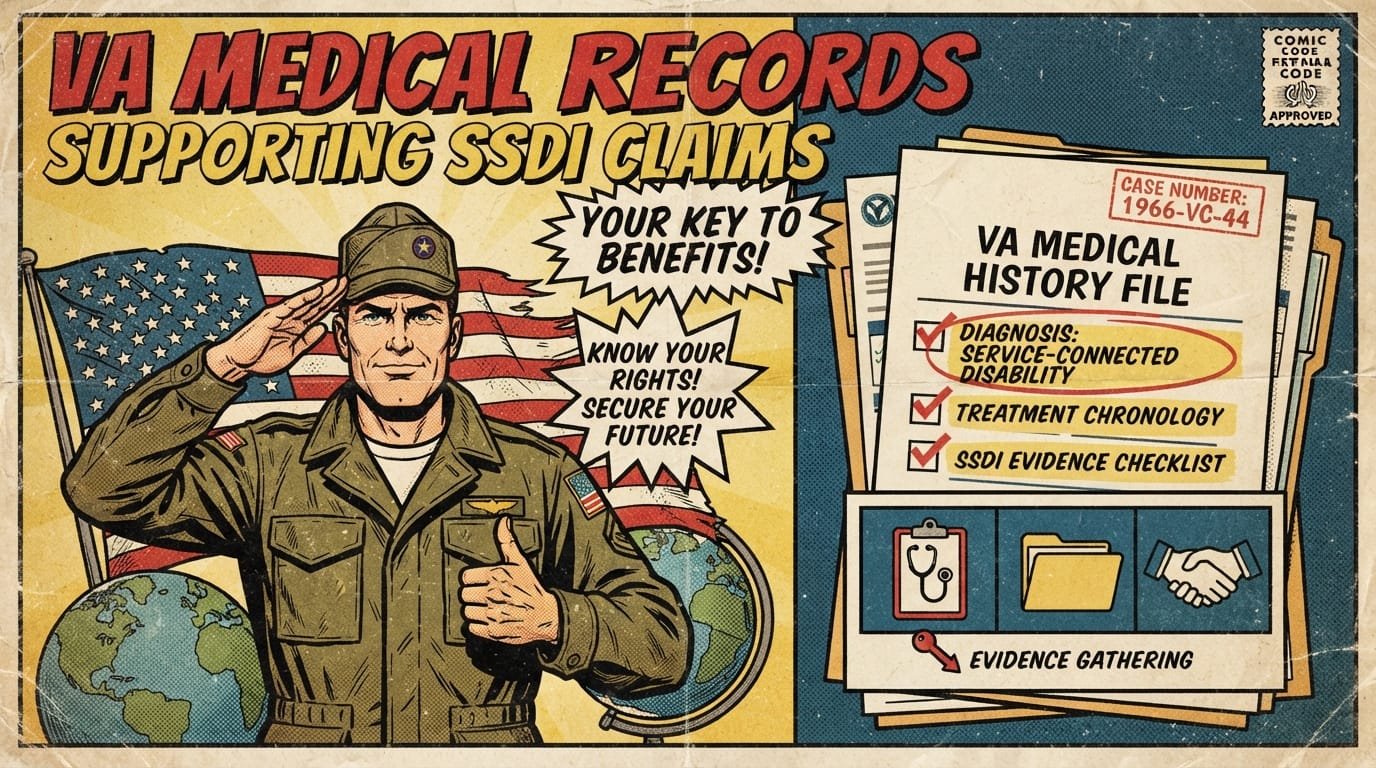
SSDI for Veterans: How Social Security Disability Works With VA Benefits
Featured Answer: Veterans can receive SSDI and VA disability compensation at the same time. The programs are separate, run by different agencies, and neither reduces the other. VA disability does not count as income for SSDI eligibility. In 2026, SSDI pays an average of about $1,630 monthly, while 100% VA disability pays $3,938.58.
Quick Facts
| Item | Details |
|---|---|
| Benefit | Social Security Disability Insurance (SSDI) |
| Eligibility | Disability preventing substantial work + sufficient SSA work credits |
| Application | Online at SSA.gov, by phone 1-800-772-1213, or in person |
| Processing Time | 3–5 months initial; expedited for 100% P&T veterans |
| Official Agency | Social Security Administration (SSA) |
| Required Forms | SSA-16, SSA-3368, SSA-827; VA rating decision letter recommended |
| Updated For | 2026 rates (2.8% COLA effective December 2025) |
What Is SSDI?
Direct Answer: SSDI (Social Security Disability Insurance) is a federal insurance program that pays monthly cash benefits to people who cannot work because of a severe, long-lasting disability. It is funded through FICA payroll taxes you paid while working.

SSDI is not a needs-based program. It does not depend on your savings or assets. It depends on two things: your work history (whether you earned enough Social Security credits) and your medical condition (whether it meets Social Security’s definition of disability).
Why SSDI Matters for Veterans

Many veterans assume VA disability and SSDI are the same thing or that one replaces the other. They are not the same, and they do not replace each other.
VA disability pays compensation for conditions connected to military service. You can receive it even if you still work.
SSDI replaces lost income when a disability prevents you from working at a substantial level. You must prove you cannot work—not just that you have a service-connected condition.
Because the two programs serve different purposes, veterans who qualify for both can collect both. In most cases, neither payment reduces the other.
What Veterans Should Do Next
If you have a service-connected disability that prevents you from working, apply for VA disability first (if you haven’t already), then apply for SSDI. Include your VA rating decision and VA medical records with your SSDI application. For veterans with a 100% Permanent and Total (P&T) VA rating, the SSA offers expedited processing—identify yourself as a “veteran rated 100% P&T” when you apply.
How SSDI and VA Disability Differ
Direct Answer: VA disability is a compensation program based on service connection. SSDI is an income-replacement program based on inability to work anywhere in the national economy. They use different disability definitions, different evidence standards, and different work rules.
Side-by-Side Comparison
| Feature | VA Disability | SSDI |
|---|---|---|
| Agency | Department of Veterans Affairs | Social Security Administration |
| Legal basis | Title 38 | Title II, Social Security Act |
| Disability standard | Service-connected condition; percentage rating 0%–100% | Total inability to engage in substantial gainful activity |
| Work credits required | No | Yes—typically 40 credits, 20 in last 10 years |
| 2026 max monthly (single) | $3,938.58 (100% rating) | $4,152 |
| 2026 average monthly | Varies by rating | About $1,630 |
| Tax status | Tax-free | Taxable based on household income |
| Can you work while receiving? | Yes (TDIU has special rules) | Limited—must stay below SGA ($1,620/month in 2026) |
| Counted for SNAP/Medicaid? | Generally excluded | Counted as income |
| Converts to retirement? | No | Yes, at full retirement age |
Veterans May Qualify for Extra Benefits
Check available financial assistance, healthcare programs and other opportunities that may apply to you.
Check EligibilitySources: VA.gov, SSA.gov, 2026 COLA figures
The Core Difference in Plain Terms
VA disability asks: Is your condition related to your military service? SSDI asks: Can you work at any job in the national economy?
A veteran can be 100% VA-rated for PTSD and still be denied SSDI if the SSA determines the veteran retains the functional capacity for some type of work. Conversely, a veteran can qualify for SSDI based on a non-service-connected condition—such as a civilian injury or illness—and receive no VA disability at all.
Eligibility: Who Qualifies for SSDI as a Veteran?
Direct Answer: To qualify for SSDI, you must meet two sets of requirements: work credits and medical disability. Having a VA rating—even 100%—does not automatically qualify you for SSDI.
Work Credit Requirements
You earn Social Security work credits by working and paying FICA taxes. In 2026:
You earn one credit for every $1,890 in covered earnings.
You can earn up to four credits per year.
You reach the four-credit maximum for the year at $7,560 in earnings.
How many credits you need depends on your age when your disability began:
| Age When Disability Began | Credits Needed |
|---|---|
| Before 24 | 6 credits in the last 3 years |
| 24–30 | Varies (generally 6–20) |
| 31 or older | 20 credits in the last 10 years (usually 40 total) |
Military service counts toward Social Security credits. If you served on active duty, you earned credits the same way civilian employees do—through payroll deductions.
Medical Eligibility: SSA’s Disability Definition
The SSA defines disability as the inability to engage in any substantial gainful activity (SGA) due to a medically determinable physical or mental impairment that has lasted or is expected to last at least 12 months or result in death.
In 2026, the SGA limit is **$1,620 per month** for non-blind individuals ($2,700 for blind individuals). If you earn more than this, you generally cannot qualify for SSDI—regardless of your medical condition.
Does a VA Rating Help?
A VA rating does not guarantee SSDI approval. However, a high VA rating—especially 70%, 90%, or 100%—can be persuasive evidence. The SSA will review your VA medical records, rating decision, and C&P exam findings when evaluating your claim.
Key points:
100% VA rating: Strong supporting evidence but not automatically qualifying.
TDIU: The VA has already determined you are unemployable due to service-connected conditions. This is an important factor the SSA considers.
10–20% ratings: Show a disability exists but also suggest you may still be able to work.
Who Qualifies: Quick Checklist
- □
You have enough Social Security work credits
- □
You have a medical condition expected to last 12+ months or result in death
- □
You cannot perform substantial gainful activity
- □
You are not currently earning above the SGA limit
- □
You have medical evidence documenting your condition and functional limitations
2026 SSDI Payment Amounts
Direct Answer: SSDI payments are based on your lifetime earnings, not your VA rating. The 2026 maximum is $4,152 per month. The average is approximately $1,630.
2026 SSDI Rates at a Glance
| Category | 2026 Amount |
|---|---|
| Maximum monthly benefit | $4,152 |
| Average monthly benefit | About $1,630 |
| Average for disabled workers | About $1,635 |
Source: SSA 2026 COLA fact sheet
Your actual SSDI amount depends on your earnings history. If you earned at or near the taxable maximum throughout your career, you may approach the maximum. If your earnings were lower or your work history was shorter, your benefit will be lower.
SSDI vs. VA Disability: Combined Value Example
Here’s what a veteran rated 100% P&T with SSDI approval might receive monthly in 2026:
| Benefit Source | Monthly Amount |
|---|---|
| VA disability (100%, veteran alone) | $3,938.58 |
| SSDI (average) | ~$1,630.00 |
| Combined monthly | ~$5,568.58 |
Both amounts are paid separately. Neither reduces the other.
Can You Receive SSDI and VA Disability at the Same Time?
Direct Answer: Yes. Veterans can receive SSDI and VA disability compensation simultaneously with no offset. VA disability is considered unearned income and does not affect SSDI eligibility or payment amount.
The “No-Offset” Rule
Federal law and SSA operating manuals confirm that VA disability compensation does not reduce SSDI benefits. The reasoning is straightforward: the two programs serve different legal purposes under different titles of law.
VA benefits fall under Title 38 (veterans’ benefits).
SSDI falls under Title II of the Social Security Act (income replacement).
Because the programs are legally independent, the SSA does not treat VA compensation as earned income. A veteran receiving $4,000 monthly in VA disability can still qualify for SSDI—and receive the full SSDI amount.
What About TDIU and SSDI?
Veterans receiving TDIU (Total Disability based on Individual Unemployability) can also receive SSDI. There is no “double-dipping” penalty. Many veterans who qualify for TDIU also qualify for SSDI because both programs evaluate unemployability—though they use different standards.
Important Distinction: SSDI vs. SSI
Do not confuse SSDI with SSI (Supplemental Security Income).
SSDI is an insurance program based on work history. VA disability does not reduce SSDI.
SSI is a needs-based program for people with limited income and resources. VA disability does count as income for SSI and can reduce or eliminate SSI payments.
If you receive SSI, VA disability compensation will affect your SSI amount. If you receive SSDI, it will not.
How to Apply for SSDI as a Veteran
Direct Answer: Apply online at SSA.gov, by phone at 1-800-772-1213, or at your local Social Security office. Include your VA rating decision and VA medical records. Veterans with 100% P&T ratings qualify for expedited processing.
Step-by-Step Application Process
Gather your documents
Social Security number
DD-214 or military discharge records
VA rating decision letter
VA medical records and C&P exam results
W-2 forms or self-employment tax returns for recent years
Names and contact information for treating providers
Apply online at SSA.gov
The online application is the fastest method.
If you prefer phone, call 1-800-772-1213 (TTY 1-800-325-0778).
You can also apply in person at your local SSA office.
Identify yourself as a veteran with a 100% P&T rating
This triggers expedited processing.
Do this on the application or tell the SSA representative.
Submit your VA records
The SSA will request records, but you can speed things up by submitting them yourself.
Include your VA rating decision, treatment records, and any functional capacity evaluations.
Complete the Adult Disability Report (SSA-3368)
This form asks about your conditions, medications, work history, and daily activities.
Be specific about functional limitations: how long you can sit, stand, walk, lift, concentrate, and interact with others.
Attend any consultative examinations
The SSA may schedule an exam with its own doctor if your records are insufficient.
Attend—missing an exam can result in denial.
Respond to requests for additional information
The SSA will contact you if it needs more records or clarification.
Respond promptly to avoid delays.
Required Forms
| Form | Purpose |
|---|---|
| SSA-16 | Application for Disability Insurance Benefits |
| SSA-3368 | Adult Disability Report |
| SSA-827 | Authorization to Disclose Information to SSA |
| SSA-3373 | Function Report (may be requested) |
Online Application
The fastest way to apply is at SSA.gov/applyfordisability. The online system walks you through each step and lets you upload documents electronically.
Expedited Processing for Veterans
Direct Answer: The SSA offers expedited processing for two groups of veterans: those with a 100% Permanent and Total (P&T) VA rating and Wounded Warriors who became disabled on active duty on or after October 1, 2001.
Who Qualifies for Expedited Processing
| Category | Criteria |
|---|---|
| 100% P&T veterans | VA rating of 100% permanent and total for service-connected impairments |
| Wounded Warriors | Disabled while on active duty on or after October 1, 2001 |
How to Request Expedited Processing
Identify yourself as a veteran rated 100% P&T when you file.
Provide your VA rating decision letter showing the 100% P&T designation.
Apply online or by phone—both methods allow you to flag your veteran status.
Expedited processing does not guarantee approval. It speeds up the decision timeline. Veterans with 100% P&T ratings may receive an initial decision in a few months instead of the standard 6–8 months.
VA-SSA Record Sharing
The VA and SSA have implemented an electronic health record transfer system that speeds up processing by transferring veterans’ health records to the SSA electronically. This replaces the previous manual method that sometimes took months.
SSDI Approval Rates for Veterans
Direct Answer: Veterans have a slightly higher SSDI approval rate than the general population at the initial application stage—around 45% to 54% compared to roughly 35% for civilians. However, nearly one-third of veterans with 100% VA ratings are still denied SSDI.
Why Veterans Are Denied Despite High VA Ratings
The VA and SSA define disability differently. Key reasons for denial include:
The SSA determines the veteran retains the ability to perform some type of work.
The medical evidence does not show functional limitations that meet SSA’s standards.
The veteran is earning above the SGA limit.
The application lacks sufficient detail about work-related limitations.
What Strengthens an SSDI Claim
Detailed medical records showing diagnoses, symptoms, medications, and treatment over time
Functional capacity evidence describing limits on sitting, standing, walking, lifting, concentrating, and interacting with others
VA rating decision and C&P exam findings
Consistent work history showing you stopped working due to your condition
Statements from treating providers about your limitations
Common Mistakes Veterans Make With SSDI Claims
Direct Answer: The most common mistakes include assuming a VA rating guarantees SSDI approval, failing to include VA medical records, not documenting functional limitations, and missing appeal deadlines.
Top 7 Mistakes to Avoid
Assuming 100% VA rating equals automatic SSDI approval
It does not. The SSA conducts its own evaluation.
Failing to include VA medical records with the SSDI application
Your VA treatment records are strong evidence. Submit them proactively.
Relying solely on the VA rating percentage
The SSA needs details about what you cannot do in a work setting—not just a percentage.
Not identifying as a 100% P&T veteran
This misses expedited processing and delays your decision.
Missing appeal deadlines
You have 60 days from the denial notice to request reconsideration. Missing this deadline can cost you benefits.
Earning above the SGA limit
In 2026, earning more than $1,620 monthly generally disqualifies you from SSDI.
Providing an incomplete work history
The SSA evaluates your ability to perform past work and adjust to other work. An incomplete history weakens your claim.
SSDI Appeals Process
Direct Answer: If your SSDI claim is denied, you have four appeal levels: Reconsideration, Administrative Law Judge hearing, Appeals Council review, and federal court. You have 60 days from the denial notice to file each appeal.
Four Appeal Levels
| Level | What Happens | Timeframe |
|---|---|---|
| Reconsideration | A different SSA reviewer examines your case; you can submit new evidence | 3–6 months |
| Administrative Law Judge (ALJ) hearing | You appear before a judge; this is where most approvals happen | 12+ months |
| Appeals Council | Reviews the ALJ decision for errors | 6–12 months |
| Federal Court | Lawsuit in federal district court | 12+ months |
How to Appeal
File online at SSA.gov/appeals or submit Form SSA-561 (Reconsideration).
Submit new medical evidence if available.
Include your VA medical records—they carry significant weight in appeals.
Consider hiring a disability attorney for the ALJ hearing level. Attorney fees are capped at 25% of back pay or $9,200 in 2026, whichever is lower.
Approval Rates by Appeal Level
Initial application: 45–54% for veterans
Reconsideration: Lower approval rate
ALJ hearing: 60%+ overall success rate when represented by an attorney
Do not skip the appeal. Most denied applicants never appeal, missing out on benefits they qualify for.
SSDI Back Pay for Veterans
Direct Answer: SSDI back pay is a lump-sum payment covering the period between your established onset date and your approval date, minus a five-month waiting period. VA disability compensation does not reduce SSDI back pay.
How Back Pay Is Calculated
Established onset date: The date the SSA determines your disability began.
Application date: When you filed your claim.
Five-month waiting period: The SSA does not pay for the first five full months of disability.
Back pay period: From the sixth full month after onset through the approval date.
SSDI back pay is typically limited to 12 months before your application date. If your onset date is earlier, you may lose back pay for months before that 12-month window.
Timeline for Receiving Back Pay
After approval, SSDI back pay typically arrives within 30–60 days. Delays can occur if:
The SSA needs to verify your work history.
There are issues with your bank account information.
Your case involves complex onset date calculations.
VA Disability and SSDI Back Pay
VA disability compensation does not offset or reduce SSDI back pay. You receive the full SSDI back pay amount regardless of your VA compensation.
Tax Treatment: SSDI vs. VA Disability
Direct Answer: VA disability compensation is always tax-free. SSDI is taxable based on your total household income using the “combined income” test. Receiving both can create tax implications.
2026 Tax Rules
| Benefit | Federal Tax Treatment |
|---|---|
| VA disability compensation | Always tax-free |
| SSDI | Taxable if combined income exceeds thresholds |
Combined Income Thresholds
Your SSDI benefits may be taxable if your “combined income” exceeds:
$25,000 (single filer)
$32,000 (married filing jointly)
Combined income = adjusted gross income + nontaxable interest + half of your Social Security benefits.
Planning Consideration
If you receive both VA disability and SSDI, your VA disability is not counted as income for the SSDI tax calculation. However, your SSDI alone—or combined with other income—may push you over the threshold.
What to do next: Consult a tax professional familiar with veterans’ benefits. The IRS Publication 907 (Tax Highlights for Persons with Disabilities) provides additional guidance.
How SSDI Interacts With Other Benefits
Direct Answer: SSDI can be received alongside VA disability, military retirement, and TDIU without offset. However, SSI is reduced by VA disability, and Workers’ Compensation benefits can reduce SSDI if the combined amount exceeds 80% of pre-disability earnings.
Benefit Interaction Table
| Benefit Combination | Offset? |
|---|---|
| SSDI + VA disability | No offset |
| SSDI + TDIU | No offset |
| SSDI + military retirement | Generally no offset (CRDP rules may apply) |
| SSDI + SSI | SSI reduced by SSDI and VA disability |
| SSDI + Workers’ Comp | Offset if combined exceeds 80% of pre-disability earnings |
SSDI and Medicare
SSDI recipients become eligible for Medicare after 24 months of receiving SSDI benefits. If you already have VA health care, Medicare can provide additional coverage. You can use both—VA health care and Medicare—depending on your needs.
SSDI and Retirement
SSDI automatically converts to Social Security retirement benefits at full retirement age (66–67, depending on your birth year). The monthly amount stays the same.
Latest Rule Changes for 2026
Direct Answer: The 2026 COLA is 2.8%, applied to both VA disability and SSDI. The SGA limit increased to $1,620 monthly. The VA and SSA continue to expand electronic record sharing to speed up claims.
Key 2026 Changes
| Change | Details |
|---|---|
| COLA | 2.8% for both VA disability and SSDI |
| SGA limit | $1,620/month (non-blind); $2,700/month (blind) |
| Work credit value | $1,890 per credit |
| SSDI maximum | $4,152/month |
| VA 100% rate | $3,938.58/month (veteran alone) |
| Attorney fee cap | 25% of back pay or $9,200, whichever is lower |
Electronic Record Sharing
The VA and SSA now transfer veterans’ health records electronically. This reduces processing times for SSDI claims filed by veterans with VA medical records.
Common Questions
1. Can I get SSDI and VA disability at the same time?
Yes. SSDI and VA disability are separate programs with separate funding. You can receive both simultaneously, and neither reduces the other. VA disability is considered unearned income and does not affect SSDI eligibility or payment amount.
2. Does a 100% VA rating automatically qualify me for SSDI?
No. A 100% VA rating does not guarantee SSDI approval. The SSA uses its own disability definition—inability to engage in substantial gainful activity. However, a 100% P&T rating qualifies you for expedited processing and strengthens your claim.
3. How much does SSDI pay in 2026?
The maximum SSDI benefit in 2026 is $4,152 per month. The average is approximately $1,630. Your actual amount depends on your lifetime earnings and work history, not your VA rating.
4. How long does SSDI take for veterans?
Initial SSDI decisions take 3–5 months on average. Veterans with 100% P&T ratings or Wounded Warrior status may receive faster decisions through expedited processing. Appeals can add 12–24 months.
5. Does VA disability affect my SSDI payment?
No. VA disability compensation does not reduce your SSDI payment. The SSA does not count VA benefits as earned income or unearned income for SSDI purposes.
6. What is the SGA limit for 2026?
The Substantial Gainful Activity limit for 2026 is $1,620 per month for non-blind individuals and $2,700 per month for blind individuals. Earning above this limit generally disqualifies you from SSDI.
7. Can I get SSDI and TDIU at the same time?
Yes. SSDI and TDIU (Total Disability based on Individual Unemployability) can be received simultaneously with no offset. Many veterans who qualify for TDIU also qualify for SSDI.
8. How do I apply for SSDI as a veteran?
Apply online at SSA.gov, by phone at 1-800-772-1213, or at your local Social Security office. Include your VA rating decision and VA medical records. Identify yourself as a 100% P&T veteran to trigger expedited processing.
9. Is SSDI taxable for veterans?
SSDI is taxable based on your combined household income. VA disability is always tax-free. If your combined income exceeds $25,000 (single) or $32,000 (married), a portion of your SSDI may be taxable.
10. What happens if my SSDI claim is denied?
You have 60 days to appeal. The first level is Reconsideration. If denied again, you can request a hearing before an Administrative Law Judge—where most approvals occur. Include your VA medical records in your appeal.
11. Does SSDI back pay get offset by VA disability?
No. VA disability compensation does not reduce SSDI back pay. You receive the full SSDI back pay amount regardless of your VA compensation.
12. How many work credits do I need for SSDI?
The number depends on your age when your disability began. Workers age 31 or older typically need 20 credits earned in the last 10 years. In 2026, you earn one credit for every $1,890 in covered earnings, up to four credits per year.
Key Takeaways
SSDI and VA disability can be received simultaneously with no offset. The programs are separate and serve different purposes.
VA disability does not count as income for SSDI. Your VA payment does not reduce your SSDI benefit.
A 100% VA rating does not guarantee SSDI approval. The SSA uses its own disability standard.
Veterans with 100% P&T ratings qualify for expedited SSDI processing. Identify yourself as a 100% P&T veteran when applying.
2026 SSDI maximum is $4,152/month; average is about $1,630. VA 100% disability pays $3,938.58/month.
The 2026 SGA limit is $1,620/month. Earning above this disqualifies you from SSDI.
VA disability is tax-free; SSDI may be taxable based on combined household income.
You have 60 days to appeal an SSDI denial. Most approvals happen at the ALJ hearing level.
SSDI back pay covers up to 12 months before your application date, minus a five-month waiting period.
VA medical records strengthen SSDI claims. Submit them proactively with your application.
Official Resources
Social Security Disability Benefits: SSA.gov/disability
Apply for Disability Benefits Online: SSA.gov/applyfordisability
Veterans and Social Security: SSA.gov/people/veterans
SSA COLA Information: SSA.gov/cola
VA Disability Compensation: VA.gov/disability
VA Disability Compensation Rates: VA.gov/disability/compensation-rates
IRS Publication 907 (Tax Highlights for Persons with Disabilities): IRS.gov/publications/p907
Medicare Information: Medicare.gov
VA and SSA Disability Comparison: VA.gov
Wounded Warrior Resource Center: warriorcare.dodlive.mil


🇺🇸 IMPORTANT DISCLAIMER – Veterans Benefits Information
This site provides general information about U.S. Department of Veterans Affairs (VA) benefits for educational and informational purposes only.
- Not Official: We are NOT affiliated with, endorsed by, or connected to the U.S. Department of Veterans Affairs (VA), the Veterans Benefits Administration (VBA), the Veterans Health Administration (VHA), or any other government agency.
- No Legal/Financial Advice: The content on this website is for informational purposes only and does not constitute legal, financial, or medical advice. VA benefits rules change frequently – always consult with an accredited Veterans Service Officer (VSO) or a qualified professional for your specific situation.
- Official Sources: For official, binding information and to apply for benefits, always visit official .gov websites: VA.gov, Benefits.VA.gov, or SSA.gov.
- No Data Collection: This site does not collect, store, or process any personal information. It does not have login forms, contact forms, or any system to capture user data. We never ask for your Social Security Number, bank details, or any personal information.
- 🚨 Scam Alert: The VA and other government agencies never charge fees for benefit applications. If anyone asks for money to "process" your VA claim, it is a scam. Report it to the VA Office of Inspector General at VA.gov/OIG.
- Advertising: This site uses third-party advertising (Adsterra) to cover operational costs. We do not endorse or guarantee any products or services advertised.
📌 Information provided as of June 2026. Always verify current eligibility and rules with official .gov sources.
This site is not affiliated with the U.S. Department of Veterans Affairs or any government agency. All information is for educational purposes only. Please visit VA.gov for official information.
