
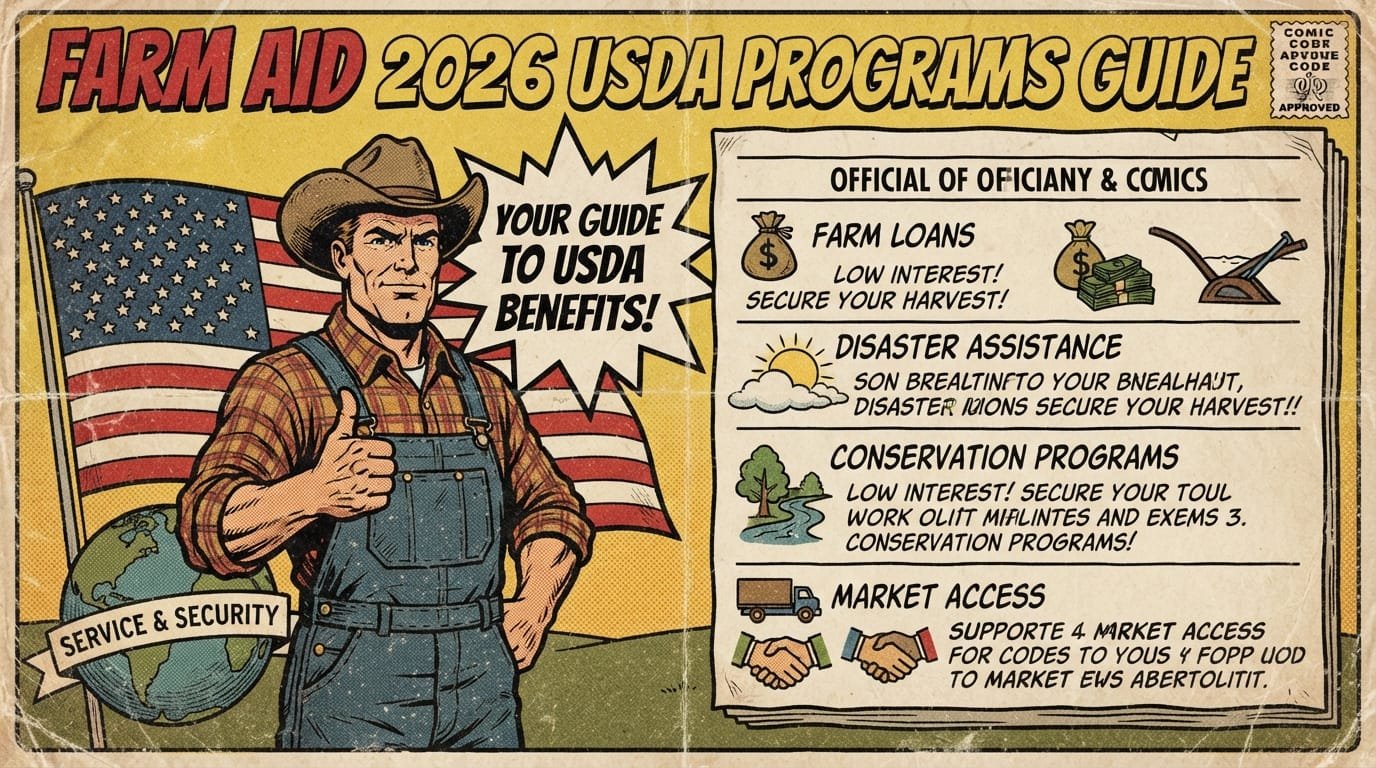
What Is Farm Aid in 2026?
Farm aid in 2026 includes $11 billion in Farmer Bridge Assistance payments, $1 billion for specialty crop farmers, expanded disaster relief through the Supplemental Disaster Relief Program, low-interest USDA farm loans starting at 1.750%, and dedicated crop insurance subsidies for veteran farmers. Applications are filed through local USDA Farm Service Agency offices.
Quick Facts
| Item | Details |
|---|---|
| Key Program | Farmer Bridge Assistance (FBA) — $11 billion in one-time payments to row crop producers |
| Secondary Program | Assistance for Specialty Crop Farmers (ASCF) — $1 billion for specialty crops and sugar |
| Disaster Relief | Supplemental Disaster Relief Program (SDRP) — 70% payment factor for 2023–2024 losses |
| Farm Loan Rates | Operating Loans: 4.750%; Ownership Loans: 5.750%; Down Payment Loans: 1.750% |
| Eligibility | Agricultural producers with qualifying crop or livestock losses; veterans receive additional benefits |
| Application | Online through farmers.gov or at local FSA county offices |
| Processing Time | FBA payments released as early as February 28, 2026; SDRP payments ongoing |
| Official Agency | USDA Farm Service Agency (FSA); Risk Management Agency (RMA) |
| Required Forms | FSA-410-1 (loan application), CCC-943 (FBA), SDRP application forms |
| Updated For | 2026 crop year; Farm Bill 2026 provisions |
Federal Farm Aid Programs for 2026
The USDA is administering over $39 billion in economic support for farmers and ranchers in 2026, including $11 billion in Farmer Bridge Assistance, $6.7 billion in Supplemental Disaster Relief payments, and $1.89 billion in Emergency Livestock Relief Program payments. These programs address temporary trade market disruptions, natural disaster losses, and increased production costs.

Farmer Bridge Assistance (FBA) Program
The Farmer Bridge Assistance program provides $11 billion in one-time bridge payments to row crop producers in response to temporary trade market disruptions and increased production costs. This is the largest single farm aid program for the 2026 crop year.

What it is: A direct payment program funded through the Commodity Credit Corporation (CCC) to help row crop producers manage cash flow during market uncertainty.
Who qualifies: Row crop producers who faced economic losses due to trade disruptions. Producers must have a qualifying share in the crop and meet Adjusted Gross Income (AGI) limitations.
Why it matters: Bridge payments provide immediate capital to cover input costs, equipment payments, and operating expenses while producers wait for market conditions to improve.
What veterans should do next: Contact your local FSA county office or visit farmers.gov to check eligibility and submit an application.
Veterans May Qualify for Extra Benefits
Check available financial assistance, healthcare programs and other opportunities that may apply to you.
Check EligibilityEnrollment period: February 23 to April 17, 2026. The USDA stated that farmers applying online can expect payments to arrive as early as February 28, 2026.
Payment rates: Commodity-specific payment rates were announced by the USDA. Contact your FSA office for the rate applicable to your crop.
Assistance for Specialty Crop Farmers (ASCF) Program
The ASCF program provides $1 billion in assistance for specialty crops and sugar—commodities not covered through the Farmer Bridge Assistance program.
What it is: A targeted relief program for producers of fruits, vegetables, nuts, nursery crops, and sugar who were impacted by unfair market disruptions.
Who qualifies: Specialty crop and sugar producers with documented losses due to market disruptions. Producers must meet FSA eligibility requirements.
Why it matters: Specialty crop producers were largely excluded from the Farmer Bridge Assistance program. ASCF fills that gap with dedicated funding.
What veterans should do next: Review the ASCF program details on the USDA website and contact your local FSA office for application assistance. The application deadline was August 7, 2026.
Supplemental Disaster Relief Program (SDRP)
The Supplemental Disaster Relief Program provides payments for crop, tree, bush, and vine losses resulting from natural disasters occurring in calendar years 2023 and 2024.
What it is: A two-stage disaster relief program covering both indemnified losses (Stage 1) and non-indemnified losses including shallow loss, uncovered losses, and quality losses (Stage 2).
Who qualifies: Producers who received an indemnity under crop insurance or the Noninsured Crop Disaster Assistance Program (NAP) for eligible crop losses (Stage 1), or producers with uncovered crop, tree, bush, and vine losses (Stage 2).
Why it matters: The USDA increased the payment factor from 35% to 70%, meaning producers with approved applications receive an additional 35% of their calculated SDRP payment.
What veterans should do next: Submit applications for Stages 1 and 2. The original April 30, 2026 deadline was extended to August 12, 2026, and then further extended to September 30, 2026.
Payments made to date: USDA has provided over $6.7 billion in SDRP payments to eligible producers.
Emergency Livestock Relief Program (ELRP)
The Emergency Livestock Relief Program issued final payments totaling more than $1.89 billion for 2023 and 2024 drought, flood, and wildfire losses.
What it is: A program providing relief to livestock producers who suffered grazing losses due to qualifying drought or wildfire conditions.
Who qualifies: Eligible livestock producers who applied for ELRP 2023 and 2024.
Why it matters: Livestock producers face unique challenges from weather-related losses. ELRP provides direct financial relief for grazing losses.
What veterans should do next: Check with your local FSA office to confirm whether you received your ELRP payment or if additional action is needed.
Emergency Assistance for Livestock, Honeybees, and Farm-Raised Fish (ELAP)
ELAP provides emergency assistance to eligible producers of livestock, honeybees, and farm-raised fish for losses due to adverse weather or other loss conditions.
What it is: A permanent disaster assistance program authorized at up to $20 million per fiscal year.
Who qualifies: Producers of livestock, honeybees, and farm-raised fish with qualifying losses. Socially disadvantaged, limited resource, beginning, and veteran farmers receive an enhanced payment rate of 90% for fish losses.
Why it matters: ELAP covers losses not addressed by other disaster programs, including feed losses, grazing losses, and physical losses.
2026 payment rates:
Farm-raised fish bird depredation: $600 per eligible acre of water
Feed losses: 60% of calculated payment
Physical losses: 90% of calculated payment for veteran farmers
Application deadline: Producers must submit a notice of loss and application for payment to their local FSA office no later than March 1, 2027, for 2026 calendar year losses.
Dairy Margin Coverage (DMC)
Dairy Margin Coverage is a safety net program that helps offset milk and feed price differences.
Enrollment period: January 12 to February 26, 2026.
What it is: A voluntary risk management program for dairy producers that provides payments when the margin between milk prices and feed costs falls below a producer-selected coverage level.
Who qualifies: Dairy producers who enroll during the annual signup period and pay the applicable premium.
Why it matters: DMC provides predictable support during periods of tight margins, helping dairy operations manage volatility.
What veterans should do next: Mark your calendar for the annual DMC signup period. Contact your local FSA office to enroll.
USDA Farm Loan Programs for 2026
The USDA Farm Service Agency (FSA) offers direct and guaranteed loans to farmers and ranchers who are unable to obtain sufficient commercial credit at reasonable rates and terms. Interest rates for 2026 remain favorable, with down payment loans as low as 1.750%.
2026 Farm Loan Interest Rates
| Loan Type | Interest Rate (May 2026) |
|---|---|
| Farm Operating Loans (Direct) | 4.750% |
| Farm Ownership Loans (Direct) | 5.750% |
| Farm Ownership Loans (Direct, Joint Financing) | 3.750% |
| Farm Ownership Loans (Down Payment) | 1.750% |
| Emergency Loan (Amount of Actual Loss) | 3.750% |
| Commodity Loans (< 1 year) | 4.750% |
| Farm Storage Facility Loans (3-year) | 3.875% |
| Farm Storage Facility Loans (5-year) | 4.000% |
| Farm Storage Facility Loans (10-year) | 4.375% |
| Farm Storage Facility Loans (12-year) | 4.500% |
Source: USDA FSA May 2026 lending rates
Farm Operating Loans
Farm Operating Loans provide access to capital for day-to-day operational needs, including seed, fertilizer, fuel, equipment, and livestock purchases.
Eligibility: Applicants must be the operator of the farm, have farming experience, meet creditworthiness standards, and be unable to obtain credit elsewhere. Borrowers must not exceed the FSA’s Adjusted Gross Income limit.
Required documents: Form FSA-410-1 (Application for Direct Loan Assistance), personal financial statement, farm operating plan, three years of tax returns, and proof of non-farm income.
How to apply: Visit your local FSA county office or apply online through farmers.gov. The Loan Assistance Tool provides a step-by-step guide through the process.
Farm Ownership Loans
Farm Ownership Loans help farmers purchase farmland, make improvements, or refinance debt. Direct ownership loans are available at 5.750%, while joint financing options are available at 3.750%. Down payment loans are available at 1.750%.
Emergency Loans
Emergency Loans provide low-interest financing at 3.750% to help producers recover from natural disasters. These loans cover actual production and physical losses.
Application Fast Track (AFT)
The FSA permanently implemented the Application Fast Track process on September 3, 2026. This program expedites the loan application and approval process for low-risk direct loan applicants by using financial benchmarks and historical repayment data.
How it works: AFT identifies applicants least likely to default based on financial benchmarks. Since the pilot began in 2023, an average of 23% of direct loan customers qualified for the streamlined process, decreasing processing time by approximately eight calendar days.
Guaranteed Loans
For producers who cannot obtain conventional credit, FSA partners with credit unions, commercial banks, and farm credit organizations to deliver Guaranteed Loans. FSA guarantees the loan against possible financial loss, reducing the lender’s risk.
Preferred Lender Program: Starting October 1, 2026, preferred lenders can exercise delegated authority through traditional loan narratives. These lenders will have authority to certify that applicants meet FSA lending requirements for creditworthiness, financial feasibility, and adequacy of collateral in place of a more detailed agency review.
Online Loan Application
FSA offers a new Online Loan Application through farmers.gov. To apply online, producers must first sign up for a farmers.gov account. Once an account is established and linked to their profile, direct loan applicants can complete the application process online.
Veteran Farmer Benefits in 2026
Veterans receive dedicated support through the USDA’s Veteran Farmer and Rancher (VFR) program, the Outreach and Assistance for Veteran Farmers and Ranchers (OAVFR) program, and the AgVets program. These programs provide crop insurance subsidies, grant funding, and technical assistance.
Veteran Farmer and Rancher (VFR) Crop Insurance Benefits
The VFR program provides veterans with additional premium subsidies for federal crop insurance policies. Veterans receive an additional 10 percentage points of premium subsidy for additional coverage (buy-up) policies that have premium subsidy.
What it is: A federal crop insurance benefit that reduces the cost of premiums for qualifying veteran farmers.
Who qualifies: Veterans who have operated farms for no more than five years (or ten years under the 2026 Farm Bill proposal).
Benefits:
Administrative fee waived
Use of another person’s production history
Additional premium subsidy (10 percentage points)
Benefits available for up to five crop years
Why it matters: Crop insurance is a critical risk management tool. The additional subsidy makes coverage more affordable for veterans starting farming operations.
What veterans should do next: Contact a crop insurance agent or approved insurance provider (AIP) to complete a VFR application.
Beginning Farmer and Rancher (BFR) Changes for 2026
The One Big Beautiful Bill Act (OBBBA) changed the definition of Beginning Farmer and Rancher to allow an individual who has not actively operated and managed a farm or ranch for more than 10 crop years (previously 5 crop years) to qualify.
Key changes:
BFR benefits now available for up to 10 crop years
Additional premium subsidy is higher for the first four crop years
Effective for 2026 crop year policies
Important note: Veterans who also qualify as BFR will receive BFR benefits since those benefits are equivalent or higher than VFR benefits.
Outreach and Assistance for Veteran Farmers and Ranchers (OAVFR)
The OAVFR program, also known as the 2501 Program, encourages and assists farmers and ranchers with owning and operating farms and ranches and accessing the full range of agricultural programs. The FY 2026 funding amount is approximately $23,800.
AgVets Program
The Farm, Food, and National Security Act of 2026 codifies the Agriculture Grants for Veteran Education and Training Services (AgVets) program to provide farming and ranching opportunities for veterans.
What it is: A competitive grant program that funds organizations providing education and training to veterans interested in agriculture.
Who qualifies: Nonprofit organizations, universities, and other entities that provide agricultural training to veterans.
Why it matters: AgVets creates pathways for veterans to enter agricultural careers through structured training and education programs.
What veterans should do next: Check the USDA NIFA website for current AgVets funding opportunities and participating organizations.
Enhancing Agricultural Opportunities for Military Veterans
The Enhancing Agricultural Opportunities for Military Veterans Competitive Grants Program provides funding for projects that increase military veterans’ participation in agriculture. The FY 2026 application deadline was July 31, 2026, with anticipated program funding of $2,853,000 and individual awards ranging from $300,000 to $750,000.
Veteran Farmer Definition in the 2026 Farm Bill
The House-passed Farm Bill redefines veteran farmers and ranchers for the purposes of the Federal Crop Insurance Program (FCIP) as former servicemembers who have operated farms for no more than 10 years (up from 5 years). The bill authorizes the same additional premium subsidies for veteran farmers and ranchers.
2026 Farm Bill: What It Means for Farm Aid
The Farm, Food, and National Security Act of 2026 passed the House on April 30, 2026, by a vote of 224-200. The Senate Agriculture Committee advanced its version in September 2026. The bill represents the first comprehensive Farm Bill since 2018.
Key Farm Bill Provisions for Disaster Assistance
| Provision | What It Does |
|---|---|
| Specialty Crop Emergency Framework (Sec. 1004) | Creates a new compensation structure to expedite aid for specialty crop producers following natural disasters, economic crises, or market disruptions |
| TAP Advance Payments (Sec. 1003) | Establishes 120-day deadlines for Tree Assistance Program advance payments |
| Standing Block Grant Authority | Creates a standing block grant authority for future disaster payments |
| ELAP Expansion | Allows funds to cover transportation costs for hauling feed and water during drought |
| Improved ECP/EWP | Enhances Emergency Conservation Program and Emergency Watershed Protection |
Source: House Agriculture Committee summaries
Commodity Program Changes
The Working Families Tax Cuts delivered reference price increases of 10–20% beginning with crop year 2025, including for seed cotton—the first meaningful Title I investment since 2002. The legislation added 30 million new base acres so all row crop producers have access to Title I programs.
Crop Insurance Investments
$6 billion was invested in crop insurance, making higher levels of coverage more affordable through increased premium support and enhancements to area-wide plans. Starting with the 2026 crop year, the premium subsidy for Supplemental Coverage Option (SCO) and Enhanced Coverage Option (ECO) increased from 65% to 80%.
How to Apply for Farm Aid in 2026
Step 1: Determine Which Programs You Qualify For
Row crop producer with trade-related losses? → Farmer Bridge Assistance (FBA)
Specialty crop or sugar producer? → Assistance for Specialty Crop Farmers (ASCF)
Crop, tree, or vine losses from 2023–2024 disasters? → Supplemental Disaster Relief Program (SDRP)
Livestock producer with grazing or feed losses? → Emergency Livestock Relief Program (ELRP) or ELAP
Need operating capital? → Farm Operating Loans
Want to purchase farmland? → Farm Ownership Loans or Down Payment Loans
Veteran farmer seeking crop insurance savings? → Veteran Farmer and Rancher (VFR) benefits
Dairy producer? → Dairy Margin Coverage (DMC)
Step 2: Gather Required Documents
Form FSA-410-1 (Application for Direct Loan Assistance)
Personal financial statement (what you own and owe)
Farm operating plan
Three years of tax returns (less for microloans)
Proof of non-farm income
Crop or livestock production records
Documentation of losses (for disaster programs)
DD-214 (for veteran-specific benefits)
Step 3: Submit Your Application
Online: Most FBA and disaster program applications can be submitted online through farmers.gov. FSA’s Online Loan Application allows direct loan applicants to apply through their farmers.gov account.
By mail: Applications can be mailed to your local FSA county office.
In person: Visit your local USDA Service Center to work with a farm loan officer or program specialist. Find your service center at farmers.gov/service-locator.
Step 4: Track Your Application
Contact your local FSA office for status updates on your application. FBA applicants who applied online received payments as early as February 28, 2026.
Common Mistakes to Avoid
Missing enrollment deadlines: FBA enrollment closed April 17, 2026. SDRP deadlines were extended to September 30, 2026. Check the USDA website for current deadlines.
Incomplete financial documentation: FSA loan applications require a complete personal financial statement and farm operating plan.
Not filing a notice of loss: For ELAP, producers must submit a notice of loss within the required timeframe. The deadline for 2026 calendar year losses is March 1, 2027.
Assuming automatic qualification: Each program has specific eligibility criteria. Review the requirements before applying.
Forgetting veteran-specific benefits: Veterans should specifically request VFR or BFR designation when applying for crop insurance and loans.
Not using free assistance: FSA county offices provide free application assistance. There is no need to pay for help with USDA program applications.
Appeals Process
If an FSA application is denied, producers can request a reconsideration through the FSA county committee or appeal to the USDA National Appeals Division (NAD). The NAD provides independent reviews of adverse decisions by USDA agencies.
Common Questions
1. What is the Farmer Bridge Assistance program?
The FBA program provides $11 billion in one-time bridge payments to row crop producers in response to temporary trade market disruptions and increased production costs. Enrollment ran from February 23 to April 17, 2026. Payments were released as early as February 28, 2026.
2. How do I apply for USDA farm loans in 2026?
Visit your local FSA county office or apply online through farmers.gov. You will need Form FSA-410-1, a personal financial statement, farm operating plan, and three years of tax returns. Interest rates for May 2026 range from 1.750% for down payment loans to 5.750% for direct ownership loans.
3. What disaster assistance is available for 2023 and 2024 losses?
The Supplemental Disaster Relief Program (SDRP) covers crop, tree, bush, and vine losses from natural disasters occurring in calendar years 2023 and 2024. The payment factor was increased from 35% to 70%. The application deadline was extended to September 30, 2026.
4. What benefits do veteran farmers receive in 2026?
Veteran farmers receive an additional 10 percentage points of premium subsidy on federal crop insurance buy-up policies, an administrative fee waiver, and use of another person’s production history. Benefits are available for up to five crop years. Veterans also qualify for the AgVets training program.
5. What is the ELAP program and how do I apply?
ELAP provides emergency assistance to livestock, honeybee, and farm-raised fish producers for losses due to adverse weather or other conditions. The 2026 payment rate for farm-raised fish bird depredation is $600 per eligible acre. Submit a notice of loss to your local FSA office by March 1, 2027.
6. How do I apply for Dairy Margin Coverage?
DMC enrollment ran from January 12 to February 26, 2026. Contact your local FSA office to enroll for the next signup period. DMC provides payments when the margin between milk prices and feed costs falls below your selected coverage level.
7. What is the Application Fast Track program?
The Application Fast Track (AFT) process expedites loan application and approval for low-risk direct loan applicants. About 23% of direct loan customers qualify. The process decreases application processing time by approximately eight calendar days. AFT is now a permanent part of FSA regulations.
8. What is the Farm Bill 2026 and what does it change?
The Farm, Food, and National Security Act of 2026 is the first comprehensive Farm Bill since 2018. It creates a specialty crop emergency framework, expands ELAP to cover feed and water hauling, establishes standing block grant authority for disaster payments, and redefines veteran farmers for crop insurance purposes.
9. What are the income limits for USDA farm loans?
Applicants must meet the FSA’s Adjusted Gross Income (AGI) limitation. For most FSA programs, the AGI limit is $900,000, though certain exceptions apply. Contact your local FSA office for specific AGI requirements for your operation.
10. How long does it take to receive farm aid payments?
FBA payments were released as early as February 28, 2026, for online applicants. SDRP payments are ongoing with a 70% payment factor. Loan processing times vary but the Application Fast Track process reduces processing by approximately eight days for qualifying applicants.
11. What is the deadline for ELAP applications for 2026 losses?
Producers must submit a notice of loss and application for payment to their local FSA office no later than March 1, 2027, for 2026 calendar year losses.
12. Can veteran farmers receive both BFR and VFR benefits?
No. You may qualify for both BFR and VFR, but you may not receive both benefits at the same time. If you qualify as BFR, BFR benefits will apply since they are equivalent or higher than VFR benefits. You may receive VFR benefits after exhausting BFR benefits if you subsequently meet VFR qualifications.
13. What is the Farm Aid Family Farm Grant?
The Farm Aid Family Farm Grant provides $5,000 to $25,000 for nonprofit organizations and small businesses working to strengthen family farm agriculture. Applications are due October 31, 2026. Grantmaking is primarily by invitation to IRS 501(c)(3) organizations.
14. What is the STAR Fund in Texas?
The State of Texas Agricultural Relief Fund (STAR Fund) provides privately funded relief for farmers, ranchers, and agribusinesses to rebuild after disasters. Grants cover infrastructure repair with no taxpayer dollars. Contact the Texas Department of Agriculture for more information.
15. What crop insurance changes take effect for 2026?
Starting with the 2026 crop year, the premium subsidy for Supplemental Coverage Option (SCO) and Enhanced Coverage Option (ECO) increased from 65% to 80%. The definition of Beginning Farmer and Rancher was expanded to 10 crop years. Veteran farmers receive an additional 10 percentage points of premium subsidy.
Key Takeaways
The USDA is providing over $39 billion in economic support for farmers and ranchers in 2026, including $11 billion through the Farmer Bridge Assistance program.
Farmer Bridge Assistance payments were released as early as February 28, 2026, for online applicants, with enrollment running from February 23 to April 17, 2026.
USDA farm loan rates for 2026 range from 1.750% for down payment loans to 5.750% for direct ownership loans, with the Application Fast Track process reducing processing time by approximately eight days.
The Supplemental Disaster Relief Program payment factor increased from 35% to 70% for 2023 and 2024 losses, with the application deadline extended to September 30, 2026.
Veteran farmers receive an additional 10 percentage points of premium subsidy on crop insurance, an administrative fee waiver, and use of another person’s production history.
The 2026 Farm Bill creates a specialty crop emergency framework, expands ELAP to cover feed and water hauling, and establishes standing block grant authority for disaster payments.
ELAP now pays $600 per eligible acre for farm-raised fish bird depredation, with a 90% payment rate for veteran farmers on fish losses.
The One Big Beautiful Bill Act expanded Beginning Farmer and Rancher benefits from 5 to 10 crop years, with higher premium subsidies in the first four years.
Dairy Margin Coverage enrollment ran from January 12 to February 26, 2026, for the 2026 program year.
Producers must submit ELAP notices of loss by March 1, 2027, for 2026 calendar year losses.
Official Resources
USDA Farm Service Agency — fsa.usda.gov
USDA Risk Management Agency — rma.usda.gov
USDA Service Center Locator — farmers.gov/service-locator
Farm Loan Assistance Tool — farmers.gov/farm-loan-assistance-tool
Veterans Crisis Line — 988, press 1
SSA.gov — Social Security benefits
IRS.gov — Tax information for farmers
USA.gov — Government services and information


🇺🇸 IMPORTANT DISCLAIMER – Veterans Benefits Information
This site provides general information about U.S. Department of Veterans Affairs (VA) benefits for educational and informational purposes only.
- Not Official: We are NOT affiliated with, endorsed by, or connected to the U.S. Department of Veterans Affairs (VA), the Veterans Benefits Administration (VBA), the Veterans Health Administration (VHA), or any other government agency.
- No Legal/Financial Advice: The content on this website is for informational purposes only and does not constitute legal, financial, or medical advice. VA benefits rules change frequently – always consult with an accredited Veterans Service Officer (VSO) or a qualified professional for your specific situation.
- Official Sources: For official, binding information and to apply for benefits, always visit official .gov websites: VA.gov, Benefits.VA.gov, or SSA.gov.
- No Data Collection: This site does not collect, store, or process any personal information. It does not have login forms, contact forms, or any system to capture user data. We never ask for your Social Security Number, bank details, or any personal information.
- 🚨 Scam Alert: The VA and other government agencies never charge fees for benefit applications. If anyone asks for money to "process" your VA claim, it is a scam. Report it to the VA Office of Inspector General at VA.gov/OIG.
- Advertising: This site uses third-party advertising (Adsterra) to cover operational costs. We do not endorse or guarantee any products or services advertised.
📌 Information provided as of June 2026. Always verify current eligibility and rules with official .gov sources.
This site is not affiliated with the U.S. Department of Veterans Affairs or any government agency. All information is for educational purposes only. Please visit VA.gov for official information.
