
Louisiana WWII Veterans in 2026: How Many Are Still Alive?
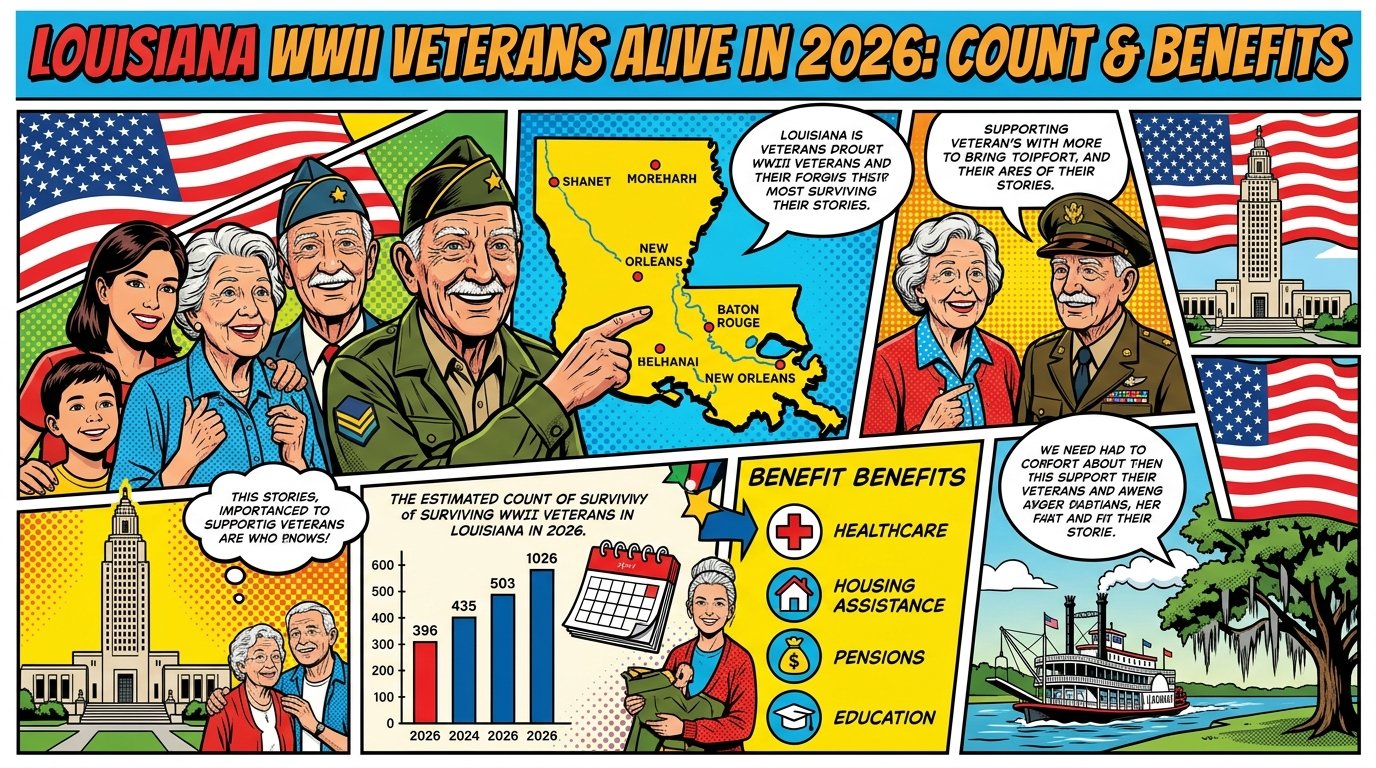
As of 2026, an estimated 147 World War II veterans are living in Louisiana, according to the National WWII Museum’s analysis of VA population projections. The state’s count has fallen from 306 in 2024 and 214 in September 2025. Nationally, about 30,607 of the 16.4 million Americans who served in WWII remain alive.
| Item | Details |
|---|---|
| Benefit | VA disability compensation, VA pension, survivor benefits, Louisiana property tax relief, state veterans home care |
| Eligibility | WWII service (generally Sept. 16, 1940–July 25, 1947), honorable discharge, Louisiana residency for state programs |
| Application | VA Form 21-526EZ (compensation); VA Form 21P-527EZ (pension); VA Form 21P-534EZ (survivor benefits) |
| Processing Time | Varies by claim type; compensation claims often 3–6 months, pension claims similar |
| Official Agency | U.S. Department of Veterans Affairs (VA) and Louisiana Department of Veterans Affairs (LDVA) |
| Required Forms | DD-214, medical evidence, income and net worth statements, marriage certificate for survivor claims |
| Updated For | 2026 VA benefit rates and 2026 VA/National WWII Museum population projections |
How Many WWII Veterans Are Still Alive in Louisiana in 2026?
Louisiana is home to approximately 147 living World War II veterans in 2026. That figure comes from the National WWII Museum’s state-by-state table, which uses U.S. Department of Veterans Affairs projections updated in September 2026. The same table places the national total at 30,607 living WWII veterans—less than 0.2% of the 16.4 million Americans who served.

VA Disability Combined Rating Calculator
Add each disability rating from your decision letter.

Estimate only. The VA makes the official rating decision. Not legal or financial advice, and not affiliated with the Department of Veterans Affairs.
The number is not a precise headcount. VA population figures are projections based on survey data and mortality trends, not a door-to-door census. The agency cautions that the estimates reflect statistical modeling rather than an actual count of every surviving veteran.
Louisiana’s Living WWII Veteran Count: Recent Estimates
The count has dropped sharply in a short period. Different sources published different estimates as the cohort shrank:
| Year / Date | Louisiana Estimate | National Estimate | Source |
|---|---|---|---|
| 2024 (VA projection) | 306 | About 66,000 | VA 2024 projection reported by the National WWII Museum |
| September 2025 | 214 | About 45,000 | VA data reported by Axios |
| 2026 | 147 | 30,607 | National WWII Museum / VA 2026 projection |
The trend is consistent with the mortality curve of a population whose youngest members are now approaching 100. The National WWII Museum notes that the VA updates these projections each September, and the 2026 figures reflect the most current available modeling.
Why You May See Different Numbers
Some articles still cite “about 300” Louisiana WWII veterans. Those figures trace back to earlier VA projection vintages, including the 2024 estimate of 306. The discrepancy is not a contradiction—it reflects how quickly the population is declining and how often projection models are refreshed.
Army Fitness Test (AFT) Score Calculator
Formerly the ACFT. Five events, 500 points. Enter your results.
Estimate for training only. Points are interpolated from the official Army tables (effective 1 June 2025) and can differ by a few points. Your score of record comes from your unit graders. Official score tables (PDF). Not affiliated with the U.S. Army.
For benefit planning, the exact statewide count matters less than whether an individual veteran or spouse qualifies for a specific program. A veteran who served in WWII may be one of 147 in Louisiana, but their eligibility for VA compensation, pension, or state property tax relief depends on their discharge character, income, disability status, and residency—not on the statewide headcount.
Why the Number Keeps Changing: WWII Veteran Mortality
The WWII veteran population is declining by thousands nationally each year, and Louisiana’s count is falling in step with the national trend. The National WWII Museum describes the loss as the disappearance of living history: the men and women who fought and won the war are now in their 90s or older.
National estimates of daily deaths vary widely depending on the model. Some projections cite roughly 131 WWII veterans dying each day; other reports use different assumptions and produce lower or higher daily averages. The VA’s own projection is the most widely cited baseline for benefit planning, and it shows the population nearing zero by the early 2040s.
For Louisiana, the practical consequence is that surviving veterans and their families should not delay benefit applications. A claim filed today can establish an effective date that preserves back pay, even if the veteran later passes away during the claims process. Surviving spouses should also check eligibility for DIC or Survivors Pension soon after a veteran’s death, because some benefits are not automatic.
Who Counts as a WWII Veteran for VA Benefits?
For VA purposes, a WWII veteran is generally someone who served on active duty between September 16, 1940, and July 25, 1947, and was discharged under conditions other than dishonorable. Those dates define the WWII period for federal veterans’ benefits, including VA pension eligibility and survivor benefits.
Not everyone who contributed to the war effort meets the legal definition. Groups such as Merchant Marine members, Women’s Army Corps personnel, and certain civilian federal employees have separate eligibility rules or may qualify under specific statutes. Louisiana law separately recognizes World War II Merchant Marine service for a state bonus, even though Merchant Marine service is treated differently under federal VA rules.
Service Dates and Discharge Character
The two most common eligibility issues for WWII-era claims are service dates and discharge character:
Service dates. The veteran’s DD-214 or equivalent separation document must show active duty within the WWII period. A few weeks of service before September 16, 1940, generally do not qualify unless the service continued into the wartime period.
Discharge character. An honorable discharge qualifies for all VA benefits. A general discharge under honorable conditions may qualify for some benefits but not others. An other-than-honorable discharge usually bars VA compensation and pension unless the veteran obtains a discharge upgrade.
Merchant Marine and Alternative Service
Merchant Marine seamen who served during WWII may qualify for certain VA benefits under specific laws, but the rules are not identical to those for armed forces veterans. Louisiana’s state Merchant Marine bonus is a separate program with its own service-period requirements. Families who are unsure should request the veteran’s military personnel file and service records before applying.
VA Benefits Still Available to Louisiana’s Living WWII Veterans
Living WWII veterans in Louisiana remain eligible for the same core VA benefit programs available to younger veterans, provided they meet each program’s requirements. Age does not disqualify a veteran from compensation or pension. In some cases, it strengthens a pension claim because the veteran is over 65.
VA Disability Compensation
VA disability compensation is a tax-free monthly payment for veterans with disabilities incurred or aggravated during military service. The amount depends on the VA disability rating, which ranges from 0% to 100%, and on the number of dependents.
A WWII veteran can file an original compensation claim now, even if they never filed before. The claim requires:
Medical evidence of a current diagnosis.
A medical nexus opinion linking the condition to service.
The veteran’s service records.
VA may schedule a Compensation and Pension (C&P) exam to evaluate the condition. For veterans in their 90s or older, VA can sometimes arrange exams at home or in an assisted living facility, but families should request accommodations early.
A successful claim can produce back pay to the effective date, which is generally the date VA received the claim or the date the disability arose, whichever is later. For a veteran who has never filed, the effective date is usually the filing date—so filing sooner preserves more potential back pay.
VA Pension and Aid & Attendance
VA pension is a needs-based, tax-free monthly benefit for wartime veterans with limited income and net worth. Unlike compensation, pension does not require a service-connected disability. The veteran must have served during a wartime period, meet the income and net worth limits, and be either 65 or older or permanently and totally disabled.
2026 VA pension maximums:
| Pension Category | Maximum Annual Amount (2026) |
|---|---|
| Single veteran, no dependents | $17,441 |
| Veteran with one dependent | Approximately $22,000+ (varies by dependent status) |
| Aid & Attendance, single veteran | Up to $29,093 |
| Survivors Pension, surviving spouse no dependents | $15,311 |
Aid & Attendance is an enhanced pension benefit for veterans who need help with activities of daily living, such as bathing, dressing, or eating, or who are housebound. A surviving spouse may also qualify for Aid & Attendance at a lower rate.
The pension application uses VA Form 21P-527EZ. The survivor version uses VA Form 21P-534EZ. Both require a detailed income and net worth statement, and VA counts most sources of income, including Social Security, in the eligibility calculation.
VA Health Care
WWII veterans qualify for VA health care, and many are in priority enrollment groups because of their service era and age. VA health care covers primary care, specialty care, hospital stays, prescriptions, and some long-term care. Enrollment depends on the veteran’s discharge character and VA’s priority group system.
Louisiana has VA medical centers in New Orleans, Shreveport, and Alexandria, plus community-based outpatient clinics across the state. Veterans who are homebound or in assisted living may qualify for VA home-based primary care or homemaker/home health aide services.
VA Burial Benefits
VA burial benefits include a burial allowance, a government headstone or marker, a burial flag, and a Presidential Memorial Certificate. A surviving spouse or family member can apply for reimbursement of some burial costs. These benefits are separate from survivor pension or DIC and do not require a service-connected death.
Louisiana State Benefits for WWII Veterans
Louisiana offers several state-level benefits that can reduce property taxes, cover care in a state veterans home, and provide education assistance to eligible family members. These programs are administered by the Louisiana Department of Veterans Affairs (LDVA) and parish-level agencies.
Louisiana Property Tax Exemption for Disabled Veterans
Louisiana’s Constitution provides an additional property tax exemption for veterans with a VA service-connected disability rating of 50% or more. The exemption applies to the veteran’s primary residence and reduces the assessed value subject to parish property taxes.
The exemption is tiered:
Veterans rated 50%–69% receive an additional exemption on a portion of assessed value.
Veterans rated 70%–99% receive a larger exemption.
Veterans rated 100% may qualify for a substantially larger exemption.
Surviving spouses may be able to transfer the exemption under certain circumstances. A 2026 Louisiana law (SB180) authorizes the surviving spouse of a deceased veteran with a service-connected disability to transfer the expanded property tax exemption, effective January 1, 2027. Families should confirm the current parish rules with the local assessor’s office.
Louisiana State Veterans Homes
Louisiana operates state-run veterans homes that provide nursing home care and assisted living to eligible veterans and, in some cases, their spouses. Admission requires Louisiana residency and at least 90 days of active military duty. The veteran must have been discharged honorably or under honorable conditions.
The monthly resident fee is approximately $2,424, though VA pension, Aid & Attendance, or Medicaid may offset some of the cost. Spouses of qualifying veterans may also be admitted under limited circumstances. The Southeast Louisiana Veterans Home in Reserve is one of the facilities where WWII veterans have resided in recent years.
Louisiana Tuition and Fee Waiver
Louisiana’s Title 29 in-state tuition exemption provides tuition and fee waivers at public colleges and universities for certain family members of qualifying veterans. For deceased veterans, surviving spouses and children may be eligible. For living veterans who were prisoners of war or missing in action, spouses may qualify. For other living veterans, children may be eligible under specific conditions.
The surviving spouse benefit has no age limit but must be used within 10 years of the date eligibility is established. Remarriage bars the benefit, and the waiver terminates at the end of the semester in which the surviving spouse remarries.
Louisiana World War II Merchant Marine Bonus
Louisiana law provides a $250 state bonus to Merchant Marine servicemen and servicewomen who served during World War II. The surviving spouse of a Merchant Marine member who died during the qualifying period may also be eligible for the bonus. This is a separate program from VA benefits and has its own application process through LDVA.
Benefits for Surviving Spouses of Louisiana WWII Veterans
Surviving spouses of WWII veterans may qualify for federal VA survivor benefits and Louisiana state survivor programs, but the rules differ depending on whether the veteran’s death was service-connected. Two federal programs matter most: Dependency and Indemnity Compensation (DIC) and Survivors Pension.
Dependency and Indemnity Compensation (DIC)
DIC is a tax-free monthly benefit for survivors of veterans who died from a service-connected condition or who died in the line of duty. There is no income limit for DIC. The 2026 basic monthly rate for a surviving spouse is $1,699.36, with additional allowances for dependent children.
A surviving spouse may qualify for DIC even if the veteran’s service-connected condition was not the immediate cause of death, provided the condition contributed materially to death. This often requires a medical opinion linking the service-connected disability to the cause of death. For elderly veterans with multiple health conditions, this can be a complex but important issue to review with an accredited representative.
Survivors Pension
Survivors Pension is a needs-based, tax-free monthly benefit for surviving spouses of wartime veterans whose deaths were not service-connected. The surviving spouse must meet income and net worth limits. The 2026 maximum for a surviving spouse with no dependents is $15,311 annually, with higher rates available for those who need Aid & Attendance.
Survivors Pension uses VA Form 21P-534EZ. VA may award the higher of DIC or Survivors Pension when a survivor qualifies for both, and a 2026 policy change is designed to speed those decisions.
Louisiana Survivor Property Tax and Tuition Benefits
The Louisiana property tax exemption for disabled veterans can be transferred to a surviving spouse under the 2026 law beginning in 2027. The surviving spouse must continue to occupy the property and remain the owner. The Louisiana tuition waiver for surviving spouses is separate and requires timely application within 10 years of eligibility.
How to Apply for VA Benefits as a Louisiana WWII Veteran
Start by gathering the veteran’s DD-214, medical records, and financial documents, then submit the correct VA form for the benefit sought. A complete claim with all required evidence is processed faster than a claim that requires VA to request records.
Step-by-Step Application Process
Request military records. If the DD-214 is missing, request it from the National Personnel Records Center or through VA.gov. Louisiana veterans can also contact LDVA for assistance.
Determine the benefit. Compensation requires a service-connected disability. Pension requires wartime service and limited income. Survivor benefits require the veteran’s death certificate and marriage certificate.
Complete the correct form. Use VA Form 21-526EZ for compensation, VA Form 21P-527EZ for pension, and VA Form 21P-534EZ for survivor benefits.
Submit online or by mail. VA.gov and eBenefits accept electronic claims. Paper claims can be mailed to the VA Pension Management Center or submitted through an accredited representative.
Attend any required exams. VA may schedule a C&P exam. For homebound veterans, request a home exam or telehealth evaluation.
Track the claim. Use VA.gov’s claim status tool or work with a Louisiana veterans service officer.
Required Documents
| Document | Why It Is Needed |
|---|---|
| DD-214 or separation document | Proves WWII service and discharge character |
| Medical records and nexus opinion | Supports a compensation claim |
| Income and net worth statement | Required for pension and Survivors Pension |
| Marriage certificate | Required for survivor benefits |
| Death certificate | Required for DIC and Survivors Pension |
| VA rating decision | Required for property tax exemption and some state benefits |
Processing Times
VA does not publish a single processing time for all claims. Compensation claims with complete evidence often take several months. Pension claims can take a similar period, and survivor claims may take longer if VA needs to develop medical evidence. Submitting a Fully Developed Claim, which includes all evidence at the time of filing, can reduce delays.
Common Mistakes That Delay Louisiana WWII Veterans’ Claims
The most common mistake is filing without the DD-214 or without a medical opinion linking the current condition to service. Other frequent errors include:
Assuming it is too late to file. There is no deadline for an original VA compensation claim. A veteran can file at any age.
Confusing pension with compensation. Pension is needs-based; compensation is service-connected. Filing the wrong form delays the claim.
Overlooking Aid & Attendance. Many older veterans qualify for the enhanced pension rate but never apply because they do not know the benefit exists.
Failing to report all dependents. Dependent allowances increase compensation and pension rates.
Missing the survivor filing window for state benefits. The Louisiana tuition waiver has a 10-year use window for surviving spouses.
Not seeking a discharge upgrade. An unfavorable discharge can block benefits, but a discharge upgrade may restore eligibility.
What to Do If a VA Claim Is Denied
A denial is not the end of the process. VA decisions can be appealed through several review lanes, including a supplemental claim with new evidence, a higher-level review by a senior adjudicator, or a Board of Veterans’ Appeals decision.
The fastest path is often a supplemental claim with new and relevant evidence, such as a missing medical opinion or a previously unavailable service record. A higher-level review is appropriate when the veteran believes VA made an error based on the existing record. The Board of Veterans’ Appeals handles cases that require a judge’s review and can include a hearing.
Louisiana veterans can contact LDVA or an accredited veterans service organization for free representation in the appeals process.
Recent Rule Changes Affecting WWII Veterans and Survivors
The most significant 2026 changes involve survivor benefit processing and Louisiana’s property tax exemption transfer. VA announced a change effective February 23, 2026, to automatically award the higher payable benefit between DIC and Survivors Pension when a survivor qualifies for both. This reduces the need for survivors to file separate claims and wait for sequential decisions.
Louisiana’s 2026 legislative session also produced changes relevant to veterans and survivors, including the property tax exemption transfer for surviving spouses of veterans with service-connected disabilities and adjustments to state veterans home admission rules. Families should confirm effective dates with LDVA before relying on a new benefit.
The PACT Act, which expanded VA health care and disability presumptions for toxic exposures, primarily affects veterans who served after WWII. However, some PACT Act-related VA process improvements—such as expanded automation and faster claims intake—can benefit all veterans, including WWII claimants, by reducing administrative delays.
Common Questions
How many WWII veterans are alive in Louisiana right now?
Approximately 147 WWII veterans are living in Louisiana in 2026, based on the National WWII Museum’s analysis of VA projections. The number is an estimate, not a precise count, and it declines as the cohort ages. Earlier estimates placed the figure at 214 in September 2025 and 306 in 2024.
Is it too late for a WWII veteran to apply for VA disability compensation?
No. There is no deadline for an original VA compensation claim. A WWII veteran can file at any age if they have a current diagnosis and medical evidence linking the condition to service. Filing now can establish an effective date and preserve back pay.
What is the difference between VA compensation and VA pension?
VA compensation is a tax-free monthly payment for a service-connected disability. VA pension is a needs-based, tax-free monthly payment for wartime veterans with limited income and net worth. A veteran can receive compensation or pension, but generally not both at the full rate.
Can a surviving spouse of a WWII veteran get VA benefits?
Yes. A surviving spouse may qualify for DIC if the veteran’s death was related to service, or Survivors Pension if the veteran’s death was not service-connected and the spouse meets income limits. The 2026 DIC basic rate is $1,699.36 per month, and the Survivors Pension maximum for a spouse with no dependents is $15,311 annually.
Does Louisiana offer a property tax exemption for WWII veterans?
Louisiana offers an additional property tax exemption for veterans with a VA service-connected disability rating of 50% or more. The exemption applies to the primary residence. Surviving spouses may be able to transfer the exemption under a 2026 law effective January 1, 2027.
Can a WWII veteran live in a Louisiana state veterans home?
Yes, if the veteran meets residency and service requirements. Louisiana state veterans homes require Louisiana residency and at least 90 days of active military duty. The monthly fee is approximately $2,424, and VA Aid & Attendance or Medicaid may help cover the cost.
What documents are needed to apply for VA survivor benefits?
The surviving spouse generally needs the veteran’s DD-214, death certificate, marriage certificate, and income information. VA Form 21P-534EZ is used for Survivors Pension and DIC claims. A complete submission reduces processing delays.
Are WWII Merchant Marine veterans eligible for Louisiana benefits?
Louisiana offers a $250 state bonus to WWII Merchant Marine servicemen and servicewomen, and to surviving spouses of those who died during the qualifying period. Federal VA eligibility for Merchant Marine service is separate and depends on specific statutory rules.
How long does a VA claim take for a WWII veteran?
Processing times vary. Compensation claims with complete evidence often take several months. Pension and survivor claims may take longer if VA needs to develop medical or financial evidence. Submitting a Fully Developed Claim can reduce delays.
What should a family do when a WWII veteran passes away?
Surviving spouses should apply for DIC or Survivors Pension promptly, request burial benefits, and notify VA and the Louisiana Department of Veterans Affairs. Some survivor benefits are not automatic, and delays can affect the effective date of payments.
Key Takeaways
Louisiana has approximately 147 living WWII veterans in 2026, down from 306 in 2024 and 214 in September 2025, according to VA projections analyzed by the National WWII Museum.
Nationally, about 30,607 WWII veterans remain alive out of 16.4 million who served—less than 0.2% of the original cohort.
WWII veterans can still file original VA compensation claims at any age if they have a current diagnosis and a medical link to service.
VA pension and Aid & Attendance provide needs-based monthly payments to wartime veterans with limited income; the 2026 Aid & Attendance maximum for a single veteran is up to $29,093 annually.
Surviving spouses may qualify for DIC or Survivors Pension, with a 2026 DIC basic rate of $1,699.36 per month and a Survivors Pension maximum of $15,311 for a spouse with no dependents.
Louisiana offers a property tax exemption for veterans rated 50% or more, plus state veterans homes and a tuition waiver for eligible family members.
The Louisiana WWII Merchant Marine bonus is $250 for qualifying Merchant Marine service.
Filing a complete claim with the DD-214 and medical evidence is the fastest path to a decision; missing records are the most common cause of delays.
Official Resources
U.S. Department of Veterans Affairs (VA): VA.gov — compensation, pension, survivor benefits, health care, and claim status.
Louisiana Department of Veterans Affairs (LDVA): vetaffairs.la.gov — state benefits, veterans homes, property tax exemption guidance, and service officers.
National WWII Museum: nationalww2museum.org — living WWII veteran statistics and state-by-state projections.
Social Security Administration: SSA.gov — survivor benefits and Social Security record requests.
Medicare.gov: Medicare.gov — health coverage coordination for veterans and surviving spouses.
USA.gov: USA.gov — government-wide benefit finder and agency directory.
🇺🇸 IMPORTANT DISCLAIMER – Veterans Benefits Information
This site provides general information about U.S. Department of Veterans Affairs (VA) benefits for educational and informational purposes only.
- Not Official: We are NOT affiliated with, endorsed by, or connected to the U.S. Department of Veterans Affairs (VA), the Veterans Benefits Administration (VBA), the Veterans Health Administration (VHA), or any other government agency.
- No Legal/Financial Advice: The content on this website is for informational purposes only and does not constitute legal, financial, or medical advice. VA benefits rules change frequently – always consult with an accredited Veterans Service Officer (VSO) or a qualified professional for your specific situation.
- Official Sources: For official, binding information and to apply for benefits, always visit official .gov websites: VA.gov, Benefits.VA.gov, or SSA.gov.
- No Data Collection: This site does not collect, store, or process any personal information. It does not have login forms, contact forms, or any system to capture user data. We never ask for your Social Security Number, bank details, or any personal information.
- 🚨 Scam Alert: The VA and other government agencies never charge fees for benefit applications. If anyone asks for money to "process" your VA claim, it is a scam. Report it to the VA Office of Inspector General at VA.gov/OIG.
- Advertising: This site uses third-party advertising (Adsterra) to cover operational costs. We do not endorse or guarantee any products or services advertised.
📌 Information provided as of June 2026. Always verify current eligibility and rules with official .gov sources.
This site is not affiliated with the U.S. Department of Veterans Affairs or any government agency. All information is for educational purposes only. Please visit VA.gov for official information.
