
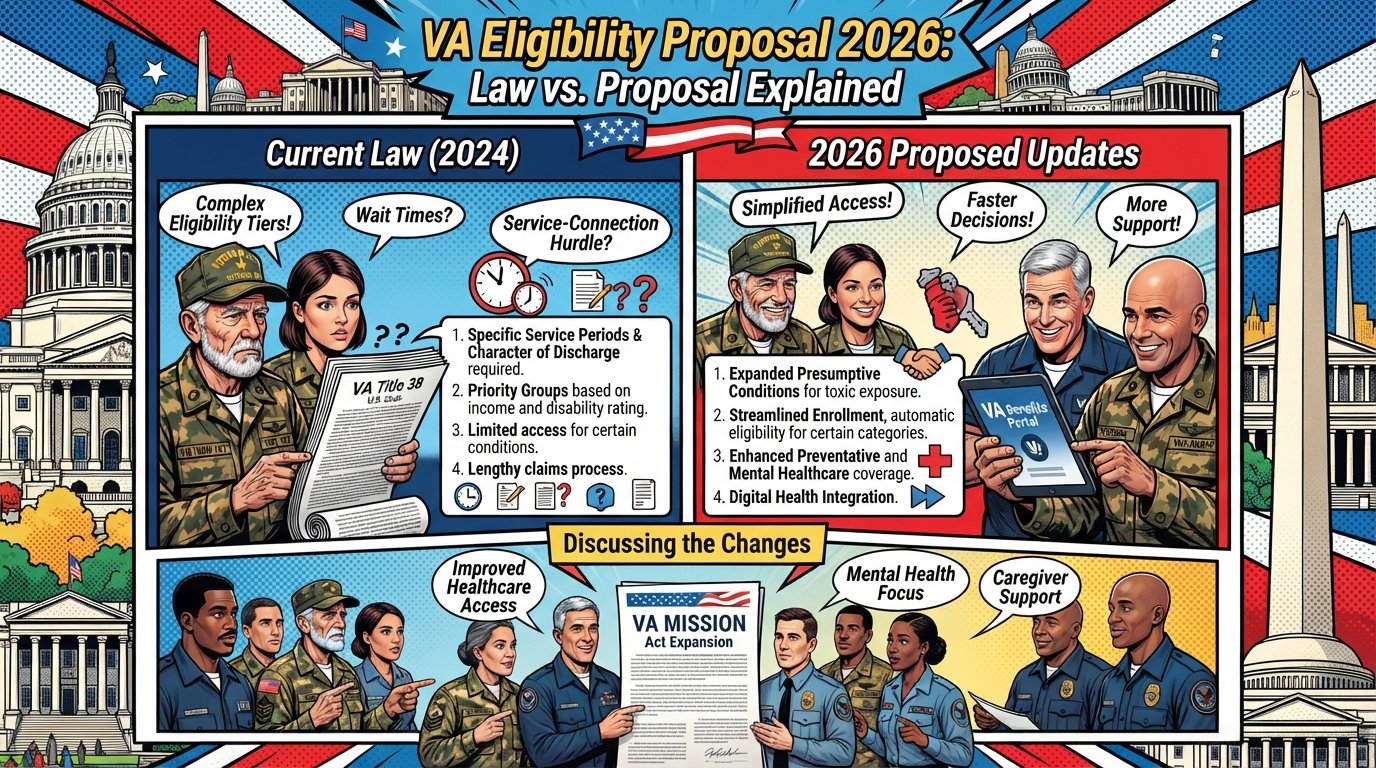
Veterans Affairs Eligibility Proposal 2026: What’s Law, What’s Proposed, and Who Qualifies
The most significant VA eligibility proposal already in effect for 2026 is the PACT Act expansion, which opened VA health care enrollment to millions of toxic-exposed veterans without requiring a disability rating. As of March 5, 2024, veterans who served in Vietnam, the Gulf War, Iraq, Afghanistan, or any post-9/11 combat zone qualify directly. Separate proposals to means-test disability compensation and impose a 30% minimum rating remain un enacted.
Quick Facts
| Item | Details |
|---|---|
| Enacted Change (2026) | PACT Act expansion: direct VA health care enrollment for toxic-exposed veterans, no disability rating required |
| Enacted Date | March 5, 2024 (accelerated from phased rollout) |
| Who Qualifies (Enacted) | Vietnam, Gulf War, Iraq, Afghanistan, post-9/11 combat zone veterans; veterans exposed to burn pits, Agent Orange, radiation, PFAS, and other hazards during training or duty in the U.S. |
| Proposed (Not Enacted) | Means-testing disability compensation at ~$135,000 household income; 30% minimum rating for compensation; ending TDIU at age 67 |
| Key Pending Bill | H.R. 6047 — Sharri Briley and Eric Edmundson Veterans Benefits Expansion Act of 2026 |
| Application | VA Form 10-10EZ for health care; VA Form 21-526EZ for disability compensation |
| Official Agency | U.S. Department of Veterans Affairs (VA) |
| Updated For | 2026 |
What Is a “VA Eligibility Proposal”?
A VA eligibility proposal is a proposed change to the rules that determine which veterans, service members, and survivors qualify for VA benefits. Proposals come from three sources: Congress (through bills), the VA itself (through proposed rules published in the Federal Register), and the Congressional Budget Office (CBO) (through budget options that are not law unless Congress acts).

The distinction matters enormously. A proposal that appears in a CBO report or a think-tank paper is not a benefit change. A bill that passes one chamber is not a benefit change. Only enacted legislation or a final VA rule changes eligibility. Veterans who confuse proposals with law can make bad decisions about their claims, their enrollment, and their finances.

Why it matters: In 2026, the VA eligibility landscape is defined by a real, enacted expansion (the PACT Act) sitting alongside loud but unenacted proposals to restrict disability compensation. Veterans need to know which is which.
What veterans should do next: Confirm your eligibility under current law, apply if you qualify, and monitor VA.gov and Congress.gov for final rules and enacted bills rather than relying on headlines about proposals.
The Enacted Expansion: PACT Act Eligibility in 2026
The PACT Act is the largest expansion of VA health care and disability benefits in decades, signed into law in August 2022. Its eligibility provisions are enacted law, not a proposal, and they are the most important VA eligibility change affecting veterans in 2026.
What the PACT Act Changed
The PACT Act created a presumption of service connection for more than 300 conditions linked to burn pits, Agent Orange, and other toxic exposures. For health care, it opened direct enrollment to veterans who served in qualifying locations and time periods, without requiring a VA disability rating or a disability claim.
Veterans May Qualify for Extra Benefits
Check available financial assistance, healthcare programs and other opportunities that may apply to you.
Check EligibilityBefore the PACT Act, a veteran exposed to burn pits or Agent Orange had to prove an individual connection between exposure and illness to receive VA care or compensation. Under the PACT Act, the location and time period of service establish eligibility.
Who Qualifies Under the PACT Act
Veterans qualify for direct VA health care enrollment under the PACT Act if they served in any of the following:
Vietnam-era service in Vietnam, Thailand, Laos, Cambodia, Guam, American Samoa, or Johnston Atoll;
Gulf War service in Southwest Asia since August 2, 1990;
Post-9/11 service in Iraq, Afghanistan, Syria, Djibouti, Egypt, Jordan, Lebanon, Uzbekistan, Yemen, or other qualifying theaters;
Camp Lejeune for at least 30 days between 1953 and 1987;
Radiation-risk activity;
Any toxic exposure risk activity (TERA), including burn pit, chemical, or hazardous-material exposure during training or duty in the United States, including PFAS/AFFF firefighting foam, asbestos, fuels, solvents, radiation, or lead.
Veterans who never deployed but were exposed to toxins during training or active duty in the United States also qualify.
The March 5, 2024 Acceleration
The VA originally planned a phased rollout of PACT Act enrollment that would have stretched eligibility over several years. In March 2024, VA accelerated the timeline, eliminating the phased approach and opening enrollment to all qualifying veterans at once.
This acceleration is why the PACT Act is described as already in effect in 2026, not as a pending proposal. The eligibility criteria are current law.
Enrollment Impact
The PACT Act’s expansion is producing measurable results. More than 100,000 new veterans enrolled in VA health care in the first three months of 2026, a pace faster than the agency hit the same mark in six of the last seven years. Since the PACT Act was signed, more than 739,000 veterans have enrolled, a 33% increase over the two-year period that preceded it.
What veterans should do next: If you served in any qualifying location or had a toxic exposure risk activity, apply for VA health care using VA Form 10-10EZ at VA.gov, by phone at 1-877-222-8387, by mail, or in person. You do not need a disability rating to apply.
Priority Groups: How VA Sorts Eligibility in 2026
VA assigns every enrolled veteran to one of eight priority groups. The priority group determines access to care and copayment obligations. It is not the same as eligibility — a veteran can be eligible and still fall into a lower priority group with copays.
Priority Group Structure (2026)
| Priority Group | Who Is In It | Copays |
|---|---|---|
| Group 1 | Veterans with service-connected disabilities rated 50% or more, veterans deemed unemployable (TDIU) due to service-connected conditions, Medal of Honor recipients | $0 for medical care |
| Group 2 | Veterans rated 30% or 40% service-connected | $0 for medical care |
| Group 3 | Veterans rated 10% or 20%; former POWs; Purple Heart recipients; veterans discharged for a disability incurred in the line of duty | $0 for medical care |
| Group 4 | Veterans receiving Aid and Attendance or Housebound benefits; veterans who are catastrophically disabled | $0 for medical care |
| Group 5 | Nonservice-connected veterans and 0% noncompensable veterans with income below the VA national income threshold | $0 inpatient/outpatient copays |
| Group 6 | PACT Act toxic-exposed veterans; veterans with 0% compensable ratings; World War II veterans; former Cadet Corps members | Varies |
| Group 7 | Veterans who agree to pay copays and whose income is above the national threshold but below the geographic means test (GMT) threshold | Copays apply |
| Group 8 | Veterans with income above both thresholds; noncompensable 0% veterans not otherwise enrolled | Copays apply |
Who Never Takes the Means Test
The VA means test (income test) does not apply to veterans with:
Any compensable service-connected disability rating (10% to 100%);
A 0% service-connected rating with PACT Act toxic exposure;
Purple Heart or Medal of Honor status;
Former POW status.
These veterans enroll without an income test. The means test is relevant only to peacetime, nonservice-connected veterans with no qualifying toxic exposure.
2026 Means Test Thresholds
For veterans who do take the means test, VA compares household income against two benchmarks:
| Household Size | Priority Group 5 National Threshold (approx.) | Priority Group 7 Geographic Means Test (GMT) Threshold |
|---|---|---|
| Veteran alone (no dependents) | ~$43,149 or less | **$43,150 up to the local ZIP GMT** (roughly $55,000 to $109,000+ in high-cost metro areas) |
Veterans below the national threshold enroll in Group 5 with $0 inpatient and outpatient copays. Veterans between the national and geographic thresholds enroll in Group 7 and pay copays. Veterans above both thresholds fall into Group 8.
Important caveat: A separate proposal referenced a $135,000 household income threshold for full benefits, excluding VA disability income. That figure is not enacted law and is discussed in the “Proposed Cuts” section below.
Proposed Changes That Have NOT Been Enacted
Several high-profile proposals to restrict VA eligibility are circulating in 2026. None of them are law. Veterans should understand them without treating them as current rules.
Means-Testing Disability Compensation
What it is: A proposal to reduce or eliminate VA disability compensation for veterans whose total household income exceeds a threshold, often described as ~$135,000, excluding VA disability income itself.
Who would be affected: Higher-income households, including veterans with 100% ratings, depending on how the proposal is structured.
Status: Proposed, not enacted. The proposal appears in CBO budget options and think-tank recommendations, not in enacted legislation. As of January 2026, there have been no enacted cuts to VA benefits.
A 30% Minimum Rating for Compensation
What it is: A proposal to require a 30% or higher VA rating to receive disability compensation, eliminating payments to veterans rated 0%, 10%, or 20%.
Who would be affected: Veterans at 0%, 10%, and 20%, and future claimants in those ranges. A 10% rating currently pays $180.42 per month in 2026.
Status: Proposed, not enacted.
Ending TDIU at Age 67
What it is: A proposal to end Individual Unemployability (TDIU) benefits when a veteran reaches age 67, on the theory that Social Security retirement age reduces the need for unemployability compensation.
Who would be affected: Veterans receiving TDIU who reach age 67.
Status: Proposed, not enacted.
Rating Schedule Changes (Sleep Apnea and Tinnitus)
Separate from eligibility, VA has proposed changes to how certain conditions are rated. A proposed rule for sleep apnea (DC 6847) would change criteria for veterans whose symptoms are controlled by CPAP. A proposed rule for tinnitus (DC 6260) would affect the 10% rating for recurrent tinnitus with a normal audiogram and no other service-connected auditory condition.
Status: As of 2026, the sleep apnea rule has been paused since February 2026 with no implementation date, and the 10% tinnitus rating remains in effect. These are rating schedule proposals, not eligibility proposals, but they can reduce future awards.
Why Veterans Should Not Panic
The VA claims process includes due process protections before a rating can be reduced. Veterans who are already rated have meaningful protections, including notice and the opportunity to appeal. No enacted cut has changed the 2026 rate table, which reflects the 2.8% COLA effective December 1, 2025.
Pending Legislation: H.R. 6047 and S. 4744
Congress is considering several bills that would expand — not restrict — VA eligibility and benefits. These are pending, not law, but they are the most relevant legislative proposals for 2026.
H.R. 6047: Sharri Briley and Eric Edmundson Veterans Benefits Expansion Act of 2026
H.R. 6047 passed the House 235–179 in May 2026 and has not moved since. The CBO estimates it would increase direct spending by $508 million in 2026** and reduce net direct spending by **$42 million over 2026–2036, driven mainly by loan-fee offsets.
Key provisions:
| Provision | What It Would Do |
|---|---|
| Aid and Attendance supplement | Add $833.33 per month** for veterans who qualify for Aid and Attendance under 38 U.S.C. § 1114(r) or § 1114(t), effective **December 1, 2026**. Roughly **7,000 veterans** could qualify, providing about **$10,000 more per year. |
| DIC COLA boost | Give DIC payments the normal Social Security COLA plus an additional 1% for the first increase and 0.5% for the second, beginning December 1, 2026. CBO estimates average monthly DIC payments would rise by about $23 in 2027**, **$34 in 2028, and $42 by 2036. |
| VA home loan eligibility for Guard and Reserve | Count certain reserve-component service — including inactive-duty training and annual training — toward VA home loan eligibility. Allow some members with at least 14 days of qualifying active-duty service to access loans, with an additional 1% loan fee if they do not otherwise qualify. CBO estimates about 1,600 reservists per year would obtain VA-guaranteed loans. |
| Home loan fee increase | Increase the rate VA charges borrowers for home loan guarantees, as an offset. |
S. 4744: Take Care of America’s Veterans Act
S. 4744 was introduced in the Senate on June 10, 2026, by Senators Moran, Boozman, and Cramer. It is a broad package that includes:
The Major Richard Star Act;
The Love Lives On Act;
An extension of increased DIC to surviving spouses of veterans who die from ALS;
The Sharri Briley and Eric Edmundson Veterans Benefits Expansion Act of 2026;
A prohibition on denying claims solely because a veteran does not report for a medical examination;
Reforms to VA disability ratings;
Improvements to military sexual trauma claims processing;
The Vets Opportunity Act and Veteran Caregiver Reeducation, Reemployment, and Retirement Act.
The bill has been read twice and placed on the Senate calendar. It is not law.
S. 4217: Copay Fairness for Veterans Act of 2026
This bill would eliminate copayments for preventive health services for eligible veterans and address care for survivors and dependents. It is introduced, not enacted.
The Veterans’ ACCESS Act and Community Care Proposals
The Veterans’ ACCESS Act of 2025 is a pending proposal that would create a pilot program allowing veterans with mental health and substance use disorders unlimited private-sector provider appointments without VA authorization. After three years, the proposal would cause non-service-connected veterans to lose eligibility for VA-paid care.
Status: Pending congressional legislation, not enacted. Critics argue it would undermine VA health care and increase taxpayer costs. Supporters frame it as expanding access. Veterans should monitor the bill’s status rather than assuming the pilot program exists.
Separately, the Mission Act community care program is current law. Under the Mission Act, veterans may qualify for community care if VA cannot provide the needed care within its access standards or if traveling to a VA facility is not feasible. This is an existing eligibility pathway, not a proposal.
How to Apply for VA Health Care and Disability Benefits in 2026
Application processes are unchanged by the pending proposals. Veterans apply under current law.
VA Health Care (VA Form 10-10EZ)
What it is: VA Form 10-10EZ is the Application for Health Benefits. It is used for enrollment at all VA medical centers.
Who qualifies: Veterans who meet basic service requirements and fall into an eligible category under current law, including the PACT Act expansion.
Required documents:
DD-214 or equivalent discharge document;
Photo ID;
Social Security number;
Insurance cards (Medicare, private insurance, Medicaid);
Income information for the prior calendar year (for priority group determination).
How to apply:
Online at VA.gov using the health benefits application.
By phone at 1-877-222-8387 (VA Health Eligibility Center).
By mail using the printed form.
In person at a VA medical facility eligibility office.
Processing time: Enrollment decisions are generally made within a few weeks, though applications requiring additional verification may take longer.
VA Disability Compensation (VA Form 21-526EZ)
What it is: VA Form 21-526EZ is the Application for Disability Compensation and Related Compensation Benefits. It is used to claim service-connected disabilities, including PTSD, physical injuries, and conditions presumed under the PACT Act.
Required evidence:
Medical diagnosis of the condition;
Service records linking the condition to service (or PACT Act qualifying service for presumptive conditions);
Buddy statements and personnel records for stressor-based claims.
How to apply: Online through VA.gov, by mail, or with a Veterans Service Organization (VSO). Veterans may attend a C&P exam if VA requests one.
Appeals Process
Veterans who disagree with a VA decision have three appeal lanes under the Veterans Appeals Improvement and Modernization Act:
| Appeal Lane | New Evidence? | Best For |
|---|---|---|
| Supplemental Claim | Yes | Denials caused by missing records or a new diagnosis |
| Higher-Level Review | No | Claims where the evidence was complete but VA made an error |
| Board Appeal | Optional | Cases that need a formal Board of Veterans’ Appeals decision |
The deadline is generally one year from the date of the decision.
Common Mistakes Veterans Make with Eligibility Proposals
Treating CBO budget options as law. Means-testing and the 30% minimum rating are proposals, not enacted policy. Do not decline to file a claim because of a headline.
Assuming the PACT Act is still phasing in. VA accelerated the rollout in March 2024. All qualifying veterans can apply now.
Believing a disability rating is required for VA health care. Since March 5, 2024, toxic-exposed veterans can enroll directly without a rating.
Missing the income exemption. Veterans with any compensable rating or PACT Act toxic exposure do not take the means test.
Confusing DIC proposals with current DIC rules. The DIC COLA boost in H.R. 6047 is not law. Current DIC rates reflect the 2.8% COLA only.
Not applying because of a past denial. The PACT Act allows veterans who were previously denied to reapply under the new presumptions.
Ignoring the appeal deadline. Veterans generally have one year to appeal a VA decision.
Relying on social media summaries. Verify proposal status at VA.gov, Congress.gov, or CBO.gov.
Assuming a pending bill passed the House is law. H.R. 6047 passed the House but has not become law.
Failing to use a VSO. VSO services are free, and accredited representatives can review claims for missing evidence.
State Differences in VA Eligibility
VA health care and disability compensation eligibility is federal and uniform across states. A veteran who qualifies in Texas qualifies in Maine. However, states vary in supplemental benefits that can affect the practical value of VA eligibility.
| State Difference | What Varies |
|---|---|
| State veterans homes | Admission rules, fees, and priority differ by state |
| Property tax exemptions | Some states offer exemptions for service-connected disabled veterans; others do not |
| State tuition waivers | Several states waive tuition for disabled veterans or dependents; eligibility and benefit levels vary |
| State pension or annuity programs | A minority of states supplement federal VA compensation with state payments |
| Medicaid treatment of VA income | Some states exclude certain VA benefits from Medicaid income calculations |
What veterans should do next: Contact your state department of veterans affairs or a county veterans service officer to identify state-level programs that complement federal VA eligibility.
PACT Act Presumptive Conditions and Survivor Eligibility
The PACT Act’s presumptive conditions list now includes more than 300 conditions, covering cancers, respiratory diseases, hypertension, and other illnesses linked to burn pits, Agent Orange, and other toxic exposures. For survivors, the PACT Act expanded Dependency and Indemnity Compensation (DIC) eligibility for deaths caused by presumptive conditions.
DIC Under the PACT Act
A surviving spouse, dependent child, or low-income parent may qualify for DIC if the veteran died from a condition presumed service-connected under the PACT Act. The survivor does not need to prove a specific exposure caused the death. The 2026 DIC base rate for a surviving spouse is $1,699.36 per month, tax-free, with added amounts for dependent children, the 8-year provision, and Aid and Attendance.
Survivors file VA Form 21P-534EZ (spouse/child) or VA Form 21P-535 (parent).
A Note on Male Breast Cancer
In 2026, the VA removed male breast cancer from the list of reproductive cancers considered presumptive under the PACT Act, prompting legislation to designate it as a presumptive illness. Veterans and survivors affected by this change should monitor Congress.gov for the status of that bill and consult a VSO about individual claim options.
Common Questions
1. Is the PACT Act a proposal or law?
The PACT Act is enacted law, signed in August 2022. Its health care and disability eligibility provisions are in effect, and VA accelerated the enrollment timeline in March 2024. It is not a pending proposal.
2. Is VA means-testing disability compensation in 2026?
No. Means-testing disability compensation at a ~$135,000 household income threshold is a CBO budget option and policy proposal, not enacted law. As of 2026, there have been no enacted cuts to VA disability compensation.
3. What is the 30% minimum rating proposal?
It is a proposal to require a 30% or higher VA rating to receive disability compensation, eliminating payments to veterans rated 0%, 10%, and 20%. It is not law. A 10% rating currently pays $180.42 per month in 2026.
4. Did H.R. 6047 become law?
No. H.R. 6047, the Sharri Briley and Eric Edmundson Veterans Benefits Expansion Act of 2026, passed the House 235–179 in May 2026 but has not become law. Its Aid and Attendance supplement ($833.33/month) and DIC COLA boost are proposals, not current benefits.
5. Can I enroll in VA health care without a disability rating?
Yes. Under the PACT Act, veterans who served in qualifying locations or had a toxic exposure risk activity can enroll directly without a disability rating or a disability claim. The VA opened this pathway on March 5, 2024.
6. What are the 2026 VA priority groups?
VA assigns veterans to eight priority groups. Groups 1–4 cover higher service-connected ratings, TDIU, Medal of Honor recipients, and catastrophically disabled veterans. Group 5 covers low-income nonservice-connected veterans. Group 6 includes PACT Act toxic-exposed veterans. Groups 7 and 8 cover veterans with income above the national threshold.
7. What is the 2026 VA means test income threshold?
For a veteran alone with no dependents, the Priority Group 5 national threshold is approximately **$43,149 or less**. Veterans between that figure and the **geographic means test (GMT) threshold** for their ZIP code fall into Group 7. The $135,000 figure that circulates online is a proposal, not the current means test.
8. What is the difference between the PACT Act and the ACCESS Act?
The PACT Act is enacted law expanding health care and disability eligibility for toxic-exposed veterans. The Veterans’ ACCESS Act of 2025 is a pending proposal to create a private-sector mental health pilot program that critics say could eventually cause non-service-connected veterans to lose VA-paid care. The ACCESS Act is not law.
9. Can survivors get DIC under the PACT Act?
Yes. Survivors may qualify for DIC if the veteran died from a condition presumed service-connected under the PACT Act, without proving a specific exposure. The 2026 DIC base rate for a surviving spouse is $1,699.36 per month. Survivors file VA Form 21P-534EZ.
10. What should I do if I was denied VA benefits before the PACT Act?
Reapply. The PACT Act allows veterans who were previously denied to file new claims under the new presumptions and eligibility rules. Use VA Form 10-10EZ for health care and VA Form 21-526EZ for disability compensation, or work with a VSO.
Key Takeaways
The PACT Act is enacted law, not a proposal, and its health care expansion took full effect on March 5, 2024.
Toxic-exposed veterans can enroll in VA health care without a disability rating; more than 100,000 veterans enrolled in the first three months of 2026.
Means-testing disability compensation, a 30% minimum rating, and ending TDIU at 67 are proposals, not enacted law.
H.R. 6047 passed the House but is not law; its $833.33/month Aid and Attendance supplement and DIC COLA boost are proposals.
VA uses eight priority groups; veterans with any compensable rating or PACT Act toxic exposure do not take the means test.
The 2026 Priority Group 5 national threshold for a veteran alone is approximately $43,149**; the **$135,000 figure is a proposal, not current law.
The Veterans’ ACCESS Act is a pending proposal, not an existing program.
The 2026 DIC base rate for a surviving spouse is $1,699.36 per month.
Veterans who were previously denied can reapply under the PACT Act.
Verify proposal status at VA.gov, Congress.gov, and CBO.gov; do not rely on headlines.
Official Resources
VA.gov — Health care eligibility: https://www.va.gov/health-care/eligibility/
VA.gov — How to apply for health care (10-10EZ): https://www.va.gov/health-care/how-to-apply/
VA.gov — PACT Act: https://www.va.gov/pact-act/
VA.gov — Disability compensation: https://www.va.gov/disability/
VA.gov — Decision reviews and appeals: https://www.va.gov/decision-reviews/
VA.gov — DIC rates: https://www.va.gov/family-and-caregiver-benefits/survivor-compensation/dependency-indemnity-compensation/
Congress.gov — Bill search: https://www.congress.gov/
CBO.gov — Budget options: https://www.cbo.gov/
USA.gov — Veterans benefits: https://www.usa.gov/veterans-benefits
🇺🇸 IMPORTANT DISCLAIMER – Veterans Benefits Information
This site provides general information about U.S. Department of Veterans Affairs (VA) benefits for educational and informational purposes only.
- Not Official: We are NOT affiliated with, endorsed by, or connected to the U.S. Department of Veterans Affairs (VA), the Veterans Benefits Administration (VBA), the Veterans Health Administration (VHA), or any other government agency.
- No Legal/Financial Advice: The content on this website is for informational purposes only and does not constitute legal, financial, or medical advice. VA benefits rules change frequently – always consult with an accredited Veterans Service Officer (VSO) or a qualified professional for your specific situation.
- Official Sources: For official, binding information and to apply for benefits, always visit official .gov websites: VA.gov, Benefits.VA.gov, or SSA.gov.
- No Data Collection: This site does not collect, store, or process any personal information. It does not have login forms, contact forms, or any system to capture user data. We never ask for your Social Security Number, bank details, or any personal information.
- 🚨 Scam Alert: The VA and other government agencies never charge fees for benefit applications. If anyone asks for money to "process" your VA claim, it is a scam. Report it to the VA Office of Inspector General at VA.gov/OIG.
- Advertising: This site uses third-party advertising (Adsterra) to cover operational costs. We do not endorse or guarantee any products or services advertised.
📌 Information provided as of June 2026. Always verify current eligibility and rules with official .gov sources.
This site is not affiliated with the U.S. Department of Veterans Affairs or any government agency. All information is for educational purposes only. Please visit VA.gov for official information.
