
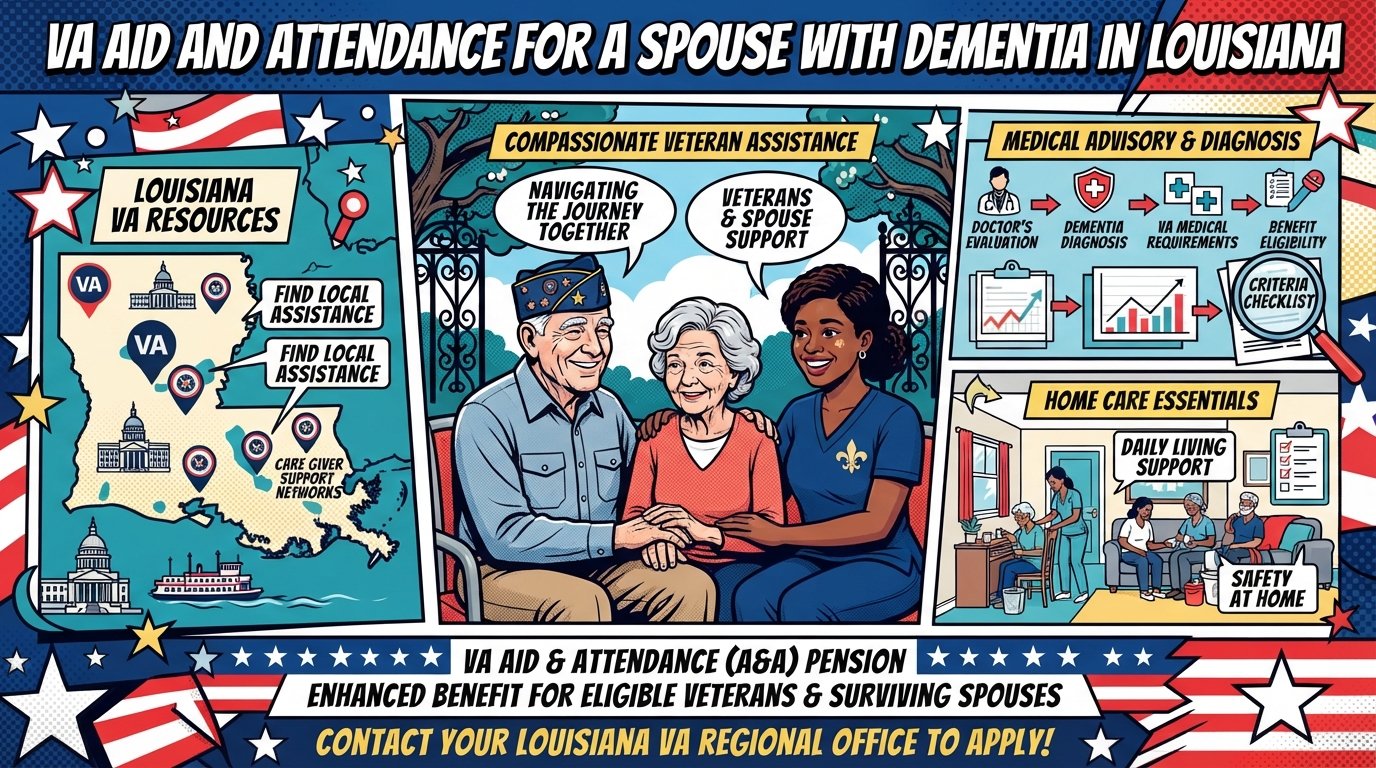
Louisiana Veterans Benefits for a Spouse With Dementia
A spouse with dementia may qualify for VA Aid and Attendance through Survivors Pension (up to $1,558 per month** in 2026) or through a veteran’s compensation if the veteran also needs care. Louisiana also operates five state veterans homes with locked memory-care wings, where spouses pay **$5,500 per month and may offset costs with VA Aid and Attendance. Surviving spouses can keep the disabled-veteran property tax exemption while they own and occupy the home.
Quick Facts
| Item | Details |
|---|---|
| Primary Federal Benefit | VA Aid and Attendance (added to Survivors Pension or VA compensation) |
| 2026 Aid & Attendance Rate (Surviving Spouse) | $1,558 per month, tax-free |
| 2026 Aid & Attendance Rate (Married Veteran, Spouse Needs Care) | $1,903 per month, tax-free |
| Louisiana State Veterans Home Fee (Spouse) | $5,500 per month; memory-care wing available |
| Louisiana Property Tax Rule | Surviving spouse keeps the disabled-veteran homestead exemption while owning and occupying the home |
| Application Form (Aid & Attendance) | VA Form 21-2680 (Examination for Housebound Status or Permanent Need for Regular Aid and Attendance) |
| Official Agencies | U.S. Department of Veterans Affairs (VA); Louisiana Department of Veterans Affairs (LDVA) |
| Processing Time | Varies; VA processes claims in receipt order. Pension claims with Aid & Attendance often take several months. |
| Updated For | 2026 benefit rates (effective December 1, 2025) |
Federal VA Benefits for a Spouse With Dementia
The U.S. Department of Veterans Affairs does not pay a standalone “dementia benefit.” Instead, dementia triggers eligibility under needs-based and dependency-based programs. The two most important pathways are VA Aid and Attendance and Survivors Pension (with Aid and Attendance). A third pathway, Dependency and Indemnity Compensation (DIC) with Aid and Attendance, applies if the veteran’s death was service-connected.

What Is VA Aid and Attendance?
VA Disability Combined Rating Calculator
Add each disability rating from your decision letter.

Estimate only. The VA makes the official rating decision. Not legal or financial advice, and not affiliated with the Department of Veterans Affairs.
VA Aid and Attendance (A&A) is a monthly cash allowance added to a VA pension or VA compensation payment. It is paid to veterans and surviving spouses who need help with daily activities because of physical or cognitive impairment. A dementia diagnosis commonly qualifies because the condition affects safety, orientation, and the ability to perform activities of daily living without supervision.
A&A is not a separate check. It increases the amount the beneficiary already receives under an underlying VA benefit. The two underlying benefits are:
VA Pension (for wartime veterans with limited income and net worth).
VA Compensation (for veterans with service-connected disabilities).
For a spouse with dementia, the most common route is Survivors Pension with Aid and Attendance if the veteran is deceased, or Aid and Attendance added to the veteran’s pension if the veteran is alive and the veteran themselves also needs care. A veteran cannot claim A&A solely because a spouse has dementia unless the veteran independently meets the care requirement.
2026 Aid and Attendance Rates
The following maximum monthly rates apply from December 1, 2025, through November 30, 2026. These are maximums; actual payments depend on income and net worth.
| Beneficiary Category | 2026 Maximum Monthly Rate |
|---|---|
| Surviving spouse | $1,558 |
| Married veteran (spouse needs care) | $1,903 |
| Single veteran | $2,424 |
| Married veteran (veteran needs care) | $2,874 |
| Two married veterans (both qualify) | $3,845 |
Army Fitness Test (AFT) Score Calculator
Formerly the ACFT. Five events, 500 points. Enter your results.
Estimate for training only. Points are interpolated from the official Army tables (effective 1 June 2025) and can differ by a few points. Your score of record comes from your unit graders. Official score tables (PDF). Not affiliated with the U.S. Army.
Sources: VA pension rate tables and 2026 A&A summaries.
For a surviving spouse with dementia, the $1,558 monthly rate** is the relevant figure. That equals **$18,697 per year, tax-free. For a married veteran whose spouse has dementia and needs care, the $1,903 monthly rate applies under the pension program.
Who Qualifies for Aid and Attendance?
Eligibility depends on the underlying benefit.
For Survivors Pension with Aid and Attendance (surviving spouse):
The deceased veteran must have served at least 90 days of active duty, with at least one day during a wartime period.
The veteran must have been discharged under conditions other than dishonorable.
The surviving spouse must not have remarried.
The surviving spouse’s yearly family income and net worth must fall below VA limits.
The surviving spouse must need help with at least one activity of daily living, be bedridden, reside in a nursing home due to disability, or have severe visual impairment.
The 2026 net worth limit for Survivors Pension is $163,699**. The income limit varies by dependency status; for a surviving spouse with no dependents, the limit is approximately **$17,372 or less for pension eligibility, with higher thresholds for those who need Aid and Attendance.
For Aid and Attendance added to a veteran’s pension:
The veteran must be a wartime veteran with limited income and net worth.
The veteran must meet the same care-need criteria.
A spouse’s dementia can increase the veteran’s dependent allowance, but the veteran must independently meet the A&A care requirement.
For Aid and Attendance through compensation (Special Monthly Compensation):
The veteran must have a service-connected disability rated at 100% or be receiving Total Disability Individual Unemployability (TDIU).
The veteran must need regular Aid and Attendance. A spouse’s dementia does not, by itself, qualify the veteran for SMC A&A.
How Dementia Meets the Aid and Attendance Standard
VA does not require a specific dementia diagnosis code. What matters is the functional impact. The VA form and medical evidence must show that the person with dementia needs another person’s help on a regular basis for safety, supervision, or daily tasks. Examples include:
Wandering or safety risks that require supervision.
Inability to manage medications, finances, or appointments without cueing.
Need for reminders or physical help with bathing, dressing, grooming, or eating.
Placement in a memory-care or assisted-living facility because of cognitive impairment.
A doctor completes the medical section of VA Form 21-2680 and documents the specific limitations. The form is titled “Examination for Housebound Status or Permanent Need for Regular Aid and Attendance” and is the central medical evidence document for A&A.
How to Apply for Aid and Attendance
Confirm the underlying benefit. A surviving spouse applies for Survivors Pension and A&A together. A veteran applies for pension or compensation and A&A together.
Gather medical evidence. Ask the treating physician, neurologist, or memory-care director to complete VA Form 21-2680. If the spouse lives in a nursing home, the facility also completes VA Form 21-0779 (Request for Nursing Home Information).
Submit the application. You can apply online through VA.gov, by mail to the VA Pension Intake Center (P.O. Box 5365, Janesville, WI 53547-5365), or in person at a VA regional office.
Track the claim. VA processes claims in the order received unless priority processing applies. Pension claims with A&A often take several months.
VA Housebound Benefit: When It Applies
VA Housebound (Special Monthly Compensation, SMC-S) is a different benefit from Aid and Attendance. It pays when a veteran is permanently and totally disabled and spends most of their time in the home because of the disability. The 2026 SMC-S rate is $4,408.53 per month for a single veteran with no dependents.
For a spouse with dementia, Housebound is usually not the right fit unless the veteran themselves is housebound. A person with dementia who can physically leave the home but cannot safely perform daily tasks may qualify for Aid and Attendance, not Housebound. A veteran who is physically unable to leave home may qualify for Housebound. The two benefits cannot be paid at the same time.
| Feature | Aid and Attendance | Housebound (SMC-S) |
|---|---|---|
| Core requirement | Need for help with daily activities or supervision | Spend most of time in home due to permanent disability |
| Dementia-friendly? | Yes, if cognitive impairment requires supervision | Less common unless veteran is physically homebound |
| 2026 rate (single veteran) | $2,424 per month | $4,408.53 per month |
| Underlying benefit | Pension or compensation | Compensation (TDIU or 100% rating) |
Survivor Benefits for a Surviving Spouse With Dementia
If the veteran has died, the surviving spouse with dementia may qualify for two distinct VA benefits: DIC and Survivors Pension. They cannot be paid at the same time, but each has different eligibility rules.
Dependency and Indemnity Compensation (DIC)
DIC is tax-free monthly compensation paid to surviving spouses and dependents when the veteran’s death was caused by a service-connected condition or when the veteran was rated totally disabled for at least eight continuous years before death.
2026 DIC rate for a surviving spouse: $1,699.36 per month, effective December 1, 2025.
Added amounts can increase the total:
$360.85 if the veteran was totally disabled for at least eight continuous years before death and the spouse was married to the veteran for those same eight years.
$421.00 for each eligible child.
Aid and Attendance can be added if the surviving spouse needs care. The 2026 A&A addition for a surviving spouse is $421.00 per month in the DIC calculation example published by VA.
DIC eligibility requires that the veteran’s death be service-connected or that the veteran was rated totally disabling for the required period. A surviving spouse with dementia may qualify for DIC with Aid and Attendance if the veteran’s death meets the service-connection rule.
Survivors Pension
Survivors Pension is a needs-based benefit for surviving spouses of wartime veterans who did not have a service-connected death. The 2026 net worth limit is $163,699**, and income limits apply. The maximum annual Survivors Pension rate for a surviving spouse with no dependents is **$15,311 per year (approximately $1,276 per month**), but the rate increases when Aid and Attendance is added to **$1,558 per month.
A surviving spouse with dementia who has limited income and needs care should apply for Survivors Pension with Aid and Attendance. This is often the most accessible federal pathway for dementia care funding.
| Benefit | Service-Connected Death Required? | Needs-Based? | 2026 Base Monthly Rate | Aid and Attendance Available? |
|---|---|---|---|---|
| DIC | Yes (or 8-year total disability rule) | No | $1,699.36 | Yes, added amount |
| Survivors Pension | No (wartime service required) | Yes (income and net worth limits) | Up to $15,311/year | Yes, raises rate to $1,558/month |
Louisiana State Veterans Homes With Memory Care
Louisiana operates five state veterans homes across the state, and at least one facility includes a locked memory-care wing for Alzheimer’s disease and dementia-related diagnoses. This is a direct, state-level option for a spouse with dementia.
Who Qualifies for a Louisiana Veterans Home?
Veterans: Honorably discharged, 90 days of active duty (wartime or peacetime), or eligible National Guard/Reservist.
Spouses of veterans: Eligible to live in a veterans home.
Gold Star parents: Eligible.
Residency: The applicant must be a Louisiana resident.
A spouse is no longer eligible if divorced from the veteran.
Fees for a Spouse With Dementia
The Louisiana Department of Veterans Affairs publishes the following fee structure:
| Resident Category | Monthly Fee |
|---|---|
| Veteran with VA service-connected rating of 70% or higher, or admitted with a diagnosis related to service connection | Free of charge (may be eligible) |
| Veteran with VA service-connected rating below 70% | $2,424 per month (may be offset by VA Aid and Attendance) |
| Spouse of a veteran | $5,500 per month |
| Gold Star parent | $5,500 per month |
Source: Louisiana Department of Veterans Affairs, Veterans Homes fee schedule.
The $5,500 monthly fee for a spouse** is significantly below the typical private nursing-home rate of **$6,000–$7,000 per month in Louisiana. A surviving spouse with dementia may be able to offset part of this cost with VA Aid and Attendance if they qualify under Survivors Pension or DIC.
How to Apply for a Louisiana Veterans Home
Complete the admissions application. LDVA provides a PDF application and an online interest form.
Submit to the chosen home. There are five locations; availability of the memory-care wing varies by facility.
Provide medical documentation. The home will assess whether the applicant needs memory care, skilled nursing, or intermediate care.
Coordinate VA benefits. Each home has Veterans Assistance Counselors on staff to help residents apply for VA benefits that can offset fees.
Louisiana Property Tax Exemption for a Surviving Spouse
Louisiana offers a graduated property tax exemption for veterans with service-connected disabilities, and the surviving spouse can keep the exemption under certain conditions.
How the Exemption Works
On top of Louisiana’s standard **$7,500 homestead exemption** (approximately $75,000 of market value), disabled veterans receive an additional exemption based on their VA rating:
| VA Disability Rating | Additional Assessed-Value Exemption |
|---|---|
| 50%–69% | $2,500 |
| 70%–99% | $4,500 |
| 100% (including TDIU) | Full exemption of remaining assessed value |
Source: Louisiana Constitution and LDVA guidance.
Surviving Spouse Rule
The surviving spouse of a deceased veteran who had a qualifying disability rating is also eligible for the additional exemption, provided the spouse owns and occupies the property. The exemption stays with the spouse while they remain the owner and occupant.
A 2026 constitutional amendment (SB180) authorized a one-time transfer of the homestead exemption to another property for a surviving spouse, effective January 1, 2027. Until that takes effect, the exemption generally remains tied to the current homestead.
What to do next: Contact the parish assessor’s office where the home is located. Bring the veteran’s VA disability rating letter, the DD-214, and proof that the spouse owns and occupies the home.
Louisiana Income Tax Treatment for Surviving Spouses
Louisiana does not tax VA disability compensation or DIC at the state level. This means the Aid and Attendance payments and DIC payments discussed above are not reduced by Louisiana state income tax.
Military retirement pay is fully exempt from Louisiana state income tax. Survivor Benefit Plan (SBP) annuities paid to surviving spouses are also excluded from Louisiana taxable income. For a surviving spouse receiving SBP and DIC, both streams are state-tax-free.
CHAMPVA: Health Coverage for a Spouse With Dementia
CHAMPVA is a VA health benefits program for the spouse or dependent child of a veteran who is permanently and totally disabled from a service-connected disability, or the surviving spouse of a veteran who died from a service-connected condition. CHAMPVA can help cover dementia-related medical care, including doctor visits, hospital care, and some long-term care services, when the spouse is not eligible for TRICARE or Medicare Part A.
Eligibility for CHAMPVA:
The veteran must be rated permanently and totally disabled from a service-connected disability, or the veteran died from a service-connected condition.
The spouse must not be eligible for TRICARE.
The spouse must not be eligible for Medicare Part A.
A surviving spouse who remarries before age 55 loses CHAMPVA eligibility.
CHAMPVA is not a cash benefit. It is a health coverage program. For dementia care, it may help with physician services, hospital stays, and some outpatient care, but it does not pay for custodial long-term care in the same way Aid and Attendance does.
VA Caregiver Support Program: When the Veteran Has Dementia
If the veteran has dementia and the spouse is providing care, the Program of Comprehensive Assistance for Family Caregivers (PCAFC) may pay a stipend to the spouse-caregiver. The program is administered by the VA Caregiver Support Program.
Caregiver eligibility:
The caregiver must be at least 18 years old.
The caregiver must be a spouse, child, parent, stepfamily member, extended family member, or someone who lives with the veteran.
The veteran must have a serious injury or illness incurred or aggravated during active duty, and the caregiver must provide personal care services.
A dementia diagnosis can qualify if the veteran cannot perform activities of daily living or cannot be left alone safely. The stipend amount varies based on the veteran’s need and the caregiver’s location.
This program is separate from Aid and Attendance. A veteran may qualify for both, but they are different benefits with different applications.
Louisiana Medicaid and Memory Care
Louisiana Medicaid (Healthy Louisiana) is the state’s joint federal-state health program for low-income residents. It covers nursing facility care and some home- and community-based waiver services, including memory care in certain settings.
Key rules for a spouse with dementia:
Community Spouse Resource Allowance: When one spouse enters Medicaid-funded care, the spouse who remains at home can keep a meaningful amount of assets to avoid impoverishment.
Income and asset limits: Louisiana Medicaid has strict limits. A elder-law attorney or LDVA counselor can help determine whether the spouse’s income and assets fall within the rules.
VA benefits and Medicaid: VA Aid and Attendance is counted as income for Medicaid purposes, but it can also help pay for care that Medicaid does not cover. Careful planning is required.
A surviving spouse with dementia who qualifies for VA Survivors Pension with Aid and Attendance may use that cash to pay for memory care while also applying for Medicaid if assets are depleted.
Social Security Disability for Early-Onset Dementia
If the spouse with dementia is under full retirement age and has a work history, they may qualify for Social Security Disability Insurance (SSDI). Alzheimer’s disease and early-onset dementia are part of Social Security’s Compassionate Allowances program, which can expedite a disability determination.
SSDI is based on the spouse’s own earnings record, not the veteran’s. It can be combined with VA benefits. The average disabled worker received about $1,630 per month** in 2026, with a maximum of **$4,152. For a spouse with dementia who has a substantial work history, SSDI can provide an additional income stream while the VA claim is pending.
How to Apply: Step-by-Step for the Spouse With Dementia
Determine the veteran’s status.
Is the veteran alive or deceased?
Was the veteran’s death service-connected?
Does the veteran have a wartime service period?
What is the veteran’s VA disability rating?
Choose the primary benefit pathway.
Situation Primary Benefit Secondary Benefit Veteran alive, spouse has dementia, veteran has low income and wartime service VA Pension with spouse as dependent; A&A if veteran also needs care Louisiana veterans home (spouse memory care) Veteran alive, spouse has dementia, veteran rated 100% P&T CHAMPVA for spouse; VA compensation with dependent additions Louisiana property tax exemption (if 100%) Veteran deceased, death service-connected DIC with Aid and Attendance CHAMPVA (if not Medicare-eligible) Veteran deceased, death not service-connected but wartime service Survivors Pension with Aid and Attendance Louisiana veterans home spouse memory care Veteran alive and has dementia, spouse is caregiver VA Caregiver Support Program (PCAFC) Aid and Attendance for the veteran Gather required documents.
DD-214 (discharge paperwork).
Marriage certificate.
Veteran’s VA rating decision (if applicable).
Death certificate (if surviving spouse).
Medical records documenting the dementia diagnosis and functional limitations.
Financial documents: bank statements, tax returns, trust documents, and proof of net worth.
Complete VA Form 21-2680. A physician, nurse practitioner, or memory-care director must complete the examination section. This is the most important medical evidence document for Aid and Attendance.
Submit the claim.
Online: VA.gov.
By mail: VA Pension Intake Center, P.O. Box 5365, Janesville, WI 53547-5365.
In person: Any VA regional office.
Free help: Every Louisiana parish has a veterans service office, and LDVA provides free claims counseling.
Apply for the Louisiana veterans home separately. The VA claim and the state home application are separate processes. Submit the LDVA admissions application to the chosen home.
Contact the parish assessor for the property tax exemption. This is a parish-level process, not a VA process.
Common Mistakes That Delay Claims
Assuming dementia automatically qualifies for Aid and Attendance. VA requires documented functional limitations, not just a diagnosis. The medical form must describe what the person cannot do safely without help.
Applying for the wrong benefit. A surviving spouse should apply for Survivors Pension with A&A, not DIC, unless the veteran’s death was service-connected. Applying for the wrong benefit causes delays.
Missing the net worth limit. The 2026 net worth limit for pension benefits is $163,699. Assets above that limit disqualify the claim, even if income is low.
Not using VA Form 21-2680. A letter from a doctor is not a substitute for the VA form. The form asks for specific functional findings that VA raters need.
Waiting too long to apply for the state veterans home. The memory-care wing has limited beds. The application should be submitted early, even if placement is not immediate.
Forgetting the property tax exemption. The surviving spouse must affirmatively apply with the parish assessor. The exemption does not transfer automatically in all cases.
Not coordinating VA and Medicaid. VA Aid and Attendance counts as income for Medicaid. Spending down assets without planning can create a gap in care coverage. An elder-law attorney or accredited VA claims agent can help.
Appeals Process If a Claim Is Denied
If VA denies an Aid and Attendance or Survivors Pension claim, the decision can be appealed. The modern appeals process has three review options:
Supplemental Claim: Submit new and relevant evidence within one year of the decision. This is often the fastest option when the denial was based on missing medical evidence.
Higher-Level Review: A senior reviewer examines the same evidence for errors. No new evidence is allowed.
Board Appeal: Appeal to the Board of Veterans’ Appeals. This can include a hearing and can take longer.
For a dementia claim, the most common denial reason is insufficient medical evidence of functional need. A supplemental claim with a properly completed VA Form 21-2680 and specific examples of supervision needs is often the strongest path.
Recent Rule Changes for 2026
2026 COLA: VA benefits received a 2.8% cost-of-living adjustment effective December 1, 2025. This raised the DIC base rate to $1,699.36** and the Survivors Pension A&A rate to **$1,558.
Louisiana SB180 (property tax transfer): A 2026 constitutional amendment allows a surviving spouse of a disabled veteran to make a one-time transfer of the homestead exemption to another property, effective January 1, 2027.
VA Form 21-2680 revision: The form was revised in June 2026. Use the current version from VA.gov.
Net worth limit: The 2026 pension net worth limit is $163,699, up from prior years.
Common Questions
1. Can a spouse with dementia get VA Aid and Attendance while the veteran is still alive?
Generally, no. Aid and Attendance is paid to the veteran or surviving spouse, not to a living veteran’s spouse based solely on the spouse’s dementia. However, the veteran may claim the spouse as a dependent, which increases the veteran’s pension rate. If the veteran also needs care, the veteran can apply for A&A. If the veteran is deceased, the surviving spouse with dementia can apply for Survivors Pension with Aid and Attendance.
2. What is the 2026 Aid and Attendance rate for a surviving spouse?
The 2026 maximum rate for a surviving spouse is $1,558 per month**, tax-free. This is paid on top of the base Survivors Pension amount when the surviving spouse meets the care requirement. The annual equivalent is **$18,697.
3. Does Louisiana have a veterans home with a dementia unit?
Yes. The Louisiana Department of Veterans Affairs operates five veterans homes, and at least one includes a locked memory-care wing for Alzheimer’s and dementia-related diagnoses. Spouses of veterans are eligible for admission at a monthly fee of $5,500.
4. Can a surviving spouse keep the Louisiana property tax exemption after the veteran dies?
Yes, if the surviving spouse owns and occupies the home and the veteran had a qualifying disability rating. The exemption remains on the property while the spouse lives there. A 2026 amendment allows a one-time transfer to another property beginning January 1, 2027.
5. Is dementia enough to qualify for VA Aid and Attendance?
Dementia is not an automatic qualifier, but it commonly supports eligibility because it affects safety and daily functioning. VA looks for evidence that the person needs another person’s help on a regular basis. A completed VA Form 21-2680 documenting the specific limitations is the strongest evidence.
6. What is the net worth limit for Survivors Pension in 2026?
The 2026 net worth limit for Survivors Pension and VA pension is $163,699. This limit includes assets and annual income. Exceeding the limit disqualifies the claim.
7. Can a spouse with dementia get Medicaid in Louisiana?
Yes, if the spouse meets Louisiana Medicaid’s income and asset limits. Louisiana Medicaid covers nursing facility care and some home- and community-based waiver services, including memory care in certain settings. The Community Spouse Resource Allowance protects some assets for the spouse who remains at home.
8. What is the difference between DIC and Survivors Pension?
DIC is for surviving spouses of veterans whose death was service-connected (or who were totally disabled for eight years). It pays $1,699.36 per month** in 2026 and is not needs-based. Survivors Pension is for surviving spouses of **wartime veterans** with limited income and net worth, regardless of whether the death was service-connected. It is needs-based and maxes out at **$1,558 per month with Aid and Attendance.
9. Can the VA pay a spouse to care for a veteran with dementia?
Yes, through the Program of Comprehensive Assistance for Family Caregivers (PCAFC) . A spouse can be the paid caregiver if the veteran has a serious injury or illness incurred or aggravated during active duty and needs personal care services. A dementia diagnosis can qualify if the veteran cannot safely perform daily activities alone.
10. How long does an Aid and Attendance claim take?
VA processes claims in the order received. Pension claims with Aid and Attendance often take several months, but timelines vary by regional office workload and the completeness of the medical evidence. Submitting a fully completed VA Form 21-2680 with the initial claim reduces delays.
Key Takeaways
VA Aid and Attendance is the primary federal cash benefit for a surviving spouse with dementia, paying up to $1,558 per month in 2026.
DIC pays $1,699.36 per month to surviving spouses of veterans whose death was service-connected; Aid and Attendance can be added.
Louisiana veterans homes have memory-care wings and admit spouses for $5,500 per month, which is below private nursing-home rates.
The surviving spouse keeps Louisiana’s disabled-veteran property tax exemption while owning and occupying the home.
VA Form 21-2680 is the key medical evidence document; a dementia diagnosis alone is not enough without documented functional limitations.
The 2026 pension net worth limit is $163,699; exceeding it disqualifies Survivors Pension claims.
Louisiana does not tax VA disability, DIC, or military retirement pay, so VA care payments are not reduced by state income tax.
CHAMPVA may cover dementia-related medical care for spouses of veterans rated permanently and totally disabled.
Louisiana Medicaid and Social Security SSDI are backup funding paths if VA benefits are insufficient or the spouse has a separate work history.
Free help is available through LDVA and parish veterans service offices; every parish has a veterans service office.
Official Resources
U.S. Department of Veterans Affairs — Aid and Attendance and Housebound: https://www.va.gov/pension/aid-attendance-housebound/
VA Form 21-2680: https://www.va.gov/find-forms/about-form-21-2680/
VA Dependency and Indemnity Compensation Rates: https://www.va.gov/family-and-caregiver-benefits/survivor-compensation/dependency-indemnity-compensation/survivor-rates/
VA Survivors Pension: https://www.va.gov/pension/survivors-pension/
VA Caregiver Support Program: https://www.va.gov/family-and-caregiver-benefits/health-and-disability/caregiver-support/
CHAMPVA: https://www.va.gov/health-care/family-caregiver-benefits/champva/
Louisiana Department of Veterans Affairs — Veterans Homes: https://vetaffairs.la.gov/homes
Louisiana Department of Veterans Affairs — State Benefits: https://vetaffairs.la.gov/benefits/state
Louisiana Medicaid (Healthy Louisiana): https://ldh.la.gov/healthy-louisiana
Social Security Administration — Disability Benefits: https://www.ssa.gov/benefits/disability/
🇺🇸 IMPORTANT DISCLAIMER – Veterans Benefits Information
This site provides general information about U.S. Department of Veterans Affairs (VA) benefits for educational and informational purposes only.
- Not Official: We are NOT affiliated with, endorsed by, or connected to the U.S. Department of Veterans Affairs (VA), the Veterans Benefits Administration (VBA), the Veterans Health Administration (VHA), or any other government agency.
- No Legal/Financial Advice: The content on this website is for informational purposes only and does not constitute legal, financial, or medical advice. VA benefits rules change frequently – always consult with an accredited Veterans Service Officer (VSO) or a qualified professional for your specific situation.
- Official Sources: For official, binding information and to apply for benefits, always visit official .gov websites: VA.gov, Benefits.VA.gov, or SSA.gov.
- No Data Collection: This site does not collect, store, or process any personal information. It does not have login forms, contact forms, or any system to capture user data. We never ask for your Social Security Number, bank details, or any personal information.
- 🚨 Scam Alert: The VA and other government agencies never charge fees for benefit applications. If anyone asks for money to "process" your VA claim, it is a scam. Report it to the VA Office of Inspector General at VA.gov/OIG.
- Advertising: This site uses third-party advertising (Adsterra) to cover operational costs. We do not endorse or guarantee any products or services advertised.
📌 Information provided as of June 2026. Always verify current eligibility and rules with official .gov sources.
This site is not affiliated with the U.S. Department of Veterans Affairs or any government agency. All information is for educational purposes only. Please visit VA.gov for official information.
