
Veteran Home Care Services Hawaii 2026: Complete Guide
VA home care services in Hawaii are available through the VA Pacific Islands Health Care System (VAPIHCS), which provides Home-Based Primary Care, Veteran-Directed Care, Homemaker/Home Health Aide services, and the Medical Foster Home Program to eligible veterans on Oahu, Maui, Kauai, Hilo, Kona, and Guam. Veterans must be enrolled in VA health care and meet clinical criteria for in-home support.
Quick Facts
| Item | Details |
|---|---|
| Benefit | In-home primary care, personal care assistance, caregiver support, and community-based long-term care services |
| Eligibility | Veterans enrolled in VA health care who need assistance with daily living activities or have complex medical needs |
| Application | Referral from VA primary care provider or social worker |
| Processing Time | Varies by program; initial assessment typically within 1-2 weeks |
| Official Agency | VA Pacific Islands Health Care System (VAPIHCS) |
| Required Forms | VA Form 10-10EZ (enrollment); program-specific assessments |
| Updated For | September 2026 |
What Is VA Home Care in Hawaii?
VA home care services allow veterans to receive medical and personal care in their own homes instead of moving to a nursing facility. The VA Pacific Islands Health Care System (VAPIHCS) serves approximately 50,000 enrolled veterans across Hawaii, Guam, and American Samoa through 12 facilities . These services are part of VA’s Geriatrics and Extended Care (GEC) programs.

Why it matters for Hawaii veterans: The islands’ geography makes facility-based care challenging for many veterans. Home-based services bring care directly to veterans wherever they live, including remote areas .

What to do next: Contact your VA primary care provider or social worker to request a home care assessment.
Who Qualifies for VA Home Care in Hawaii?
Veterans must be enrolled in VA health care and meet clinical criteria for in-home support. The specific eligibility requirements vary by program.
General Eligibility Requirements
To receive VA home care services in Hawaii, veterans must:
Be enrolled in VA health care through VAPIHCS
Meet clinical criteria for the specific program (assessed by VA care team)
Live within the VAPIHCS service area (Hawaiian Islands, Guam, American Samoa)
Clinical Criteria
Most home care programs require veterans to have:
Difficulty making or keeping clinic visits due to illness severity
Need for assistance with activities of daily living (ADLs) such as bathing, dressing, or eating
A caregiver who may be experiencing burden
Complex medical needs requiring team-based support
Home-Based Primary Care (HBPC)
Veterans May Qualify for Extra Benefits
Check available financial assistance, healthcare programs and other opportunities that may apply to you.
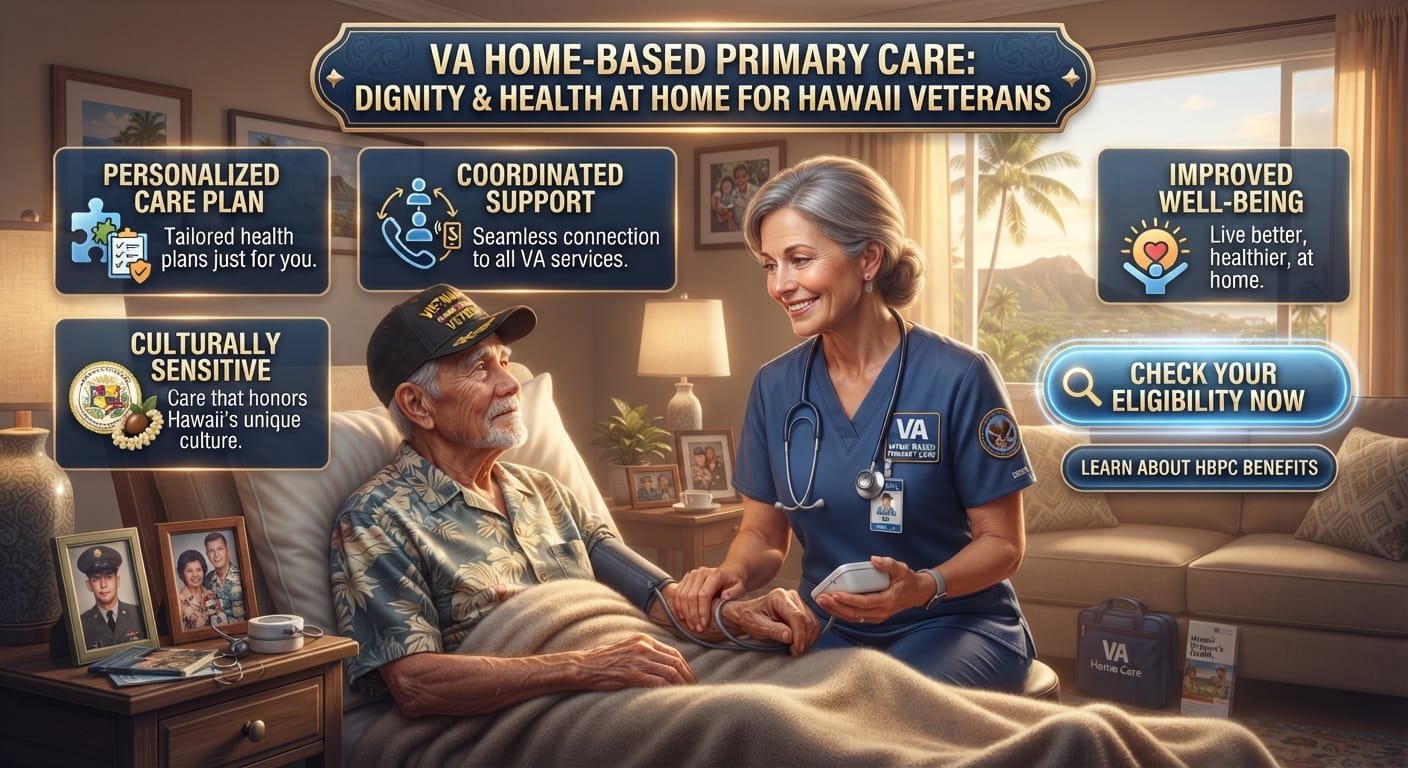
Check EligibilityHome-Based Primary Care provides comprehensive primary care services in the veteran’s home. A VA physician supervises an interdisciplinary team including nurses, social workers, dietitians, physical therapists, pharmacists, and psychologists .
Services Provided
Primary care visits at home by a provider
Home visits by a registered nurse
Coordination of services by a social worker
Physical therapy evaluations
Mental health and consultation services
Nutritional assessment and counseling
Medication management with a pharmacist
What HBPC Does Not Provide
Emergency care
Daily nursing care
Daily therapy
Housekeeping or chore services
Personal care
Availability in Hawaii
HBPC is available on Oahu, Hawaii (Hilo and Kona), Kauai (Lihue), Maui, and Guam .
Veteran-Directed Care (VDC)
Veteran-Directed Care gives veterans a flexible budget to manage their own home care services. Veterans or their family caregivers decide what mix of services best meets their needs .
How VDC Works
VA assigns a flexible monthly budget based on the veteran’s ADL needs
Veteran hires their own workers — including family, friends, or neighbors
Veteran determines tasks the worker will perform
VA provider manages payments electronically to the worker
Services Covered Under VDC
Personal care (bathing, dressing, toileting)
Homemaker services (meal preparation, light housekeeping)
Respite care for family caregivers
Adult day care
Other services approved in the veteran’s care plan
Who Qualifies
Veterans of all ages enrolled in VA health care who need significant assistance with daily living activities or whose caregiver is experiencing burden. A 19-question assessment determines ADL needs and budget amount .
Homemaker/Home Health Aide Services
Homemaker/Home Health Aide services provide trained workers to assist veterans with personal care and household tasks in their homes.
Services Provided
Homemaker services include:
Meal preparation
Light housekeeping
Light shopping
Laundry
Home health aide services include:
Bathing and dressing
Shaving and oral care
Toileting
Walking and transferring
Eating assistance
Verbal medication reminders
Admission Criteria
To qualify for homemaker/home health aide services, veterans generally need:
Three or more ADL dependencies, OR
Two ADL dependencies plus two or more of the following:
Three or more IADL dependencies
Recent nursing facility discharge
Upcoming nursing home discharge plan
Age 75 or older
Three or more hospitalizations in past year
Clinical depression diagnosis
Lives alone in the community
How to Access
A referral must be placed by a VA Primary Care social worker or designee with documented approval of an attending physician or licensed practitioner. The referral should specify the number of homemaking and home health aide hours requested per week .
Medical Foster Home Program
The Medical Foster Home Program places veterans in private homes with caregivers who provide 24/7 care in a family-like environment. This program serves as an alternative to institutional long-term care .
How It Works
Veterans live with a caregiver who agrees to provide personal care and supervision. The caregiver partners with VA’s Home-Based Primary Care team for medical oversight. Veterans receive home-cooked meals, participate in family life, and have personal 24/7 care while maintaining community connections .
Hawaii Availability
The Medical Foster Home Program started at VAPIHCS in 2008 and has expanded to the Hawaiian Islands and Guam. In Hawaii, homes must be licensed by the State of Hawaii. In Guam, state licensing is not required .
Caregiver Requirements
Caregivers must apply through VA and undergo inspections by four professionals:
Medical Foster Home Coordinator
Nurse (medication administration verification)
Fire Safety Inspector
Dietitian (kitchen and food preparation)
Community Care Network (CCN)
The VA Community Care Network allows veterans to receive care from approved community providers when VA cannot provide services directly. Region 4 covers Hawaii and includes residential, home, and hospice care services .
Services Available Through CCN
Home health services
Homemaker/home health aide
Hospice and palliative care
Respite care
Skilled home care (physical therapy, occupational therapy, wound management)
Eligibility for CCN
Veterans qualify for community care when:
VA doesn’t provide the needed service in-house
No full-service VA facility is available
VA can’t meet designated access standards (wait times or driving distance)
Community care is in the veteran’s best medical interest
How to Apply for VA Home Care in Hawaii
Step 1: Enroll in VA Health Care
If not already enrolled, apply online at VA.gov, call VAPIHCS, or visit the Spark M. Matsunaga VA Medical Center in Honolulu. There is no cost to enroll.
Step 2: Contact Your VA Primary Care Provider or Social Worker
Ask for an assessment for home care services. Be specific about your needs — difficulty with daily activities, caregiver burden, transportation challenges, or medical complexity.
Step 3: Complete Assessment
A VA social worker or care coordinator will conduct an assessment to determine:
ADL and IADL dependencies
Caregiver situation and needs
Home environment safety
Medical complexity
Step 4: Get Referral to Appropriate Program
Based on the assessment, you may be referred to:
Home-Based Primary Care
Veteran-Directed Care
Homemaker/Home Health Aide
Medical Foster Home
Community Care Network services
Step 5: Begin Services
Once approved, services begin according to your care plan. Review the plan regularly with your care team as needs change.
Comparison of Hawaii VA Home Care Programs
| Program | Services | Who Qualifies | Managed By |
|---|---|---|---|
| Home-Based Primary Care | Primary care, nursing, social work, therapy, pharmacy | Complex medical needs, difficulty with clinic visits | VA physician-led team |
| Veteran-Directed Care | Flexible budget for personal care, homemaker, respite | Need ADL assistance, caregiver burden | Veteran/family with VA support |
| Homemaker/Home Health Aide | Personal care, light housekeeping, meal prep | 3+ ADL dependencies or 2+ with risk factors | Community agencies contracted by VA |
| Medical Foster Home | 24/7 care in family home setting | Need nursing facility level of care | VA-approved caregiver |
| Community Care Network | Home health, hospice, respite | VA cannot provide service or access standards not met | Community providers |
Common Mistakes to Avoid
1. Assuming you need to be homebound. Home-Based Primary Care is for veterans who have difficulty with clinic visits, but being homebound is not strictly required .
2. Not asking about Veteran-Directed Care. This program lets you hire family members as paid caregivers. Many veterans don’t know this option exists.
3. Confusing HBPC with home health aide services. HBPC provides medical care and coordination. Personal care (bathing, dressing) comes through homemaker/home health aide or Veteran-Directed Care.
4. Waiting until a crisis. Request an assessment early, before a hospitalization or caregiver burnout forces the issue.
5. Not exploring community care options. If VA can’t meet your needs, the Community Care Network may connect you with providers closer to home .
6. Forgetting about the Medical Foster Home option. Veterans who need 24/7 care but don’t want institutional settings should ask about this program.
Common Questions
What VA home care services are available in Hawaii?
VAPIHCS offers Home-Based Primary Care, Veteran-Directed Care, Homemaker/Home Health Aide services, the Medical Foster Home Program, and access to community care providers. Availability varies by island .
Who qualifies for VA home care in Hawaii?
Veterans enrolled in VA health care who need assistance with daily activities or have complex medical needs. Clinical criteria vary by program. Contact your VA primary care provider for an assessment.
Is VA home care free?
Home-Based Primary Care may have a means test to determine cost. Homemaker/Home Health Aide services are generally provided at no cost to eligible veterans. Veteran-Directed Care provides a budget based on assessed needs .
What is Veteran-Directed Care?
VDC gives veterans a flexible monthly budget to hire their own caregivers — including family members — and decide what services they need. It’s designed for veterans who need ADL assistance and want more control over their care .
Can I hire a family member through VA home care?
Yes, through Veteran-Directed Care. Veterans in VDC can hire family, friends, or neighbors and determine the tasks they perform. VA manages the payment process .
What is the Medical Foster Home Program?
It places veterans in private homes with approved caregivers who provide 24/7 care in a family environment. Veterans receive nursing facility-level care while living in a home setting .
Does VA home care cover housekeeping?
Homemaker services include light housekeeping, meal preparation, shopping, and laundry. However, HBPC does not provide housekeeping or chore services .
How do I apply for VA home care in Hawaii?
Contact your VA primary care provider or social worker at VAPIHCS. They will conduct an assessment and refer you to the appropriate program based on your needs.
What if VA can’t provide home care where I live?
The Community Care Network may connect you with approved community providers. Eligibility depends on VA’s ability to provide services directly or meet access standards .
Is respite care available for family caregivers?
Yes. Respite care is available through Veteran-Directed Care and the Community Care Network. It provides short-term relief for family caregivers .
Can veterans on Maui receive HBPC?
Yes. Home-Based Primary Care is available on Maui, along with Oahu, Kauai, Hilo, Kona, and Guam .
What is the difference between HBPC and home health aide?
HBPC provides medical care (physician, nursing, therapy, pharmacy) in the home. Home health aide provides personal care (bathing, dressing, toileting). They are different services and may be combined based on need .
Key Takeaways
VA home care in Hawaii is coordinated through VAPIHCS, serving veterans on Oahu, Maui, Kauai, Hilo, Kona, and Guam
Home-Based Primary Care provides medical care in the home with a physician-led interdisciplinary team
Veteran-Directed Care gives veterans a flexible budget to hire their own caregivers, including family members
Homemaker/Home Health Aide services provide personal care and light housekeeping for veterans with ADL dependencies
The Medical Foster Home Program offers 24/7 care in a family setting as an alternative to institutional care
Community Care Network expands options when VA cannot provide services directly
Contact your VA primary care provider or social worker to request a home care assessment
Being homebound is not required for all programs; difficulty with clinic visits may be sufficient
Services vary by island — ask what’s available in your specific location
Request an assessment early rather than waiting for a crisis
Official Resources
VA Pacific Islands Health Care System: va.gov/pacific-islands-health-care
VA Geriatrics and Extended Care: va.gov/geriatrics
VA Aid and Attendance: va.gov/pension/aid-attendance-housebound
VA Community Care: va.gov/communitycare
VA Caregiver Support: caregiver.va.gov

🇺🇸 IMPORTANT DISCLAIMER – Veterans Benefits Information
This site provides general information about U.S. Department of Veterans Affairs (VA) benefits for educational and informational purposes only.
- Not Official: We are NOT affiliated with, endorsed by, or connected to the U.S. Department of Veterans Affairs (VA), the Veterans Benefits Administration (VBA), the Veterans Health Administration (VHA), or any other government agency.
- No Legal/Financial Advice: The content on this website is for informational purposes only and does not constitute legal, financial, or medical advice. VA benefits rules change frequently – always consult with an accredited Veterans Service Officer (VSO) or a qualified professional for your specific situation.
- Official Sources: For official, binding information and to apply for benefits, always visit official .gov websites: VA.gov, Benefits.VA.gov, or SSA.gov.
- No Data Collection: This site does not collect, store, or process any personal information. It does not have login forms, contact forms, or any system to capture user data. We never ask for your Social Security Number, bank details, or any personal information.
- 🚨 Scam Alert: The VA and other government agencies never charge fees for benefit applications. If anyone asks for money to "process" your VA claim, it is a scam. Report it to the VA Office of Inspector General at VA.gov/OIG.
- Advertising: This site uses third-party advertising (Adsterra) to cover operational costs. We do not endorse or guarantee any products or services advertised.
📌 Information provided as of June 2026. Always verify current eligibility and rules with official .gov sources.
This site is not affiliated with the U.S. Department of Veterans Affairs or any government agency. All information is for educational purposes only. Please visit VA.gov for official information.
