
Introduction to Diomede Islands
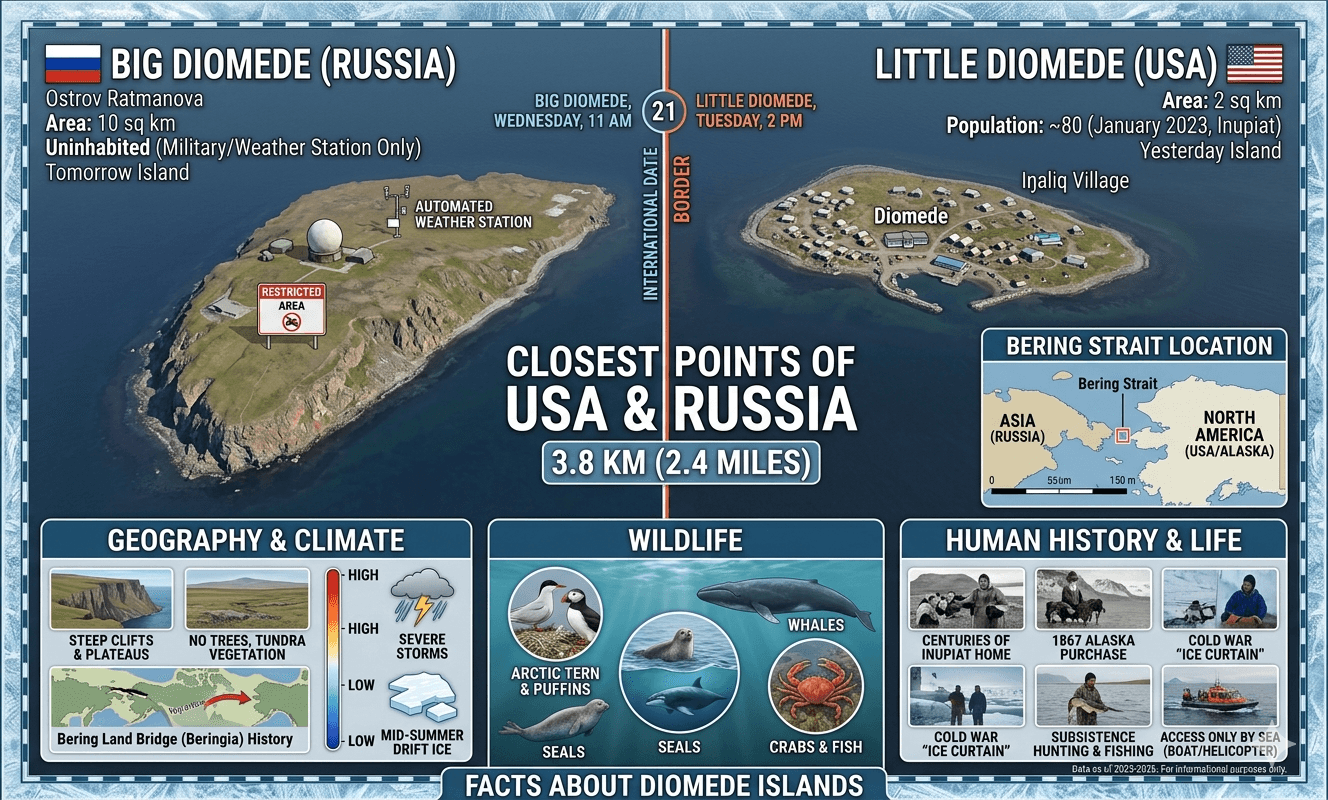
The Diomede Islands are an intriguing pair located in the Bering Strait, serving as a natural boundary between the United States and Russia. These islands consist of Big Diomede, which belongs to Russia, and Little Diomede, a part of the United States. Remarkably, these two islands are positioned merely 2.4 miles apart, making them a striking symbol of the geopolitical tensions that exist between the two nations.
Big Diomede, known as “Ratmanov Island” in Russian, boasts the title of the easternmost point of Russia. It is largely uninhabited and is primarily known for its military installations and natural beauty. In contrast, Little Diomede, home to a small population, serves as a reminder of the distinct daily life and culture on the American side of the border. With its rugged terrain and arctic landscape, Little Diomede offers a stark juxtaposition to its larger neighbor.

What makes these islands particularly unique is not just their proximity, but also the significant temporal differences that separate the lives of their inhabitants. Despite the mere 2.4 miles that lie between them, the two islands are in vastly different time zones. Little Diomede operates on an Alaskan time zone (UTC-9), while Big Diomede observes the Russian time zone (UTC+12). This time difference results in a notable irregularity, where individuals on either island live more than 21 hours apart. This phenomenon serves as a geographical oddity, highlighting a peculiar aspect of life along this international border.

The Diomede Islands exemplify the complexities of living in close proximity yet remain worlds apart in various aspects, including culture, governance, and time. As a geographical landmark, they ignite interest in discussions surrounding international relations and the daily impacts of such boundaries on local populations.
Diomede Islands: The 2.4 Miles Between Alaska and Russia That Separate ‘Yesterday’ and ‘Tomorrow’
The Diomede Islands are 2.4 miles apart but 21 hours apart. Big Diomede (Russia) and Little Diomede (USA) explained. Facts, history, and why you can’t walk there.
The One-Sentence Answer
The Diomede Islands are two small, rocky islands in the middle of the Bering Strait, located just 2.4 miles (about 4 km) apart—yet because the International Date Line runs between them, they are 21 hours apart in time .
Big Diomede belongs to Russia. Little Diomede belongs to the United States. And if you stand on the shore of Little Diomede, you can literally see tomorrow across the water—because Big Diomede is a full day ahead .
Veterans May Qualify for Extra Benefits
Check available financial assistance, healthcare programs and other opportunities that may apply to you.
Check EligibilityThat is why they are nicknamed Tomorrow Island (Big Diomede) and Yesterday Island (Little Diomede) .
The Two Islands at a Glance
| Feature | Big Diomede (Russia) | Little Diomede (USA) |
|---|---|---|
| Nickname | Tomorrow Island | Yesterday Island |
| Location | Part of Chukotka, Russia | Part of Alaska |
| Area | 4 square miles (10 sq km) | 2.8 square miles |
| Population | No permanent residents; Russian weather station and military base | Approx. 160 residents (village of Diomede) |
| Time Zone | UTC+14 (21 hours ahead of Little Diomede) | UTC-9 (UTC-8 in summer) |
| What’s There | Military installation, weather station | Small Alaskan Native village, school, clinic, helipad |
Where Are They?
The Diomede Islands sit in the Bering Strait, the narrow body of water that separates Asia from North America .
- Little Diomede is about 130 miles northwest of Nome, Alaska .
- Big Diomede is about 2.4 miles further west—but that 2.4 miles is the international border between the United States and Russia .
To put it in perspective: The two islands are closer to each other than Manhattan is to Newark. Yet they belong to two nuclear superpowers.
The 21-Hour Time Difference Explained
Here is where it gets wild.
The International Date Line runs between the two islands. That means:
- Little Diomede (USA) is in the Western Hemisphere. Think of it as seeing the end of the day.
- Big Diomede (Russia) is in the Eastern Hemisphere. It is already living in tomorrow .
Real example: If it is 5:00 PM on Saturday on Little Diomede, it is 2:00 PM on Sunday on Big Diomede .
In winter, the difference is 21 hours. In summer, due to daylight saving time differences, the gap shrinks to 20 hours .
What this means in real life: You could stand on the shore of Little Diomede, look across the water at Big Diomede, and literally see people living in the future.
Can You Walk Between Them?
Yes and no.
In winter, the Bering Strait freezes solid. An ice bridge forms between the two islands .
Theoretically: You could walk from the United States to Russia in about 30 minutes across the ice.
Practically: It is illegal . There is no legal border crossing between the two islands. The Russian side is strictly controlled with a military base. The US side is remote and monitored.
Bottom line: Do not try it. You will be stopped—or worse.
A Brief History
1728: The Naming
The Danish explorer Vitus Bering (working for Russia) first sighted the islands on August 16, 1728—which happened to be St. Diomede’s Day in the Russian Orthodox calendar. He named them after the saint .
1867: The Border Is Drawn
When the United States purchased Alaska from Russia in 1867, the treaty used the Diomede Islands to define the new border . The line ran straight between Big Diomede and Little Diomede.
1948: The Cold War Freeze
During the Cold War, the Soviet Union evacuated the native population from Big Diomede and established a military base there . The island became closed to outsiders. To this day, Big Diomede is a restricted Russian border zone with no permanent civilian population .
Today
- Big Diomede remains a Russian military installation. It is sometimes called Ratmanov Island in Russia .
- Little Diomede is home to about 160 Inupiat people who live in the village of Diomede, Alaska . They hunt walrus and whale, and rely on helicopter or small plane service from Nome for supplies .
Life on Little Diomede (The US Side)
Little Diomede is one of the most remote inhabited places in the United States .
- Population: ~160 people
- Access: No roads. No cars. No restaurants. No hotels. The only way in or out is by helicopter or small plane from Nome, weather permitting .
- Economy: Subsistence hunting (walrus, seal, whale, crab) plus some tourism from adventurous travelers.
- Schools: One small K-12 school.
- What residents see every day: Across the 2.4 miles of water, they watch the lights of the Russian military base on Big Diomede .
One resident, Edward Soolook, told a reporter: “We’re the back door of the country—or the front door, rather.” He also said Russian troops stationed on Big Diomede sometimes yell at fishing boats that stray too close .
Fun Facts That Break Your Brain
Fact 1: If you call a friend on Big Diomede from Little Diomede, you are calling tomorrow .
Fact 2: The islands are often mentioned as a potential route for a bridge or tunnel connecting North America and Asia . The distance between them is only 2.4 miles—but the political gap is much wider.
Fact 3: You can see Russia from Alaska. Actually, you can see Big Diomede from Little Diomede on a clear day. And you are looking at a different calendar date .
Fact 4: The islands are sometimes called the Gvozdev Islands in Russia, after a Russian explorer .
Frequently Asked Questions
1. How far apart are the Diomede Islands?
Approximately 2.4 miles (3.8 km) at their closest point .
2. Why are they called the Diomede Islands?
Named by Vitus Bering on St. Diomede’s Day (August 16, 1728) .
3. Who owns Big Diomede?
Russia. It is part of the Chukotka Autonomous District .
4. Who owns Little Diomede?
The United States. It is part of Alaska .
5. Can you travel between the islands?
No. There is no legal border crossing. Travel is forbidden by both countries .
6. Do people live on Big Diomede?
No permanent residents. There is a Russian weather station and military base, but no civilian population .
7. How do people get to Little Diomede?
By helicopter or small plane from Nome, Alaska (130 miles away) .
8. What is the time difference between the islands?
21 hours (20 hours in summer) . Big Diomede is ahead.
9. Why are they called Yesterday and Tomorrow Island?
Because of the International Date Line. Little Diomede is “Yesterday” (behind), Big Diomede is “Tomorrow” (ahead) .
10. Has anyone ever walked between them?
In winter, an ice bridge forms. But crossing is illegal and dangerous due to military presence and extreme conditions .
The Cold War Context (Why This Still Matters)
During the Cold War, the Bering Strait was a front line .
The United States stationed nuclear-armed Nike Hercules missiles in Alaska to guard against a Soviet attack through the strait. The Soviet Union, in turn, fortified Big Diomede.
Today, tensions remain. Following Russia’s invasion of Ukraine, the proximity of these two islands—2.4 miles separating two nuclear powers—is a reminder of how fragile peace can be .
But for the residents of Little Diomede? One told a reporter: “We’re safe, as long as we sleep good at night” .
Final Takeaway
The Diomede Islands are a geographic anomaly. Two islands, 2.4 miles apart, separated by:
- An international border
- The International Date Line (21 hours)
- A military base vs. a native village
- Russia vs. the United States
You can see Russia from Alaska—and literally look into tomorrow. But you cannot walk there. Not legally. Not safely. And probably not ever.
What to remember: Tomorrow Island (Big Diomede, Russia) is a day ahead. Yesterday Island (Little Diomede, USA) is a day behind. And the 2.4 miles between them might as well be a million.
Geography and Natural Features
The Diomede Islands, consisting of Big Diomede and Little Diomede, are located in the Bering Strait, a narrow body of water separating Alaska from Russia. Big Diomede, spanning approximately 5.4 square miles, stands as a significant geographical landmark, while Little Diomede covers around 1.2 square miles. These islands are situated roughly 2.4 miles apart, a proximity that encapsulates the cultural and political divide between the two nations. The islands’ geographical positioning provides a unique context, as they serve as a symbol of the East-West divide.
The climate of the Diomede Islands is classified as subarctic, characterized by cold, harsh winters and brief, cool summers. This climatic condition has a profound influence on the vegetation and wildlife that inhabit the islands. The landscape is predominantly rocky and rugged, dominated by steep cliffs and minimal arable land, which limits extensive agricultural activities. However, the lower elevations support hardy vegetation such as mosses, lichens, and low-lying shrubs, adapting well to the challenging climatic conditions.
Ecologically, the islands play host to a variety of fauna, including migratory birds and marine life, influenced by their strategic location in the Bering Strait. The surrounding waters are rich in nutrients, which supports significant fisheries and attracts diverse marine species, including seals and various types of fish. The interaction between the land and water in this unique setting has created a delicate ecosystem, highly dependent on the regional climate and ocean currents.
Overall, the Diomede Islands are a testament to the interplay between geographical features, climate, and ecological networks, highlighting their importance as both natural landmarks and cultural entities in the expansive Arctic region.
Historical Overview
The Diomede Islands, located in the Bering Strait, are a pair of small islands known as Big Diomede and Little Diomede. Their historical significance is profound, as they are positioned just 2.4 miles apart, yet serve as a stark representation of the political divide between the United States and Russia. The indigenous populations of these regions, primarily the Inupiat people, have lived in and around the Diomedes for thousands of years, relying on the rich marine resources of the Bering Sea.
The islands were first documented by European explorers in the early 18th century, particularly through Russian expeditions. This discovery initiated contact which profoundly affected the local cultures. The colonization process introduced new social structures and economic systems that disrupted traditional ways of life. By the late 19th century, the Russian-American Company had established a presence that led to extensive resource extraction, fundamentally altering local ecosystems and communities.
The significance of the Diomede Islands escalated during the Cold War. Following World War II, the political tensions between the United States and the Soviet Union crystallized, with the islands emerging as a symbol of ideological confrontation. Big Diomede, under Soviet control, symbolized the eastern edge of the Communist empire, while Little Diomede represented American interests. This proximity became a focal point for military strategy and surveillance operations, particularly as both nations sought to control Arctic routes and resources.
Throughout these turbulent times, the indigenous communities faced various challenges, including displacement and cultural erosion, exacerbated by both colonization and geopolitical tensions. Today, the Diomede Islands stand as a testament to the complexities of history, where indigenous heritage, colonial impact, and Cold War dynamics converge.
Cultural Significance
The Diomede Islands, comprising Big Diomede (part of Russia) and Little Diomede (part of the United States), serve as a prominent cultural crossroads between two distinct nations. These islands possess unique cultural identities shaped by their indigenous populations. The residents of Little Diomede are primarily members of the Iñupiat Eskimo community, whereas Big Diomede is inhabited by the Chukchi people. Both groups have a long-standing history tied to the harsh Arctic environment, which has significantly influenced their traditions and lifestyles.
Life on Little Diomede is characterized by a deep-rooted connection to the sea and wildlife, shaping subsistence practices such as hunting, fishing, and gathering. These activities are not just means of survival; they embody the community’s cultural values, reinforcing their identity and kinship bonds. Traditional games, storytelling, and celebration of seasonal festivals remain vital components of Iñupiat culture, fostering a sense of collective identity among residents.
Conversely, the Chukchi of Big Diomede have diverse cultural customs influenced by their historical conditions and interactions with other indigenous groups in Siberia. Traditional practices here also revolve around hunting and fishing, rooted in a profound respect for nature. The social structures maintain a communal aspect, where individuals partake in shared responsibilities and ceremonies, primarily aimed at preserving their heritage and fostering communal ties.
The proximity of these two islands, just 2.4 miles apart, encourages an intriguing cultural interaction, albeit limited by political boundaries. While exchanges have historically occurred, the current socio-political climate presents challenges in maintaining cross-border relationships. Regardless, the cultural significance of Diomede Islands remains strong, exemplifying how identity is continually shaped by geographical circumstances, heritage, and shared experiences among the indigenous peoples.</p>
Living Conditions and Daily Life
The Diomede Islands, comprising Big Diomede (part of Russia) and Little Diomede (part of the United States), present unique living conditions shaped by their geographical and political circumstances. The remoteness of these islands, situated just 2.4 miles apart, is a significant factor influencing the daily life of their inhabitants.
On Little Diomede, the population is primarily composed of Inupiat Eskimos, who engage in traditional hunting and fishing practices for sustenance. Housing is mainly constructed from wood, featuring simple structures that may lack modern amenities. Access to resources is limited, as the island is isolated from the mainland, resulting in a reliance on locally available food sources, supplemented by occasional shipments from the mainland. Economic activities are constrained, with most residents dependent on subsistence living, fishing, and government assistance programs.
In contrast, Big Diomede, primarily inhabited by Russian citizens, goes through a different set of economic challenges. The lack of infrastructure and limited access to goods leads residents to depend on imports from the mainland, creating a reliance on government subsidies for food and basic supplies. Housing conditions on Big Diomede are comparable, featuring basic accommodations, but with further challenges due to the harsh climate and limited access to modern conveniences.
Educational opportunities are scarce on both islands. Little Diomede boasts a single school, which serves children from kindergarten through high school. However, due to the small population, families often grapple with decisions regarding education, as students sometimes report to mainland schools for better educational resources. Similarly, residents of Big Diomede may experience limited educational options, further complicated by language barriers and governmental restrictions.
In essence, living in such a remote part of the world poses various challenges for the inhabitants of the Diomede Islands. From housing and access to resources to economic limitations and educational opportunities, residents navigate the complexities of life on these isolated islands, adapting continuously to their unique environment.
The Time Zone Paradox
The Diomede Islands, consisting of Big Diomede, owned by Russia, and Little Diomede, under U.S. jurisdiction, are situated a mere 2.4 miles apart in the Bering Strait. Despite this proximity, an astonishing time difference of 21 hours exists between the two islands. This phenomenon arises from the unique positioning of the International Date Line, which is the key determinant of time zones across the globe.
Big Diomede operates on the Kaliningrad Time Zone, which is situated 11 hours ahead of Coordinated Universal Time (UTC+11). In stark contrast, Little Diomede follows the Alaskan Time Zone, which is 9 hours behind Coordinated Universal Time (UTC-9). As a result, when it is 12:00 noon on Little Diomede, it is 9:00 AM the next day on Big Diomede. This absurd 21-hour discrepancy not only highlights the peculiarities of timekeeping but also emphasizes the complexities of geopolitical borders.
The time zone paradox affects the daily lives of the residents. While the population of Little Diomede is quite small, consisting primarily of Alaska Native Iñupiat people, they live within this unusual temporal environment. Conversations between residents of the two islands can often lead to confusing situations, as this significant time gap requires careful coordination, especially during communication. Anecdotes abound about missed calls or messages that are delivered a day late, often leading to humorous misunderstandings.
In practical terms, this divergence in time zones illustrates more profound cultural and social separations caused by political borders. As residents navigate their daily schedules, they are reminded of the broader context of global time-keeping systems and the arbitrary divisions they create, even in locations as geographically close as the Diomede Islands.
Tourism and Accessibility
The Diomede Islands, situated in the Bering Strait, present a unique and intriguing destination for adventurous travelers. Comprising of two islands—Big Diomede, which belongs to Russia, and Little Diomede, which is part of the United States—the distance between the two is a mere 2.4 miles. Despite this proximity, accessibility is heavily restricted due to notable geopolitical tensions that dictate travel regulations between the two nations.
Visitors wishing to explore Little Diomede must typically secure transportation from the mainland of Alaska, as there are no direct international travel routes to Big Diomede. The primary means of accessing Little Diomede involves a ferry or charter flights from Nome, Alaska, which operates seasonally, often limited by weather conditions. This creates logistical challenges for potential tourists, notably during winter months when the icy waters can halt all forms of transportation.
Once on Little Diomede, visitors can partake in various activities that include cultural exchanges with the local Inuit community and opportunities to learn about the island’s unique ecology. These experiences offer insights into the indigenous lifestyle, history, and the challenges faced due to minimal resources and harsh weather conditions. However, tourism on Big Diomede is practically non-existent for American tourists due to strict travel restrictions imposed by the Russian government. This limited accessibility not only affects potential tourism but also underscores the broader implications concerning international relations in the region.
In conclusion, tourism opportunities on the Diomede Islands are notably constrained, primarily due to the geopolitical landscape. While Little Diomede presents a fascinating glimpse into life near one of the most remote borders in the world, much of the intrigue remains off-limits, making it a destination for those willing to navigate the complexities of travel in this challenging environment.
Wildlife and Environmental Concerns
The Diomede Islands, situated in the Bering Strait, are home to an abundance of wildlife that showcases the region’s rich biodiversity. These islands serve as a crucial habitat for numerous species of migratory birds, including the common eider, Arctic tern, and various species of gulls. The presence of these avian populations highlights the islands’ importance as a resting and feeding ground during migration seasons. Additionally, the surrounding marine environment supports a diverse array of marine life, such as seals, sea otters, and a plethora of fish species that thrive in the nutrient-rich waters.
However, the environmental integrity of the Diomede Islands and its surrounding ecosystems is facing significant threats due to climate change. The region is experiencing changes in temperature and precipitation patterns, which have profound effects on both terrestrial and marine habitats. Rising sea temperatures can lead to shifts in the distribution of fish species, impacting the food web that supports marine mammals and birds. The loss of ice due to warming trends can also disrupt the natural habitats that are critical for many species, including seals that use sea ice for pup rearing.
Furthermore, the potential for increased shipping traffic and resource extraction activities, driven by changing ice conditions, poses additional environmental concerns. These developments could lead to habitat degradation and increased pollution, which are detrimental to both wildlife and flora in the region. Conservation efforts are essential to monitor wildlife populations and mitigate the impacts of climate change and human activities. Protecting the natural heritage of the Diomede Islands is crucial not only to preserve the existing ecosystems but also to ensure a balanced coexistence between nature and human endeavors in this unique geographic area.
Conclusion and Future Perspectives
The Diomede Islands, consisting of Big Diomede (part of Russia) and Little Diomede (part of the United States), serve as an intriguing symbol of cultural identity and geopolitical synergy. Despite the mere 2.4 miles separating the two nations, the islands embody the complexities of international relations, particularly in the context of U.S.-Russia dynamics. The indigenous peoples of the islands not only maintain their distinct cultural heritage but also reflect shared ecosystems and histories, demonstrating how interconnected the communities are despite political barriers.
From a geopolitical perspective, the Diomede Islands hold ongoing significance as a frontier between two superpowers. The area is vulnerable to the impacts of climate change, with shifting landscapes and melting ice affecting the local environment, resources, and ways of life. This scenario underscores the necessity of cooperation for environmental stewardship. Enhanced collaboration between both nations could yield benefits in resource management, wildlife preservation, and the adaptation strategies needed to address the adverse effects posed by global warming.
Looking to the future, the inhabitants of the Diomede Islands face unique challenges as global conditions evolve. There is potential for increased cross-border cooperation and tourism, which may yield economic opportunities for the local populations. However, this must be balanced against the need to preserve the cultural identity and ecosystems that define these islands. It remains crucial for policymakers and community leaders to foster dialogue and partnership, ensuring that the rich heritage of the Diomede Islands can be maintained while preparing for the environmental and social changes of the future.

🇺🇸 IMPORTANT DISCLAIMER – Veterans Benefits Information
This site provides general information about U.S. Department of Veterans Affairs (VA) benefits for educational and informational purposes only.
- Not Official: We are NOT affiliated with, endorsed by, or connected to the U.S. Department of Veterans Affairs (VA), the Veterans Benefits Administration (VBA), the Veterans Health Administration (VHA), or any other government agency.
- No Legal/Financial Advice: The content on this website is for informational purposes only and does not constitute legal, financial, or medical advice. VA benefits rules change frequently – always consult with an accredited Veterans Service Officer (VSO) or a qualified professional for your specific situation.
- Official Sources: For official, binding information and to apply for benefits, always visit official .gov websites: VA.gov, Benefits.VA.gov, or SSA.gov.
- No Data Collection: This site does not collect, store, or process any personal information. It does not have login forms, contact forms, or any system to capture user data. We never ask for your Social Security Number, bank details, or any personal information.
- 🚨 Scam Alert: The VA and other government agencies never charge fees for benefit applications. If anyone asks for money to "process" your VA claim, it is a scam. Report it to the VA Office of Inspector General at VA.gov/OIG.
- Advertising: This site uses third-party advertising (Adsterra) to cover operational costs. We do not endorse or guarantee any products or services advertised.
📌 Information provided as of June 2026. Always verify current eligibility and rules with official .gov sources.
This site is not affiliated with the U.S. Department of Veterans Affairs or any government agency. All information is for educational purposes only. Please visit VA.gov for official information.
