
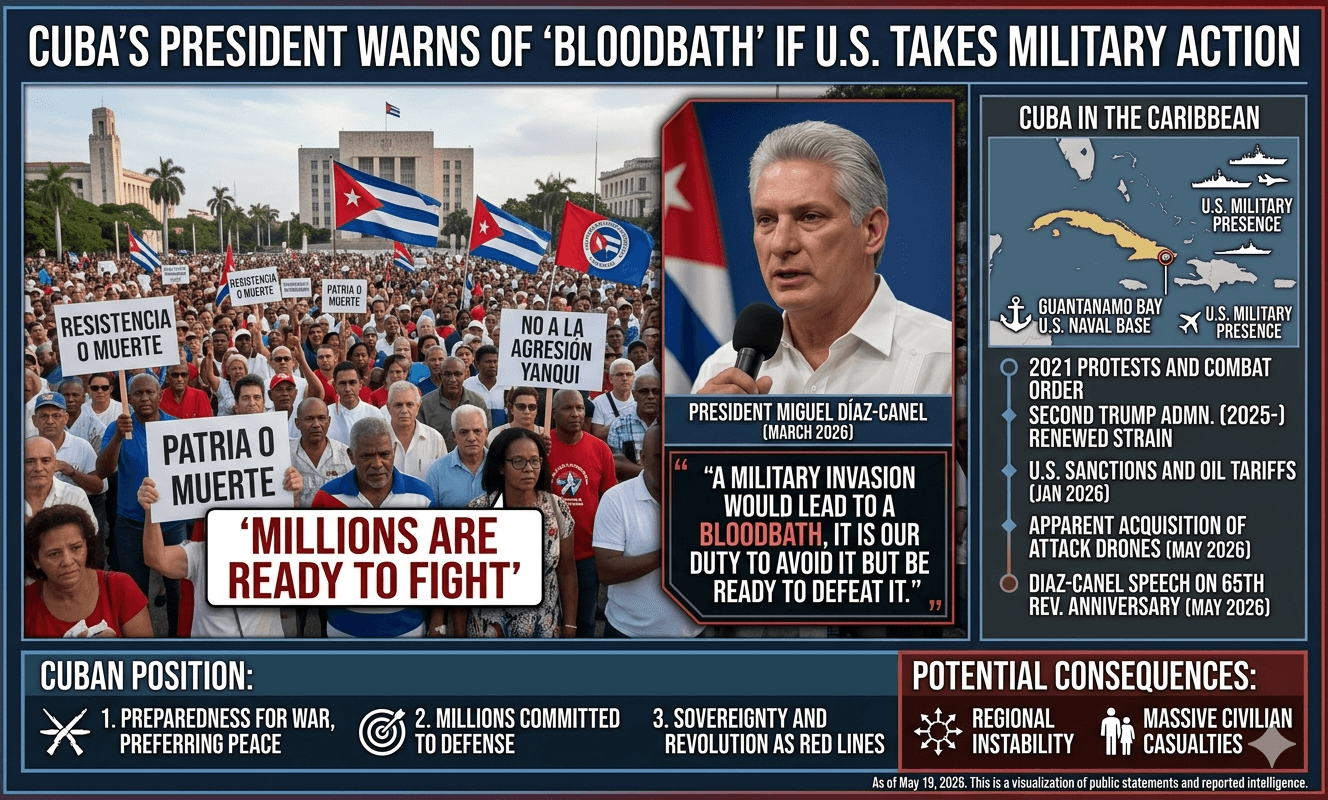
Rising Tensions in U.S.-Cuba Relations
The relationship between the United States and Cuba has long been strained by historical conflicts and differing political ideologies. The embargo imposed by the U.S. in the 1960s and the subsequent Cuban Missile Crisis in 1962 have created a legacy of mistrust that shapes interactions today. Recent developments have escalated tensions, as Cuba’s President Miguel Díaz-Canel has issued warnings against potential military actions from the U.S., describing them as acts that could lead to a “bloodbath.”
Recent diplomatic efforts aimed at improving relations have seen tepid successes; however, the ongoing economic challenges in Cuba, exacerbated by U.S. sanctions, have left many Cubans frustrated, leading to demonstrations and calls for reform. In response, the Cuban government has adopted a defensive posture, portraying military action as a significant threat to national sovereignty. This narrative plays into the broader geopolitical implications of U.S. foreign policy and regional dynamics in Latin America.

Moreover, the rhetoric from U.S. officials regarding interventions in Cuba acts as a catalyst for the Cuban government to rally national support and reinforce its stance. As concerns about stability rise, the implications stretch beyond the two nations involved, affecting neighboring countries and overall regional security. President Díaz-Canel’s warnings underscore the fragile nature of peace in the Caribbean, highlighting the dire consequences that could arise from military interventions.

As tensions continue to escalate, both countries must navigate their historical grievances with caution, focusing on dialogue and diplomacy rather than confrontation. The potential for violence in the region brings forth a necessity for both nations to engage in constructive discussions, seeking common ground to ease hostilities.
Cuba‘s President Warns of ‘Bloodbath’ If U.S. Takes Military Action
Cuba’s President Díaz-Canel warns US military action will cause a “bloodbath.” He cites the right to self-defense as tensions spike over drone reports and new sanctions.
The Direct Warning in Plain English
Cuban President Miguel Díaz-Canel just put the United States on notice. He says any U.S. military attack on Cuba would trigger “a bloodbath with incalculable consequences” and destroy regional peace and stability in Latin America and the Caribbean .
Díaz-Canel made the statement Monday on X (formerly Twitter). He said Cuba has the “absolute and legitimate right” to defend itself against any military action . But he insisted that Cuba poses no threat to the U.S. or any other country.
Veterans May Qualify for Extra Benefits
Check available financial assistance, healthcare programs and other opportunities that may apply to you.
Check EligibilityHere is the bottom line for you: The rhetoric between Washington and Havana just went from cold to red hot. This is not diplomatic posturing. This is a direct warning from a sitting president who believes his country is being backed into a corner.
What Happened? The Spark Behind the Warning
The president’s comments did not come out of thin air. They were a direct response to a report by the news outlet Axios on Sunday, May 17, 2026 .
According to that report, which cites unverified classified U.S. intelligence assessments:
- Cuba has allegedly acquired more than 300 military drones from Russia and Iran .
- They discussed possible attack plans against U.S. targets, specifically the naval base at Guantánamo Bay, U.S. military vessels, and even Key West, Florida .
U.S. officials told Axios they do not believe Cuba is an imminent threat right now. But they are worried. A senior U.S. official said advances in drone technology “being that close” to U.S. shores is “concerning” .
Cuba denies this entirely. Foreign Minister Bruno Rodríguez called the Axios report “contradictory disinformation” and accused the U.S. government of building “a fraudulent case” to justify “an eventual military aggression” .
The Real-World Situation in Cuba Right Now
To understand why this is happening now, you have to look at the humanitarian situation on the island.
Cuba is currently in a deep crisis. There are daily blackouts, food shortages, and fuel has completely run out in some areas . In recent weeks, many Cubans only have electricity for one or two hours a day .
Why the fuel collapse? In January, the U.S. removed Venezuelan President Nicolás Maduro (Cuba’s key fuel supplier) from power and took control of Venezuela’s oil production . Immediately after, the Trump administration threatened tariffs on any country that sells or supplies oil to Cuba .
The reality check: The Cuban government is facing an empty gas tank and a hungry population. Historically, when regimes feel internal pressure, they sometimes look for an external enemy to rally the people against. For Díaz-Canel, that enemy is the United States.
Who Is Involved? (The Key Players)
Here is how the lines are drawn:
- Cuba: Claims self-defense. Cuban Ambassador to the U.N. Ernesto Soberón Guzmán told AFP: “If someone tried to invade Cuba, Cuba will fight back, no doubt about it… In the 60s, they tried to invade Cuba, and they were defeated” .
- The U.S. (Trump Administration): Currently applying “maximum pressure.” Officials are reportedly preparing to indict former Cuban leader Raúl Castro for the 1996 shootdown of civilian planes . Additionally, the Treasury just slapped new sanctions on Cuba’s intelligence agency and top leaders .
- Civilians on the Ground: In Havana, the sentiment is mixed. One resident told Reuters, “If they come, they will have to fight, because Cuba will respond… It is better that they do not come because there will be a fight” . Others, like 58-year-old Ulises Medina, urge negotiation: “They must reach an agreement and talk and negotiate” .
Current Status of “Military Action”
Is the U.S. actually going to attack?
As of today (May 19, 2026), no.
U.S. officials have told the Associated Press that the United States is not looking at imminent military action against Havana . The administration is currently entangled in other global conflicts (like the war in Iran) .
However, President Trump has repeatedly threatened that “Cuba is next” . CIA Director John Ratcliffe recently visited the island to deliver warnings directly to Cuban officials: Cuba cannot serve as a “platform for adversaries” (meaning Russia and Iran) .
Warnings about misinformation: Be very careful what you read online right now. Both sides are engaged in information warfare. The U.S. is declassifying intelligence to justify pressure. Cuba is calling it all lies to justify resistance. The truth is likely in the messy middle.
What This Means for the Region
A military conflict between the U.S. and Cuba would not stay in Cuba.
- Florida: If the intelligence reports are true (that Cuba discussed hitting Key West), this becomes a homeland security issue .
- Guantánamo Bay: The U.S. naval base sits on Cuban soil. Under international law, it is sovereign U.S. territory, but it is surrounded by hostile ground forces. A fight would start there.
- Migration: Experts predict that if the U.S. launches an attack or tightens the noose further, a massive wave of Cuban migrants will head for the U.S. border by sea (via Florida) or land (through Central America).
The Political Context You Need to Understand
This is not just about Cuba. It is about Trump‘s second-term foreign policy.
After the successful (and controversial) operation to remove Maduro in Venezuela in January 2026, the administration signaled that the “maximum pressure” campaign would move to Cuba next .
The playbook looks the same:
- Cut off oil (Done).
- Sanction leaders (Done Monday).
- Indict top officials (Pending for Raúl Castro).
- Build a legal/intelligence case for “imminent threat” (Current stage).
The mistake to avoid: Do not assume this is just talk. The administration has already shown it is willing to use military force to remove leaders it views as adversaries (Venezuela). However, Cuba is not Venezuela. Cuba is 90 miles from Florida, has a more coherent military, and has Russia/Iran actively placing assets there.
FAQ
1. What exactly did Cuba‘s president say?
He said a U.S. attack would cause “a bloodbath with incalculable consequences” and that Cuba has the “absolute right” to self-defense .
2. Did Cuba threaten to attack the U.S. first?
Cuba denies making threats. A U.S. intelligence leak alleged Cuba discussed plans for drones to hit Guantánamo Bay and Key West, but Díaz-Canel insists “Cuba does not represent a threat” .
3. Is the U.S. going to war with Cuba today?
As of May 19, 2026, no. Officials say an attack is not imminent, though President Trump has made threats that “Cuba is next” .
4. Why is this happening right now?
Cuba is suffering from fuel and food shortages because the U.S. cut off their oil supply from Venezuela. The U.S. is using the pressure to try to force a regime change or a deal .
5. How do ordinary Cubans feel?
Mixed. Some vow to fight to the death. Others, exhausted by the economic crisis, are pleading for negotiations to avoid bloodshed .
6. What role does Russia/Iran play?
The U.S. alleges Cuba has acquired over 300 drones from Russia and Iran. This makes the conflict a proxy fight, as the U.S. is now directly challenging Russian/Iranian footholds in the Western Hemisphere .
Final Takeaway
Díaz-Canel just drew a very sharp red line in the sand. He is telling the White House: If you cross this line, you will pay in blood.
The U.S. is saying: We have the intelligence to prove you are a threat, and we are preparing to act.
Here is how this affects you: If you have travel plans to Cuba in the next 30 days, check your insurance and have an exit plan. If you have family in South Florida, expect potential disruptions if the rhetoric escalates to action.
For now, it is a standoff. But in international relations, standoffs only end one of two ways: a deal or a disaster. Watch the oil tankers. If they start moving toward Cuba again, talks are working. If they stay away, this gets worse.
The Warning from President Díaz-Canel
In a recent statement, President Miguel Díaz-Canel of Cuba issued a stark warning regarding the potential for U.S. military intervention on the island. He characterized the situation as precarious, making a bold assertion that any aggressive actions taken by the United States could result in a “bloodbath.” This term, chosen for its grave implications, reflects not only the heightened tensions between the two nations but also the deep-rooted historical context that shapes Cuba’s perspective on foreign military involvement.
Historically, Cuba has viewed military intervention as a significant threat to its sovereignty. The island’s tumultuous history includes multiple instances of U.S. intervention, ranging from the Bay of Pigs invasion in 1961 to various covert actions aimed at destabilizing the Cuban government. These events have left a lingering apprehension in the Cuban psyche regarding American military presence and involvement. President Díaz-Canel’s reference to a “bloodbath” serves as a reminder of the potential consequences of such actions, not only for Cuba but also for regional stability.
In his address, Díaz-Canel emphasized Cuba’s commitment to defend its territory and sovereignty against any perceived aggressor. He articulated that the people of Cuba stand united in the face of oppressive external pressures. The warning reflects a continuation of the narrative fostered by previous Cuban leaders, emphasizing that any military engagement would lead to dire humanitarian consequences. The phrase “bloodbath” encapsulates not just the potential loss of life but also the dangers of reigniting historical grievances that could have far-reaching implications for international relations in the region.
The Right to Self-Defense: Cuba’s Perspective
The principle of self-defense is a fundamental concept in international relations, allowing states to protect their sovereignty and territorial integrity from external aggression. According to Cuban officials, this right is not merely a theoretical construct but a necessary response to ongoing threats, particularly from the United States. Cuba’s government emphasizes the legitimacy of its defensive stance within the framework of international law, which provides nations the authority to act when faced with imminent danger.
Cuba’s interpretation of self-defense is heavily shaped by its historical context. Since the 1959 revolution, the island has viewed itself as under constant threat from U.S. military intervention and political hostility. This perspective is reinforced by past events, including the Bay of Pigs Invasion and the extensive U.S. sanctions regime. Therefore, Cuban leaders argue that their military preparations and rhetoric are aligned with their sovereign right to defend against perceived aggression while also abiding by international legal standards.
International laws, such as Article 51 of the United Nations Charter, clarify that nations retain the right to self-defense in the case of an armed attack. Cuba asserts that this article supports its actions in the face of U.S. military maneuvers. By asserting its right to self-defense, Cuba aims to project both internal solidarity and external legitimacy in the international community. Cuban officials often call attention to this legal framework in an effort to gain global sympathy for their position while framing U.S. military posturing as a violation of international law. Accordingly, any military action taken by the U.S. would be seen not only as a threat to Cuban sovereignty but also as a violation of established global norms.
Impact of U.S. Drone Reports on Tensions
The recent reports surrounding U.S. drone activities in close proximity to Cuban airspace have significantly heightened tensions between the two nations. Information has emerged indicating a marked increase in drone surveillance operations, purportedly aimed at intelligence-gathering on both military and civil activities within Cuba. These incursions have prompted alarm among Cuban officials, who perceive this as a direct threat to their sovereignty and national security.
In official statements, the Cuban government expressed profound concern over the motives behind these drone deployments, stating that they represent not just an infringement on Cuban airspace but also a potential precursor to military action. The presence of drones is seen as an overt display of force that further complicates the delicate diplomatic landscape existing between the United States and Cuba. The Cuban military has subsequently ramped up its own defense readiness, which further contributes to escalating tensions.
Public sentiment in Cuba has also been notably affected. Many citizens view the U.S. drone activities as a catalyst for imminent conflict, leading to widespread discussions on the streets and in local media about the state of U.S.-Cuba relations. This situation has sparked national unity among the populace, rallying behind their government as they confront what is perceived as external aggression. Furthermore, the Cuban government has reiterated its commitment to defending its territory against any perceived threats, escalating military exercises and showcasing its capability to respond to any potential incursions.
Moreover, diplomatic channels have been strained as both governments continue to issue warnings and statements. The atmosphere remains charged as international observers closely monitor the developments stemming from these drone activity reports. Overall, the situation surrounding U.S. drones serves as a potential flashpoint that could influence further military and diplomatic engagements in the region.
Understanding Recent U.S. Sanctions on Cuba
In recent years, the United States has imposed a series of economic sanctions on Cuba, aimed primarily at addressing concerns related to human rights violations, political repression, and the island’s association with regimes perceived as adversarial to U.S. interests. The sanctions have been part of broader efforts to influence Cuba’s governance and encourage democratic reforms. Notably, the restrictions include measures against key sectors such as tourism, transportation, and financial services.
The severity of these restrictions has increased under various U.S. administrations, reflecting changing political landscapes and foreign policy objectives. For instance, limitations have been placed on remittances sent to Cuba from Cubans living abroad, which are vital for the Cuban economy. The reduction of remittances not only affects individual families but also exacerbates the country’s overall economic challenges. Additionally, restrictions on trade, including the import of essential goods and food, have contributed to shortages and heightened living costs for the Cuban populace.
Sanctions have been supported by several U.S. lawmakers who believe that economic pressure will eventually compel the Cuban government to adopt reforms. However, critics argue that such measures disproportionately harm the Cuban people rather than their government. The continuous economic strain may deepen animosity between the two nations, stifling diplomatic dialogue and possibilities for reconciliation. Consequently, the populace endures a challenging socio-economic reality, which some view as a direct consequence of the ongoing sanctions.
Thus, while the intended goal of these measures is to promote change, the resultant impact on the Cuban economy and society is complex, highlighting the nuanced nature of U.S.-Cuba relations.
Historical Context: U.S. Military Interventions
The history of U.S. military interventions in Cuba and Latin America is a complex narrative that has shaped regional dynamics and U.S.-Cuban relations significantly. Beginning in the late 19th century, American military presence in the region became increasingly evident, with the Spanish-American War in 1898 marking the beginning of direct U.S. involvement in Cuban affairs. Following the war, the Platt Amendment in 1901 granted the U.S. substantial control over Cuban governance, leading to multiple instances where military intervention was justified under the guise of maintaining stability.
Throughout the 20th century, several significant military actions demonstrated the U.S. approach towards interventionism in Latin America. The Bay of Pigs invasion in 1961 stands out as a notable example of U.S. attempts to influence Cuba’s political landscape. This ill-fated operation, aimed at overthrowing Fidel Castro, exemplified the extent to which the U.S. would go to counter leftist movements in the region. The subsequent failure not only solidified Castro’s regime but also intensified anti-American sentiment among the Cuban populace.
In addition to Cuba, the U.S. engaged in numerous interventions throughout Latin America during the Cold War, often justifying these actions as efforts to combat communism. Covert operations, military support for dictators, and direct invasions, such as those in the Dominican Republic (1965) and Grenada (1983), further illustrated this pattern. The consequences of these interventions have been profound, resulting in long-term instability, civil conflicts, and human rights violations across the region.
Given this historical context, President Díaz-Canel’s warnings of a potential “bloodbath” resonate deeply with the past experiences of military aggression in the region. Understanding the historical precedence of U.S. interventions not only provides critical insight into the Cuban leader’s concerns but also highlights the complexities surrounding international relations in Latin America.
Reactions from the Cuban Public and Government
In light of President Miguel Díaz-Canel’s alarming warnings of a potential “bloodbath” resulting from any U.S. military action against Cuba, reactions have unfolded across the spectrum of Cuban society. Public sentiment appears to be deeply divided, reflecting both fear of escalation and calls for national unity against perceived external aggression. Many ordinary Cubans view the rhetoric as a culmination of long-standing tensions between the two nations, expressing concerns about the implications for their everyday lives amidst the uncertainty surrounding military confrontations.
For instance, a Havana resident, Maria Elena, stated, “We have lived through countless threats, but this feels different. Our families are here, and we only want to live in peace.” Her sentiments underscore a common desire among Cubans to prioritize stability over further escalation, suggesting that the prospects of military conflict evoke both anxiety and disillusionment regarding the government’s narrative. Additionally, various social media platforms have become a stage for fierce debates, with younger citizens advocating for more transparency and dialogue instead of escalating tensions.
On the government side, officials have consistently reinforced themes of sovereignty and resilience. Eduardo, a government spokesperson, articulated that any military action would not just affect political dynamics, but would directly impact Cuban civilians. He emphasized, “We stand ready to defend our homeland, but we wish for peace and diplomacy.” This official stance aims to bolster nationalistic fervor while reassuring the public of their safety. Overall, the government appears to be balancing between maintaining a strong posture against external threats and addressing the pervasive concerns regarding the humanitarian impact of military conflicts.
As the situation evolves, the responses from both the public and government officials will undoubtedly shape the broader narrative of national identity and resistance in Cuba. The interaction between these sentiments reflects the complex layers of a society navigating the treacherous waters of external threats and internal aspirations for peace.
International Reactions and Global Implications
The rising tensions between the United States and Cuba have elicited a range of international responses, reflecting the complex interplay of global geopolitics. Many nations, particularly in Latin America and the Caribbean, have expressed concerns regarding the potential consequences of military action in Cuba. Countries such as Mexico and Venezuela have articulated strong opposition to any escalation, emphasizing the importance of dialogue and peaceful resolution over confrontation. Their leaders have warned that military intervention could destabilize not only Cuba but also the entire region, potentially leading to widespread humanitarian crises.
Furthermore, organizations such as the United Nations have called for diplomatic solutions, urging the U.S. to reconsider any aggressive posturing. The UN Secretary-General issued a statement emphasizing the need for restraint and respect for Cuba’s sovereignty. This appeal mirrors a broader international consensus that prioritizes diplomatic channels over military incursion. The involvement of multinational entities may complicate the U.S. approach, as other countries leverage their relationships with Cuba to advocate for peace and stability.
The potential global implications of U.S. military action against Cuba extend beyond immediate political and military repercussions. Key players in global politics, such as Russia and China, have expressed their opposition to U.S. intervention, with Russia offering to support Cuba within international forums. This alignment highlights the potential for a renewed Cold War dynamic, as nations navigate their interests in a polarized global environment.
The geopolitical landscape is increasingly polarized, with alliances being tested. As tensions escalate, the actions of neighboring countries could significantly influence the situation, potentially leading to either a resolution or further escalation. These dynamics underscore the need for patience in international relations, where the focus should remain on diplomatic engagement and conflict avoidance.
Conclusion: The Path Forward for U.S.-Cuba Relations
The current state of U.S.-Cuba relations is marked by tension and uncertainty. In light of recent remarks by Cuba’s President regarding the potential consequences of U.S. military action, it becomes crucial to reflect on the various pathways that may shape the future interactions between the two nations. Both countries are at a crossroads where decisions made now could have far-reaching implications for regional stability and international diplomatic relations.
One possible scenario involves a renewed commitment to diplomatic engagement. Previous attempts at normalizing relations, particularly during the Obama administration, demonstrated that dialogue and cooperation could yield positive outcomes. Exploring opportunities for trade agreements, cultural exchanges, and the collaborative resolution of mutual concerns such as migration and public health may pave the way for a more peaceful coexistence. The role of diplomacy must not be underestimated, as it serves as a vital tool in addressing grievances and fostering understanding.
Additionally, international actors can play a significant role in shaping U.S.-Cuba relations. Organizations such as the United Nations, along with countries in Latin America and Europe, could facilitate discussions aimed at de-escalation and conflict avoidance. By promoting multilateral conversations, these nations can help create a supportive environment that promotes peaceful dialogue over aggressive posturing. The involvement of international stakeholders would underscore the importance of cooperative strategies in addressing not only U.S.-Cuba relations but also broader geopolitical dynamics.
In conclusion, the path forward for U.S.-Cuba relations requires careful consideration of various strategies that prioritize diplomacy and international cooperation. Embracing dialogue over confrontation will not only decrease tensions but also contribute to a more stable and constructive relationship that benefits both nations and their citizens.






🇺🇸 IMPORTANT DISCLAIMER – Veterans Benefits Information
This site provides general information about U.S. Department of Veterans Affairs (VA) benefits for educational and informational purposes only.
- Not Official: We are NOT affiliated with, endorsed by, or connected to the U.S. Department of Veterans Affairs (VA), the Veterans Benefits Administration (VBA), the Veterans Health Administration (VHA), or any other government agency.
- No Legal/Financial Advice: The content on this website is for informational purposes only and does not constitute legal, financial, or medical advice. VA benefits rules change frequently – always consult with an accredited Veterans Service Officer (VSO) or a qualified professional for your specific situation.
- Official Sources: For official, binding information and to apply for benefits, always visit official .gov websites: VA.gov, Benefits.VA.gov, or SSA.gov.
- No Data Collection: This site does not collect, store, or process any personal information. It does not have login forms, contact forms, or any system to capture user data. We never ask for your Social Security Number, bank details, or any personal information.
- 🚨 Scam Alert: The VA and other government agencies never charge fees for benefit applications. If anyone asks for money to "process" your VA claim, it is a scam. Report it to the VA Office of Inspector General at VA.gov/OIG.
- Advertising: This site uses third-party advertising (Adsterra) to cover operational costs. We do not endorse or guarantee any products or services advertised.
📌 Information provided as of June 2026. Always verify current eligibility and rules with official .gov sources.
This site is not affiliated with the U.S. Department of Veterans Affairs or any government agency. All information is for educational purposes only. Please visit VA.gov for official information.
