
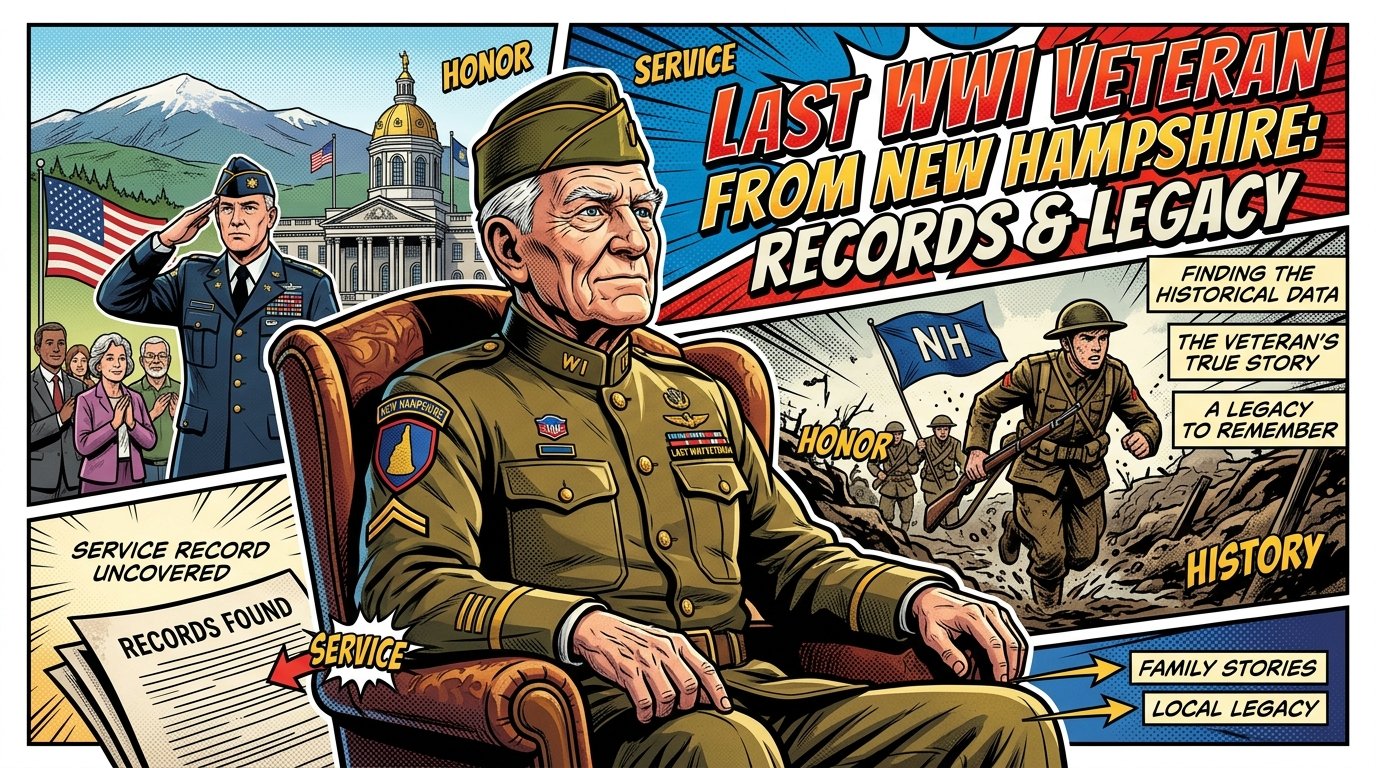
The Last WWI Veteran from New Hampshire: Frank Durbin, Damon Hall, and the Search for the Final Doughboy
Featured Snippet Answer: No single, officially designated “last WWI veteran from New Hampshire” exists in state records. Frank J. Durbin (1895–1999), born in New Hampshire, was one of the last surviving American WWI veterans. Damon Hall, a New Hampshire veteran, received the French Legion of Honor in 1999 at age 105. Both represent the final living links to the Granite State’s WWI generation.
Quick Facts
| Item | Details |
|---|---|
| Status | No single officially designated “last” veteran in state records |
| Key Figure 1 | Frank J. Durbin (1895–1999), born in New Hampshire; one of the last surviving American WWI veterans |
| Key Figure 2 | Damon Hall, New Hampshire veteran; received French Legion of Honor in 1999 at age 105 |
| Conflict | World War I (1917–1918) |
| New Hampshire Service | Thousands of Granite Staters served; the state provided National Guard units and individual volunteers |
| Notable Unit | 26th “Yankee” Division (New England National Guard) |
| Research Resources | National Archives, New Hampshire State Library, VA National Cemetery Administration |
| Updated For | 2026 historical research standards |
Who Was the Last WWI Veteran from New Hampshire?
There is no single, officially certified “last WWI veteran from New Hampshire” in the way that some states have documented a final survivor. The historical record does not contain a formal state designation. However, two men stand out as the strongest candidates for the title, and their stories illuminate the Granite State’s role in the First World War.

Frank J. Durbin: Born in New Hampshire, Among the Last Surviving Americans
Frank J. Durbin was born in New Hampshire on October 19, 1895, and died on April 25, 1999, at age 103. He was widely recognized as one of the last surviving American veterans of World War I. Durbin enlisted in the U.S. Army in 1915 at age 20, before the United States formally entered the war, and served through the conflict.

Durbin’s status as “one of the last” is significant. By the late 1990s, the number of living American WWI veterans had dwindled to a handful. Durbin’s death in 1999 removed one of the final living links to the American Expeditionary Forces. His New Hampshire birth ties him directly to the Granite State’s WWI generation.
Damon Hall: New Hampshire’s Legion of Honor Recipient
Damon Hall was a New Hampshire World War I veteran who, in February 1999, received the French Legion of Honor at age 105. The Legion of Honor is France’s highest decoration, and in the late 1990s the French government undertook an intensive search to award it to living American veterans who had served on French soil during the war.
Hall’s receipt of the Legion of Honor at 105 places him among the final surviving New Hampshire veterans of the conflict. Whether he was the absolute last is not definitively established in public records, but his story represents the end of an era for the Granite State.
Why the “Last” Is Difficult to Certify
Certifying a “last” veteran requires exhaustive verification of every individual who served from a given state. Veterans’ records are fragmented. Some men served under different home addresses, some moved after the war, and some records were lost in the 1973 National Personnel Records Center fire. State veterans’ agencies did not maintain a centralized “last survivor” registry. As a result, historians rely on obituaries, newspaper accounts, and organizational records to identify the final survivors, and a definitive single answer may never be possible.
New Hampshire’s Role in World War I
Veterans May Qualify for Extra Benefits
Check available financial assistance, healthcare programs and other opportunities that may apply to you.
Check EligibilityNew Hampshire contributed thousands of soldiers and sailors to the American war effort, and the state’s National Guard units were federalized for service in France. The Granite State’s WWI story is one of individual service, community sacrifice, and national contribution.
The 26th “Yankee” Division
Many New Hampshire soldiers served in the 26th Infantry Division, known as the “Yankee Division.” The 26th was formed from National Guard units across New England, including New Hampshire, and it saw extensive combat in France. The division participated in major campaigns, including the Chemin des Dames, Champagne-Marne, Saint-Mihiel, and the Meuse-Argonne Offensive.
New Hampshire’s National Guard units were part of this division, and Granite Staters fought in its ranks throughout the war. The 26th Division earned a reputation for toughness and was one of the most decorated American divisions of the conflict.
New Hampshire’s Casualties and Sacrifice
New Hampshire suffered significant losses in World War I. Communities across the state lost sons, brothers, and fathers. Towns erected memorials, and the state created honor rolls to preserve the memory of those who served and died.
The New Hampshire Historical Society notes that the state claimed one of the great heroes of the war: Private First Class George Dilboy, who was posthumously awarded the Congressional Medal of Honor for his heroism. Dilboy’s story is one of many that illustrate the courage of New Hampshire’s WWI generation.
Memorials and Remembrance
New Hampshire’s WWI memorials include the New Hampshire State House bronze tablet, created by the legislature in 1919, and the Memorial Union Building at the University of New Hampshire, which was designated the official state WWI memorial. These sites preserve the names and stories of Granite Staters who served.
How to Research a New Hampshire WWI Veteran
If you are researching a family member or ancestor who served in World War I from New Hampshire, several resources can help. The same records that document Frank Durbin and Damon Hall can help you trace the service of other Granite State veterans.
Key Records and Where to Find Them
Draft Registration Cards. Nearly all men aged 18–45 registered for the draft in 1917–1918. These cards include name, age, address, occupation, and physical description. They are available through the National Archives and genealogy databases.
Military Service Records. The National Personnel Records Center (NPRC) holds Official Military Personnel Files (OMPFs) for veterans. Some WWI records were destroyed in the 1973 fire, but many are available or can be reconstructed from alternate sources.
State and Local Records. The New Hampshire State Library maintains newspaper indexes and archival materials, including references to individual veterans. Local historical societies and town clerks also hold records.
Unit Histories. Regimental and divisional histories, such as those of the 26th Division, often include rosters and accounts of battles.
Cemetery Records. The VA’s National Cemetery Administration and local cemetery commissions maintain burial records for veterans.
Using the New Hampshire State Library
The New Hampshire State Library’s newspaper index is a valuable starting point. It indexes articles about individual veterans, including awards, obituaries, and service notices. A search for “Damon Hall,” for example, returns the 1999 article about his Legion of Honor award. Similar searches for other names can uncover local newspaper coverage that is not available in national databases.
Frank Durbin: A Life of Service
Frank J. Durbin’s life spanned nearly the entire 20th century. Born in New Hampshire in 1895, he enlisted in the Army in 1915, before the United States entered the war. He served through the conflict and returned home to live a long life, dying in 1999 at age 103.
Durbin’s service and longevity made him a symbol of the disappearing WWI generation. By the time of his death, the war had been over for more than 80 years. His passing was noted in national and local media as one of the final losses of the American Doughboy generation.
What Durbin’s Story Represents
Durbin’s story is not one of dramatic heroism or high rank. It is the story of an ordinary soldier who answered his country’s call, served honorably, and lived a long life. That is the story of most WWI veterans. Their service was essential, but it was often quiet and uncelebrated. Recognizing Durbin and others like him honors the millions of ordinary Americans who served.
Damon Hall: The Legion of Honor and the Final Years
Damon Hall’s receipt of the French Legion of Honor in 1999 at age 105 is a remarkable marker of longevity and service. The Legion of Honor was awarded to living American veterans who had served on French soil, and the French government’s search identified roughly 550 surviving veterans at the time.
Hall’s story illustrates the international dimension of WWI service. American soldiers fought alongside French forces, and France has never forgotten their contribution. The Legion of Honor is a tangible expression of that gratitude, awarded decades after the war to men who were often in their final years.
The Significance of the Legion of Honor
The Legion of Honor is France’s highest order of merit. It was established by Napoleon Bonaparte in 1802 and is awarded for extraordinary contributions to France. For American WWI veterans, the award recognized their service in the defense of France during the war. Damon Hall’s receipt of the award at 105 places him among the final living recipients of that generation.
Common Questions
1. Who was the last WWI veteran from New Hampshire?
There is no single, officially certified “last” WWI veteran from New Hampshire. Frank J. Durbin, born in New Hampshire, was one of the last surviving American WWI veterans and died in 1999. Damon Hall, a New Hampshire veteran, received the French Legion of Honor in 1999 at age 105. Both were among the final survivors.
2. Was Frank Durbin from New Hampshire?
Yes. Frank J. Durbin was born in New Hampshire on October 19, 1895. He was recognized as one of the last surviving American veterans of World War I and died on April 25, 1999.
3. Who was Damon Hall?
Damon Hall was a New Hampshire World War I veteran who received the French Legion of Honor in February 1999 at age 105. His award was part of France’s effort to honor living American veterans who had served on French soil.
4. How many New Hampshire residents served in World War I?
Thousands of Granite Staters served in World War I. Many served in the 26th “Yankee” Division, a New England National Guard unit that saw extensive combat in France. The exact number is difficult to determine because records are fragmented, but New Hampshire’s contribution was significant.
5. What was the 26th “Yankee” Division?
The 26th Infantry Division was a National Guard division made up of units from New England, including New Hampshire. It fought in major campaigns in France, including the Meuse-Argonne Offensive, and was one of the most decorated American divisions of WWI.
6. Are there any living WWI veterans in New Hampshire?
No. The last American WWI veteran, Frank Buckles, died in 2011. There are no living WWI veterans in New Hampshire or anywhere in the United States.
7. How can I find a New Hampshire WWI veteran’s grave?
The VA’s National Cemetery Administration, local cemetery commissions, and Find a Grave are the primary resources. The New Hampshire State Library’s newspaper index can also help locate obituaries and burial notices.
8. What records exist for New Hampshire WWI veterans?
Draft registration cards, military service records at the National Archives, unit histories, local newspaper archives, and state library indexes are the primary sources. Some records were lost in the 1973 NPRC fire, but many are available through alternate sources.
9. Did New Hampshire have any notable WWI heroes?
Yes. Private First Class George Dilboy of New Hampshire was posthumously awarded the Congressional Medal of Honor for his heroism in France. His story is one of many that illustrate the courage of New Hampshire’s WWI generation.
10. What is the New Hampshire State Library’s role in WWI research?
The New Hampshire State Library maintains a newspaper index that includes articles about individual veterans, including awards, obituaries, and service notices. It is a valuable resource for genealogists and historians researching Granite State veterans.
11. Why is it difficult to identify the “last” WWI veteran from a state?
Records are fragmented, veterans moved after the war, and some military records were destroyed in the 1973 fire. States did not maintain centralized “last survivor” registries, so historians rely on obituaries, newspaper accounts, and organizational records. A definitive single answer is often impossible.
12. What lessons can veterans today take from New Hampshire’s WWI generation?
The WWI generation reminds us that service is often quiet and unglamorous, that the transition home can be difficult, and that remembrance matters. The benefits system veterans use today was built in part because of the challenges faced by earlier generations of veterans.
Key Takeaways
No single, officially certified “last WWI veteran from New Hampshire” exists in state records. The historical record does not contain a formal designation.
Frank J. Durbin (1895–1999), born in New Hampshire, was one of the last surviving American WWI veterans.
Damon Hall, a New Hampshire veteran, received the French Legion of Honor in 1999 at age 105.
New Hampshire contributed thousands of soldiers and sailors to WWI, many serving in the 26th “Yankee” Division.
The 26th Division fought in major campaigns in France, including the Meuse-Argonne Offensive.
Private First Class George Dilboy of New Hampshire was posthumously awarded the Medal of Honor.
The New Hampshire State Library’s newspaper index is a key resource for researching individual WWI veterans.
Draft registration cards, military service records, and cemetery records are the primary sources for WWI genealogy.
There are no living WWI veterans in the United States. The last American WWI veteran, Frank Buckles, died in 2011.
New Hampshire’s WWI memorials, including the State House tablet and the UNH Memorial Union Building, preserve the memory of the state’s WWI generation.
Official Resources
National Archives — World War I Records: archives.gov/topics/wwi
National Personnel Records Center: archives.gov/personnel-records-center
VA National Cemetery Administration — Burial Records: cem.va.gov
New Hampshire State Library — Newspaper Index: archive.nhlibraries.org
New Hampshire Historical Society: nhhistory.org
New Hampshire State Veterans Cemetery: nhsvc.org
USA.gov — Veterans Benefits: usa.gov/veterans-benefits
🇺🇸 IMPORTANT DISCLAIMER – Veterans Benefits Information
This site provides general information about U.S. Department of Veterans Affairs (VA) benefits for educational and informational purposes only.
- Not Official: We are NOT affiliated with, endorsed by, or connected to the U.S. Department of Veterans Affairs (VA), the Veterans Benefits Administration (VBA), the Veterans Health Administration (VHA), or any other government agency.
- No Legal/Financial Advice: The content on this website is for informational purposes only and does not constitute legal, financial, or medical advice. VA benefits rules change frequently – always consult with an accredited Veterans Service Officer (VSO) or a qualified professional for your specific situation.
- Official Sources: For official, binding information and to apply for benefits, always visit official .gov websites: VA.gov, Benefits.VA.gov, or SSA.gov.
- No Data Collection: This site does not collect, store, or process any personal information. It does not have login forms, contact forms, or any system to capture user data. We never ask for your Social Security Number, bank details, or any personal information.
- 🚨 Scam Alert: The VA and other government agencies never charge fees for benefit applications. If anyone asks for money to "process" your VA claim, it is a scam. Report it to the VA Office of Inspector General at VA.gov/OIG.
- Advertising: This site uses third-party advertising (Adsterra) to cover operational costs. We do not endorse or guarantee any products or services advertised.
📌 Information provided as of June 2026. Always verify current eligibility and rules with official .gov sources.
This site is not affiliated with the U.S. Department of Veterans Affairs or any government agency. All information is for educational purposes only. Please visit VA.gov for official information.
