
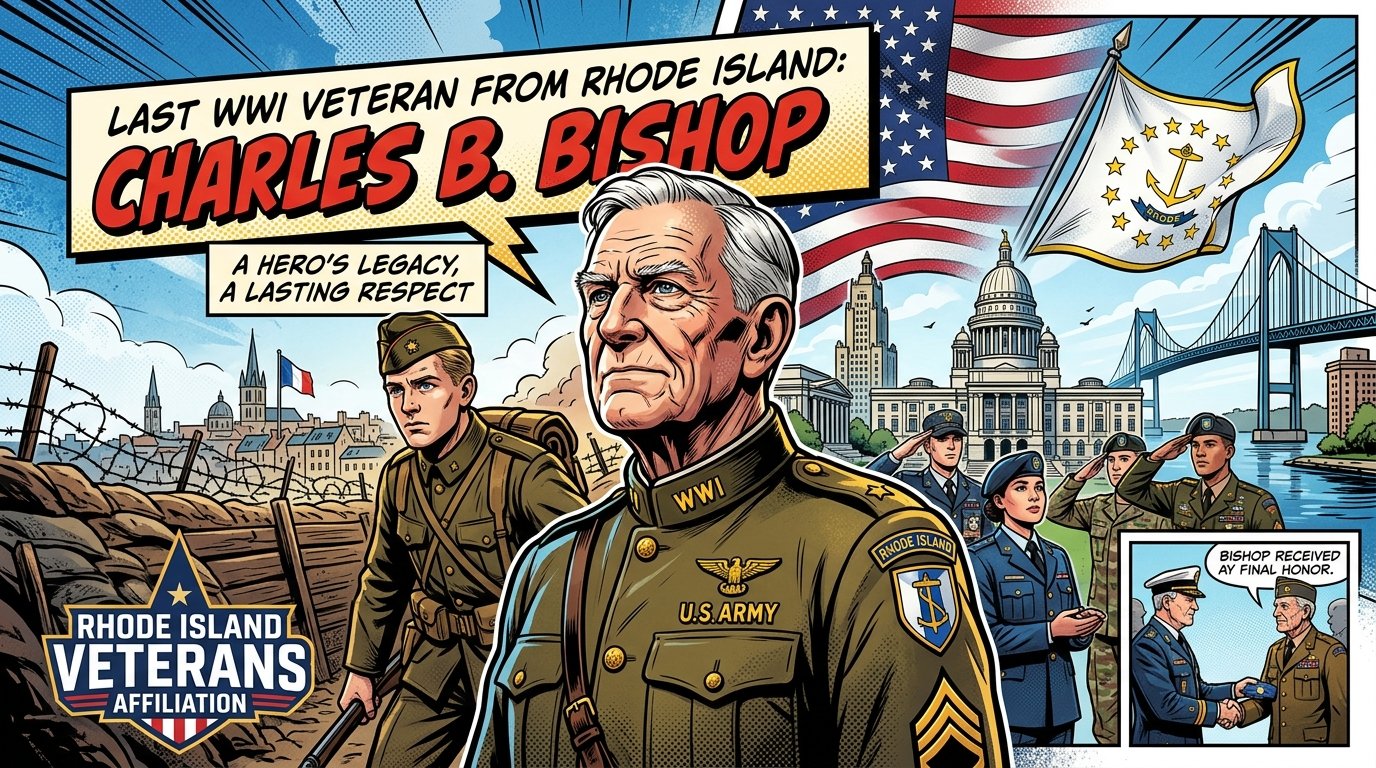
The Last WWI Veteran from Rhode Island: Charles Bryant Bishop and the End of an Era
Featured Snippet Answer: Charles Bryant Bishop was Rhode Island’s last surviving World War I veteran. He served in Battery C, 102nd Field Artillery, 26th “Yankee” Division, and died in 1986 at age 91. His passing marked the end of Rhode Island’s living connection to the First World War, a conflict in which more than 23,000 Rhode Islanders served.
Quick Facts
| Item | Details |
|---|---|
| Full Name | Charles Bryant Bishop |
| Lifespan | 1894–1986 |
| Hometown | Rhode Island |
| Military Unit | Battery C, 102nd Field Artillery Regiment, 26th “Yankee” Division |
| Conflict | World War I |
| Recognition | Rhode Island’s last surviving World War I veteran |
| Death | Died at Greenwood Nursing Home at age 91 |
| Historical Significance | Represented the final living link to Rhode Island’s WWI generation |
| Official Historical Resources | National Archives, VA.gov, Rhode Island Historical Cemeteries Commission |
Who Was Charles Bryant Bishop?
Charles Bryant Bishop was a Rhode Island soldier who served in World War I and became the state’s last surviving veteran of that conflict. He lived to be 91 years old and died at Greenwood Nursing Home. At the time of his death, he was identified as “Rhode Island’s last surviving World War I veteran of Battery C, 102nd Field Artillery, 26th ‘Yankee’ Division”.

Bishop’s life spanned nearly the entire 20th century. He was born in 1894, before the advent of military aviation, and died in 1986, in an era of nuclear weapons and space shuttles. His service in the First World War placed him among the millions of Americans who answered the call when the United States entered the conflict in 1917.
A Life of Service and Quiet Legacy

Historical records about Bishop’s post-war life are limited, as is common for ordinary soldiers who returned home and resumed civilian life. He was married to Vena Bishop. His obituary and cemetery records preserve the essential facts of his service and his place in Rhode Island history. He is buried in Rhode Island, and his grave remains a physical marker of the state’s WWI heritage.
Charles Bishop’s Military Service in World War I
Charles Bishop served in the 102nd Field Artillery Regiment, a unit of the 26th Infantry Division, famously known as the “Yankee Division.” The 26th Division was formed from National Guard units across New England, including Rhode Island, and it saw extensive combat in France during World War I.
The 26th “Yankee” Division
The 26th Division was activated in 1917 and deployed to France as part of the American Expeditionary Forces. It participated in major campaigns, including the Chemin des Dames, Champagne-Marne, Saint-Mihiel, and the Meuse-Argonne Offensive. The division earned a reputation for toughness and was one of the most decorated American divisions of the war.
Bishop’s assignment to Battery C of the 102nd Field Artillery placed him in a unit responsible for providing mobile fire support to infantry operations. Field artillery was a critical component of WWI combat, and artillerymen faced the constant threat of counter-battery fire, gas attacks, and the brutal conditions of trench warfare.
What Field Artillery Service Involved
Operating and maintaining field guns, typically the French-designed 75mm gun used by many American artillery units.
Transporting ammunition and equipment through mud, shell craters, and contested terrain.
Establishing firing positions under enemy observation and fire.
Coordinating fire missions with infantry units to support advances and defend against counterattacks.
Enduring gas attacks, artillery bombardments, and harsh weather in the trenches and forward positions.
Veterans May Qualify for Extra Benefits
Check available financial assistance, healthcare programs and other opportunities that may apply to you.
Check EligibilityBishop’s service was not glamorous, but it was essential. Artillerymen like him made it possible for infantry to advance and hold ground. Their work was dangerous, physically demanding, and often overlooked in popular narratives of the war.
Rhode Island’s Role in World War I
Rhode Island contributed significantly to the American war effort in World War I. By some estimates, the state sent 23,000 soldiers and sailors to fight, and more than 600 Rhode Islanders died in the conflict. These numbers represented a substantial share of the state’s young male population at the time.
Rhode Islanders in the Great War
Rhode Islanders served in every branch of the military and in a wide range of units. Some, like Charles Bishop, served in New England National Guard units that were federalized for the war. Others served in the Navy, the Marine Corps, and support roles. The state’s industrial base also contributed to the war effort, producing textiles, machinery, and other materiel.
Memorials and Remembrance
Rhode Island has several memorials to its World War I veterans, including monuments in Providence, Newport, and other communities. Some of these memorials have suffered from neglect and vandalism over the years, but local organizations and city governments have worked to restore them. The grave of Charles Bishop and the graves of other WWI veterans across the state serve as quiet reminders of the generation that fought in the “war to end all wars.”
Why the “Last Veteran” Matters
The death of the last surviving World War I veteran from Rhode Island marked the end of a living connection to one of the most consequential conflicts in human history. When Charles Bishop died in 1986, no one remained in Rhode Island who could speak from personal experience about the trenches, the gas attacks, the artillery barrages, or the Armistice of November 11, 1918.
The End of a Living Link
For decades after the war, WWI veterans were a visible presence in American communities. They marched in Armistice Day parades, belonged to the American Legion and Veterans of Foreign Wars, and shared their stories with younger generations. As the years passed, their numbers dwindled. The death of the last veteran in each state and community became a symbolic moment—a reminder that history is not abstract, but carried by individuals who lived it.
What Veterans Today Can Learn from Bishop’s Generation
The WWI generation left a legacy that still matters to veterans today:
Service is often unglamorous. Most soldiers, then and now, do their duty far from the spotlight. Their contributions are essential but rarely celebrated in headlines.
The transition home is hard. WWI veterans returned to a country that was often unprepared to support them. The veterans’ benefits system that exists today, including VA disability compensation, health care, and education benefits, was built in part because of the failures of earlier eras.
Remembrance matters. Memorials, graves, and historical records honor service and preserve the stories of those who served. Veterans and their families can participate in remembrance by documenting their own service and the service of their ancestors.
How to Research a WWI Veteran in Rhode Island
If you are researching a family member or ancestor who served in World War I from Rhode Island, several resources can help. The same records that preserved Charles Bishop’s service can help you trace the service of other Rhode Island WWI veterans.
Key Records and Where to Find Them
Draft Registration Cards. Nearly all men aged 18–45 registered for the draft in 1917–1918. These cards include name, age, address, occupation, and physical description. They are available through the National Archives and Ancestry.com.
Military Service Records. The National Personnel Records Center (NPRC) holds Official Military Personnel Files (OMPFs) for veterans. Some WWI records were destroyed in a 1973 fire, but many are available or can be reconstructed from alternate sources.
State and Local Records. The Rhode Island Historical Cemeteries Commission and local historical societies maintain records of veterans’ graves and memorials.
Unit Histories. Regimental and divisional histories, such as those of the 26th Division, often include rosters and accounts of battles.
Newspaper Archives. Local newspapers from the WWI era reported on enlistments, deployments, casualties, and returning veterans.
Using VA Resources
The Department of Veterans Affairs maintains burial records and headstone applications for veterans. The VA’s National Cemetery Administration can confirm burial in a VA national cemetery and provide information about headstones and markers. These records are available to the public and can be an important starting point for genealogical research.
Common Questions
1. Who was the last WWI veteran from Rhode Island?
Charles Bryant Bishop was Rhode Island’s last surviving World War I veteran. He served in Battery C, 102nd Field Artillery, 26th “Yankee” Division, and died in 1986 at age 91. His death marked the end of Rhode Island’s living connection to the First World War.
2. What unit did Charles Bishop serve in?
He served in Battery C, 102nd Field Artillery Regiment, 26th Infantry Division, the “Yankee Division.” This unit was composed of National Guard soldiers from New England and saw extensive combat in France.
3. How many Rhode Islanders served in World War I?
By some estimates, Rhode Island sent 23,000 soldiers and sailors to fight in World War I. More than 600 Rhode Islanders died in the conflict.
4. Are there any living WWI veterans in Rhode Island?
No. The last American WWI veteran, Frank Buckles, died in 2011. Charles Bishop, Rhode Island’s last surviving WWI veteran, died in 1986. There are no living WWI veterans in Rhode Island or anywhere in the United States.
5. What was the 26th “Yankee” Division?
The 26th Infantry Division was a National Guard division made up of units from New England, including Rhode Island. It fought in major campaigns in France, including the Meuse-Argonne Offensive, and was one of the most decorated American divisions of WWI.
6. How can I find a WWI veteran’s grave in Rhode Island?
The Rhode Island Historical Cemeteries Commission maintains an online database of cemetery records, including veterans’ graves. You can also search Find a Grave and the VA’s National Cemetery Administration records.
7. What records exist for Rhode Island WWI veterans?
Draft registration cards, military service records at the National Archives, unit histories, local newspaper archives, and state cemetery records are the primary sources. Some records were lost in the 1973 NPRC fire, but many are available through alternate sources.
8. Why is Charles Bishop’s service significant?
Bishop’s service represents the broader contribution of Rhode Island to World War I. As the state’s last surviving veteran, he became a symbolic link to a generation that is now entirely gone. His grave and records help preserve the memory of that generation.
9. Did Rhode Island have any notable WWI heroes?
Yes. Rhode Islanders served with distinction in many units. Carlo Lafazia, a Providence native, was killed in action in France and is memorialized at the Meuse-Argonne American Cemetery. Other Rhode Islanders earned decorations for valor and service.
10. What happened to Rhode Island’s WWI memorials?
Many WWI memorials in Rhode Island remain standing, though some have suffered from vandalism and neglect. Local governments and historical organizations have worked to restore them, including a monument to Carlo Lafazia in Providence that was restored after being vandalized.
11. Can I visit Charles Bishop’s grave?
Charles Bishop is buried in Rhode Island. His grave is recorded in historical cemetery indexes. Researchers and family members can locate the grave through the Rhode Island Historical Cemeteries Commission or Find a Grave.
12. What lessons can veterans today take from the WWI generation?
The WWI generation reminds us that service is often quiet and unglamorous, that the transition home can be difficult, and that remembrance matters. The benefits system veterans use today was built in part because of the challenges faced by earlier generations of veterans.
Key Takeaways
Charles Bryant Bishop was Rhode Island’s last surviving World War I veteran. He served in Battery C, 102nd Field Artillery, 26th “Yankee” Division, and died in 1986 at age 91.
The 26th Division was a New England National Guard unit that saw extensive combat in France, including the Meuse-Argonne Offensive.
Rhode Island sent approximately 23,000 soldiers and sailors to World War I, and more than 600 Rhode Islanders died in the conflict.
Bishop’s death marked the end of Rhode Island’s living connection to the First World War.
WWI service records are available through the National Archives, draft registration cards, unit histories, and state cemetery records.
The VA maintains burial and headstone records that can help researchers locate and document WWI veterans’ graves.
Rhode Island’s WWI memorials and graves preserve the memory of the state’s contribution to the war.
The WWI generation’s legacy reminds veterans today that service, transition, and remembrance are enduring themes.
There are no living WWI veterans in the United States. The last American WWI veteran, Frank Buckles, died in 2011.
Researching a WWI ancestor can connect families to their own history and to the broader story of Rhode Island’s role in the war.
Official Resources
National Archives — World War I Records: archives.gov/topics/wwi
National Personnel Records Center: archives.gov/personnel-records-center
VA National Cemetery Administration — Burial Records: cem.va.gov
Rhode Island Historical Cemeteries Commission: rihistoriccemeteries.org
Rhode Island Department of Veterans Affairs: va.ri.gov
USA.gov — Veterans Benefits: usa.gov/veterans-benefits
🇺🇸 IMPORTANT DISCLAIMER – Veterans Benefits Information
This site provides general information about U.S. Department of Veterans Affairs (VA) benefits for educational and informational purposes only.
- Not Official: We are NOT affiliated with, endorsed by, or connected to the U.S. Department of Veterans Affairs (VA), the Veterans Benefits Administration (VBA), the Veterans Health Administration (VHA), or any other government agency.
- No Legal/Financial Advice: The content on this website is for informational purposes only and does not constitute legal, financial, or medical advice. VA benefits rules change frequently – always consult with an accredited Veterans Service Officer (VSO) or a qualified professional for your specific situation.
- Official Sources: For official, binding information and to apply for benefits, always visit official .gov websites: VA.gov, Benefits.VA.gov, or SSA.gov.
- No Data Collection: This site does not collect, store, or process any personal information. It does not have login forms, contact forms, or any system to capture user data. We never ask for your Social Security Number, bank details, or any personal information.
- 🚨 Scam Alert: The VA and other government agencies never charge fees for benefit applications. If anyone asks for money to "process" your VA claim, it is a scam. Report it to the VA Office of Inspector General at VA.gov/OIG.
- Advertising: This site uses third-party advertising (Adsterra) to cover operational costs. We do not endorse or guarantee any products or services advertised.
📌 Information provided as of June 2026. Always verify current eligibility and rules with official .gov sources.
This site is not affiliated with the U.S. Department of Veterans Affairs or any government agency. All information is for educational purposes only. Please visit VA.gov for official information.
