
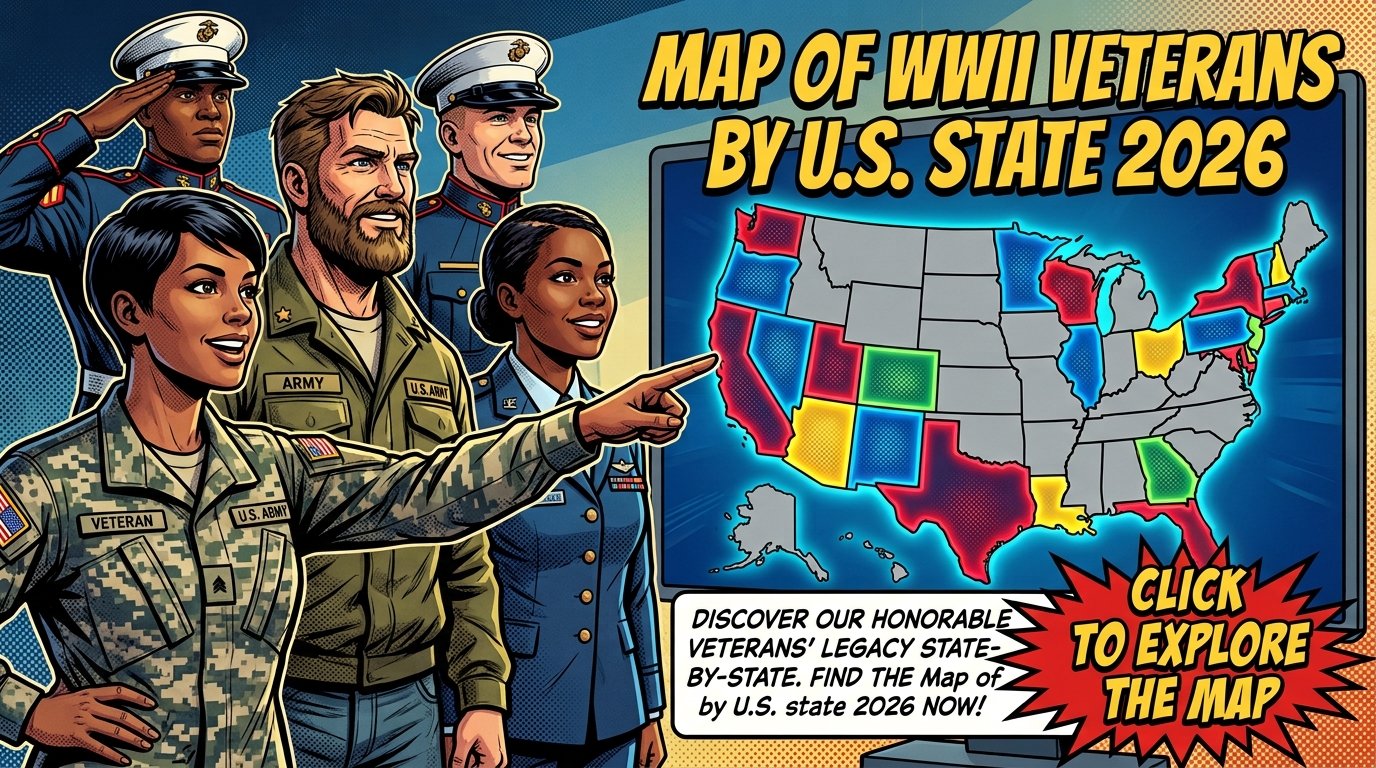
Approximately 30,607 U.S. WWII Veterans Are Still Alive
As of 2026, approximately 30,607 of the 16.4 million Americans who served in World War II are still alive, according to U.S. Department of Veterans Affairs statistics compiled by the National WWII Museum. That represents less than 0.2% of those who served. All surviving WWII veterans are now in their 90s or older.
Quick Facts
| Item | Details |
|---|---|
| Total Who Served | 16.4 million Americans |
| Living as of 2026 | Approximately 30,607 |
| Percentage Alive | Less than 0.2% |
| Youngest Veterans | Late 90s |
| Oldest Veterans | 110+ |
| Daily Loss Rate | Approximately 40–131 per day (declining) |
| State With Most Veterans | California (3,414) |
| Official Agency | U.S. Department of Veterans Affairs (VA) |
| Updated For | 2026 |
How Many WWII Veterans Are Left in 2026?
Approximately 30,607 WWII veterans are still alive in the United States as of 2026. The National WWII Museum, which tracks these statistics using VA data, reports that this number represents less than 0.2% of the 16.4 million Americans who served during the war.

The number has declined rapidly in recent years. As recently as 2023, the VA counted approximately 95,000 living WWII veterans. By the end of 2025, that number had dropped to 45,418. The 2026 projection of 30,607 reflects a loss of roughly 15,000 veterans in a single year.

The VA’s Veteran Population Projection (VetPop) Model projects further declines in the coming years:
| Year | Projected Living WWII Veterans |
|---|---|
| 2025 | 45,418 |
| 2026 | 30,607 |
| 2027 | 26,000 (projected) |
| 2028 | 20,000 (projected) |
By the end of 2027, estimates suggest approximately 28,000 WWII veterans will remain.
Why the Numbers Vary
Different sources report different numbers of living WWII veterans. This is not because the data is unreliable — it is because different organizations use different methodologies and update their figures at different times.
The National WWII Museum compiles VA statistics and updates its projections each September. The 2026 figure of 30,607 reflects the VA’s most recent projection model. The 2025 figure of 45,418 was the last actual count before the 2026 projection was released.
Veterans May Qualify for Extra Benefits
Check available financial assistance, healthcare programs and other opportunities that may apply to you.
Check EligibilityNews outlets sometimes report figures that are several months or even a year old. When you see numbers like “45,000” or “50,000” in news articles, they are typically citing the 2025 data. The most current figure for 2026 is 30,607.
The U.S. Department of Veterans Affairs publishes its own population projections in its annual volume. The VA’s 2026 projection for all veterans is 17,260,286, with wartime veterans making up 13,840,105 of that total. The WWII-specific breakdown is included in the National WWII Museum’s tracking.
How Many WWII Veterans Die Each Day?
Approximately 40 to 131 WWII veterans die each day, though the rate has declined as the total population has shrunk. As recently as 2023, roughly 131 veterans were passing away every day. That number is likely lower now because the overall population has decreased so much.
The daily loss rate is a moving target. In 2025, some sources reported that roughly 100–130 veterans were passing away per day. The National WWII Museum’s data suggests the rate is now closer to 40 per day, reflecting the smaller remaining population.
What matters most is the trajectory: every day, the number of living WWII veterans grows smaller. The youngest veterans of the war are now approaching their late 90s, and the oldest are over 110.
Living WWII Veterans by State
WWII veterans live in every U.S. state except Alaska, according to VA data. California has the largest number of surviving veterans, followed by Florida, Pennsylvania, New York, and Texas.
| Rank | State | Living WWII Veterans (2026) |
|---|---|---|
| 1 | California | 3,414 |
| 2 | Florida | 2,506 |
| 3 | Pennsylvania | 1,741 |
| 4 | Texas | 1,918 |
| 5 | New York | 1,574 |
| 6 | Illinois | 1,152 |
| 7 | Ohio | 1,092 |
| 8 | Michigan | 1,113 |
| 9 | Virginia | 980 |
| 10 | Washington | 897 |
| 11 | Wisconsin | 837 |
| 12 | North Carolina | 835 |
| 13 | Minnesota | 823 |
| 14 | New Jersey | 716 |
| 15 | Georgia | 690 |
Source: National WWII Museum, 2026.
At the other end of the scale, several states have fewer than 100 surviving WWII veterans. Alaska has none, according to the VA data. The District of Columbia has 48, Wyoming has 41, and Vermont has 45.
The concentration of veterans in California and Florida reflects broader population patterns. California’s large population and major military installations during the war contributed to its high number. Florida’s warm climate and veteran-friendly tax policies have long made it a popular retirement destination for older veterans.
Demographic Characteristics of Living WWII Veterans
All living WWII veterans are now in their 90s or older. The youngest veterans of the war, those who enlisted at the very end of the conflict, are now approaching their late 90s. The oldest living veterans are over 110.
Age of Living WWII Veterans
The youngest World War II veterans will soon turn 100. Most living veterans are between 97 and 105 years old. A small number of supercentenarians — those over 110 — remain.
The oldest living American WWII veteran is James Clayton Flowers, who is 110 years old. Other veterans over 109 include Duane Brewton and several others who have been recognized in local news reports.
Gender
The vast majority of living WWII veterans are men. Women served in the war in significant numbers — approximately 350,000 women served in the U.S. Armed Forces during WWII — but their numbers among the living are much smaller. The Women’s Army Corps (WAC), Navy WAVES, and other women’s units contributed to the war effort, and a small number of these women are still alive today.
Race and Ethnicity
WWII veterans come from all racial and ethnic backgrounds. The war saw the service of African American, Hispanic, Asian American, and Native American service members, often in segregated units. Their stories have become an important part of the historical record, and many have been documented by oral history projects.
What Benefits Are Available to WWII Veterans?
WWII veterans are eligible for the full range of VA benefits, including several programs specifically enhanced for their generation. As veterans of a wartime era, they qualify for benefits that may not be available to peacetime veterans.
VA Health Care
All WWII veterans are eligible for no-cost VA health care, medical services, and nursing home care. Since November 2023, this benefit has been expanded so that WWII veterans no longer must make co-payments, pay enrollment fees, or pay monthly premiums.
The VA provides a comprehensive Medical Benefits Package to all enrolled veterans. WWII veterans receive priority enrollment status, and the VA waives copayments for hospital care and outpatient care for this group.
VA Disability Compensation
VA disability compensation is a monthly tax-free payment to veterans with service-connected injuries or illnesses. WWII veterans who have service-connected conditions can apply for disability compensation using VA Form 21-526EZ. The VA’s 2026 budget includes $22,128,000 in obligations for WWII veterans’ compensation.
VA Pension
The VA pension program provides monthly tax-free payments to wartime veterans with limited income. WWII veterans who are 65 or older, or who have a permanent and total disability, may qualify. In 2026, a single veteran can receive up to $17,441 annually in VA pension.
Dependency and Indemnity Compensation (DIC)
Surviving spouses and dependents of WWII veterans who died from service-connected causes may be eligible for DIC, a tax-free monthly benefit.
Burial Benefits
The VA provides burial allowances and headstones or markers for veterans, including WWII veterans. These benefits are available for veterans buried in national cemeteries or private cemeteries.
Survivor Benefits
Surviving spouses, dependent children, and parents of deceased WWII veterans may qualify for VA survivor benefits, including DIC and VA pension.
How to Verify WWII Service Records
If you are researching a family member’s WWII service, or if you need to verify your own service, here are the key steps.
Step 1: Gather basic information. You will need the veteran’s full name, date of birth, Social Security number (if available), service number, and branch of service.
Step 2: Request military records. The National Archives and Records Administration (NARA) maintains military service records. Most WWII records are stored at the National Personnel Records Center in St. Louis, Missouri. You can request records online at archives.gov or by submitting Standard Form 180.
Step 3: Check for fire-damaged records. A fire at the National Personnel Records Center in 1973 destroyed approximately 16–18 million Official Military Personnel Files. If your veteran’s records were affected, NARA may be able to reconstruct key information from alternative sources.
Step 4: Use VA records. The VA also maintains records of veterans’ benefits and claims. If the veteran received VA benefits, those records may provide additional documentation.
Step 5: Explore alternative sources. Unit histories, morning reports, and after-action reports can supplement official records. The National WWII Museum, the Library of Congress Veterans History Project, and local historical societies may have relevant materials.
The Future of the WWII Veteran Population
The WWII veteran population is in its final years. By the mid-2030s, the VA projects that virtually all WWII veterans will have passed away.
The VA’s Veteran Population Projection Model projects that the total veteran population will decline from 17.26 million in 2026 to 14.6 million by 2035. WWII veterans will represent a vanishingly small fraction of that total.
The National WWII Museum in New Orleans is dedicated to preserving the stories of the WWII generation. The Museum’s mission is to tell the story of the American experience in the war and to carry on the legacies of those who served. Its oral history collection includes thousands of interviews with veterans.
The Library of Congress Veterans History Project also collects and preserves first-hand accounts of veterans, including WWII veterans. Families are encouraged to submit their veterans’ stories before they are lost.
Common Mistakes When Researching WWII Veterans
Mistake 1: Assuming all records are available. Many WWII records were destroyed in the 1973 fire at the National Personnel Records Center. If your veteran’s records were affected, you may need to use alternative sources.
Mistake 2: Confusing service numbers. WWII-era service numbers follow different formats depending on the branch of service. Make sure you have the correct service number for the branch you’re researching.
Mistake 3: Expecting immediate results. NARA processes millions of records requests each year. Turnaround times for WWII records can be several weeks to several months.
Mistake 4: Overlooking the VA’s records. If the veteran received VA benefits at any point, the VA may have records that supplement NARA’s holdings.
Mistake 5: Not asking the veteran directly. If the veteran is still alive, the best source of information is the veteran themselves. Record their story and ask detailed questions about their service.
Common Questions
How many WWII veterans are still alive today?
Approximately 30,607 U.S. WWII veterans are still alive as of 2026, according to VA statistics compiled by the National WWII Museum. That represents less than 0.2% of the 16.4 million Americans who served. All surviving veterans are now in their 90s or older.
How many WWII veterans die each day?
Approximately 40 to 131 WWII veterans die each day. The rate has declined as the total population has decreased. In 2023, roughly 131 veterans were passing away daily. The current rate is likely closer to 40 per day.
What is the youngest age of a living WWII veteran?
The youngest living WWII veterans are in their late 90s. Most are over 100. The youngest veterans of the war, those who enlisted at the very end of the conflict, are now approaching their 100th birthdays.
How many WWII veterans are in California?
California has the largest number of living WWII veterans, with approximately 3,414 as of 2026. Florida follows with 2,506, and Texas has 1,918. These three states account for a significant portion of the remaining WWII veteran population.
Are there any WWII veterans in Alaska?
No. Alaska has no living WWII veterans, according to VA data. It is the only state with zero surviving veterans from the war. The District of Columbia has 48, and several states have fewer than 100.
What benefits are available to WWII veterans?
WWII veterans are eligible for no-cost VA health care, disability compensation, VA pension, DIC for survivors, burial benefits, and survivor benefits. Since November 2023, all WWII veterans qualify for no-cost VA health care without copayments or enrollment fees.
How do I verify a WWII veteran’s service?
To verify a WWII veteran’s service, request military records from the National Archives and Records Administration using Standard Form 180. You will need the veteran’s full name, date of birth, service number, and branch of service. Many WWII records are stored at the National Personnel Records Center in St. Louis.
How many WWII veterans are left worldwide?
The total number of WWII veterans worldwide is estimated at 100,000 to 300,000, though this figure is difficult to verify because many countries do not track veteran populations in the same way the U.S. does. The U.S. has approximately 30,607 living WWII veterans.
Who is the oldest living WWII veteran?
The oldest living American WWII veteran is James Clayton Flowers, who is 110 years old. Several other veterans over 109 have been recognized in local news reports. The oldest WWII veteran worldwide was Ilie Ciocan of Romania, who died at 112 in May 2026.
Will there be any WWII veterans alive in 2030?
It is possible that a small number of supercentenarians will still be alive in 2030, but the VA projects that virtually all WWII veterans will have passed away by the mid-2030s. By 2027, an estimated 26,000–28,000 WWII veterans are expected to remain.
Key Takeaways
Approximately 30,607 U.S. WWII veterans are still alive as of 2026, less than 0.2% of the 16.4 million who served.
The number has dropped sharply from 45,418 at the end of 2025 and 95,000 in 2023.
All living WWII veterans are in their 90s or older; the youngest are approaching 100.
California has the most living WWII veterans (3,414), followed by Florida (2,506) and Texas (1,918).
Alaska has no living WWII veterans; the District of Columbia has 48.
Approximately 40 to 131 WWII veterans die each day, with the rate declining as the population shrinks.
All WWII veterans are eligible for no-cost VA health care, with no copayments or enrollment fees.
WWII veterans qualify for VA disability compensation, VA pension, DIC, burial benefits, and survivor benefits.
The National WWII Museum and the Library of Congress Veterans History Project preserve the stories of the WWII generation.
By the mid-2030s, virtually all WWII veterans will have passed away, making preservation efforts increasingly urgent.
Official Resources
U.S. Department of Veterans Affairs (VA) — VA.gov — Veteran population data, benefits, and health care
National WWII Museum — nationalww2museum.org — WWII veteran statistics and oral histories
Library of Congress Veterans History Project — loc.gov/vets — First-hand veteran accounts
National Archives and Records Administration (NARA) — archives.gov — Military service records





🇺🇸 IMPORTANT DISCLAIMER – Veterans Benefits Information
This site provides general information about U.S. Department of Veterans Affairs (VA) benefits for educational and informational purposes only.
- Not Official: We are NOT affiliated with, endorsed by, or connected to the U.S. Department of Veterans Affairs (VA), the Veterans Benefits Administration (VBA), the Veterans Health Administration (VHA), or any other government agency.
- No Legal/Financial Advice: The content on this website is for informational purposes only and does not constitute legal, financial, or medical advice. VA benefits rules change frequently – always consult with an accredited Veterans Service Officer (VSO) or a qualified professional for your specific situation.
- Official Sources: For official, binding information and to apply for benefits, always visit official .gov websites: VA.gov, Benefits.VA.gov, or SSA.gov.
- No Data Collection: This site does not collect, store, or process any personal information. It does not have login forms, contact forms, or any system to capture user data. We never ask for your Social Security Number, bank details, or any personal information.
- 🚨 Scam Alert: The VA and other government agencies never charge fees for benefit applications. If anyone asks for money to "process" your VA claim, it is a scam. Report it to the VA Office of Inspector General at VA.gov/OIG.
- Advertising: This site uses third-party advertising (Adsterra) to cover operational costs. We do not endorse or guarantee any products or services advertised.
📌 Information provided as of June 2026. Always verify current eligibility and rules with official .gov sources.
This site is not affiliated with the U.S. Department of Veterans Affairs or any government agency. All information is for educational purposes only. Please visit VA.gov for official information.
