
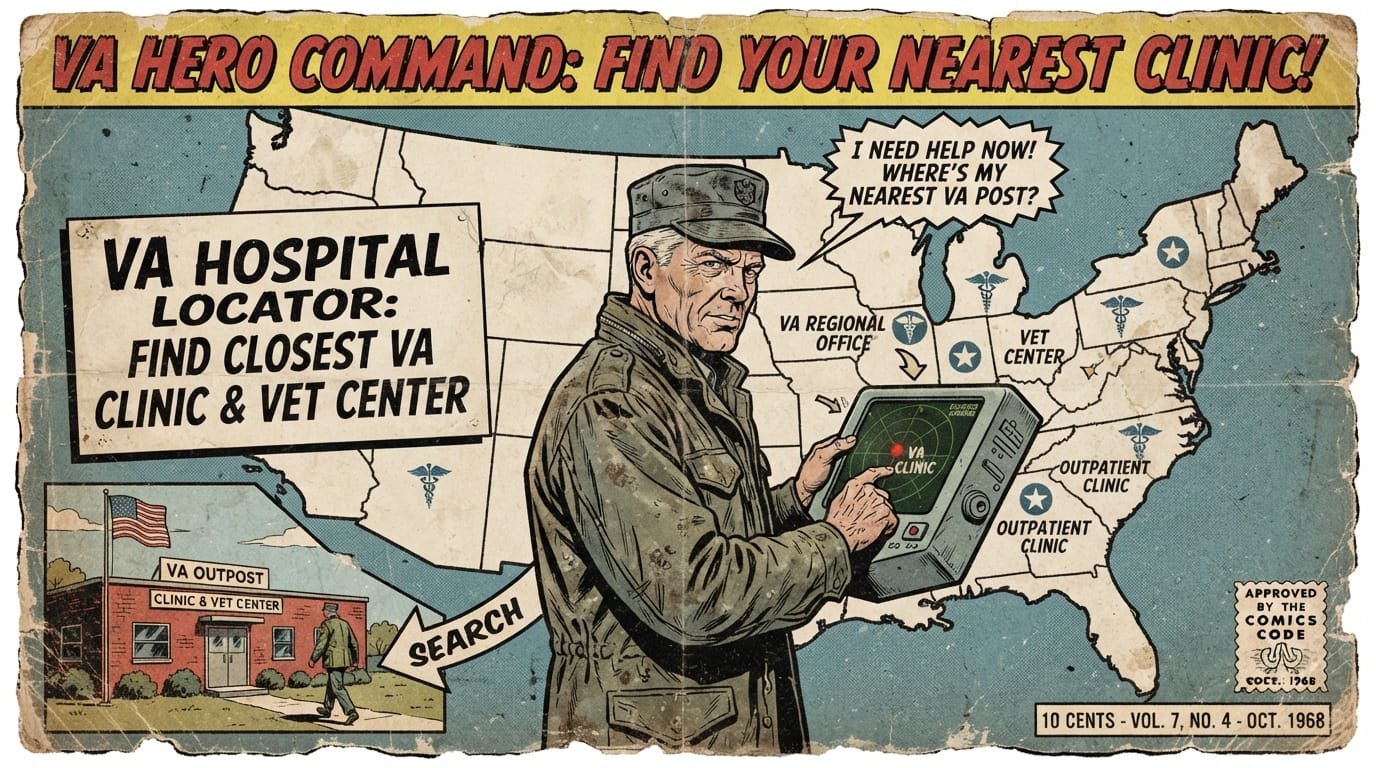
Veteran Hospital Near Me: How to Find the Closest VA Medical Center
You can find the VA medical center closest to you by using the official VA facility locator at va.gov/find-locations. Enter your city, state, or ZIP code, then filter by facility type — VA medical center, clinic, or Vet Center. The tool shows addresses, phone numbers, hours, and available services.
Quick Facts
| Item | Details |
|---|---|
| Benefit | VA health care at the nearest VA medical center, clinic, or Vet Center |
| Eligibility | Veterans with qualifying military service and discharge status |
| Application | VA Form 10-10EZ (online, mail, phone, or in-person) |
| Processing Time | Typically 1–2 weeks for online applications |
| Official Agency | U.S. Department of Veterans Affairs (VA) |
| Required Forms | VA Form 10-10EZ (enrollment); VA Form 10-10EZR (updates) |
| Updated For | October 2026 |
How to Find a VA Medical Center Near You
The fastest way to find a VA medical center near you is the VA facility locator at va.gov/find-locations. This official tool lets you search by city, state, ZIP code, or your current location, and it covers VA medical centers, community-based outpatient clinics (CBOCs), Vet Centers, VA benefits offices, VA cemeteries, and in-network community care providers.

Step-by-Step: Using the VA Facility Locator
Go to va.gov/find-locations.
Enter your location. Type your city and state or your ZIP code. You can also use the “Use my location” option on mobile devices.
Choose a facility type. Select from:
VA health facilities (medical centers and clinics)
Vet Centers (counseling and readjustment services)
VA benefits offices
VA cemeteries
Community providers (in-network)
Urgent care locations
Filter by service. If you need a specific service — mental health, women’s health, audiology, pharmacy — use the service filter to narrow results.
Review results. Each listing shows the facility name, address, phone number, hours, and a link to the facility’s page with more details.
Other Ways to Find VA Care
Call MyVA411: 800-698-2411. This is VA’s main information line for help finding facilities and answering questions.
Call the Health Care Line: 877-222-8387 (press 0). Use this for questions about enrollment and scheduling.
Use the VA Health Chat app: For enrolled Veterans, this app can connect you with a nurse, help schedule appointments, and locate facilities.
Why it matters: VA care is not one-size-fits-all. Different facilities offer different services. A full VA medical center may have emergency care, surgery, and specialty clinics, while a CBOC offers primary care and mental health. Knowing what’s available near you prevents wasted trips and delays.

What to do next: Save the phone number and address for your nearest VA medical center and your nearest CBOC. If you’re not enrolled, complete VA Form 10-10EZ before you need care — not during an emergency.
VA Medical Center vs. VA Clinic vs. Vet Center: What’s the Difference?
VA health care is delivered through three main types of facilities, each with a different scope of services. Understanding the difference helps you choose the right one for your needs.
| Facility Type | What It Offers | When to Use It |
|---|---|---|
| VA Medical Center | Full-service hospital: primary care, specialty care, surgery, emergency department, mental health, pharmacy, imaging, inpatient care | Complex or urgent medical needs; specialty referrals; emergency care |
| VA Clinic (CBOC) | Primary care, mental health, some specialty services, telehealth, lab work | Routine care, chronic condition management, preventive screenings, mental health counseling |
| Vet Center | Readjustment counseling, PTSD treatment, military sexual trauma counseling, bereavement counseling, community outreach | Combat Veterans, Veterans who experienced sexual trauma, families seeking counseling |
Source:
Decision Tree: Which Facility Should You Choose?
Are you experiencing a life-threatening emergency — chest pain, stroke symptoms, severe bleeding, trouble breathing?
→ Call 911 or go to the nearest emergency room. You do not need VA approval for emergency care.
Veterans May Qualify for Extra Benefits
Check available financial assistance, healthcare programs and other opportunities that may apply to you.
Check EligibilityDo you need care today for a non-emergency issue — sprain, sore throat, minor infection?
→ Go to a VA urgent care clinic or an in-network community urgent care provider.
Do you need routine primary care, a chronic condition check, or a mental health appointment?
→ Contact your assigned VA medical center or CBOC. If you don’t have one assigned, call 877-222-8387.
Are you a combat Veteran seeking counseling or readjustment support?
→ Contact your nearest Vet Center. Vet Centers are separate from VA medical centers and offer confidential counseling.
Do you need a specialist — cardiology, dermatology, orthopedics?
→ Your VA primary care provider must refer you. If VA cannot provide the service within access standards, you may qualify for Community Care.
VA Health Care Eligibility: Who Qualifies?
VA health care eligibility is primarily based on military service and discharge status. Veterans who served in the active military, naval, or air service and were discharged under conditions other than dishonorable are generally eligible.
Basic Eligibility Requirements
Service requirement: Most Veterans who enlisted after Sept. 7, 1980, or entered active duty after Oct. 16, 1981, must have served 24 continuous months or the full period for which they were called to active duty.
Discharge status: Must be other than dishonorable.
Reserves and National Guard: Members called to active duty by a federal order may qualify. Those who served only for training purposes generally do not qualify.
Expanded Eligibility Under the PACT Act
All Veterans who meet basic service and discharge requirements and were exposed to toxins or hazards during service — at home or abroad — are now eligible for VA health care. This includes Veterans who served in the Vietnam War, Gulf War, Iraq, Afghanistan, or any combat zone after 9/11.
Why it matters: The PACT Act expanded eligibility for millions of Veterans who may not have qualified before. If you were previously denied VA health care, you may now be eligible.
What to do next: If you’re unsure whether you qualify, apply. VA will determine your eligibility and priority group. There is no penalty for applying.
How to Enroll in VA Health Care
Enrollment in VA health care is free and begins with VA Form 10-10EZ, “Instructions and Enrollment Application for Health Benefits” (revision date February 2025).
Required Documents
Gather these before you apply:
DD-214 or equivalent (Certificate of Release or Discharge from Active Duty) for each period of service
Social Security number
Insurance information (Medicare, Medicaid, private insurance)
Household income information (prior year gross household income and deductions)
Bank account information for direct deposit, if applicable
Four Ways to Apply
Option 1: Online (Fastest)
Go to VA.gov and complete the online application. This is the fastest method and typically processes within 1–2 weeks.
Option 2: By Phone
Call 1-877-222-8387 (1-877-222-VETS). A VA representative will help you complete the form over the phone.
Option 3: By Mail
Download and print VA Form 10-10EZ from VA.gov. Complete it, sign it, and mail it to:
Health Eligibility Center
2957 Clairmont Road NE, Suite 200
Atlanta, GA 30329-1647
Option 4: In Person
Visit the nearest VA medical center or clinic. Bring a signed VA Form 10-10EZ with you.
Signature Requirements
You or someone acting as your power of attorney must sign and date the form. If you sign with an “X,” two people who know you must witness your signature. If using a power of attorney, submit a copy of the POA document with your application.
What to do next: Apply online if you can. If you need help, call the toll-free number or visit a VA enrollment office. Veterans Service Organizations (VSOs) also offer free application assistance.
Community Care: When VA Care Isn’t Available Nearby
Community Care allows eligible Veterans to receive care from approved non-VA providers when the VA cannot provide the needed care. This is especially relevant for Veterans who live far from a VA medical center or face long wait times.
Community Care Eligibility Criteria
You must meet both basic requirements:
You’re enrolled in or eligible for VA health care, and
You have approval from your VA health care team before you get care from a community provider (except for urgent or emergency care).
And at least one of these must be true:
You need a service that VA doesn’t provide at any VA facility.
You live in a state or territory without a full-service VA facility.
You and your VA provider agree that community care is in your best medical interest.
VA cannot provide the service in a way that meets quality standards.
VA cannot provide care within its access standards for drive time or wait time.
Access Standards for Community Care (2026)
| Care Type | Drive Time Standard | Wait Time Standard |
|---|---|---|
| Primary Care | 30 minutes | 20 days |
| Mental Health | 30 minutes | 20 days |
| Extended Outpatient Care | 30 minutes | 20 days |
| Specialty Care | 60 minutes | 28 days |
Source:
Why it matters: If you live more than 30 minutes from a VA primary care clinic, or if the soonest VA appointment is more than 20 days away, you are legally eligible for Community Care. You don’t have to wait for VA to offer it — you can request it.
What to do next: Contact your VA facility’s Community Care office or call the national Community Care Contact Center at 877-881-7618.
Emergency and Urgent Care: Where to Go
Knowing the difference between emergency and urgent care can save you hours of waiting and ensure VA covers the cost.
When to Go to the Emergency Room (or Call 911)
Go to the nearest emergency room or call 911 for:
Sudden loss of awareness or sight
Arm or leg weakness or numbness
Severe chest pain or pressure
Heavy, uncontrollable bleeding
New severe abdominal pain
Major trauma or burns
Head injury
Trouble breathing
Stroke symptoms
Seizures
You do not need VA approval or a referral to go to a non-VA emergency room. If you receive emergency care at a non-VA facility, you or your provider must notify VA within 72 hours. Call 844-724-7842 or report online at emergencycarereporting.communitycare.va.gov.
When to Go to Urgent Care
Go to urgent care for problems that need attention today but are not life-threatening:
Sore or persistent cough
Sprains or minor broken bones
Mild nausea or vomiting
Urinary tract infection symptoms
Minor cuts, burns, or rashes
VA offers urgent care at VA medical centers and through in-network community urgent care providers. The average wait time in urgent care is 20 minutes or less, compared to 2 hours and 15 minutes for emergency room care.
Important: Urgent care facilities do not count as emergency departments. If you use a non-VA urgent care facility, different rules apply than for emergency care. Confirm your eligibility before you go.
What to do next: Save the phone number for VA Health Connect — call your local VA medical center and select option 3 to speak with a nurse 24/7. They can advise you on where to go and whether tele-emergency care is appropriate.
Finding a Vet Center Near You
Vet Centers are community-based counseling centers that provide confidential readjustment counseling and outreach services to Veterans, active duty service members, and their families. They are separate from VA medical centers and often have different locations.
Services Offered at Vet Centers
Individual, group, and family counseling
PTSD treatment and readjustment counseling
Military sexual trauma (MST) counseling
Bereavement counseling
Substance abuse assessment and referral
Community outreach and education
How to Find a Vet Center
Use the same VA facility locator at va.gov/find-locations and select “Vet Centers” as your facility type. You can also call 1-877-927-8387 (1-877-WAR-VETS) to be connected with the nearest Vet Center.
Why it matters: Vet Centers offer a different environment than VA medical centers — they are community-based, often smaller, and designed specifically for readjustment support. Many Veterans who are not enrolled in VA health care can still use Vet Center services.
What to do next: If you’re a combat Veteran or a Veteran who experienced military sexual trauma, contact your nearest Vet Center. Services are free and confidential.
VA Benefits Beyond Health Care: Dental, Vision, and Caregiver Support
Finding a VA medical center is often the first step to accessing other VA benefits. Here’s what else may be available once you’re enrolled.
VA Dental Benefits
Dental care is not automatically included in VA health care. Eligibility is limited to specific groups:
Veterans with a service-connected dental disability rated 100% or a compensable dental condition
Former prisoners of war
Veterans with a service-connected disability rated 100% (temporary ratings generally don’t qualify)
Veterans enrolled in a VA homeless program or receiving care for a condition that requires dental treatment
About 26% of VHA-enrolled Veterans were eligible for dental benefits as of February 2026, according to VA data.
What to do next: If you think you may qualify, ask your VA primary care provider for a dental referral. If you don’t qualify for VA dental, the VA Dental Insurance Program (VADIP) offers discounted private dental insurance to enrolled Veterans.
VA Vision Benefits
If you are enrolled in VA health care, you’re eligible for diagnostic, preventive, and therapeutic eye care services. You may also be eligible to receive eyeglasses and medically necessary contact lenses.
Veterans with a service-connected disability rating of 10% or more are eligible for an eye exam and glasses. Veterans without a service-connected rating may still qualify if there is a medical necessity.
What to do next: Request an optometry referral through your VA primary care provider. If you have a service-connected rating, mention it when scheduling.
VA Caregiver Support Program
The VA Caregiver Support Program provides training, counseling, and respite care to family caregivers of eligible Veterans. The Program of Comprehensive Assistance for Family Caregivers (PCAFC) offers additional benefits including a monthly stipend for the primary caregiver.
Eligibility for PCAFC:
The Veteran has a VA disability rating (individual or combined) of 70% or higher.
The Veteran was discharged from the U.S. military or has a date of medical discharge.
The Veteran needs at least 6 months of continuous in-person personal care services.
Why it matters: Caregivers of seriously ill or injured Veterans often provide full-time care without compensation. PCAFC provides financial support and training, reducing caregiver burnout and helping Veterans remain at home.
What to do next: Apply for the Caregiver Support Program through VA.gov or by calling the Caregiver Support Line at 1-855-260-3274. A clinical evaluation will determine eligibility.
Common Mistakes to Avoid When Seeking VA Care
Going to a VA clinic without enrollment. You must be enrolled in VA health care to receive care at a VA facility. If you’re not enrolled, apply with VA Form 10-10EZ before scheduling.
Going to a non-VA emergency room and not notifying VA. VA must be notified within 72 hours of non-VA emergency care for VA to cover the cost. Call 844-724-7842 as soon as possible.
Assuming urgent care is the same as emergency care. Urgent care facilities do not count as emergency departments. Different rules apply for coverage.
Not checking the facility’s service offerings. Not every VA clinic offers every service. Use the facility locator to filter by service before you drive there.
Waiting too long for an appointment. If the soonest VA appointment is more than 20 days away for primary or mental health care (28 days for specialty care), you may be eligible for Community Care. Ask.
Not documenting your wait times. Keep a record of when you requested an appointment and what date you were offered. This helps prove eligibility for Community Care.
Common Questions
1. How do I find the VA medical center closest to me?
Use the VA facility locator at va.gov/find-locations. Enter your ZIP code or city and state, then filter by “VA health facilities.” You can also call MyVA411 at 800-698-2411 for help finding a facility.
2. What is the difference between a VA medical center and a VA clinic?
A VA medical center is a full-service hospital with emergency care, surgery, and specialty clinics. A VA clinic (CBOC) offers primary care, mental health, and some specialty services. Use a medical center for complex or urgent needs; use a clinic for routine care.
3. Do I need to be enrolled in VA health care to go to a VA hospital?
Yes. You must be enrolled in VA health care to receive care at VA facilities or to have VA cover community care. Enrollment is free using VA Form 10-10EZ.
4. How long does VA health care enrollment take?
Online applications typically process within 1–2 weeks. Paper applications may take longer. You’ll receive a decision letter by mail explaining your enrollment status and priority group.
5. Can I go to any VA medical center, or do I have to use the one closest to me?
You can receive care at any VA medical center, but you are typically assigned to a primary care facility based on your home address. If you need care while traveling, you can visit another VA facility. For ongoing specialty care, you may need a referral.
6. What should I do if the VA clinic near me doesn’t offer the service I need?
Ask your VA primary care provider for a referral. If VA cannot provide the service within its access standards — 30 minutes/20 days for primary care, 60 minutes/28 days for specialty care — you may be eligible for Community Care.
7. How do I find a Vet Center near me?
Use va.gov/find-locations and select “Vet Centers” as the facility type. You can also call 1-877-927-8387 to be connected with the nearest Vet Center.
8. What is the VA urgent care benefit?
VA urgent care covers treatment for non-emergency conditions at VA facilities or in-network community urgent care providers. Eligible Veterans can use urgent care for minor injuries and illnesses. You should confirm your eligibility before using a non-VA urgent care facility.
9. What number do I call for VA health care questions?
Call the Health Care Line at 877-222-8387 (press 0) for enrollment and scheduling questions. Call MyVA411 at 800-698-2411 for general VA information.
10. Can I get emergency care at a non-VA hospital?
Yes. You do not need VA approval to go to a non-VA emergency room. However, VA must be notified within 72 hours of your care. Call 844-724-7842 or report online at emergencycarereporting.communitycare.va.gov.
11. What is the 72-hour rule for VA emergency care?
If you receive emergency care at a non-VA facility, you or your provider must notify VA within 72 hours for VA to consider covering the cost. The facility must be a true emergency department — urgent care facilities do not qualify.
12. How do I update my address or income information with VA?
Use VA Form 10-10EZR, the Health Benefits Update Form. You can complete it online at VA.gov. Updating your information can trigger a priority group review if your circumstances have changed.
Key Takeaways
Find the nearest VA facility using the official locator at va.gov/find-locations.
VA medical centers offer full-service hospital care; VA clinics (CBOCs) offer primary care and mental health; Vet Centers offer readjustment counseling.
Enrollment is free using VA Form 10-10EZ — apply online, by phone, by mail, or in person.
Community Care is available if VA cannot meet drive time (30 min primary/60 min specialty) or wait time (20 days primary/28 days specialty) standards.
Emergency care at a non-VA facility requires notification to VA within 72 hours.
Urgent care is for non-life-threatening issues and has shorter wait times than the ER.
Dental and vision benefits are available to many enrolled Veterans, with specific eligibility rules.
Caregiver support is available for Veterans with a 70% or higher disability rating who need daily assistance.
Vet Centers provide confidential counseling for combat Veterans and MST survivors.
Call 877-222-8387 for enrollment and scheduling questions; call 988, press 1 for crisis support.
Official Resources
VA Facility Locator: https://www.va.gov/find-locations
VA Health Care Enrollment (VA Form 10-10EZ): https://www.va.gov/health-care/apply/application/introduction
VA Form 10-10EZR (Update Form): https://www.va.gov/health-care/update-health-information/
VA Community Care: https://www.va.gov/communitycare/
VA Emergency Care Reporting: https://emergencycarereporting.communitycare.va.gov/request
VA Dental Benefits: https://www.va.gov/health-care/health-needs-conditions/dental-care/
VA Vision Benefits: https://www.va.gov/health-care/health-needs-conditions/vision-care/
VA Caregiver Support: https://www.caregiver.va.gov/
Veterans Crisis Line: Dial 988, then press 1
MyVA411: 800-698-2411
VA Health Care Line: 877-222-8387
Community Care Contact Center: 877-881-7618
USA.gov Veterans Benefits: https://www.usa.gov/veterans-benefits



🇺🇸 IMPORTANT DISCLAIMER – Veterans Benefits Information
This site provides general information about U.S. Department of Veterans Affairs (VA) benefits for educational and informational purposes only.
- Not Official: We are NOT affiliated with, endorsed by, or connected to the U.S. Department of Veterans Affairs (VA), the Veterans Benefits Administration (VBA), the Veterans Health Administration (VHA), or any other government agency.
- No Legal/Financial Advice: The content on this website is for informational purposes only and does not constitute legal, financial, or medical advice. VA benefits rules change frequently – always consult with an accredited Veterans Service Officer (VSO) or a qualified professional for your specific situation.
- Official Sources: For official, binding information and to apply for benefits, always visit official .gov websites: VA.gov, Benefits.VA.gov, or SSA.gov.
- No Data Collection: This site does not collect, store, or process any personal information. It does not have login forms, contact forms, or any system to capture user data. We never ask for your Social Security Number, bank details, or any personal information.
- 🚨 Scam Alert: The VA and other government agencies never charge fees for benefit applications. If anyone asks for money to "process" your VA claim, it is a scam. Report it to the VA Office of Inspector General at VA.gov/OIG.
- Advertising: This site uses third-party advertising (Adsterra) to cover operational costs. We do not endorse or guarantee any products or services advertised.
📌 Information provided as of June 2026. Always verify current eligibility and rules with official .gov sources.
This site is not affiliated with the U.S. Department of Veterans Affairs or any government agency. All information is for educational purposes only. Please visit VA.gov for official information.
