
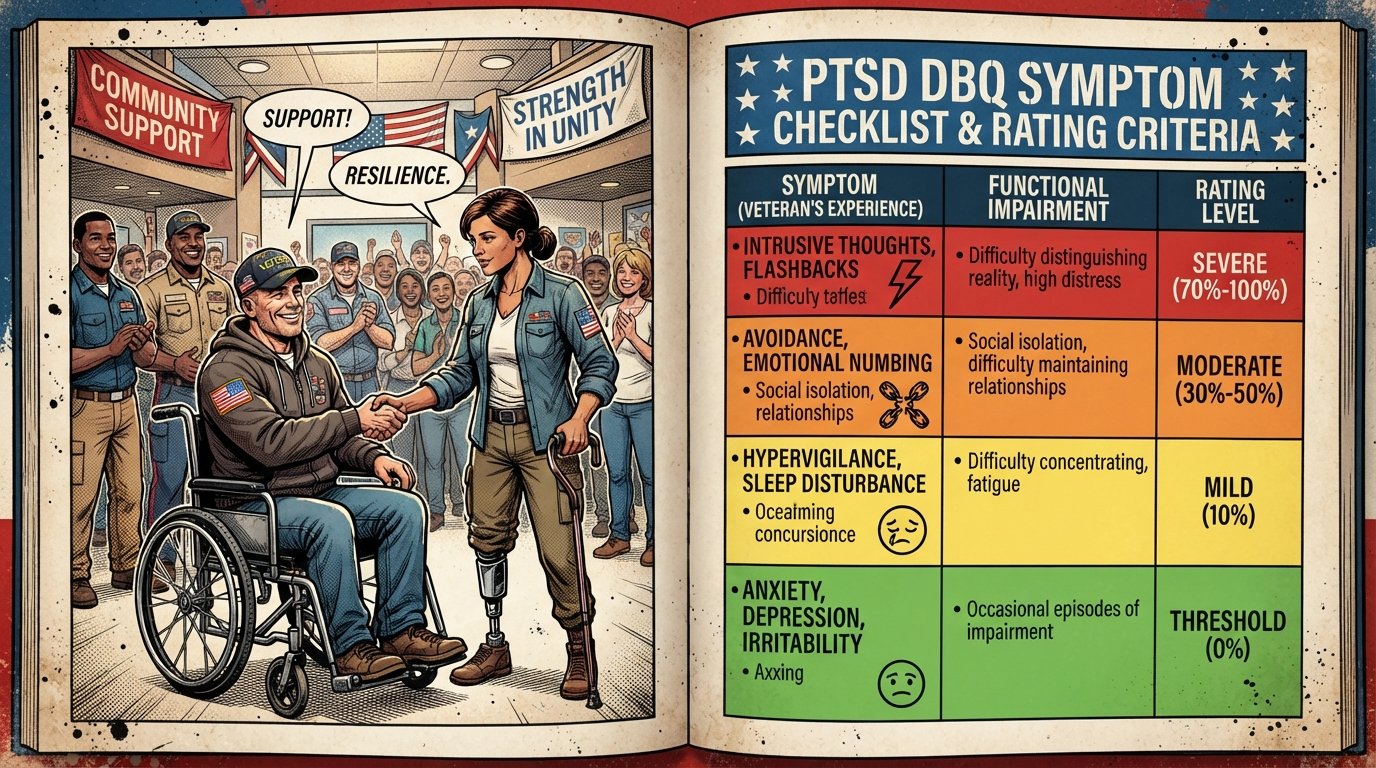
PTSD DBQ: What It Is and How It Affects Your Claim
A PTSD DBQ (Disability Benefits Questionnaire) is the standardized VA form a medical examiner completes to document your PTSD diagnosis and symptom severity. It directly determines your VA disability rating by recording which symptoms you have and how they impair your occupational and social functioning. The examiner’s DBQ findings control the percentage you receive.
Quick Facts
| Item | Details |
|---|---|
| Benefit | VA disability compensation for service-connected PTSD |
| Eligibility | Veterans with a PTSD diagnosis linked to military service |
| Application | VA Form 21-526EZ; VA Form 21-0781 for stressor statement |
| Processing Time | Average 3–4 months for a fully developed claim |
| Official Agency | U.S. Department of Veterans Affairs (VA) |
| Required Forms | VA Form 21-526EZ; VA Form 21-0781; PTSD DBQ (completed by examiner) |
| Updated For | 2026 rating criteria and compensation rates |
What Is a PTSD DBQ?
A PTSD DBQ is a Disability Benefits Questionnaire specifically designed for post-traumatic stress disorder. It is a standardized form that a medical examiner completes after evaluating your PTSD symptoms. The form documents your diagnosis, the severity of your symptoms, and how those symptoms affect your ability to work and function socially.

The VA uses over 70 DBQs to evaluate different disabilities. Each DBQ is disease-specific and organized to provide the precise medical evidence the VA needs to rate a particular condition. The PTSD DBQ captures mental health symptoms, diagnostic criteria from the DSM-5, and functional impairment.

The DBQ is not something you fill out yourself. It is completed by a medical professional—either a VA examiner or a private provider—during a Compensation and Pension (C&P) exam or a private evaluation.
Why the PTSD DBQ Matters for Your Claim
The PTSD DBQ is the single most important piece of evidence in your disability claim. Your rating depends almost entirely on what the examiner documents in the DBQ. The VA rating decision is essentially a translation of the DBQ findings into a percentage under 38 CFR § 4.130.
If the DBQ accurately captures your worst symptoms, you receive a fair rating. If it downplays your symptoms, you receive a lower rating. If it omits symptoms entirely, you may be denied. The DBQ controls the outcome.
The Two Types of PTSD DBQs
The VA uses two versions of the PTSD DBQ depending on whether this is your first evaluation or a re-evaluation.
| DBQ Type | When Used | Who Completes It |
|---|---|---|
| Initial PTSD DBQ | First-time PTSD claim | VA examiner only |
| Review PTSD DBQ | Re-evaluation or increased rating claim | VA examiner or private provider |
Veterans May Qualify for Extra Benefits
Check available financial assistance, healthcare programs and other opportunities that may apply to you.
Check EligibilityFor initial PTSD claims, the DBQ is restricted to VA examiners. Private providers cannot complete an Initial PTSD DBQ for a new claim. For review DBQs, a private provider can complete the form if you are seeking an increased rating or a re-evaluation.
What the PTSD DBQ Evaluates
The PTSD DBQ is organized into sections that guide the examiner through a structured evaluation. Each section captures specific information the VA needs for rating purposes.
Section I: Diagnostic Summary
This section confirms whether you currently have a PTSD diagnosis and documents the diagnostic code. The examiner records your current diagnoses, including any co-occurring conditions like depression or anxiety.
Section II: PTSD Diagnostic Criteria
The examiner evaluates your symptoms against the six DSM-5 criteria for PTSD:
Criterion A: Exposure to actual or threatened death, serious injury, or sexual violence
Criterion B: Intrusion symptoms (flashbacks, nightmares, distressing memories)
Criterion C: Avoidance of trauma-related stimuli
Criterion D: Negative alterations in cognition and mood
Criterion E: Alterations in arousal and reactivity (hypervigilance, sleep disturbance, irritability)
Criterion F: Duration of more than one month and significant distress or impairment
Section III: Symptoms
This section contains a checklist of 31 mental health symptoms. The examiner checks which symptoms apply to you. The symptoms are grouped by severity level and correspond directly to the rating criteria:
Symptoms associated with a 30% rating:
Depressed mood
Anxiety
Suspiciousness
Panic attacks (weekly or less often)
Chronic sleep impairment
Mild memory loss
Symptoms associated with a 50% rating:
Flattened affect
Circumstantial, circumlocutory, or stereotyped speech
Panic attacks more than once a week
Difficulty understanding complex commands
Impairment of short- and long-term memory
Impaired judgment
Impaired abstract thinking
Disturbances of motivation and mood
Difficulty establishing and maintaining effective work and social relationships
Symptoms associated with a 70% rating:
Suicidal ideation
Obsessional rituals interfering with routine activities
Speech intermittently illogical, obscure, or irrelevant
Near-continuous panic or depression
Impaired impulse control
Spatial disorientation
Neglect of personal appearance and hygiene
Difficulty adapting to stressful circumstances
Inability to establish and maintain effective relationships
Symptoms associated with a 100% rating:
Gross impairment in thought processes or communication
Persistent delusions or hallucinations
Grossly inappropriate behavior
Persistent danger of hurting self or others
Intermittent inability to perform activities of daily living
Disorientation to time or place
Memory loss for names of close relatives, own occupation, or own name
Section IV: Occupational and Social Impairment
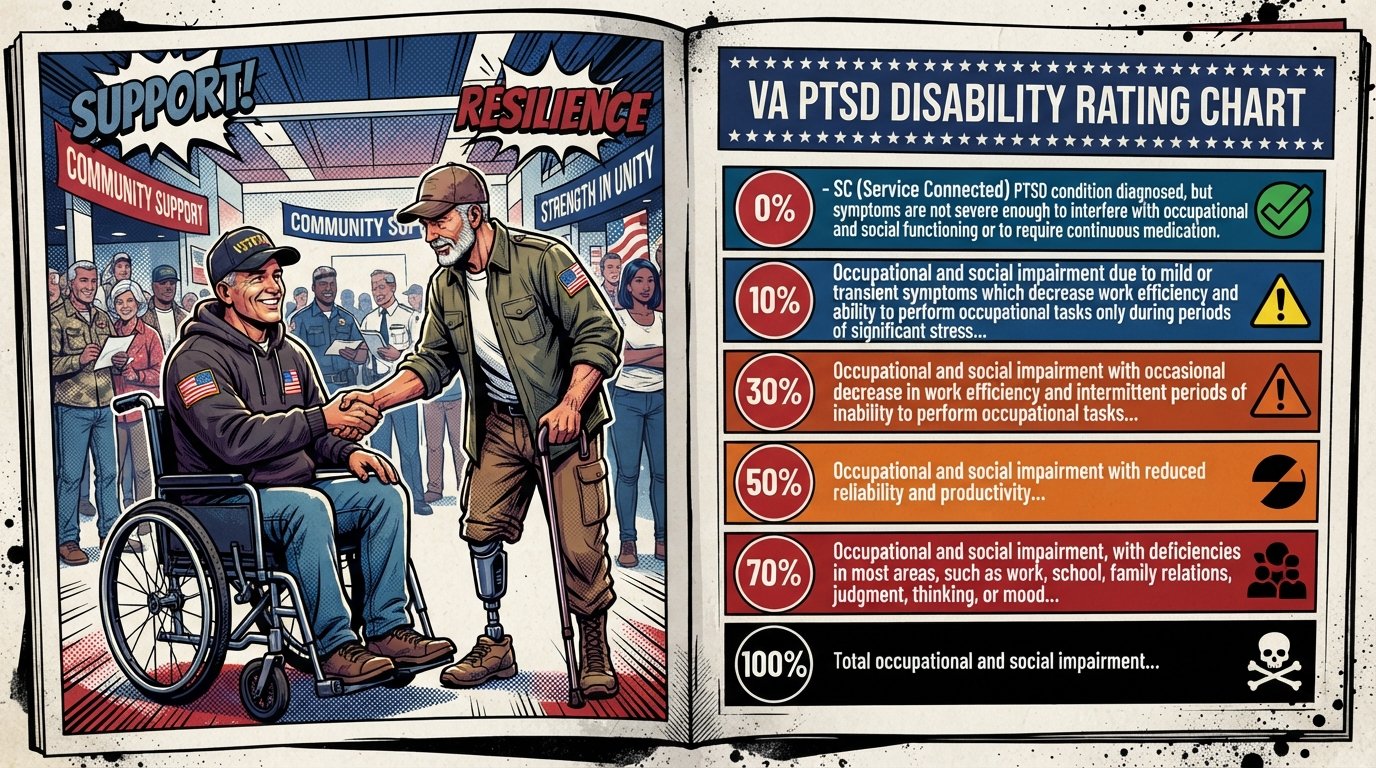
The examiner selects the level of occupational and social impairment that best describes your condition. This selection directly corresponds to your rating:
Total occupational and social impairment = 100%
Deficiencies in most areas = 70%
Reduced reliability and productivity = 50%
Occasional decrease in work efficiency = 30%
Mild or transient symptoms = 10%
Section V: Other Pertinent Information
The examiner records additional details, including your treatment history, medication compliance, and any other factors affecting your condition.
How the DBQ Determines Your Rating
The VA rating decision is a direct application of the DBQ findings to the rating schedule. The examiner’s selection in Section IV (Occupational and Social Impairment) is the primary driver of your rating. The symptom checklist in Section III provides supporting evidence.
A VA Board of Veterans’ Appeals decision illustrates how the VA weighs DBQ findings. In one case, the veteran’s 2022 DBQ documented five symptoms associated with a 30% rating, three associated with a 50% rating, and two associated with a 70% rating. The examiner selected “deficiencies in most areas” (70% impairment). The Board assigned a 70% rating based on the combination of the examiner’s impairment selection and the symptom pattern.
The Board also noted that the veteran’s symptoms did not more nearly approximate a 100% rating because he was employed, married, and showed no evidence of delusions, hallucinations, or disorientation. This shows that the DBQ findings are weighed against the full record.
What Happens During a PTSD C&P Exam
A C&P exam for PTSD is a mental health evaluation that typically lasts two to four hours. The examiner reviews your claims file, asks questions about your symptoms, and observes your behavior. The examiner completes the PTSD DBQ during or immediately after the exam.
The examiner will ask about:
The traumatic event that caused your PTSD
Your current symptoms, including flashbacks, nightmares, and hypervigilance
How your symptoms affect your work, relationships, and daily activities
Your treatment history and medication
The examiner will also observe your appearance, speech, mood, affect, and thought process. These observations become part of the DBQ.
Who Completes the PTSD DBQ
For initial PTSD claims, the DBQ is completed by a VA examiner or a VA-contracted examiner. The VA contracts with four companies to conduct C&P exams:
Leidos QTC Health Services: 800-682-9701
Veterans Evaluation Services (VES): 877-637-8387
OptumServe Health Services: 866-933-8387
Loyal Source: Contact information provided in scheduling letter
Approximately 93% of C&P exams are conducted by third-party contractors, not VA employees. If you are scheduled for a C&P exam today, it is very likely being conducted by a contractor.
For review DBQs or increased rating claims, you can ask your own treating provider to complete the form. This gives you more control over the evidence submitted.
Private DBQ vs. VA C&P Exam DBQ
Veterans have two paths to obtain a PTSD DBQ. Each has advantages and disadvantages.
| Factor | Private DBQ | VA C&P Exam DBQ |
|---|---|---|
| Who completes it | Your treating provider | VA or VA-contracted examiner |
| Cost | $150–$600+ per condition | Free |
| Control over timing | You choose when | VA schedules |
| Review before submission | Yes | No |
| Initial PTSD claims | Not permitted | Required |
| Review/increased claims | Permitted | Permitted |
| Fraud screening | Increased since Elizabeth Dole Act (2025) | Standard VA process |
Since the Elizabeth Dole Act took effect in January 2025, private DBQs face increased VA fraud screening. Use a legitimate treating provider who has an established relationship with you. Avoid third-party “DBQ mills” that complete forms without proper examinations.
How to Prepare for Your PTSD C&P Exam
Preparation improves the accuracy of your DBQ. The examiner can only document what you tell them and what they observe.
Before the Exam
Review your symptoms and how they affect your daily life
Write down specific examples of your worst days
Bring a list of your medications and treatment history
Bring a support person if you need one
Request a female examiner if your claim involves military sexual trauma
During the Exam
Describe your worst days, not your best
Be specific about how symptoms affect work and relationships
Do not minimize or downplay your symptoms
Answer questions honestly and completely
Mention symptoms even if they seem embarrassing
The examiner assesses your typical level of impairment, not how you are doing on the day of the exam. If you are having a good day, describe what your bad days look like.
Common Mistakes That Hurt Your PTSD DBQ
| Mistake | Consequence | How to Avoid |
|---|---|---|
| Downplaying symptoms | Lower rating assigned | Describe your worst days honestly |
| Describing only current symptoms | Incomplete DBQ | Discuss symptom frequency and severity over time |
| Omitting symptoms that seem minor | Missing rating criteria | List every symptom, even if it seems unrelated |
| Missing the exam | Claim denied | Attend or reschedule with good cause |
| Not mentioning work problems | Lower occupational impairment rating | Explain how PTSD affects your job performance |
| Not mentioning relationship problems | Lower social impairment rating | Describe how PTSD affects your family and social life |
What to Do If Your DBQ Is Inaccurate
If the DBQ does not accurately reflect your symptoms, you have options.
Request a new exam. If the DBQ contains errors or omissions, you can request a new C&P exam. The VA may grant this if you provide evidence that the exam was inadequate.
Submit a private DBQ. For review claims, you can submit a DBQ completed by your own treating provider. This can contradict an inaccurate VA DBQ.
File an appeal. If the rating decision based on the DBQ is incorrect, you can file a Supplemental Claim with new evidence, request a Higher-Level Review, or appeal to the Board of Veterans’ Appeals.
Submit a lay statement. Your own statement describing your symptoms can supplement an inadequate DBQ. Lay statements from family and friends are also valuable.
The VA Form 21-0781 and the DBQ
VA Form 21-0781 is not the DBQ. It is a separate form that you complete yourself. Form 21-0781 is titled “Statement in Support of Claimed Mental Health Disorder(s) Due to an In-Service Traumatic Event(s).”
You use Form 21-0781 to describe the traumatic event that caused your PTSD. The VA uses this information to verify your stressor through military records. The form asks for the date, location, and circumstances of the event.
As of June 28, 2024, the VA discontinued VA Form 21-0781a, which was previously used for PTSD claims related to personal assault. Now all mental health conditions, including PTSD, are reported on Form 21-0781.
The DBQ and Form 21-0781 serve different purposes. Form 21-0781 establishes the in-service stressor. The DBQ documents your current symptoms and impairment. Both are essential for a complete PTSD claim.
2026 PTSD Rating Changes and the DBQ
The VA has proposed significant changes to how it rates PTSD and other mental health conditions. As of March 2026, these changes remain proposed. No final rule has been published, and current ratings remain in effect for veterans already rated.
The proposed system would replace the current occupational-and-social-impairment framework with a Five Functional Domains model. The five domains are:
Cognition: Memory, concentration, decision-making, problem-solving
Interpersonal interactions and relationships: Social functioning at home, work, and community
Task completion and life activities: Work duties, education, daily responsibilities
Navigating environments: Comfort leaving home, using transportation, unfamiliar settings
Self-care: Hygiene, nutrition, basic daily routines
Each domain would be rated on a severity scale from 0 to 4. Ratings would be determined by the combination of severity levels across domains. The 0% rating would be eliminated, meaning any service-connected mental health condition would receive at least 10%.
The proposed changes would require new DBQs designed to capture the five domains. The VA has stated it is developing new DBQs for mental health conditions and introducing special training for healthcare professionals. If finalized, these changes would affect how DBQs are completed and how ratings are assigned.
Veterans already rated are protected under grandfathering provisions. If you are considering a PTSD claim, current rules apply until a final rule is published.
Secondary Conditions and the DBQ
Many veterans with PTSD develop secondary conditions that can increase their combined rating. The DBQ for PTSD documents your primary condition, but you can file separate claims for secondary conditions.
| Secondary Condition | Typical Rating | Connection to PTSD |
|---|---|---|
| Depression | 30–70% | Often co-occurs with PTSD |
| Sleep apnea | 30–50% | PTSD disrupts sleep; medications cause weight gain |
| Hypertension | 10–20% | Chronic stress elevates blood pressure |
| GERD | 10–30% | Stress and medications worsen reflux |
| Erectile dysfunction | Special monthly compensation | PTSD medications cause sexual dysfunction |
To claim a secondary condition, you need a medical opinion stating that your PTSD caused or aggravated the condition. The DBQ for the secondary condition documents its severity.
TDIU and the PTSD DBQ
If your PTSD prevents you from maintaining substantially gainful employment but your rating is less than 100%, you may qualify for Total Disability Based on Individual Unemployability (TDIU). TDIU pays you at the 100% rate.
The PTSD DBQ supports a TDIU claim by documenting the severity of your occupational impairment. If the DBQ shows deficiencies in most areas of work functioning, it strengthens your TDIU claim. You must also submit VA Form 21-8940 and VA Form 21-4192.
How to Request a Copy of Your PTSD DBQ
You can request a copy of your C&P exam DBQ through the VA. Submit a Privacy Act request to your VA regional office or use the VA’s Freedom of Information Act (FOIA) process. The VA will provide the DBQ after the rating decision is made.
Review the DBQ carefully. If it contains errors or omissions, you can use that information to support an appeal or a request for a new exam.
Common Questions
What is a PTSD DBQ?
A PTSD DBQ is a Disability Benefits Questionnaire that a medical examiner completes to document your PTSD diagnosis and symptom severity. The VA uses the DBQ to assign your disability rating. It records your symptoms, functional impairment, and diagnostic criteria from the DSM-5.
Can my private doctor fill out a PTSD DBQ?
For initial PTSD claims, no. The Initial PTSD DBQ is restricted to VA examiners. For review or increased rating claims, a private treating provider can complete the Review PTSD DBQ. Since January 2025, private DBQs face increased fraud screening under the Elizabeth Dole Act.
How long does a PTSD DBQ take?
A PTSD C&P exam typically lasts two to four hours. The examiner completes the DBQ during or immediately after the exam. Private DBQ evaluations may take a similar amount of time, depending on the provider.
What happens if I miss my PTSD C&P exam?
If you miss your C&P exam without good cause, the VA may deny your claim. If you have a valid reason, contact the VA or the contractor immediately to reschedule. Document your reason for missing the exam.
Does the DBQ determine my PTSD rating?
Yes. The DBQ is the primary evidence the VA uses to assign your rating. The examiner’s selection in the Occupational and Social Impairment section directly corresponds to your rating percentage. The symptom checklist provides supporting evidence.
Can I submit a DBQ from my own doctor?
For review claims and increased rating claims, yes. For initial PTSD claims, no. The Initial PTSD DBQ must be completed by a VA examiner. A private DBQ can be submitted as supplemental evidence for other claim types.
What symptoms does the PTSD DBQ check?
The PTSD DBQ includes a checklist of 31 mental health symptoms. These include depressed mood, anxiety, panic attacks, sleep impairment, memory loss, flattened affect, suicidal ideation, and many others. The examiner checks which symptoms apply to you.
How does the DBQ affect my TDIU claim?
The DBQ documents your occupational impairment. If the DBQ shows that your PTSD causes deficiencies in most areas of work functioning, it supports a TDIU claim. TDIU pays at the 100% rate if your PTSD prevents substantially gainful employment.
What is the difference between an Initial and Review PTSD DBQ?
The Initial PTSD DBQ is used for first-time PTSD claims and is restricted to VA examiners. The Review PTSD DBQ is used for re-evaluations and increased rating claims. A private provider can complete a Review PTSD DBQ.
Can I appeal a DBQ finding?
You cannot appeal the DBQ itself, but you can appeal the rating decision based on the DBQ. If the DBQ is inaccurate, you can request a new exam, submit a private DBQ, or file an appeal with new evidence.
Key Takeaways
A PTSD DBQ is the standardized VA form a medical examiner completes to document your PTSD diagnosis and symptom severity.
The DBQ directly determines your VA disability rating by recording which symptoms you have and your level of occupational and social impairment.
The examiner’s selection in the Occupational and Social Impairment section corresponds directly to your rating: 100%, 70%, 50%, 30%, or 10%.
Initial PTSD DBQs are completed by VA examiners only. Review DBQs can be completed by private treating providers.
VA Form 21-0781 is a separate form you complete to describe your in-service stressor. It is not the DBQ.
Approximately 93% of C&P exams are conducted by VA-contracted examiners, not VA employees.
Describe your worst days during the C&P exam. Downplaying symptoms leads to lower ratings.
If your DBQ is inaccurate, you can request a new exam, submit a private DBQ for review claims, or file an appeal.
The VA has proposed a Five Functional Domains model for mental health ratings. As of March 2026, these changes remain proposed.
Private DBQs face increased fraud screening under the Elizabeth Dole Act effective January 2025.
Official Resources
VA Disability Compensation: https://www.va.gov/disability/
VA Form 21-526EZ: https://www.va.gov/forms/21-526ez/
VA Form 21-0781: https://www.va.gov/forms/21-0781/
38 CFR § 4.130 Rating Schedule: https://www.ecfr.gov/current/title-38/section-4.130
VA C&P Exam Information: https://www.va.gov/disability/va-claim-exam/
VA Decision Reviews and Appeals: https://www.va.gov/resources/decision-reviews-faqs/
VA Mental Health Services: https://www.va.gov/health-care/health-needs-conditions/mental-health/


🇺🇸 IMPORTANT DISCLAIMER – Veterans Benefits Information
This site provides general information about U.S. Department of Veterans Affairs (VA) benefits for educational and informational purposes only.
- Not Official: We are NOT affiliated with, endorsed by, or connected to the U.S. Department of Veterans Affairs (VA), the Veterans Benefits Administration (VBA), the Veterans Health Administration (VHA), or any other government agency.
- No Legal/Financial Advice: The content on this website is for informational purposes only and does not constitute legal, financial, or medical advice. VA benefits rules change frequently – always consult with an accredited Veterans Service Officer (VSO) or a qualified professional for your specific situation.
- Official Sources: For official, binding information and to apply for benefits, always visit official .gov websites: VA.gov, Benefits.VA.gov, or SSA.gov.
- No Data Collection: This site does not collect, store, or process any personal information. It does not have login forms, contact forms, or any system to capture user data. We never ask for your Social Security Number, bank details, or any personal information.
- 🚨 Scam Alert: The VA and other government agencies never charge fees for benefit applications. If anyone asks for money to "process" your VA claim, it is a scam. Report it to the VA Office of Inspector General at VA.gov/OIG.
- Advertising: This site uses third-party advertising (Adsterra) to cover operational costs. We do not endorse or guarantee any products or services advertised.
📌 Information provided as of June 2026. Always verify current eligibility and rules with official .gov sources.
This site is not affiliated with the U.S. Department of Veterans Affairs or any government agency. All information is for educational purposes only. Please visit VA.gov for official information.
